


 by Tom Gurney
Tom Gurney BSc (Hons) is an art history expert with over 20 years experience
Published on June 19, 2020 / Updated on November 20, 2026
Email: tomgurney1@gmail.com / Phone: +44 7429 011000
Senju in Musashi Province
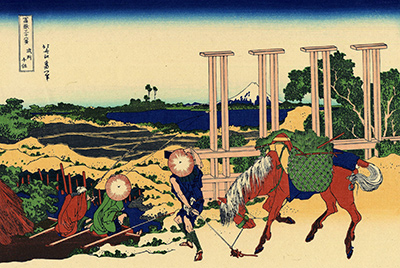
A horse drops its head beside a row of tall wooden frames. Its red-brown body and blue-green load fill the foreground of Katsushika Hokusai’s Senju in Musashi Province. Farther back, a blue strip of water runs across the sheet. Mount Fuji rises just beyond it, where the pale uprights interrupt the view. At the lower left, two seated people face the water while the person leading the horse continues along the bank. The scene is quiet enough to register those separate actions, and the frames give each glance towards the mountain a different stopping point. [1] [2]
The Metropolitan Museum of Art dates its impression JP2988 to about 1830–32. The Japanese title, 武州千住 (Bushū Senju), places the subject at Senju in the old province of Musashi. The Sumida Hokusai Museum identifies the pictured structure as a frame for regulating water near the edge of the post town. The Cleveland Museum of Art makes the structure explicit in its title for another impression, The Weir at Senju in Musashi Province. Look first at the horse, then through the tall frames. The change in scale from one to the other is how the print takes us from the bank to Fuji. [1] [2] [3]
At a Glance
- ArtistKatsushika Hokusai
- Dateca. 1830–32
- MediumColour woodblock print
- SeriesThirty-six Views of Mount Fuji
Contents
A view through the weir
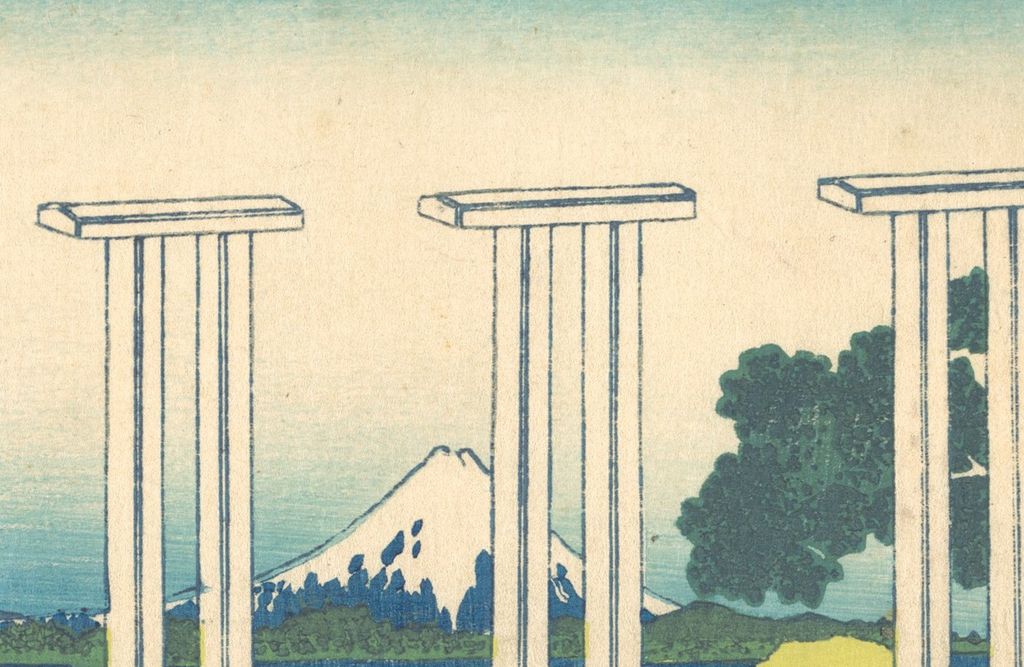
Four pale frames stand across the middle and right of the Met image. Their short caps rise incrementally towards the right. Thin shaded marks run beside the uprights, allowing each one to read as timber with some depth. A long crosspiece ties much of the structure together, although parts of it disappear behind the horse and its burden. The repetition gives the eye a line to follow across the scene. Where the horizontal beam passes behind the load, we can pick it up again on the far side, just as we can follow the line of the bank after it vanishes behind one of the seated figures. [1]
The frames take up more space than the mountain, and they set the terms on which we see it. The light slope first appears in the gap between the left pair of frames. A slim upright then cuts across the distant form. Look below the peak, where the blue edge of the water gives way to low green land. Those longer, nearly level shapes make the sudden incline of Fuji easy to recognise. The Tokyo Fuji Art Museum calls attention to Hokusai’s decision to place the mountain among the regularly spaced posts. It also notes a resemblance between the silhouette of the mountain and the curved back of the horse, whose head is lowered. The eye can test that resemblance across two very different distances. [1] [4]
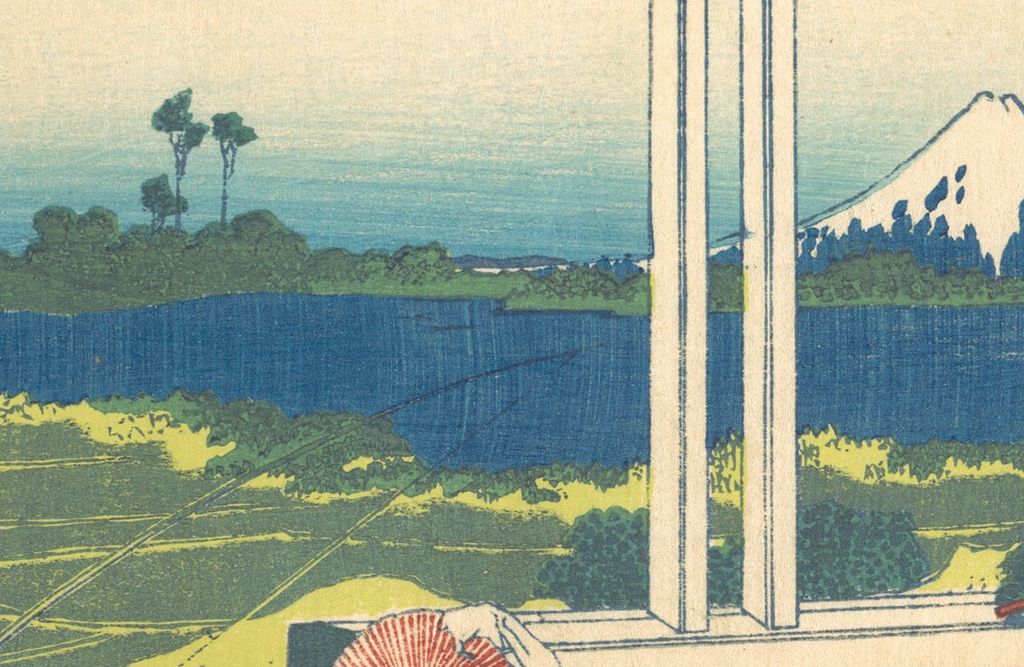
The Sumida Hokusai Museum associates the scene with the Motojuku irrigation gate on the outskirts of Senju. Its account describes a gate admitting water to farmland from the river then known locally as the Arakawa, the present Sumida River. It calls the water-regulating framework shown behind the horse the Motojuku weir. The Tokyo Fuji Art Museum likewise places the view by a sluice upstream on the Sumida, a little away from the post station. It identifies Senju with the area in today’s Adachi and describes the old station as a traffic junction for routes including the Ōshū, Mito and Nikkō roads. The print shows enough to suggest why managing the water mattered here. The strips of cultivated ground extend right up to the water, and people use the narrow spaces beside it. [1] [2] [4]
A laden horse and two people fishing
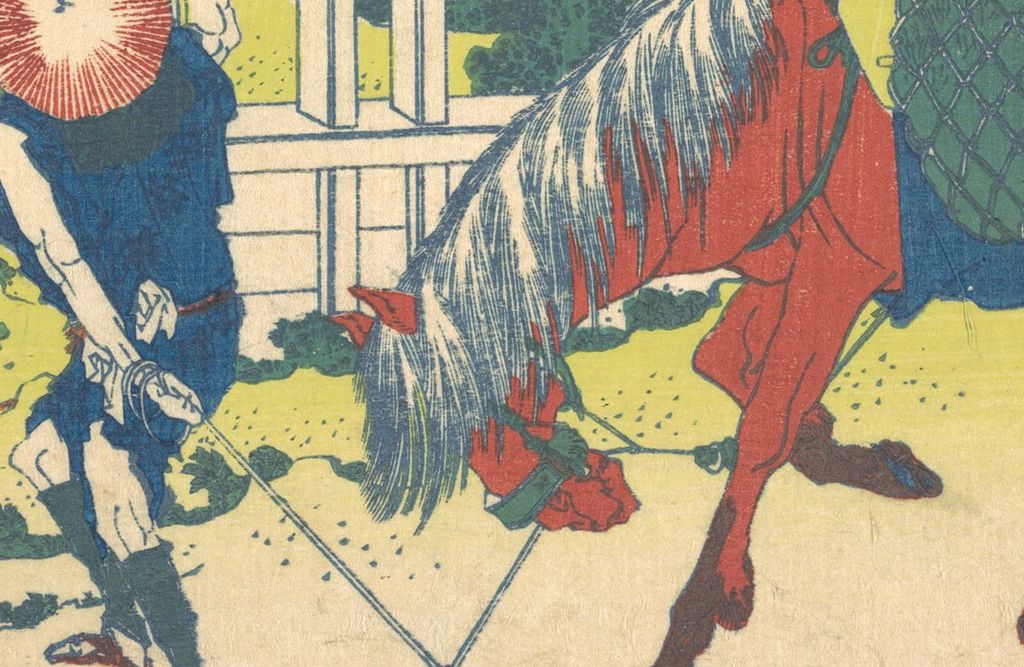
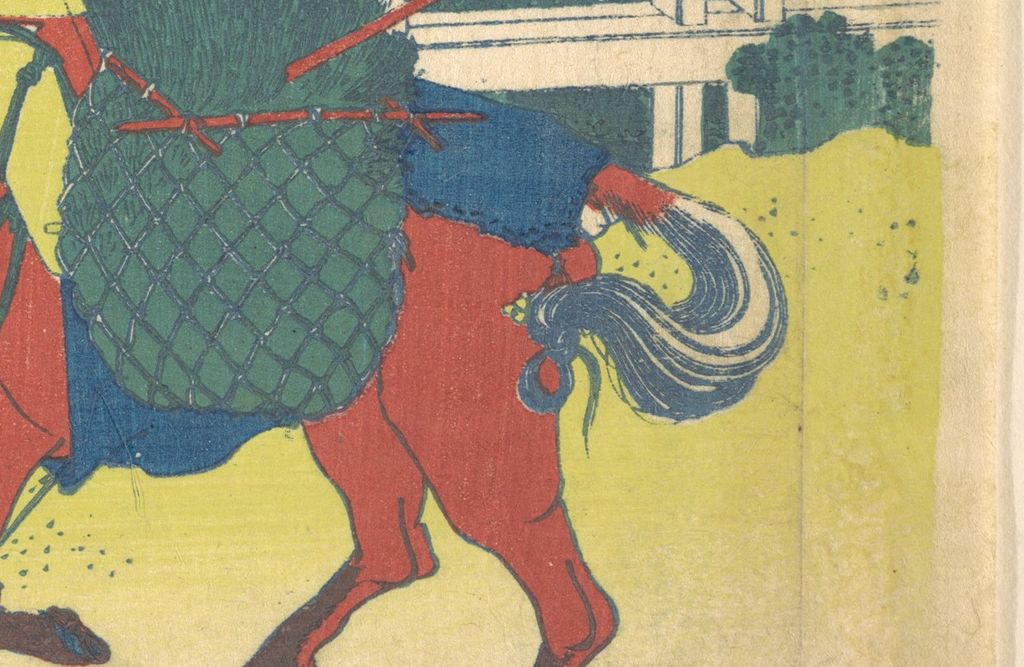
The horse’s coat creates a single area of warm colour underneath the long timber beam. Its legs extend into the pale foreground, giving the animal an outline distinct from the dark load above it. Hokusai specifies the load with a repeated mesh pattern. The curve of the patterned bag suggests the weight carried against the horse’s side. At the lower left of the bag, the mane spreads into fine strokes that point down towards the ground. A stout figure steps just ahead. The leading line from the horse meets the person’s hand and turns again, drawing the animal and its guide together across what would otherwise be a blank patch of the path. Sumida describes the horse as carrying cut grass and its companion as a farmer. [1] [2]
The other two people occupy a lower part of the bank, behind the line of the path. One wears a red garment. The other is wrapped in green and has a broad, round hat like the farmer’s. The viewer sees their backs, and the lines running out across the scene are slender enough to disappear against areas of a similar tone. Sumida identifies both people as fishing. The Tokyo Fuji Art Museum’s entry at Cultural Heritage Online observes that the faces of the fishers and the person leading the horse are left out of view. What we learn about them comes through position and gesture. One person travels across the sheet while the other two remain by the brink, looking towards ground and water that the viewer sees only obliquely. [1] [2] [5]
The two visible hats are particularly useful for gauging the space. Both have fine strokes radiating from the centre and a reddish band near the edge. They echo one another across the gap, but the farmer’s hat is higher and set against the pale uprights. The lower hat overlaps the shoulder of a seated figure and stands out against vegetation. Placing the two circles at different heights gives the quiet foreground a rhythm of its own. [1]
The opposite bank is comparatively low and long. Yellow patches nearer the posts separate into small irregular edges. Across the water, distant foliage looks smoother, and a pair of slim trees to the left occupies very little space against the sky. On the right, a pale branching trunk stands out against a broad patch of dark foliage. These differences make the vegetation do more than fill the spaces around the weir. The little distant trees give the long banks a scale, and the prominent branching trunk stands as a nearby interruption with an outline quite unlike the straight edges of the timber. One can follow the curve of a bough, return to the square frame beside it, and then look back through the gap. [1]
Three Senju views
The fields, path and water in this design put the viewer in a different position from Fuji Seen in the Distance from Senju Pleasure Quarter. In that print, the long foreground rank of people carrying equipment sets a rhythm across the whole width. Low buildings sit in a band beyond open ground. At the weir, three people and a single horse occupy the near bank, and the eye has to negotiate the tall vertical frames before reaching the mountain. The two views use related place names but their different foregrounds make the routes across the images readily distinguishable. [1] [6]
There is another change of pace in Sekiya Village on the Sumida River. There, three horses with riders follow a curving embankment. The bending pine and the staggered riders carry the view along the road. The horse at the weir lowers its head, and the people fishing give the scene two more points at which to pause. The National Museum of Western Art’s Iuchi exhibition checklist records the designs separately, with Senju in Musashi listed at no. 9, Sekiya at no. 32, and the pleasure-quarter view at no. 40. Following the foreground action is a quick way to tell them apart even when the print titles are unfamiliar. [1] [6] [7] [8]
Looking at two impressions
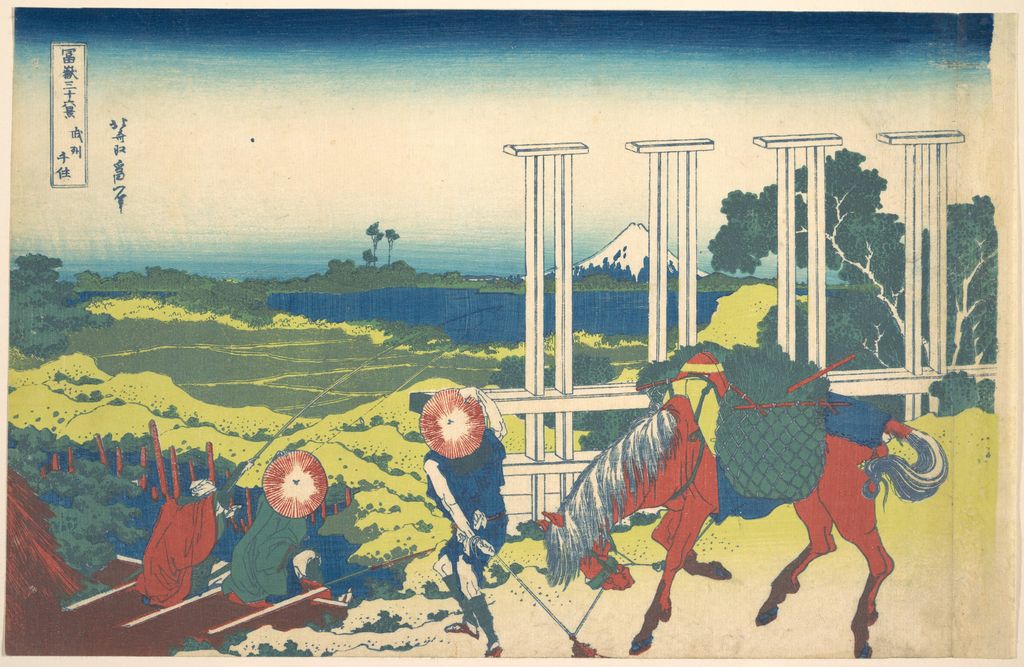
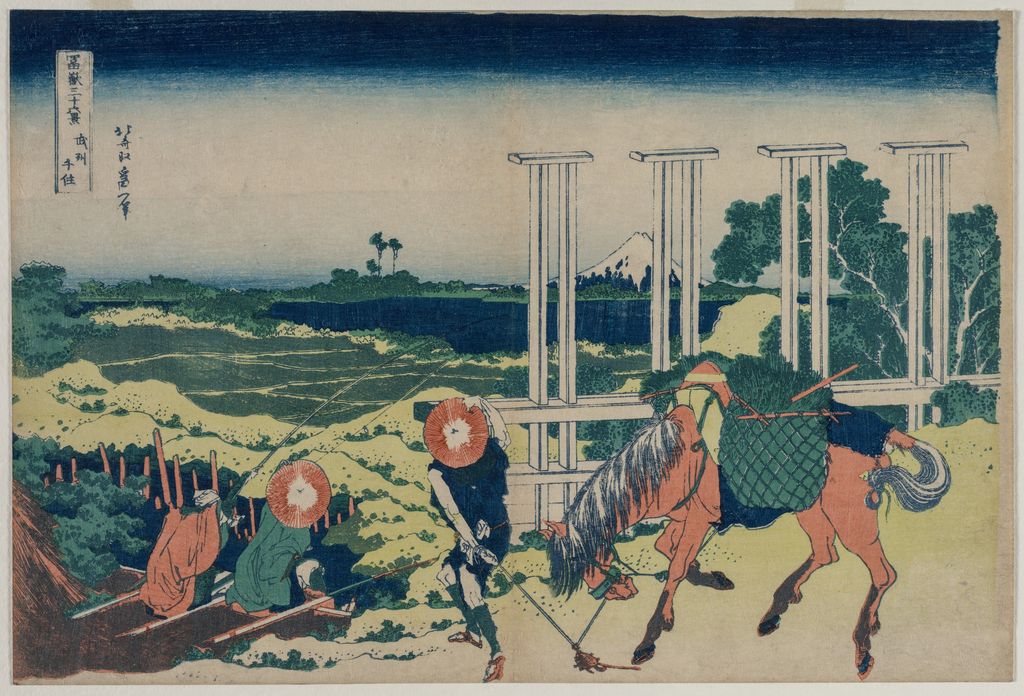
The Met describes JP2988 as a colour woodblock print in ink and colour on paper and records dimensions of 24.4 by 38.1 centimetres. Cleveland dates impression 1924.964 to the early 1830s and records a sheet about 37.8 centimetres wide and 25.4 centimetres high. The placement of the caps, horse and seated figures identifies the same composition in both. The photographs also show differences in tone. At the Met the yellow-green strip of land just behind the figures appears relatively bright, while in the Cleveland photograph the same area looks paler and the adjoining greens more subdued. The horse in the Cleveland image is a softer reddish brown than in the Met image. The broad river band and the dark blue top of the sky remain easy to recognise in both. [1] [3]
The differences matter when we look through the frames. In each image the posts separate from the landscape because their edges are set against bands of darker colour. In the Met photograph the dark plants across the middle stand out more sharply against the light patches above them. In the Cleveland image the lighter ground beneath the horse gives its silhouette a slightly different weight. Paper condition, printing and photography can all affect the appearance of an impression as seen online. The two museum photographs make useful comparisons of specific surfaces and colour relationships. They leave open the order in which the two sheets were printed. [1] [3]
The small white summit has the same interrupted outline in both photographs. Its shape can be held in mind when the eye returns down the vertical timber, across the crosspiece and to the horse’s rounded shoulder. The landscape has a long recession into the distance, while the repeated wooden parts keep bringing the viewer back to the bank. Hokusai makes distance visible through the everyday things placed in front of it: the weir, a horse’s load, and the thin lines cast out by two fishers. [1] [2] [3]
Where this work sits in Hokusai’s career
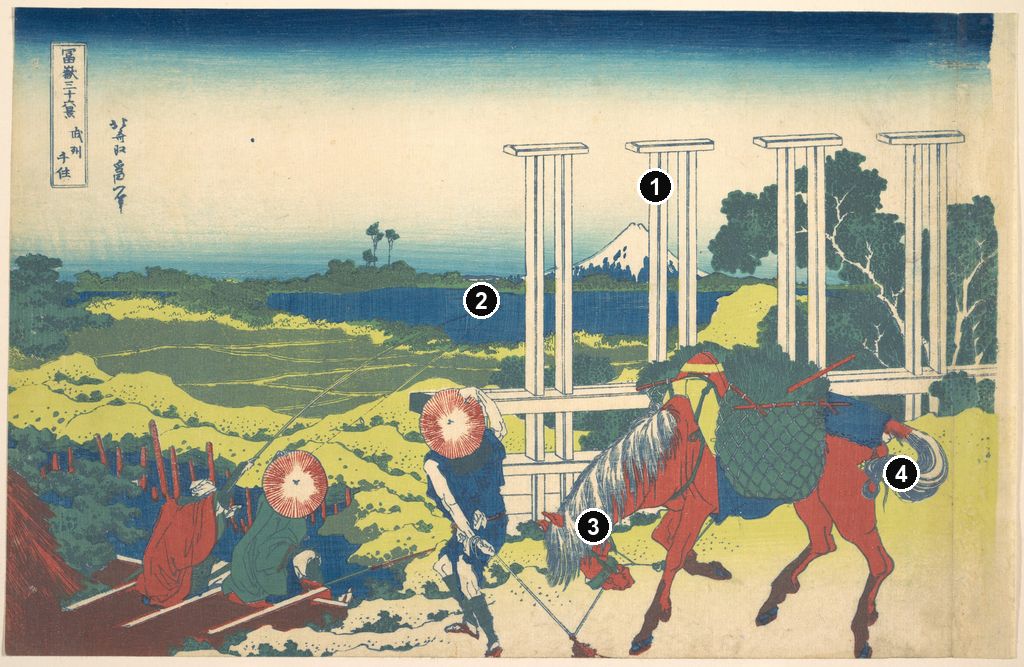
Annotated Details from Senju in Musashi Province
The Metropolitan Museum of Art, JP2988. [1]
Details from SENJU IN MUSASHI PROVINCE
Select a detail to look closely.
Upright timbers cross the landscape
Pale upright lines rise in front of the distant view. Their spacing gives the open ground and water a distinct rhythm. [1]
Water and fields form horizontal bands
Changes of colour draw the eye across the middle of the print and behind the nearer people. [1]
Figures share the foreground
The people and their equipment interrupt the lower bands of colour. Their size makes the distant elements appear much smaller. [1]
The horse turns along the edge
The dark animal and its legs stand out against the yellow ground. It closes the movement of the foreground at right. [1]
Explore Hokusai’s works
Discussion
Look again at the images and ideas explored in Senju in Musashi Province. These editorial prompts invite your observations.
Reader Insights
Which structures cross the direction of the water?
How does the nearer group affect your sense of the scale of the view?
Join the Conversation
Share a detail, comparison or question about Senju in Musashi Province below.
References
- The Metropolitan Museum of Art, Senju in Musashi Province (Bushū Senju), JP2988, catalogue and photograph. View source.
- Sumida Hokusai Museum, Senju in Musashi Province, Japanese catalogue and commentary on the irrigation gate, weir and figures. View source.
- The Cleveland Museum of Art, The Weir at Senju in Musashi Province, 1924.964, catalogue and photograph. View source.
- Tokyo Fuji Art Museum, Thirty-six Views of Mount Fuji: Senju in Musashi Province, 06148, catalogue and Japanese commentary on geography and composition. View source.
- Tokyo Fuji Art Museum via Cultural Heritage Online, Senju in Musashi Province (冨嶽三十六景《武州千住》), commentary on the figures. View source.
- The Metropolitan Museum of Art, Fuji Seen in the Distance from Senju Pleasure Quarter, JP1326. View source.
- The Metropolitan Museum of Art, Sekiya Village on the Sumida River, JP1338. View source.
- The National Museum of Western Art, Tokyo, Hokusai: Thirty-six Views of Mt. Fuji, Iuchi Collection exhibition checklist, nos. 9, 32 and 40. View source.







