



 by Tom Gurney
Tom Gurney BSc (Hons) is an art history expert with over 20 years experience
Published on June 19, 2020 / Updated on November 20, 2026
Email: tomgurney1@gmail.com / Phone: +44 7429 011000
Hydrangea and Swallow
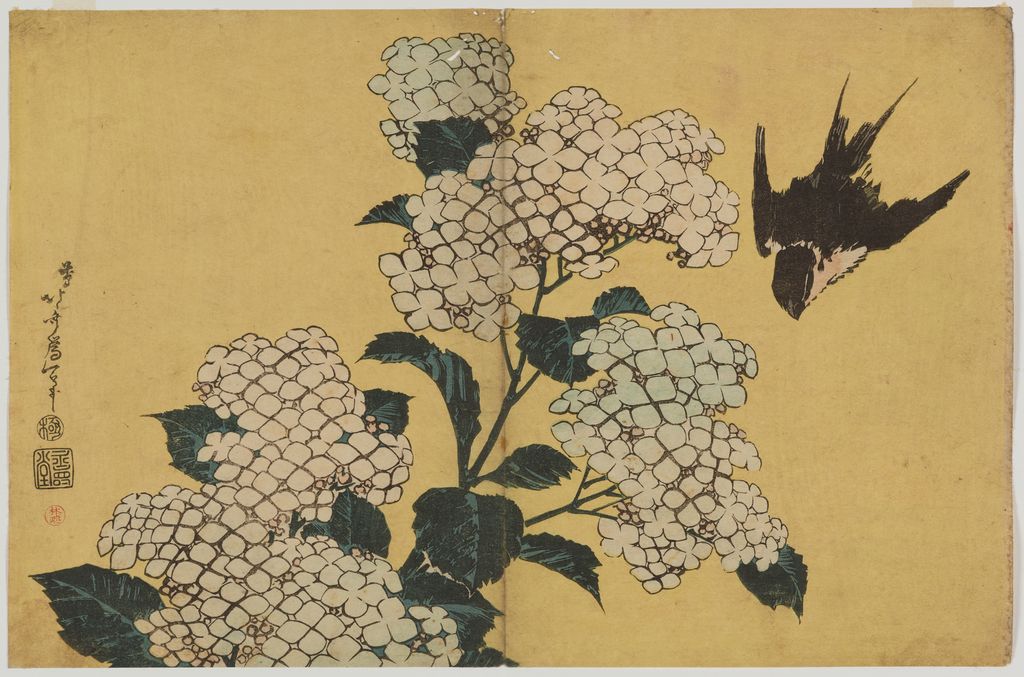
A swallow dives beside a hydrangea in Katsushika Hokusai’s colour woodblock print Hydrangea and Swallow (Ajisai ni tsubame, 紫陽花に燕). The beak points down, the spread wings sweep back and the two long tips of the tail rise into the yellow ground. A bank of pale flowers almost meets the bird’s dark silhouette. The narrow gap between the two makes the encounter feel brief. Tokyo National Museum holds an impression measuring 24.5 by 37 centimetres, catalogued as a nineteenth-century horizontal ōban, a large-format print. The Nagano Prefectural Art Museum dates the Japan Ukiyo-e Museum’s impression to 1833–34. [1] [2] [3]
At a Glance
- ArtistKatsushika Hokusai
- DateEarly 1830s
- MediumColour woodblock print
- SeriesLarge Flowers
Contents
The swallow’s steep descent
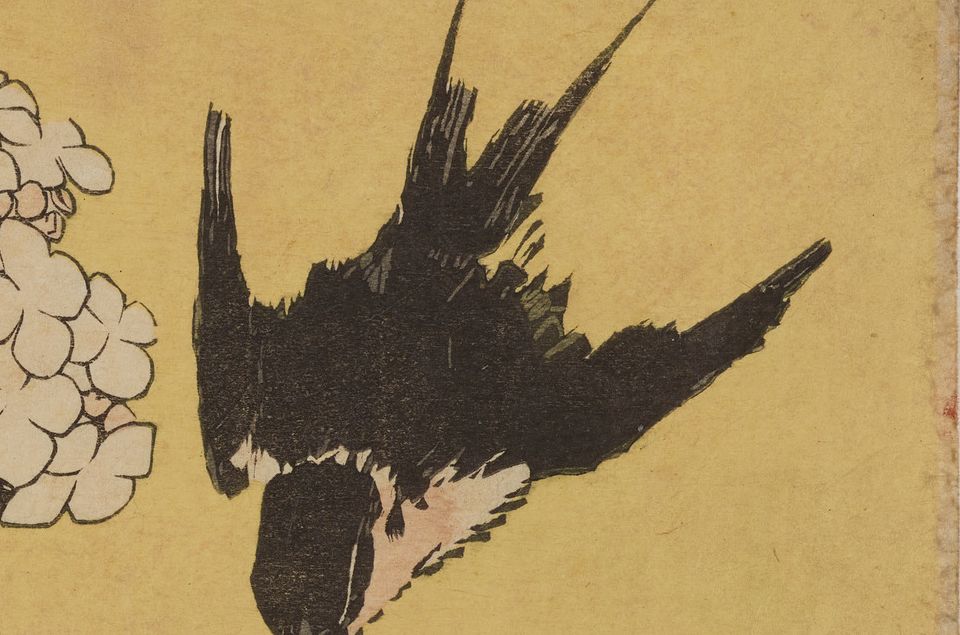
Follow the bird from the beak at lower left to the two fine tail tips above. This diagonal gives the clearest sense of its direction. The wing stretching out to the right creates a second line across the first. Its jagged outline lets the individual feather tips show against the unbroken ground. At the other side, a narrow upright tip rises beside the bird’s body. The wings form an uneven spread, as they would appear at a particular instant in a bank or turn. The fork in the tail and the space beyond each feather tip sharpen the silhouette. [1] [4]
Look closer and the body separates into differently weighted marks. The crown and upper wings are nearly continuous dark shapes in Tokyo’s photograph. Under the head, a narrow pale area leads towards smaller brown and black marks along the breast. That light edge helps the viewer find the head and beak inside the shape of the descending bird. The head is low and angled toward the empty ground below the flowers. There is room to sense its next movement and little indication of where the bird might be going after that. The bodies of the bird and the plant almost meet, although their outlines remain distinct. [1] [4]
The surrounding colour is particularly important to that reading of speed. There is a wide interval beyond the beak and along the lower right of the print. Within it, the eye can carry the bird’s downward line some distance past the body. In the packed centre of the hydrangea, the same interval would have been broken up by smaller contours. Hokusai placed the bird where every narrow shape at its perimeter can be read. Leaving most of the right side open also makes its dark mass stand in balance with flowers that take up a much larger area. [1] [4]
How the hydrangea fills the sheet
Start at the lower edge, where the paper cuts through leaves and flower heads. The first impression is of a plant that continues outside the picture. Follow a branch out of that thick foliage and the structure becomes easier to see. Stems meet at sharp angles and separate again to support the blossoms farther up. Leaves turn at different angles along the way. Where a leaf overlaps a flower head, its dark mass interrupting the pale cluster makes it easy to distinguish the two at a glance. [1] [4]
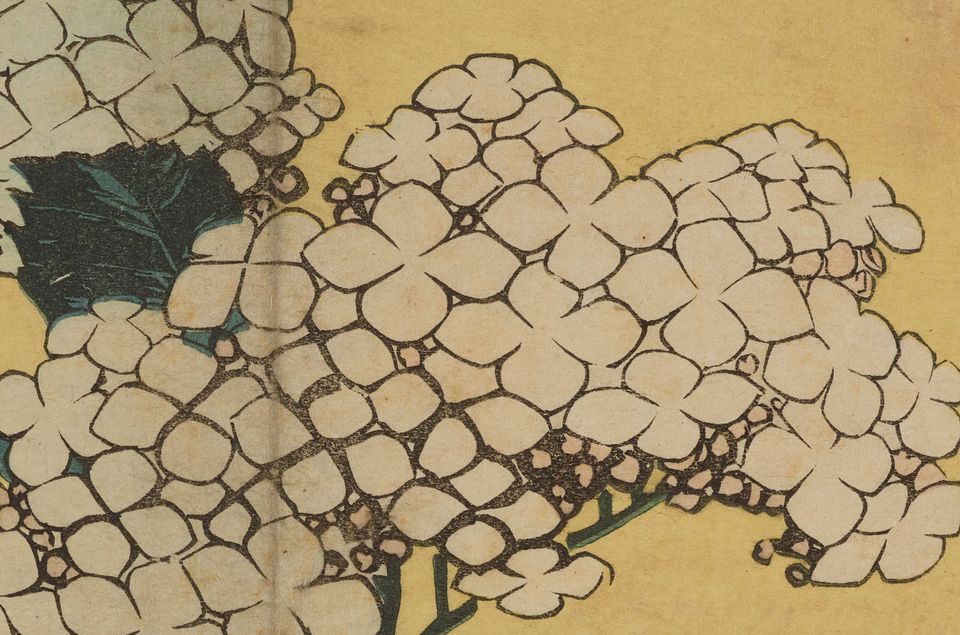
On the upper flower head, Hokusai outlines dozens of individual small forms. Their shapes change as they cross the cluster. Some are almost round, while others narrow into wedges or seem to slip behind their neighbours. In Japan’s Cultural Heritage Online photograph, parts of these upper clusters have a pale blue-grey or cream tone. The outlines are fine enough to suggest the density of the flower head without giving every part equal emphasis. A cloud of many small shapes changes into a single curved rim where it meets the yellow. Up close the marks keep the eye moving across minute changes. At a distance they hold the whole plant together. [1]
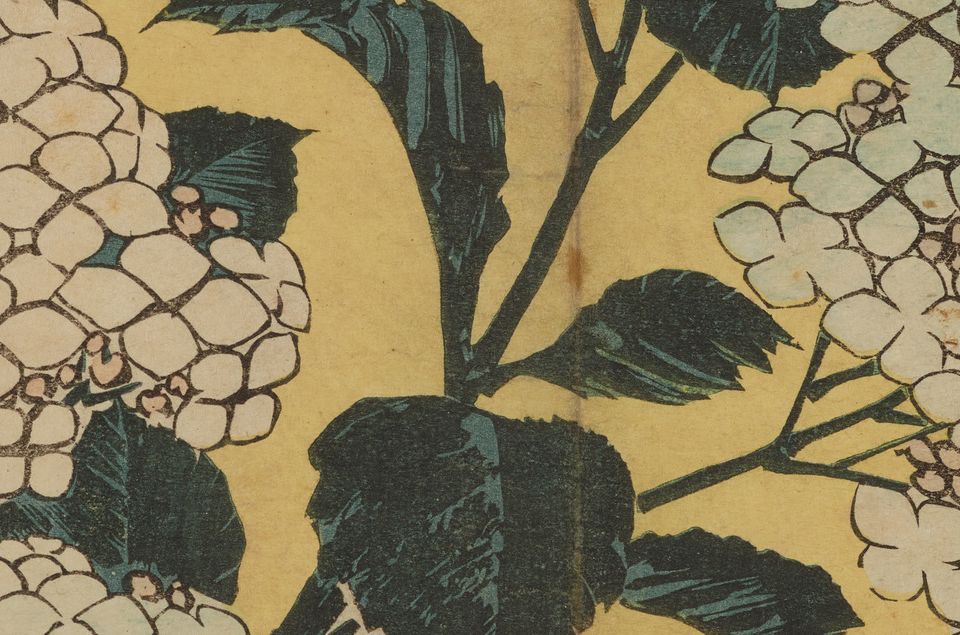
The leaves offer a different way of drawing a curved surface. Watch how the broad leaf just below the main cluster bends and comes back to a pointed tip. Dark colour flattens its interior at first glance, then the veins trace outward from the central vein toward the edges. Other leaves enter the gaps beneath the heads or disappear behind them. These relatively large passages of dark colour give the blossoms weight even where very little colour distinguishes them from the ground. They also draw the eye towards the dark swallow, where a related change of scale takes place from the broad wing to finely cut feather tips. [1] [4]
The Japan Search gallery on ajisai places Hokusai’s sheet alongside Edo-period images of hydrangeas in painting, prints and decorative objects. The Sumida Hokusai Museum’s exhibition on birds points out how depictions of birds could evoke seasons and places for Edo viewers. Here the heads are already dense with blooms, and Sotheby’s catalogue reads the subject as a rainy-season encounter. The flowers supply that cue in a picture with no depicted rainfall or horizon. The title pairs the bloom and the bird without committing the scene to a particular garden or location. [4] [5] [6]
Two impressions of the design
Tokyo’s impression and the Gerhard Pulverer sheet catalogued by Sotheby’s both have a yellow ground. Their photographs vary in how clearly the pale blues and greens stand apart from it. For example, the head below and to the left of the swallow appears cooler and more clearly defined in the photograph of the Pulverer sheet. Tokyo’s photograph gives some lower heads a warmer appearance. The individual contours remain comparable, including where the wing points back, where a branch comes out from beneath the central blossoms and where the stems cross behind a dark leaf. Those shared shapes make it possible to read the prints as two impressions of the same design. [1] [4]
The catalogues record different physical dimensions. The Pulverer sheet measures 25.7 by 38.2 centimetres, compared with Tokyo’s 24.5 by 37 centimetres. These are measurements of the two catalogued objects. The Tokyo image shows a small red mark beneath the column of dark marks on the left, where the Sotheby’s front photograph has open ground. Differences in margins, marks and the appearance of printed colours give each object a history of its own. The photographs document the visible differences well enough for comparison. Establishing a printing order or distinguishing a pigment change from other causes would require closer physical evidence. [1] [2] [4]
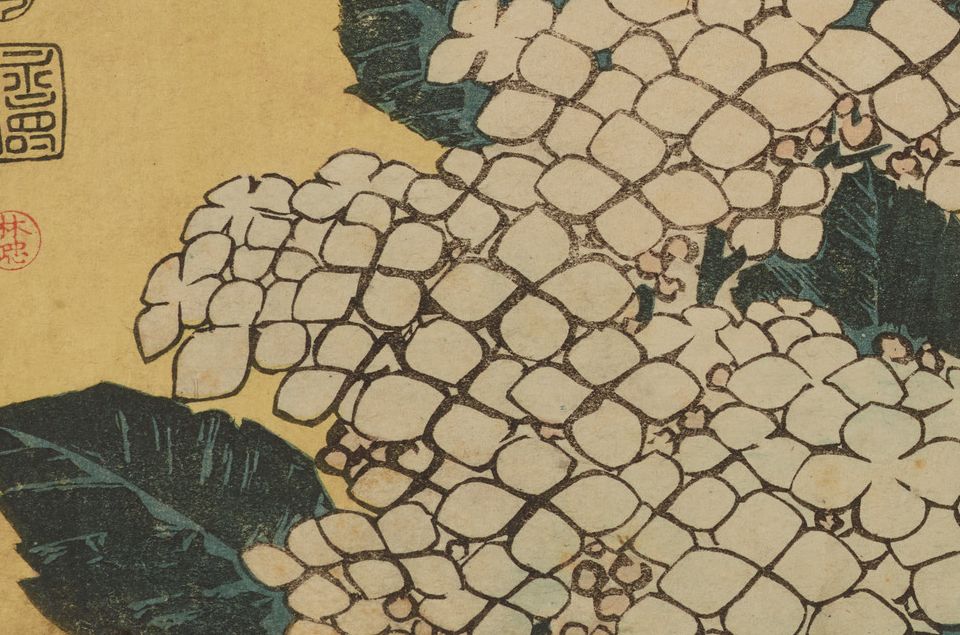
On the Pulverer sheet, Sotheby’s records the signature Saki no Hokusai Iitsu hitsu, in which Hokusai signs as Iitsu and refers to his former name. The catalogue identifies a kiwame approval seal and names Nishimuraya Yohachi, whose publishing house was known as Eijudō. Look to the left of the flowers for the vertical writing and the compact marks beneath it. Their placement leaves room for the top of the plant to spread, while a small stretch of yellow separates the writing from the cluster below. At the other end of the sheet the swallow similarly holds its own space. [4]
These forms also reward a look at the process behind Hokusai’s woodblock prints. The Met describes how the designer, carver and printer worked with a publisher, with carefully aligned blocks transferring the different colours to the same sheet. The slender flower outlines and the dark masses beside them exemplify the kind of close relationship the printing process had to preserve. The swallow presents the same challenge especially clearly at the meeting of the breast and the wing, where the fine boundary contributes to the bird’s legibility. [1] [4] [7]
A wider look at the flower prints
The Sumida Hokusai Museum distinguishes Hokusai’s large-format bird-and-flower designs from the works he made in a medium format, and identifies Nishimuraya Yohachi as the publisher of both groups in the Tenpō era. The Nagano exhibition checklist places Hydrangea and Swallow alongside Peonies and Butterfly and Chrysanthemums and Horsefly, all represented there by impressions from the Japan Ukiyo-e Museum. In these titles alone, there is already a shift from a bird passing the blooms to much smaller insects. The horizontal format made room for finely drawn plants and for the space around each encounter. The name Large Flowers is a modern way of referring to the untitled group. [3] [4] [6]
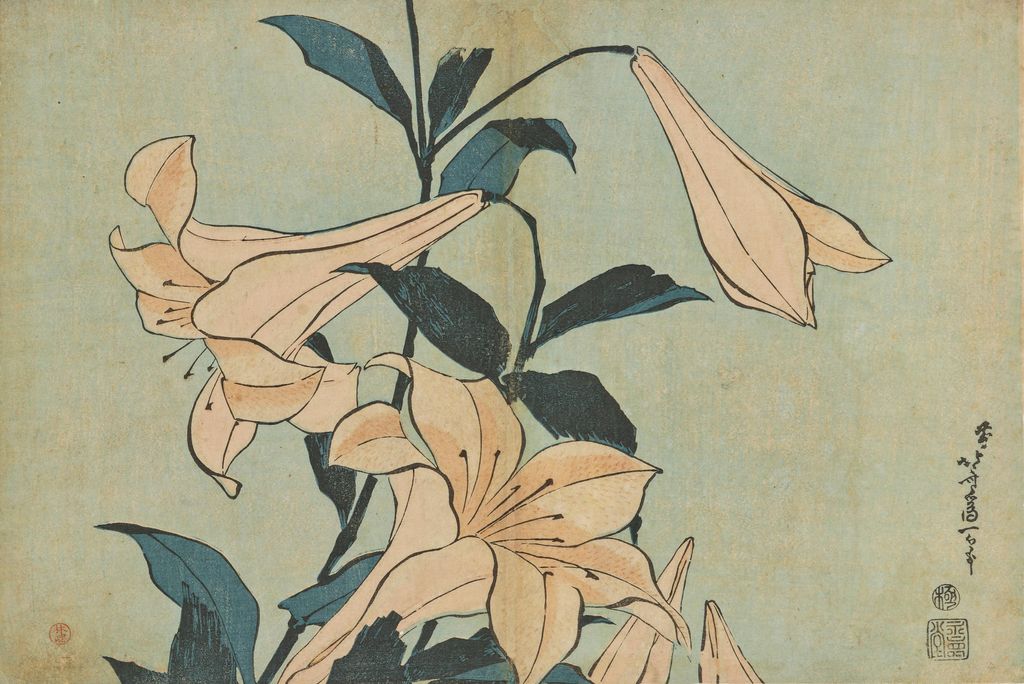
Set the hydrangea beside Lily, another Hokusai sheet held by Tokyo National Museum. The open lily has long petals that a viewer can follow from the throat to the tip. The petals project into the surrounding space as individual forms. The hydrangea’s outline gathers many small flowers into a head before it opens on the yellow ground. At the same scale on a screen, the two prints prompt different sorts of looking. The lily draws the eye along the length of a single flower, while the hydrangea keeps sending it back and forth between the head as a whole and the units that make it up. [1] [8]
In Poppies, a flower head turns out from the other blooms and directs the eye along stems bent at different angles. On the Met’s impression of that design, the movement seems to run through the plant. In Hydrangea and Swallow, the rapidly descending outline is separate from the set of forms that gives it scale. A viewer can take time over the turns of the stems before moving across the narrow band of yellow to the bird, where the change of pace is immediate. Swallow and hydrangea together make it possible to see the quick movement of a wing and the slower unfolding of a flower head on the same sheet. [1] [4] [9]
Where this work sits in Hokusai’s career
Image comparison
Annotated Details from Hydrangea with Swallow
Tokyo National Museum via ColBase, A-10569-2788. Adapted with numbered markers and detail crops under the ColBase terms. [1]
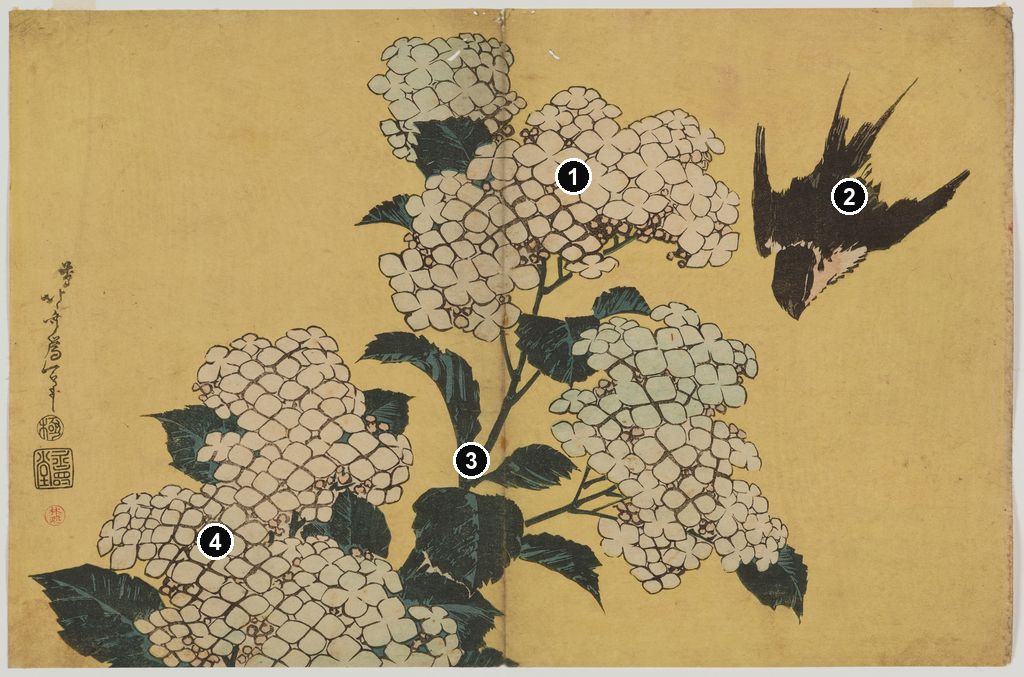
Details from HYDRANGEA WITH SWALLOW
Select a detail to look closely.
Flower heads at different heights
The individual florets make up rounded groups. The open ground between the groups keeps the upper branches legible. [1]
The swallow in downward flight
The pointed wings and tail stand out against the open ground. The spread of the wings sets a diagonal against the upright plant. [1]
The dark turn of a leaf
Leaves project from the stems between the rounded flowers. Their sharper ends give the viewer a way to follow smaller changes of direction. [1]
A cluster at the edge
The florets pack closely together lower in the image. The outer flowers are interrupted by the edge, suggesting more of the plant beyond the sheet. [1]
Explore Hokusai’s works
Discussion
Look again at the images and ideas explored in Hydrangea and Swallow. These editorial prompts invite your observations.
Reader Insights
How does the bird’s direction relate to the growing plant?
Which gaps let you read the flower clusters separately?
Join the Conversation
Share a detail, comparison or question about Hydrangea and Swallow below.
References
- Agency for Cultural Affairs, Japan, Hydrangea and Swallow (紫陽花に燕), photograph and catalogue data for the Tokyo National Museum impression. View source.
- Art Platform Japan, Hydrangea with Swallow (紫陽花に燕), Tokyo National Museum accession A-10569-2788. View source.
- Nagano Prefectural Art Museum, Hokusai exhibition checklist, entries 203–206, including the Japan Ukiyo-e Museum impression of Hydrangea and Swallow. View source.
- Sotheby’s, Hydrangeas and Swallow, lot 585 from Japanese Woodblock Prints from an Important Private European Collection, catalogue and photograph of the Gerhard Pulverer impression. View source.
- Japan Search, Hydrangea (Ajisai), gallery of collection records and examples across media. View source.
- Sumida Hokusai Museum, The Hokusai Bird Park (北斎バードパーク), exhibition overview and section on bird-and-flower colour prints. View source.
- The Metropolitan Museum of Art, Department of Asian Art, Woodblock Prints in the Ukiyo-e Style. View source.
- Agency for Cultural Affairs, Japan, Lily (百合), photograph and catalogue data for the Tokyo National Museum impression. View source.
- The Metropolitan Museum of Art, Poppies in the Wind, accession JP1860. View source.






