


 by Tom Gurney
Tom Gurney BSc (Hons) is an art history expert with over 20 years experience
Published on June 19, 2020 / Updated on November 20, 2026
Email: tomgurney1@gmail.com / Phone: +44 7429 011000
Poppies
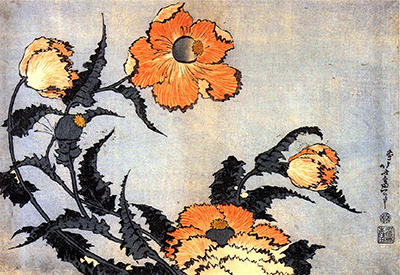
Follow the slender stem from the lower left of Katsushika Hokusai’s Poppies. It bends outwards before lifting a half-open flower into the upper left of the sheet. Farther right, a fully open poppy turns its centre towards us. The two blooms lean away from one another, their stems crossing a thicket of pointed leaves. Below them, a third bloom almost tumbles out of the picture. Hokusai leaves much of the upper right empty, giving the flowers room to appear to sway. [1] [2]
The Tokyo National Museum holds the impression catalogued as Poppies (Keshi, 芥子), accession A-10569-2787. It is a horizontal ōban, a large-format sheet, printed in colour from woodblocks in nineteenth-century Japan. The Metropolitan Museum of Art calls its impression of the same design Poppies in the Wind and dates it to 1820–34. That title draws attention to what Hokusai asks the stems and petals to make visible. [1] [2] [3]
At a Glance
- ArtistKatsushika Hokusai
- Date1820–34 (Met JP1860)
- MediumColour woodblock print
- SeriesLarge Flowers
Contents
How the wind travels through the print
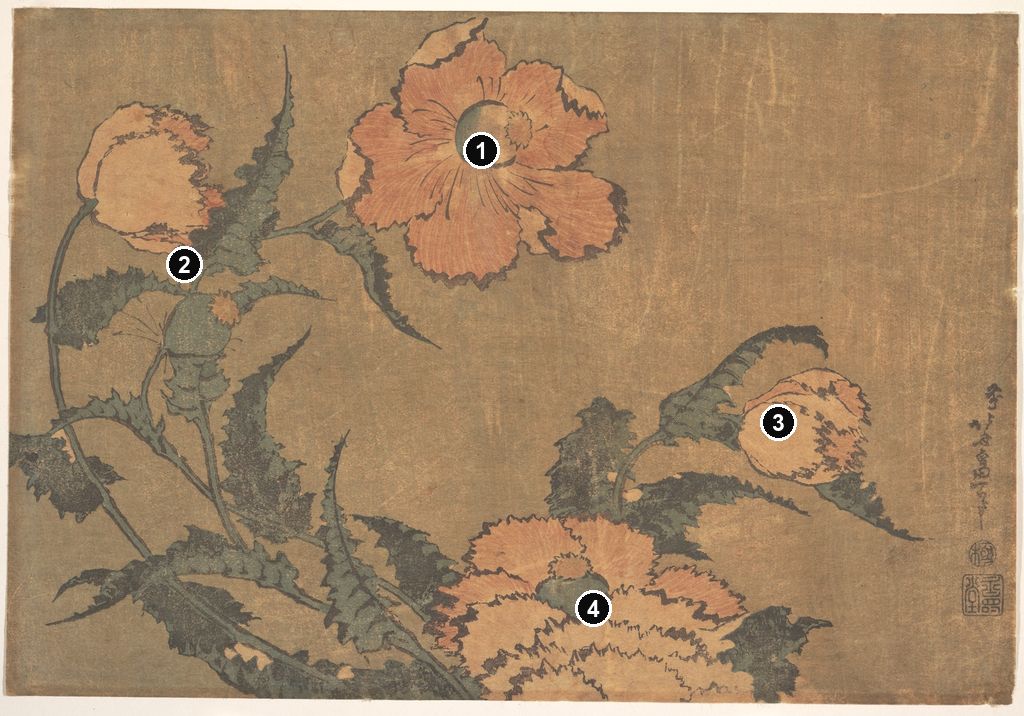
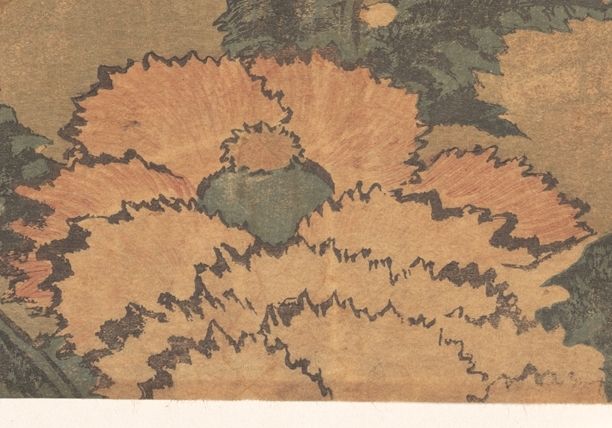
The open poppy seems to draw the movement towards a single point. Fine lines fan out from its almost round centre, folding and gathering around the edges. One petal stands high with an angular interruption at its tip. Another hangs low, where the lines spread across a broader surface. The central disk gives the eye somewhere to rest while the outlines and ribs pull it in different directions. A few small pale shapes along the upper rim help the edge of the flower register as a series of turns. [1] [2]
Look next at the flower on the left. Its head is turned to the side, and most of its centre is hidden by the rim. Lines that spread widely across the open poppy are squeezed closer here. The flower on the right turns more sharply downwards, almost into the tip of a dark leaf beneath it. Over the course of one glance, the viewer sees several positions a poppy might take as it twists on its stem. The contrast in angles makes the instability feel immediate, even though the shapes are fixed on the paper. [1] [2]
The leaves divide that movement into shorter beats. Some rise almost vertically from the tangle below. Others stretch horizontally or curve across a gap, ending in a hooked, serrated point. The arc above the flower on the right is particularly clear. It follows a smooth line until the edge breaks into small teeth. Tokyo’s catalogue draws attention to this jagged drawing and the rhythm it gives the image. The gust becomes legible in bent stalks and tight little changes in the leaf edges as much as in the broad sweep of the flowers. [1] [2]
The framing helps preserve the sense of a passing moment. Several stems disappear past the lower edge, where the sheet also cuts across the petals in the foreground. A long leaf reaches the left edge. Hokusai gives us enough of the cluster to follow its movement, while its limits remain out of sight. The space beyond the plants is broad and uninterrupted. A thin stem cutting across it is easy to pick out, then hard to find again when it joins the dense foliage. The print gives the eye a small version of the experience of trying to follow one moving stem among many. [1] [2]
Looking at two impressions
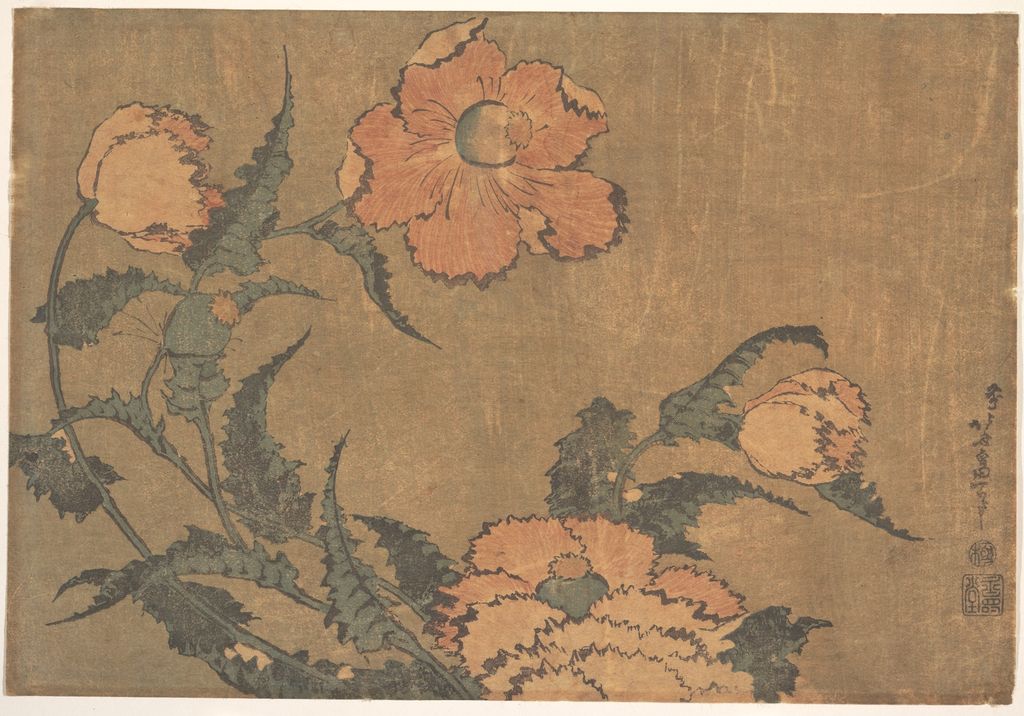
Tokyo’s photograph shows a cool, blue-grey ground with red and pink flowers. Dark leaf tips remain easy to pick out, and fine lines radiating through the larger petals are visible even in a small reproduction. In the Met photograph, the ground appears warmer and browner. The flowers read as muted orange and buff, with less tonal separation between some of the petals and the surrounding field. The dark pattern of stems and leaves carries more of the picture in this impression. JP1860, the Met sheet, measures 24.8 by 36.2 centimetres. [1] [2]
The two images make it possible to follow the same marks across the change in palette. The forked point of a leaf projects below the open bloom in both. Near the bottom, a serrated petal edge crosses in front of the larger flower, partly covering it. At the right edge, a small column of writing and a pair of marks sit clear of the main cluster. The repeated contours establish the comparison. The photographs give limited evidence about why the colours differ. Ink application, the condition of the paper and the way each sheet was photographed can all affect the appearance of a reproduction. [1] [2]
This comparison also shows what the workshop had to accomplish. As the Sumida Hokusai Museum explains, an ukiyo-e publisher co-ordinated the work of the designer, carver and printer. In a polychrome woodblock print, different parts of the image had to come together on the same sheet. The eye can test that relationship in the open poppy, where slender lines, coloured petal shapes and the round centre meet. A leaf farther down poses a different challenge. Its fine teeth have to remain clear against broad areas of filled colour, even where other leaves crowd around it. [1] [2] [4]
Flowers on a wide sheet
The Tokyo catalogue associates the design with a set of bird-and-flower prints issued by Nishimuraya. The RISD Museum identifies the publisher of its own impression, 34.493, as Nishimuraya Yohachi and groups the print under the modern name Large Flowers. The National Gallery of Victoria describes the same group as an untitled set of horizontal ōban prints, many coupling flowers with an insect or bird. Published dates vary. The RISD exhibition checklist puts its Poppies impression in the late 1820s, while Boston’s Museum of Fine Arts dates the Large Flowers group to about 1833–34. The Met’s broader range accommodates both dates. [1] [2] [5] [6] [7]
The wide format makes room for several directions of growth in a single design. The leftmost stems reach upwards, the point of a dark leaf on the right extends sideways, and the scale of the lower bloom pulls the eye forward. In Lily, another large-format flower print, the Tokyo sheet places an open lily near the centre and a solitary bent bud above. The space around that bud helps give it a different weight from the busy group beneath it. In Poppies, the wind seems to act on several flowers at once. Their uneven heights and the gaps between them give the gust a route across the sheet. [1] [6] [8]
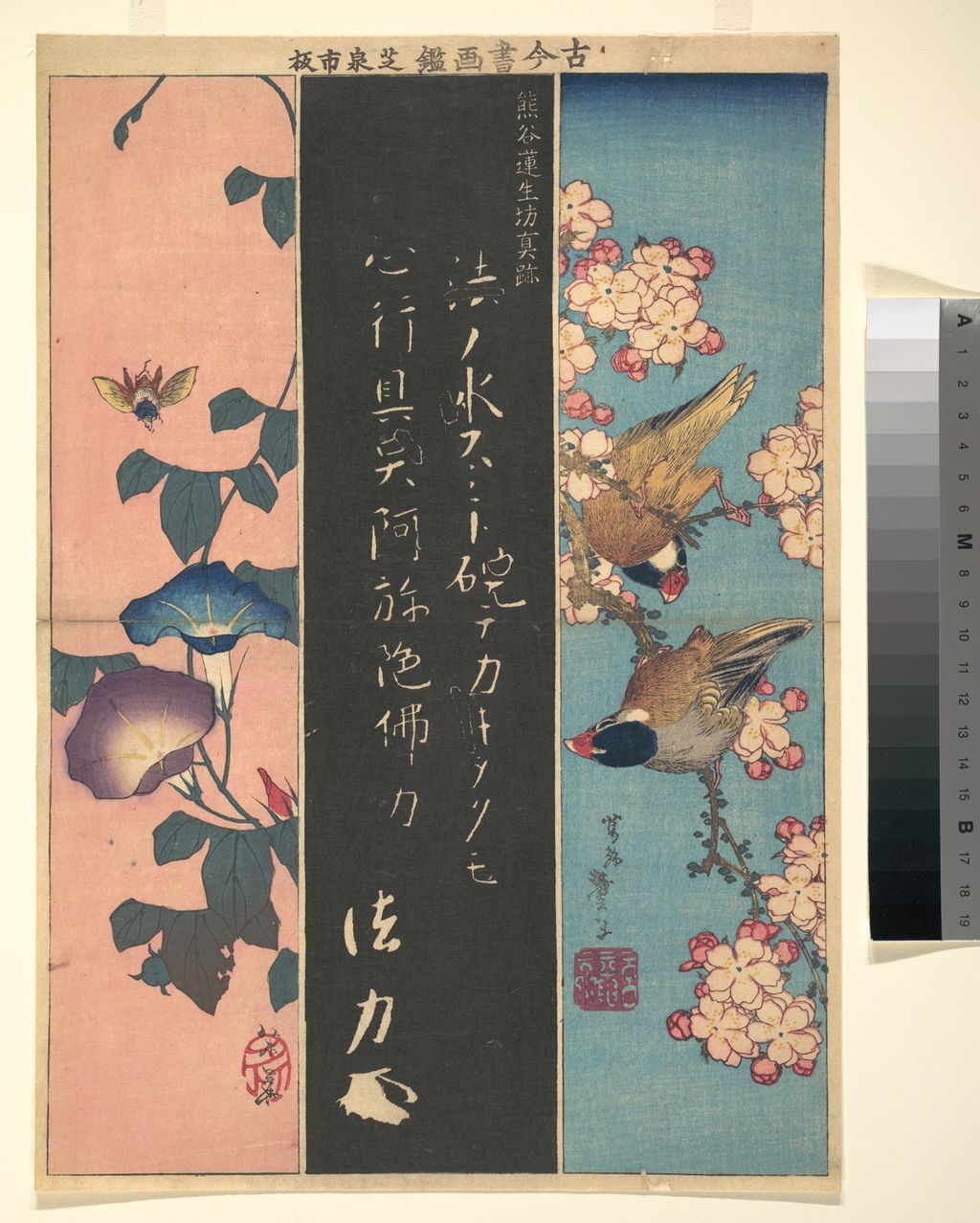
The Cuckoo and Azaleas design offers a comparison from the group known as Small Flowers. The RISD exhibition checklist records two impressions of that design. In the smaller group, the National Gallery of Victoria describes birds and plants sharing the sheet with poetry. A reader may pause at an inscription before returning to a bird or a blossom. In Poppies, the writing is far over on the right, close to the middle height of the sheet. It has a place to itself beyond the leaning flower, and it gives the composition a quiet vertical line where the plant forms are always curving or breaking into points. [1] [5] [6]
From a poppy to a wave
A RISD exhibition invited viewers to compare the bending flowers with Under the Wave off Kanagawa, commonly called The Great Wave. The comparison is easiest to see where an outline curves out over a gap and then breaks into small projections. In the landscape, foam gathers along the advancing crest. In Poppies, the fine points along the leaves interrupt the sweep of the stems and petals. The broad arc gives a sense of direction in both prints, while its broken edge fixes the eye on a particular phase of movement. [1] [5] [9]
The two scenes give the viewer different ways to judge that movement. The boats alongside the wave give a sense of its size, while distant Mount Fuji appears small inside its curve. The poppies give us changes in the angle of the flowers themselves. Try starting with the face of the most open bloom and moving across to the bowed flower at the right. The narrow stem and the arc of the leaf above it make the second flower feel suspended, as though the next movement might lift it again. The print keeps attention on that small interval between one position and the next. [1] [2] [9]
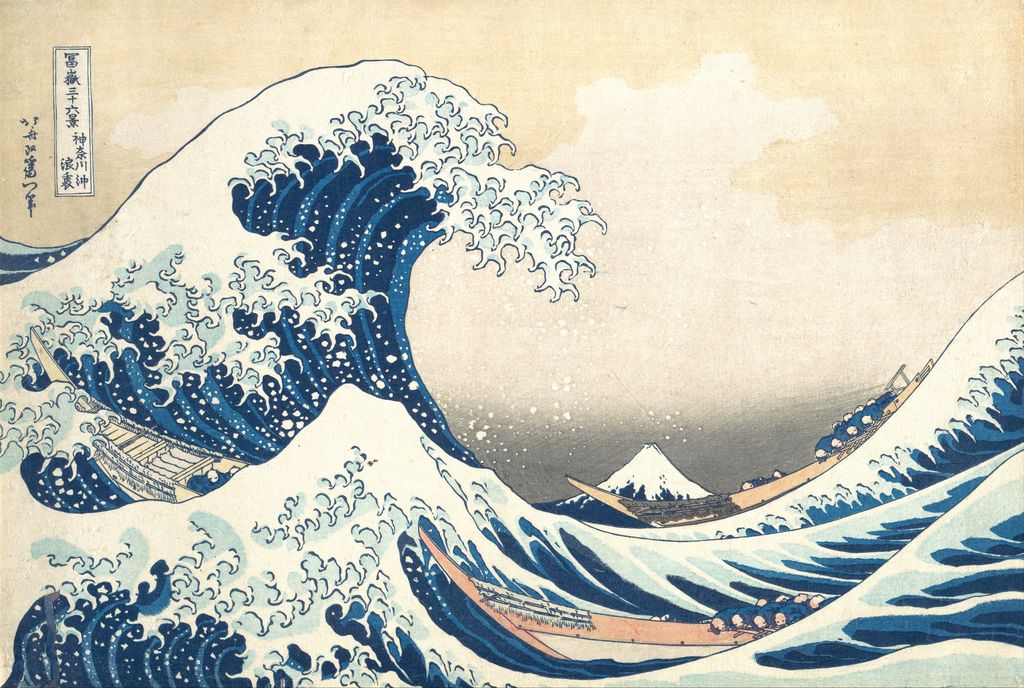
Image comparison
Where this work sits in Hokusai’s career
Annotated Details from Poppies
The Metropolitan Museum of Art, JP1860. [2]
Details from POPPIES
Select a detail to look closely.
The open flower turns towards us
Fine printed lines fan out from the centre. Their changing spacing makes the petals appear to turn around the round disk. [2]
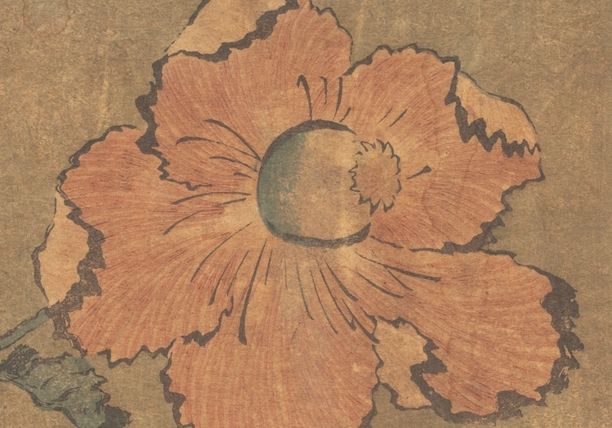
A bloom seen from the side
The left flower hides much of its centre. Its leaning head and curved stalk pull away from the more open bloom. [2]
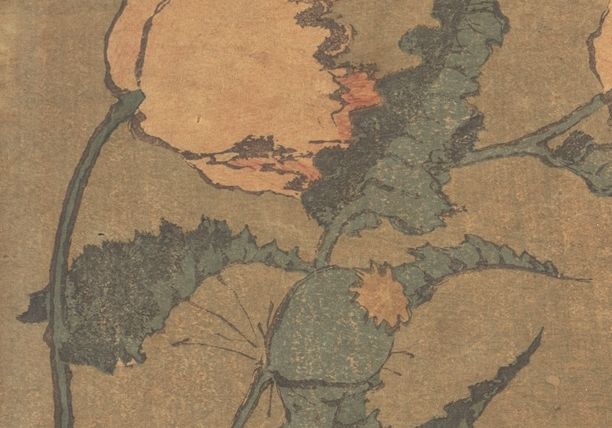
A leaf arches above a drooping bloom
The dark leaf and the downturned flower form an arch and a hanging weight. Tiny turns in the leaf edge interrupt the longer curve. [2]
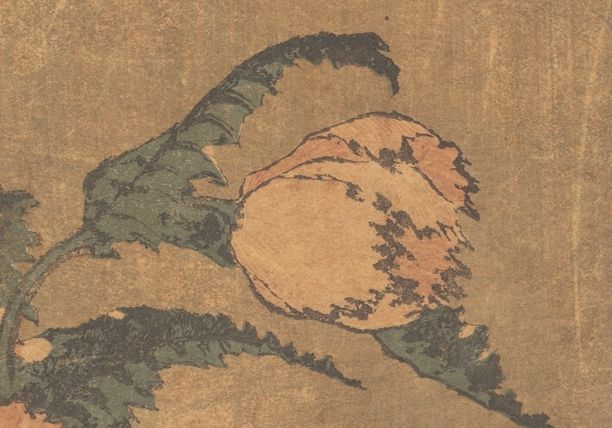
The frame cuts across the nearest flower
The bloom at the lower edge spills past the printed field. Its larger shape crowds the fine stems and suggests that the plant continues outside the view. [2]
Explore Hokusai’s works
Discussion
Look again at the images and ideas explored in Poppies. These editorial prompts invite your observations.
Reader Insights
Which flower gives you the strongest sense of the wind?
What stays easy to recognise across different impressions?
Join the Conversation
Share a detail, comparison or question about Poppies below.
References
- Japan Agency for Cultural Affairs, Poppies (芥子), Tokyo National Museum impression, Cultural Heritage Online record 551863. View source.
- The Metropolitan Museum of Art, Poppies in the Wind, accession JP1860. View source.
- Art Platform Japan, Poppies, Tokyo National Museum accession A-10569-2787. View source.
- Sumida Hokusai Museum, Wow, Hokusai! See, Examine, and Discover Ukiyo-e. View source.
- RISD Museum, Feathers, Flowers, Talons and Fangs: Power and Serenity in Japanese Nature Prints, exhibition checklist, accession 34.493 and accessions 34.486.1–2. View source.
- National Gallery of Victoria, Hokusai, exhibition labels, “Birds and flowers” section. View source.
- Museum of Fine Arts, Boston, Hokusai Features Legendary Artist, Best Known for Iconic Great Wave, exhibition press release. View source.
- Japan Agency for Cultural Affairs, Lilies (百合), Tokyo National Museum impression, Cultural Heritage Online record 464115. View source.
- The Metropolitan Museum of Art, Under the Wave off Kanagawa, accession JP1847. View source.







