


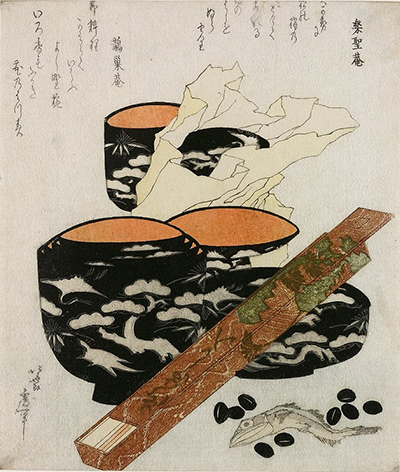
Katsushika Hokusai, Fish, Beans, Chopstick Case and Lacquer Bowls. The holding of this impression is unidentified.
Buy Art Prints Nowfrom Amazon
* As an Amazon Associate I earn from qualifying purchases.
 by Tom Gurney
Tom Gurney BSc (Hons) is an art history expert with over 20 years experience
Published on June 19, 2020 / Updated on November 20, 2026
Email: tomgurney1@gmail.com / Phone: +44 7429 011000
Still Life: Fish, Beans, Chopstick Case and Lacquer Bowls
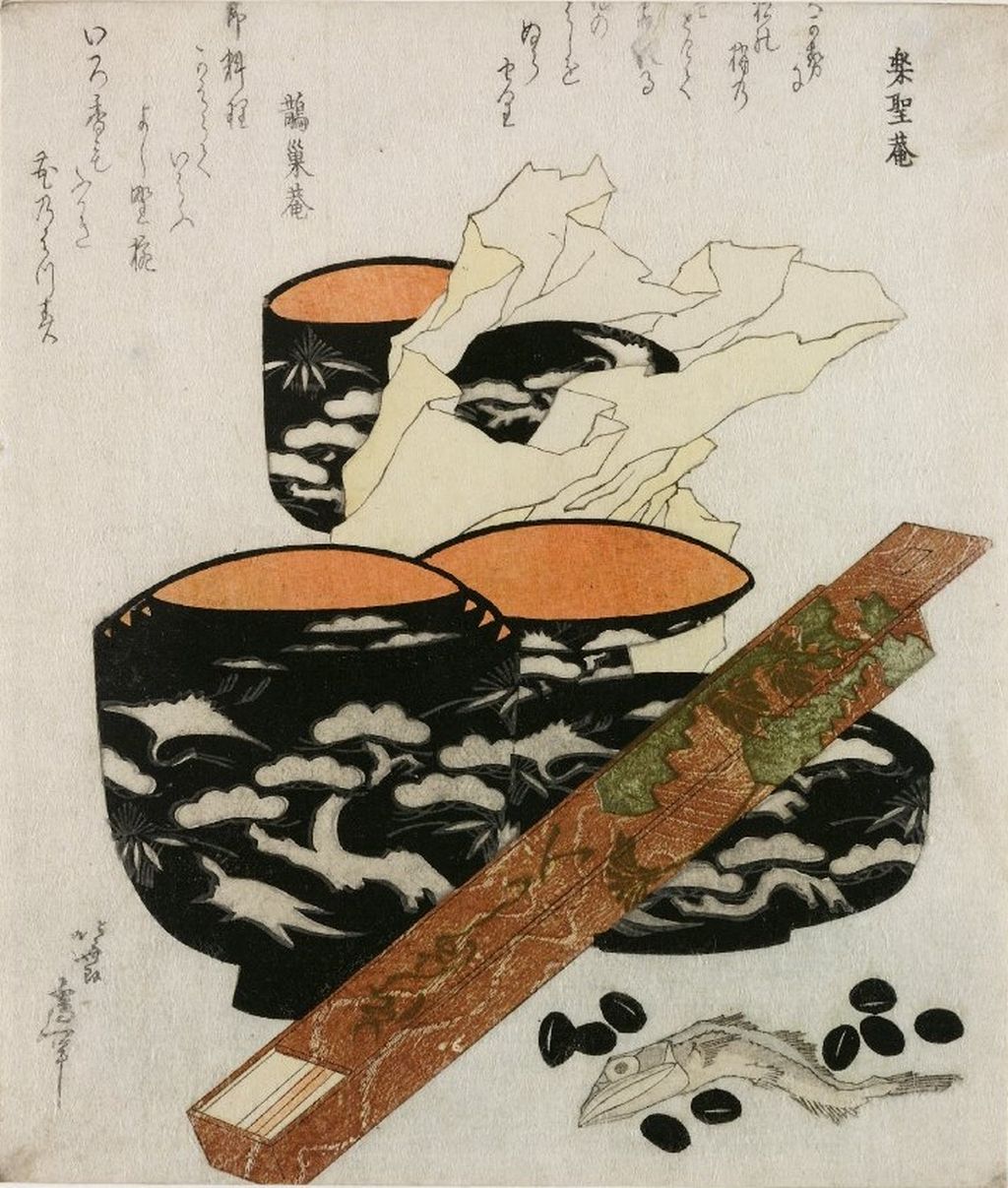
A long chopstick case crosses a group of black lacquer bowls in this colour woodblock design by Katsushika Hokusai. Its decorated lid runs diagonally from near the bottom of the sheet towards the right edge. The orange or red interiors of the bowls form wide ovals, while a dried fish and black beans lie in the open space below the case. Several columns of writing reach down from the top. The Chazen Museum of Art titles its impression Fish, Beans, Chopstick Case and Lacquer Bowls and dates it to probably 1823. The British Museum records another impression as a surimono, a type of woodblock print often commissioned for private distribution. [1] [2] [4]
The Chazen and British Museum images show the same arrangement. Both preserve the leftward turn of the fish's head, the opened end of the case, the overlapping vessels and the angular folds of the pale material above them. The reproduction of the design here is close in colouring and composition to the British Museum image. The holding of the particular sheet reproduced here remains unverified. [1] [2] [3]
At a Glance
- ArtistKatsushika Hokusai
- DateProbably 1823
- MediumColour woodblock print
- FormatPrivately commissioned surimono
Contents
Reading the bowls and the case
Start with the bowls. The nearest rim makes the widest ellipse. A second opening sits a little higher and farther right, while an opening at the back appears above the folds on the left. Each exposes a stretch of warm colour enclosed by a dark edge. The differences in height allow the bowls to occupy separate planes even though there is no tabletop line. Their overlap is especially important near the middle, where the dark shapes meet and the pale patterns could almost run from one vessel into the next. The upper bowl is separated from the others by more uncovered paper, which gives its orange opening a small field of its own. [1] [2] [3]
The bowls carry light motifs across broad fields of black. Some forms have clustered tips and radiating marks resembling sprays of pine needles. Others are elongated and turn in curves. They change direction as the vessels swell below their rims. The pale material above the bowls behaves differently. Its edges bend sharply and overlap irregularly, leaving short enclosing lines and points. A portion of dark decoration shows through a gap in this pale form. That opening helps the eye judge which layers stand in front of the vessels and which belong to their surfaces. The composition conveys both their rounded shape and the shapes applied to them. [1] [2] [3]
The Chazen identifies the long foreground object as a chopstick case. At its lower end the light shafts are visible inside a small rectangular opening. Behind them the sides of the case recede into a warm brown decorated surface, with green accents in the British Museum reproduction. The long edges form a diagonal that is steeper than the arrangement of the bowls. Follow those edges upward and the case covers a little of each dark mass in turn. Follow it back down and it brings the eye to the closely grouped beans. The open end is one of the smallest passages in the sheet, yet it gives a purpose to the largest straight-edged form. [1] [2] [3]
Fish, beans and a possible seasonal setting
The dried fish is smaller than the vessels and differs from them in tone. Its thin outline and visible ribs sit low in the composition against the paper. The dark beans around it are much more solidly printed. A light edge separates individual beans in the small clusters so that each can retain its shape. Like the opening of the case, the fish is seen more clearly once the larger objects have established the scale. The fish and beans supply the subject of the meal at the very point where the image comes closest to being an arrangement of decorated possessions. [1] [2] [3]
The combination has a possible New Year resonance. Japan's Ministry of Agriculture, Forestry and Fisheries describes sweet black soybeans and a dish of small dried fish among the foods served at New Year. In that context the beans carry a wish for health, while the small fish carry a wish for plentiful harvests. The print shows a dried fish and black beans, and these associations help explain why such small foods could hold a viewer's attention. The museum records leave the recipe, species and exact occasion open. It is possible to recognise the significance of the grouping without assigning the fish to a particular dish. [1] [2] [5]
The black bodies and coloured interiors also direct attention to the care taken in preparing and presenting food. The Kyoto National Museum's account of the late Edo lacquer artisan Sano Chōkan includes a story about a set of lidded soup bowls made as a gift for a celebration. It is a separate example from the history of lacquerware, but it brings the bowls in the print closer to the experience of handling a carefully made vessel. Chōkan's story turns on the tight fit of the lids. Hokusai makes rims, surfaces and vessels layered against one another the subject of looking. [2] [6]
Poetry on a small print
The Chazen sheet is just over twenty centimetres high and just under eighteen wide. A reader could bring it close and move between the writing and the printed objects. The Hokusai-kan Museum in Obuse describes surimono as prints made to order, for seasonal gatherings, private exchanges and notices of performances. The people involved could recognise references in both verse and image. Hokusai worked in the form across his career. On this sheet the words take up their own area above the vessels, but the longest columns draw the eye well into the space beside them. [1] [2] [4]
The scale makes the arrangement of the text part of the reading. In the British Museum image, the bowls occupy much of the lower half and have clean, dark silhouettes. Above, thin strokes collect into groups with unequal margins between them. A line can sit directly over a rim or end beside an open expanse of paper. The pale shape behind the bowls meets the edge of this upper field without cutting it off. Text and objects can each be viewed separately before the eye returns to the whole print. [2] [3]
The stronger inscriptions at the upper right and near the left of the arrangement in the British Museum image appear to read Rakuseian (楽聖庵) and Jakusōan (鵲巣庵). An Atomi University Library record identifies both writing names on a separate actor print. The Rijksmuseum also records those names in connection with Hokusai's Stone (Ishi), a different surimono dated about 1823. That design shows a young woman making a miniature landscape on a lacquered tray and its catalogue records three poems. These comparisons establish that the writing names circulated on other printed designs. The museum records for the bowls leave the verses themselves untranslated, so a precise reading of their relation to the objects remains open. [2] [7] [8]
The Rijksmuseum's Stone also documents blind printing and metallic pigments, two techniques that could enrich a small sheet. Blind printing presses a design into the paper without applying a printed colour. Metallic pigments can reflect light as the reader moves the sheet. In the still life of bowls, the case's changing colours and the light marks on the dark vessels are visible even in a photograph. Whether this print uses either speciality in a particular spot would require an examination of the sheet under changing light. [1] [2] [8]
Two impressions and a second still life
The Chazen reproduction gives the open bowls a deeper red cast. The British Museum photograph gives them a more orange appearance and makes the green on the case more prominent. In the Chazen image the bold name at the far right is less evident. Many finer outlines recur in the same places, down to the box's open end and the arrangement of the fish and beans. Photographs can make differences between sheets accessible, and both the conditions of the physical print and the capture can affect what colours are visible. The catalogues add information that an image comparison cannot supply. The Chazen traces its sheet to Frank Lloyd Wright, who had purchased it in Japan by 1925. It later entered the Van Vleck collection and passed to the museum through John H. Van Vleck's bequest. [1] [2]
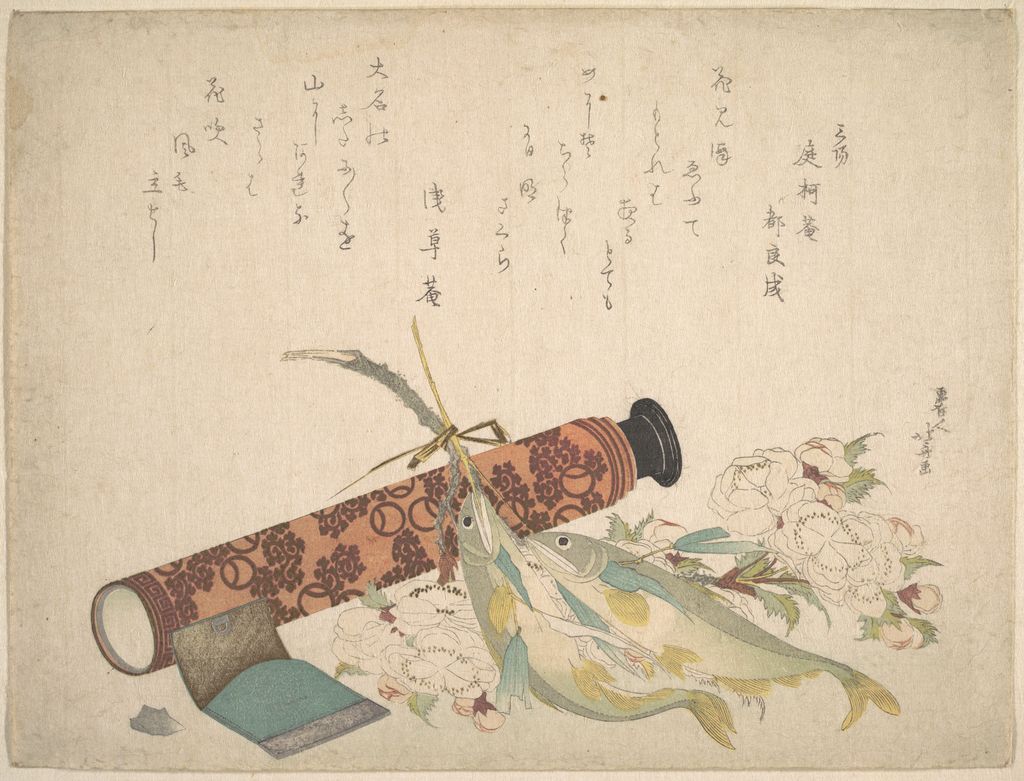
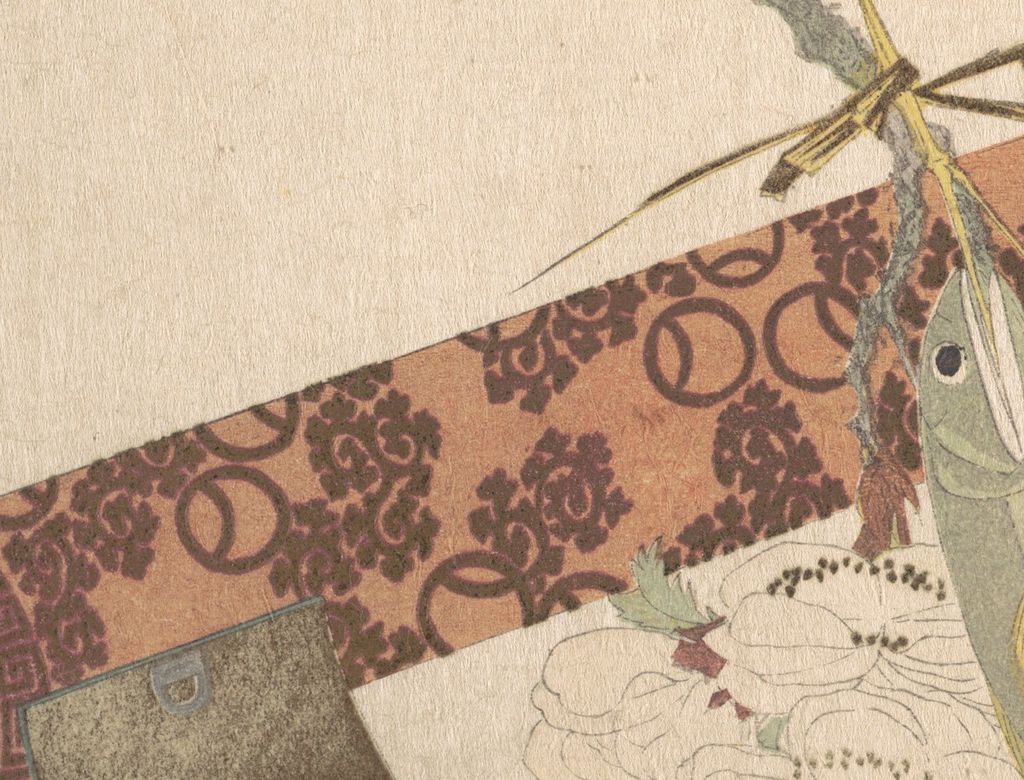
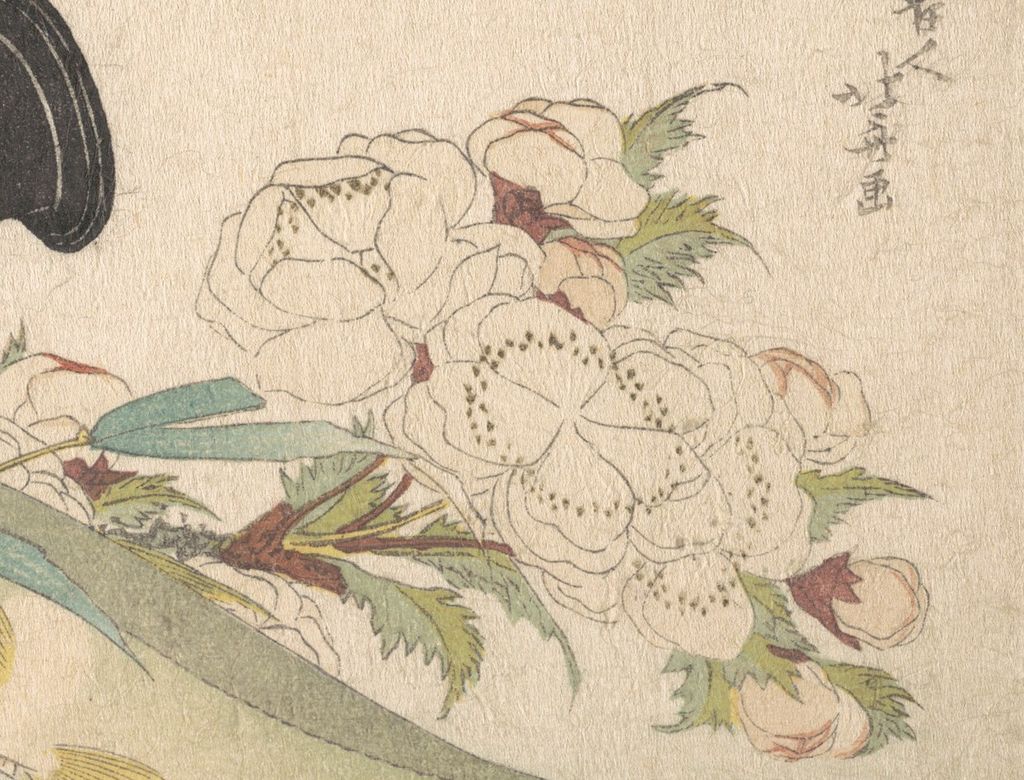
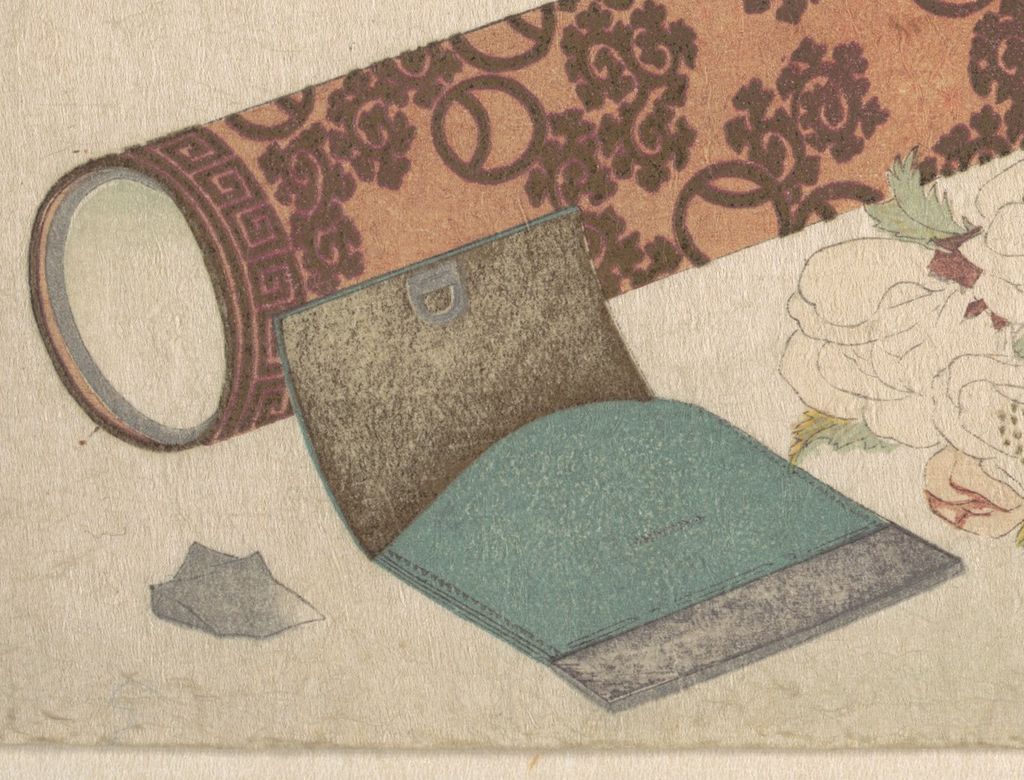
Hokusai also made a larger, horizontal still life with objects associated with cherry blossoms. The Metropolitan Museum of Art's impression, about 1804–13, shows a richly patterned telescope, two sweet fish, double cherry blossoms and a tissue case. The museum identifies two poets, Asakusa-an and Teika-an, whose verses share the theme of cherry blossoms. The telescope and the chopstick case both give length and direction to their respective sheets. In the Met print, though, the horizontal field allows the fish and flowers to spread out beside the diagonal. In the bowl design, the case cuts through a more compact succession of orange ovals. A different relationship between objects and verse emerges from each arrangement. [1] [2] [9]
The Met identifies Hokusai's signature on its earlier impression as Gakyōjin Hokusai ga. That catalogued signature belongs to the cherry-blossom design, just as the probable date of 1823 belongs to the Chazen catalogue entry for the bowls. Both prints offer quick recognition of the objects and then slow down the eye with ornament, overlapping surfaces and small passages of text. In the bowl design, start again with the red-orange ovals and follow the long case towards the fish. Hokusai lets a group of small items take up the whole field of attention. [1] [2] [9]
Where this work sits in Hokusai’s career
Hokusai Manga
From 1814Still Life: Fish, Beans, Chopstick Case and Lacquer Bowls
Probably 1823Annotated Details from Still Life with Double Cherry-Blossom Branch, Telescope, Sweet Fish, and Tissue Case
The Metropolitan Museum of Art, JP1870. A separate still life. Public domain. [9]
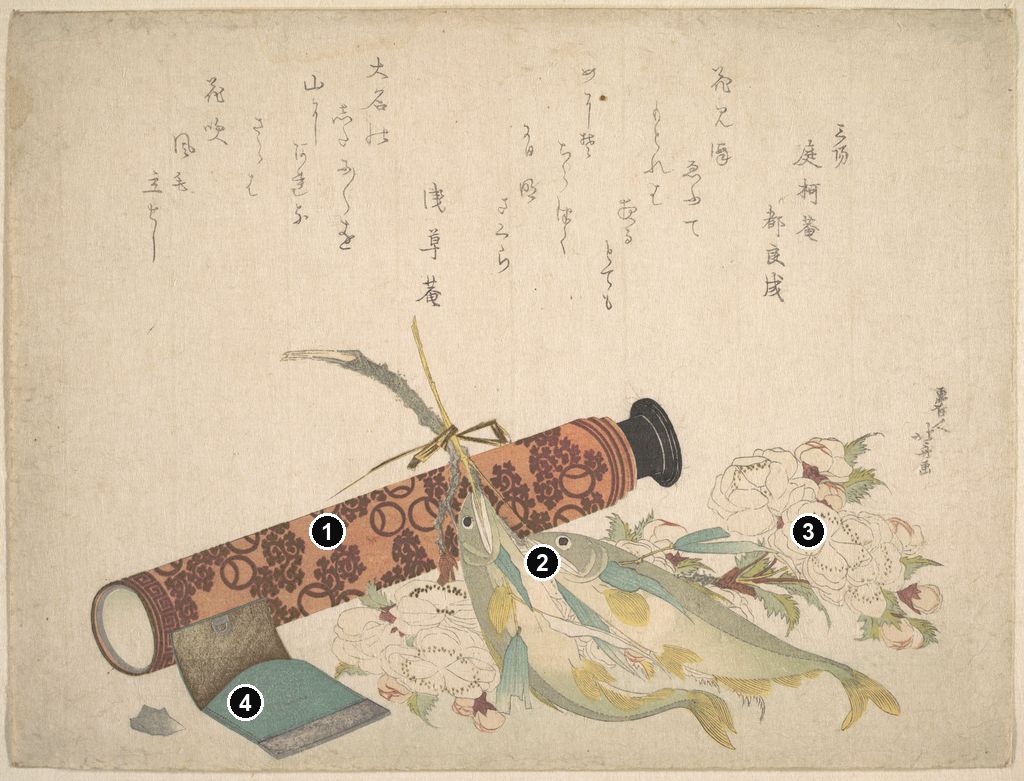
Details from STILL LIFE WITH DOUBLE CHERRY-BLOSSOM BRANCH, TELESCOPE, SWEET FISH, AND TISSUE CASE
Select a detail to look closely.
A patterned case holds the telescope
The length of the object supplies a diagonal through the tabletop arrangement. [9]
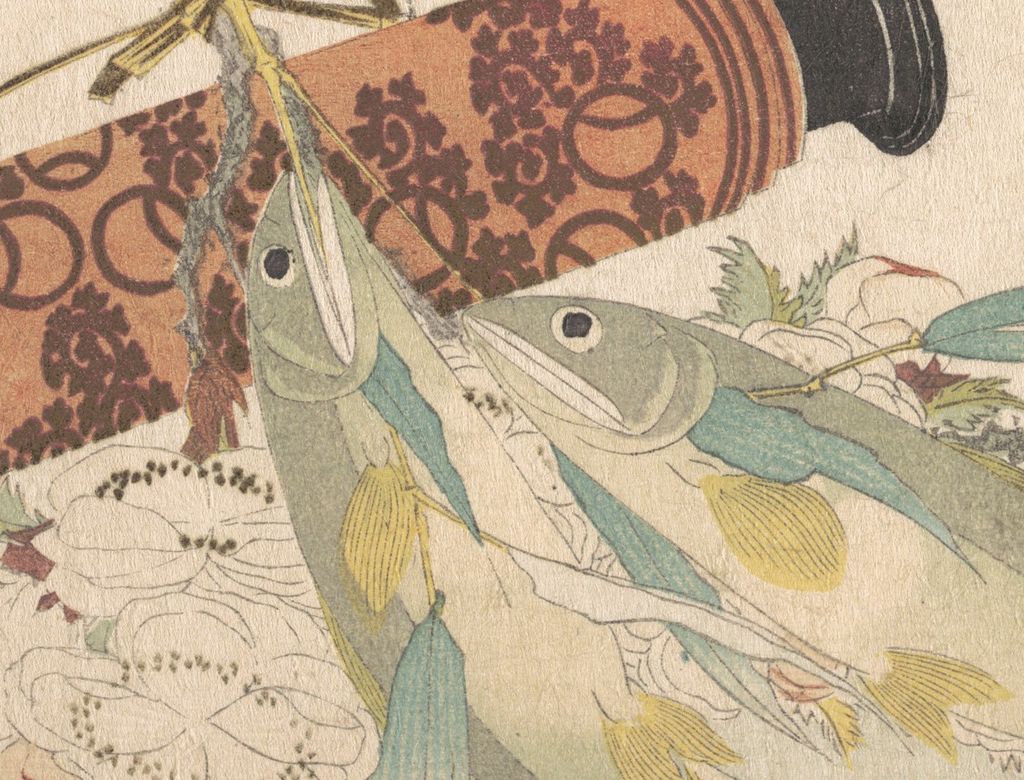
Double blossoms cluster along the branch
The flowers give this separate still life a recognisable seasonal subject. [9]
A case sits beneath the other objects
The small case extends the composition towards the lower edge. [9]
Explore Hokusai’s works
Discussion
Look again at the images and ideas explored in Still Life: Fish, Beans, Chopstick Case and Lacquer Bowls. These editorial prompts invite your observations.
Reader Insights
How do the different angles make the objects distinguishable?
What festive associations do the bowls and their contents carry?
Join the Conversation
Share a detail, comparison or question about Still Life: Fish, Beans, Chopstick Case and Lacquer Bowls below.
References
- Chazen Museum of Art, Katsushika Hokusai, Fish, Beans, Chopstick Case and Lacquer Bowls, 1980.2375. Title, dating, process, dimensions and provenance. Collection record View source.
- British Museum, Katsushika Hokusai, Surimono / print, 1902,0212,0.365. Identification of soup bowls, dried fish, black beans and poetry. Collection record · Indexed collection photograph and description View source 1. View source 2.
- Wikimedia Commons, Hokusai-shikishiban-still-life.jpg. Public Domain Mark reproduction of the design, holding unidentified. Image record View source.
- Hokusai-kan Museum, The Rarely Seen Art of Surimono, bilingual exhibition introduction, 2023. The purposes of privately commissioned prints and Hokusai's work in the form. Exhibition View source.
- Ministry of Agriculture, Forestry and Fisheries, Washoku: Traditional Dietary Cultures of the Japanese. Black soybeans and small dried fish among foods served at New Year. Publication View source.
- Kyoto National Museum, Akio Haino, The Lacquer Artisan Sano Chokan. Account of late Edo lacquer soup bowls presented for a celebration. Museum article View source.
- Atomi University Library, Segawa Kikunojō V, BA77566700. Catalogue note identifying Rakuseian and Jakusōan as writers of kyōka verses on a different print. Record via CiNii Books View source.
- Rijksmuseum, Katsushika Hokusai, Stone (Ishi), RP-P-1958-305. A separate print with related writing names, blind printing and metallic pigments. Collection record View source.
- The Metropolitan Museum of Art, Katsushika Hokusai, Still Life: Double Cherry-Blossom Branch, Telescope, Sweet Fish, and Tissue Case, JP1870. Image, contents, verse, date and signature of a distinct surimono. Collection record View source.








