


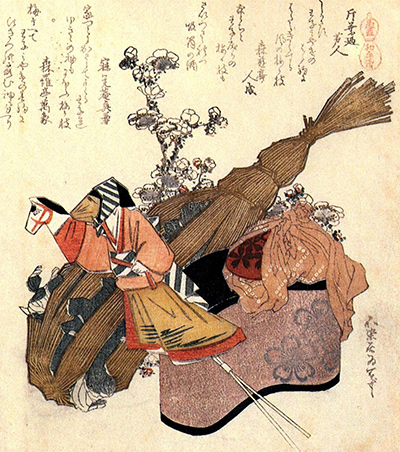
Katsushika Hokusai, Shrine Visit on the First Horse Day of the Second Month, 1822. The holding of this impression is unidentified.
Buy Art Prints Nowfrom Amazon
* As an Amazon Associate I earn from qualifying purchases.
 by Tom Gurney
Tom Gurney BSc (Hons) is an art history expert with over 20 years experience
Published on June 19, 2020 / Updated on November 20, 2026
Email: tomgurney1@gmail.com / Phone: +44 7429 011000
A Hand Puppet by Katsushika Hokusai
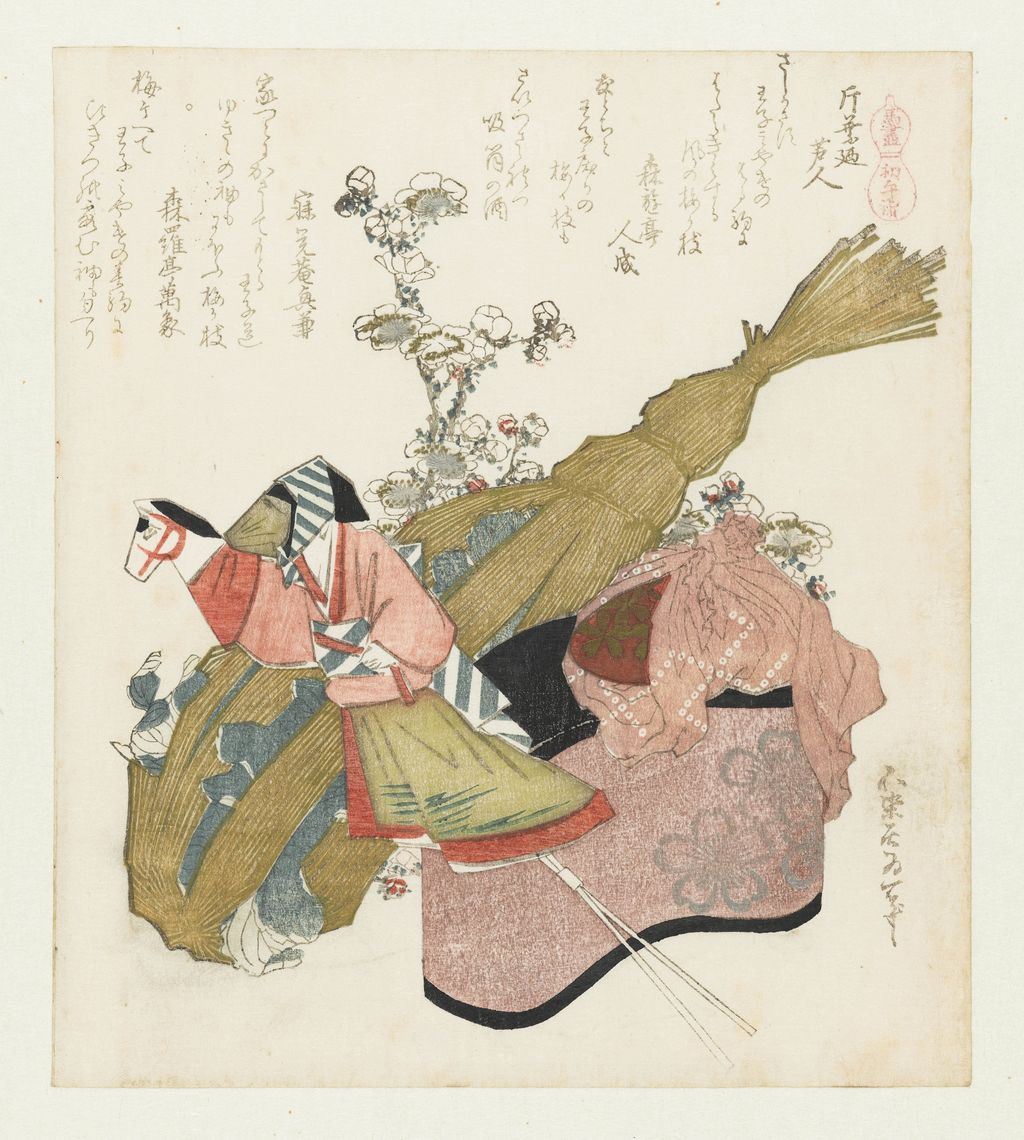
A fox puppet in an orange jacket lifts a tiny horse head in Hokusai’s Shrine Visit on the First Horse Day of the Second Month. Two thin rods emerge beneath its flared skirt. Behind it, a bundle of leaves bound in straw points up towards a red title cartouche, while pale blossoms rise between the objects and the poems above them. The title A Hand Puppet draws attention to one detail of the print. Its inscribed title, Hatsuuma mairi, identifies the occasion linking the puppet, the bundle, the blossoms and the sake vessel. Hokusai designed the print in 1822 for All Kinds of Horses (Umazukushi), a series of illustrated New Year greetings. [1] [2] [3]
At a Glance
- ArtistKatsushika Hokusai
- Date1822
- MediumColour woodblock print
- SeriesAll Kinds of Horses
Contents
The fox and the horse
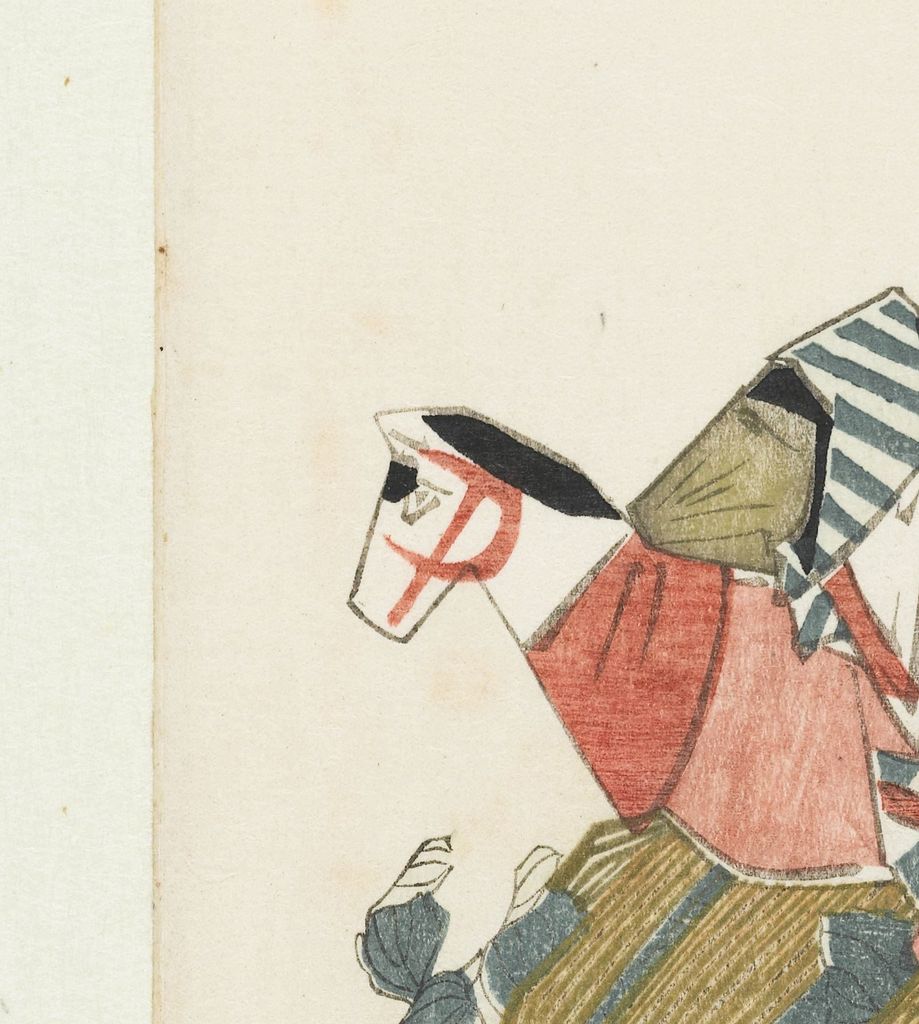
At the left of the arrangement, the pale fox muzzle projects from a striped head covering. A smaller white head, marked with red lines, appears beyond the raised sleeve. The Rijksmuseum identifies the figure as a fox hand puppet performing the spring horse dance. The toy therefore gives the viewer two creatures to recognise at different scales. The fox is the performer and the little horse head is part of its act. Both faces point to the left, but the horse head is held a little higher, away from the body. Its position makes the lift of the sleeve legible. Below, the skirt spreads out with its hem raised on a diagonal. The lines beneath it remain visible all the way to their ends. Even in a still life, those details give the reader a way to imagine how the movement would be made. [1] [3]
The compact figure initially seems large because it crosses the straw bundle and the pink fabric at the right. Looking across the print puts its scale back into proportion. The large bundle extends far beyond it. The cup and cloth are only a little lower than the fox’s head, and the two slender rods extend out of the folds into an open patch of paper. The eye can follow the performance and then recognise the object as something that could be picked up. The Sumida Hokusai Museum associates the small fox toy with Ōji Inari Shrine in Edo. The print gives a shrine souvenir enough space to carry the action of a dance. [1] [2] [3]
A related sheet in the same series, Hobby Horse (Harugoma), makes the dance legible through a different arrangement of toys. The Rijksmuseum describes a hobby horse and a toy bird on a lacquer tray and identifies dancing with the hobby horse as a New Year performance by children. The horse head there sits among objects laid out on a tray. In Hatsuuma mairi, the small horse is already lifted into the air inside the picture’s miniature performance. The difference is worth looking for because both sheets use objects to allude to an activity beyond the paper. In the first, the toys are assembled in one place. In the second, the raised sleeve and flared skirt suggest the next instant of a dance. [1] [5]
The shrine visit in a still life
Hatsuuma means the first day of the horse, here in the second month of the old calendar. The day became associated with visits to shrines dedicated to Inari, the deity linked with rice and successful harvests. Foxes are Inari’s messengers. The National Diet Library’s account of the festival traces the celebration from Fushimi Inari in Kyoto and quotes an eighteenth-century Edo guide recording banners, sacred music and dance, and people gathering at the shrine. Its examples include images of the festival at Ōji. Hokusai gives the shrine visit a recognisable setting through objects a visitor could connect with the occasion. The toy recalls Ōji, while the horse dance picks up the name of the day. [1] [3] [4]
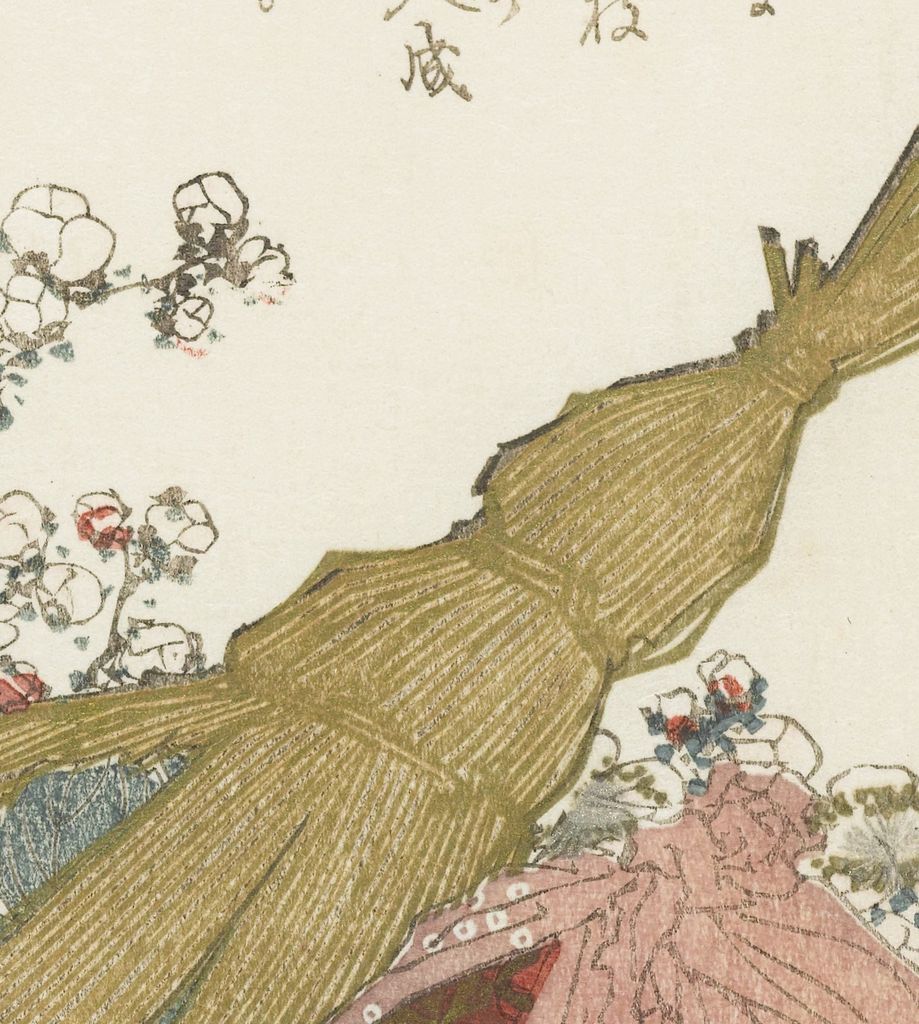
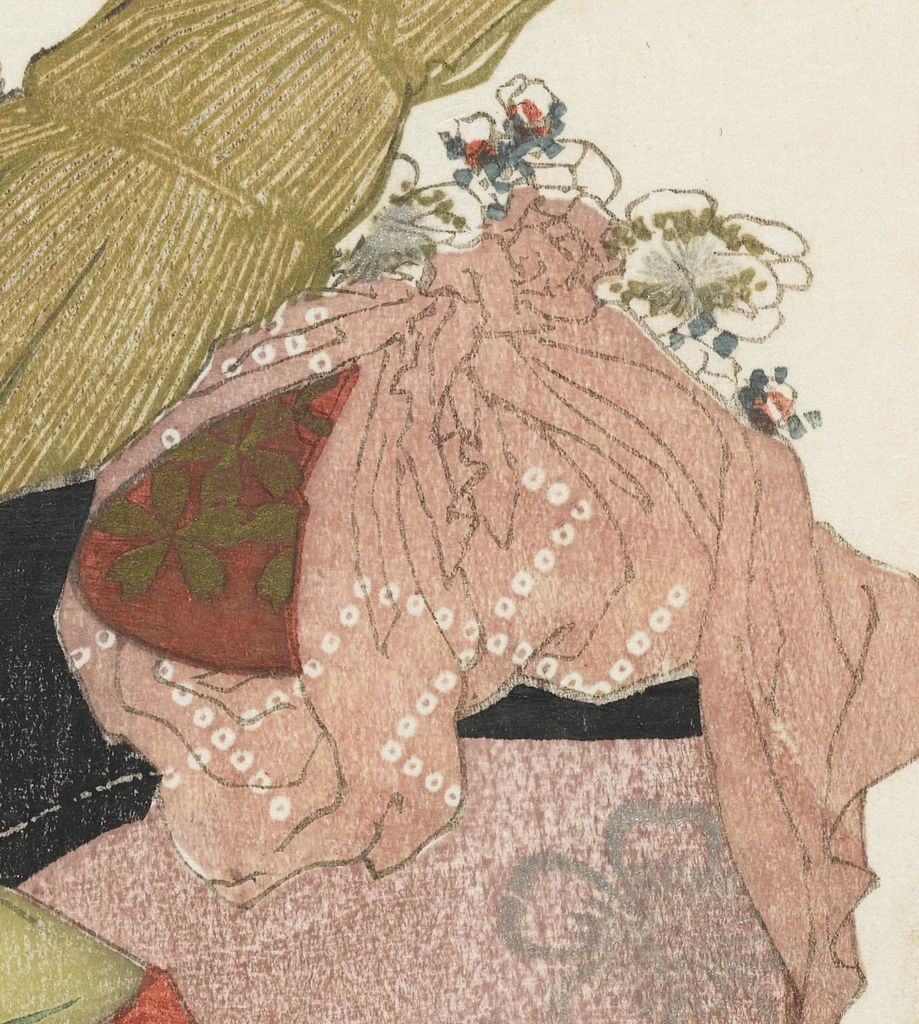
The pink cloth at the right falls in sharp little folds, tied together at its upper edge before spreading across a container. Just to its left a patch of red breaks the pale colour of the fabric. The Rijksmuseum identifies the arrangement as a sake bottle with a red cup and pink cloth. The cloth partially conceals the vessels, so colour and contour have to do some of the work of describing them. Compare that drape with the straight, closely packed lines of the straw bundle. The cloth folds around rounded forms and drops under its own weight. The tied straw narrows where the cords pull it together, then fans out into cut ends. Their overlap gives two different surfaces a clear relation to one another. [1] [2]
The flowering stems make a second movement through the print. Their short, irregular offshoots stand out against the longer diagonal of the bundled straw. The blossoms continue towards the field of writing, where the paper is otherwise mostly open. The Sumida Hokusai Museum records the custom of adding a plum bloom to offerings at Hatsuuma. That association makes the blossom relevant to the occasion as well as to the spacing of the image. It also explains how a scene made for New Year distribution can anticipate a festival in the second month. The addressed reader receives a greeting that looks ahead to another visit in early spring. [1] [3]
Four poems and a printed greeting
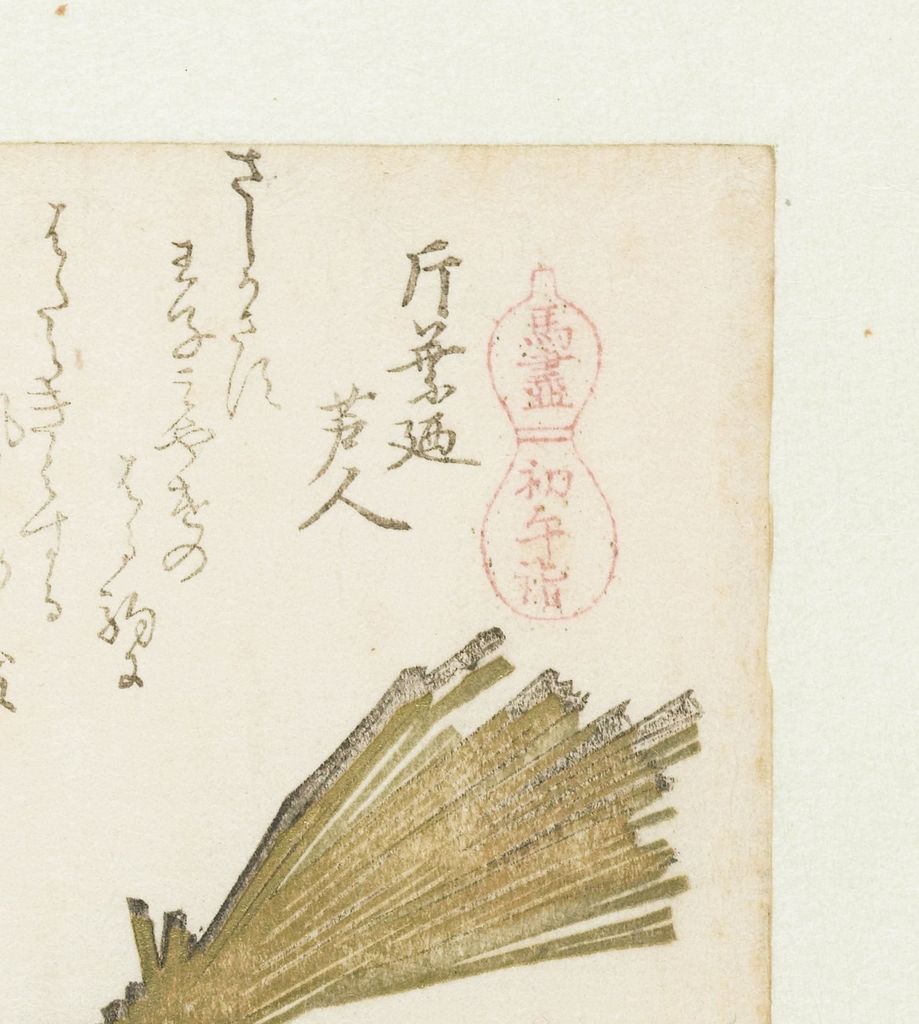
The verses occupy the upper part of the sheet, where the small passages of handwriting run in vertical lines. The red cartouche near the right edge is set apart from the ink of the poems. It identifies the series and the individual subject. The name inscriptions attach the writing to contributors as well as to Hokusai. The Rijksmuseum credits Oncha no Ashindo, Shinyūtei Hitonari, Bisoan Okukama and Shinratei Manzō as the four poets. When the small print is seen at a greater distance, the contrasting densities of the handwriting remain visible even if the individual characters cannot be read. Moving closer brings the separate groups of lines and signatures into view. [1] [2]
The Sumida Hokusai Museum describes the surviving designs in All Kinds of Horses as New Year gifts for 1822, a horse year, with horse associations carried in the pictures and the kyōka, or comic verse. The Library of Congress explains the wider practice of private circles commissioning illustrated sheets and sending them to members, patrons and friends. The small format suits reading that moves between visual clues and written lines. In this design a recipient familiar with the festivities could connect the fox and the tiny horse with the visit. The straw and sake vessel give the reader further particulars to recognise, while the red title gives those objects a shared occasion. [1] [3] [6]
Other sheets in the series make a different use of the association. The Chiba City Museum of Art’s Chess-pieces (Shōgi koma) shows a board, pieces and an arrangement of flowers. The word koma can refer to a game piece or a horse, and chimes with the goma of Harugoma. In Hatsuuma mairi, the word uma is part of the festival’s name. The puppet gives the reader a pictured horse head as well, but in the scaled-down form of a prop. Considered beside Chess-pieces, this sheet shows two ways the sequence makes an animal present in an arrangement of familiar things. The horse can come into view through a word, a toy, a title or several of these at once. [1] [3] [5] [7]
Looking at the Rijksmuseum impression
The Rijksmuseum’s impression, RP-P-1958-284, measures 206 × 184 mm. Its catalogue records a polychrome woodblock print with metallic pigments and polishing, or tsuyazuri. The Chiba City Museum of Art’s sheet, 2923076, is slightly larger at 214 × 188 mm and identifies the format as shikishiban surimono. The two catalogues describe individual sheets. In photographs of both, the bundle tips towards the red cartouche and the places where the fox’s costume crosses the bundle and fabric agree. The relative width of the margins and the strength of the colour vary between reproductions. Neither comparison establishes which impression supplied the older image published under the title A Hand Puppet. The Rijksmuseum image used here can be tied to a named collection and its own physical record. [1] [2] [8]
The Rijksmuseum’s record of polishing and metallic pigment also gives a reason to consider the physical sheet alongside the photograph. The exact shine of a printed surface depends on the direction of the light and the viewer’s position. A photograph shows the relationships among outlines, colours and folds under one set of conditions. It provides good evidence of where the kit of objects sits. The catalogue supplements it with information about the way the surface was finished. The guide to Hokusai’s woodblock prints describes how separate blocks build up colour and detail. Here that division can be appreciated by following a single contour until the neighbouring colour changes, especially around the sleeve and the trim at the bottom of the skirt. [1] [6]
Return to the small white horse head and trace the print in the opposite direction. The fox’s sleeve brings the eye back across the figure to the bundle, which leads up into the open paper and towards the red title. The blossom offers a more broken path through the same space. Looking at the small objects in sequence explains why the design can be encountered first as a puppet picture and then as a shrine visit. The festival is present through the things that could be carried home, set out or used in its celebration. [1] [3] [4]
Image comparison
Where this work sits in Hokusai’s career
Annotated Details from Shrine Visit on the First Horse Day of the Second Month
Rijksmuseum, RP-P-1958-284. Public domain. [1]
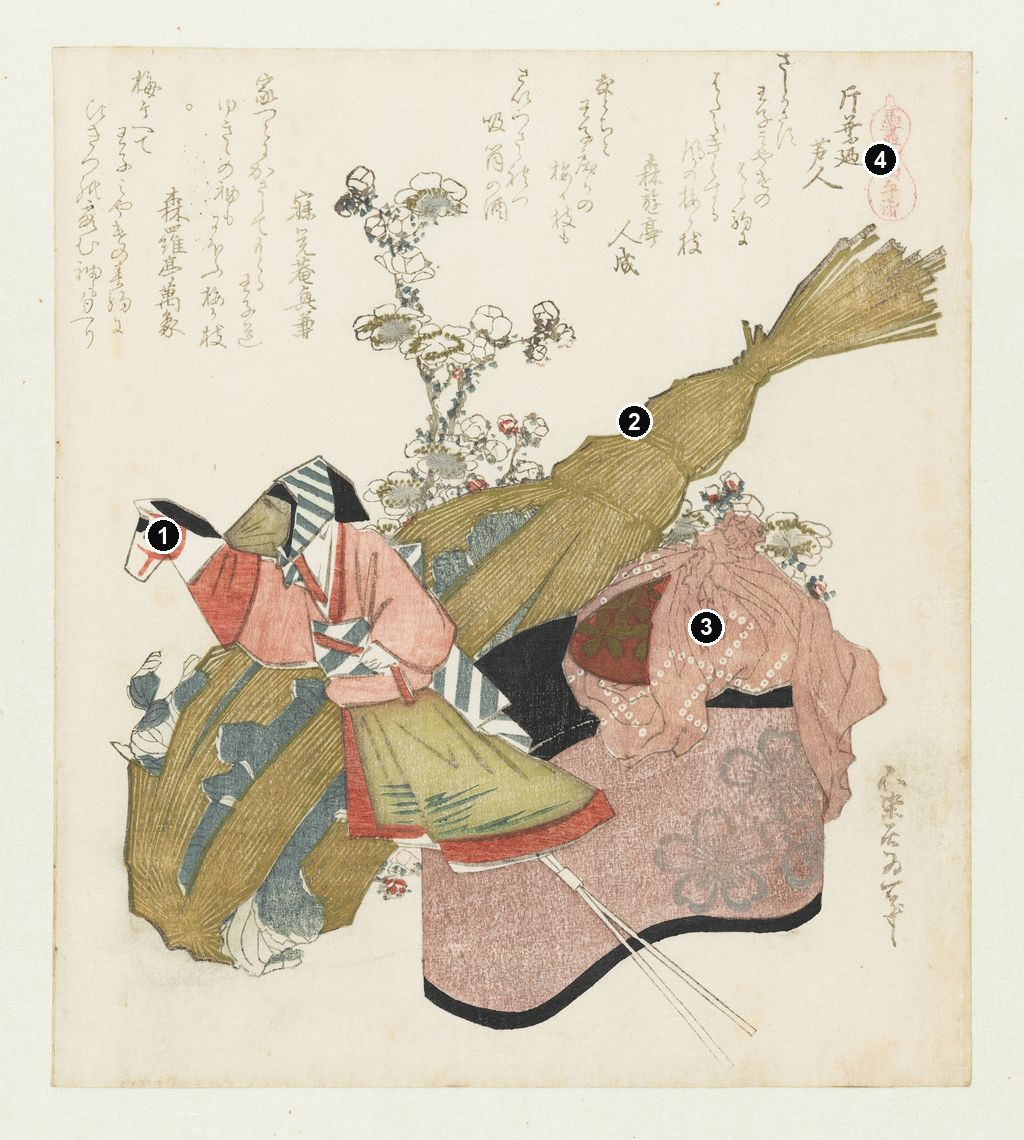
Details from SHRINE VISIT ON THE FIRST HORSE DAY OF THE SECOND MONTH
Select a detail to look closely.
The fox lifts a small horse head
The animal mask and the horse head bring the shrine object into the print. [1]
Pink cloth gathers above the sake vessel
The loose folds have a different outline from the firm straw wrapping. [1]
The title names the shrine visit
The cartouche puts the objects and verse in the context of the first Horse Day. [1]
Explore Hokusai’s works
Discussion
Look again at the images and ideas explored in A Hand Puppet by Katsushika Hokusai. These editorial prompts invite your observations.
Reader Insights
Which objects connect the print with the shrine visit?
Where do the puppet’s rods meet the lines of the straw wrapping?
Join the Conversation
Share a detail, comparison or question about A Hand Puppet by Katsushika Hokusai below.
References
- Rijksmuseum, Hatsuuma mairi, RP-P-1958-284. Object image, title and series, poets, print technique and dimensions. View source.
- Chiba City Museum of Art, Shrine Visit on the First Horse Day of the Second Month, from the series All Kinds of Horses, 2923076. Separate impression, date, format and dimensions. View source.
- Sumida Hokusai Museum, Umazukushi: Hatsuuma, Peter Morse Collection. Japanese catalogue essay on the New Year series, plum offerings and Ōji Inari shrine toy. View source.
- National Diet Library, Hatsuuma, curated collection narrative and examples published through Japan Search. View source.
- Rijksmuseum, Hobby Horse (Harugoma), RP-P-1958-291. Companion Hokusai print on New Year toys and the spring horse dance. View source.
- Library of Congress, The Floating World of Ukiyo-e, “Poetry, Narrative, and Surimono.” Museum exhibition essay on print commissions, poetry circles and distribution. View source.
- Chiba City Museum of Art, Chess-pieces, from the series All Kinds of Horses, 2933028. Companion Hokusai design with game pieces and flowers. View source.
- Wikimedia Commons, A hand puppet, a straw container and a sake containerwith cup. Digital reproduction of the design under the older descriptive title, without an impression accession. View source.







