


 by Tom Gurney
Tom Gurney BSc (Hons) is an art history expert with over 20 years experience
Published on June 19, 2020 / Updated on November 20, 2026
Email: tomgurney1@gmail.com / Phone: +44 7429 011000
Phoenix
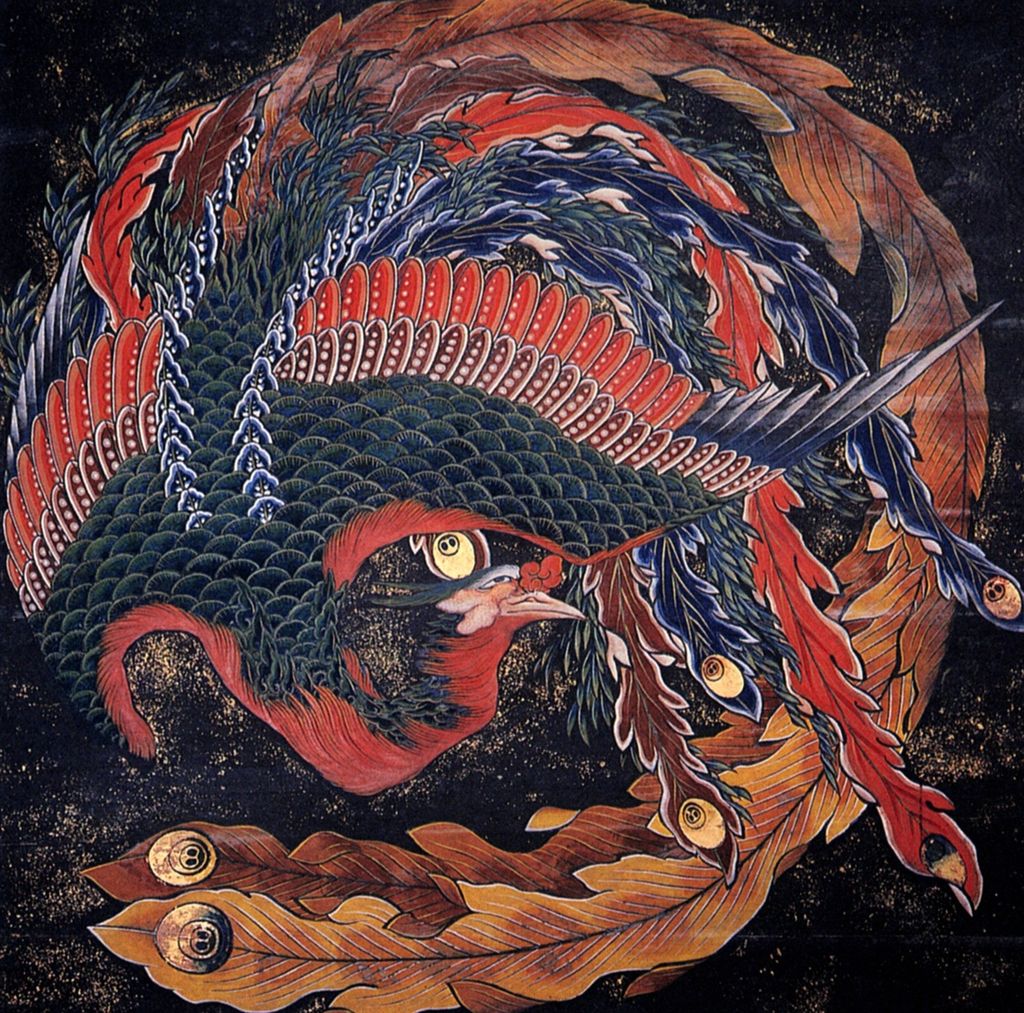
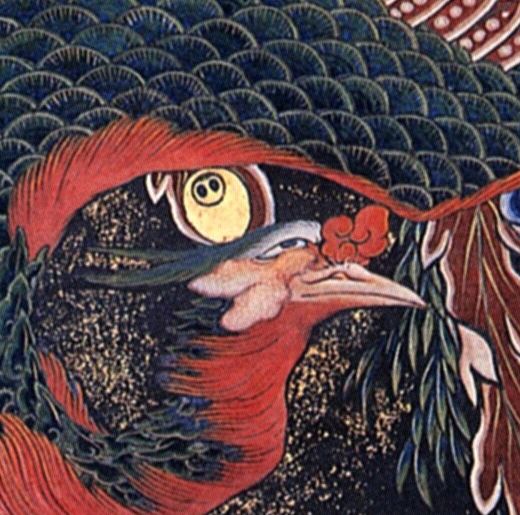
A yellow eye looks out from under the sweep of a wing in Katsushika Hokusai’s Phoenix. It sits below the middle of the painting, close to a pale beak and a bright red curve of plumage. Much of the bird spreads around that small face. Long feathers follow the upper and right edges, then turn back across the foot of the picture. The space around the bird is dark enough that some of its contours emerge gradually, while the eye is legible at a glance. The two effects make sense for a picture set into a ceiling, where a viewer might catch the eye first and only later follow the feather patterns. [1] [2]
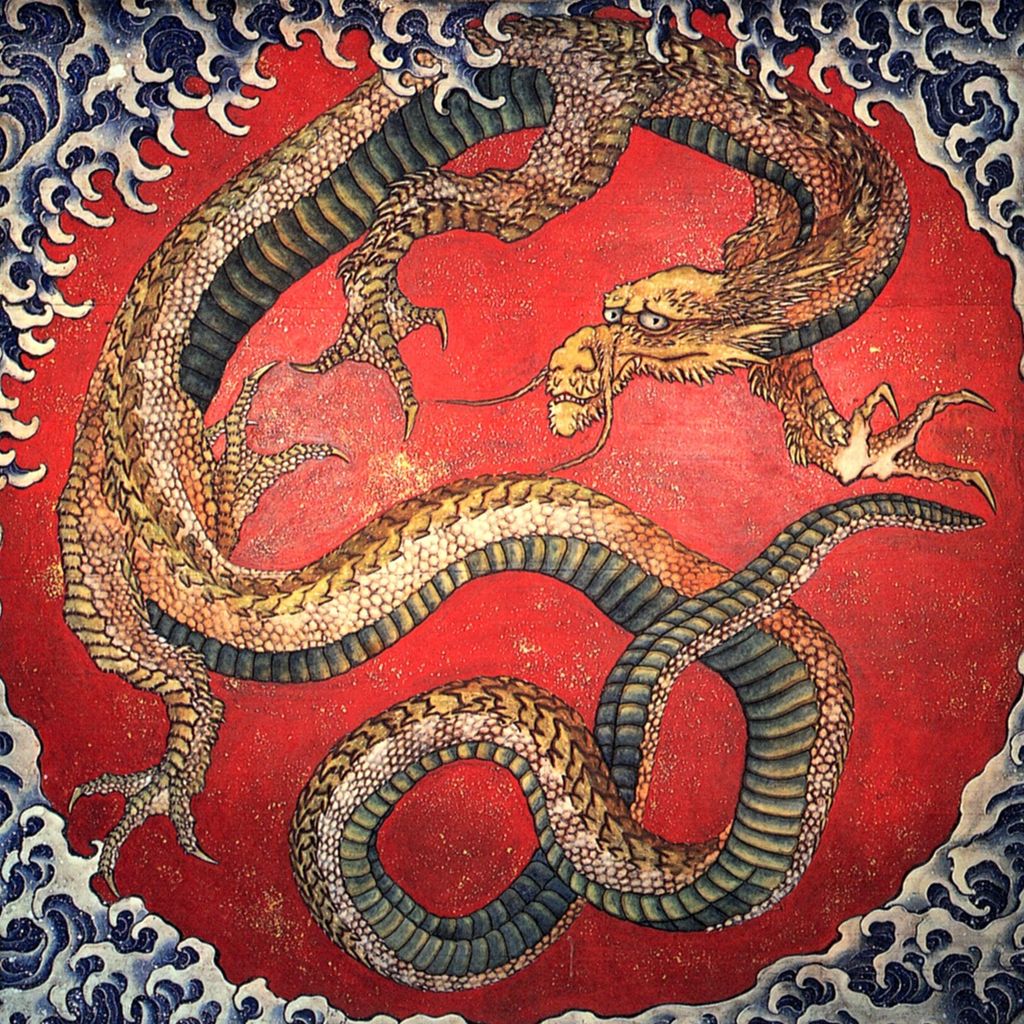
Hokusai painted this Phoenix in 1844 for the festival float of the Higashimachi neighbourhood in Obuse. The Nagano Prefectural Art Museum records it as colour on paulownia board and gives its dimensions as 123.0 by 126.5 centimetres. The Higashimachi Neighborhood Council owns it, and the Hokusai Museum in Obuse displays it on deposit. Its companion is the red-ground Dragon on the same float. The two paintings occupy ceilings on a structure made to travel through the town at festival time. [1] [2] [3]
At a Glance
- ArtistKatsushika Hokusai
- Date1844
- MediumColour on paulownia panel
- CommissionHigashimachi festival float
Contents
The eye under the wing
The head is easier to find once you see how far down the wing reaches. A broad band of rounded, overlapping feathers passes across the image like a lowered brow. Close to its lower contour, the yellow eye holds its place against the darker green and blue nearby. Red plumage rises around the head and curves under it, with a narrow interruption at the beak. That interruption matters. The beak points sideways, and its light edges give a direction to a head that might otherwise be lost in all the surrounding arcs. [1]
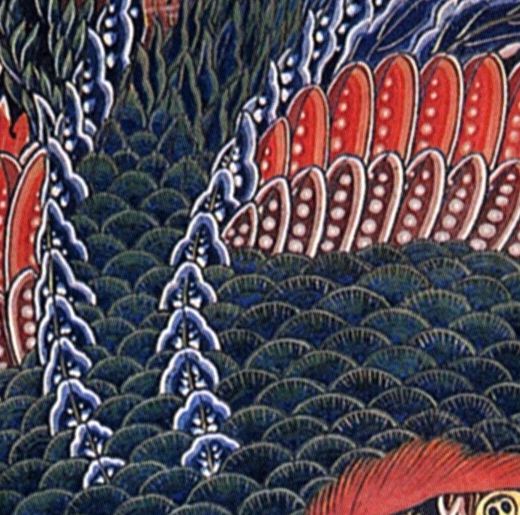
Follow the wing up from the bird’s head. Its larger feathers are arranged in a row, with rounded red tips and small pale markings that lend the row a series of short accents. The feather lengths change across the band. Towards the right, several narrow dark plumes angle out beyond the softer curves and cross brighter plumage behind them. The parallel tips converge visually even though each feather still has its own edge. Hokusai makes us see the wing as a single sweeping shape while leaving enough variation to follow the passage from one feather to the next. [1]
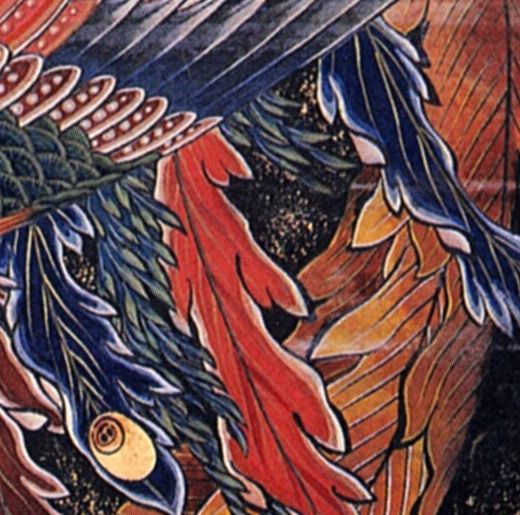
Above and below that band, the pattern changes again. Thin, wavering lines divide patches of green and blue, while broad orange feathers extend around the outside. Near the bottom, two of the bright plumes end in circular marks, their centres set against the dark space around them. These smaller circles answer the actual eye near the middle. Their presence makes the direction of the head especially important, since it is the beak and its red surround that give away which of these shining spots belongs to the face. The long feather shapes that carry the other circles help the eye turn back across the panel. [1]
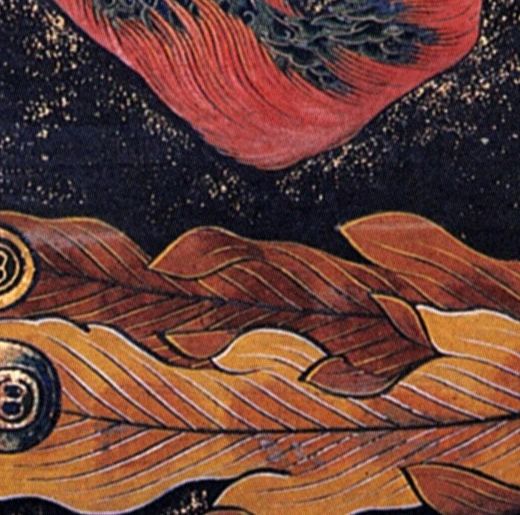
The dark field has room for flecks of lighter colour, visible in particular between the arcs around the bottom. They give the background some texture without interrupting the bird’s outline. The Hokusai Museum describes the painting as based on dark indigo, a description of the overall colour effect that helps explain the brightness of the red and orange passages. The Kyushu National Museum photograph also shows how much of the dark wing stays legible when pale lines pick out its divisions. The strongest contrasts occur in small areas, so the head and the details it is set among can hold together across the nearly square surface. [1] [2]
A ceiling on a moving float
The Higashimachi float predates the painting. According to the Hokusai Museum, records place its construction in 1806, and it is the oldest of the seven surviving festival floats in Obuse. Takai Kōzan commissioned Hokusai’s pair in response to local residents’ wishes. A record of the later digitisation project dates the alterations and commission to 1843, the year before Hokusai painted the two panels. Part of the ceiling was modified to accommodate them. The size and proportions of the painting belong to that setting, where the wood support had to fit a particular place within a larger structure. [2] [4]
The Sumida Hokusai Museum describes the Obuse floats processing through town during festivals. That use has consequences for what a person passing them could see. At a slant, the painted surface would look narrower, and parts of it could be obscured by the structure around it. With a change of position, the sweep of the plumage and the eye might come into view in a different order. An upright photograph allows a steady, single view. The arrangement of the bird makes more sense if you also imagine seeing it in portions, with no broad landscape or horizon to settle the angle from which you should look. [1] [4] [5]
The picture also changes a little from one reproduction to another. The Kyushu exhibition photograph gives the long plumes across the bottom a very bright yellow. In the image released for the float digitisation, similar yellow and orange shapes are less bright, and the shade beside them shows more brown. The lines that divide the feather tips and the direction of the crossing plumes stay clear in both. Those are details a reader can use to trace the bird across photographs without assuming that the colour on screen is exactly what a viewer would see in the float. [1] [4]
The two ceilings bring different colour conditions into the same float. The Hokusai Museum interprets the Dragon’s fiery red ground and the Phoenix’s dark indigo field in light of the Chinese idea of yin and yang. In the Phoenix, the red is largely carried by the bird, where the head and rows of feathers punctuate the darkness. Its companion distributes that colour over a much broader area. Looking from one panel to the other reveals what the background contributes to each. For the Phoenix, the dark space makes it possible to keep the head tiny without losing its expression among feathers more than capable of drawing the eye away. [1] [2]
A bird associated with peace
The bird’s Japanese name is hōō (鳳凰), the name used in Japan for the auspicious creature known in China as the fenghuang. The Hokusai Museum describes it as a sign of peace and good fortune in East Asian tradition. That context suits the neighbourhood’s commission, which brought auspicious subjects into the decoration of a shared festival object. It also helps explain why the pairing with the Dragon mattered beyond the immediate effect of red and indigo. Both creatures recur in Hokusai’s work, and the float gave him a chance to set them in relation to one another on neighbouring surfaces. [2] [6] [7]
Hokusai worked in many painted and printed formats. The float panel gave him a surface larger than the paper sheets on which his best-known prints circulated and a different way of bringing the image before the public. On the float, the painted bird’s changing scale is particularly striking. The whole design makes a bold mass in the ceiling, yet its effect depends on repeated small decisions, including where to stop a pale border or where to leave a strip of dark ground between two colours. The Sumida Hokusai Museum brought the Phoenix to Tokyo for its Visual Magic exhibition in 2019–20 and reproduced both the full painting and a detail. Those two views show how much of the design remains visible even when you can see only a fraction of it. [1] [3] [5]
The later phoenix at Ganshōin
Hokusai returned to the bird in another ceiling painting at Ganshōin, also in Obuse. The temple painting, commonly called Phoenix Glaring in All Directions, dates to 1848 according to Obuse’s tourism association. It was made for the ceiling of the temple’s main hall. The Nagano Prefectural Art Museum has listed a surviving master drawing for that later ceiling as a separate object, dated about 1846. The preparatory drawing belongs to the temple commission. The two completed ceilings are four years apart. [8] [9]
The temple image retains the rounded body and the long feathers that curve around it, but the relationship of dark and bright areas changes. In the digitisation reproduced by NTT East, a head with a red throat and pale facial markings sits amid spreading bands of blue, green and orange. The comparatively light ground is visible in broad gaps that separate the ends of the plumage. The circle marks on several of the feathers stand out at different distances from the head. Where the float painting lets the field close in tightly around a few bright details, the larger composition uses those gaps to spread the bird’s presence across the ceiling. [1] [10]
Seen together, the two works clarify Hokusai’s choices for the smaller surface. The Higashimachi Phoenix stays concentrated almost to its edges. From the red tips at the top of the wing to the bright curves low in the field, the feather patterns continually lead back across the image. As the view changes below the float, a catching point in the dark remains that small eye under the wing. Its place among so many larger shapes is one of the reasons the panel can feel animated even in a stationary photograph. [1] [2] [10]
Where this work sits in Hokusai’s career
Phoenix
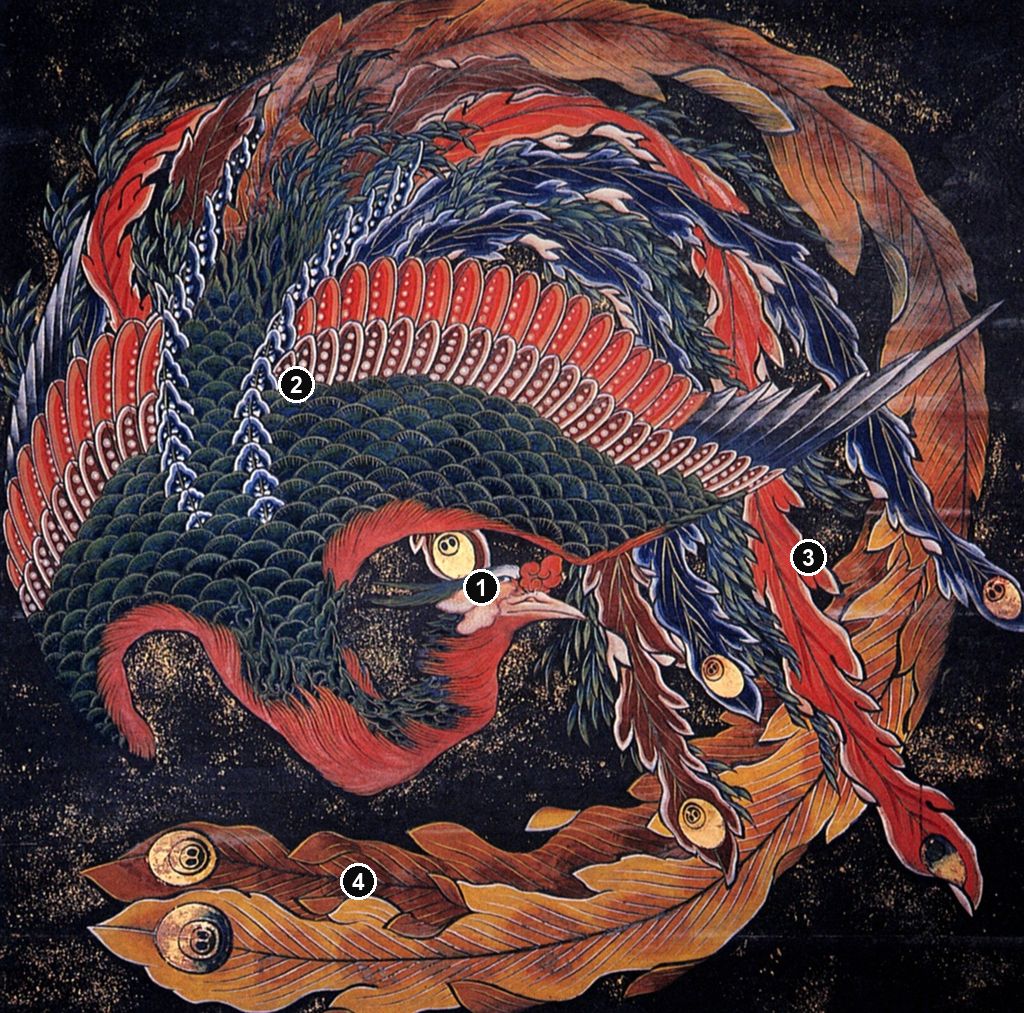
1844Annotated Details from Phoenix
Hokusai Museum, Obuse. Reproduction via Visipix and Wikimedia Commons. [1]
Details from PHOENIX
Select a detail to look closely.
The head looks out from the plumage
The eye picks out the turn of the head against dark feathers. The red curve beneath it gives the smaller form a distinct edge. [1]
Layered rows of wing feathers
Feathers gather into bands that follow the wing’s curve. Repeated dark and red passages make each layer readable against the next. [1]
Long feathers turn down at the side
Slender strokes extend outward and then curve towards the lower edge. Their length connects the compact centre to the surround. [1]
The plumage carries the eye along the base
Warmer shapes sweep under the body. Eye-like forms punctuate the feather tips and slow the rhythm of the curves. [1]
Explore Hokusai’s works
Discussion
Look again at the images and ideas explored in Phoenix. These editorial prompts invite your observations.
Reader Insights
Where do the wings and tail guide your eye?
How does the dark ground change your reading of the plumage?
Join the Conversation
Share a detail, comparison or question about Phoenix below.
References
- Kyushu National Museum, Hokusai, exhibition record and photograph of the Higashimachi Phoenix, 1844, from the Higashimachi Neighborhood Council, Obuse. View source.
- Hokusai Museum, Obuse, Higashimachi Festival Float (東町祭屋台), history of the float and the paired panels. View source.
- Nagano Prefectural Art Museum, exhibition report for Katsushika Hokusai and Three Shinano Regions, chap. 1, no. 3, support, dimensions and ownership of the Higashimachi Phoenix. View source.
- NTT East and NTT ArtTechnology, report on the high-definition digitisation of the Higashimachi and Kanmachi floats, 25 September 2023, §1(1). View source.
- Sumida Hokusai Museum, Visual Magic: Exhibition of Masterpieces from Hokusai Museum, Obuse, exhibition release, p. 2, panel photographs and original display context. View source.
- Hokusai Museum, Obuse, 北斎が小布施に残した傑作 天舞う龍と鳳凰, museum introduction to the dragon and phoenix motifs and the two Obuse phoenixes. View source.
- National Diet Library, Japan Search, Holy Beasts and Mythical Creatures, curatorial overview of the auspicious East Asian phoenix motif. View source.
- Obuse Tourism Association, Ganshoin Temple, local record of the temple ceiling and its 1848 date. View source.
- Nagano Prefectural Art Museum, exhibition list documenting Hokusai’s master drawing for the Ganshōin ceiling. View source.
- NTT East and the Hokusai Museum, Obuse, Digital × Hokusai: A Genuine Painter, exhibition record and photograph of the Ganshōin painting, courtesy of Ganshōin Temple. View source.









