


 by Tom Gurney
Tom Gurney BSc (Hons) is an art history expert with over 20 years experience
Published on June 19, 2020 / Updated on November 20, 2026
Email: tomgurney1@gmail.com / Phone: +44 7429 011000
Nakahara in Sagami Province
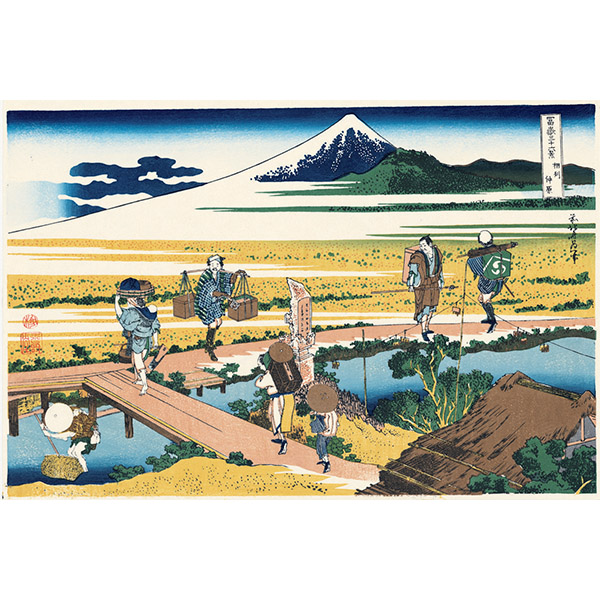
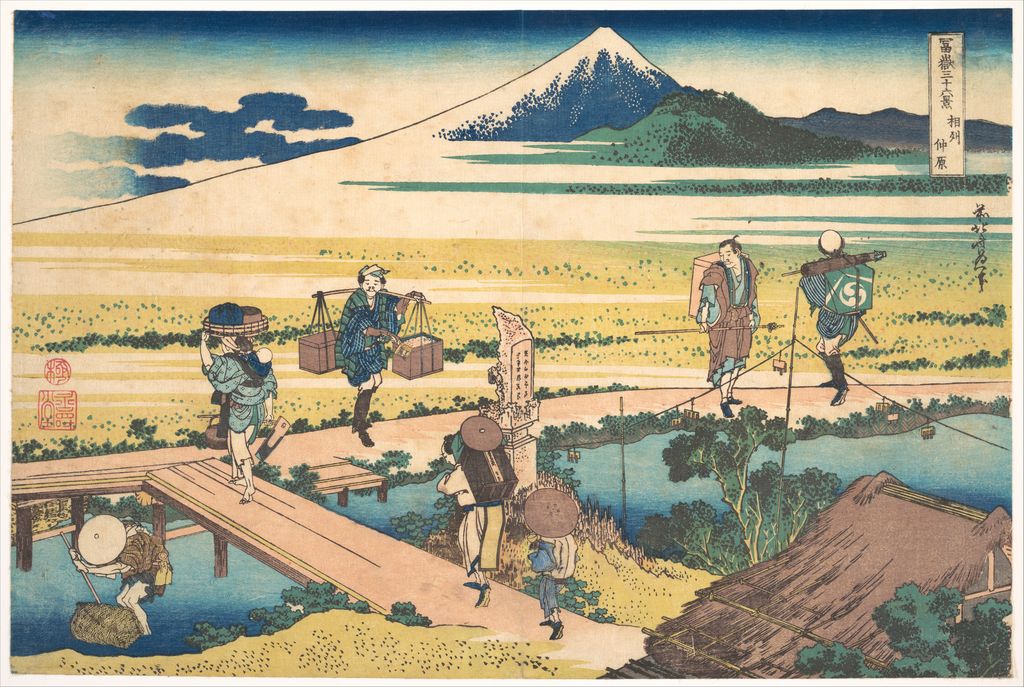
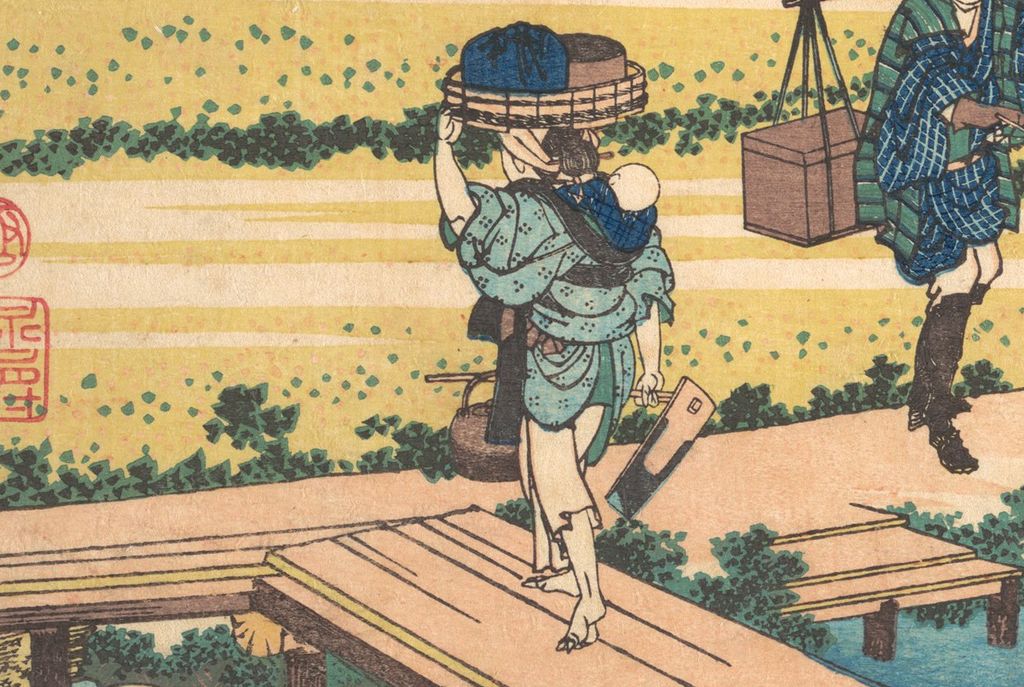
A woman is crossing a plank bridge in Katsushika Hokusai’s Nakahara in Sagami Province. A round container rests on her head, and a child looks out over her shoulder. Below the planks, a person stoops over the water. More people approach from either side, carrying bundles, baskets and a small shrine. The scene opens behind them into fields, with Mount Fuji rising beyond. The mountain is easy to see from the moment we look at the print. It takes longer to see how many lives have converged at the crossing. [1] [2]
The Japanese title, 相州仲原 (Sōshū Nakahara), puts the design in the former province of Sagami, at Nakahara in present-day Hiratsuka, Kanagawa Prefecture. The Metropolitan Museum of Art dates its impression, JP2978, to about 1830–32. It is a colour woodblock print on paper measuring 25.4 by 38.1 centimetres. The Chiba City Museum of Art dates its own impression to about 1831–33 and places the design among the ten added after the initial thirty-six in Thirty-six Views of Mount Fuji. Those catalogues tell us where the crossing belongs in the series and give us two physical sheets through which to study it. [1] [2]
At a Glance
- ArtistKatsushika Hokusai
- Dateca. 1830–32 (Met JP2978)
- MediumColour woodblock print
- SeriesThirty-six Views of Mount Fuji
Contents
Where the road crosses the stream
In JP2978 the bridge runs diagonally down from the far left towards the right-hand foreground. Its pale planks narrow as they approach the path on the opposite bank. The bend in the route is easier to see if you follow the outer edge of the bridge to where it meets the almost horizontal road. A line along that road directs the eye towards the approaching travellers on the right. Hokusai lifts the viewpoint enough for us to see the deck above the stream and still make out the activity below. [1] [2]
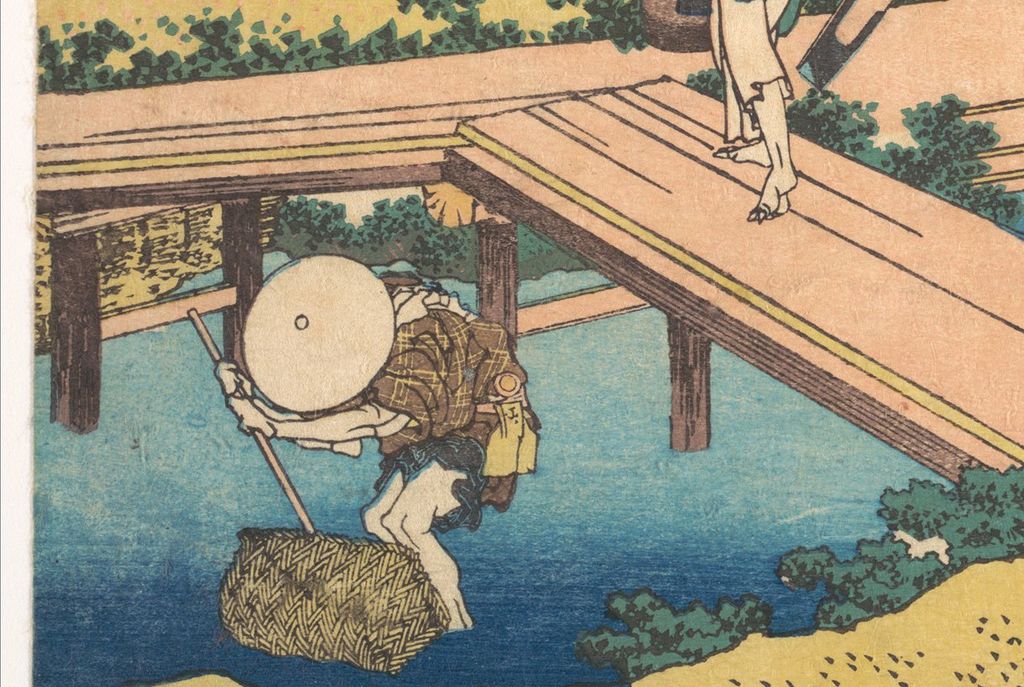
The water does not simply run along the lower edge of the sheet. It opens into a broad blue patch beyond the near end of the bridge and appears again between the dark supports at left. The fisherman’s low posture gives that smaller opening a human scale. His rounded hat is close to the deck while his arms reach towards the water. The Tokyo Fuji Art Museum describes him scooping with a net. Above him the woman is upright, with her clothing and the things she carries breaking the clean angle of the planks. Our eye can move down from the bridge to the fisherman in a few millimetres, a change in height that Hokusai makes feel substantial. [1] [3]
At the lower right, a thatched roof interrupts the view of the bank. The Cleveland Museum of Art identifies it as the roof of a shrine, and Chiba describes the back of a stone figure beside the road, possibly Jizō or a guardian of travellers. The roof and sculpture belong to the human space of the picture. Neither needs to be as conspicuous as Fuji to shape the way we look. The dark roof keeps attention close to the foreground, while the long line of the bridge draws it back towards the people gathering at the turn. [1] [2] [4]
The people who meet here
The round load above the woman’s head is only part of what she carries. Chiba identifies a kettle hanging from her hoe as well as the baby on her back. The smaller head becomes visible behind her own once you know where to look. Hokusai has set the two faces close together beneath the wide rim of the container. Keeping an eye on that group makes it easier to see how the objects are balanced across her body. The little arcs marking a handle or rim have as much to tell us about the act of crossing as the position of her feet. [1] [2]
Across the stream, one man balances a pair of containers at the ends of a pole. The hanging lines put weight at either end while the figure himself stands at the centre. The Chiba catalogue describes this figure as an itinerant seller serving people on pilgrimage. Farther right, a traveller carries a large wrapped load marked with a conspicuous emblem. Chiba reads him as a cloth merchant and identifies the neighbouring figure as a mountain ascetic. Each interpretation starts from objects we can see, including the marked wrapping and the equipment of the men on the road. Seen together, the objects suggest why people with such different loads would use the same crossing. [1] [2]
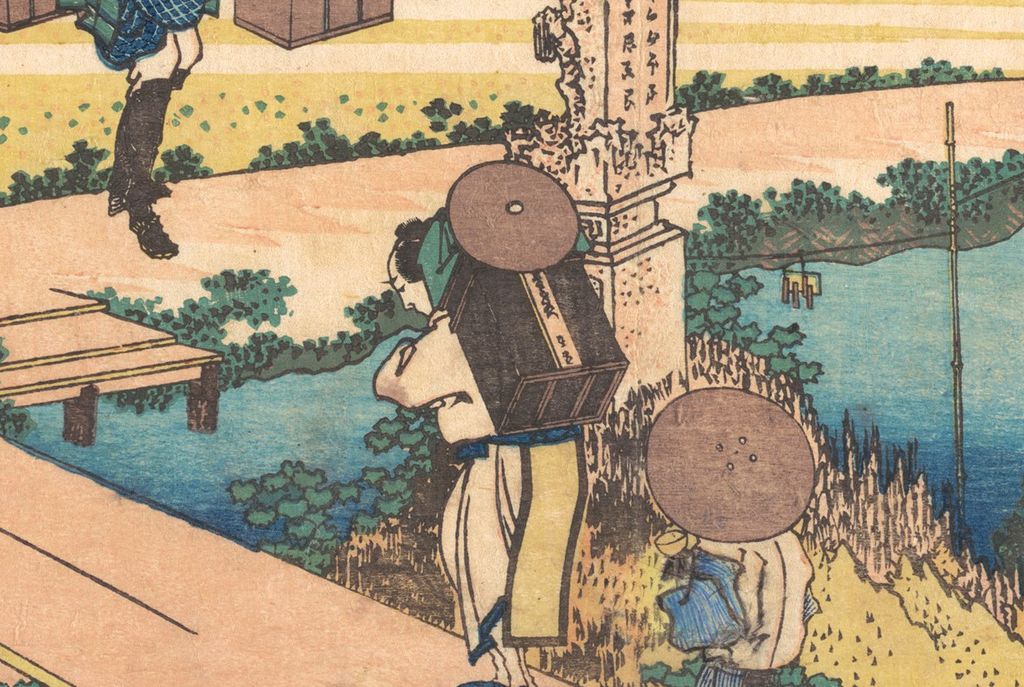
The small group seen from behind near the lower centre takes a little longer to read. One traveller carries a tall object secured against the back, which Chiba identifies as a portable shrine. The accompanying figure carries a small gong or bell. Chiba associates this group with the rokujūrokubu, a pilgrimage traditionally understood as offering a copy of the Lotus Sutra at a sacred site in each of Japan’s sixty-six old provinces. The National Museum of Japanese History explains that meaning in its catalogue of a text about the pilgrimage, and the Tokushima Prefectural Museum documents a surviving box carried on such a journey in 1728. The box and bell in the print make the catalogue’s reading of the group intelligible, even though we cannot trace where these particular walkers are going. [1] [2] [5] [6]
The Tokyo Fuji Art Museum places the wider road scene in the context of pilgrimage to Mount Ōyama and identifies the lower mountain in front of Fuji as Ōyama itself. Hiratsuka’s municipal history describes the network of routes by which visitors approached that popular destination in the Edo period. These accounts help explain the mix of people along a short stretch of road. Hokusai places someone engaged in fishing within sight of a group carrying religious equipment, and both are within a few steps of people bringing goods along the route. The distant landmark gives a scale to the plain while the crossing gives space to the various reasons someone might have for moving through it. [1] [3] [7]
The fields beneath Fuji
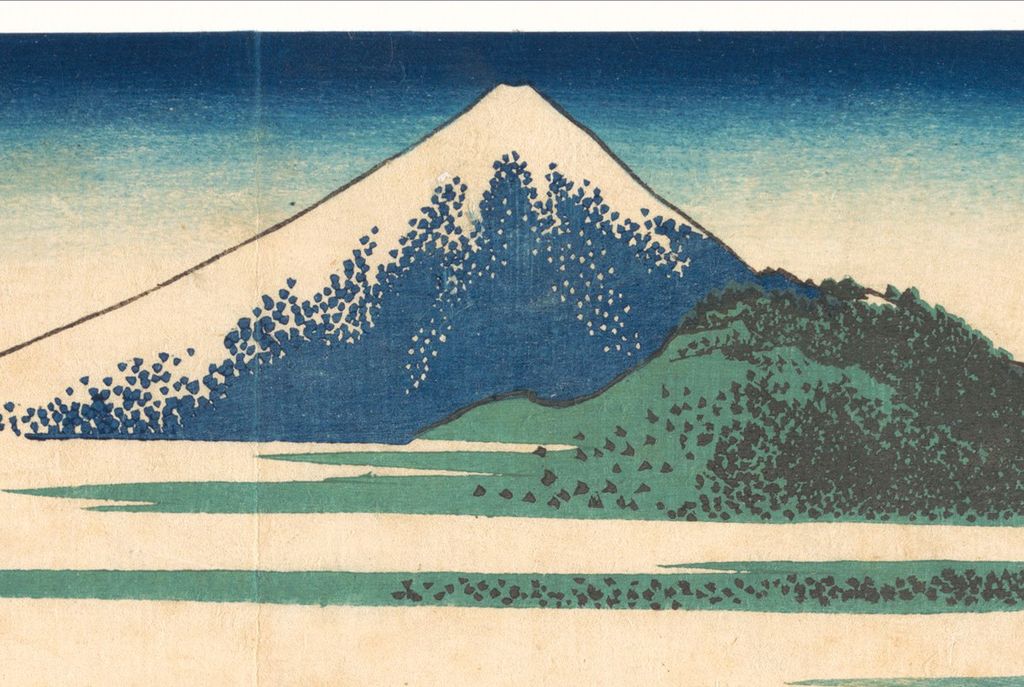
The mountain begins as a fine, ascending line at the far left. It moves across a stretch of sky and passes behind a group of dark clouds. The summit comes to a point a little right of centre. From there the far side drops towards a nearer, darker ridge. Across the plain, bands of green and lighter colour narrow to long strips. They make the foot of the mountain appear far away, even though only a short space on the paper separates it from the busy road. [1]
Look back at the clouds after following the mountain’s outline. Their short, rounded forms cut across its long slope while the elongated bands at the base of the mountain lead in the other direction. The lower stretch of road follows that second, flatter rhythm until it reaches the bridge. In other words, the change of direction that makes the foreground route feel so clear has already been prepared higher in the print. It is as possible to start with that exchange between diagonals and level lines as it is to start with the people. Either way, the gaze eventually crosses the stream. [1]
The arrangement is distinctive within the series. In The Coast of Nobuto, Hokusai uses the uprights and lintel of a torii gate to frame the view over a tidal shore, where people gather shellfish. At Nakahara the bridge sits much lower and stays open to the sky. It shapes the route taken by the figures without interrupting the outline of Fuji. Compare where the busiest group occurs in each print. At Nobuto it clusters beside and below the gate, and at Nakahara people are distributed along the road, onto the planks and down into the water. [1] [2] [8]
The travellers in Ejiri in Suruga Province offer another comparison. There, wind bends the trees and blows paper into the sky, giving the figures a shared event to react to. At Nakahara their actions remain independent. The passer-by near the fisherman keeps her load balanced, while the two people on the far road can pass at their own pace. The crossing brings those different speeds within sight of one another. [1] [9]
Looking across impressions
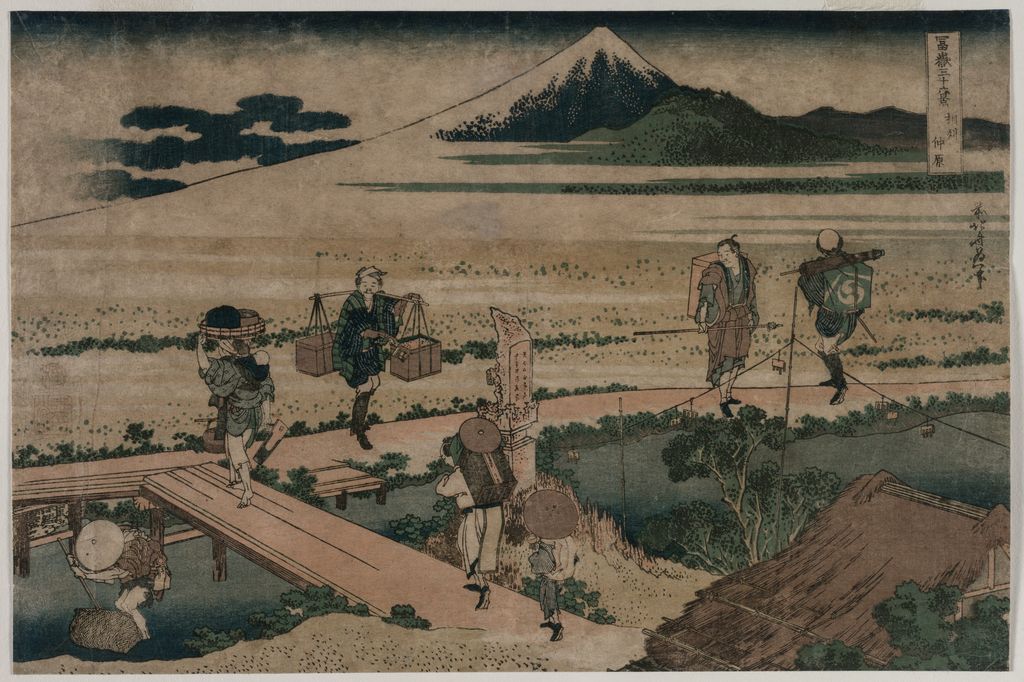
The Cleveland Museum of Art’s 1940.997 impression preserves the same narrow summit, dark clouds to its left and road full of people below. In the Met photograph the field comes forward in long, warm yellow bands, and the blue under the bridge looks especially clear. In the Cleveland reproduction the field is greyer, its pale bands closer in tone to the sky. The transition between the colours is gentler there, and the bridge and the outline of the road stand out more readily than the open field. The two red marks on the left side of the Met photograph are absent from the Cleveland reproduction. Those are details of the sheets and their presentation that would be easy to miss if we used the two photographs interchangeably. [1] [4]
Cleveland dates its impression to about 1835 and measures it at 25.1 by 37.8 centimetres. The Met gives the earlier range of about 1830–32, and the Chiba catalogue treats its sheet as part of the later group within the series. Chiba calls that group ura-Fuji and notes the use of black ink for the key block, the block that prints the principal outlines. The catalogue dates and the colours of the photographs do not in themselves establish the order in which these particular sheets were printed. For comparison, the most reliable starting point is the same contour on each sheet. The summit, the characteristic clouds and the diagonal planks can all be located even when the surrounding tones differ. [1] [2] [4]
Where this work sits in Hokusai’s career
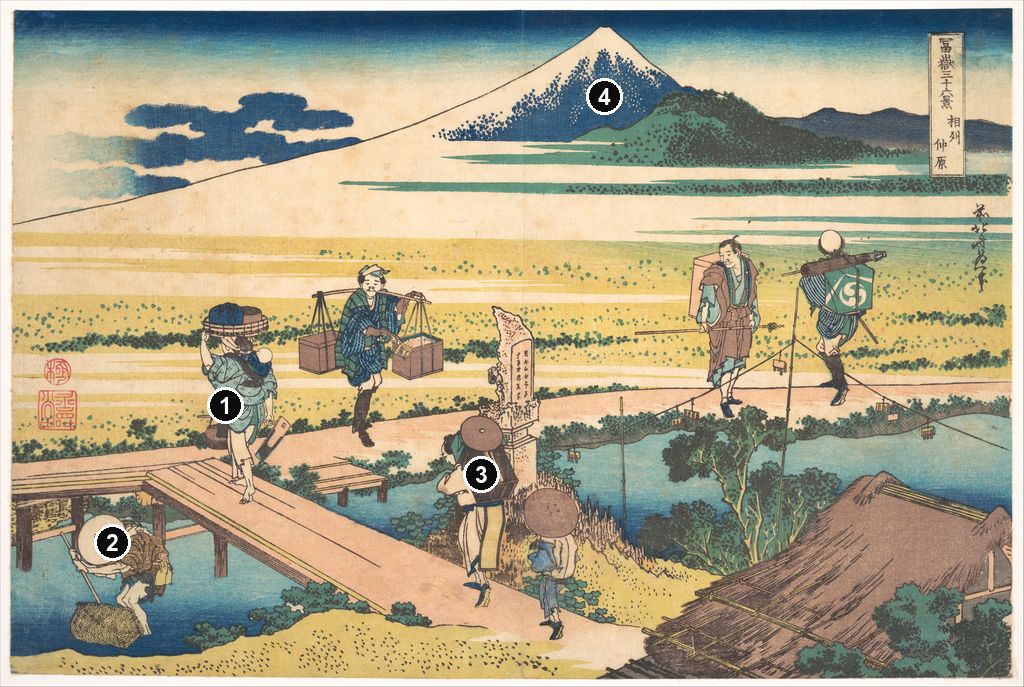
Annotated Details from Nakahara in Sagami Province
The Metropolitan Museum of Art, JP2978. [1]
Details from NAKAHARA IN SAGAMI PROVINCE
Select a detail to look closely.
A traveller steps onto the crossing
The figure’s tilted body and load are legible in a few short lines. The crossing forms a slant that leads towards the other walkers. [1]
A fisher below the bridge
One person remains close to the water while others cross above. This change in height makes the foreground a scene of several different activities. [1]
A figure carries a small shrine
The shrine identified in Chiba’s catalogue rises behind the person’s head. Its outline helps separate the carrier from the other figures moving nearby. [1]
Fuji rises among horizontal bands
The pointed peak emerges behind the long clouds. Its short slopes stand out against the repeated strips of colour across the sky and fields. [1]
Explore Hokusai’s works
Discussion
Look again at the images and ideas explored in Nakahara in Sagami Province. These editorial prompts invite your observations.
Reader Insights
Which journeys cross paths beside the river?
What helps you pick out individual figures at this small scale?
Join the Conversation
Share a detail, comparison or question about Nakahara in Sagami Province below.
References
- The Metropolitan Museum of Art, Nakahara in Sagami Province (Sōshū Nakahara), JP2978, collection record and photograph. View source.
- Chiba City Museum of Art, Nakahara in Sagami Province, from the series Thirty-six Views of Mt. Fuji, 2903021, Japanese and English object commentary. View source.
- Tokyo Fuji Art Museum, Thirty-six Views of Mount Fuji: Nakahara in Sagami Province, 06199, Japanese object commentary. View source.
- Cleveland Museum of Art, Nakahara in Sagami Province from Thirty-six Views of Mount Fuji, 1940.997, object record and photograph. View source.
- National Museum of Japanese History, Rokujūrokubu engi (六十六部縁起), H-1761, collection record. View source.
- Tokushima Prefectural Museum, A carrying box for the pilgrimage of the sixty-six provinces (六十六部廻国巡礼の笈), object commentary. View source.
- City of Hiratsuka, All Roads Lead to Mount Ōyama (すべての道は大山に通ず), local history series, no. 5. View source.
- The Metropolitan Museum of Art, The Coast of Nobuto (Nobuto ura), JP2958, collection record and photograph. View source.
- The Metropolitan Museum of Art, Ejiri in Suruga Province (Sunshū Ejiri), JP12, collection record and photograph. View source.







