


 by Tom Gurney
Tom Gurney BSc (Hons) is an art history expert with over 20 years experience
Published on June 19, 2020 / Updated on November 20, 2026
Email: tomgurney1@gmail.com / Phone: +44 7429 011000
Viewing Sunset over Ryōgoku Bridge from the Onmaya Embankment
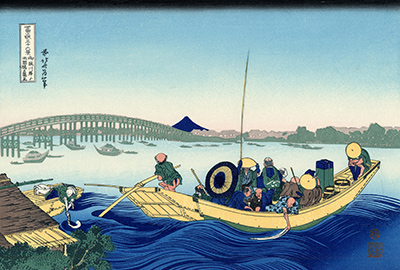
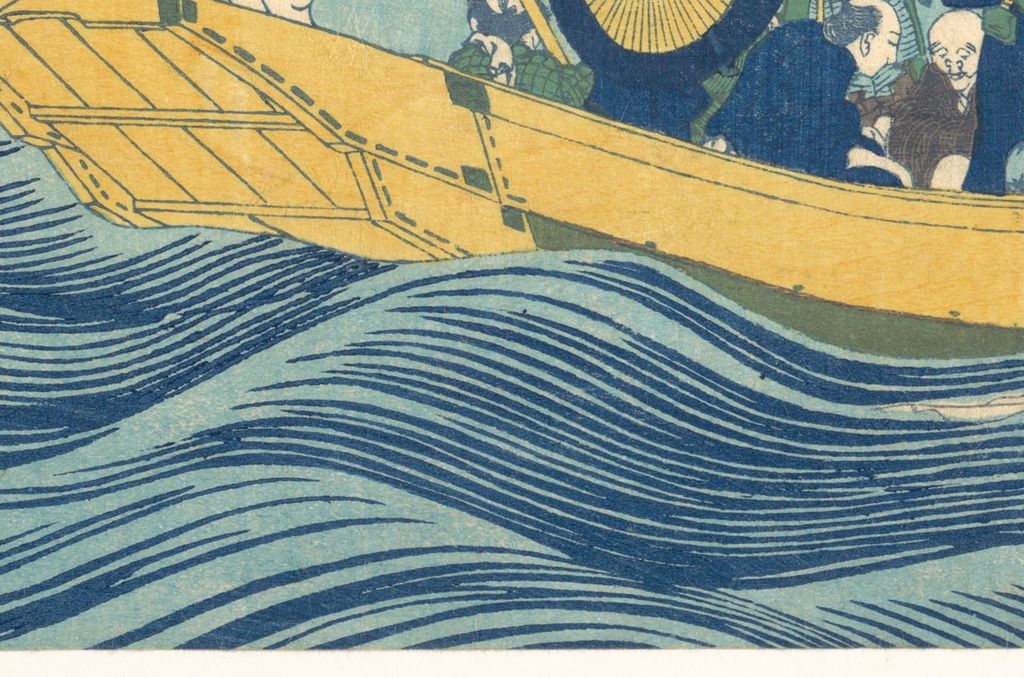
A ferry rides low in the Sumida River, its long yellow side following the swell of the water. The passengers sit close together among hats, bundles and an umbrella. Behind them Ryōgoku Bridge crosses the print in a low, dark arc. Fuji rises just beyond the point where the bridge meets the town, and a narrow pole carried by one passenger reaches into the empty sky. Katsushika Hokusai gives the smallest things in this evening view unusually clear outlines. The ferry and its passengers hold our attention long enough for the distant bridge and mountain to come into focus. [1]
The Metropolitan Museum of Art dates its impression JP2997 to about 1830–31. The colour woodblock print measures 24.4 by 37.5 centimetres. Its title cartouche names the view from Onmayagashi, or the Onmaya Embankment, towards Ryōgoku Bridge. A separate impression in the Iuchi Collection appeared as item 33 in the National Museum of Western Art’s exhibition checklist. The checklist gives the Japanese title as 御廐川岸より両国橋夕陽見, using a different written form of the character for a stable from the Met’s 御厩. The same design belongs to Thirty-six Views of Mount Fuji, where Fuji can take up anything from a broad sweep of colour to a small triangle above a roofline. [1] [2]
At a Glance
- ArtistKatsushika Hokusai
- Dateca. 1830–32
- MediumColour woodblock print
- SeriesThirty-six Views of Mount Fuji
Contents
The ferry crossing and the bridge downstream
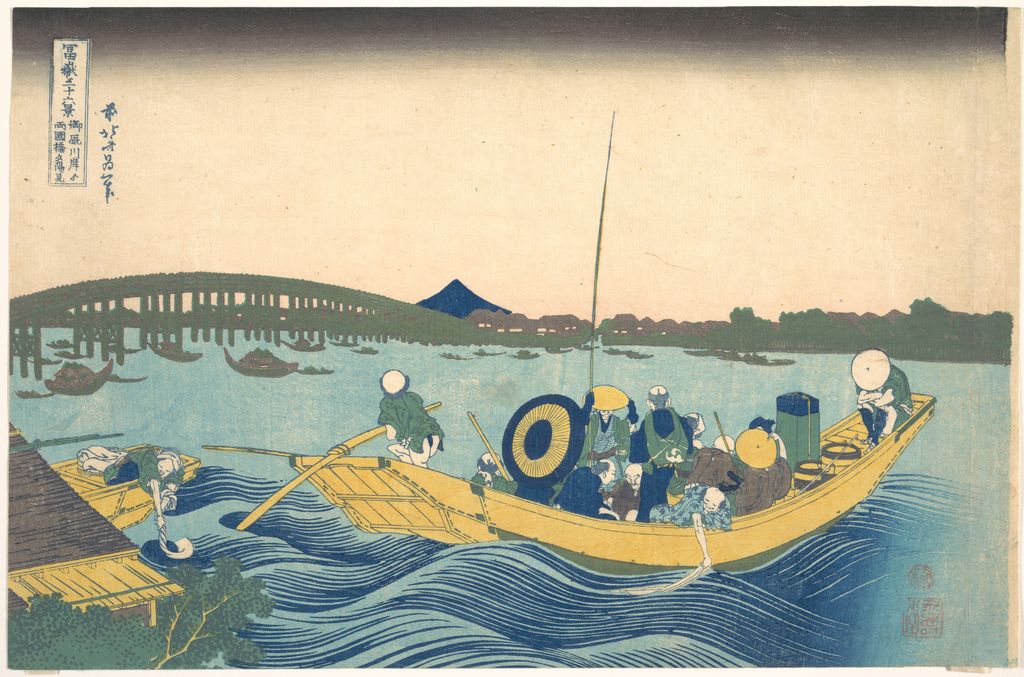
Onmaya was the name associated with the shogunate’s former stables on the west bank, north of Ryōgoku Bridge. The Sumida Hokusai Museum places the ferry landing near present-day Kuramae in Taitō and identifies its other landing across the river near Yokoami in Sumida. The Museum of Fine Arts, Boston, notes that the Onmaya ferry was also known as the Fuji View Ferry, a name explained by the mountain’s visibility from the crossing on clear days. The craft filling the foreground is that ferry. The large bridge towards the left is Ryōgoku, downstream from the crossing. [3] [4]
Hokusai gives the boat enough width for the viewer to see both its side and something of what is inside. The projecting end at left exposes the long edges of the boards. A large oar angles across them and dips into the water. The boatman bends towards it, his head turned to the side. At the other end the hull rises, and a seated figure bows under a round hat. The spacing of these two figures makes the crowded stretch between them look close and sheltered. The curved line of the boat’s lower edge keeps nearly all of the passengers inside a single broad shape. [1]
Smaller boats help establish the scale of the crossing. At the lower left, beside a sloping roof cut by the edge of the print, a woman bends from a smaller craft. The MFA identifies her action as washing. One of the ferry passengers lets a pale length of cloth trail over the side, repeating the action at another scale. Farther away, several boats register as little dark forms below the bridge. The openings between its supports let pieces of the water show through. This arrangement gives the viewer several distances to cross before reaching the skyline. [1] [4]
Hats, a long pole and the work of the crossing
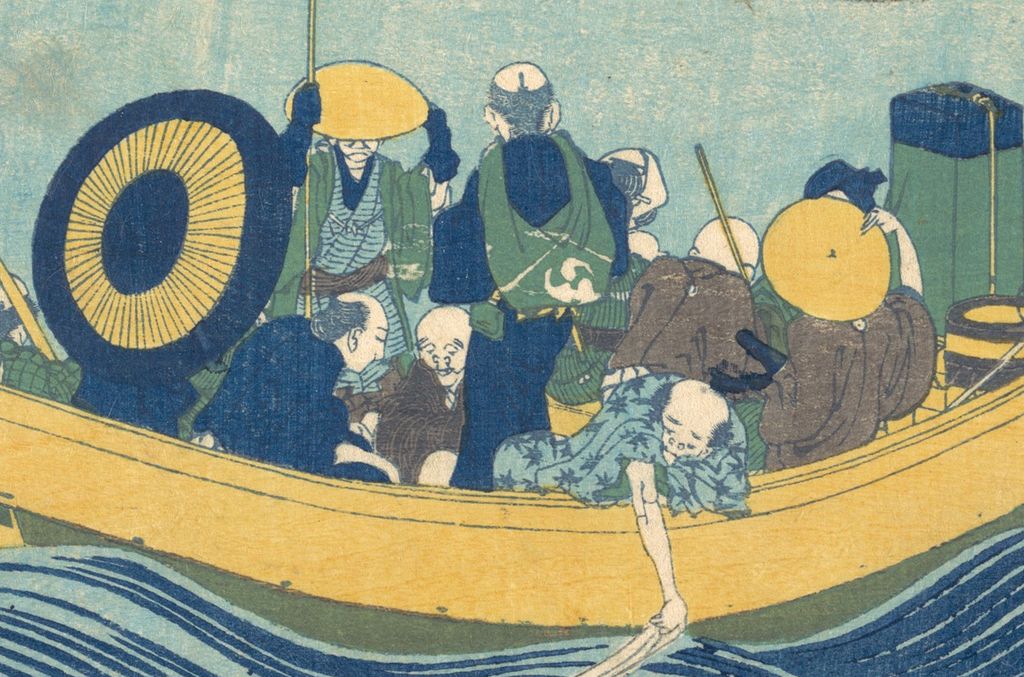
The people on the ferry are close enough for Hokusai to differentiate their clothes and postures. The Met sees a mixture of merchants, monks and a bird catcher. It identifies the latter by the long rod that extends from the group near the middle. The MFA catalogue suggests that the same pole might belong to a fisherman. Its slender shape is clear enough to follow almost to the upper band of the sky, but the picture gives little certainty about its owner’s occupation. The pole still tells us something plain about his task on the boat. While those around him hunch or turn, he must hold it clear of them. [1] [4]
Look at the circle beside the pole. Its blue centre and rim surround a yellow ring of fine radial lines. The spokes are easy to pick out even though the umbrella is crowded in among the passengers. Nearby, several broad hats hide parts of the faces beneath them. The changes of angle do much of the descriptive work. A face turned in at the centre fills a small opening between dark shapes. At right a yellow hat is tilted towards the inside of the boat. Hokusai uses those little differences to turn the ferry into a group of people sharing a crossing, each occupied in a different way. [1]
The upright pack and the smaller circular containers near the raised end are more simply described than the clothing of the passengers. Their straight edges and ellipses provide steady shapes beside the bent backs. The MFA identifies a publisher’s mark on a passenger’s pack in the impression it discusses. Such a mark can sit comfortably among the believable objects of travel while pointing beyond the scene to the trade that made the print. It rewards close viewing in much the same way as the quiet gestures of the passengers do. [1] [4]
Keio University’s Takahashi Collection holds another impression. Its catalogue names Nishimuraya Yohachi as publisher and transcribes the signature as 前北斎為一筆, in which the artist uses the name Iitsu and identifies himself as formerly Hokusai. The separate lines at the upper left of JP2997 show where the information belongs in the composition. The title is packed inside a tall rectangle. The more freely spaced signature stands alongside it over the light part of the sky. Both are conspicuous from close up, but they take up little room above the bridge. The reader can move between a design identified in writing and a view that describes its place through boats, buildings and distance. [1] [8]
A bridge in silhouette and the last light
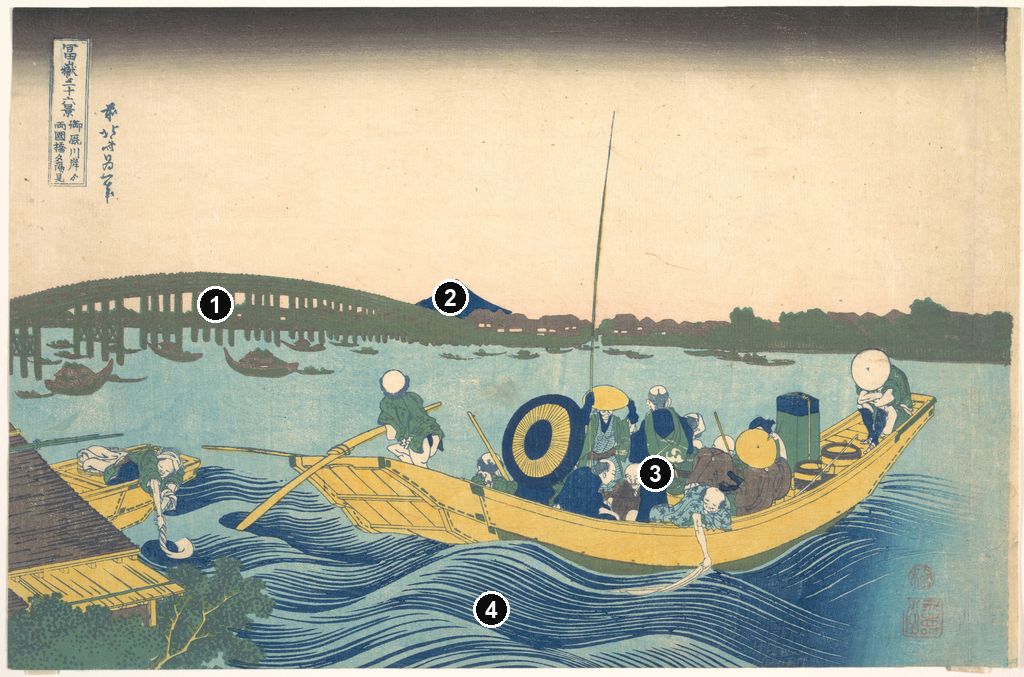
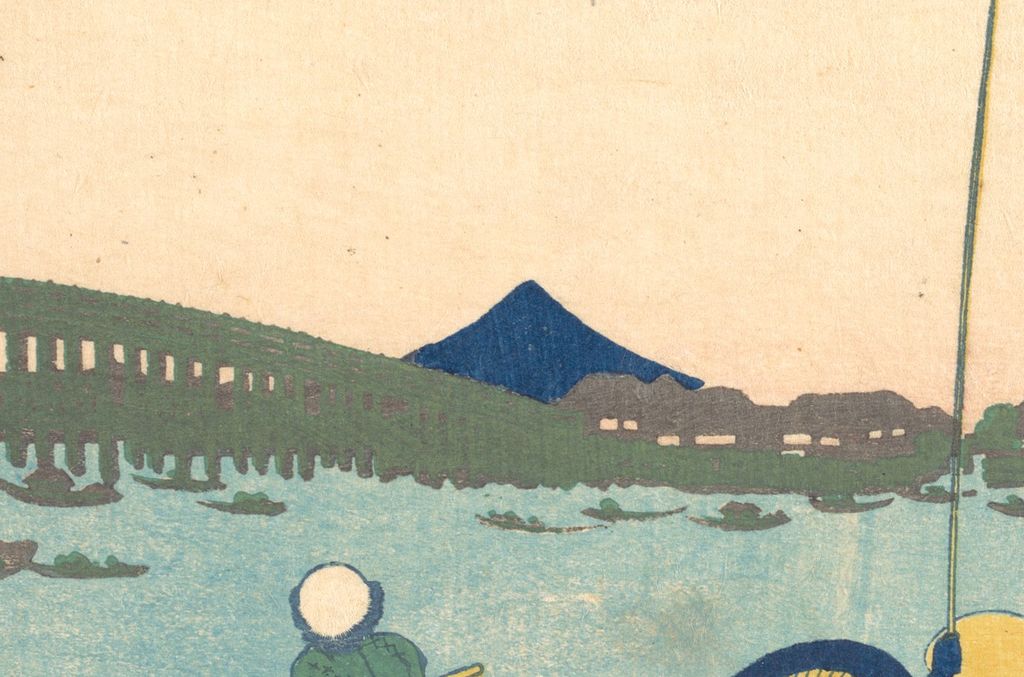
The bridge can be followed from the tightly spaced posts at left up to the shallow crest of the span. Its far end gradually merges into the low rooftops. The arc is flatter than the ferry’s curve, but it still calls that much nearer shape to mind. Fuji supplies a third profile. Its small peak is just tall enough to rise visibly above the line of the town. Because it appears right beside the bridge, it is easy to read the two as a single stretch of the horizon before the mountain’s steep slopes distinguish it. [1] [4]
The figures and water nearest us have strong lines. Closely set ripples swell and bend under the boat, then settle into longer curves at the lower edge. Across the river Hokusai makes much more use of broad silhouettes. The Shimane Art Museum describes this change from distinct foreground outlines to largely unoutlined areas of colour in the distance as a form of atmospheric perspective. The far shore is easy to recognise as a town and difficult to separate into individual buildings. The print conveys both distance and the declining light through that loss of detail. [1] [5]
In the Met’s JP2997 photograph, the upper edge is almost black. Below it the sky passes into a wide, light area. No sun disc interrupts the open space above the bridge. The MFA reads the upper band as the dark sky of a scene after sunset. The horizontal bands guide the eye through the change in light without identifying a precise time or the position of the sun. Between the pale sky and light blue water the bridge and Fuji sit in a narrow strip of darkness. The long pole crosses almost the whole interval from that strip to the dark sky. [1] [4]
Two impressions at different strengths of colour
The Met’s JP2554 is another printing of the design, dated by the museum to about 1830–32 and measuring 25.7 by 37.8 centimetres. The same boat, pole, bridge and ridge of roofs appear in the same relative positions. The strongest differences in the museum photographs are in the hull, water and sky. The yellow side of the ferry looks brighter in JP2997. In JP2554 it is paler and nearer the colour of the exposed planking. The light passages in the foreground water are especially conspicuous where they pass between the dark lines in JP2997. More of that area reads as a continuous blue in JP2554. [1] [6]
The sky also appears warmer in the photograph of JP2554. The dark upper strip extends farther down before giving way to the pale area around the pole, and the printed detail of the bridge is easier to pick out in places. In either impression, the shapes hold together when seen from farther away. The bridge remains a dark line even as its supports become visible at closer range. These photographs show how differences between two impressions affect what the eye notices first. They leave open which differences arise from the printing, the later condition of the sheets, or the way each one was photographed. [1] [6]
Another stretch of Edo water
In Tsukudajima in Musashi Province, Hokusai gives another big boat a prominent place below Fuji. The Met identifies the cargo of that boat as cotton bales. Hokusai sets its pale load among several vessels, with more masts and sails to follow as the eye moves towards the island. In the Ryōgoku print, the ferry’s burden is mostly people. A single passenger’s pole rises through the composition where the Tsukudajima print gives us numerous slender uprights. The sunset view opens more space above the boat. It lets the quiet activity of the crossing stand against a town already receding into shadow. [1] [7]
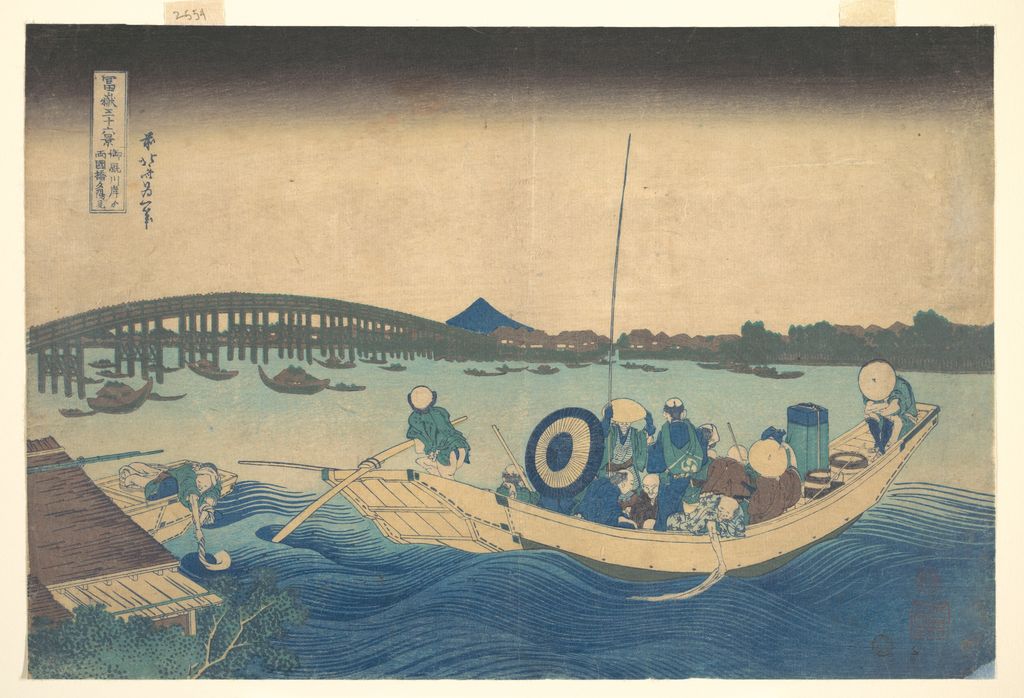
Image comparison
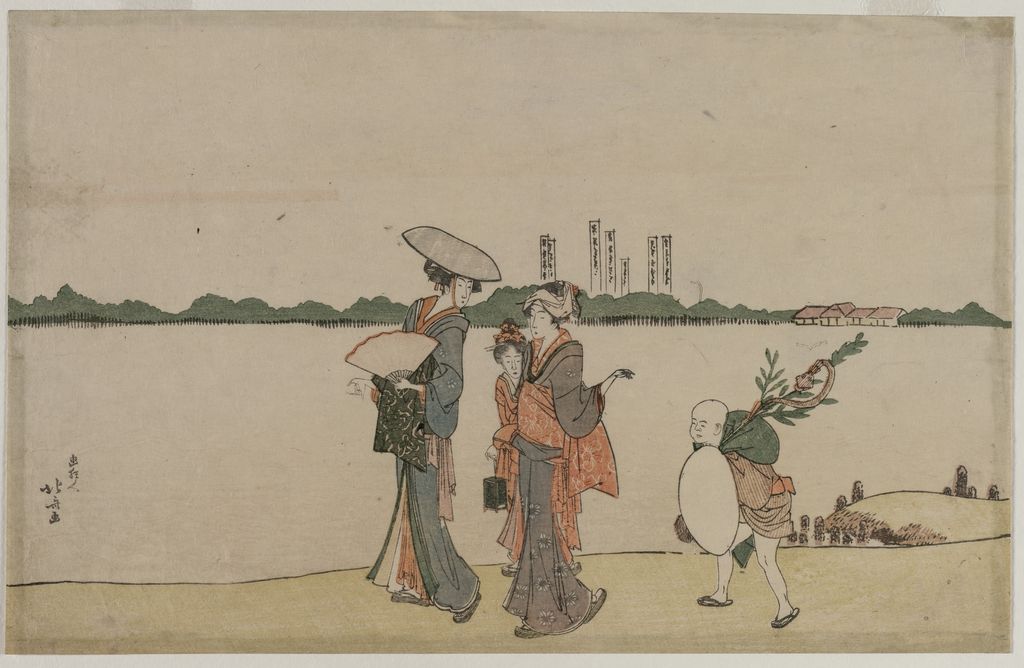
Where this work sits in Hokusai’s career
Hokusai Manga
From 1814Viewing Sunset over Ryōgoku Bridge from the Onmaya Embankment
ca. 1830–32Annotated Details from Viewing Sunset over the Ryōgokubashi Bridge from the Ommayagashi Embankment
The Metropolitan Museum of Art, JP2997. The display crop excludes the photographic scale. [1]
Details from VIEWING SUNSET OVER THE RYŌGOKUBASHI BRIDGE FROM THE OMMAYAGASHI EMBANKMENT
Select a detail to look closely.
The bridge stretches across the distance
The arch and repeated supports carry the eye across the far river. Boats below it are small beside the ferry. [1]
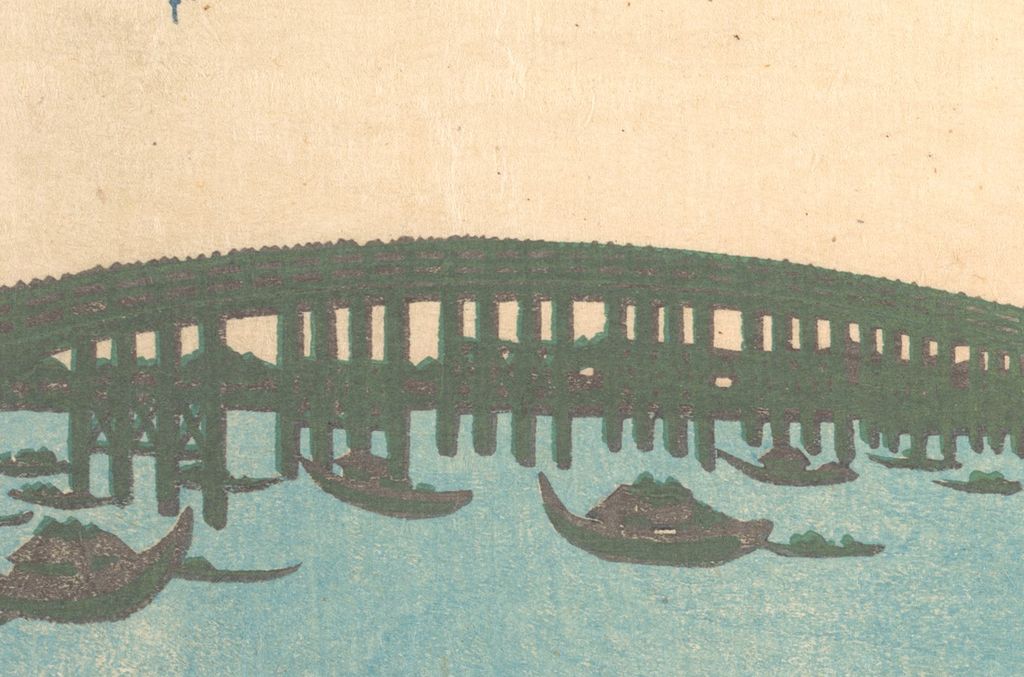
Fuji clears the opposite bank
The dark blue triangle rises just beyond the bridge. Its point is easy to miss among the longer shapes of the land. [1]
Passengers gather inside the ferry
Rounded hats and the high curve of the hull hold the group together. The oars and poles extend out of that shape. [1]
Blue lines turn below the boat
Several bands bend across the near water and follow the curved outline of the boat. [1]
Explore Hokusai’s works
Discussion
Look again at the images and ideas explored in Viewing Sunset over Ryōgoku Bridge from the Onmaya Embankment. These editorial prompts invite your observations.
Reader Insights
What leads your eye from the ferry to the far bridge?
Where does the current bend around the boat?
Join the Conversation
Share a detail, comparison or question about Viewing Sunset over Ryōgoku Bridge from the Onmaya Embankment below.
References
- The Metropolitan Museum of Art, Katsushika Hokusai, Viewing the Sunset over Ryōgoku Bridge from the Onmaya Embankment, accession JP2997, collection record and photograph. View source.
- National Museum of Western Art, Tokyo, Hokusai: Thirty-six Views of Mt. Fuji, Iuchi Collection checklist, item 33. View source.
- Sumida Hokusai Museum, Katsushika Hokusai, 冨嶽三十六景 御厩川岸より両国橋夕陽見, Japanese collection commentary. View source.
- Sarah E. Thompson, Hokusai’s Landscapes, Museum of Fine Arts, Boston, catalogue entry 22. View source.
- Shimane Art Museum, Katsushika Hokusai, 冨嶽三十六景 御厩川岸より両国橋夕陽見, Japanese collection commentary. View source.
- The Metropolitan Museum of Art, Katsushika Hokusai, Viewing the Sunset over Ryōgoku Bridge from the Onmayagashi Embankment, accession JP2554, collection record and photograph. View source.
- The Metropolitan Museum of Art, Katsushika Hokusai, Tsukudajima in Musashi Province, accession JP2990, collection record. View source.
- Keio University Libraries, Katsushika Hokusai, 富嶽三十六景 御厩川岸より両国橋夕陽見, Takahashi Collection, 200X@4-10. View source.







