


 by Tom Gurney
Tom Gurney BSc (Hons) is an art history expert with over 20 years experience
Published on June 19, 2020 / Updated on November 20, 2026
Email: tomgurney1@gmail.com / Phone: +44 7429 011000
Feminine Wave by Katsushika Hokusai
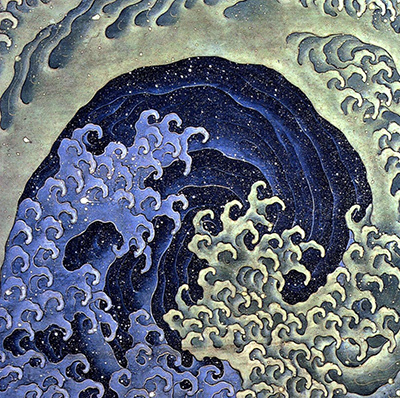
A deep blue breaker rolls around the centre of Katsushika Hokusai’s Feminine Wave. Lighter curls climb its face, and a mass of pale foam presses across the dark hollow beneath it. There is enough space between the smaller curls to follow several movements at once. A surge can seem to be folding over at the same instant that water closer to the edge is breaking apart. The square field gathers that activity into a single turning mass. Hokusai painted the panel for the ceiling of the Kanmachi neighbourhood’s festival float in Obuse. It belongs with Masculine Wave to the pair collectively known as Angry Waves (Dotō-zu). [1] [2]
The Hokusai-kan Museum’s exhibition checklist dates the pair to 1845. Its permanent collection account describes work on the two paintings and the float’s decoration extending from 1845 into the following year. The individual name Feminine Wave, or Menami (女浪), distinguishes the panel from Onami (男浪). In the museum’s collection gallery, Menami is the image with a broad, dark arc above a crowded bank of pale foam. The captions accompanying the float’s digitisation identify the same composition. [1] [2] [3] [4]
At a Glance
- ArtistKatsushika Hokusai
- Date1845
- MediumColour on paulownia panel
- CommissionKanmachi festival float
Contents
The dark arc and the breakers within it
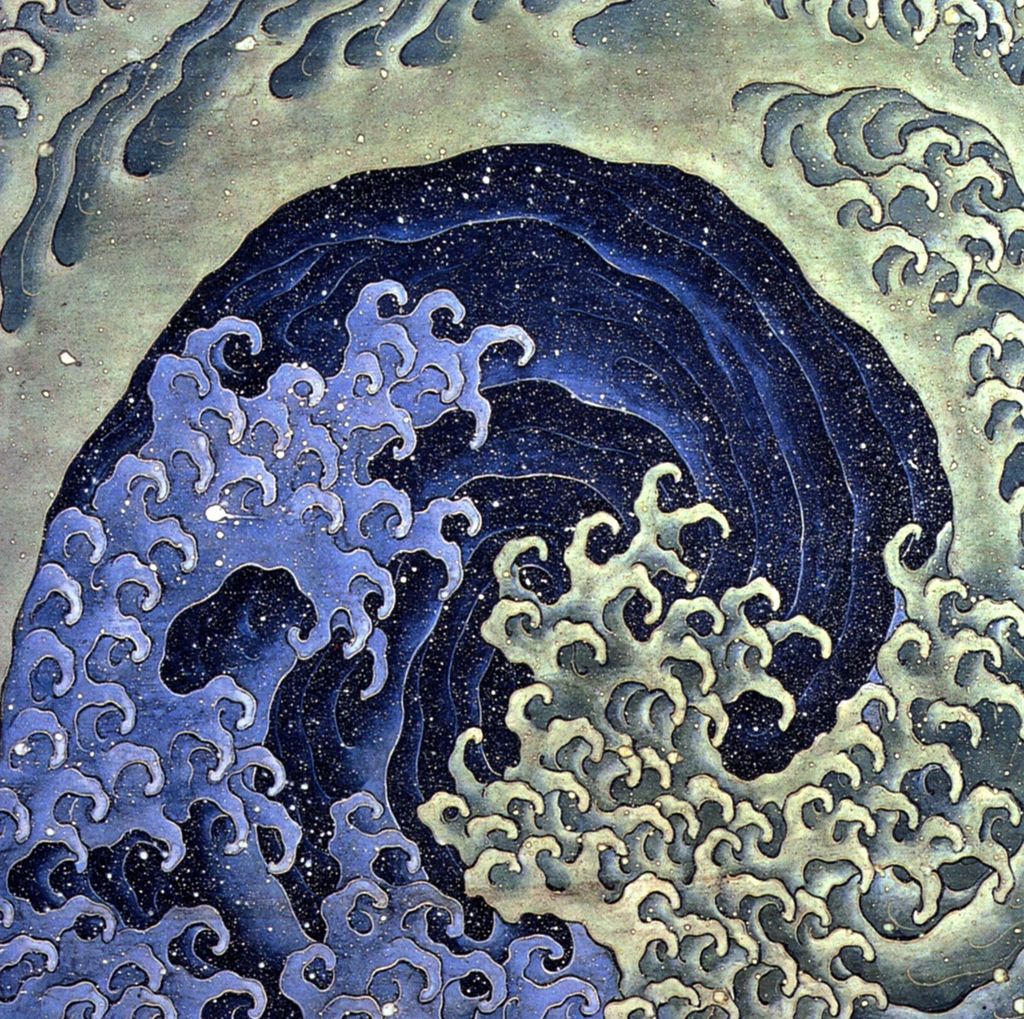
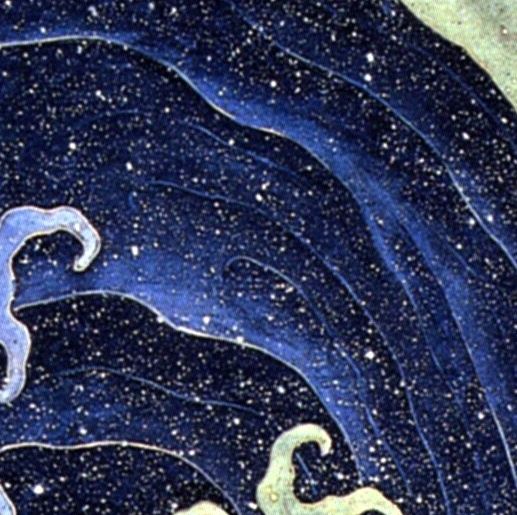
Start with the broadest curve. A dark blue band turns over the upper portion of the painted field and bends back in on the right. Layers of smaller curves run along its inner surface. These are easiest to see around the shoulder of the breaker, where they partially follow the outer contour, then diverge as they meet other parts of the surge. The strongest sweep belongs to the broad expanse of blue, yet the view stays active because its inner markings keep breaking that expanse into shorter paths. [2] [4]
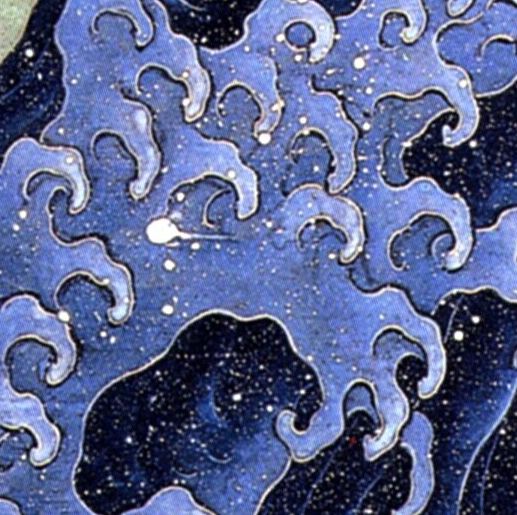
In the lower portion of the reproduction, bluish foam surges up on the left while a paler mass rises farther right. The tips of those forms split into lobes and then curl back or narrow to points. At some joins the palest edges pull two shapes apart. Elsewhere a small dark slot between overlapping forms gives the impression that one stands forward of the other. The change in scale from the large breaker to these little hooks lets the eye move from a whole mass of water to the thin edges where it stirs and breaks. [2] [4]
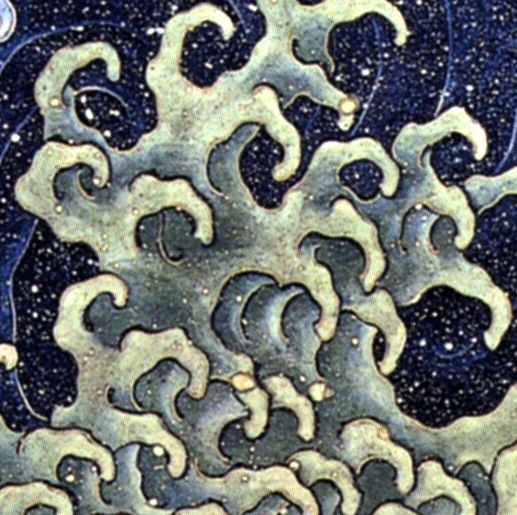
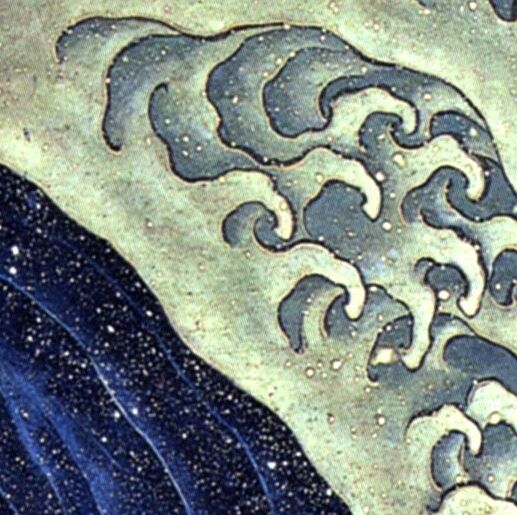
Follow a line where pale foam meets the blue near the middle and the apparent space shifts. The broad dark band can look like a wall until a lighter tongue of water crosses it. That overlap gives the white and grey-green area a position in front, leaving parts of the blue to read as recesses. There is also a comparatively open arc at the top, where pale water surrounds the darkest band. The shape of that interval matters as much as the edge of the dark crest. It keeps the whole turn distinct even while the spaces lower down are crowded with smaller movements. [2] [4]
At the perimeter, curls enter and leave the field. A small portion of a breaker may be visible where the rest lies beyond the edge. On the lower left, several curls almost touch before they disappear out of view. The panel therefore gives the eye both a route back towards the large arc and several ways to leave it. Seen from a distance the largest contrast can provide a starting point. Seen close up, the differences between a blunt crest, a split tip and a narrow loop prevent the repeated foam from settling into a uniform pattern. [2] [4]
Two ways of turning water
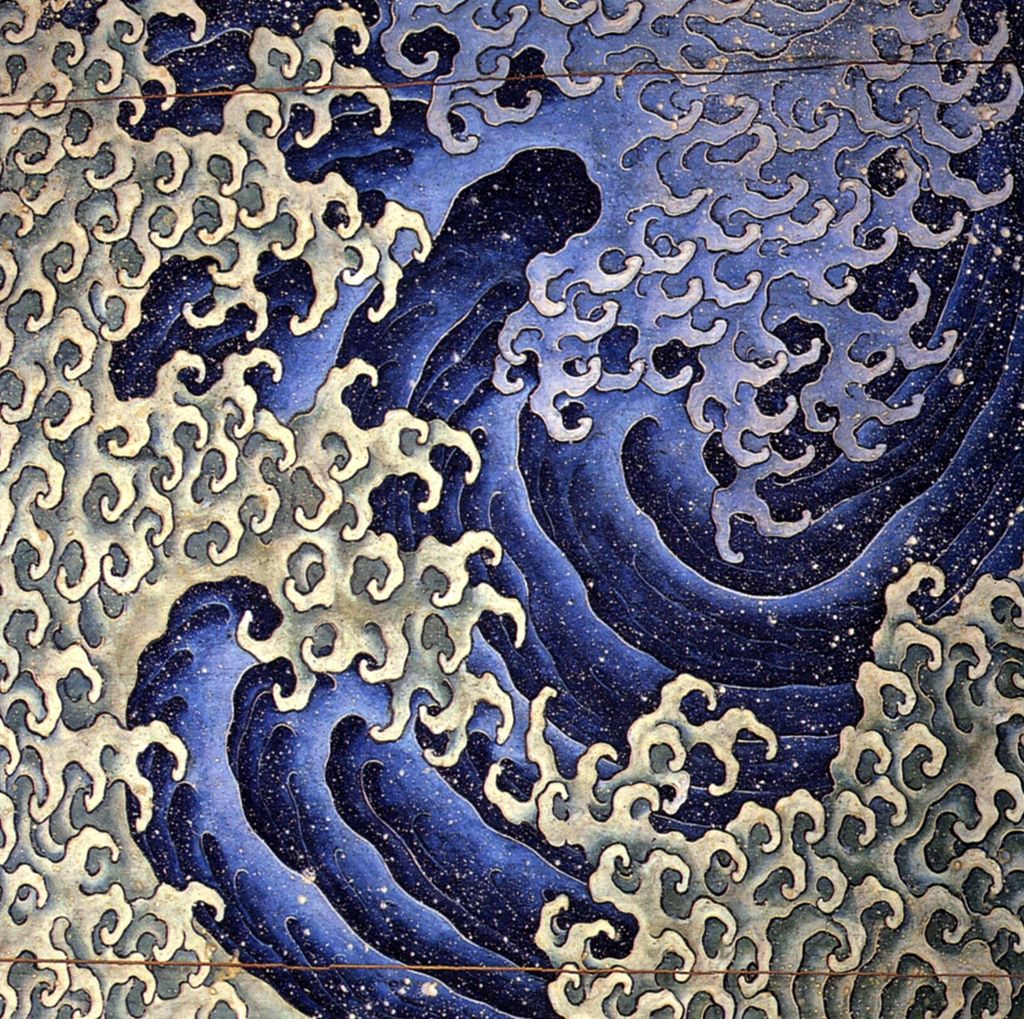
In Masculine Wave, broad rolls of blue cross the field and emerge repeatedly between pale fringes of foam. One rises towards the middle, another folds across the right, and a lower crest approaches the edge. The result is a succession of places where the view opens and closes. In Feminine Wave, the dark arc draws several of these shifts into a more concentrated turn. At the place where pale and dark meet near its centre, the foam seems to gather in front of the curling blue and start the movement again on a smaller scale. [2] [4]
The different patterns are particularly clear when the museum images are set side by side. The large blue passages in Masculine Wave tend to stand apart across the field, whereas in Feminine Wave their spacing gives prominence to one dark bend. Both paintings are turbulent. Their names are a convenient way to locate the two compositions, and the words Angry Waves refer to what the two panels share. Size, spacing and overlap give a firmer account of their differences than the English nouns and adjectives alone. The Hokusai-kan’s presentation of contemporary artist Miran Fukuda’s response includes her own statement that the panels’ original orientation is uncertain. The directions in a catalogue view describe that particular view of the panel. [1] [2] [4] [5]
Water above the festival stage
The Kanmachi float is part of the work’s setting. According to the Hokusai-kan, Takai Kōzan paid for the construction himself. Among the vehicle’s carved ornaments are a figure of Gongsun Sheng, the strategist from the Chinese novel Water Margin, and a winged dragon poised above him. The museum also distinguishes the surrounding decorative paintings from the central wave panels. It credits Kōzan with colouring the borders around the two waves from Hokusai’s designs. The painted water, the border and the carved structure each occupy a different part of what a viewer encounters overhead. [1] [6]
The photographs made for the digitisation project show both panels with their painted borders. Around Feminine Wave, patterned bands of warm colour and small floral forms surround the cool expanse of water. The transition from the dense blue to the narrow bands of reds and yellows makes the square easy to pick out. With Masculine Wave beside it, the differences extend to the border. Small concentric circles mark corners on the companion panel, while other ornamental shapes meet those points around Feminine Wave. The separate frames help the two works register as individual pictures within the same vehicle. [1] [4] [6]
Look at the photograph of the whole float in the museum’s collection gallery and the height of the ceiling becomes part of the painting. The roof and supports establish a frame of reference outside the painted one. From beside the vehicle an upward glance would bring some areas into view sooner than others. A move towards the centre of the stage would disclose more of the square field and change the angle at which its edges appear. The strongest arc and the light foam bank are big enough to offer something to follow as that angle changes. They make the painting intelligible before the smaller lines can be picked out. [1] [2]
The surviving structure also helps explain the difference between seeing the painted panel and seeing a square picture front on. In a frontal reproduction the edges remain at a fixed angle to the viewer, and the whole arc is visible at once. On the float the relationship between the arc and the roof shifts with the observer’s position. A curl that seems to travel sideways in an illustration may be experienced as a turn inward or overhead. That is a specific effect of a ceiling painting. Its force comes partly from the work Hokusai did within the painted field and partly from the place the float gives to that field. The neighbourhood association’s deposit of the float and panels at the Hokusai-kan preserves the physical setting as well as the two compositions. [1] [2] [4]
From the printed wave to the painted surface
The Hokusai-kan has traced Hokusai’s attention to waves through sketches of incoming and receding water, the Great Wave off Kanagawa and Fuji from the Sea in volume two of One Hundred Views of Mount Fuji. The Met’s impression of the Great Wave, JP1847, shows a crest towering over boats and framing a distant Fuji. The position of the mountain draws attention to the scale of the breaker, and the hulls indicate the sea’s direction of movement. Even where foam nearly closes around the view, the hollow of the wave remains a space through which to see the distance. [3] [7] [8]
In Fuji from the Sea, the 1835 book image discussed in the Obuse exhibition, the breaker covers a large part of a double-page view. Compare the shapes at its tips with the hooks in Feminine Wave. Around the crest in the book, empty ground picks out the separate marks near the edge and leads the eye into the open distance. A pale curl on the ceiling panel is more likely to meet another mass of painted water. The spaces between its edges feel like openings among the waves. Hokusai gives each work a different way to guide the eye from a large breaking form to the smaller changes around it. [2] [3] [7]
The ceiling painting gives the blue and pale areas a job that the boat and mountain serve in the print. They show how far the water has turned, which part of it seems to stand in front and where the eye can pick up the sweep after losing sight of an edge. The scale of that movement comes from contrasts within the water itself. Set beside the other panel on the same float, those contrasts make two distinct rhythms available to someone looking up. Masculine Wave opens a view between several main crests, while Feminine Wave carries the eye around one broad bend and back into a close assembly of smaller breakers. [1] [2] [4] [7] [8]
Where this work sits in Hokusai’s career
Feminine Wave
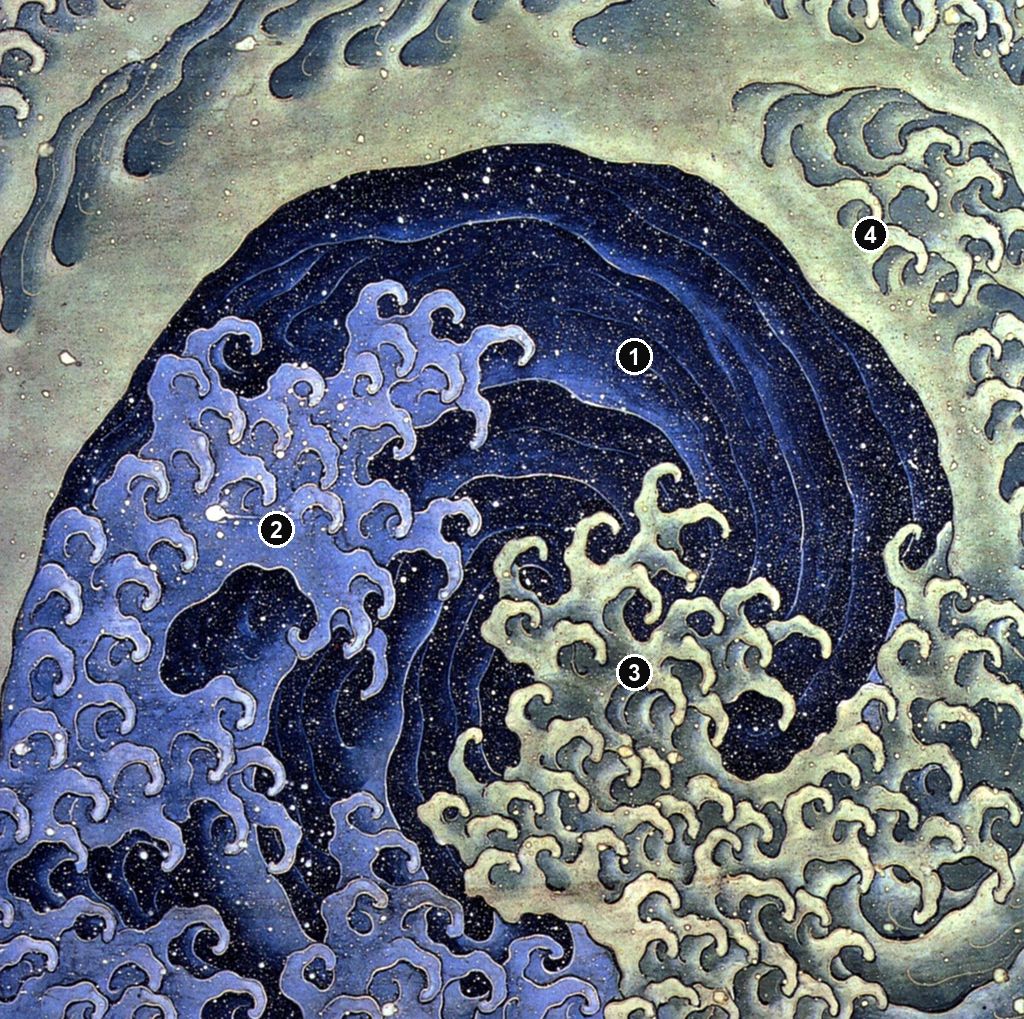
1845Annotated Details from Feminine Wave
Hokusai Museum, Obuse. Reproduction via Visipix and Wikimedia Commons. [1]
Details from FEMININE WAVE
Select a detail to look closely.
A dark arc rises across the painting
The broad, rounded crest holds together above several shorter waves. Pale forms around its outer edge trace its direction. [1]
A smaller rise reaches into the arch
A series of lighter tips rises beneath the dark crest. This smaller rhythm gives the larger arc an interior scale. [1]
Pale curls cross the lower part of the wave
Fine foam becomes a dense passage across the dark field. Gaps between the curls allow the deeper blues to remain visible. [1]
The upper surround changes tone
Curving forms grow softer against a muted ground. The resulting edge makes the crest’s darker silhouette more apparent. [1]
Explore Hokusai’s works
Discussion
Look again at the images and ideas explored in Feminine Wave by Katsushika Hokusai. These editorial prompts invite your observations.
Reader Insights
How do the successive crests lead your eye around the ceiling?
Which blue bands help distinguish the wave from its foam?
Join the Conversation
Share a detail, comparison or question about Feminine Wave by Katsushika Hokusai below.
References
- Hokusai-kan Museum, Obuse, Kanmachi Festival Float (上町祭屋台), permanent collection record. View source.
- Hokusai-kan Museum, Obuse, Permanent Collection, labelled photographs of the Kanmachi float and both wave panels. View source.
- Hokusai-kan Museum, Obuse, Hokusai’s Evolution, 2024 exhibition checklist, section 5 and Festival Float Gallery item 2. View source.
- NTT East and NTT ArtTechnology, Hokusai’s Astonishing Wave Paintings, photographs of Masculine Wave and Feminine Wave, identification of the owner and deposit, and record of the 2023 digitisation. View source.
- Miran Fukuda and Hokusai-kan Museum, Obuse, Hokusai vs Fukuda Miran: A Message to Obuse, exhibition and artist’s statement on the two wave panels. View source.
- NTT East and NTT ArtTechnology, Digital × Hokusai, The Climax Part 2, museum collaboration showing the two wave paintings and carved figures from the Kanmachi float. View source.
- Hokusai-kan Museum, Obuse, Hokusai’s Evolution, 2024 exhibition essay with the illustrated comparison Fuji from the Sea. View source.
- The Metropolitan Museum of Art, Under the Wave off Kanagawa, impression JP1847, object and image record. View source.









