


 by Tom Gurney
Tom Gurney BSc (Hons) is an art history expert with over 20 years experience
Published on June 19, 2020 / Updated on November 20, 2026
Email: tomgurney1@gmail.com / Phone: +44 7429 011000
The Ghost of Oiwa by Katsushika Hokusai
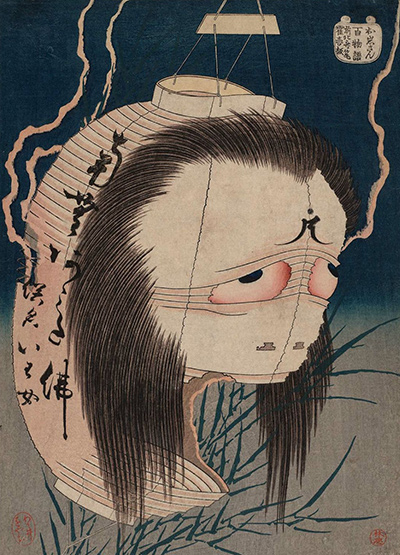
A paper lantern hangs from thin cords. Its ribs curve around the sides, its top is open, and frayed trails wind up into the dark. Then the shape turns into the face of a woman. Her eyes peer through slits in the paper, her hair hangs in straight lengths, and the lowest tear yawns like a mouth. Katsushika Hokusai’s The Ghost of Oiwa gives the wronged wife of a famous kabuki play a form that can hang from a hook. The longer the face holds our attention, the more clearly we can see how the lantern is put together. [1] [2]
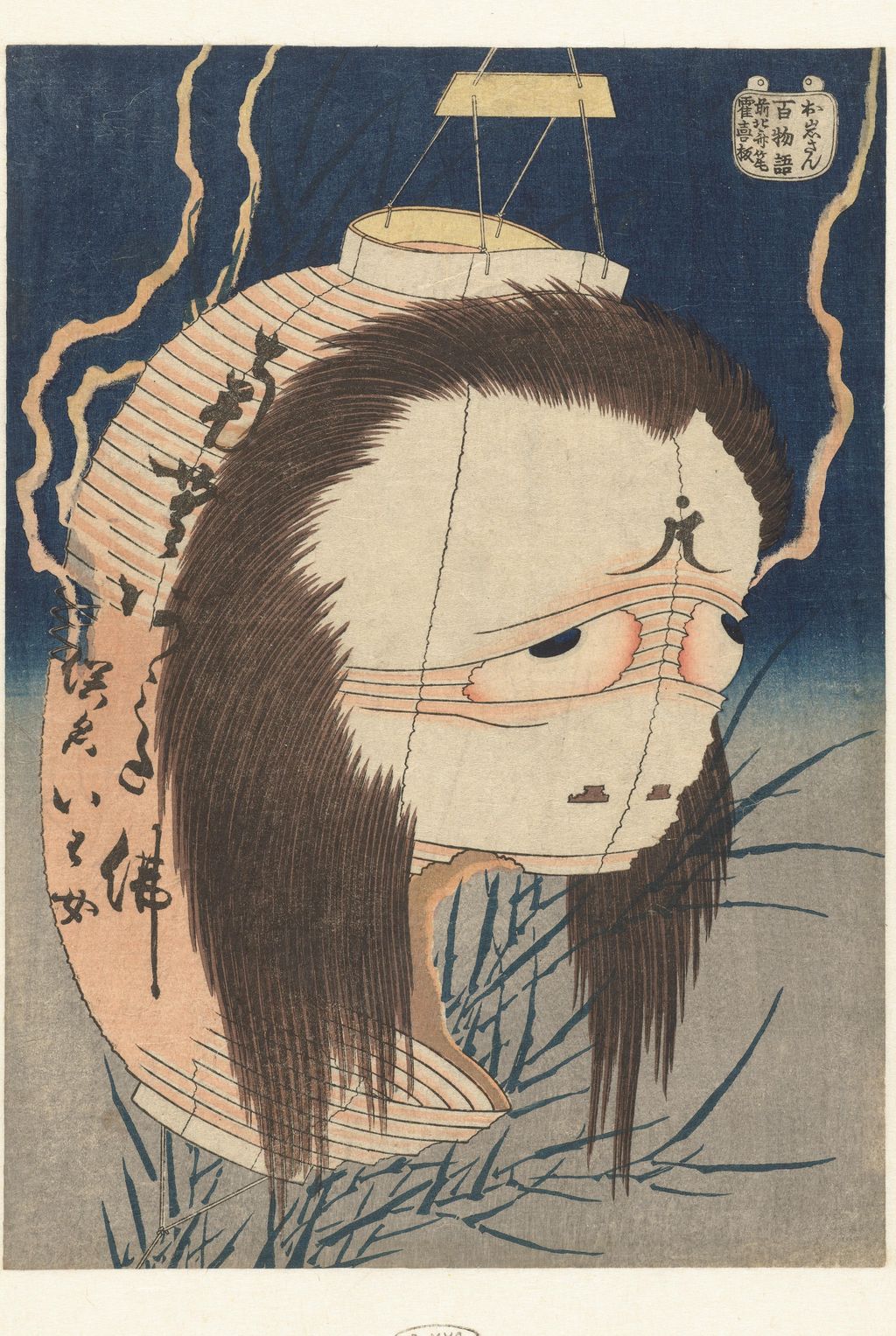
The Museum of Fine Arts, Boston, dates its Spaulding impression of The Ghost of Oiwa (Oiwa-san) to about 1831–32. It is a colour woodblock print, or nishiki-e, from One Hundred Ghost Stories (Hyaku monogatari), published by Tsuruya Kiemon. The sheet measures 25.9 by 18.4 centimetres, a vertical chūban format. Boston records three impressions of the design, including the Spaulding example (21.10239) and the Bigelow example shown in its Hokusai: Inspiration and Influence exhibition. The Rijksmuseum dates its impression to 1830. [1] [2] [3]
At a Glance
- ArtistKatsushika Hokusai
- DateEarly 1830s
- MediumColour woodblock print
- SeriesOne Hundred Ghost Stories
Contents
Where the paper becomes a face
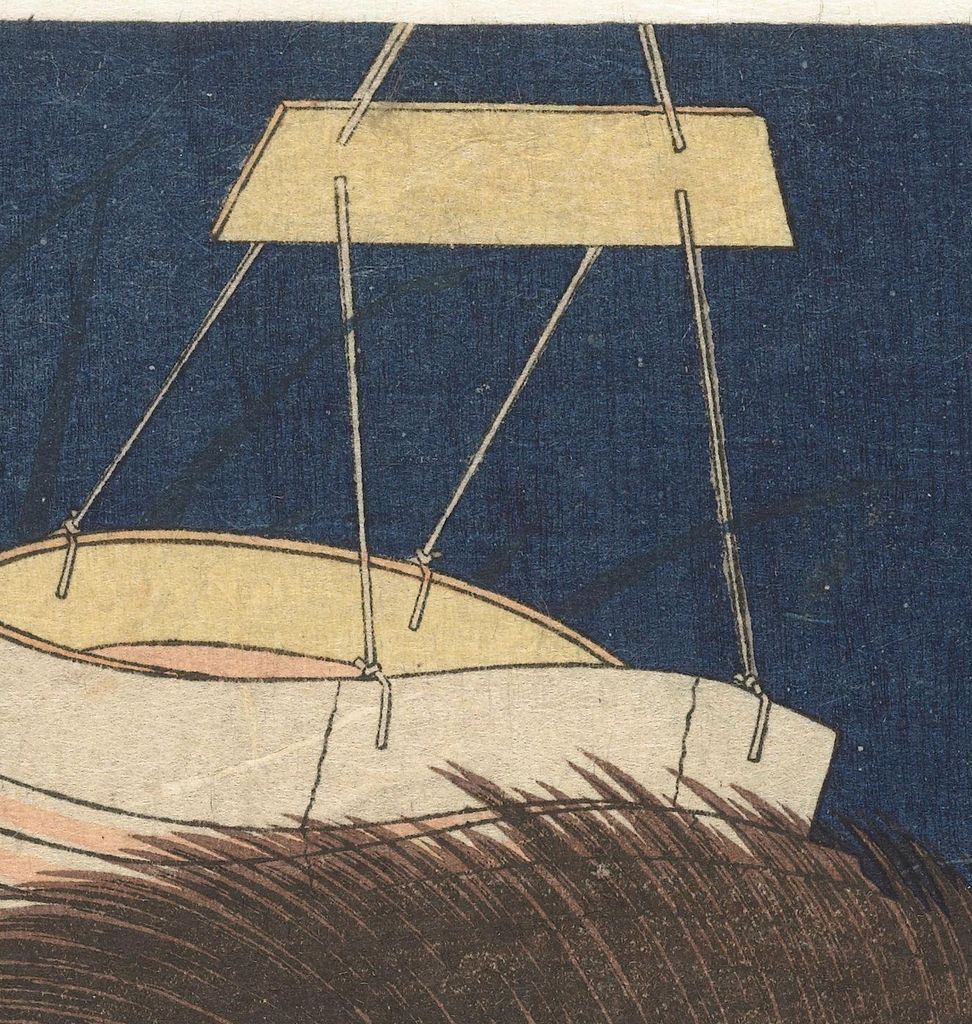
Begin with the top of the lantern. The oval opening tilts towards us, so that we can see a thin strip of the inside. Cords rise to a small horizontal support, and beyond it they leave the sheet. The left flank bulges towards the margin while the face turns towards the right. These details establish a hanging volume before we have worked out what has happened to it. Even the unnaturally broad forehead follows the curve of the paper stretched over the ribs. [2] [4]
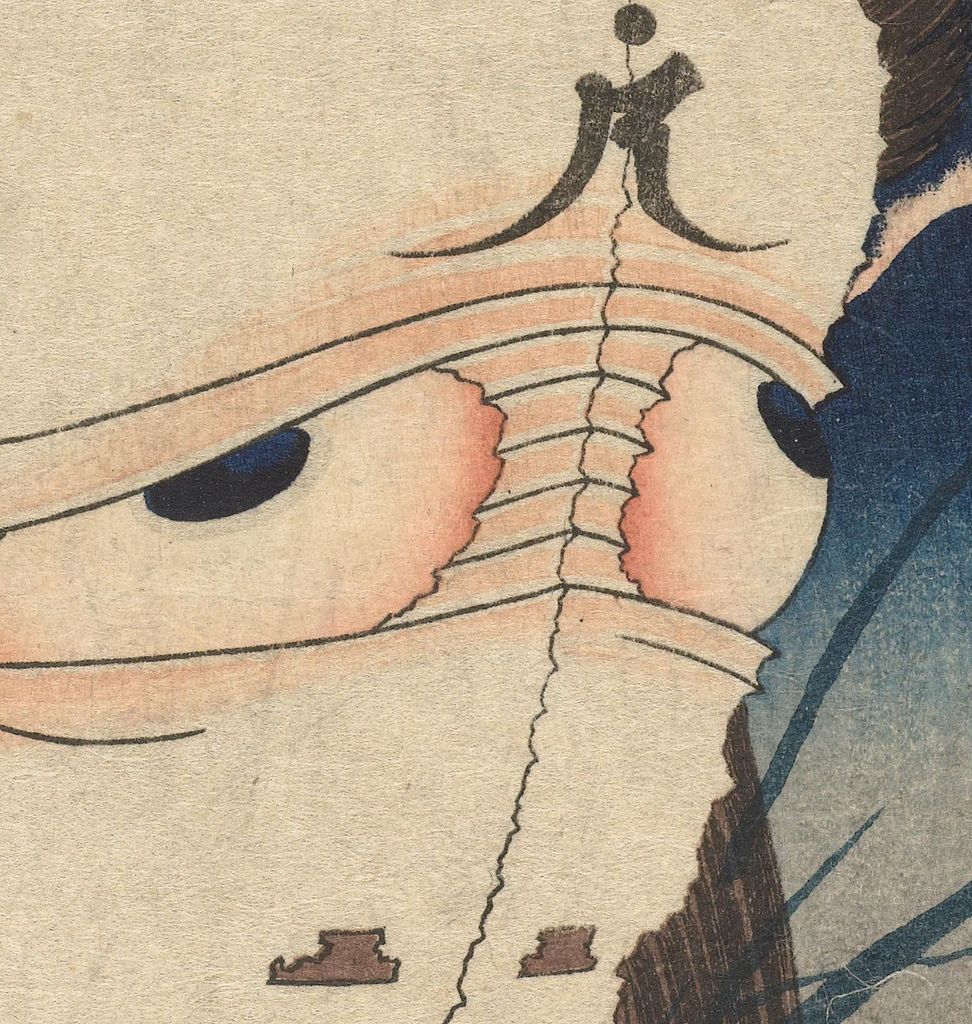
The change is clearest around the eyes. On the left, thin, almost parallel lines travel across the flank of the lantern. They reappear under the hair and bend into the folds around the eyes. The nearer eye is wider and more exposed, a pink-edged opening with the dark pupil tucked under the upper lid. The second eye is squeezed in at the rounding edge of the face. A few small faults in the paper suggest nostrils, and narrow vertical splits run down the forehead and cheek. Hokusai gives the paper enough anatomy to convince the eye while keeping its creases and splits visible. [2] [4]
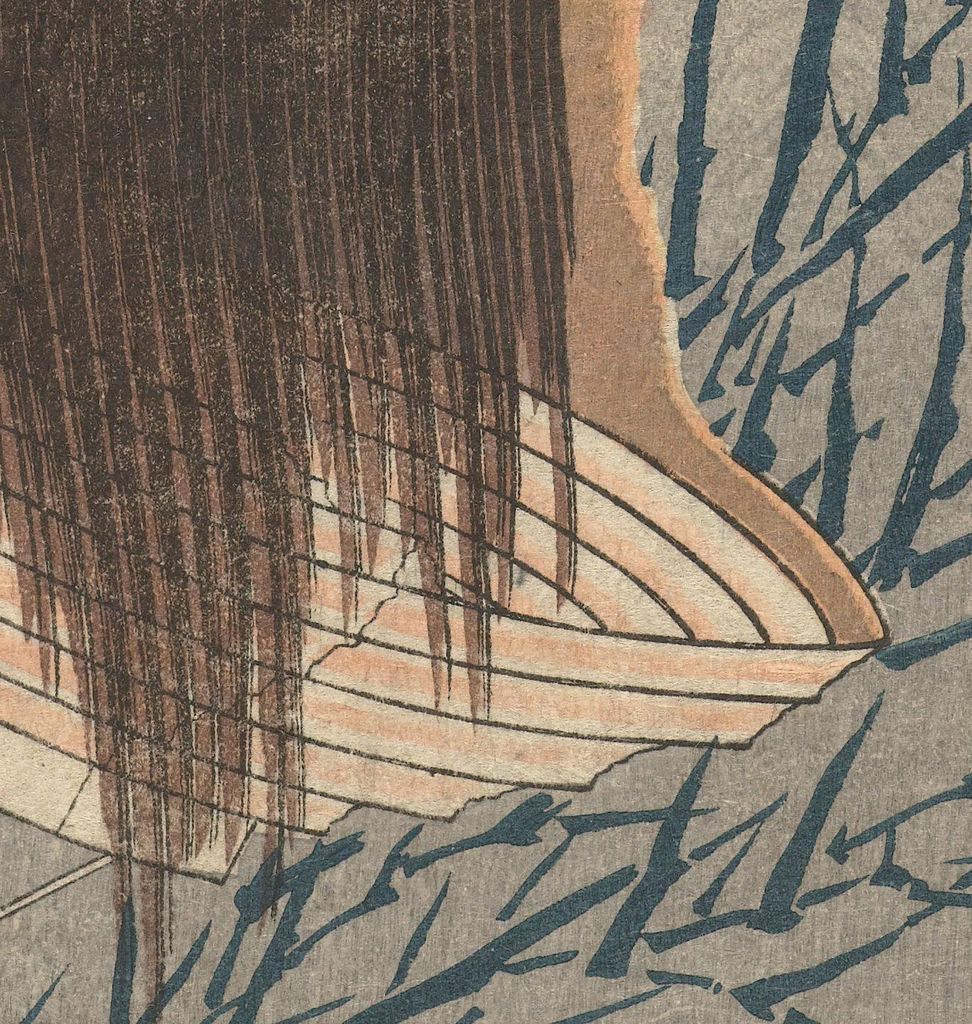
The mouth is the largest tear and the place where the illusion is easiest to test. Look through the opening and the thin leaves behind the lamp are visible in the same grey-blue as those outside it. A rust-coloured rim traces the edge of the tear. The lower ribs curve along a flap that seems to hang open like a jaw. The shape might suggest a cry. Its depth comes from the space showing through the paper. [2] [3] [4]
The hair darkens the left side and breaks into separate, almost straight lines around the mouth. On the right it thins to a narrow fall against the reeds. Follow those strands upwards and they become a thick curve sweeping off the forehead. Their delicacy makes a difference. The lantern's ribs are widely spaced and regular, while the fine marks of the hair gather tightly enough to shade the paper. Seen from a distance the two systems give us a single head. Seen up close they let us pick out the shape of a lantern under it. [2] [4]
In Boston's Bigelow image, orange-red trails frame the lamp and wind up through the deep blue above it. The background softens to grey lower down, where the stems cross and fan out. The Library of Congress reproduction keeps the same arrangement, but the trails look much paler and the distance between the midnight blue above and the grey below is more abrupt. The photographs show how much of the effect depends on the relative depth of the colours. In both, the pale face and mouth read strongly from across the room while the thin dark foliage only comes into focus at closer range. [2] [4]
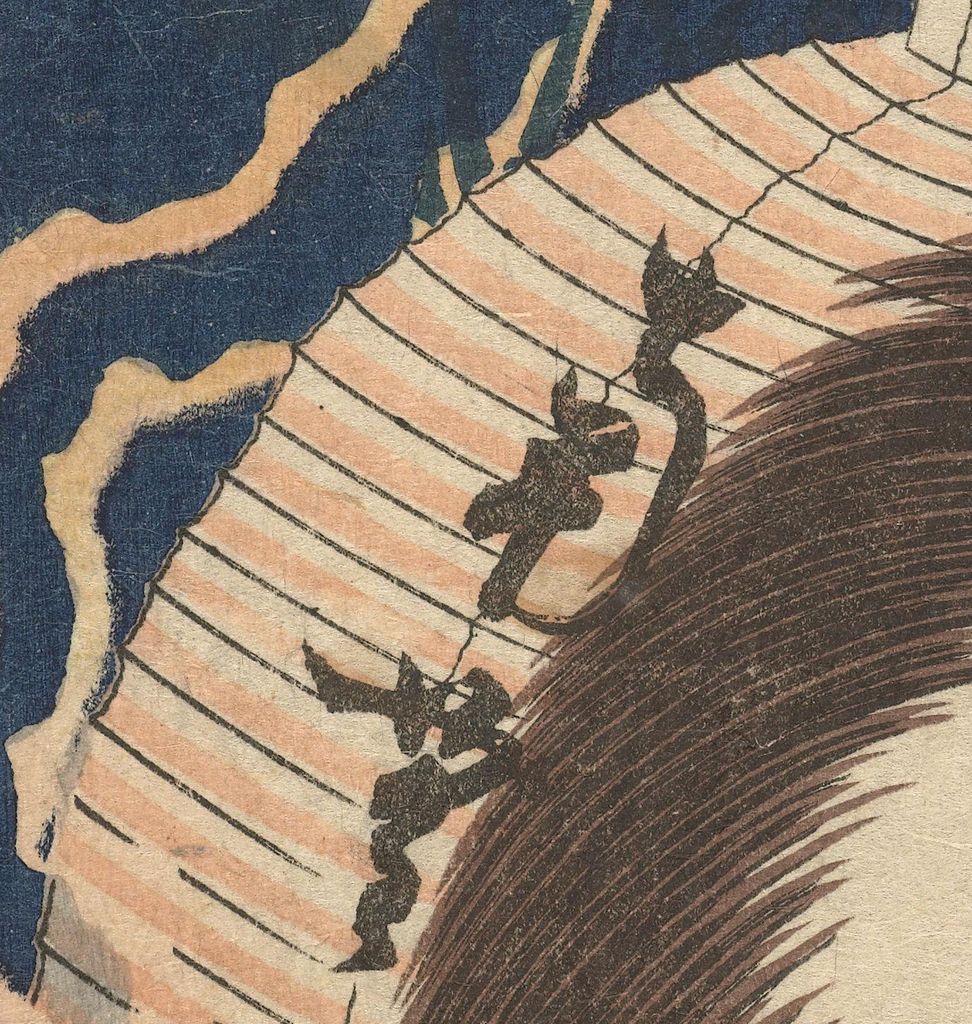
The writing occupies two different parts of the design. A small cartouche hangs in the upper right, away from the face, with the title and series name. Along the lantern's left side, the Museum of Applied Arts in Vienna identifies a Buddhist invocation to Amida, Namu Amida Butsu, and Oiwa's name. The inscription breaks where the paper is damaged and disappears in places behind the hair. At the right, the blank expanse of forehead gives a separate dark mark room to stand out. The words on the curved surface make this a lantern with a particular history, even before a viewer reads the figure's name in the cartouche. [1] [4] [5]
Oiwa in the kabuki theatre
Oiwa comes from Tōkaidō Yotsuya Kaidan, often shortened to Yotsuya Kaidan. Tsuruya Nanboku IV wrote the play, which premiered at Edo's Nakamuraza theatre in 1825 with Onoe Kikugorō III in the role of Oiwa. The Japan Arts Council classifies it as sewamono, a play set in the world of everyday life. Its ghosts enter a story about neighbours, marriage and ambition. A neighbour, Itō Kihe, prepares the poison in the hope of marrying his granddaughter to Oiwa's husband, Tamiya Iemon, who is involved in the plot. The poison disfigures Oiwa. She dies cursing Iemon and returns to torment him. [6] [7]
In the scene at Iemon's house, Oiwa combs her hair and it falls out. The Japan Arts Council describes this as one of the play's keren, showpiece effects that make a physical change visible to a live audience. The order of events matters. The audience sees the harm done to Oiwa while she is alive, and later sees the same injured face return under circumstances Iemon cannot control. In Hokusai's print the lamp assumes that shape in an instant. For a viewer who knows the play, the strands of hair and the swollen eyes can recall the earlier scene at the same time as the haunting. [2] [6] [7]
The lantern entrance belongs to the stage history after the premiere. Theatre historian Satoko Shimazaki describes the original 1825 apparition as rising out of cloth and carrying a child. Later stagings replaced that scene with the ghost emerging from a burning lantern. This distinction puts Hokusai's print in the years when the play was already being adapted in performance, and when a small print could make a theatrical invention familiar away from the playhouse. The association was close enough that the print could evoke the stage entrance through the lantern alone. [1] [8] [9]
Hokusai gives us the prop and the ghost in the same silhouette. Onstage the audience can see a lantern, see an entrance, and then watch the actor. In the print there is time to look at the tear, work out where the reeds are, and discover that the face is still there. Iemon is outside the frame. With no figure to watch being frightened and scarcely any setting beyond a few plants, the encounter falls to the person looking at the sheet. [2] [7] [8]
Other visions of the ghost
In an 1836 colour woodblock by Utagawa Kuniyoshi, the lantern hangs at the upper left among dense blue foliage. Thin trails escape through the ragged opening in its paper and wind down to a figure with long hair and a patterned robe. The image in the National Gallery of Victoria identifies Kikugorō III by name, and his face and costume give the print the character of an actor portrait. Kuniyoshi leaves enough room for the viewer to trace a path between the prop and the part. Hokusai compresses both into the lantern, and its cartouche identifies the ghost and the series. [1] [5] [10]
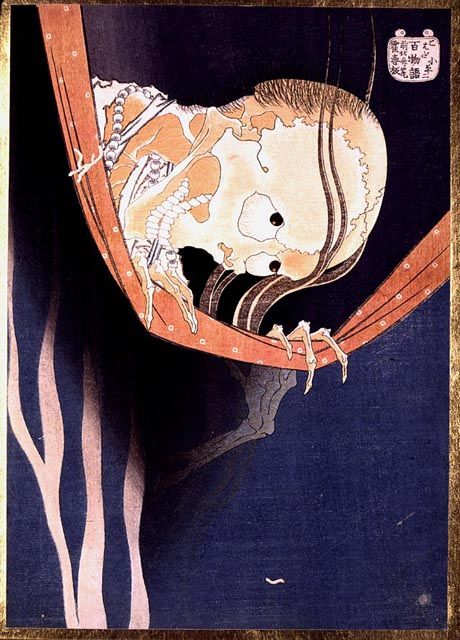
Hokusai uses a different device in The Ghost of Kohada Koheiji, a companion print also published by Tsuruya Kiemon. Koheiji is the murdered man of a separate story, distinct from Iemon's servant Kobotoke Kohei in Yotsuya Kaidan. Hokusai shows Koheiji as a skeletal face and bony hands emerging through swirls, parting a mosquito net to look in. The net was meant to protect a sleeper, so finding a face over its edge puts the threat uncomfortably close. Oiwa's lantern likewise belongs to the material world that people handle and trust. In one print the hands disturb the barrier. In the other the barrier itself takes on the features of the ghost. [6] [11] [12]
The Laughing Demon, or Warai Hannya, also belongs to the series. The horned figure grips a child's head, and its bent fingers and broad grin bring the eye straight to the encounter. Set beside it, Oiwa's downcast eyes give her a weary expression as well as a frightening one. Recognising the lantern as the face can take a second look, and then its shape is hard to get out of sight. The prints have room for different kinds of dread within the same compact format. [2] [4]
One Hundred Ghost Stories
The title Hyaku monogatari recalls an Edo-period gathering where participants told tales after dark and extinguished a light as each story ended. At the hundredth story and the last light, a supernatural event was said to occur. The Shimane Art Museum identifies five known designs in Hokusai's series. The Library of Congress preserves an album with five prints, including Oiwa, Koheiji and the laughing figure. In that company the lantern makes an especially apt subject. Something that normally holds back the dark has become the thing it reveals. [4] [9] [13]
The design also makes the making of a colour print unusually easy to imagine. Accurate alignment lets the black edges of the eyes hold the pink at the rims, and the dark marks of the hair travel across the light paper and down into the grey below. In the Rijksmuseum record the technique is described as a black line block with colour blocks. Our guide to Hokusai's ukiyo-e woodblock prints explains how these impressions were made. Seen at the size of an actual sheet, the tiny lines around Oiwa's eyes and the opening low in the lantern ask for little more than a step closer. [1] [2] [3]
Where this work sits in Hokusai’s career
Image comparison
Annotated Details from The Ghost of Oiwa
Rijksmuseum, AK-MAK-930. The display crop excludes the photographic scale. [3]
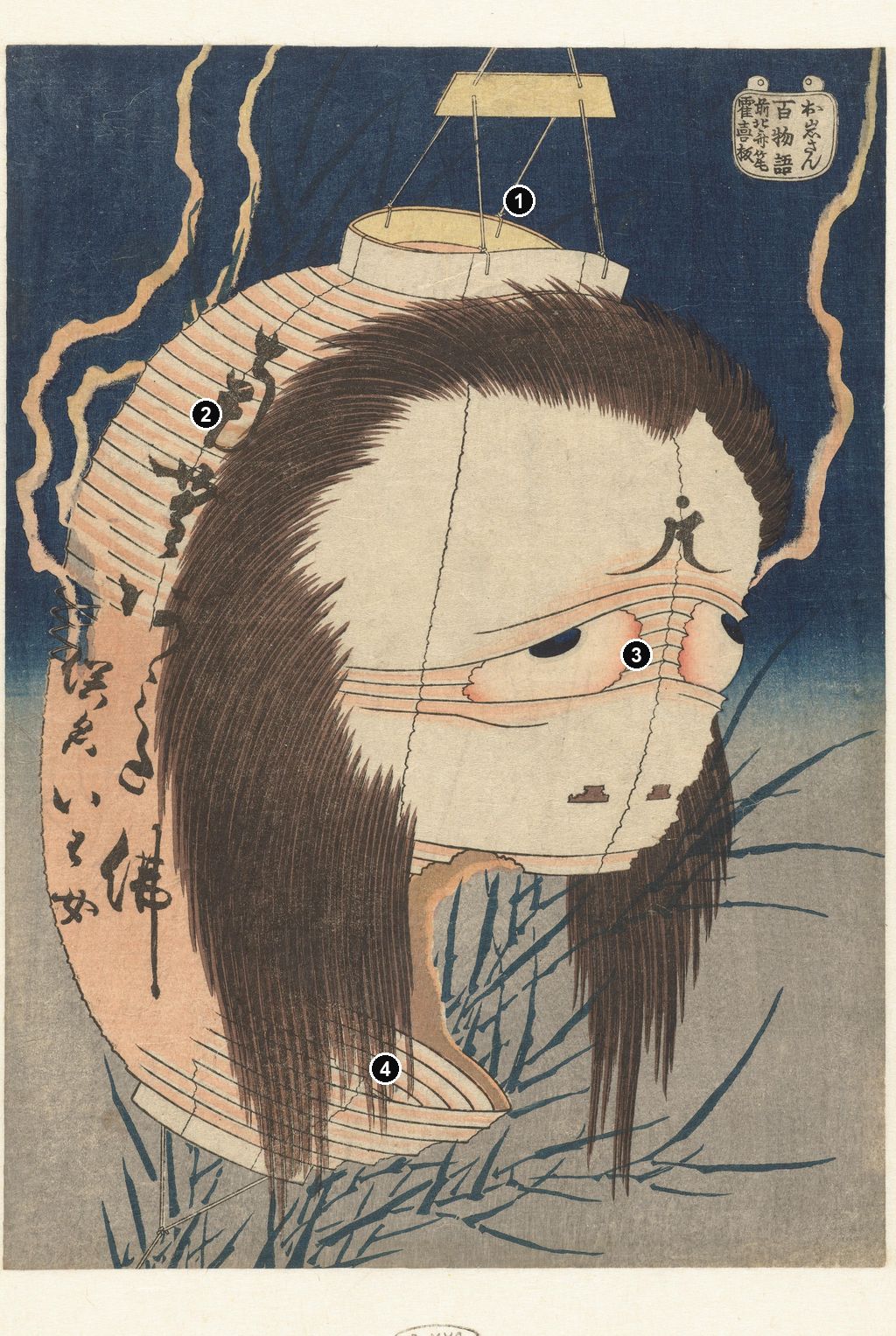
Details from THE GHOST OF OIWA
Select a detail to look closely.
The lantern hangs from a cord
The suspension piece and the slanting cords give the face a support. Beneath them the rim keeps the round shape of a lantern. [3]
Paper ribs curve around the head
Short curved lines run over the folded paper. Their regular spacing survives where the lantern gives way to the mass of hair. [3]
The eye and the paper share a fold
The lowered eyelid follows a curve across the lantern. The crease makes it possible to read one line as a fold in the paper and a feature of Oiwa’s face. [3]
Hair and reeds cross below
Strands of hair fall over the lower rim while the pale loops and dark reeds shift direction. The strands carry the eye from the lantern to the ground. [3]
Explore Hokusai’s works
Discussion
Look again at the images and ideas explored in The Ghost of Oiwa by Katsushika Hokusai. These editorial prompts invite your observations.
Reader Insights
Where do you first notice that the face belongs to a lantern?
What does the small scale of the print contribute to the apparition?
Join the Conversation
Share a detail, comparison or question about The Ghost of Oiwa by Katsushika Hokusai below.
References
- Museum of Fine Arts, Boston, The Ghost of Oiwa (Oiwa-san), from the series One Hundred Ghost Stories (Hyaku monogatari), Spaulding impression 21.10239. View source.
- Museum of Fine Arts, Boston, Hokusai: Inspiration and Influence, exhibition record and Bigelow impression of The Ghost of Oiwa. View source.
- Rijksmuseum, O-Iwa het lantaarn spook, AK-MAK-930. View source.
- Library of Congress, The Floating World of Ukiyo-e: Images and Literary Sources, album of five Hokusai prints including Oiwa-san, LC-USZC4-8749. View source.
- MAK – Museum of Applied Arts, Vienna, Mrs. Oiwa (Oiwa san), KI 11038. View source.
- Japan Arts Council, Invitation to Kabuki, “Tokaido Yotsuya Kaidan,” plot and character notes. View source.
- Japan Arts Council, Kabuki A to Z, “Tokaido Yotsuya Kaidan,” premiere, performance history and stage effects. View source.
- Satoko Shimazaki, “The End of the ‘World’: Tsuruya Nanboku IV’s Female Ghosts and Late-Tokugawa Kabuki,” Monumenta Nipponica 66, no. 2 (2011), pp. 209–246. View source.
- Shimane Art Museum, The series One Hundred Ghost Stories (Hyaku monogatari): The Ghost of Oiwa, Nagata Seiji Collection. View source.
- National Gallery of Victoria, Utagawa Kuniyoshi, Onoe Kikugoro III as the ghost of Oiwa in the play Yotsuya Kaidan, 2022.565. View source.
- Museum of Fine Arts, Boston, The Ghost of Kohada Koheiji, from the series One Hundred Ghost Stories (Hyaku monogatari). View source.
- Minneapolis Institute of Art, The Ghost of Kohada Koheiji. View source.
- Wayne Crothers, “There are ghosts in the NGV Collection,” National Gallery of Victoria. View source.







