


 by Tom Gurney
Tom Gurney BSc (Hons) is an art history expert with over 20 years experience
Published on June 19, 2020 / Updated on November 20, 2026
Email: tomgurney1@gmail.com / Phone: +44 7429 011000
The New Fields at Ōno in Suruga Province
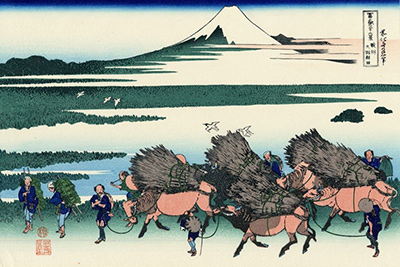
Bundles of cut reeds tower above the cattle in Katsushika Hokusai’s The New Fields at Ōno in Suruga Province. The group crosses the foot of the print beneath a broad view of Mount Fuji. From a distance the loads look like a row of dark wedges. Up close, the uneven ends of the stalks show what gives each bundle its bulk. The Metropolitan Museum of Art dates its colour woodblock impression JP2954 to about 1830–32. The National Museum of Western Art’s Iuchi Collection checklist records the design as no. 47, 駿州大野新田, Sunshū Ōno shinden. [1] [2]
At a Glance
- ArtistKatsushika Hokusai
- Dateca. 1830–32
- MediumColour woodblock print
- SeriesThirty-six Views of Mount Fuji
Contents
A working crossing at the foot of Fuji
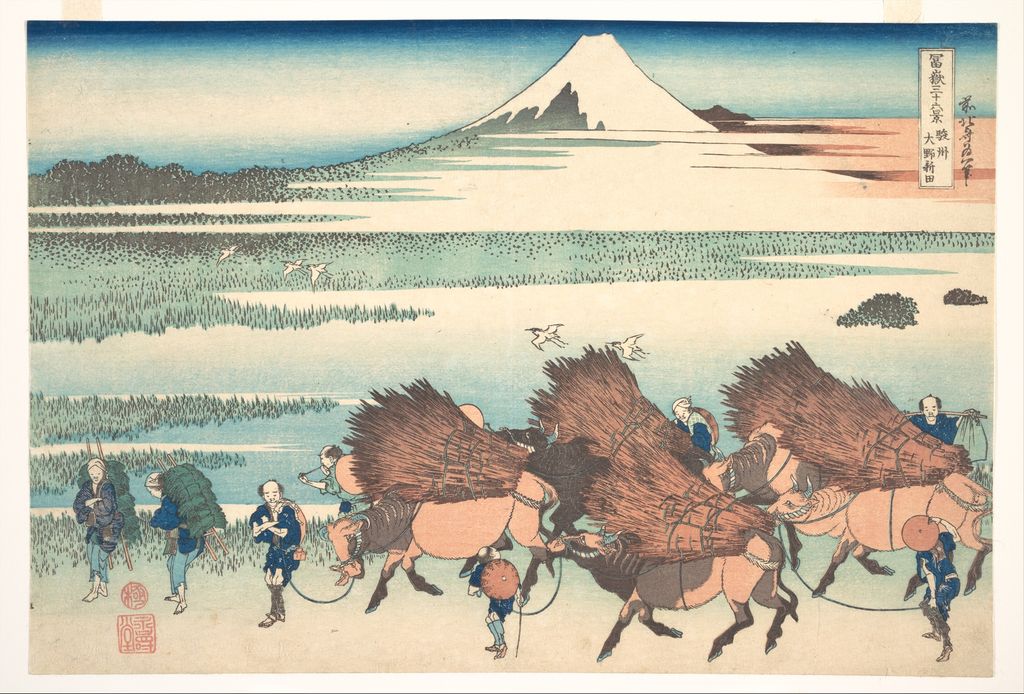
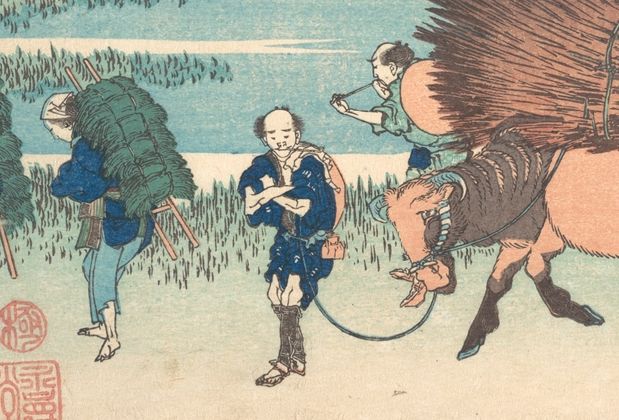
Start at the left, where two people carry loads high on their backs. In JP2954 the dark green cargo stands out against the paler bands behind them. Farther right a figure walks ahead of a beast whose lowered head comes nearly to the person’s shoulder. Follow the long curve from the figure’s hand towards the animal. There is enough open paper below the load to see where the rope passes. Elsewhere, ropes disappear briefly among the legs and bodies of the group. Their loops link people and animals even where the print gives only a small part of each figure room to show. [1]
Chiba City Museum of Art describes farmers carrying cut reeds on cattle. The Tokyo Fuji Art Museum’s account, published by Japan’s Agency for Cultural Affairs, identifies a woman at the left carrying freshly cut reeds and a man with a pipe at the head of the cattle. In JP2954 those figures are separated by a walker and patches of marsh. They are recognizable by small details, including the way their arms cross in front of them. Chiba’s reading of the scene as a quiet spell after work fits the visible pace. The group has the appearance of people accustomed to moving together with heavy loads. [1] [3] [4]
Most of the animals’ backs disappear under their cargo. Their heads, legs and portions of the bodies are sufficient to make their progress intelligible. Some hooves touch the ground squarely while other feet lift and point backwards. The gait becomes particularly clear in the foremost dark animal, where all four legs can be followed below the silhouette of the bundle. A round hat nearby has a much simpler outline than the reeds. Against the knotted lines of the load it marks the position and scale of the person walking beside it. [1]
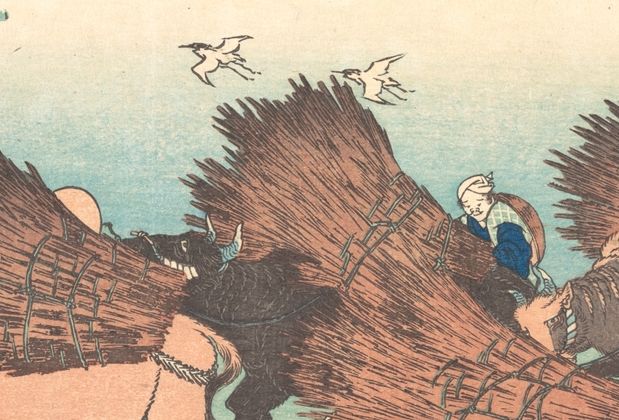
Even the bundles do different work within that row. Along the lower centre one bundle sweeps down nearly to the head of the neighbouring animal. Behind it the longer stems of a farther load rise steeply above the rest. The Tokyo Fuji Art Museum draws attention to the resemblance between these sloping masses and the sides of Fuji. Try following a bundle from its narrow end towards the spreading stalks. Each mass changes direction and terminates in stray ends, while the mountain has two long edges that meet only once. The echo is close enough to connect the two parts of the picture and loose enough to retain the movement of the reeds. [1] [4]
Where the fields meet the marsh
Sumida Hokusai Museum places the village of Ōno Shinden between the Tōkaidō post towns of Hara, in present-day Numazu, and Yoshiwara, in present-day Fuji City. The name survives in Fuji City. The city describes its historical surroundings as marshy, with reeds growing in abundance and a view directly towards the mountain. The title’s shinden refers to newly opened agricultural land or the settlement associated with it. The Iuchi checklist translates the phrase as new paddies, while the Met’s title gives the wider sense of new fields. Both translations direct attention to the use of this low ground. [1] [2] [5] [6]
Fuji City’s historical account describes sustained efforts to reclaim land around Ukishima Marsh during the Edo period. One episode it documents belongs to 1850, when Takahashi Yūkichi of Ōno Shinden made a drainage channel to protect Ōno and two neighbouring settlements from floods. That example comes after the Met’s dating of JP2954. It helps explain how farming and wet ground could occupy the same landscape over a long period. Hokusai gives the viewer the open terrain and the traffic across it, leaving the history of particular drainage works to the written record. [1] [7]
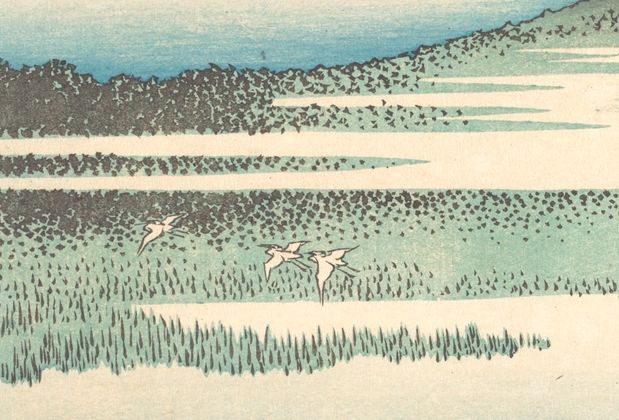
The low horizon makes the way he draws that terrain especially important. A band of short, closely spaced marks divides one pale interval from another. On the left, little tongues of growth project into lighter ground. Their edges fray into individual strokes. A few darker clumps on the right sit apart from the longer bands. This irregular spacing makes the plain readable as a patchwork of water, vegetation and open ground. The view conveys a sense of distance without prescribing where each channel or field begins. [1]
Several light birds cross the lowland. In JP2954 tiny ones are outlined against the farther strip of vegetation. Larger birds nearby have open wings above the reed bundles. Chiba identifies these as white egrets and describes their role in joining the foreground and distance. Their sizes make that connection visible. The closest birds can be followed stroke by stroke, while the smaller ones take only a few touches. They also interrupt the straight run of the marsh bands, drawing the eye up and away from the people and cattle. [1] [3]
Colour and space in two impressions
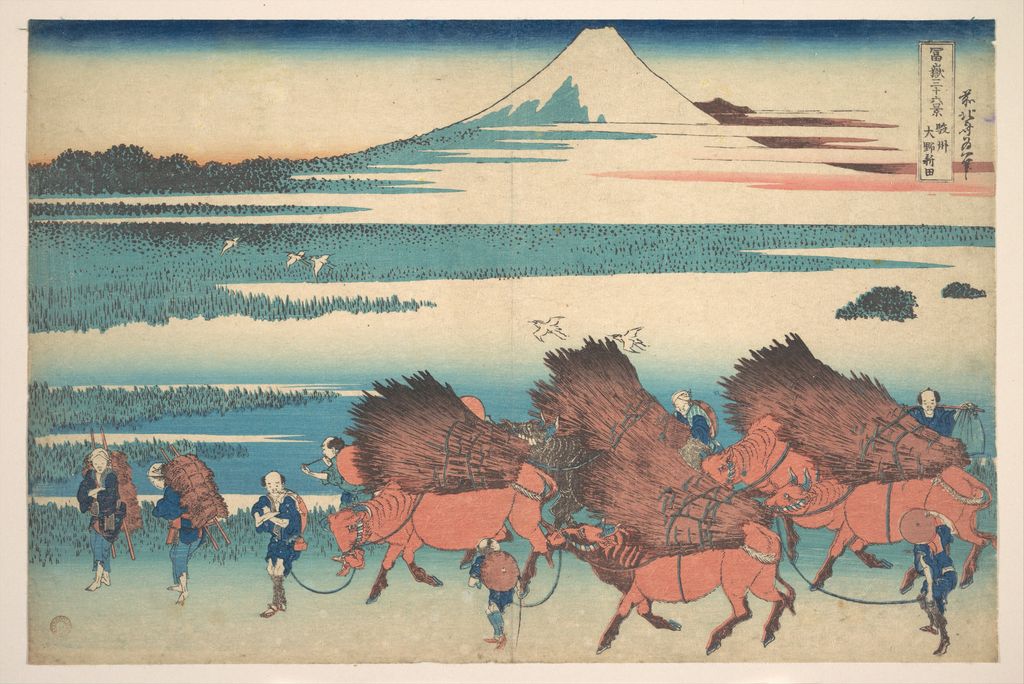
JP2954 measures 25.4 by 37.5 centimetres. The Met’s other impression, JP1456, measures 25.1 by 37.8 centimetres. The arrangements align down to the birds’ wings, the horizontal marks across the fields and the lines of the harness. In the photograph of JP1456 the cattle’s flanks have a stronger salmon colour. A carried bundle near the left is brown where the corresponding area in JP2954 is deep green. The repeated shape of the load makes that difference especially easy to notice. [1] [8]
The middle distance also reads differently. In JP1456 the dark marks of vegetation sit in a fuller blue-green strip. A blue band behind the figures at the left stands out against both the reed beds and the foreground. Its equivalent in JP2954 is appreciably softer. Compare the mountain too. The dark irregular patches below the white summit in JP2954 look more blue-green in JP1456. These are differences between the surviving sheets as photographed. Colour in the museum images can guide comparison, while an explanation of which blocks were used or how they were inked would require separate evidence. [1] [8]
Chiba places the design within the ten additional views that brought Thirty-six Views of Mount Fuji to forty-six. It describes a black key-block outline and the use of graded Berlin blue in its own impression. Its account helps explain why the firm outline of a small feature and the gradual lightening of a band deserve separate attention. In the Met photographs, for example, the thin contour of Fuji can be followed against the sky even where the colour at the base of the peak softens into the lower landscape. The two photographs leave room for each sheet’s own colour and condition. [1] [3] [8]
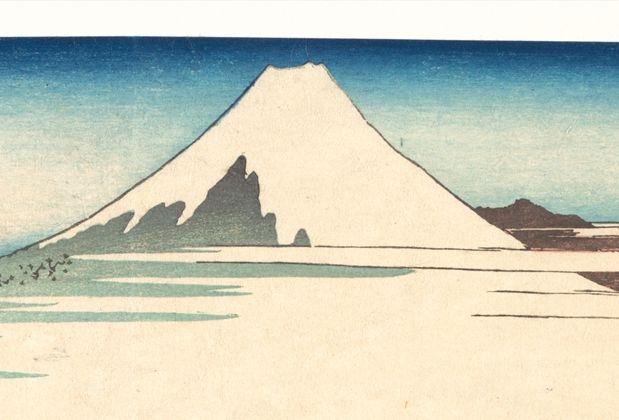
Look at the plain immediately below the peak. Long bands of pale paper reach in from the left and right. They widen towards the middle and make the base of the mountain difficult to fix as a single line. The summit is quietly emphatic above them, with very little between its point and the upper edge of the print. That placement gives Fuji height while leaving much of the sheet available for the reeds, travellers and cattle. The mountain is large, and the parts of the picture nearest the viewer are the ones with the closest detail. [1]
The photographs also show differences in the marks on the sheet. Two conspicuous red stamps lie near the lower left of JP2954. JP1456 has a small, faint mark in that corner instead. The long title cartouche remains at the upper right in both impressions. There its vertical sides cut across the horizontal streaks extending towards the edge. The narrow band between the cartouche and Fuji belongs to the landscape, while the writing identifies the scene. Keeping those marks apart helps distinguish the recurring features of the design from marks visible on only one surviving sheet. Look at the upper right and then the lower left to see how differently writing and stamps sit within the picture. [1] [8]
Another way to picture work in Suruga
In Fuji from the Katakura Tea Fields in Suruga, people spread across plots and paths. Sumida identifies tea picking and the transport of harvested leaves among their activities. At Ōno the harvest has already gathered into bundles, and the work is concentrated along a single near edge. The pictures give different views of transport as well as different crops. Katakura lets the eye follow several routes through the fields. Ōno lets it follow the progress of a group across the sheet, with the pale intervals of the marsh behind. [1] [9]
The same mountain holds the two landscapes together within Thirty-six Views of Mount Fuji. In the Ōno print the largest shape above the plain is Fuji, but the foremost group can sustain a long look of its own. Trace the foot of one animal, the loop of its rope and the spread of the reed ends before looking up again. Between them and the mountain, a few lightly marked birds cross the wide terrain that makes the settlement’s setting distinct. [1] [3]
Where this work sits in Hokusai’s career
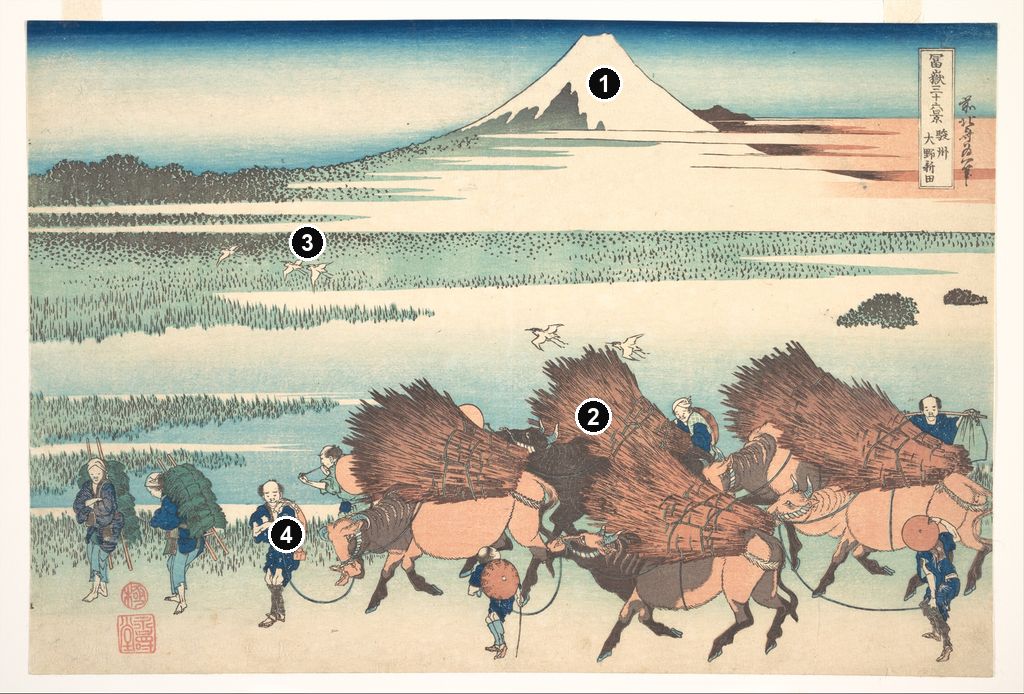
Annotated Details from Ōno-shinden in Suruga Province
The Metropolitan Museum of Art, JP2954. [1]
Details from ŌNO-SHINDEN IN SURUGA PROVINCE
Select a detail to look closely.
Mount Fuji fills the distant opening
Its pale slope rises over the low horizontal strips of land. [1]
Large bundles change the outline of the procession
The peaked loads repeat above the figures. They create a second set of peaks below Fuji. [1]
The fields extend in broad bands
Narrow marks and patches extend across the plain on either side of the route. [1]
People accompany the loaded animals
Their outlines show through clearly in the foreground. The far landscape has few elements on this scale. [1]
Explore Hokusai’s works
Discussion
Look again at the images and ideas explored in The New Fields at Ōno in Suruga Province. These editorial prompts invite your observations.
Reader Insights
What puts the people and their loads in the foreground?
Where do the low fields give way to distant hills?
Join the Conversation
Share a detail, comparison or question about The New Fields at Ōno in Suruga Province below.
References
- The Metropolitan Museum of Art, The New Fields at Ōno in Suruga Province (Sunshū Ōno shinden), impression JP2954, collection record and photograph. View source.
- National Museum of Western Art, Iuchi Collection exhibition checklist, no. 47, 駿州大野新田, New Paddies at Ono in Suruga. View source.
- Chiba City Museum of Art, 駿州大野新田, impression 2923074, bilingual catalogue and commentary on the cattle, birds and printing. View source.
- Tokyo Fuji Art Museum via the Agency for Cultural Affairs, 冨嶽三十六景《駿州大野新田》, Japanese catalogue commentary on the cattle, reed bundles and people. View source.
- Sumida Hokusai Museum, 冨嶽三十六景 駿州大野新田, Japanese collection record and description of the location between Hara and Yoshiwara. View source.
- Fuji City, 葛飾北斎が描いた富士市の風景, municipal account of the former reed marsh and the surviving place name. View source.
- Fuji City, 富士のあゆみ 14, municipal historical bulletin on Edo-period development of Ukishima Marsh and the 1850 drainage channel. View source.
- The Metropolitan Museum of Art, The New Fields at Ōno in Suruga Province (Sunshū Ōno shinden), impression JP1456, collection record and photograph. View source.
- Sumida Hokusai Museum, 冨嶽三十六景 駿州片倉茶園ノ不二, collection record and Japanese catalogue commentary on the tea harvest. View source.







