


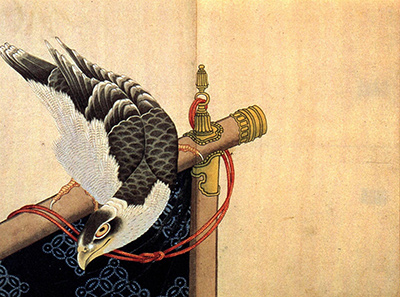
Katsushika Hokusai, Falconer’s Falcon, from An Album of Brush-Drawn Paintings. Hokusai-kan Museum, Obuse.
Buy Art Prints Nowfrom Amazon
* As an Amazon Associate I earn from qualifying purchases.
 by Tom Gurney
Tom Gurney BSc (Hons) is an art history expert with over 20 years experience
Published on June 19, 2020 / Updated on November 20, 2026
Email: tomgurney1@gmail.com / Phone: +44 7429 011000
Hawk on a Ceremonial Stand by Katsushika Hokusai
The hawk in Hokusai’s painting leans so far over its perch that its head hangs below its feet. The pale beak comes close to a dark blue cloth. Above it, the folded wings and rear feathers point up and left, while a red cord loops down from the stand and passes close to the bird’s head. Much of the sheet to the right is spare. The arrangement makes the bird’s downward turn unusually clear and brings the alert eye, the patterned plumage and the fittings of the perch into close view. [1] [2]
The Hokusai-kan Museum in Obuse holds the work as a leaf from Hokusai’s Album of Brush-Drawn Paintings. The Sumida Hokusai Museum calls it Falconer’s Falcon (Takajō no taka, 鷹匠の鷹), and the Château des ducs de Bretagne exhibited the leaf under the English title Falcon on a Perch. The unusually steep angle of the bird, ornamental finial, red cord and blue textile identify the work across those records and the published image here. The Nantes catalogue dates the painting to about 1834–36. Sumida dates the album leaves within the broader period from about 1834 to 1844. [1] [2] [3]
At a Glance
- ArtistKatsushika Hokusai
- Dateca. 1834–44
- MediumInk and colour on paper
- AlbumAn Album of Brush-Drawn Paintings
Contents
A bird in the act of leaning
Start with the eye, low on the left side of the composition. A sharply defined ring closes around its dark centre. The darker area above it gives way to fine marks on the white cheek and neck, and a short curved line carries the face down to the tip of the hooked beak. The beak and eye look down and left, almost along the line of the lowermost cord. Their direction extends the movement of the head, even though the beak itself is only a small interruption in the field of blue below. [1] [2]
The pose becomes clearer by looking back to the feet. Their slender, segmented forms hook over the shaft of the perch in two places. The leg on the left emerges below the mass of pale feathers, while the one farther right reaches from behind the edge of a darker wing. The line of the support passes beneath both feet at an angle, cutting across the much steeper line from the upper plumage to the head. The two slopes give the eye different ways of judging the lean. The bird seems on the verge of moving farther, yet the contacts at the perch remain visible. [1] [2]
Several kinds of feather marks help make the turn legible. The long outer shapes near the upper left form pointed tips and overlap in a tight group. Beneath them, shorter, rounded markings accumulate across the folded wing in darker rows. The small strokes on the pale side of the body turn with its surface and taper towards the neck. Their closer spacing distinguishes the texture of the light plumage from the broad, dark patches. Even in a small reproduction the different marks separate the bird’s volumes. In a larger view they are part of the explanation for its pose. [1] [2]
What the perch contributes
At the right end of the sloping bar, two groups of fittings catch the eye. A cap turns around the end of the shaft in bands, emphasising its roundness. Just to its left, a small upright ornament rises from a scalloped base. The ribbing of the finial, the ring below it and the ridged collar all require short, closely spaced lines, with the edges of the metalwork picked out in darker outlines. The long surfaces of the wood between these details are comparatively quiet. The concentration of marks makes the spot where the horizontal rail meets the upright one of the most carefully articulated parts of the picture. [1] [2]
The cord moves around and across that structure. Its red braid drops on the right of the upright, bends beneath the bird and returns towards the lower left. It runs over the rail at one point and around the fitting farther right. The lower section contains a visible knot. Following it takes a viewer in and out of the tight group of beak, feet and bar, then briefly into the open area to the right. The cord and the fittings belong to the familiar visual language of a tethered hawk. In this painting the bird and its equipment give Hokusai a way to move between delicate marks and continuous lines. [1] [2] [4]
Below the perch, small pale rings repeat across the dark textile. Some remain clearly visible between the folds and others fade into the shaded blue. That pattern helps show where the cloth turns and gives the bird’s pale head a distinct background. The flower-like groups also repeat at a different pace from the smaller curves on the wing. The space above the stand and out to its right is much less filled. The viewer has room to follow the silhouette of the equipment before returning to the dense area where the bird, cord and cloth intersect. [1] [2]
The brush-painted album and Hokusai’s signature
Sumida catalogues the work as colour on paper within an album of brush paintings, and the Nantes catalogue specifies ink and colour on paper. The Japanese term nikuhitsu describes work made directly by the artist’s brush. In this case the paper carries a painted composition that can be studied alongside other leaves in an album. A woodblock print could circulate in multiple impressions from the same design. The leaf in Obuse has its own physical identity, even when seen through photographs, exhibitions or digital facsimiles. [1] [2] [3] [5]
The Nantes entry gives Hokusai’s signature in a form that joins successive artist names, Saki no Hokusai Iitsu aratame Gakyō Rōjin Manji hitsu. It identifies the brush of the artist formerly known as Hokusai Iitsu, who now signs as Gakyō Rōjin Manji, the Old Man Mad about Painting. The entry also records a Fuji seal. The photographs focused tightly on the bird and its stand do not give a reliable view of the complete inscription and seal. The signature and seal descriptions come from the exhibition record. [1] [2]
The narrower date given in Nantes also appears in the Suntory Museum of Art’s 2022 checklist for the album as a whole. Sumida’s earlier checklist assigns the broader date to the individual leaves. The dates place the album in the same period as the first two volumes of One Hundred Views of Mount Fuji, issued in 1834 and 1835. The book’s printed openings and the painted hawk show that drawing for publication and working in colour with a brush remained part of the artist’s practice within a short span of years. [1] [3] [5] [6]
The group of works listed alongside the hawk gives a sense of that album’s range. It includes Scissors and Sparrow, Bowl and Japanese Pear Blossom, Snake and Small Bird and Lesser Cuckoo. In the Nantes exhibition image of Scissors and Sparrow, the bird and the instrument sit apart from each other across the light paper. In the hawk leaf, three closely interrelated subjects occupy the same side of the painting: the bird, its support and the cloth. Comparing those arrangements makes the concentrated detail around the hawk’s feet easier to see as a choice about the whole page. [1] [3]
In the 2023 Digital × Hokusai exhibition, the checklist put a full-size facsimile of the hawk in a frame with Pheasant’s Eyes and Fan and Scissors and Sparrow. The works shared a scale and a viewing space, and the visual differences stood out within the frame. Each leaf varies how much of the paper it fills, where the viewer looks first and how much detail its main subject can carry. A facsimile can make such choices easier to compare. The album in Obuse is the record of the painted works themselves. [2] [3] [11]
Hokusai’s other hawks
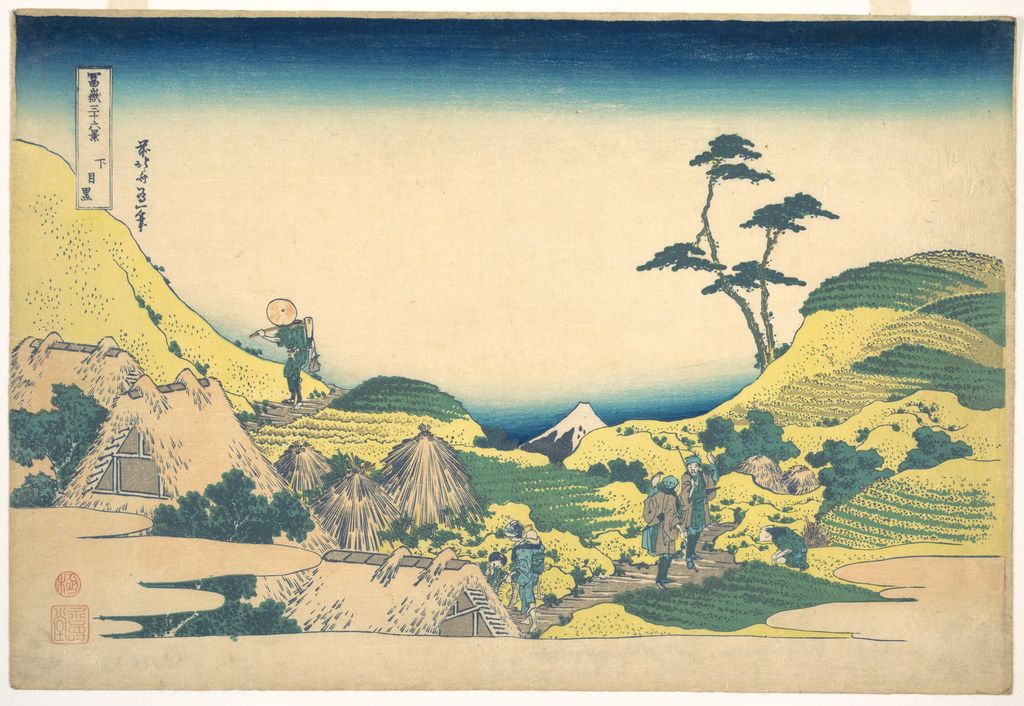
Hawks turn up in settings that give their presence different meanings. In Lower Meguro, a print from Thirty-six Views of Mount Fuji, two small falconers stand on a path near a kneeling man. The Sumida Hokusai Museum connects them with the shogun’s hunting grounds in the area. The Metropolitan Museum of Art’s impression shows the group low in a landscape of roofs, fields, hills and trees. The print asks a viewer to notice a very small bird within a place where hunting took place. The album painting brings the bird up close and makes the pattern on its wings, its foot and the equipment visible. [7] [8]
In Hawk and Cherry Blossoms, Sumida identifies the bird as a hawk used in falconry and dates the print to about 1834. The long, narrow woodblock design presents the bird amid flowering branches. Its upright figure and surrounding blossoms create a different outline from the diagonal form in the Obuse picture. In the earlier Portrait of Chino Hyōgo, Hokusai placed a hawk on the sitter’s arm while the man was seated at his desk. It belongs to a documented portrait on silk alongside the sitter’s book, clock and other possessions. The Obuse leaf brings the hawk onto a perch and gives the bird and fittings the concentration of a portrait. Follow the low eye back up to the high feathers and the empty part of the paper comes into view again. Hokusai holds the motion in the small area where the bird is still in contact with the wood. [1] [2] [9] [10]
Where this work sits in Hokusai’s career
Hokusai Manga
From 1814Hawk on a Ceremonial Stand by Katsushika Hokusai
ca. 1834–44Explore Hokusai’s works
Discussion
Look again at the images and ideas explored in Hawk on a Ceremonial Stand by Katsushika Hokusai. These editorial prompts invite your observations.
Reader Insights
Where does the painted bird meet the perch?
Which details distinguish the equipment from the hawk’s plumage?
Join the Conversation
Share a detail, comparison or question about Hawk on a Ceremonial Stand by Katsushika Hokusai below.
References
- Château des ducs de Bretagne, Hokusai exhibition dossier, p. 14, no. 83, Falcon on a Perch, official reproduction, date, technique, signature and seal. View source.
- NTT East and Hokusai-kan Museum, Digital × Hokusai: Bringing Paintings to Life, exhibition image labelled Falconer’s Falcon, from An Album of Brush-Drawn Paintings, with Hokusai-kan Museum credit. View source.
- Sumida Hokusai Museum, Hokusai: The Magic of Visual Arts, bilingual checklist, no. 12 and related album leaves, 2019. View source.
- Japanese Architecture and Art Net Users System, Columbia University, Takagari, terminology and depictions of trained hawks on perches. View source.
- Suntory Museum of Art, Hokusai from the British Museum: Beyond the Great Wave exhibition checklist, 2022, no. 112, Album of Brush Drawings, held by the Hokusai-kan Museum. View source.
- National Diet Library, One Hundred Views of Mount Fuji by Katsushika Hokusai, online exhibition and publication dates for the first and second volumes. View source.
- The Metropolitan Museum of Art, Lower Meguro (Shimo Meguro), accession JP2987, printed c. 1830–32, collection record and public-domain reproduction. View source.
- Sumida Hokusai Museum, Lower Meguro, collection record and commentary on the shogun’s falconers in the design. View source.
- Sumida Hokusai Museum, Hawk and Cherry Blossoms, collection record and account of the falconry subject and long woodblock format. View source.
- Japan Ukiyo-e Association, A Personal Handbook of Katsushika Hokusai, p. 429, description of Chino Hyōgo’s portrait, its silk support and the hawk on the sitter’s arm. View source.
- NTT East, 2023 Digital × Hokusai checklist, no. 69, first frame, documenting the full-scale facsimiles of the Hokusai-kan album paintings. View source.







