


 by Tom Gurney
Tom Gurney BSc (Hons) is an art history expert with over 20 years experience
Published on June 19, 2020 / Updated on November 20, 2026
Email: tomgurney1@gmail.com / Phone: +44 7429 011000
Tama River in Musashi Province
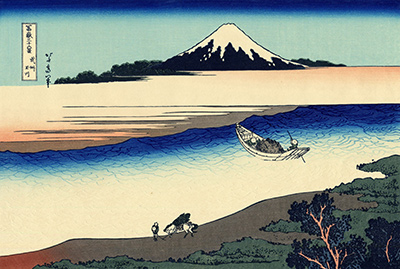
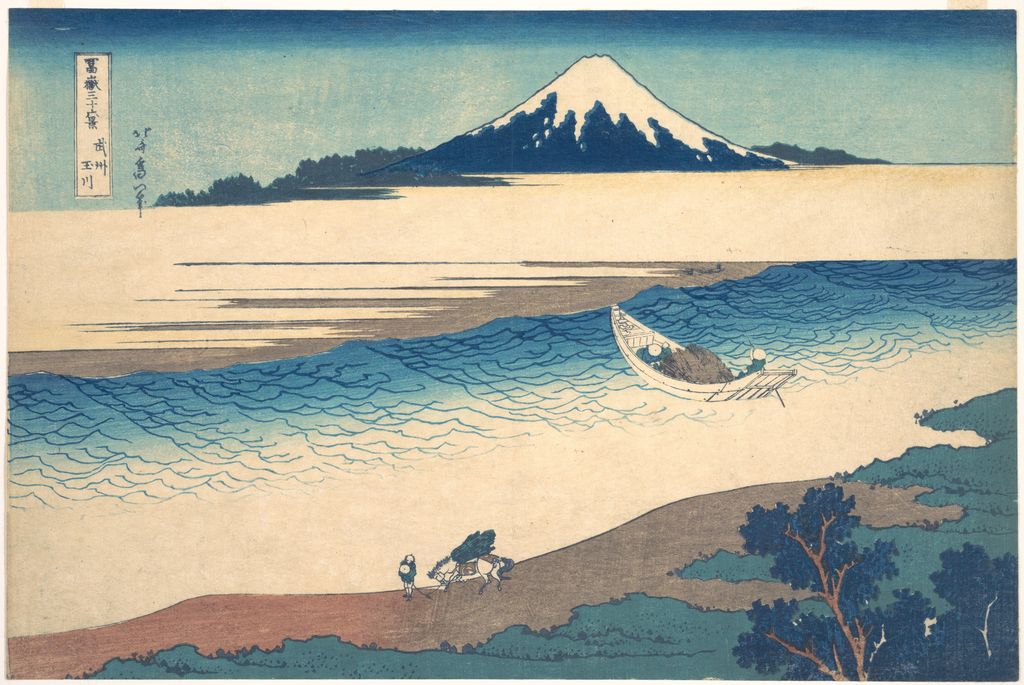
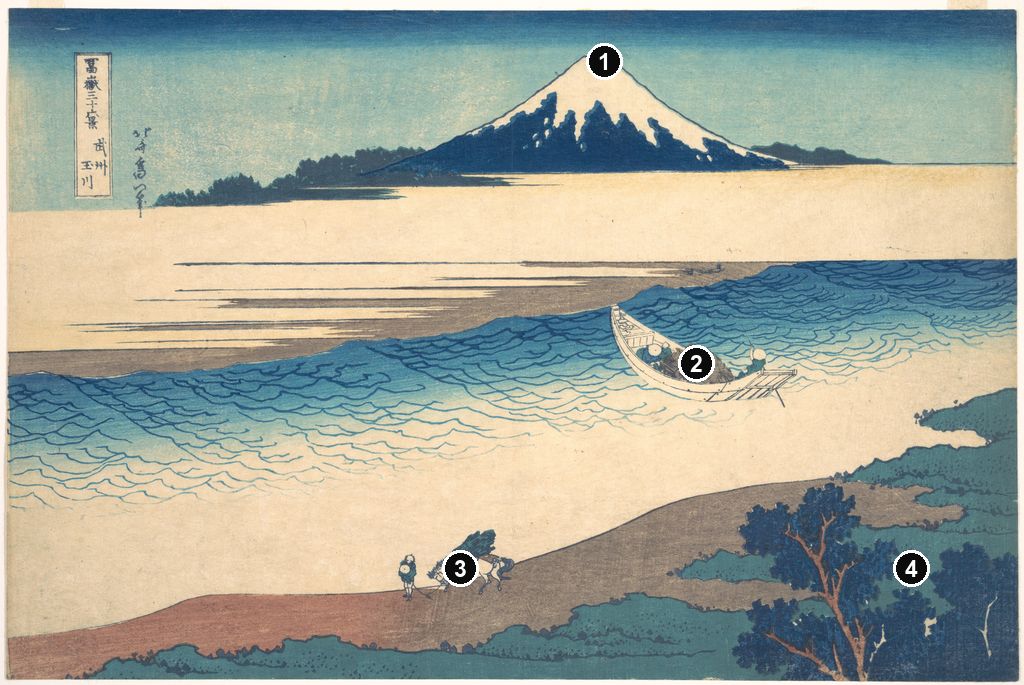
A loaded boat is midway across the water in Katsushika Hokusai’s Tama River in Musashi Province. Its pale bow cuts into a dark belt of ripples, while a person and a packhorse follow the near bank. Fuji rises above both, its white summit separated from the river by a broad stretch of mist. The Metropolitan Museum of Art dates its woodblock impression JP2991 to about 1830–32. The National Museum of Western Art’s checklist of the Iuchi Collection records this design as no. 12 under the Japanese title 武州玉川, Bushū Tamagawa. [1] [2]
At a Glance
- ArtistKatsushika Hokusai
- Dateca. 1830–32
- MediumColour woodblock print
- SeriesThirty-six Views of Mount Fuji
Contents
A boat crossing the Tama
The title refers to the river now generally written 多摩川 in Japanese. The Tokyo Fuji Art Museum proposes that the viewpoint is near a ferry crossing around present-day Chōfu, in the middle reaches. It presents that location as an interpretation. The title names a river and a historical province, without identifying a landing. The current river basin extends eastward from the mountains of Yamanashi towards Tokyo Bay, and the print offers few individual landmarks between the river and Fuji. The ferry and the broad channel can be read closely without assigning the view to a particular bend or modern bridge. [1] [3] [4]
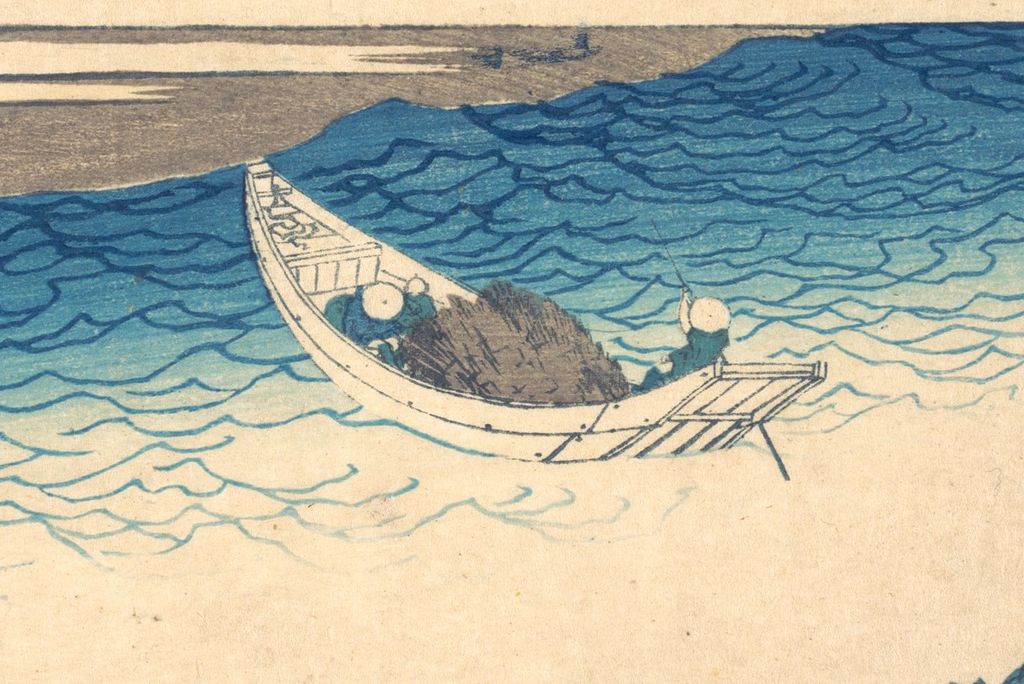
Hokusai sets the boat diagonally across the pattern of ripples. Its raised end points towards the upper left in JP2991, and the lower end lies against a much paler part of the water. This angle makes the boat easy to pick out in a scene otherwise dominated by bands that run across the sheet. Even where the waves lap against the boat, the pale edge of its hull remains legible. A few fine lines extend from the lower end. The Tokyo Fuji Art Museum describes the vessel as heading towards the opposite bank. The visible angle suggests movement across the current while leaving the destination outside the immediate action. [1] [3]
The Met identifies the cargo as branches and twigs. Part of the load is a dense dark shape in the centre of the hull, and finer lines separate it from the curved sides. Look at the small figure near the lower end of the vessel. The light shape of the head is clearer against the dark bundle than it would be against the pale water alone. A few touches are enough to put a working person aboard and to give the load a size relative to the boat. Most of the river remains open around it. Its apparent breadth depends in part on how little of it the ferry occupies. Look at the nearly empty water to the left of the boat. That area balances the fuller lower right corner, where successive patches of foliage crowd together. [1]
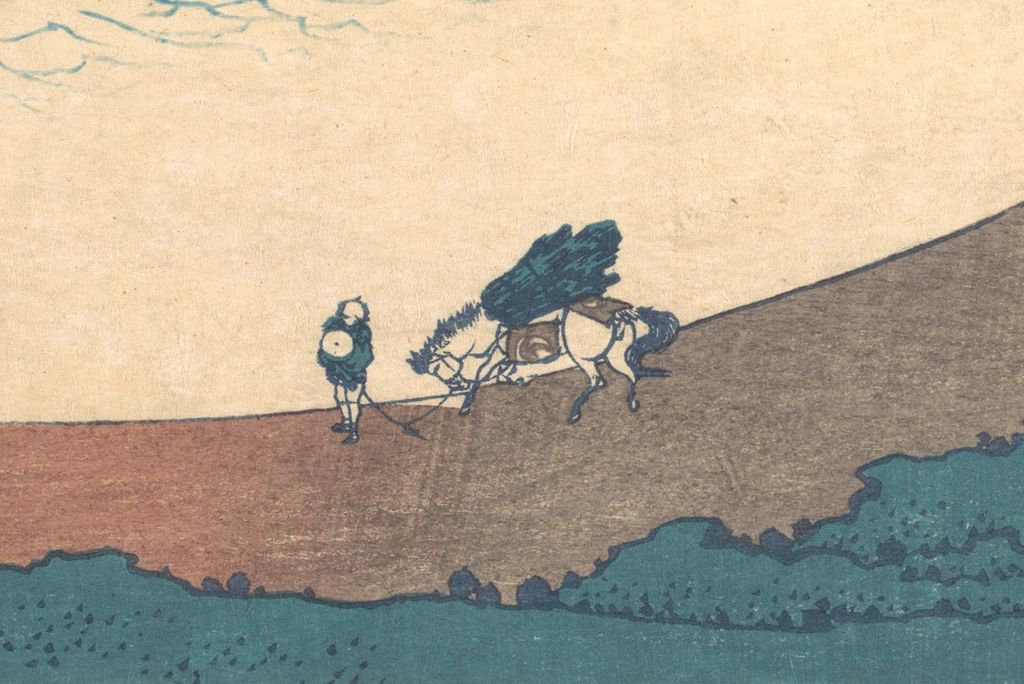
The pair on the near shore gives the crossing a counterpart on land. The horse and its handler travel together at the foot of the view. A dark mass rises above the animal’s back, and the body and legs are tiny against the pale ground. The figure is clear enough to see how the two are positioned in relation to one another, but it takes a moment to separate them from the slope. The Shimane Art Museum likewise singles out the person leading the horse in its description of the Shinjō Collection impression. The near path and the ferry share the landscape, with no visible meeting point between them. [1] [5]
The river’s changing surface
Hokusai gives the two edges of the river different characters. The foreground edge rises towards the right behind the horse and appears again among the trees. Farther back, the blue water meets a boundary marked by long, thin projections and interruptions. Some of those narrow horizontal marks extend left into lighter space. They slow down the transition between water and land and give the farther side a breadth of its own. The right corner in the foreground, where the vegetation comes right up to the edge of the sheet, brings the viewer back to the nearest ground. [1]
In JP2991, successive curves run almost side by side in some strips and break into smaller shapes elsewhere. Individual strokes stay readable even where the water loses much of its blue. The Shimane Art Museum draws attention to the irregular surface in its interpretation of this view. Here changes across a relatively quiet channel give the water much of its life. The movement is particularly easy to follow immediately to the left of the boat, where several curls across the river are visible against a light ground. At the very front of the channel, warm paper takes over and the water nearly merges with an uninterrupted pale area. [1] [5]
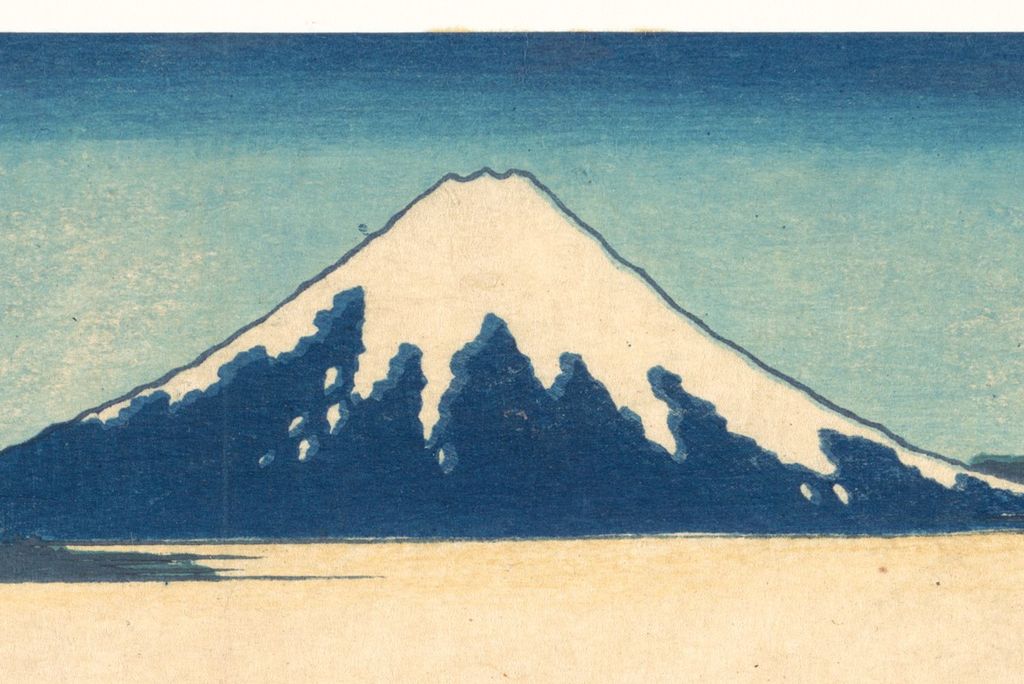
A separate light interval lies above the river, beneath the slopes of Fuji. It extends much of the way across the sheet with very few marks through its middle. The Sumida Hokusai Museum describes the mountain as seen beyond drifting mist. That reading fits the way the lower edge of the mountain flattens into a narrow strip and stops well short of the ferry. The light area above the water and the pale part of the river below it are close enough in tone to echo one another. Their distinct edges keep the distant air and the near water separate. [1] [6]
The summit occupies a wide part of the top half once its long sides are taken into account. The Tokyo Fuji Art Museum comments on the enlarged appearance of the distant mountain. In JP2991, the high point is roughly above the boat’s raised end, and the mountain’s base extends much farther sideways than the vessel. Its white upper shape has an irregular lower edge, broken by small points of blue. Compare the hue of the lower slopes with the dark foliage entering at the lower right. The Met points out that these blues connect foreground and distance, a relationship that becomes clear when the two areas are seen across the intervening pale bands. [1] [3]
Two impressions and the unprinted water
The Met’s JP2991 measures 25.1 × 37.8 centimetres. The museum’s JP2560, another impression of the same design, measures 25.4 × 38.1 centimetres and also dates to about 1830–32. The boat, horse, ripples and mountain align closely in their photographs. The blue belt around the ferry looks stronger in JP2991, with a sharper dark blue at the far edge of the water. JP2560 has an apparently broader transition from turquoise into the light foreground. Its ripple lines are still visible, especially beside and below the boat, but many are less emphatic at the same viewing size. Differences in photographed colour and contrast can affect that comparison, so the pictures alone cannot sequence these sheets. [1] [7]
Compare the horizon as well as the water. JP2560 shows a prominent dark blue band along the top. The sky below that band is lighter than the mountain’s lower slopes, which have a cooler, slightly greyer appearance than in JP2991. The change in the relative weight of these two areas affects where one looks. In JP2991, the dark curves in the river pull attention down towards the boat. In JP2560, the broader blue at the top competes more strongly with the centre of the sheet. The shape of the white summit still holds its own in both. [1] [7]
Some lines may be easier to see on a sheet in person. The Sumida Hokusai Museum identifies karazuri, a form of colourless embossing, in the ripples of its Peter Morse Collection impression. Pressure leaves a shallow relief on the paper without adding a printed colour to that area. Sumida considers its sheet to be an initial or very early impression and notes that this surface treatment is absent from most surviving examples of the view. The Tokyo Fuji Art Museum also identifies embossing in the front of the river on its own sheet. These observations concern the surfaces of those impressions. They give viewers a reason to look for the change from colour to relief. An examination of the paper itself would give a firmer basis for identifying that feature in the Met sheets. [3] [6]
One boat and a distant peak
In Tsukudajima Island in Musashi Province, Hokusai lets several boats occupy the water and gives the nearest one a load of cotton bales, according to the Met. Its strongly pointed hull recalls the outline of Fuji. The Tama River uses a different relationship between vessel and mountain. The narrow ferry points across the river, while Fuji’s long slopes spread out above it. The space between them matters as much as the forms themselves. With no other boats crowding the crossing, the ferry stands out as a single diagonal through a landscape organised mainly by the width of the river and the extent of the sky. [1] [8]
The wider Thirty-six Views of Mount Fuji gives a reader many ways of judging the distance to the same peak. In this view, follow the path from the horse towards the right until it breaks into the dark trees, then move back to the boat and across the ripples. The trip across the sheet feels longer than the small number of objects would suggest. Fuji can be seen immediately, yet the path, crossing and mist intervene between its slopes and the place from which we look. [1]
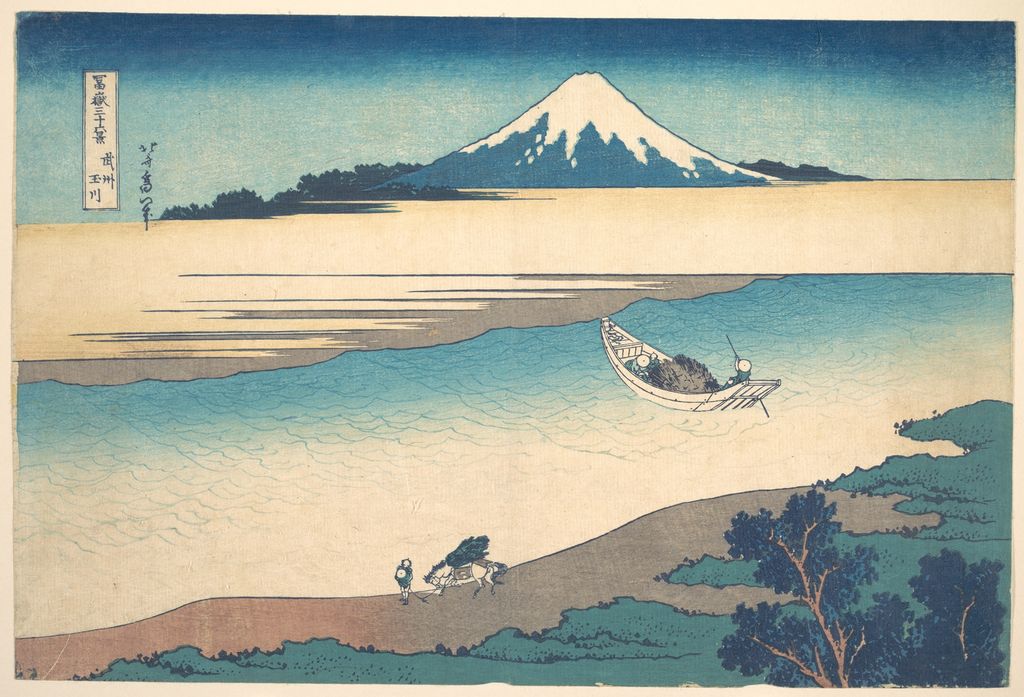
Image comparison
Where this work sits in Hokusai’s career
Annotated Details from The Tamagawa River in Musashi Province
The Metropolitan Museum of Art, JP2991. [1]
Details from THE TAMAGAWA RIVER IN MUSASHI PROVINCE
Select a detail to look closely.
Fuji rises across the water
A pale summit stands out against blue on both sides. Its broad base leads the eye along the far shore. [1]
A ferry breaks the band of the river
A dark load interrupts the pale interior of the curved boat. The small profile has room around it. [1]
A figure and pack horse follow the shore
The dark pair sits above the foreground waterline. The slope behind them makes their movement easy to follow. [1]
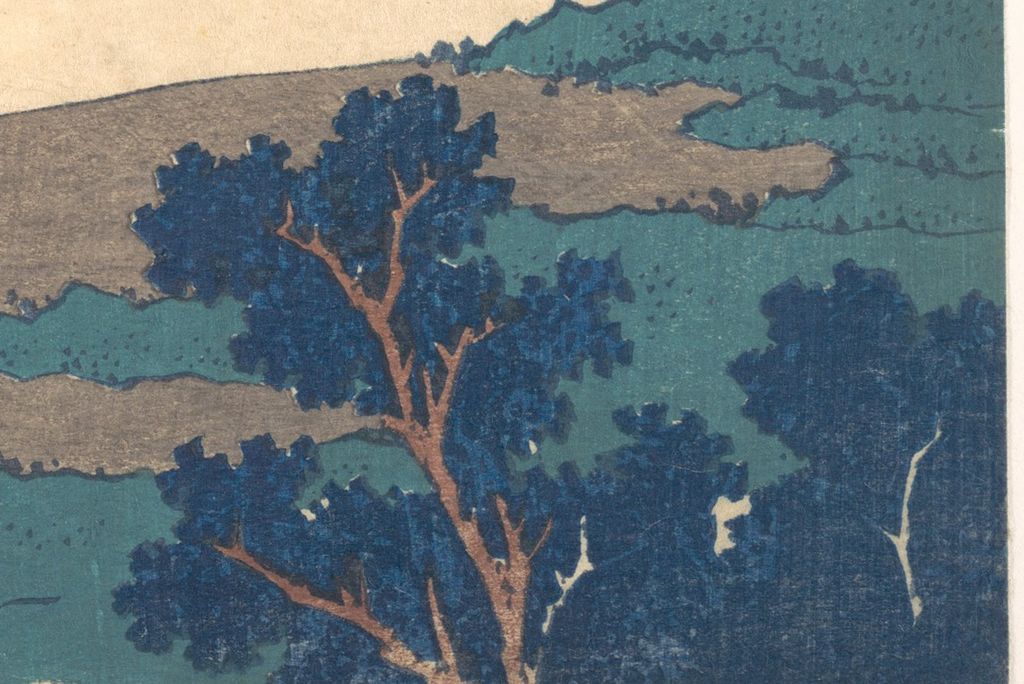
Dark foliage anchors the near bank
Blue returns in the cluster on the right. Compare its weight and broken edge with the blue across Fuji’s slopes. [1]
Explore Hokusai’s works
Discussion
Look again at the images and ideas explored in Tama River in Musashi Province. These editorial prompts invite your observations.
Reader Insights
What connects the boat to the distant bank?
Where do similar shades of blue reappear?
Join the Conversation
Share a detail, comparison or question about Tama River in Musashi Province below.
References
- The Metropolitan Museum of Art, Tama River in Musashi Province (Bushū Tamagawa), impression JP2991, collection record and photograph. View source.
- National Museum of Western Art, Iuchi Collection exhibition checklist, no. 12, 武州玉川. View source.
- Tokyo Fuji Art Museum, 冨嶽三十六景 武州玉川, collection record 06209 and Japanese commentary. View source.
- Ministry of Land, Infrastructure, Transport and Tourism, Tama River basin map and geography. View source.
- Shimane Art Museum, 武州玉川, Shinjō Collection impression and Japanese commentary. View source.
- Sumida Hokusai Museum, 冨嶽三十六景 武州玉川, Peter Morse Collection impression and Japanese commentary. View source.
- The Metropolitan Museum of Art, Tama River in Musashi Province (Bushū Tamagawa), impression JP2560, collection record and photograph. View source.
- The Metropolitan Museum of Art, Tsukudajima in Musashi Province (Buyō Tsukudajima), impression JP2990. View source.







