


 by Tom Gurney
Tom Gurney BSc (Hons) is an art history expert with over 20 years experience
Published on June 19, 2020 / Updated on November 20, 2026
Email: tomgurney1@gmail.com / Phone: +44 7429 011000
Two Carp
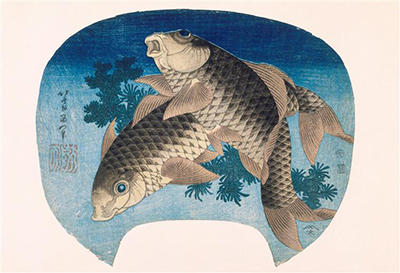
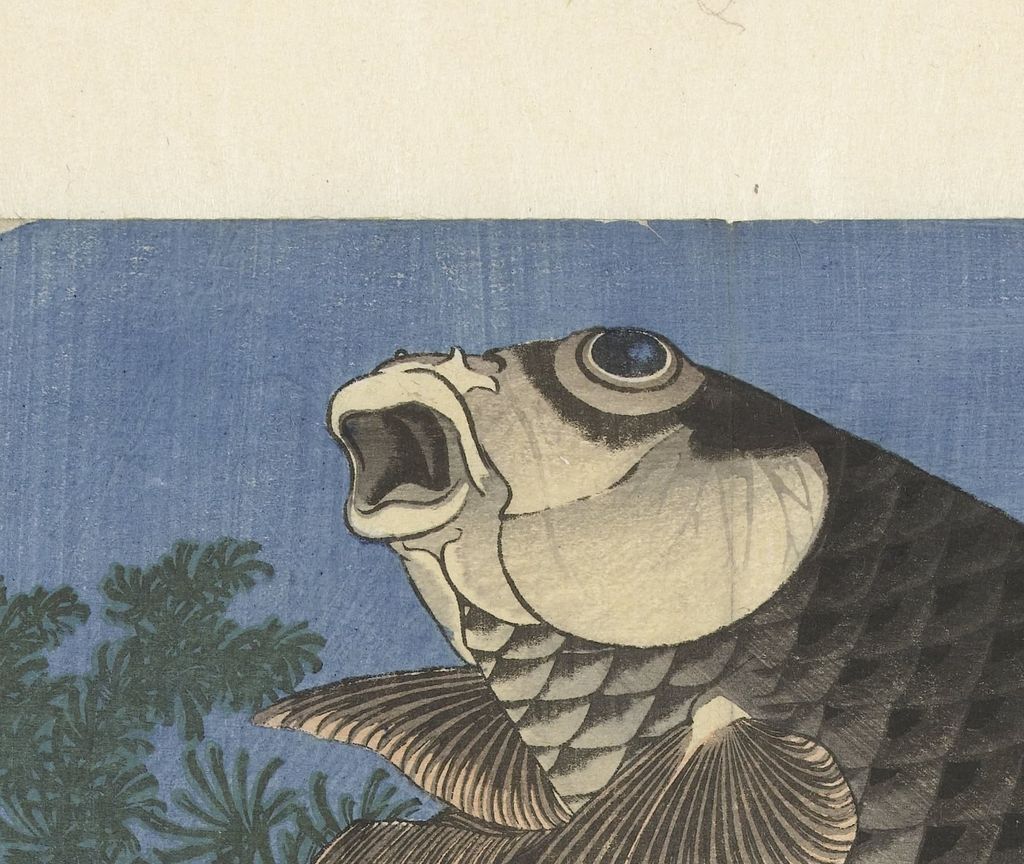
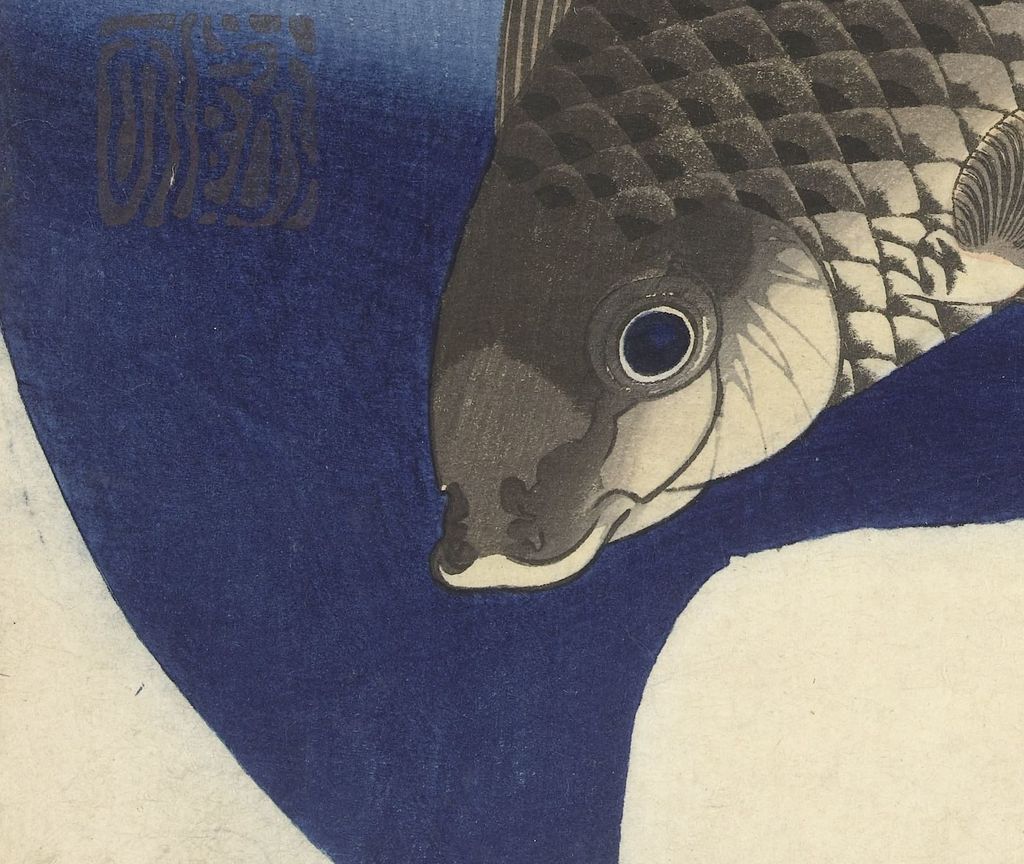
Two fish turn through a fan-shaped field of blue. One raises its open mouth towards the upper edge, where the curve of the paper image flattens into a broad arch. The other points down and left, towards a narrow strip of water beside the rounded opening at the foot of the design. Their bodies overlap in the middle. Follow the scales out from that crossing and the mass resolves into two fish, their heads and tails pulling the eye in different directions. [1]
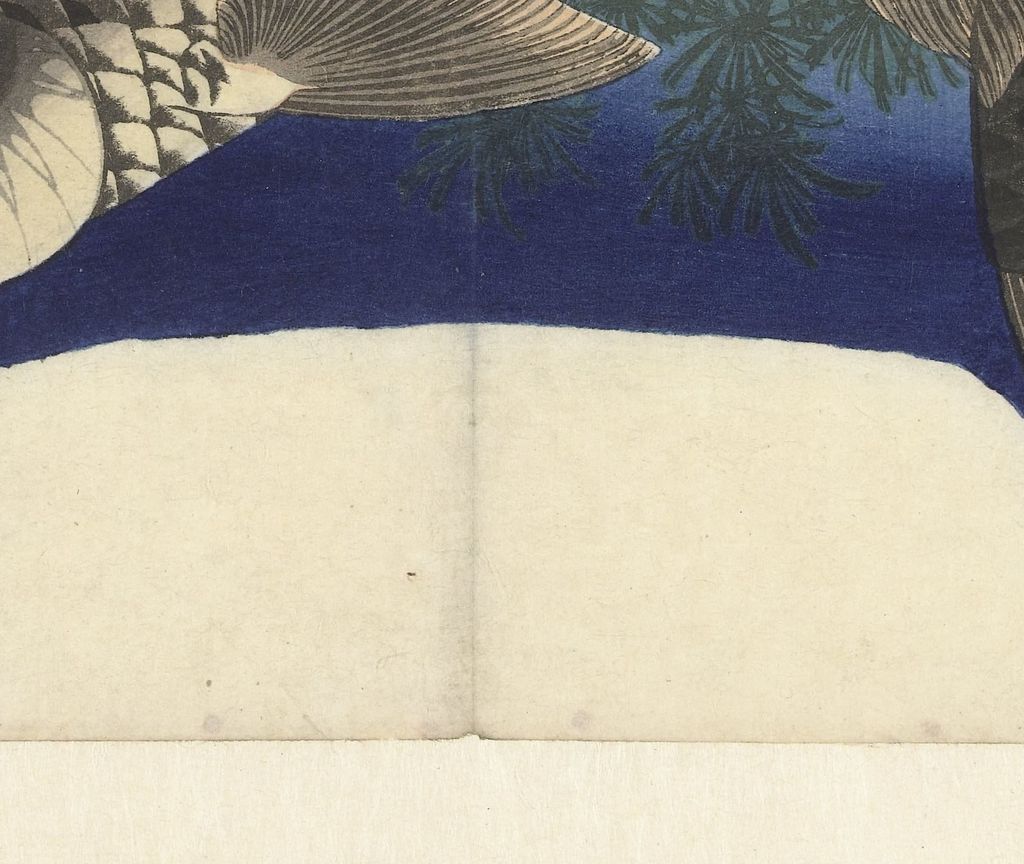
The Rijksmuseum dates its impression of Katsushika Hokusai’s Two Carp to 1831. It describes the object as an uchiwa-e, a print designed for the shape of a fixed fan, and records the sheet under accession RP-P-1960-3. The dimensions are 17.6 by 28.6 centimetres. The photograph preserves the paper around the blue design, including the pale area at the bottom where the printed field curves up into a rounded recess. The fish are both contained within that blue field. Even the fin nearest the right edge has a little space around it. [1]
At a Glance
- ArtistKatsushika Hokusai
- Date1831
- MediumColour woodblock print
- FormatRigid fan design
Contents
Reading across the two fish
The upper head is pale against the blue. The mouth has a lip, a shadow inside it and several short creases around the opening. A rim of light around the eye helps establish the angle of the head. Behind it, darker scales take up the space occupied at the front by smoother skin. The lower fish repeats parts of that sequence at a different angle. Its eye looks much closer to the lower curve, and the mouth and front of the body seem to follow that curve downwards. The two faces are separated as much by their positions against the blue as by the overlapping forms between them. [1]
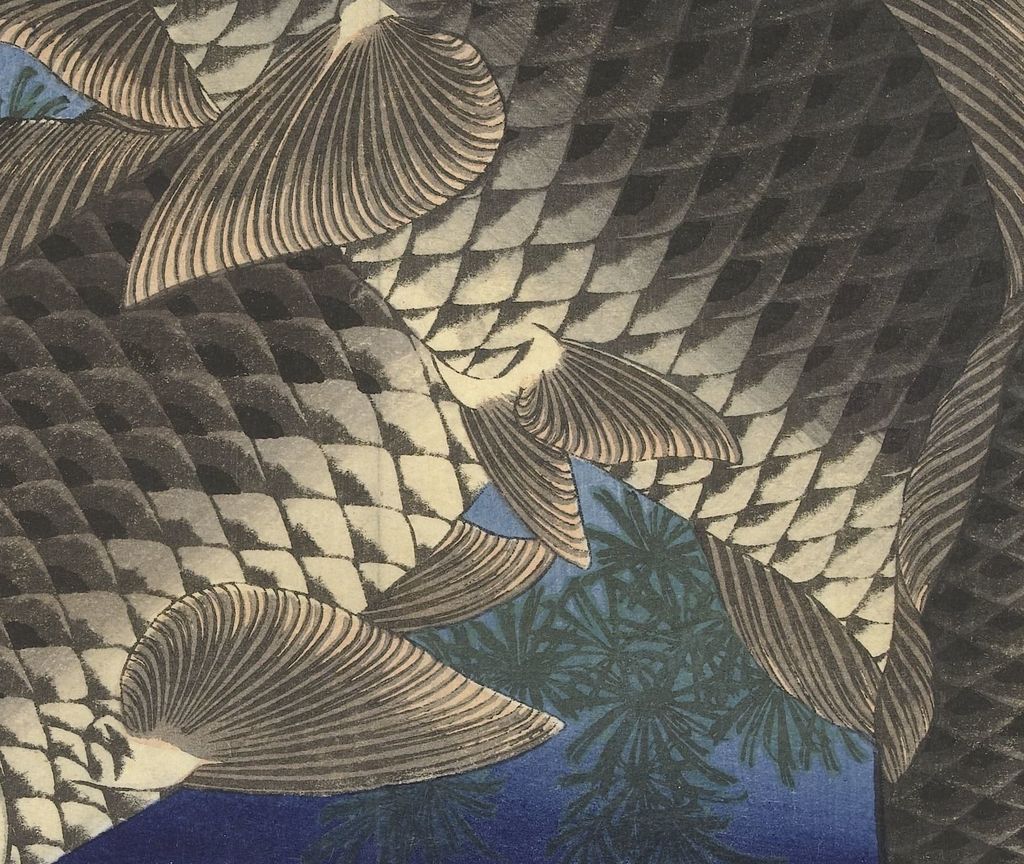
The centre of the print takes longer to read. Lines of scales meet and cross one another, and the darkest sections of the bodies gather at the crossing. Hokusai gives the scales a repeated structure, then changes the amount of light they catch as each fish turns. On the lower fish, the lighter area near the head narrows into the dark body. On the upper fish, rows of light scales become conspicuous again below the dark back. The different sequences let us follow two surfaces through the same patch of the picture. [1]
The fins use a different kind of line. The scales give the body a texture made up of small overlapping shapes, while long thin strokes run from the base to the edge of each fin. In places the strokes spread like ribs. The tails use the same directional lines on a larger scale. On the right, the curve of the upper fish takes its tail down towards the edge, while the other tail opens farther up the sheet. The open water between them gives each tail its own contour. [1]
Dark plants fill some of the spaces around the fish. The Rijksmuseum describes the vegetation as seaweed in its object label. The feathery forms make the blue read as water while retaining large areas where the fish have room to move. At the left, the leaves create a dark cluster beside the vertical characters. Farther round the curve, stems show through the space between the body and tail. Those patches of vegetation help the eye judge which parts of the fish overlap and which simply come close together. [1]
Try taking in the heads and tails as four separate points around the crossing. The two heads tilt opposite ways on the left, and the tails open at different heights on the right. Between the upper face and the upper tail, there is a shallower stretch of blue than there is along the lower margin. The open spaces form an uneven frame around the two fish. Each turn of a body changes the shape of the surrounding water as surely as it changes the shape of the fish itself. [1]
A design made for a fixed fan
The fan shape directs the movement. The blue surface rises over the pale recess and comes down to a point on either side. The heads and tails lie at different distances from that boundary. The left fish draws close to the curve, where its pale mouth comes near the unprinted paper. The lower right tail follows the boundary on the other side. The space above the recess is reserved for the dark overlapping bodies. The outer shape explains the arrangement almost as clearly as the bodies themselves do. [1]
In its account of Edo-period fans, the Metropolitan Museum of Art explains that uchiwa-e could be attached to a split bamboo frame with a handle, or collected in the form of a print. In RP-P-1960-3 the Rijksmuseum catalogues paper and records the technique of the impression. The photograph shows the flat work and its margins, including the complete outline of the printed fan. An assembled fan would bring that shape into the hand and change the way it was seen, as the viewer moved it or turned it towards the light. The Rijksmuseum record establishes the relationship to the format through the shaped image itself. [1] [2]
The fan shape can also be a painted support. Hokusai’s Drunken Asaina, in the Met, depicts the reclining figure on a fan painted in ink and colour on paper. It is now mounted as a hanging scroll. There the broad curved upper edge leaves open space around a single compact figure. In Two Carp, the fish use much more of the available width, and a darker field covers almost the entire fan surface. Both works exploit the shape by keeping the strongest forms well inside its outline. Their medium and surviving presentation give those shapes a different physical presence. [1] [3]
Black line and printed colour
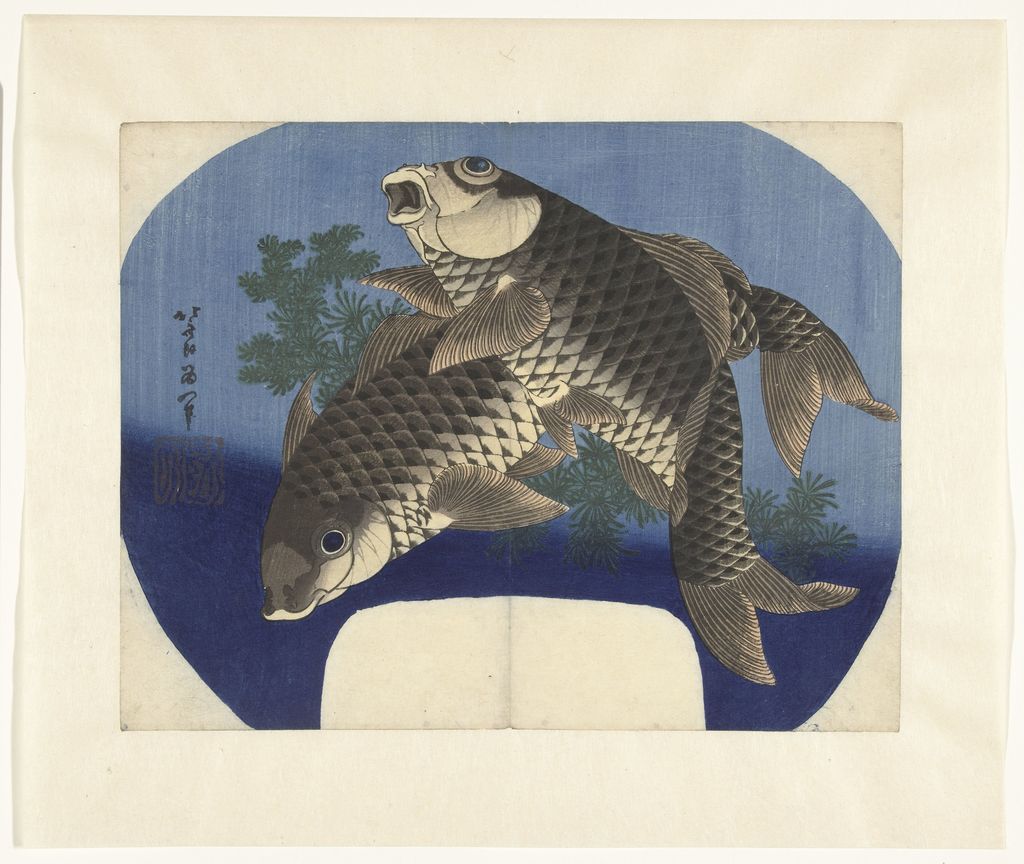
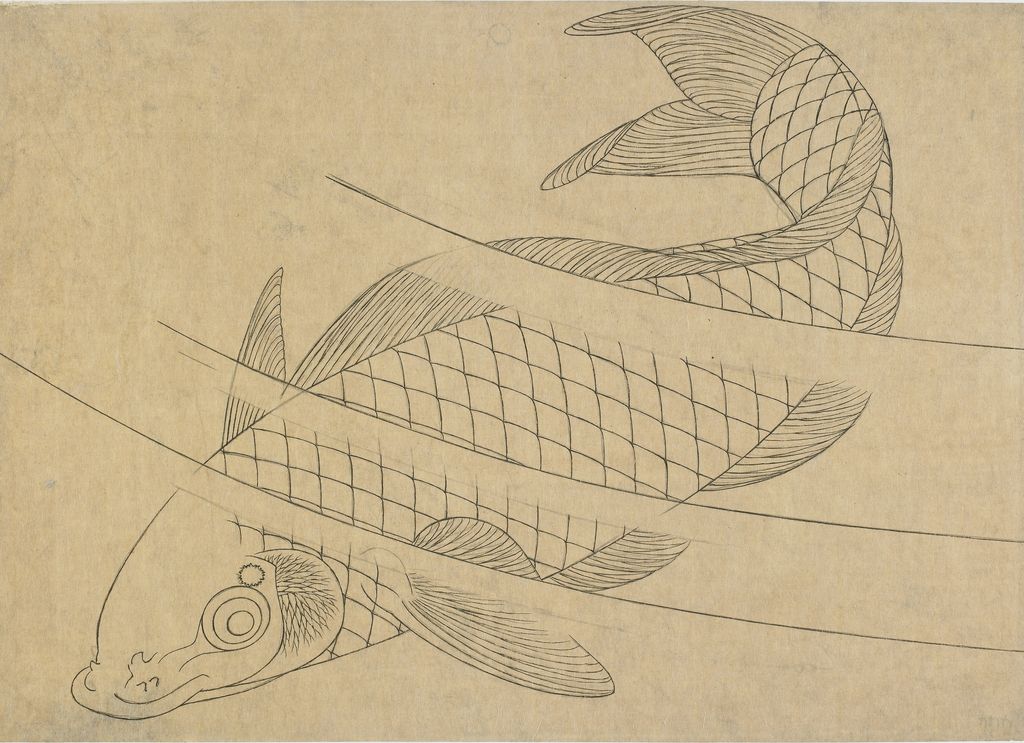
The Rijksmuseum identifies Two Carp as a colour woodcut made with a black line block and colour blocks. A reader can see what that distinction contributes by following a single contour. Around the upper mouth, the dark printing makes the rim and opening clear. Across the flanks, the pattern of dark scales holds together as the colour underneath shifts from grey to lighter tones. The blue field carries much less line than the fish themselves. That difference lets a thin dark edge, such as a fin tip, remain readable against an expanse of colour. The print is a useful example of how colour blocks can supply much of the space and volume while black marks articulate the forms. [1]
The woodblock printmaking process also helps explain why it matters which reproduction we are looking at. In the Rijksmuseum image, a dark band of blue runs through the lower region of the fan. The lighter colour above it gives the back of the upper fish an especially distinct outline. Look back at the narrower gaps around the tails and the gradation gives the water some variation, even without a line that would mark its surface. The museum’s description identifies the black and colour blocks. It leaves the pigment and the printing sequence for a technical account of the particular impression. [1]
Carp on a wider sheet and in falling water
In Hokusai’s Carp and Turtles, held by the Saitama Prefectural Museum of History and Folklore, the artist gives two fish and two turtles a much wider field. The city’s catalogue describes the work as a colour painting on paper from 1813 and gives the painted dimensions as 26.8 by 91.8 centimetres. Across the long shape, the fish occupy the central part and the smaller animals sit about them. The pale sweep of water leaves space for those smaller bodies to register on their own. The broad distance between one end of the sheet and the other encourages the viewer to travel across it. [4]
Set that painted picture beside the fan and the overlap of the fish makes an especially good point of comparison. In the painting, the overlapping curves sit within a long horizontal movement. The tails and the water sweep extend it. In Two Carp, turning bodies are concentrated towards the centre while their tips reach closer to the edge. A pair of fish can therefore organise both a broad stretch of paper and a compact curved field. The frame gives the crossing of the bodies a different consequence in each work. [1] [4]
The long upright print Two Carp in a Cascade gives the eye another direction to follow. In the Tokyo National Museum impression catalogued as A-10569-659, one large fish is set against the bands of the falling water, and a much smaller fish is visible in the pool below. The water keeps the two fish apart in the viewer’s field of attention. The fan print brings both fish into the same region by laying one across the other. The cascade can sustain a long journey from the upper rocks down towards the basin, while the fan keeps sending the eye back through its centre. [1] [5]
That return is a good way to see the work in a single glance and then more slowly. Start where the upper head stands out against the blue, then let the scales take your eye down through the overlap. Follow the lower fish towards its mouth, and let the curve of the fan take you across the bottom. The small recess stops that movement for a moment. When the right-hand tail picks it up again, the curve has brought you back to a different part of the same two bodies. [1]
Where this work sits in Hokusai’s career
Annotated Details from Two Carp
Rijksmuseum, RP-P-1960-3. [1]
Details from TWO CARP
Select a detail to look closely.
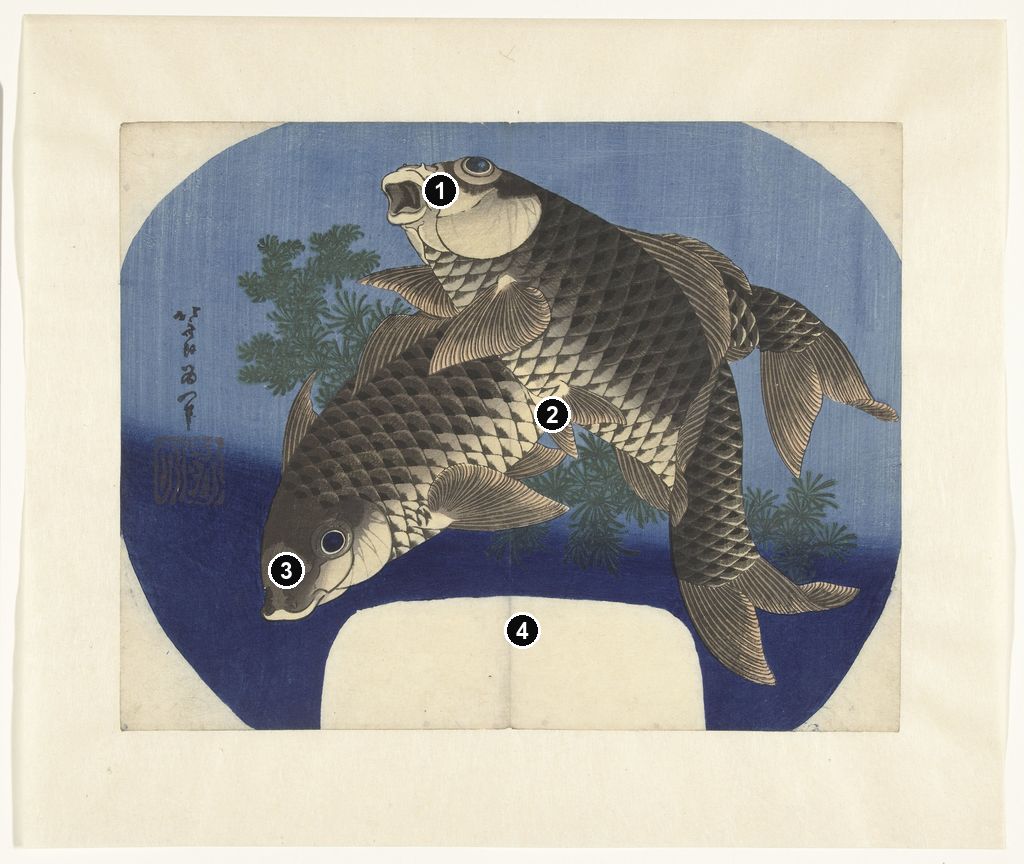
The upper carp turns towards the edge
The pale head projects from the dark body. The blue beyond leaves a narrow opening above its mouth. [1]
Two bodies cross
The pale scale marks and dark edges distinguish the body in front from the fish behind it. [1]
The lower fish curves down
The lower carp follows a different arc. Its downward movement carries the eye towards the shaped opening. [1]
The fan opens below the fish
The unprinted recess rises between the lower edges and interrupts the field of blue. [1]
Explore Hokusai’s works
Discussion
Look again at the images and ideas explored in Two Carp. These editorial prompts invite your observations.
Reader Insights
How do the fish lead your eye around the arc?
What changes where the image meets the lower opening?
Join the Conversation
Share a detail, comparison or question about Two Carp below.
References
- Rijksmuseum, Two Carp, accession RP-P-1960-3, object record and photograph. View source.
- The Metropolitan Museum of Art, Fans to Remember, curatorial account of Japanese fixed fans and fan-shaped prints. View source.
- The Metropolitan Museum of Art, Drunken Asaina, accession 1991.151, object record and image. View source.
- City of Saitama, Illustration of Carp and Turtles by Katsushika Hokusai (Color on Paper), Saitama Prefectural Museum of History and Folklore painting and object description. View source.
- Tokyo National Museum via Cultural Heritage Online, Carp Ascending a Waterfall (鯉の滝登り), accession A-10569-659, object record and image. View source.







