


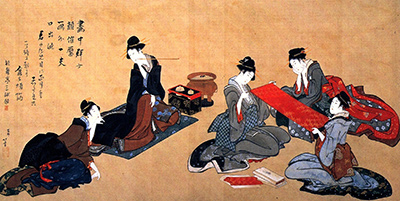
Unidentified group scene. Hokusai’s documented portrait shows Chino Hyōgo alone at his desk.
Buy Art Prints Nowfrom Amazon
* As an Amazon Associate I earn from qualifying purchases.
 by Tom Gurney
Tom Gurney BSc (Hons) is an art history expert with over 20 years experience
Published on June 19, 2020 / Updated on November 20, 2026
Email: tomgurney1@gmail.com / Phone: +44 7429 011000
Portrait of Chino Hyōgo by Katsushika Hokusai
Chino Hyōgo sits at a low desk, reading, with a hawk perched on his arm. A clock stands beside the desk. A brush holder contains brushes and a peacock feather, and a sword rests on a rack behind him. Hokusai painted these objects alongside a man who helped administer the Takashima domain in Shinano Province. The finished work is a hanging scroll in colour on silk, dated to 1810–12 in the Nagano Prefectural Art Museum’s exhibition catalogue. Its Japanese title, Chino Hyōgo shōzō (千野兵庫肖像), gives the sitter’s name. The description of him at his writing desk refers to the scene within the portrait. [1] [2]
Hyōgo was also known as Chino Sadasuke (千野貞亮). The painting remains in a private collection, and the Nagano museum showed it in Katsushika Hokusai and the Three Shinanos in 2023. A photograph from that exhibition identifies the original scroll alongside a later hanging scroll of three separate portraits. The horizontal group scene historically reproduced online under the English writing-desk title differs from both documented compositions. Its figures and furnishings cannot establish what is visible in Hokusai’s portrait. [1] [3] [4]
At a Glance
- ArtistKatsushika Hokusai
- Dateca. 1810–12
- MediumColour on silk, hanging scroll
- SubjectPortrait of a senior Takashima retainer
Contents
A senior retainer at his desk
Hyōgo served as a karō, a senior retainer with administrative responsibilities, in the Takashima domain around Suwa. The 2023 exhibition gave his portrait a setting through records from the Suwa City Museum and works deposited there. Two registers attest to the domain’s practice of listing retainers. An undated letter from Hyōgo shows his hand at work on paper, and another document is a copy of correspondence attributed to him. An incoming letter from Suwa Gunjirō is dated 1782. Displayed alongside the painting, these objects put the desk in the context of a life that included writing, reading and the exchange of information. [1] [5]
The text Hyōgo reads is unidentified in the published descriptions. The distinction matters because the exhibition puts quite different kinds of evidence within sight of one another. A letter has a sender and an addressee. A register records people in an administrative order. A portrait can make writing and reading part of an individual’s appearance without fixing the book to a particular transaction. Hyōgo’s position in the painting can be read alongside his position in the domain, while the scene remains a composed image of a named person. [1] [2] [5]
The objects around Hyōgo bring his public duties and personal interests into the same picture. The sword is set behind him, where it remains visible while his attention goes to the book. The clock and brush holder sit at the working height of the desk. The hawk occupies the space just beside Hyōgo’s concentrated face and hands. It introduces the presence of another living being among objects that would otherwise stay fixed. In his study for Kokka, art historian Toshinobu Yasumura draws attention to both the number of the sitter’s possessions and Hokusai’s rendering of their different surfaces. The selection gives the portrait a sense of how its sitter lived among the things he used and kept. [2] [6]
In the detail reproduced in the Japanese handbook, the tabletop gives the scene its strongest line. A red frame and dark surface carry the eye across the clock, book and sitter’s hands. The open volume spreads out close to the front edge of the desk. Hyōgo turns his head towards the book and extends a hand to the upper corner of the pages. His robe spreads behind the desk in dark folds, with a pale crest on either side of the collar. Behind the open book, the light grey plumage of the hawk shows clearly against the dark clothing. The objects then come into focus separately, especially the upright clock and the broad pages laid open near his knees. [2]
The furnishings have distinct shapes as well as materials. Read across the desk and the standing clock rises away from the book’s flat pages. The long peacock feather and brushes make a cluster of slender lines at the far end. The rack behind Hyōgo takes the eye into a shallower stretch of space, running almost across the sitter’s shoulder line. The differences give the accessories a role in the composition even where their history remains unknown. The published descriptions identify a Japanese clock and brush holder without assigning either one to a particular maker. [2] [6]
A painted scroll and its signature
Hokusai’s Portrait of Chino Hyōgo is a single hanging scroll. In the catalogue, the format is recorded alongside the technique, colour on silk. The material and format would have given the viewer a continuous painted surface with the person and his belongings set against a yellow-toned field. The identity of this painting is tied to a particular painted support and its history. A woodblock design such as Lake Suwa survives in multiple impressions on paper. The later portrait scroll offers a different kind of survival, in which another artist painted an earlier likeness again. [1] [2] [3] [7]
The two portraits that headed the Suwa section of the Nagano exhibition are both on silk, which makes their different arrangements worth looking at first. Hyōgo and his possessions occupy the first work. The later painter, Kitahara Toshikiyo, places the likenesses of Hyōgo, his son Sadachika and Shōkaen in a vertical sequence. The original places a viewer in front of one man and the things arranged around him. The later version puts that likeness in relation to two other people, each occupying a different area of the same scroll. [1] [3] [8]
Dating the original involves more than identifying the silk and its sitter. The museum places it in the seventh through ninth years of the Bunka era, corresponding to 1810–12. Yasumura uses the period in which Hokusai signed with the name found on the work to propose a narrower range, Bunka eight or nine. A published handbook transcribes the inscription as 東陽葛飾北斎辰政写 and records a seal reading 雷震. The inscription’s opening, Tōyō, is of particular interest to the exhibition researchers, who interpret it as identifying the painter with Edo. The proposed date rests on how the artist’s names were used during his career. Neither the medium nor the presence of the inscription alone gives a precise date or a place of execution. [1] [2] [3] [6]
The later portraits and the possibility of a visit
The Nagano museum catalogues Kitahara Toshikiyo’s Portraits of Chino Sadasuke, Chino Sadachika, and Shōkaen to the late Edo or Meiji period. The scroll is deposited at the Suwa City Museum. Toshikiyo is understood to have copied the likenesses of father and son and added Shōkaen below. In the exhibition photograph, the two scrolls make clear what that process changes. A likeness that has its own hanging scroll in the earlier work can be held in a later composition that places members of a family history in a single sequence. The copy matters as evidence of the continued circulation of the likeness, as well as a work with an artist, structure and approximate date of its own. [1] [3] [8]
Yasumura uses the combined portraits as evidence that Hokusai also painted Hyōgo’s son. In discussing the original portrait, Yasumura and Nagano curator Osamu Uesawa call attention to the precise treatment of familiar objects and the explicit reference to Edo in the signature. They propose that Hokusai may have worked in Suwa, where he could have encountered the Chino family and seen their possessions. The curators also acknowledge the absence of a document recording such a visit. The proposal has force because it brings together two portraits, the wording of a signature and the detail in a painted interior, while the exact movements of Hokusai remain open. [3] [6] [8]
Hyōgo died in 1812, the year in which Yasumura notes that Hokusai appeared in Nagoya and made sketches associated with the beginnings of the Hokusai Manga. The art historian suggests that travel through Suwa could fit that sequence if the portrait was made in Bunka nine. The itinerary depends on the dating of the work and a possible visit that the existing documentary record does not establish. It does, however, give a reason to consider the portrait alongside the early nineteenth-century work Hokusai made for people and audiences beyond Edo. The Nagoya sketches have their own published history. The first volume of the Manga appeared in 1814 and drew on drawings associated with his stay with Gekkōtei Bokusen. [3] [6] [10]
From the sitter’s room to Lake Suwa
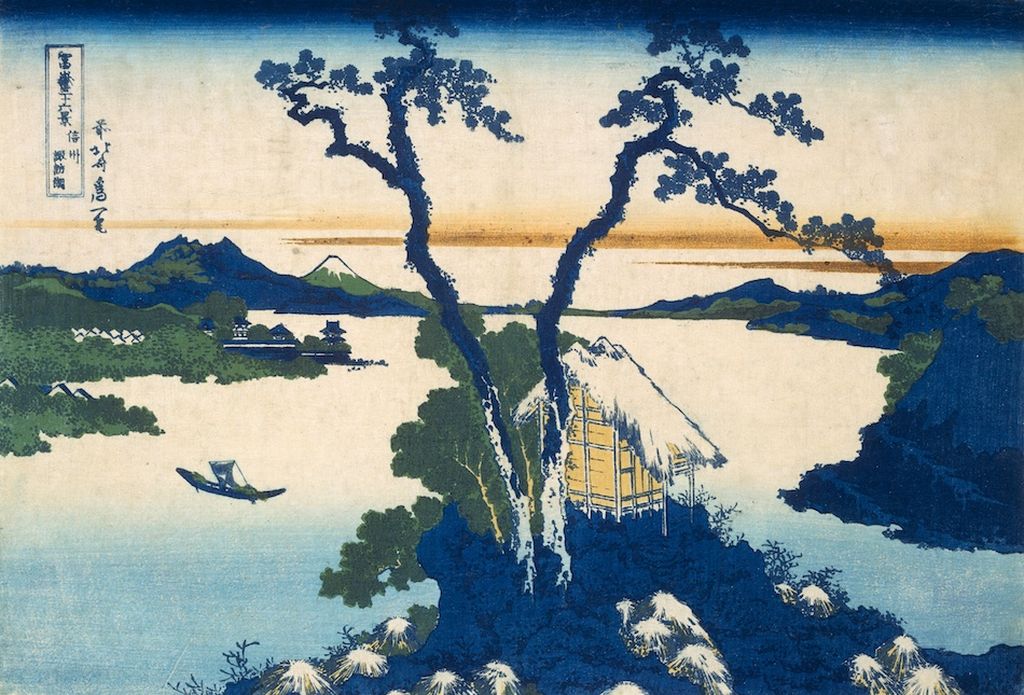
The 2023 exhibition put the portraits in the same regional chapter as Hokusai’s Lake Suwa in Shinano Province. The Tokyo Fuji Art Museum’s impression, which appeared in the exhibition, belongs to Thirty-six Views of Mount Fuji and is dated to 1830–32. The print looks out across a broad body of water from a small promontory. A tree and building draw attention to the nearby land, while the mountain’s triangular form appears at a distance. The relationship between near and far gives the lake its scale. [1] [7] [9]
The print arrived roughly two decades after the portrait. Both works give distant viewers a way into Hokusai’s associations with Suwa, and they do so through different evidence. In the print, a named place is carried out into the world as part of a published series. In the hanging scroll, a sitter’s name is rooted in the domain’s history, with a letter and later copies placing the man in a fuller record. In the 2023 exhibition the landscape, likeness and documents came together again. That arrangement gives Hyōgo’s book, the objects on his desk and the hawk in his room a setting wider than the painted silk. [1] [3] [7] [9]
Where this work sits in Hokusai’s career
Portrait of Chino Hyōgo
ca. 1810–12Hokusai Manga
From 1814Ōiko Pouring Sake for a Warrior
1820 or 1829 in collection recordsExplore Hokusai’s works
Discussion
Look again at the images and ideas explored in Portrait of Chino Hyōgo by Katsushika Hokusai. These editorial prompts invite your observations.
Reader Insights
What do the objects around Chino Hyōgo tell us about the sitter?
What does the Lake Suwa print add to the setting?
Join the Conversation
Share a detail, comparison or question about Portrait of Chino Hyōgo by Katsushika Hokusai below.
References
- Nagano Prefectural Art Museum, bilingual checklist for Katsushika Hokusai and the Three Shinanos, especially items 233–243 on the portrait and related works and documents. View source.
- Japan Ukiyo-e Association, A Personal Handbook of Katsushika Hokusai, p. 429, catalogue description of the silk portrait, desk, belongings and signature. View source.
- Culture Nagano, exhibition report and gallery talk with Toshinobu Yasumura and Osamu Uesawa, “Hokusai’s connections with Suwa” section, with a labelled photograph of the two scrolls. View source.
- Wikimedia Commons, Portrait of Chino Hyogo Seated at His Writing Desk, historical online group-scene reproduction with the writing-desk label. View source.
- Nagano Prefectural Art Museum, 2023 institutional report and original exhibition inventory, with the loan and deposit information for works relating to the Chino family. View source.
- Toshinobu Yasumura, “Portrait of Chino Hyōgo by Katsushika Hokusai,” author’s summary, Kokka no. 1556, on the sitter, objects and interpretation of the artist’s signature. View source.
- Tokyo Fuji Art Museum, Thirty-six Views of Mount Fuji: Lake Suwa in Shinano Province, 01167, object record, exhibition history and public-domain image. View source.
- Osamu Uesawa, Nagano Prefectural Art Museum curator, interview at the 2023 exhibition on the figures in Kitahara’s later scroll and Hokusai’s possible visit. View source.
- Nagano Prefectural Art Museum, exhibition prospectus, part two on Hokusai and Suwa and the Tokyo Fuji Art Museum loan of Lake Suwa in Shinano Province. View source.
- Matthi Forrer, “Hokusai as an Illustrator of Books,” Smithsonian Libraries and Archives and National Museum of Asian Art, Pulverer Collection, on the 1812 Nagoya visit and Hokusai Manga. View source.







