


 by Tom Gurney
Tom Gurney BSc (Hons) is an art history expert with over 20 years experience
Published on June 19, 2020 / Updated on November 20, 2026
Email: tomgurney1@gmail.com / Phone: +44 7429 011000
Hodogaya on the Tōkaidō Road
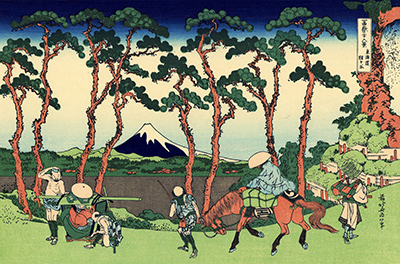
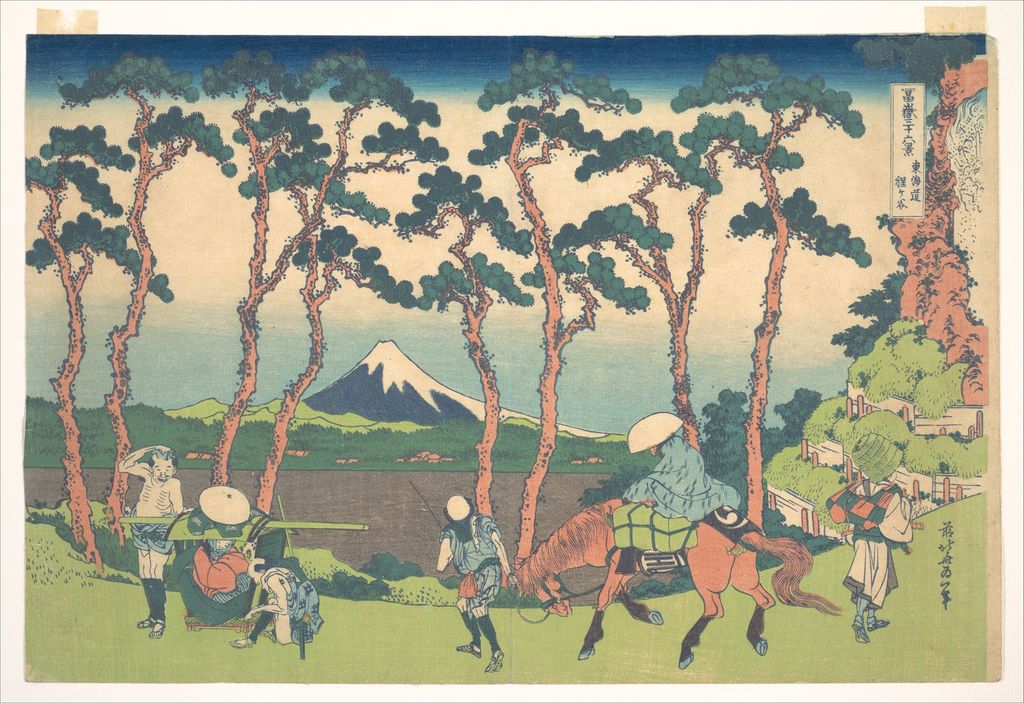
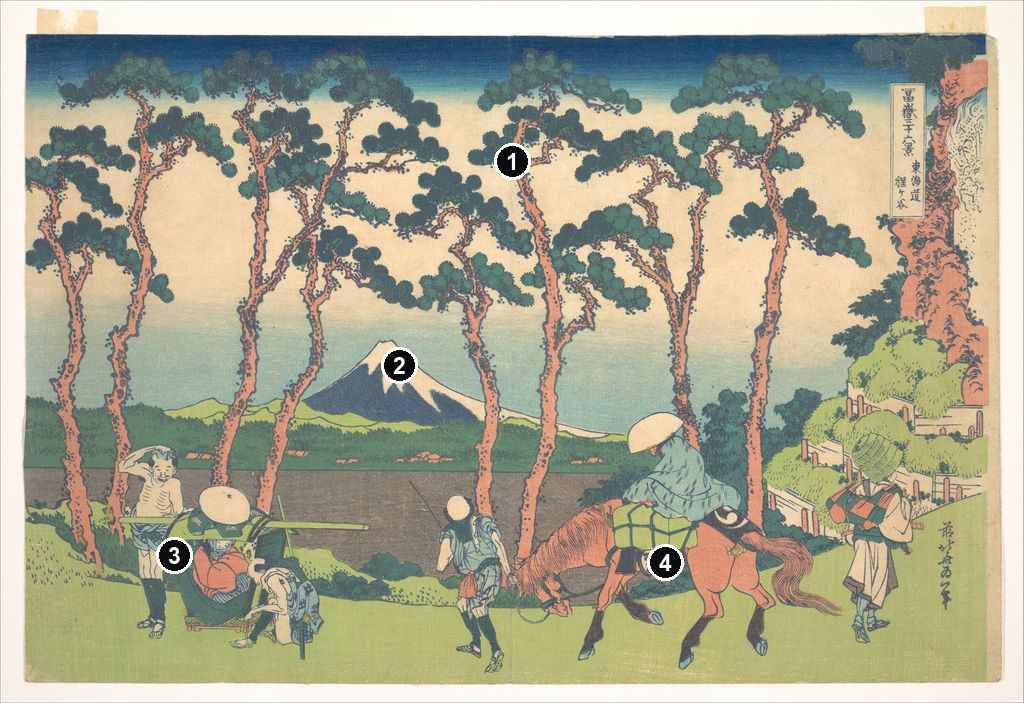
Mount Fuji appears between the trunks of roadside pines in Katsushika Hokusai’s Hodogaya on the Tōkaidō Road. A mounted traveller passes in front of the trees. Farther left, two men have stopped with a palanquin, and someone in the group bends close to the ground. A horse lowers its head almost to the height of a person on foot. The walkers, the horse and the men at rest take up the narrow green strip across the bottom of the print. Between the trunks, a pale summit rises above fields that extend well beyond the road. Hokusai gives the traveller’s view and the labour of getting there nearly equal room. [1]
The Metropolitan Museum of Art dates its colour woodblock impression JP2562 to about 1830–32. It measures 25.7 by 38.1 centimetres. The upright title cartouche at the upper right names Hodogaya as a place on the Tōkaidō. Its straight border stands beside the last tree, whose narrow trunk changes direction as it rises. The design belongs to Thirty-six Views of Mount Fuji, where a near object can determine how much of the mountain a viewer sees. Here the pines separate the mountain from the foreground in several places, and the people move in and out of the openings between them. [1]
At a Glance
- ArtistKatsushika Hokusai
- Dateca. 1830–32
- MediumColour woodblock print
- SeriesThirty-six Views of Mount Fuji
Contents
The intervals between the trunks
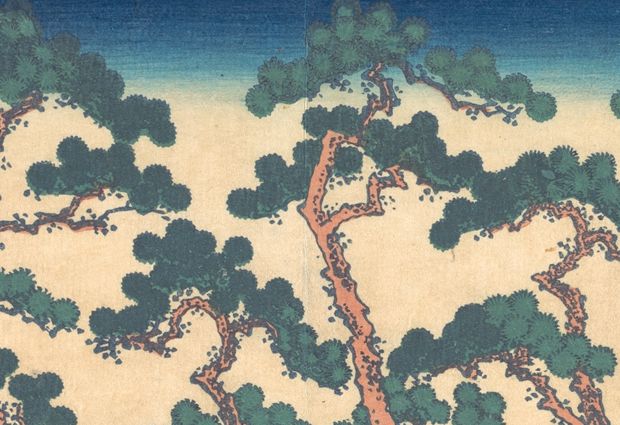
Start at the left edge and follow the dark branches overhead. Their crowns gather in flat, compact clusters, while the trunks bend in uneven, narrow lines. Some rise almost straight for much of their length before sending out a branch. Others divide much lower and then lean towards a neighbouring tree. The Sumida Hokusai Museum counts eight pines and links the rhythm of the trunks with the steps of the travellers and horse. A person walking through the avenue would continually lose and regain a view of Fuji. Hokusai makes a similar alternation possible for someone looking across a still sheet. [1] [2]
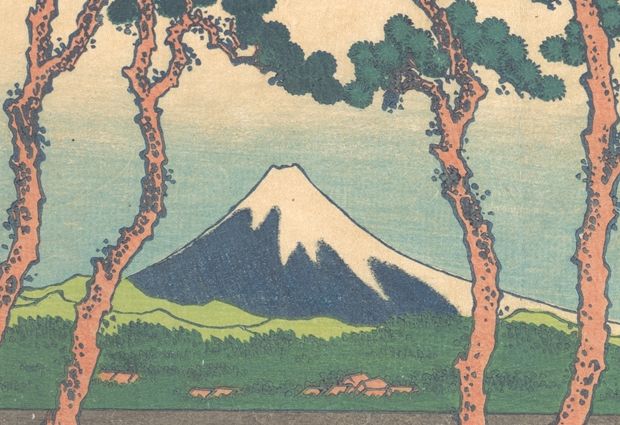
The widest opening gives the left side of the summit and its broken boundary of snow room to appear. The mountain slopes down towards the right, where one of the nearer trunks crosses it. The branches above that opening crowd around the sky, yet the peak sits a little lower and stays visible. Pale colour beyond the crowns separates the fine branching marks from the deeper blue along the upper edge. The sky, the mountain and the roadside trees are easy to distinguish despite the amount of overlap. Once the mountain is found, the branches give the eye several ways to return to it. [1]
Below Fuji, the distant ground runs in low bands. Small roofs sit against their edges, distinct in colour but barely larger than the strokes beside them. A broad middle field is comparatively quiet. Its surface gives the eye a pause between the thin, busy drawing of the pines and the greens along the road. At right, buildings follow the rising ground in a staggered line. One roof hides part of another, and the turns in the land carry attention back towards the foreground. Hokusai changes the density of the image from one strip to the next while keeping the trees legible across all of them. [1]
The pines also change the apparent scale of what lies behind them. Where a dark trunk passes in front of the fields, it has almost the same width as an entire roof farther away. The ridge of the mountain can run for much of a gap while still presenting far less detail than a nearby branch. In the lower part of the sheet the open spaces between the trunks hold a face, a bundle or part of the horse’s body. Higher up, the same intervals hold entire stretches of country. [1]
A pause beside the road
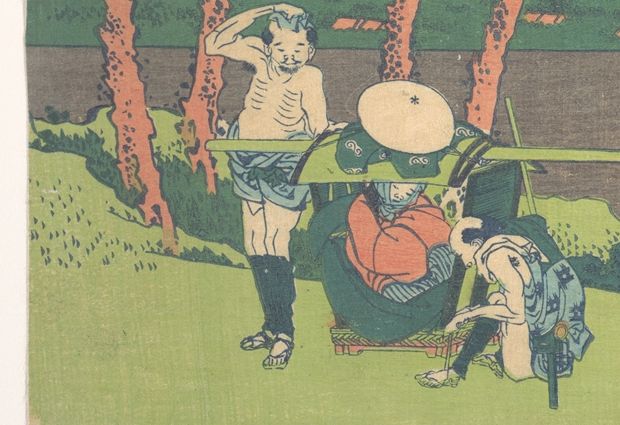
The Tokyo Fuji Art Museum identifies the two men at the left as palanquin carriers on a break. One raises a hand and cloth towards his face. The shafts of the palanquin project sideways and give the group an almost horizontal line, even though its figures differ in posture and height. The museum reads the passenger as asleep. Its commentary also identifies another man as adjusting the ties of his straw sandals. The group gives several kinds of rest a place in one view, from closing the eyes to stopping briefly to make it easier to walk again. [1] [3]
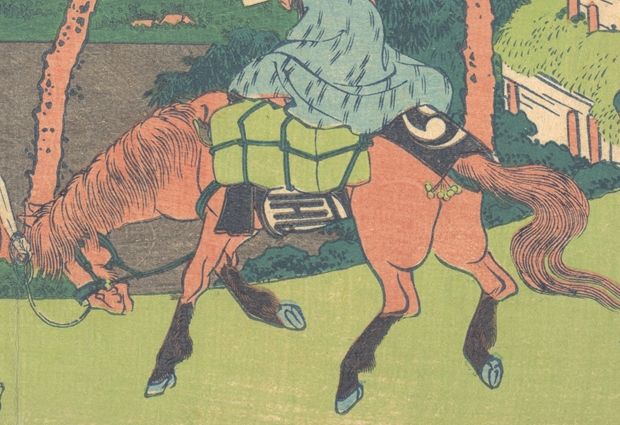
The horse keeps the pace of this pause from taking over the entire foreground. Its lowered head and extended legs move the eye towards the left, while the rider’s taller form occupies part of the opening between the pines. The reins, hooves and thin outlines of legs are enough to separate the animal from the people nearby. Sumida identifies a horse handler looking towards Fuji. The fact that at least one figure takes in the view adds a second kind of attention to the roadside scene. The people are both users of the road and potential spectators of the mountain. [1] [2]
The bodies all stay close to the lower edge, but no two groups occupy quite the same amount of space. The shafts extend farther than the palanquin. A round hat is wider than the head it conceals. The horse’s body stretches across more ground than its rider or the person behind it. These differences carry the eye laterally along the road. The trees above offer a different route through the sheet, rising in stages before the branches turn back towards the mountain. It is possible to follow the sequence of roadside groups first and discover the distant view afterwards. [1]
Hodogaya between two post stations
Sumida identifies Hodogaya as a Tōkaidō post station in what is now Yokohama and places the scene tentatively on the slope towards the next station at Totsuka. The Tokyo Fuji Art Museum singles out the pines associated with Shinanozaka, near Hodogaya. Yokohama’s historical map describes Shinanozaka as a steep ascent on the old road approaching Totsuka. Those accounts help explain the planted avenue and the breaks in the journey. The visible road in the print remains a carefully arranged stretch of foreground, with the mountain placed between the pines where it can be read across the sheet. [1] [2] [3] [4]
In Inume Pass in Kai Province, another Fuji print, travellers and packhorses appear as a small procession on the face of a large slope. There the rising contour of the land supplies a broad line of travel. At Hodogaya the people stand close enough for individual gestures to count. The movement runs across the lower edge and is interrupted by the settled group on the left. The gaps between Hodogaya’s pines bring Fuji into view in stages. At Inume the shape of the hillside gives the eye a longer, uninterrupted sweep towards the mountain. [1] [5]
The same place name can also belong to a different story about the route. In Utagawa Hiroshige’s Hodogaya Station and Shinkame Bridge, dated about 1834 by the Met, the bridge is the named feature of the view, and the print belongs to Hiroshige’s sequence of views of the fifty-three stations of the Tōkaidō. In Hokusai’s composition the avenue and its gaps organise the scene, and the view through them ties the location to a series about Fuji. The title alone therefore tells a viewer only part of the job that Hodogaya does in each design. [1] [6]
One design in different colours
The same trunks, roofs, people and horse can be followed in the Met’s impression JP1427. The museum dates it to about 1830–32 and measures it at 25.2 by 37.5 centimetres. In the photograph of JP2562, a light green extends across the foreground and picks up again on the rise at right, and the horse’s load shows green against the reddish body. In JP1427, a pale blue wash follows the lower edge, with heavier blue around the vegetation at right. The foreground changes from a fairly continuous band in JP2562 to a more visibly mottled zone of light and dark in JP1427. The character of the pauses changes with it. [1] [7]
The two pictures also show the value of attending to marks near the edges. Two small seals are visible near the lower right in JP1427. The Met identifies the round one with the dealer and collector Hayashi Tadamasa. That mark sheds light on the history of this particular sheet. The cartouche above is part of the design that the two impressions share. The National Museum of Western Art’s exhibition checklist separately identifies an Iuchi Collection sheet as item 31 under the Japanese title 東海道程ヶ谷. Reading an accession, a title and a collector’s mark together helps keep those printed and collected histories distinct. [1] [7] [8]
Comparing photographs can show how the colours change the role of the same shapes. Printing order and the causes of colour variation require other evidence. Look first at the opening around Fuji, which stays in much the same place in JP2562 and JP1427. Then follow the dark pine trunks down to the ground, where the changes in colour become much more apparent. What looks like a bright verge in one photograph is a cooler passage beside a dark bank in the other. The road, the travellers and the uneven screen of trees still govern how the mountain comes into view. [1] [7]
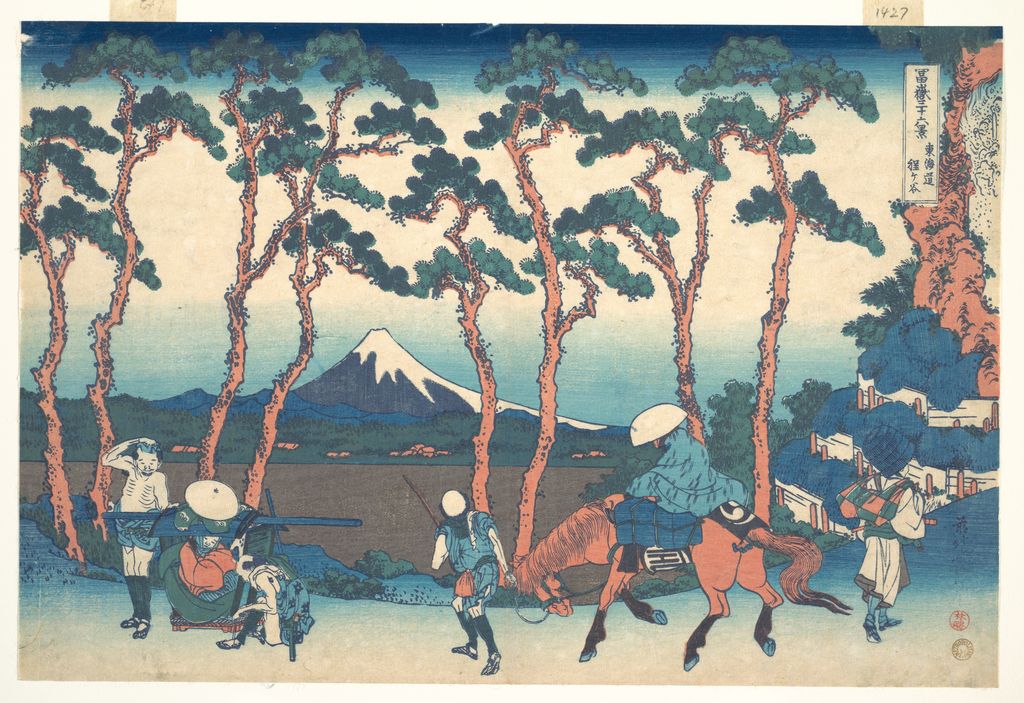
Image comparison
Where this work sits in Hokusai’s career
Annotated Details from Hodogaya on the Tōkaidō Road
The Metropolitan Museum of Art, JP2562. [1]
Details from HODOGAYA ON THE TŌKAIDŌ ROAD
Select a detail to look closely.
The trunks mark out the road
The pines rise at irregular intervals. Their edges divide the view into a series of small openings. [1]
A mountain appears in one gap
The pale summit and blue slopes take up only part of the opening between the trunks. [1]
Travellers group along the lower edge
Several figures follow the low line of the road. Their repeated steps give a sense of movement among the upright trees. [1]
A horse and its rider cross the verge
The horse extends across the foreground. Its legs interrupt the narrow green strip and connect the groups of travellers. [1]
Explore Hokusai’s works
Discussion
Look again at the images and ideas explored in Hodogaya on the Tōkaidō Road. These editorial prompts invite your observations.
Reader Insights
How do the pines divide the journey into short intervals?
Which gap gives you the clearest view of Fuji?
Join the Conversation
Share a detail, comparison or question about Hodogaya on the Tōkaidō Road below.
References
- The Metropolitan Museum of Art, Hodogaya on the Tōkaidō (Tōkaidō Hodogaya), accession JP2562, collection record and photograph. View source.
- Sumida Hokusai Museum, Thirty-six Views of Mount Fuji: Hodogaya on the Tōkaidō Road (冨嶽三十六景 東海道程ヶ谷), Japanese curatorial commentary. View source.
- Tokyo Fuji Art Museum, Thirty-six Views of Mount Fuji: Hodogaya on the Tōkaidō Road, object 06154 and Japanese curatorial commentary. View source.
- City of Yokohama, Walking Map of the History of Totsuka on the Old Tōkaidō (旧東海道戸塚宿 歴史を訪ねる散策マップ), Shinanozaka entry. View source.
- The Metropolitan Museum of Art, The Inume Pass in Kai Province (Kōshū Inume tōge), accession JP1426, collection record and photograph. View source.
- The Metropolitan Museum of Art, Utagawa Hiroshige, Hodogaya Station and Shinkame Bridge, accession JP475. View source.
- The Metropolitan Museum of Art, Hodogaya on the Tōkaidō (Tōkaidō Hodogaya), accession JP1427, collection record and photograph. View source.
- National Museum of Western Art, Tokyo, Hokusai: Thirty-six Views of Mt. Fuji, Iuchi Collection exhibition checklist, item 31. View source.







