


 by Tom Gurney
Tom Gurney BSc (Hons) is an art history expert with over 20 years experience
Published on June 19, 2020 / Updated on November 20, 2026
Email: tomgurney1@gmail.com / Phone: +44 7429 011000
Inume Pass in Kai Province
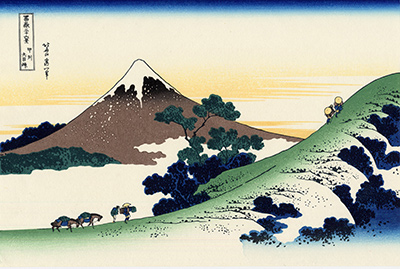
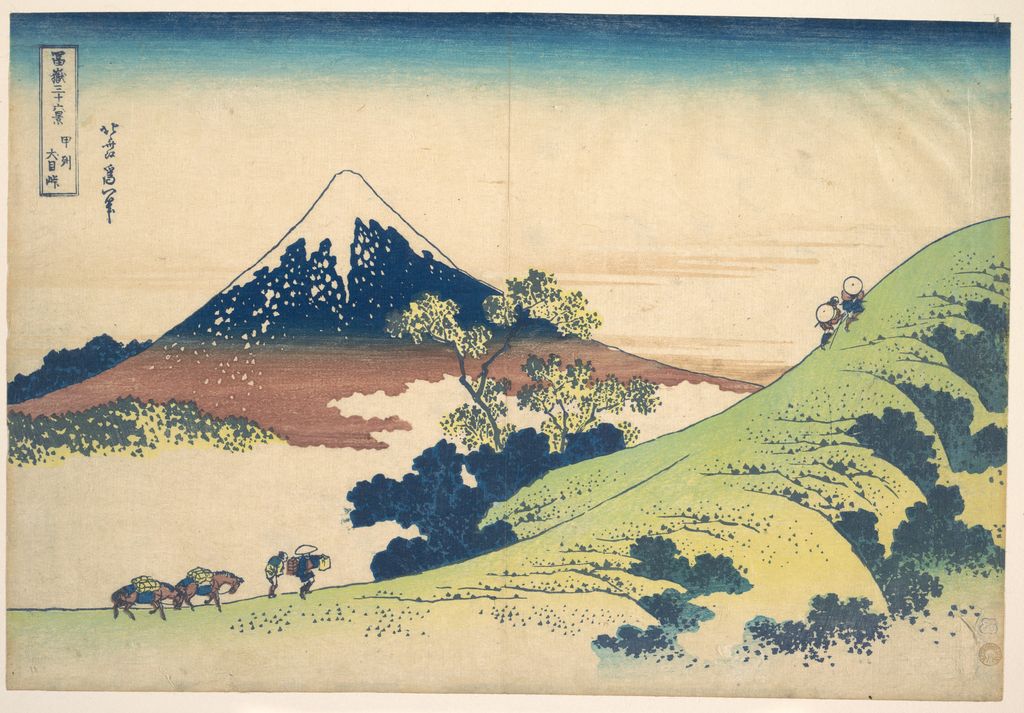
Two travellers approach the top of a slope at the far right of Katsushika Hokusai’s Inume Pass in Kai Province. Farther down, people and packhorses advance in a line, scarcely higher than the grass. The ground beneath them curves upwards until it carries the eye almost to the upper corner of the print. Across a pale interval, Mount Fuji rises on the left. Its snow-covered upper slopes are picked out by a thin contour and a ragged line of dark rock. The hill the travellers must cross and the mountain they can see answer one another across the width of the sheet. [1]
The Metropolitan Museum of Art dates its impression JP1426 to about 1830–32. It is a colour woodblock print measuring 24.6 by 36.2 centimetres. Its Japanese title, 甲州犬目峠, names the Inume Pass in Kai Province, also called Kōshū. The design belongs to Thirty-six Views of Mount Fuji, in which the same mountain takes on different roles according to the place from which it is seen. At Inume Pass the journey has already gained some height, and Fuji is still much farther away. [1]
At a Glance
- ArtistKatsushika Hokusai
- Dateca. 1830–32
- MediumColour woodblock print
- SeriesThirty-six Views of Mount Fuji
Contents
The travellers on the slope
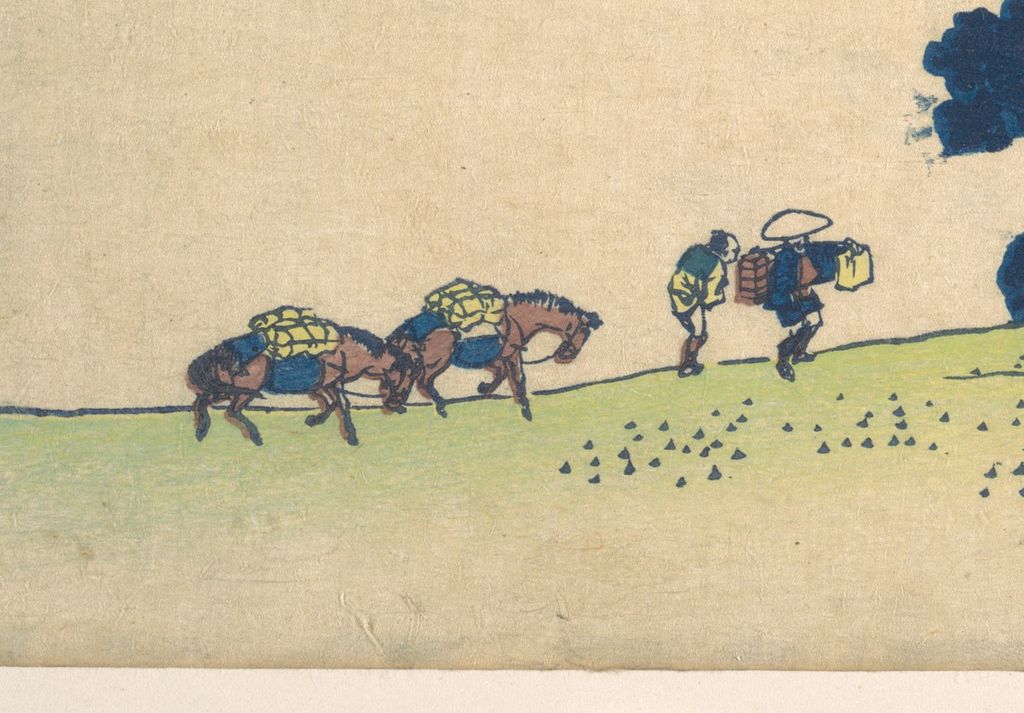
The near hill fills the lower right and almost reaches the upper edge. Along its skyline a continuous curve rises sharply at the end. The movement is gentler on the lower ground, where the packhorses are spaced at short intervals. Their repeated lowered heads and the people beside them give this part of the print a pace. A few dark marks beneath the horses’ bodies are enough to hold their feet against the green field. Hokusai lets the upper pair stand on a cleaner stretch of the slope, so those two small bodies stay legible at a distance. [1]
Bristol Museums’ interpretation of its impression Mb4856 draws attention to the two figures high on the hill. It reads them as turning towards Fuji. Their place on the slope makes that reading persuasive. They have almost reached the edge of the scene, but looking across to the mountain returns attention to the part of the sheet they appear to be leaving behind. Following their gaze is another way to trace the journey, alongside the track by which the figures lower down enter the view. [1] [2]
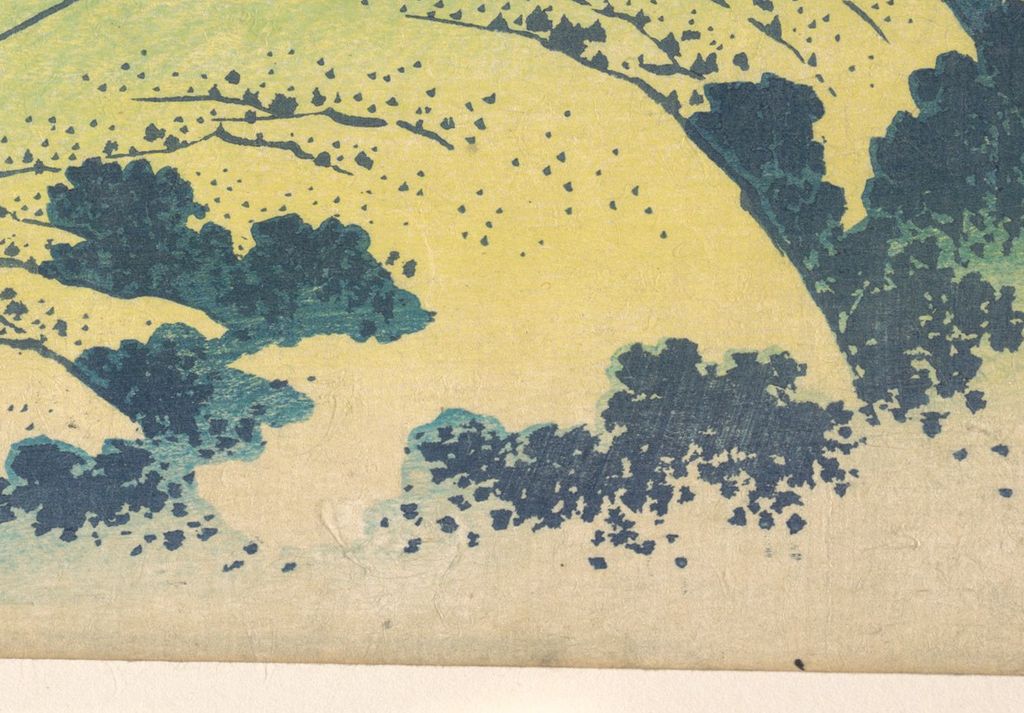
On the face of the hill, darker clumps of foliage recur from bottom to top. They lie at different angles, and long streams of small marks run between them. Those marks suggest grass and the way the land falls away beneath the skyline. Nearer the bottom edge, a larger patch of shadow sits close to the viewer. Beyond the crest the marks become sparse. This change in density sets a distance between the foreground and the two travellers at the top, even though both are printed on the same large passage of green. [1]
Hokusai gives the traveller’s body a different role in Mishima Pass in Kai Province. There, people stretch their arms around the trunk of a great tree. The trunk acts as an immediate measure of human size, while Fuji can be seen farther off. At Inume, the people are small signs on a continuous hillside. Their gradual ascent measures the slope, and the more distant mountain measures the reach of the view. Both designs give the viewer a sense of effort through what people do with their bodies. [1] [2] [3]
The mountain beyond the valley
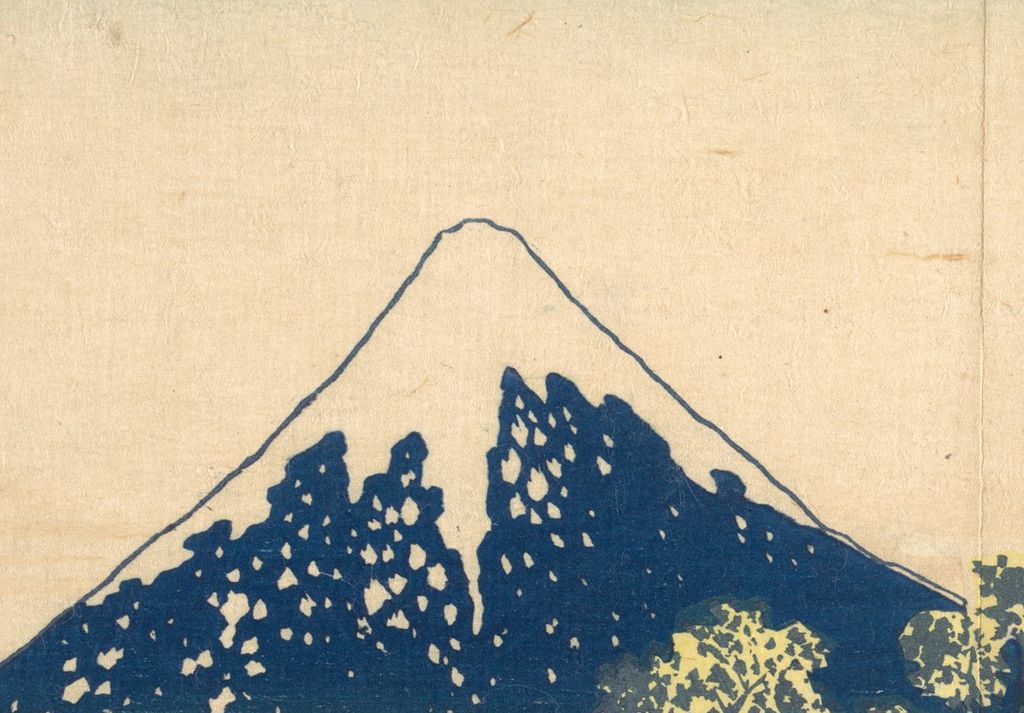
Fuji has two edges that are especially easy to follow. Its upper contour rises out of the landscape in a slender stroke, with few marks in the space within it. Just below, a rough band of dark rock works in the opposite direction. Small pale breaks descend into the blue along that band, so snow seems to hang on the uneven surface. The lower part of the mountain spreads broadly to either side in warmer tones. A standing group of trees overlaps it towards the right. The layers let us put the trees between the travellers and Fuji without having to follow the ground continuously from one group to the other. [1]
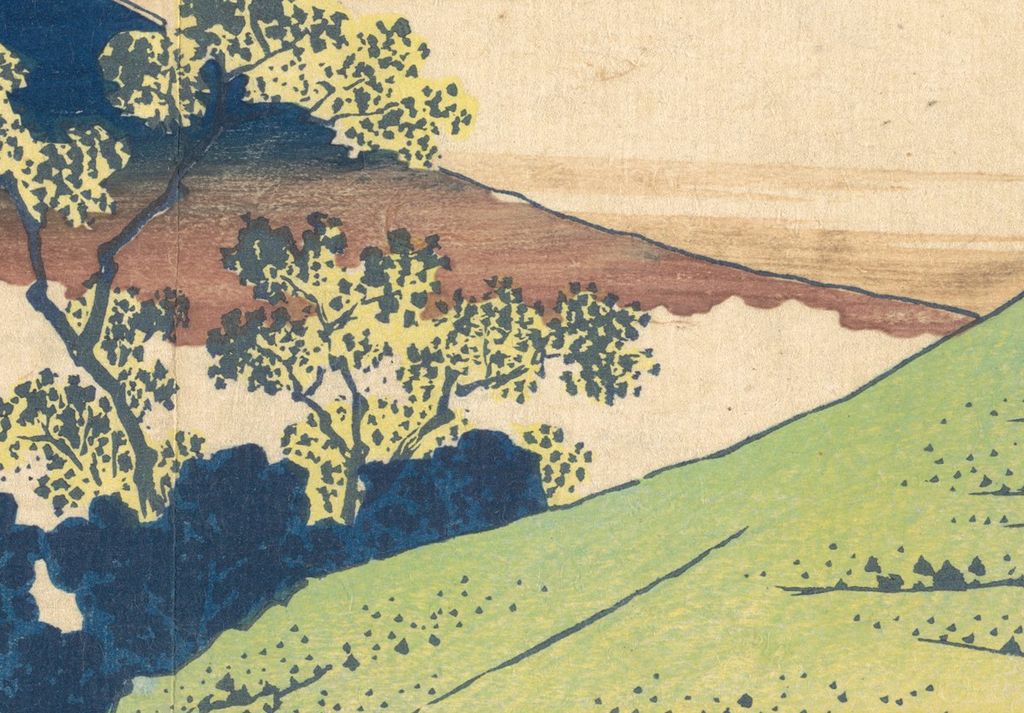
A light band across the valley does much of this work. Its shape narrows into irregular lobes below the mountain, leaving edges and patches of vegetation exposed. The MOA Museum of Art reads the white cloud as rising from the valley of the Katsura River. The cloud separates the rising foreground from Fuji’s lower flanks, and the long pale stretches around it give the image much of its sense of depth. Up at the top of the sheet, a dark band changes into lighter sky. The valley cloud is set much lower, where the edges of the land can partly hide it. [1] [4]
The summit has breathing room above it. Hokusai leaves most of the upper sky continuous from the title cartouche at the left to the corner above the travellers. A few nearly level streaks to the right of Fuji cut gently across that open space. Their direction makes the upward turn of the foreground more noticeable, while their light tone lets the summit remain distinct. This is one place where the least emphatic marks do a great deal to set the angle of the whole scene. [1]
The Tokyo Fuji Art Museum describes a view through spring haze in its impression and points to the small figures as part of the scene’s unhurried character. Bristol Museums, looking at its own sheet, takes the faint red streaks in the sky as a sign of morning. These are readings of the appearance of particular impressions. In JP1426, the stronger transitions between the dark top of the sky, the light valley and the near greenery make the distance feel expansive even before we attach a season or hour to it. [1] [2] [5]
The road through Kai
The Sumida Hokusai Museum places Inume post station on the Kōshū Kaidō in present-day Uenohara, Yamanashi Prefecture. It describes Inume as the highest of the post stations in the Gunnai region and locates the pass somewhere on the way from Inume to neighbouring Shimotorisawa, to the west. The museum notes that the precise point is now unknown. That distinction is useful when looking at the print. The title supplies a real route and the hillside makes the climb believable, while the location of the viewer within that route remains open. [6]
The Tokyo Fuji Art Museum records a local tradition linking the picture to a high point called Tōmi, where Fuji can be seen. It also notes that the view itself differs markedly from Hokusai’s arrangement. In the print, the position of the two highest travellers, the shape of the winding ground and the interval of haze are all organised to make the mountain emerge in a certain order. A passing traveller might have had to turn to get an equivalent view. Hokusai brings the act of climbing and the sight across the valley into one horizontal field. [1] [5] [6]
Utagawa Hiroshige took up the same subject later. In the 1858 design shown by the Ashmolean Museum, the land comes together in a vertical sheet. Travellers are low on the sloping path at the right, with cliffs and a deep ravine occupying most of the view. A diagonal line of geese crosses in front of Fuji, high towards the left. In Hokusai’s earlier design, the travellers have more open ground on which to move and the highest pair come closer to the level of the mountain. In Hiroshige’s view, the climb from the path to the sight of Fuji also takes the eye over the sides of the ravine. The two layouts make the same pass feel very different underfoot. [1] [7]
Two impressions at the Met
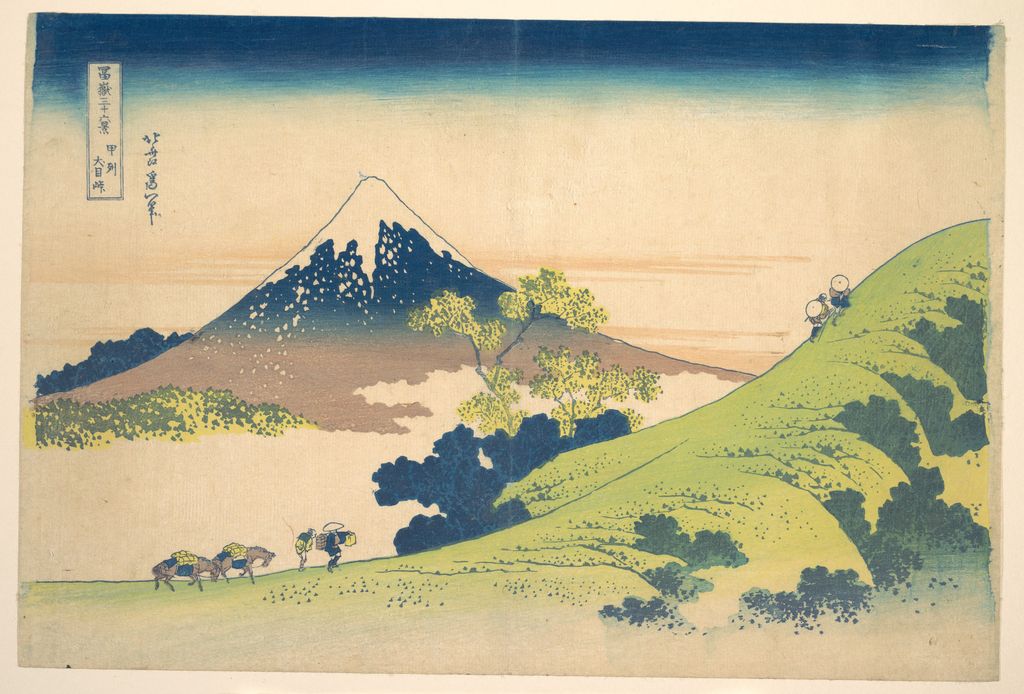
The Met’s JP1426 and JP2558 share the same design. The long arc beneath the upper pair, the trees overlapping Fuji and the small procession at lower left remain in place. The museum dates both sheets to about 1830–32, but records different dimensions. JP1426 measures 24.6 by 36.2 centimetres and JP2558 measures 25.4 by 38.1 centimetres. A difference in the size of the surviving sheets can be seen without having to read a corresponding change into the size of the mountain or the other printed forms. [1] [8]
In the museum photographs, JP2558 has a wide, bright yellow-green slope and some light foliage where the distant trees overlap the mountain. The lower mountain reads as a subdued brown, while the upper sky runs from a dense band of blue to a lighter space above Fuji. In JP1426, a warmer, pinkish-brown band is more legible across the lower flank. The near green also changes over a shorter interval before the hillside becomes pale. The trees on the slope consequently have more contrast with the ground in some places than in others. These differences offer two routes into the image, first through the bright hill or first through the mountain’s layered colours. [1] [8]
Seen together, the impressions make it easier to pick out which effects depend on colour and which hold across the printed lines. Follow the crest from the horses up to the two small figures, then turn your eye across the valley to the upper edge of Fuji. The scale keeps changing, from the foliage at your feet to people in the middle distance and the exposed rock on a mountain far beyond them. The structure of the view remains legible across the two sheets, even as their strongest patches of colour draw the eye to different parts of it. [1] [8]
Where this work sits in Hokusai’s career
Annotated Details from Inume Pass in Kai Province
The Metropolitan Museum of Art, JP1426. [1]
Details from INUME PASS IN KAI PROVINCE
Select a detail to look closely.
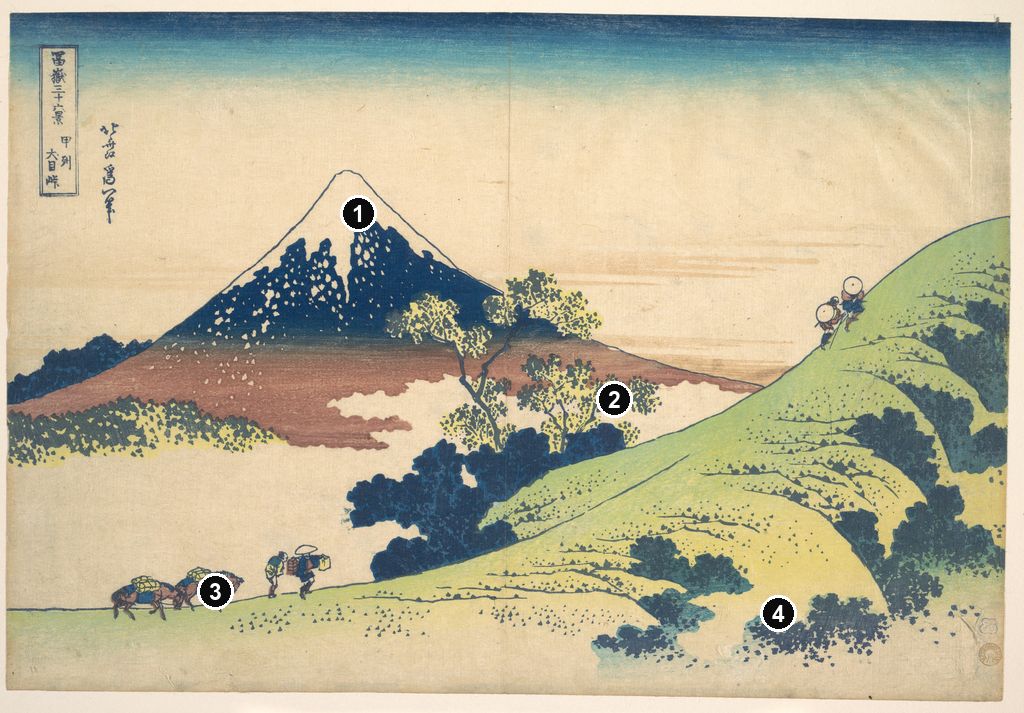
Fuji rises over the intervening land
Its snow line and dark slopes make the distant peak legible. A lighter band isolates it from the near ridge. [1]
A green slope climbs across the sheet
The diagonal links the lower part of the print with its right edge. It gives the route a stronger incline than the flatter layers behind it. [1]
Travellers near the bottom of the pass
Dark figures occupy a narrow stretch of the route. Their size and spacing let the eye measure the slope above them. [1]
Trees mark the lower turn
Small dark masses close to the lower edge give the bright ground a broken rhythm. They anchor the rising route against the broader colour fields. [1]
Explore Hokusai’s works
Discussion
Look again at the images and ideas explored in Inume Pass in Kai Province. These editorial prompts invite your observations.
Reader Insights
How do the travellers establish the scale of the slope?
Where do you shift your attention from the foothills to Fuji?
Join the Conversation
Share a detail, comparison or question about Inume Pass in Kai Province below.
References
- The Metropolitan Museum of Art, The Inume Pass in Kai Province (Kōshū Inume tōge), accession JP1426, object record and photograph. View source.
- Bristol Museums, Hokusai and Hiroshige Landscapes, exhibition descriptions for Inume Pass in Kai Province, Mb4856, and Mishima Pass in Kai Province, Mb4857. View source.
- The Metropolitan Museum of Art, Mishima Pass in Kai Province, object record and photograph. View source.
- MOA Museum of Art, Thirty-six Views of Mount Fuji Digital Remix, Japanese commentary on Inume Pass in Kai Province. View source.
- Tokyo Fuji Art Museum via Cultural Heritage Online, Thirty-six Views of Mount Fuji: Inume Pass in Kai Province, Japanese object commentary. View source.
- Sumida Hokusai Museum, Thirty-six Views of Mount Fuji: Inume Pass in Kai Province, Japanese collection record. View source.
- Ashmolean Museum, Hiroshige’s Japan: Views of Mount Fuji, exhibition discussion and illustration of Hiroshige’s Inume Pass in Kai Province, EAX.4389. View source.
- The Metropolitan Museum of Art, The Inume Pass in Kai Province (Kōshū Inume tōge), accession JP2558, object record and photograph. View source.







