


 by Tom Gurney
Tom Gurney BSc (Hons) is an art history expert with over 20 years experience
Published on June 19, 2020 / Updated on November 20, 2026
Email: tomgurney1@gmail.com / Phone: +44 7429 011000
Shichirigahama Beach in Sagami Province
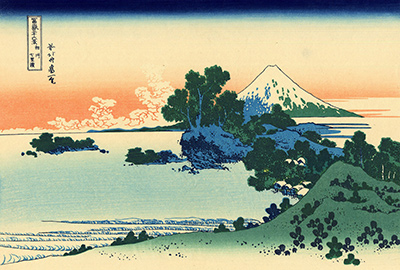
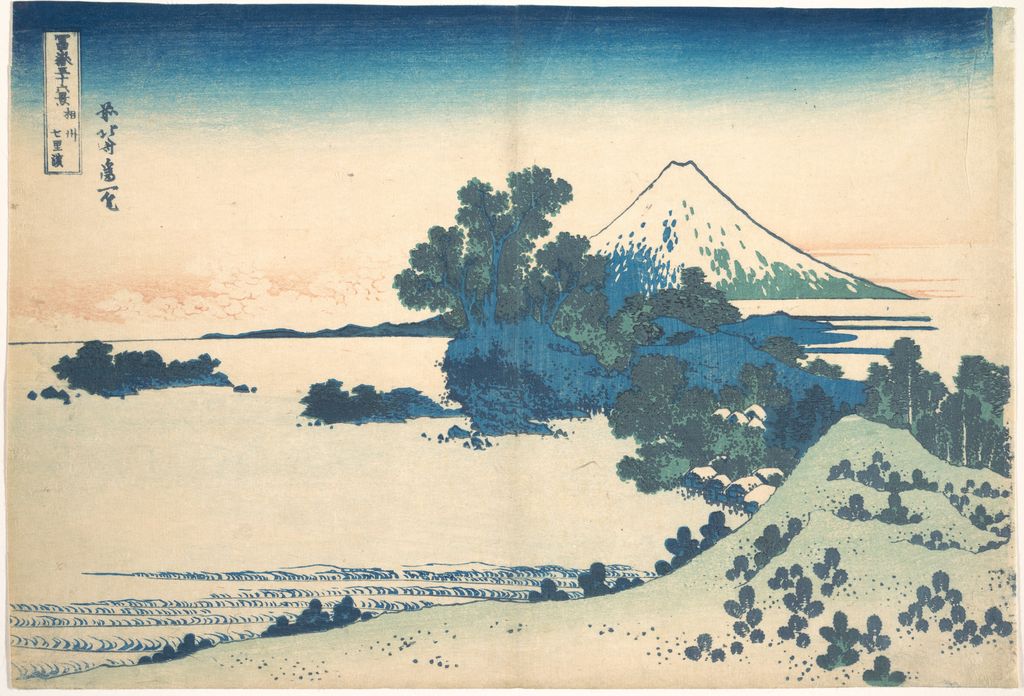
Low waves run ashore beneath a hillside in Katsushika Hokusai’s Shichirigahama Beach in Sagami Province. Above the surf, several roofs are visible between dark trees. Mount Fuji rises beyond them, its summit outlined against a pale sky. The strip of water that leads into the view occupies much of the left half, while the hill, settlement and mountain overlap towards the right. There are signs of people in the roofs, but no figures to follow. The waves supply the movement. [1] [2]
The Metropolitan Museum of Art dates its impression JP2979 to about 1830–32 and records it as a colour woodblock print measuring 25.4 by 37.5 centimetres. The cartouche at upper left names the scene 相州七里浜, Sōshū Shichirigahama, using another name for Sagami Province. The design belongs to Thirty-six Views of Mount Fuji. The National Museum of Western Art lists an impression from the Iuchi Collection as no. 13 in its exhibition checklist. [1] [3]
At a Glance
- ArtistKatsushika Hokusai
- Dateca. 1830–32
- MediumColour woodblock print
- SeriesThirty-six Views of Mount Fuji
Contents
From the near hillside to Fuji
The lower-right hill starts with an open stretch of pale green. Clusters of rounded leaves, separate at first, bunch together towards the rise, and small dots roughen the ground in the intervals between them. The crest stays low in the sheet, with a narrow run of light left open along it. Its line then drops diagonally across the foreground and meets the bottom edge towards the left. That slope offers a way into the picture even before the mountain is visible. The eye can follow it down to the water or turn back and pick out the roofs where the hill gives way to darker trees. [1]
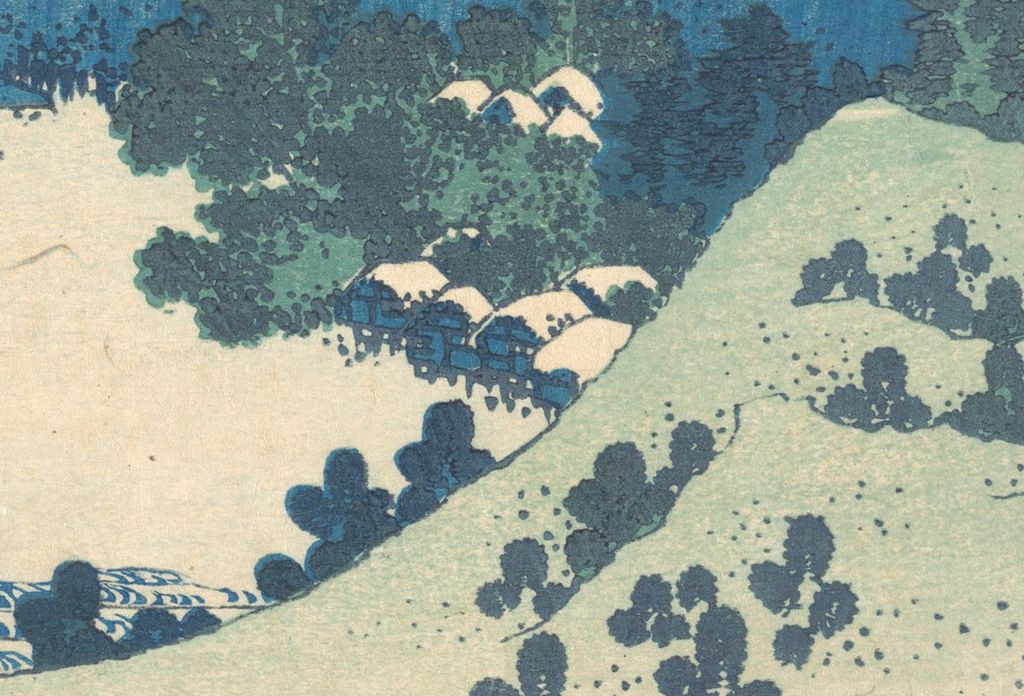
The roofs appear in groups. A few show between the upper trees and a tighter set emerges lower down, where the edge of the pale ground meets the foliage. Their light sides have simple angular edges that stand out among the irregular patches of blue and green. Hokusai has given the buildings enough detail to be recognised without making the settlement the centre of the scene. As the slope rises on the right, the larger trees obscure parts of the land behind them. On the left their canopy ends suddenly and gives way to a broad reach of open water. [1]
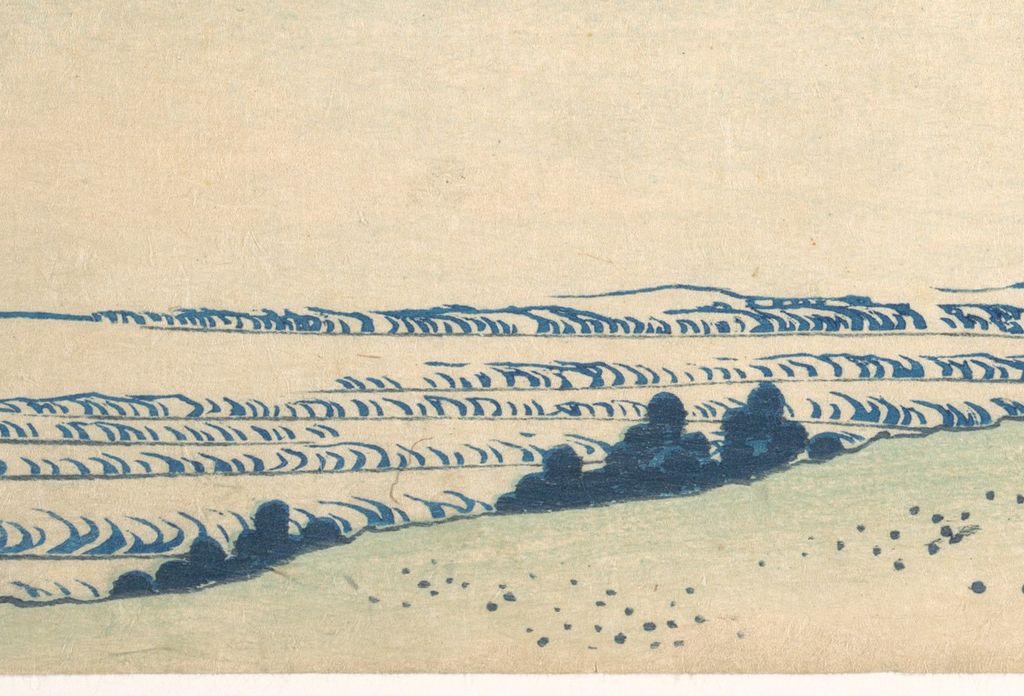
At the foot of the print, the breakers form rows of small hooked marks. Some rows touch the left edge, while others lose their definition as they reach the darker shapes at the base of the hill. In the middle of the sheet, the sea is open between the tree-covered ground and the outcrops to its left. Much of this interval has very little drawn detail. The wave marks nearest the viewer establish what the broad light area beyond them represents. From there the eye can climb to a thin, distant strip of land, where the texture of the surf gives way to a nearly level line. [1]
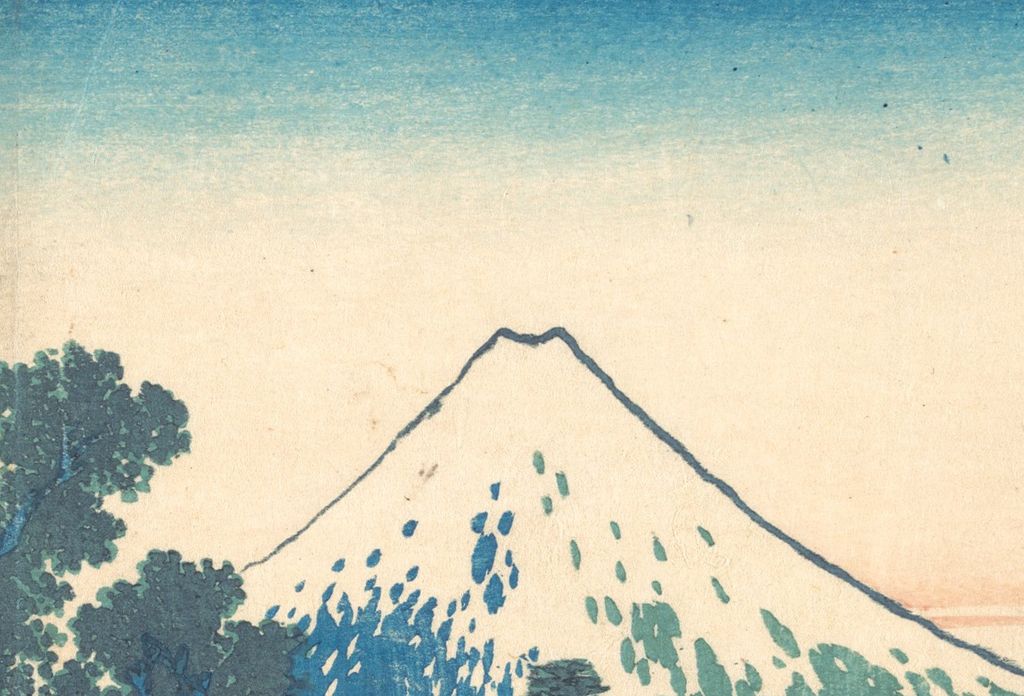
Fuji appears past the tall trees. Where its left flank meets the crowns, portions of the outline are interrupted, while the longer right flank can be followed almost without a break. Short marks within the mountain grow denser low on the slope and leave broad pale spaces near the summit. The clean upper outline makes the peak easy to recognise even though the foreground occupies more of the available space. The steep part of the near hill and the long fall of Fuji’s flank also work in different directions, carrying the eye back through the layers of land between them. [1]
A coast known for its views
The Sumida Hokusai Museum locates Shichirigahama between Inamuragasaki and Koyurugi Cape on the coast of present-day Kamakura. The stretch of shore was known for views towards Enoshima and Fuji. The museum points out that many other pictures show this scenery from the shore and that woodblock prints often gave prominence to people making the pilgrimage to Enoshima. Hokusai raises the viewpoint over the coast here. With the rooftops low in the view, the landscape has room to extend past them. [2]
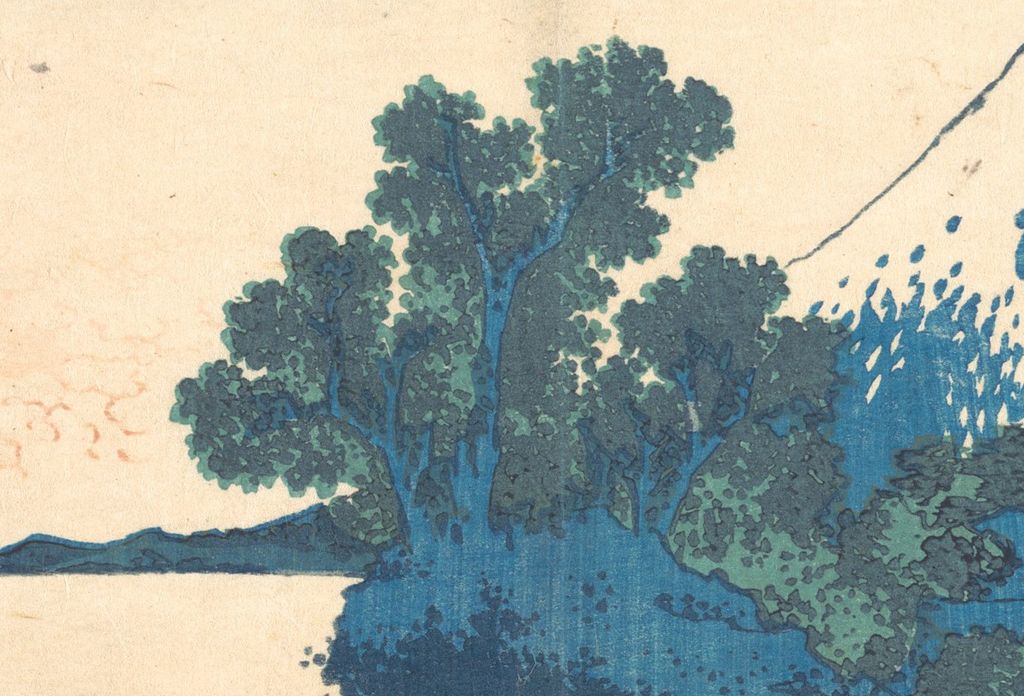
Museum accounts vary in their reading of the landmarks. The Sumida museum sees Koyurugi Cape and, beyond it, Enoshima. The Tokyo Fuji Art Museum reads the foreground as Kamakurayama, the settlement as Shichirigahama and the island to its left as likely Enoshima. Chiba City Museum of Art observes that the size of the trees on the central landform could suggest Koyurugi Cape, even though it has been identified as Enoshima. The overlap in Hokusai’s design helps explain why those readings are possible. A dense foreground cluster, several smaller shapes surrounded by water and a distant strip of coastline occupy a small space beneath the mountain. [1] [2] [4] [5]
The earlier painter Shiba Kōkan also brought beach, island and mountain together. Sarah E. Thompson, writing for the Museum of Fine Arts, Boston, describes Kōkan’s Seven-Mile Beach with Enoshima and Fuji, dated about 1790, as an important precedent for Hokusai. She records that the painting was displayed at the Atago Shrine in Edo from 1796 to 1811. In the catalogue reproduction, pale surf sweeps towards the right-hand shore and dark hills diminish as they approach the horizon. Fuji is small and low behind the island. There are people on the beach close to the viewer, where the surf and the near bank have their most pronounced contours. [6]
Thompson pairs Kōkan’s painting with Hokusai’s Spring at Enoshima, from the 1797 album Willow Silk. In the album illustration, people stand near the water at lower right while a wave turns up near the left edge. Fuji is visible on the opposite side of the sheet from the figures. In the later Shichirigahama, the waves are smaller and more evenly spaced, the view is lifted and the people have disappeared from the shore. The three pictures show how the relation between the beach and the mountain changes with the height of the viewer and the attention given to the foreground. [1] [6]
Two ways to print the sky
The JP2979 impression has its deepest blue sky along the upper edge. The colour softens below it, leaving a wide interval of pale sky at the height of Fuji. Look left from the mountain and the clouds are easier to see near the horizon than in the open area above. They appear as faint pink lines and patches, low against the paler sky. The green of the near hill is subdued, and much of the bay between the breakers and the landforms is almost the colour of the paper. These passages allow the dark trees in the middle distance to stand out on either side of the waterline. [1]
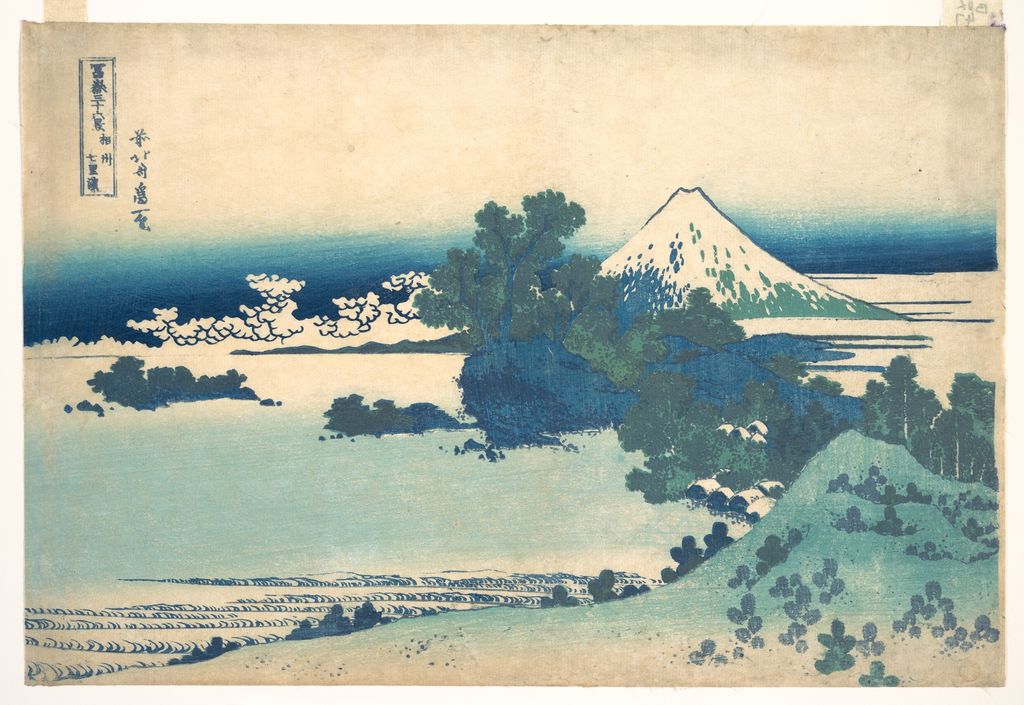
In the Met’s other impression, JP15, a dark blue band runs along the horizon and fades upwards. The cataloguers discuss the print in connection with aizuri, a blue-dominated manner of printing, and identify Prussian blue as central to the effect. The clouds to the left of Fuji have clear dark outlines and pale interiors against the blue. The bay reads closer to blue-green, and the broad light area above the bank of colour draws more attention to the top of the sheet. The mountain and trees keep their positions, with a marked change in the strength of the colour around them. [7]
The photographs of the two Met impressions show these changes most clearly where the low cloud shapes meet the surrounding sky. The dark band in the JP15 photograph makes the space around the clouds as emphatic as the lines of the clouds themselves. In JP2979 the pale colour around them makes the outline much less insistent. That difference can be seen without assigning every variation in tone or surface to the printer. Paper, the condition of a sheet and the way it is reproduced can affect the appearance of a particular impression. [1] [7]
The account accompanying the Tokyo Fuji Art Museum impression on Japan’s Cultural Heritage Online places this variation in the context of a publisher’s advertisement. The notice described blue-printed views to be issued one at a time and specifically named Shichirigahama as an example of how Fuji’s appearance changes with location. The catalogue entry associates its own impression’s warmer, late-day sky with a later printing, drawing also on the state of the outline block. That assessment concerns the Tokyo sheet. It shows how a single design advertised for its view of Fuji could offer visibly different conditions of light across impressions. [8]
Enoshima from the crossing
In Hokusai’s Enoshima in Sagami Province, also from the Fuji series, the viewer looks towards a cluster of buildings at the foot of a densely wooded rise. People cross the exposed sand in small groups, and a boat sits in the water to the right. The Tokyo Fuji Art Museum explains that the sandbar was exposed at low tide and that the stone lantern marks the approach used by pilgrims. Fuji sits much lower in this design and only takes up a small space near the right margin. The crossing links the foreground to the buildings, giving the viewer a route to follow into the landscape. [9] [10]
The paired views change what a person can see of the coast. From the approach to Enoshima, movement across the sand and the concentration of buildings give the island much of its scale. From the height of Shichirigahama, roofs only occasionally break the tree cover and nobody crosses the visible ground. The first view lets us follow people towards the trees. The second asks us to follow the ground itself, from the near hill to the outcrops and past them to the far slope of Fuji. [1] [9]
Where this work sits in Hokusai’s career
Annotated Details from Shichirigahama Beach in Sagami Province
The Metropolitan Museum of Art, JP2979. [1]
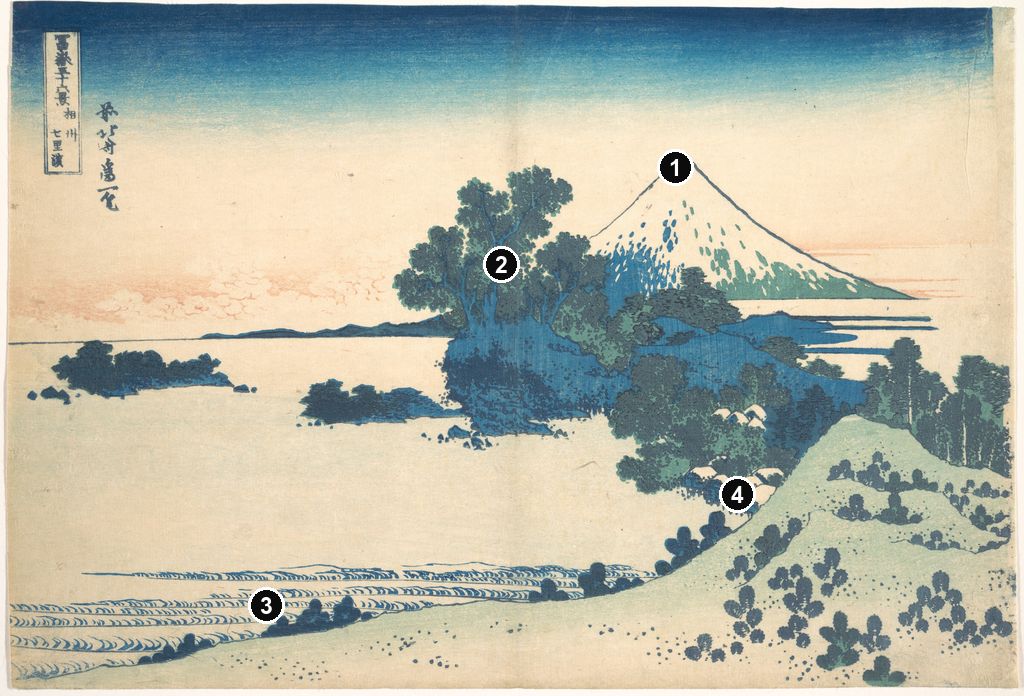
Details from SHICHIRIGAHAMA BEACH IN SAGAMI PROVINCE
Select a detail to look closely.
Fuji rises behind the foliage
The summit clears the dark silhouettes of trees, while part of its slope remains hidden behind them. [1]
A headland interrupts the horizon
The dark group of trees crosses the pale bands of sky and water. It occupies more of the sheet than the mountain. [1]
The near shore runs along the lower edge
A narrow strip of land and scattered marks give the pale foreground a distinct edge. [1]
Rooflines emerge below the trees
The rooftops take up little of the sheet. The surrounding foliage and the horizontal bands of water help place them within the landscape. [1]
Explore Hokusai’s works
Discussion
Look again at the images and ideas explored in Shichirigahama Beach in Sagami Province. These editorial prompts invite your observations.
Reader Insights
Which stretches of shoreline seem furthest from the viewer?
Where does the foliage interrupt the view towards Fuji?
Join the Conversation
Share a detail, comparison or question about Shichirigahama Beach in Sagami Province below.
References
- The Metropolitan Museum of Art, Katsushika Hokusai, Shichirigahama in Sagami Province (Sōshū Shichirigahama), JP2979, object record and photograph. View source.
- The Sumida Hokusai Museum, Shichirigahama Beach in Sagami Province, Japanese collection commentary on the coastline, viewpoints and pilgrims. View source.
- The National Museum of Western Art, Hokusai: Thirty-six Views of Mt. Fuji from the Iuchi Collection, exhibition checklist, no. 13. View source.
- Tokyo Fuji Art Museum, Shichirigahama Beach in Sagami Province, Japanese collection commentary. View source.
- Chiba City Museum of Art, Shichirigahama Beach in Sagami Province, accession 2903020, collection commentary. View source.
- Sarah E. Thompson, Hokusai’s Landscapes: The Complete Series, Museum of Fine Arts, Boston, pp. 14–15, figs. 5–7. View source.
- The Metropolitan Museum of Art, Katsushika Hokusai, Shichirigahama in Sagami Province (Sōshū Shichirigahama), JP15, object record and photograph. View source.
- Cultural Heritage Online, Shichirigahama Beach in Sagami Province, Tokyo Fuji Art Museum catalogue entry on the advertisement and the colouring of its impression. View source.
- The Metropolitan Museum of Art, Katsushika Hokusai, Enoshima in Sagami Province (Sōshū Enoshima), JP22, object record and photograph. View source.
- Tokyo Fuji Art Museum, Enoshima Island in Sagami Province, Japanese collection commentary. View source.







