


 by Tom Gurney
Tom Gurney BSc (Hons) is an art history expert with over 20 years experience
Published on June 19, 2020 / Updated on November 20, 2026
Email: tomgurney1@gmail.com / Phone: +44 7429 011000
Cushion Pine at Aoyama
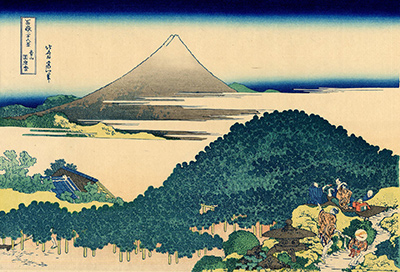
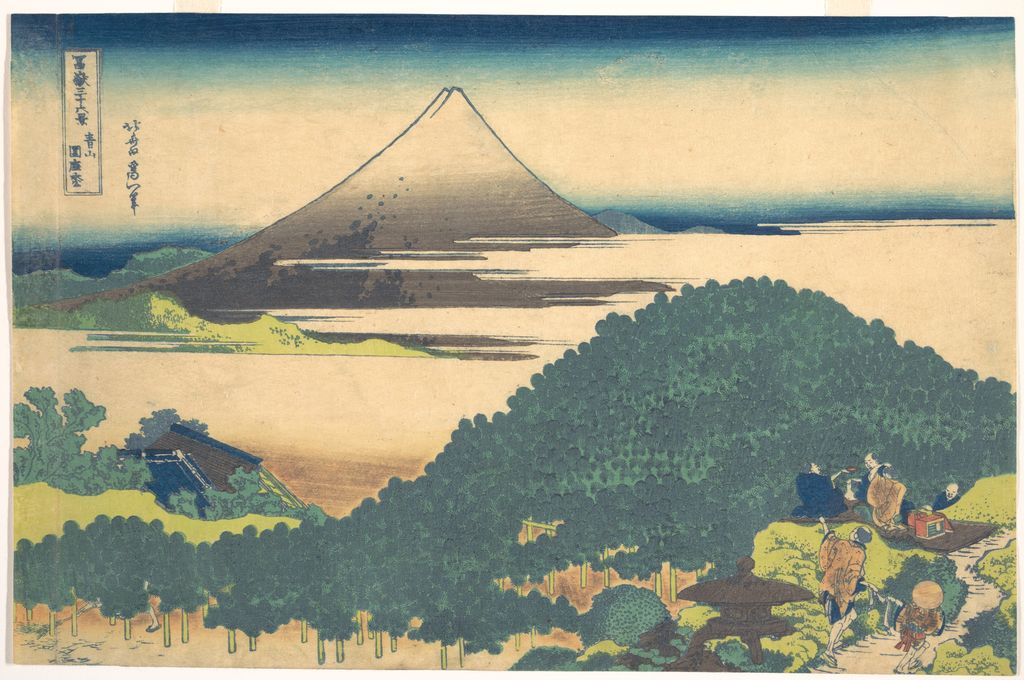
A huge pine rises from the lower right of Katsushika Hokusai’s Cushion Pine at Aoyama. It spreads almost from the path to the middle of the print, with room for people to sit among the shrubs beneath it. Mount Fuji, some distance behind, clears the field of clouds. It is the higher of the two shapes on the page, but the pine sprawls much farther sideways and comes close enough to see how Hokusai draws its foliage. The Metropolitan Museum of Art dates its colour woodblock impression JP2985 to about 1830–32. The National Museum of Western Art lists the design as no. 10 in its exhibition checklist of the Iuchi Collection, under the Japanese title 青山円座松. [1] [2]
At a Glance
- ArtistKatsushika Hokusai
- Dateca. 1830–32
- MediumColour woodblock print
- SeriesThirty-six Views of Mount Fuji
Contents
A tree that people came to see
The pine stood in the garden of Ryūganji, a temple in what is now Jingūmae in Tokyo’s Shibuya ward. The Sumida Hokusai Museum explains that the tree spread in a circle, as the name enza no matsu, or cushion pine, suggests. The Shimane Art Museum gives kasamatsu, a name referring to the shape of a broad hat, as another name for the tree. Tokyo Fuji Art Museum records a description of the branches extending more than three ken, or about 5.6 metres. That description gives an idea of how the tree was remembered, while Hokusai’s print gives an idea of how it felt to approach it. [3] [4] [5]
People knew the pine from Edo guidebooks, as the National Gallery of Victoria notes in its account of the impression from the Japan Ukiyo-e Museum. The tree was a destination in its own right. In a series named for a mountain that could be seen from many places, this print starts with a much more particular place to stand. One could go to the temple with someone, spend time beneath the tree and look out only when the view opened. Hokusai makes room for both sights by placing the pine close at hand and keeping the mountain clear of its highest branches. [1] [6]
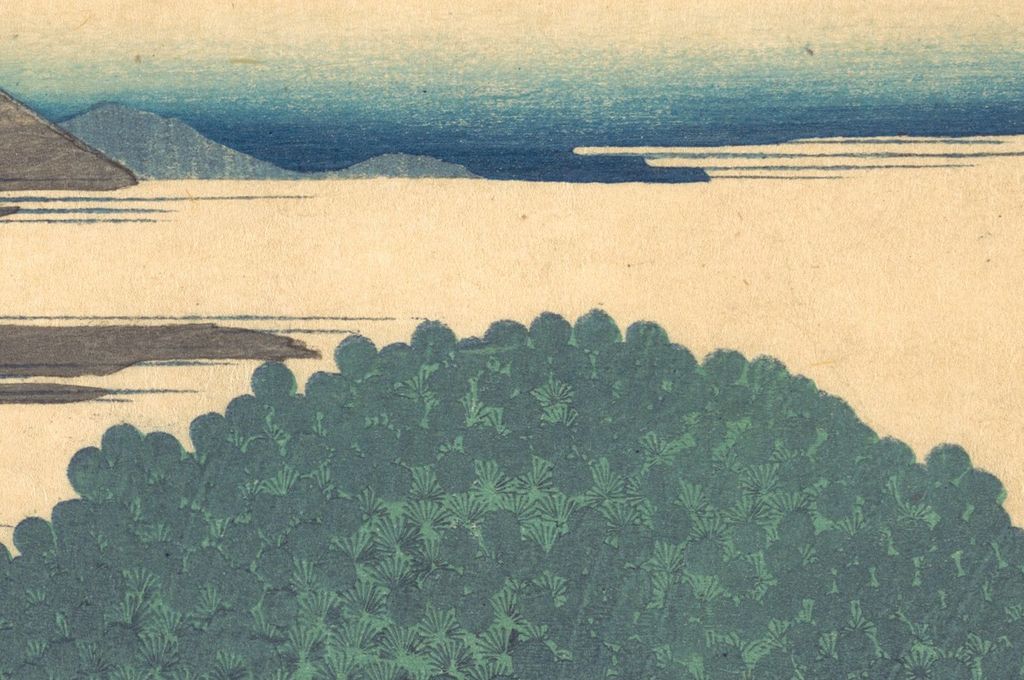
Hokusai gives the tree a well-defined outline before he gives it a recognisable trunk. The upper edge climbs gradually from the left, rounds off above the people and drops a little before the foliage reaches the right edge. Clusters of needles form short rounded marks along the skyline. Further down the canopy, those marks bunch into irregular patches with green showing through. Near the foot of the tree, thin uprights are visible in the gaps under the leaves. These lines lead the eye sideways along the bottom of the spread. Much of the view takes place under branches wide enough to lose sight of where they began. [1]
Walking, sitting and working in the garden
A path enters from the lower right. It begins behind a rounded hat close to the edge, then bends up past a larger figure in a patterned garment. The Met reads these figures as a father and son, with the father indicating Fuji. Trace the taller figure’s gesture and see how little of the way needs to be covered on foot before the eye is out beyond the garden. The path gives the people a route around the foliage, while the gesture gives them a view out of it. The summit has a place within a small exchange between two people. [1]
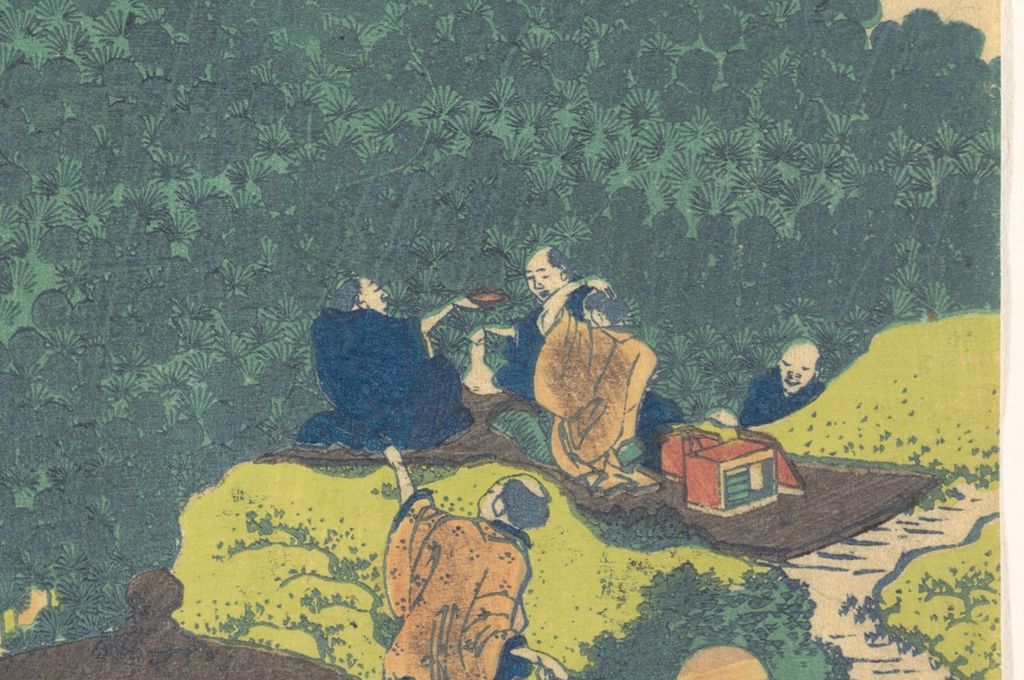
Above the path, several people settle into a space at the edge of the greenery. The Shimane Art Museum describes them as visitors sharing cups on a woollen mat. Their folded limbs and inclined heads make a compact group, while the travellers lean into the rising path. Look at the different shapes needed to show these two occupations. Garments bunch up around the seated people and hang in longer folds around the standing figure. Small patches of colour and the narrow dark shape under the group hold the picnic together without enclosing it in a building. [1] [4]
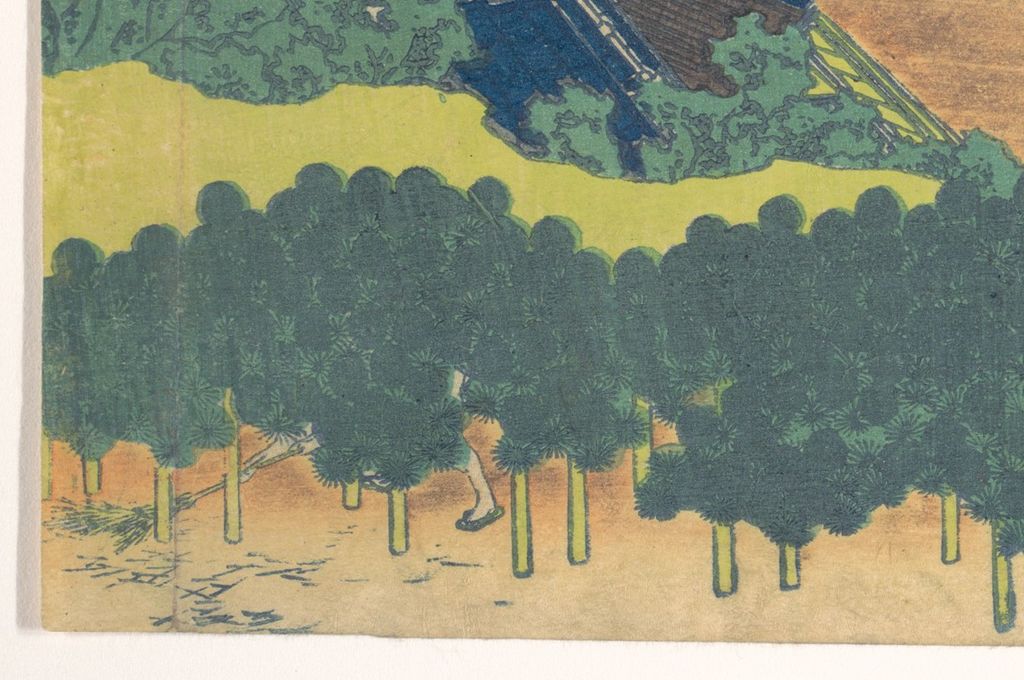
Another figure is easier to pass over. Close to the lower left, where the trunks or posts are slender and the ground almost bare, the Shimane Art Museum picks out someone sweeping up pine needles. In JP2985 the bent figure takes up a fraction of the height of the visitors at right. The museum pairs the worker with the group exchanging cups. You can also follow that pairing by moving along the lower edge of the print. The slope and the seats under the pine are places to pause, while the pale ground under the dark foliage shows the work of keeping the garden. [1] [4]
Between the two sides is part of a roof. Its slant is short and steep, with other edges of the building lost behind plants. The blues along the roof help pick it out from the earthy colour around it. Roads, a roof and a sheltered patch for sitting take the viewer through different parts of the garden in a small area of paper. Because Hokusai shows only parts of these places, there is always another stretch just behind the shapes that block it. This gives the narrow strips of visible ground a sense of continuation. [1]
Two profiles and the space between them
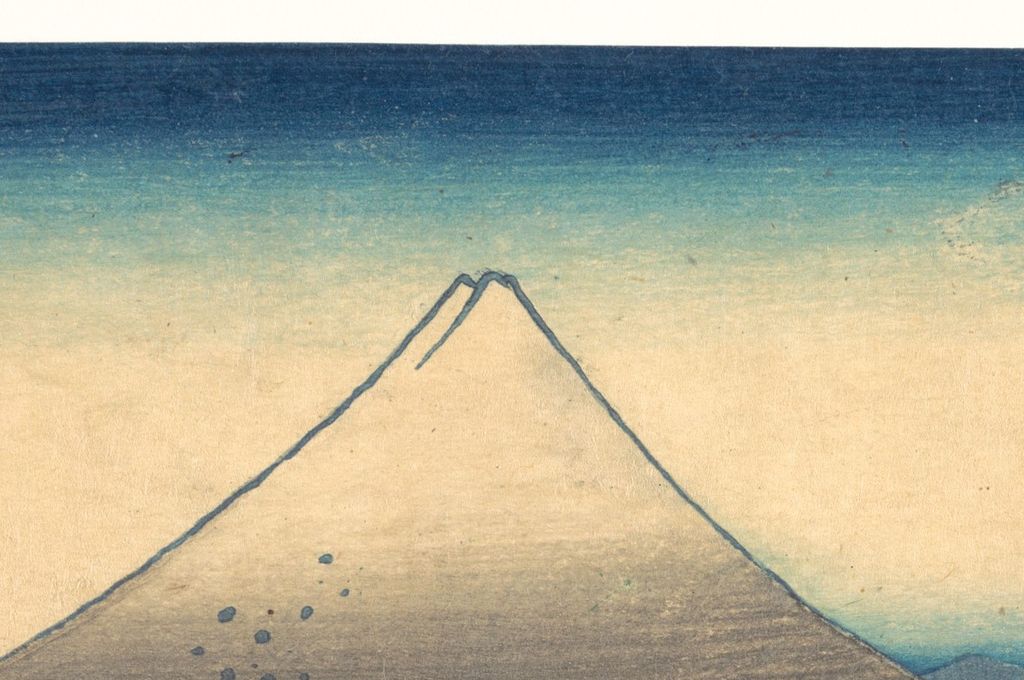
Fuji’s peak rises higher and farther left than the summit of the tree. A narrow mark near the top breaks into two lines before merging with the line of the upper slope. The slopes turn down on either side, becoming broad quite quickly. In the foreground the pine does almost the reverse. The rising foliage grows out of a long, low spread before the rounded top comes into view. The dark edges of both forms are easy to follow against pale paper. They rise at different angles, so the eye can compare them before taking in all the intervening landscape. [1] [3]
The distance between the two forms is harder to measure than their height. Bands of cloud stretch across the lower mountain and pass in front of the dark slope. Hokusai thins them into strokes, then opens a wide area of unprinted or pale paper below them. The garden interrupts the lower edge of this area. Its short leaves and clearly outlined branches are close enough to distinguish one from another. Fuji’s lower contours, by comparison, disappear and return in long strips. The picture moves from tiny clustered marks to broad, smooth intervals and back to a single peak. [1]
A second division comes from the blue near the horizon. It is strongest where it meets the cloud banks, fading into the sky above. At the very top of the sheet another blue band runs across the image. The opening between the two bands helps the fine edge of the mountain stand out. Fuji has very little detail at the summit compared with the crowded textures in the lower half. Its prominence comes partly from the amount of space Hokusai leaves around it. [1]
What two surviving sheets show
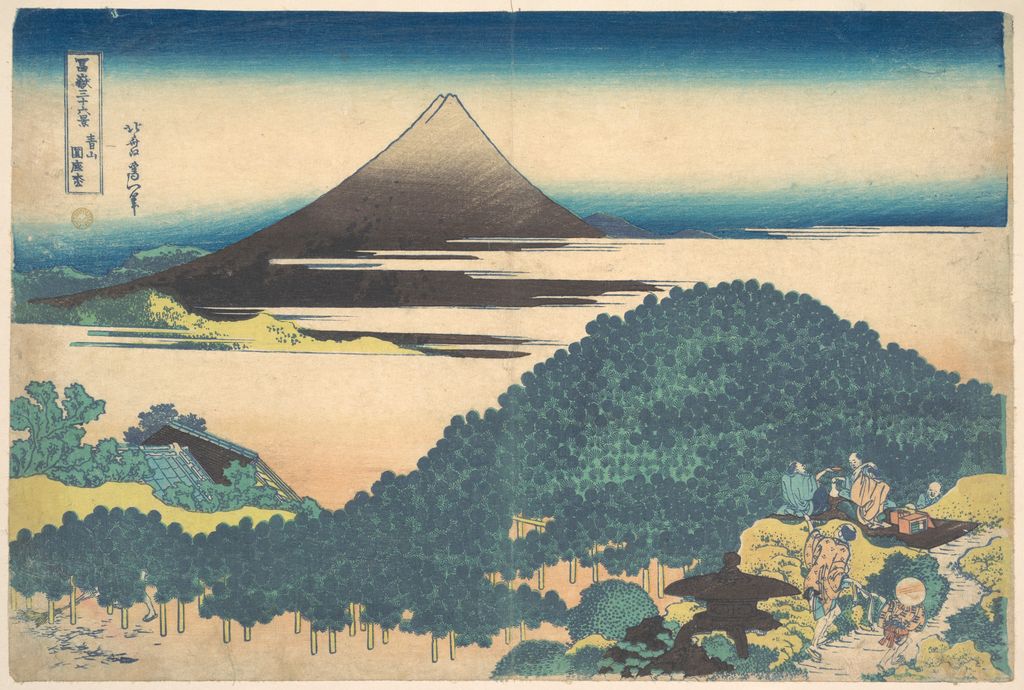
The Met has another impression of the same design, JP28. It dates both sheets to about 1830–32, and measures JP28 at 25.4 × 38.1 centimetres and JP2985 at 24.4 × 37.5 centimetres. In both photographs the narrow openings in the clouds, the tilted roof and the little figures along the path correspond closely. The strongest differences are easiest to see in broad areas of colour. Fuji’s lower flank looks darker and more continuous in JP28. In JP2985 the small mottled marks near the lower slope are more distinct against the lighter ground. The split outline of the summit remains clear in both photographs. [1] [7]
Compare the building on the left and the group at right as well. The photograph of JP28 shows more green across the roof and a lighter garment on the figure at the left of the seated group. In JP2985 the same area of roof looks bluer, and the garment shows up as a darker patch against the adjacent robes. The structure and the fold of the clothes are recognisable in both. Observations about those colour differences describe the museum images, where differences of printing, the sheets’ condition and the photographs themselves can all affect appearance. The two Met records give the same date range. [1] [7]
A second great tree in the series
In Mishima Pass in Kai Province, Hokusai again makes a nearby tree assert itself against distant Fuji. At Mishima the trunk runs nearly straight through the centre of the picture, and travellers stretch their arms around it. In Aoyama the branches run sideways and the people spread out over the surrounding ground. The first tree makes the mountain seem small by putting a massive upright beside it. The second invites comparison between two whole profiles. In both cases, a person’s reach or stride gives the viewer a unit of scale that the mountain itself cannot provide. [1] [8]
Look across the Thirty-six Views of Mount Fuji and these differences become easier to see. Sometimes Hokusai brings the mountain so close that its face supplies most of the colour in the picture. At Aoyama the experience of seeing it is closer to taking a turn through a garden. Someone could walk up the path, pass the picnic and look out over the clouds. Even after Fuji comes into view, the great dark spread of the pine keeps drawing the eye back to the people under it. [1]
Where this work sits in Hokusai’s career
Annotated Details from The Enza-no-matsu Pine Tree at Aoyama
The Metropolitan Museum of Art, JP2985. [1]
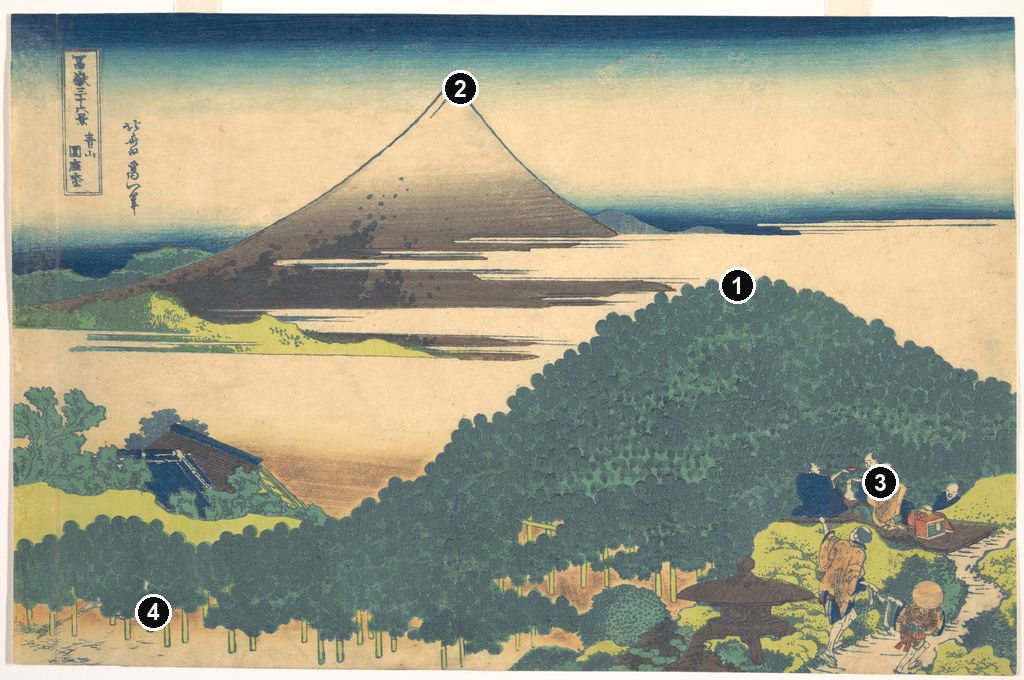
Details from THE ENZA-NO-MATSU PINE TREE AT AOYAMA
Select a detail to look closely.
The pine forms a broad dome
Its dark canopy spreads over the near hillside. The outline rises more gently than the outline of Fuji. [1]
Fuji projects into the sky
The steep peak repeats the upward movement of the nearer tree. Long stretches of pale paper give it a different scale. [1]
Visitors gather beside the pine
A small group stands out against the darker greenery. The people help give the tree its unusual size. [1]
A small worker appears below the branches
Look near the left edge of the foreground. A sweeper is easy to miss in the shadows beside the visitors. [1]
Explore Hokusai’s works
Discussion
Look again at the images and ideas explored in Cushion Pine at Aoyama. These editorial prompts invite your observations.
Reader Insights
How do the two main profiles echo each other?
What are the people doing beside the tree?
Join the Conversation
Share a detail, comparison or question about Cushion Pine at Aoyama below.
References
- The Metropolitan Museum of Art, Cushion Pine at Aoyama (Aoyama enza no matsu), impression JP2985, collection record and photograph. View source.
- National Museum of Western Art, Iuchi Collection exhibition checklist, item 10, Cushion Pine at Aoyama. View source.
- Sumida Hokusai Museum, Thirty-six Views of Mount Fuji: Cushion Pine at Aoyama, Japanese collection commentary. View source.
- Shimane Art Museum, Cushion Pine at Aoyama, Japanese collection commentary, H0795-1-01. View source.
- Tokyo Fuji Art Museum, Thirty-six Views of Mount Fuji: The Cushion Pine Trees at Aoyama, Japanese collection commentary, 06260. View source.
- National Gallery of Victoria, Hokusai exhibition labels, entry for Cushion Pine at Aoyama. View source.
- The Metropolitan Museum of Art, Cushion Pine at Aoyama (Aoyama enza no matsu), impression JP28, collection record and photograph. View source.
- The Metropolitan Museum of Art, Mishima Pass in Kai Province (Kōshū Mishima goe), impression JP2970, collection record and photograph. View source.







