


 by Tom Gurney
Tom Gurney BSc (Hons) is an art history expert with over 20 years experience
Published on June 19, 2020 / Updated on November 20, 2026
Email: tomgurney1@gmail.com / Phone: +44 7429 011000
Peonies and Butterfly
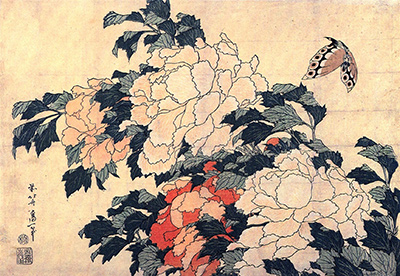
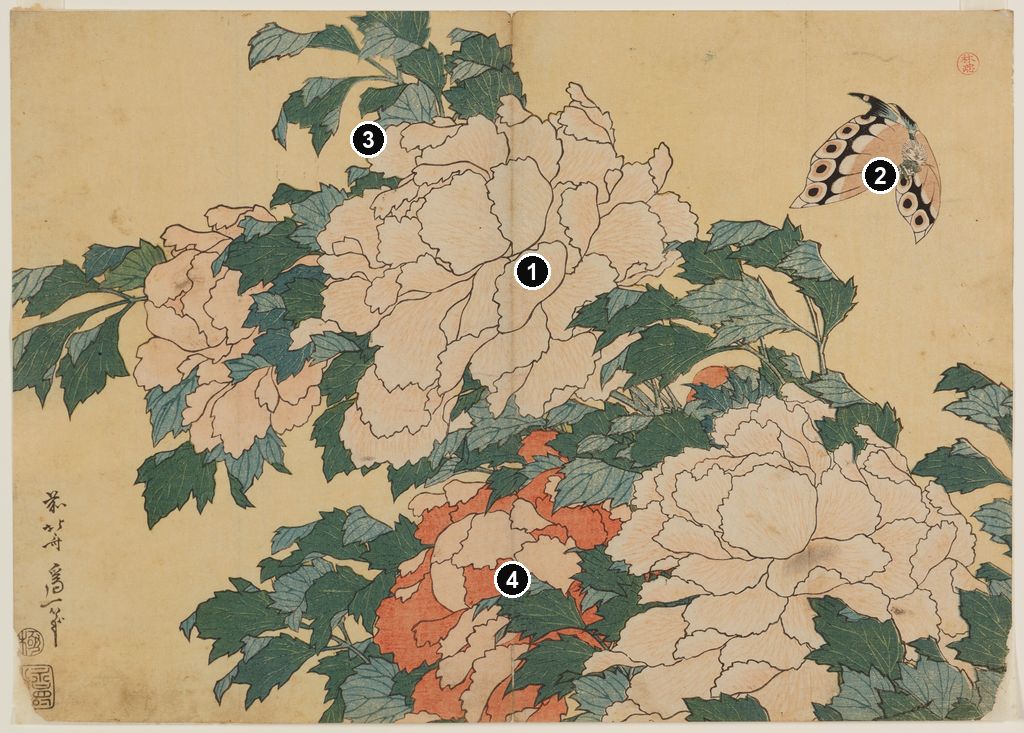
A butterfly turns in the air above a stand of peonies in Katsushika Hokusai’s colour woodblock print Peonies and Butterfly. The plants occupy almost the whole width of the sheet. Pale blossoms rise out of dense foliage, with touches of red deeper in the cluster. A patch of open ground near the upper right gives the butterfly room to spread its wings. From a distance, the eye goes first to the largest flowers. The longer you look, the more the small insect helps you see the movement in the much larger forms below it. [1] [2]
Tokyo National Museum holds two impressions catalogued as 牡丹に蝶 (Botan ni chō). The Sumida Hokusai Museum uses the title 牡丹に胡蝶 (Botan ni kochō) for its Peter Morse impression. Both titles identify the peonies and the butterfly. The Sumida museum dates its sheet to around 1833–34, in the early years of the Tenpō era. These impressions are horizontal ōban, the large print format favoured for Hokusai’s group of designs known as Large Flowers. The yellow ground and the scale given to the flowers are particularly useful features for following this design across its surviving sheets. [1] [2] [3] [4] [5]
At a Glance
- ArtistKatsushika Hokusai
- DateEarly 1830s
- MediumColour woodblock print
- SeriesLarge Flowers
Contents
How the peonies fill the sheet
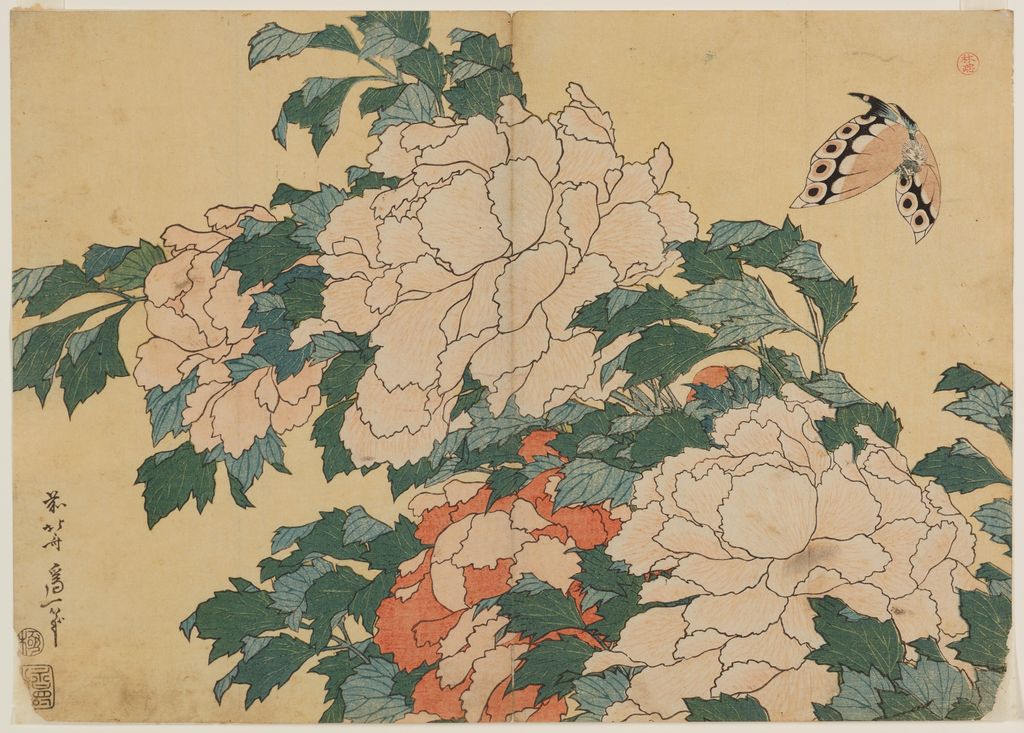
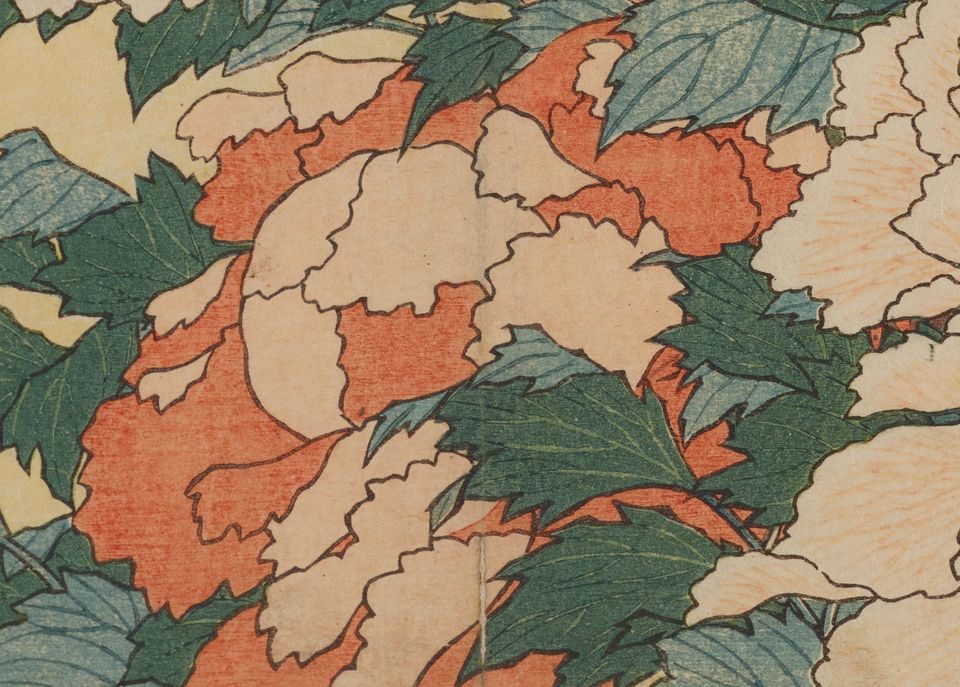
Start with the tall pale bloom left of centre. Its outline rises through a series of small steps and folds, then descends into the leaves. Within that outline, thin lines break the flower into overlapping petals. Near the top, a few edges project into the open ground where their irregular shapes are easy to see. Farther down, some curves are interrupted by other petals or by foliage. The density of the lines changes between the frilled edges and the broader surfaces. The eye can trace one petal at a time and still take in the bloom as a single large shape. [1] [2]
The blossoms at the lower right form a second, lower concentration. Leaves rise between the two masses, so the eye travels across several dark shapes before settling on another pale flower. Here the framing puts the viewer much closer to the plant. Several forms extend through the bottom and right edges, and the lowest leaves are only partly visible. At the left, a smaller cluster reaches out on a separate branch. The different levels make it possible to follow the plant across the print without needing to see where it grows from the ground. [1] [2]
The coloured accents are concentrated in some of the smaller blossoms and in the lower middle of the sheet. In Tokyo’s smaller impression, one group of warm red-orange petals sits deep inside the green forms where the foliage partly obscures it. Other petals remain close to the colour of the surrounding field. The upper bloom and the flowers near the lower right stand out largely through line and through the leaves that enclose them. This division of colour and line makes the plant readable at different distances. First the print resolves into large masses, then the lines disclose the individual turns of petals and leaves. [1]
The butterfly and the wind
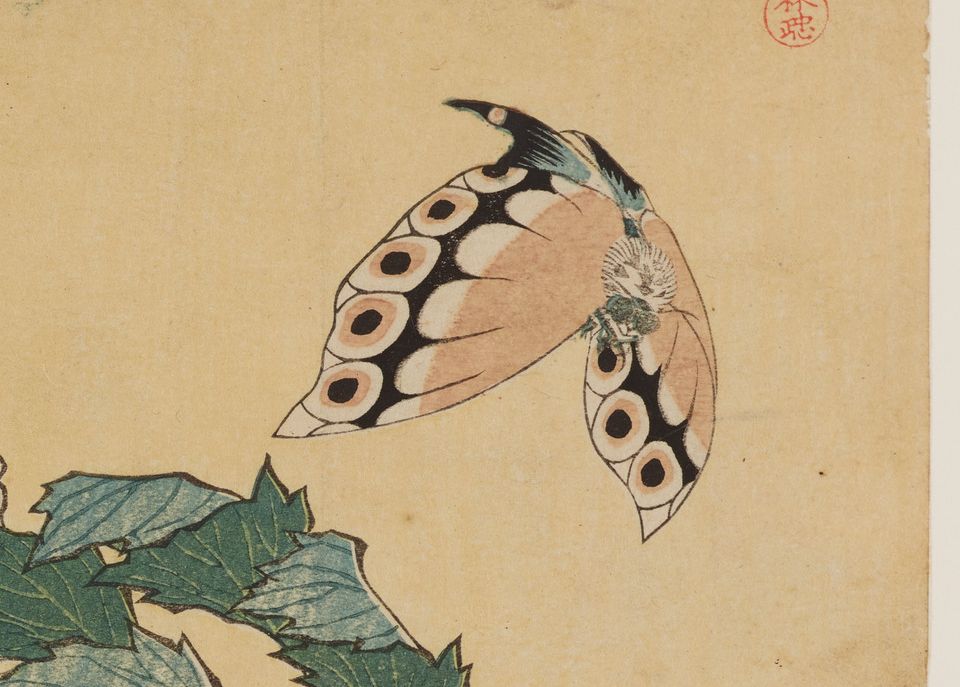
The butterfly occupies the open upper right. Its body and the wings make a tilted shape, with dark marks running along the outer edges and small pale gaps between them. The upper edge of the left wing and the curved edge of the other give the silhouette an imbalance that suggests a turn. Hokusai placed the insect far enough above the foliage for its outline to remain clear. The nearby tips of leaves point in several directions, so the eye can compare the butterfly’s angle with the forms closest to it. [1] [2]
The Sumida Hokusai Museum reads the scene as a gust coming from the right that bends the peonies and disturbs the butterfly’s flight. That interpretation connects otherwise separate details. The foliage pushes outward in sharp projections, the uneven edge of the highest bloom seems to lift, and the insect tilts above them. There is very little in the scene to tell us where the wind comes from except its effect. As you look from one form to the next, the moment gains a sense of direction. The butterfly makes the changes in angle particularly easy to recognize because its body is isolated against the ground. [1] [3] [4]
Hokusai made a related use of the gap between an insect and a plant in Bluebells and Dragonflies. There a long, narrow body and the extended wings of the dragonfly cross above the pointed stems. The dragonfly’s outline lends itself to a straight line and a span. The butterfly among the peonies offers a more compact silhouette with broader surfaces and more obvious curves. In each print, a small animal holds its own beside the vegetation because the part of the sheet directly around it is comparatively quiet. [1] [6]
The publisher, the seals and the yellow ground
The Sumida museum identifies the work as one of ten large-format flower and bird designs published by Nishimuraya Yohachi, also known as Eijudō. The Minneapolis Institute of Art records the same publisher for impression 74.1.211 and identifies a publisher’s seal, a kiwame approval seal and the signature Saki no Hokusai Iitsu hitsu. The signature identifies Iitsu as the former Hokusai. In the Tokyo photographs, the inscription and marks form a small vertical group at the lower left, with a little ground around them. Their position helps separate the lettering from the dense contours near the middle and right. [1] [2] [3] [5]
As the Sumida museum explains, the ground of its impression uses kitsubushi, a printing treatment that fills the background with yellow. The unbroken field makes the thin lines at the edges of the flowers clear and gives the insect its own space. The deep green of the leaves produces sharper boundaries in some places, while the pale petals sit closer to the ground in others. An even field of colour can thus affect how the viewer reads all the other blocks of a colour woodblock print. Its task here is to keep both an intricate flower and a small, airborne body legible. [3] [4] [7]
The densely overlapping petals and large fields of unmarked colour also interested later collectors. A sheet of the design measuring 24 by 36.5 centimetres was lent by the Fondation Claude Monet in Giverny to the National Museum of Western Art’s 2017 exhibition in Tokyo. Its catalogue lists that particular impression as circa 1831–33. The foundation’s account of the Japanese prints at Giverny puts the sheet in context as part of a collection that includes many works by Hokusai, Hiroshige and Utamaro. The documented presence of this design in Monet’s collection gives it a specific place in the history of Japanese prints reaching other audiences. [8] [9]
What changes between impressions
The two Tokyo sheets make a good comparison because their differences can be seen against a stable arrangement. The upper peony, red accents below, butterfly and bottom-left marks remain in the same relation. The catalogued dimensions are 24.5 by 34.7 centimetres for A-10569-2783 and 26 by 38.8 centimetres for A-11120. In the photograph of the smaller sheet, parts of the lower bloom and the butterfly’s wings are especially pale. In the photograph of the larger sheet, more of the flower edges at left and lower centre read as pink, and the insect’s wings look darker and fuller. [1] [2]
A comparison like this directs attention to what the photographs actually show. The butterfly holds the same position near the top right, even where a change in the weight of the dark areas alters its prominence. A stem that separates from the topmost foliage, and a leaf crossing in front of the lower pale bloom, provide further landmarks for lining up the designs. The sheets differ in dimensions and the images in colour and contrast. Those observations leave the printing sequence open, since the surviving appearance also reflects the sheet’s history and the conditions under which it was photographed. [1] [2]
The Minneapolis reproduction provides another way to read the lower half of the picture. Its leaves look cooler and more subdued than those in the photograph of Tokyo’s larger sheet. Narrow gaps between the leaves near the lower edge are still clear, and the shape of the foliage can be followed around the part of the central bloom that rises above it. Pink on the left remains comparatively pale in the Minneapolis image, while orange in the lower cluster draws the eye deeper into the plant. The sequence of large shapes holds through these visible differences. [2] [5]
A different peony print with a canary
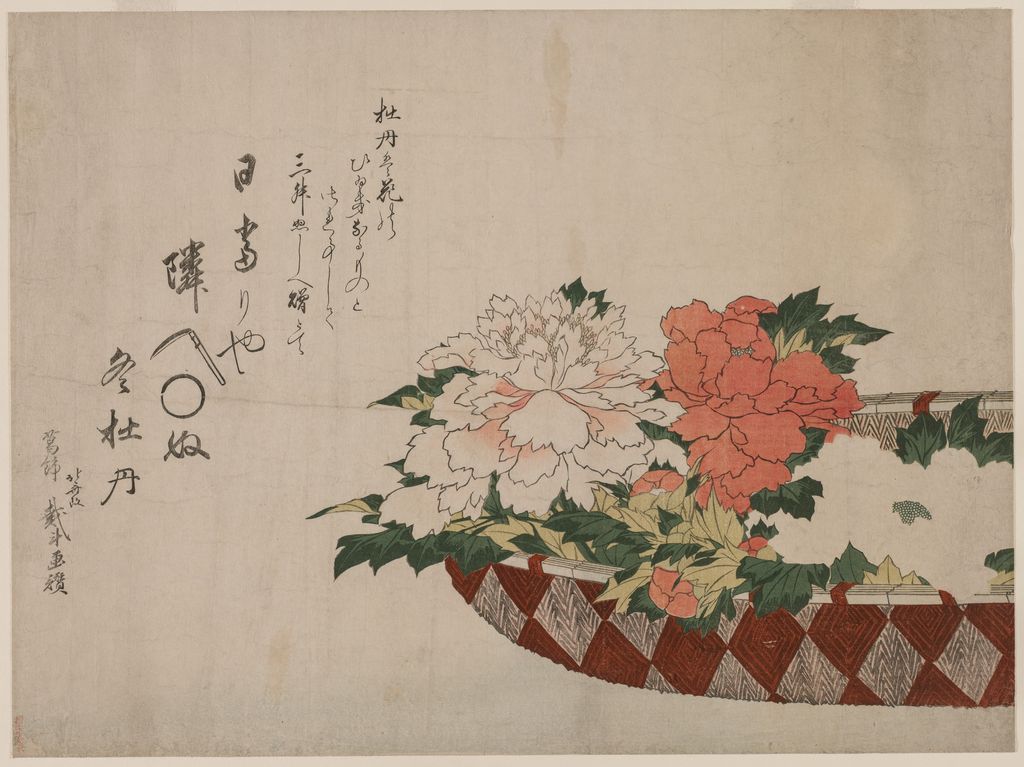
Hokusai also designed Peonies and Canary, represented by impression 21.10228 at the Museum of Fine Arts, Boston. The museum dates it to about 1834 and identifies it as a vertical chūban, a smaller format than the landscape-oriented butterfly print. The upright sheet has a deep blue field and leaves room for a poem in Chinese alongside the flowers and pale bird. Boston records the same publisher and Iitsu signature. It classifies the canary composition in the group commonly called Small Flowers. Its format, bird and inscription distinguish it from the butterfly print in ways the repeated flower name alone cannot convey. [1] [5] [10] [11]
The canary has a substantial body within the vertical opening between the flower clusters, and the poem gives the eye a separate place to pause. In Peonies and Butterfly, the flowers and insect carry the encounter across a broad field. The almost continuous foliage along the bottom makes the single small opening around the wings especially conspicuous. Follow the pale flower at the upper centre out to the pointed leaves and then to the butterfly. That short passage is enough to turn a mass of carefully printed petals into a scene that seems to be changing as you look. [1] [3] [10] [11]
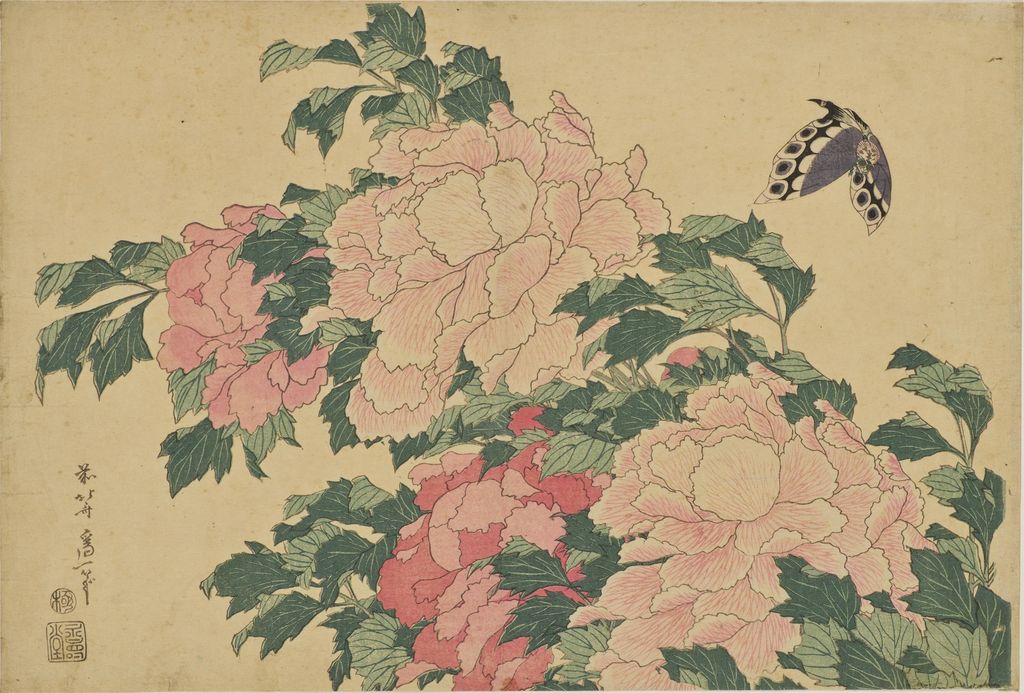
Image comparison
Where this work sits in Hokusai’s career
Annotated Details from Peonies and Butterfly
Tokyo National Museum via ColBase, A-10569-2783. Adapted with markers and detail crops under the ColBase terms. [1]
Details from PEONIES AND BUTTERFLY
Select a detail to look closely.
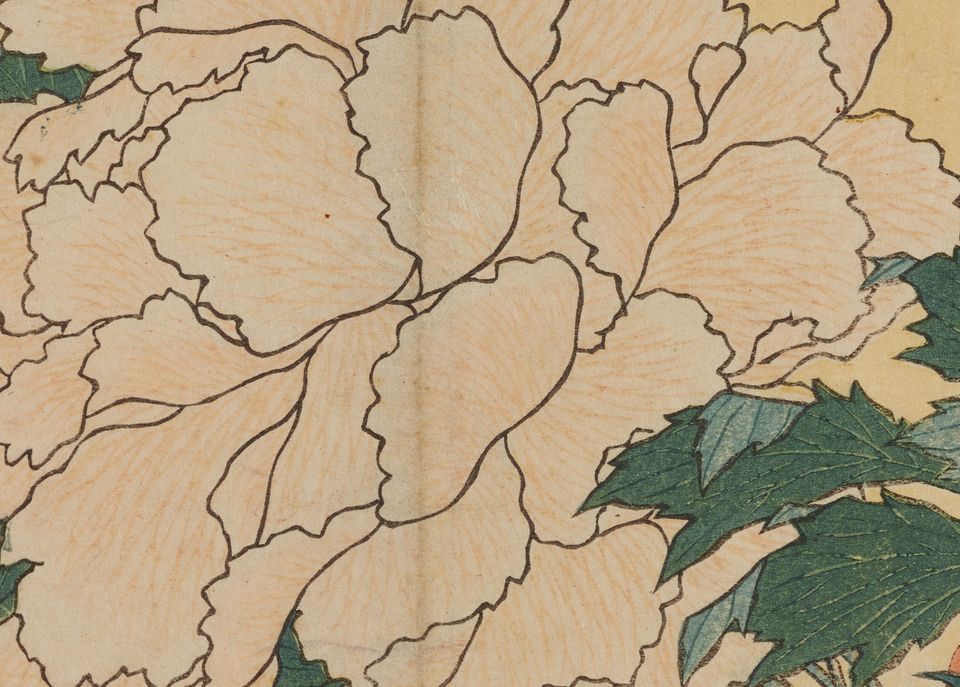
The largest flower opens outwards
The light mass is built up from overlapping outlines. Turning petals give the flower several edges within a single broad form. [1]
The butterfly enters above the blossom
A few dark strokes define the insect against open paper. Its position keeps the upper right distinct from the tightly packed flowers. [1]
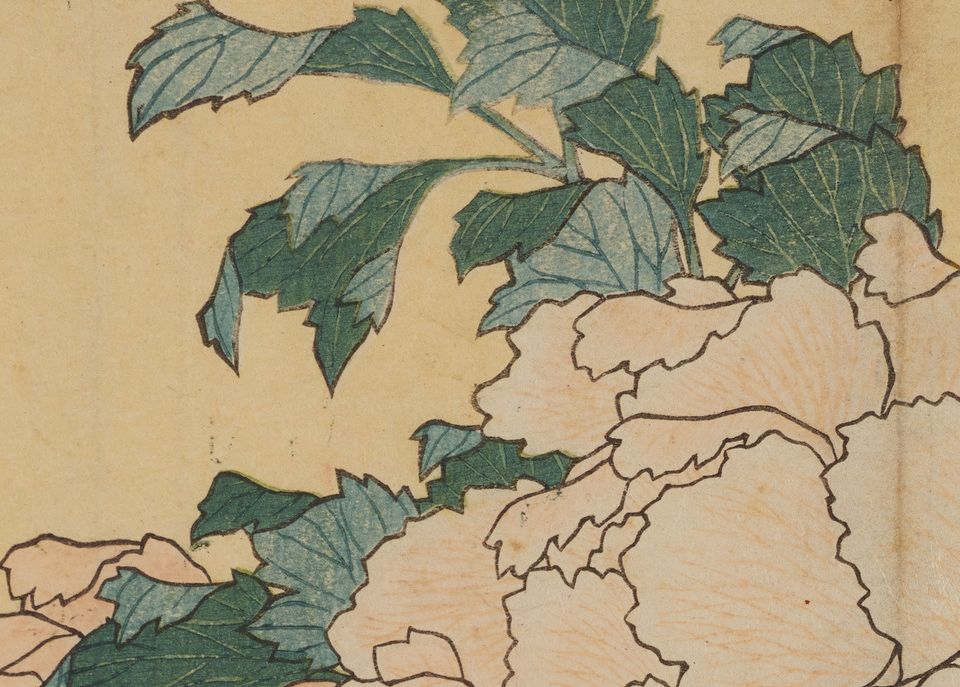
Leaves frame the upper edge
Dark leaves extend over the large flower. The irregular shapes preserve the sharpness of the leaf tips against the pale petals. [1]
Smaller coloured forms overlap below
A warmer group of petals takes on more weight where they cross the darker leaves. The colour can be followed into the crowd of overlapping forms. [1]
Explore Hokusai’s works
Discussion
Look again at the images and ideas explored in Peonies and Butterfly. These editorial prompts invite your observations.
Reader Insights
Where does a blossom overlap another form?
What do the butterfly and its open surroundings add to the print?
Join the Conversation
Share a detail, comparison or question about Peonies and Butterfly below.
References
- Japan Agency for Cultural Affairs, Peonies and Butterfly (牡丹に蝶), Tokyo National Museum impression A-10569-2783, Cultural Heritage Online 460811. View source.
- Japan Agency for Cultural Affairs, Butterfly and Peonies (牡丹に蝶), Tokyo National Museum impression A-11120, Cultural Heritage Online 484707. View source.
- Sumida Hokusai Museum, Peonies and Butterfly (牡丹に胡蝶), Peter Morse Collection, object notes and dating. View source.
- Sumida City, Peonies and Butterfly (牡丹に胡蝶), municipal cultural property database, Peter Morse impression, record 101084. View source.
- Minneapolis Institute of Art, Peonies and Butterfly, collection data for impression 74.1.211. View source.
- The Metropolitan Museum of Art, Hokusai’s bellflower and dragonfly print, impression JP746. View source.
- Sumida Hokusai Museum, Wow, Hokusai! See, Examine, and Discover Ukiyo-e, permanent gallery account of the printmaking process. View source.
- National Museum of Western Art, Hokusai and Japonisme, 2017 exhibition checklist, entry H-29, Peonies and Butterfly. View source.
- Fondation Claude Monet, Japanese Prints, account of Monet’s collection at Giverny. View source.
- Museum of Fine Arts, Boston, Peonies and Canary (Shakuyaku, kanaari), collection record for impression 21.10228. View source.
- Museum of Fine Arts, Boston, Peonies and Canary (Shakuyaku, kanaari), Bigelow impression photograph and record supplied to Google Arts & Culture. View source.







