


 by Tom Gurney
Tom Gurney BSc (Hons) is an art history expert with over 20 years experience
Published on June 19, 2020 / Updated on November 20, 2026
Email: tomgurney1@gmail.com / Phone: +44 7429 011000
Climbing on Fuji
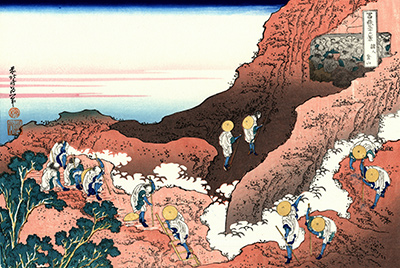
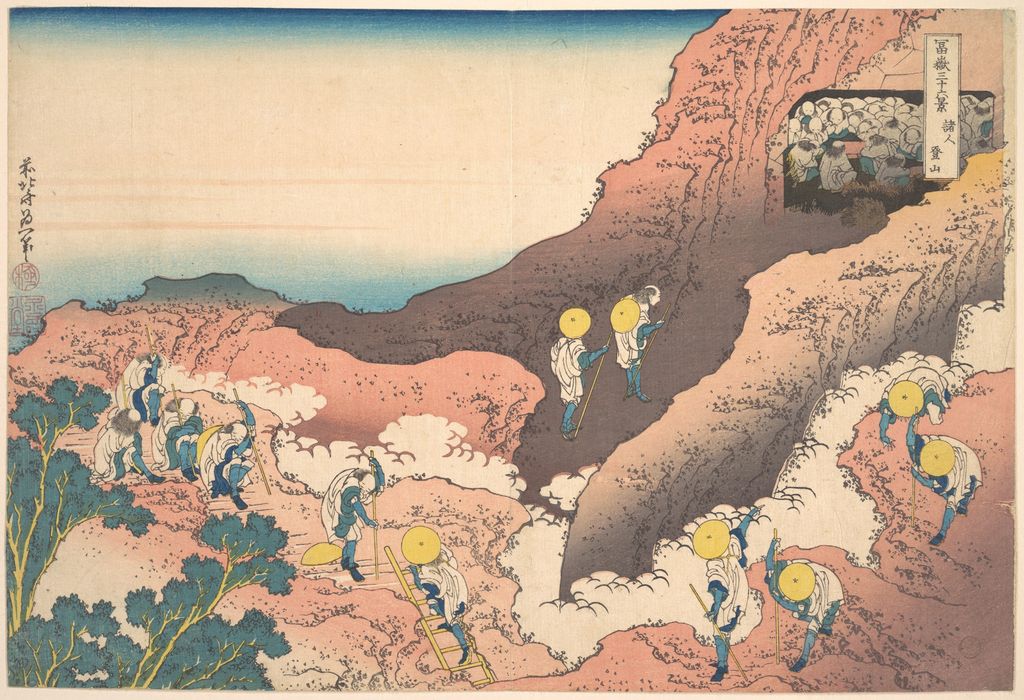
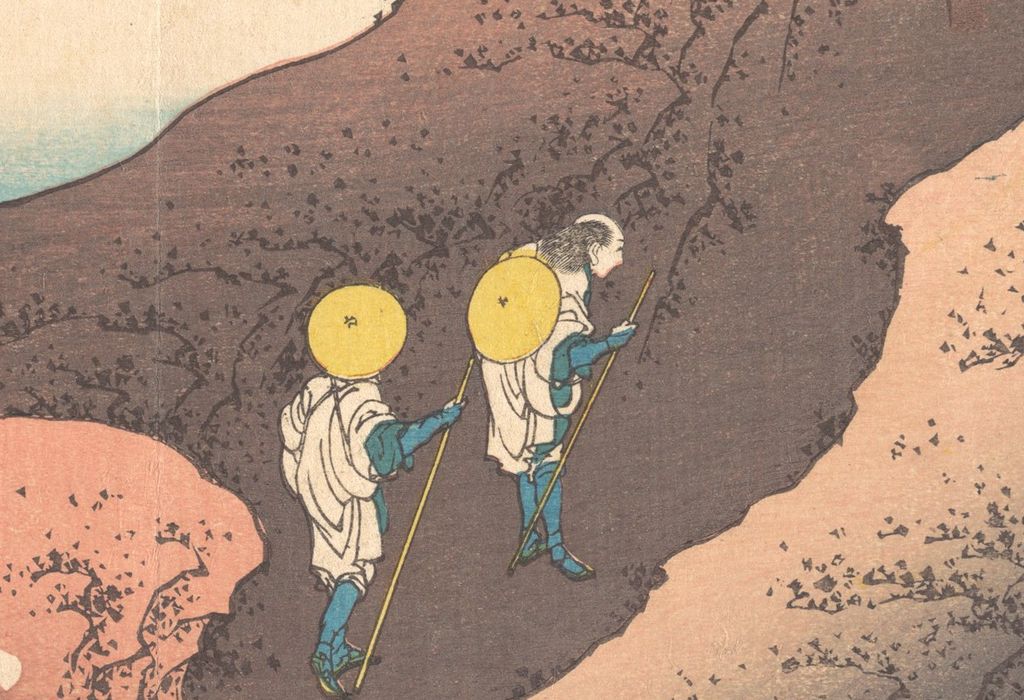
Two climbers cross a dark stretch of rock in Katsushika Hokusai’s Groups of Mountain Climbers. Their bodies incline in the same direction. One has lifted a foot, the other reaches forward with a staff, and both wear pale clothing with round yellow hats against their backs. Higher up, a crowd has already found shelter in a rock chamber. In this view from Thirty-six Views of Mount Fuji, the mountain is the ground beneath everyone’s feet. Hokusai puts us close enough to see the work of getting from one foothold to the next. [1] [2]
The Japanese title is 諸人登山. The Metropolitan Museum of Art uses the reading Shojin tozan in its catalogue of the impression JP1322, which it dates to about 1830–32. Shimane Art Museum gives Morobito tozan for its impression of the same design. Both titles put the people and their ascent at the centre of the subject. The print is unusual within Thirty-six Views of Mount Fuji for showing Fuji from its upper slopes, where the familiar outline is beyond the viewer’s field of vision. [1] [2] [3]
At a Glance
- ArtistKatsushika Hokusai
- Dateca. 1830–32
- MediumColour woodblock print
- SeriesThirty-six Views of Mount Fuji
Contents
Finding a foothold
Start at the bottom of the Met’s sheet, where a ladder runs diagonally up towards the left. A pilgrim has put a foot on it. The round hat interrupts the pale curves of the clothing, and the blue lower leg almost touches the line of a rung. Above, a second person stoops on the ledge, with one arm raised. Those two figures are very close together on paper. The ladder separates their positions clearly enough that you can follow the short climb between them. It also tells you something about the terrain. A step between neighbouring surfaces could require extra equipment. [1]
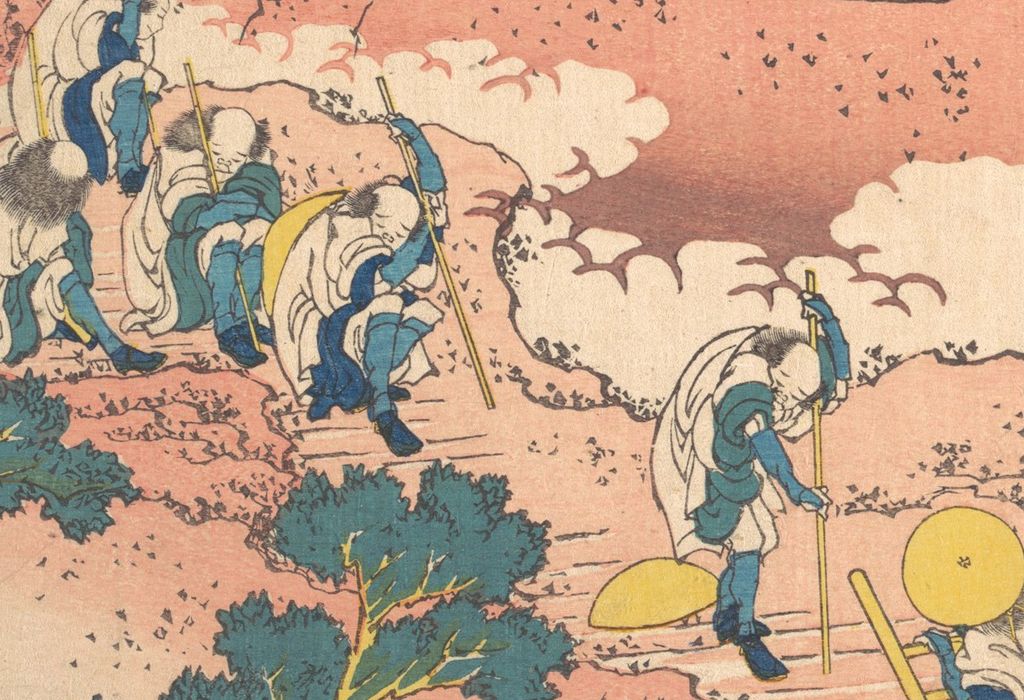
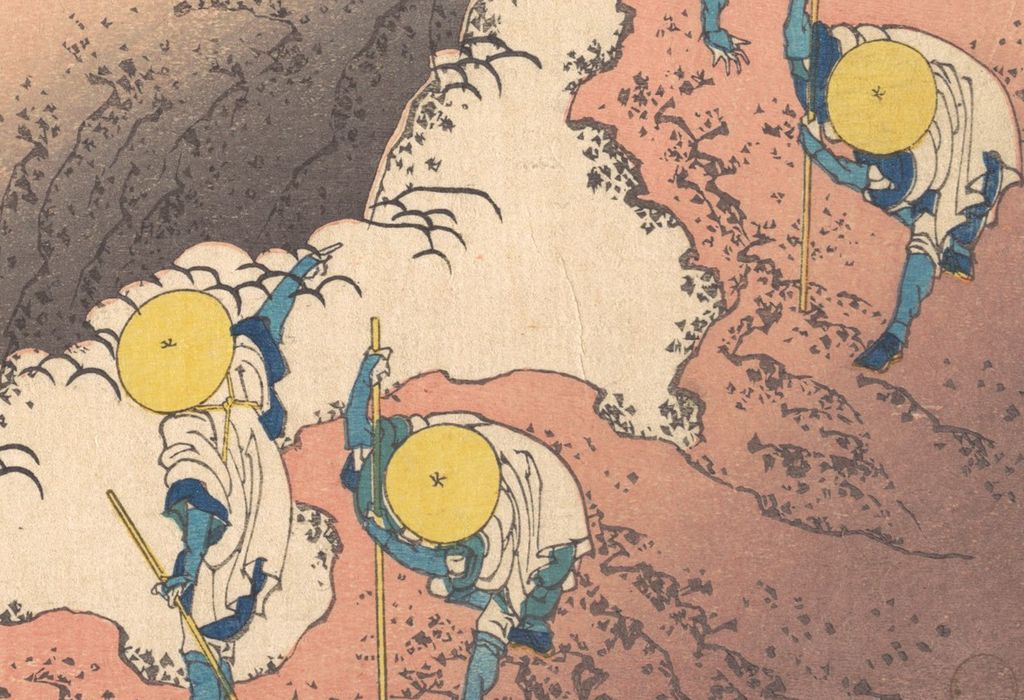
Farther left, a group negotiates another break in the path. Some of the bodies are compressed into bent shapes, and the ends of the staffs appear at different heights. The dark foliage along the edge almost merges with the blue areas of the clothes. Hokusai leaves lighter rock visible immediately above the group so that legs and staffs remain individually legible. Across the clouds on the right, there are more people on separate exposed stretches. Two of them lean into a climb at the lower right, while another pair higher up almost seems to repeat the same labour on a different pitch. The scattered groups let us see a path in pieces, through the different ways people use it. [1]
The two walkers on the central incline are easier to read from a distance. The rock has darkened behind them, drawing the eyes towards pale clothing, upright staffs and conspicuous yellow disks. Their posture echoes the slope without disappearing into its texture. Look at where the end of a staff comes down against the rock, then at where a lifted foot stops in relation to it. Each line describes a prospective point of contact. The print gives us enough to imagine how the next step will happen, even while the larger path ahead is obscured by the slope. [1]
Above the clouds
Much of the upper left of the print is open sky. In JP1322 a dark blue band fades down from the top edge, leaving a lighter area crossed by faint warm streaks. The long border between sky and rock begins low on the left and climbs out of the top of the sheet. The blue is horizontal while the mountain drives diagonally upwards. With little in the sky to tell us how far away anything is, the boundary between the two gives an unusually strong sense of height. Sumida Hokusai Museum draws attention to that expansiveness in its account of the print. [1] [2]
Lower down, pale cloud forms come up between areas of exposed rock. A rounded cloud edge cuts off parts of the terrain that seem about to join. It helps distinguish the steep diagonal of the central rock from the route past the people on the right. MOA Museum of Art identifies the white forms as clouds rising from the valley. Near the upper edge, those soft lobes give way to granular markings and long lines on the rock face. The effect of being high on the mountain comes partly from being able to look down at the clouds and up at the next climb in the same glance. [1] [4]
The relation of figure to rock is very different in Rainstorm Beneath the Summit. There the silhouette lets us take in the mountain as a single form, and the lightning seems small in relation to it. Here a few people are big enough to set the scale, and their feet and hands do the work of making the mountain intelligible. The surface that reads as a dark slope from far away becomes a place of ladders, ledges and shelter when Hokusai brings us onto it. [1] [5]
A place to rest near the summit
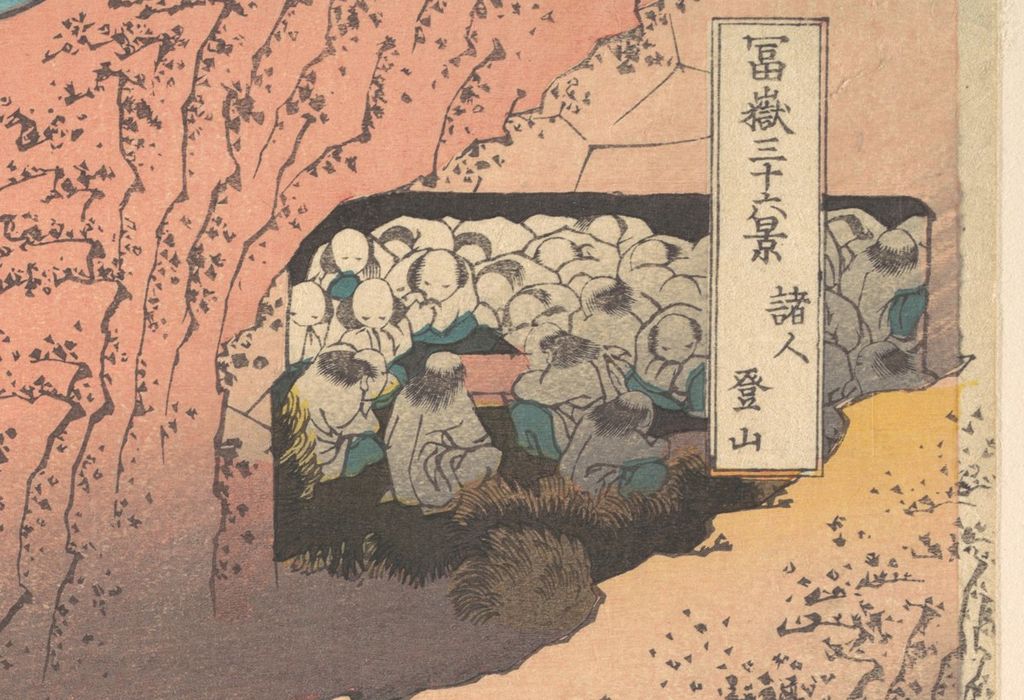
Follow the dark rock above the two central climbers and it leads towards an opening at the upper right. The roof descends low enough to hem in the mass of lightly drawn heads and bodies. Faces and head coverings sit close together, and several people in front have their backs to us. Outside the chamber the climbers are usually separated by stretches of rock. Inside, the mass of nearly touching bodies makes the room appear shallow and crowded. Hokusai puts the print’s upright title cartouche over part of that opening, so the name of the scene is read alongside the people who have reached this stage of the climb. [1]
The institutions describing the scene emphasise different aspects of the shelter. Sumida Hokusai Museum calls it an ishimuro, a stone chamber offering protection from the wind. The National Diet Library connects the people gathered near the summit with waiting for sunrise. The Met describes the ascent in relation to worship in the mountain’s grottoes. The crowded figures are visible, while their ultimate intentions are harder to read from the sheet alone. Seen in the light of those accounts, resting, taking shelter and preparing for worship can all belong to the experience of the same climb. [1] [2] [6] [7]
Sumida identifies the climbers with Fujikō, associations devoted to Mount Fuji and its worship. It relates the scene to ohachimeguri, the circuit around the peaks surrounding the summit crater. The groups wear light robes and woven hats and carry the pilgrimage staffs known as kongō-zue. Some of the hats in the print sit against the shoulders. They are particularly conspicuous when the climbers face uphill and away from us. A visitor can recognise the group through its shared equipment even without knowing the name of each object. The repeated staffs also let Hokusai vary the angle, height and timing of each person’s effort. [1] [2] [6]
Hokusai returned to Fuji’s paths and shelters in One Hundred Views of Mount Fuji. The Met’s first volume, dated 1834, includes an opening that puts a close view of the ascent on the right and pilgrims sliding back down through volcanic sand on the left. Shimane links the group gathered in the rock chamber of Groups of Mountain Climbers to a separate illustration in the second volume, Fuji’s Rock Chamber. The books can give the climb, the descent and the rest stop separate scenes. The colour print holds moving pilgrims and sheltered ones together, and makes the upward pull towards the opening part of the entire landscape. [1] [3] [8]
Two impressions of the same climb
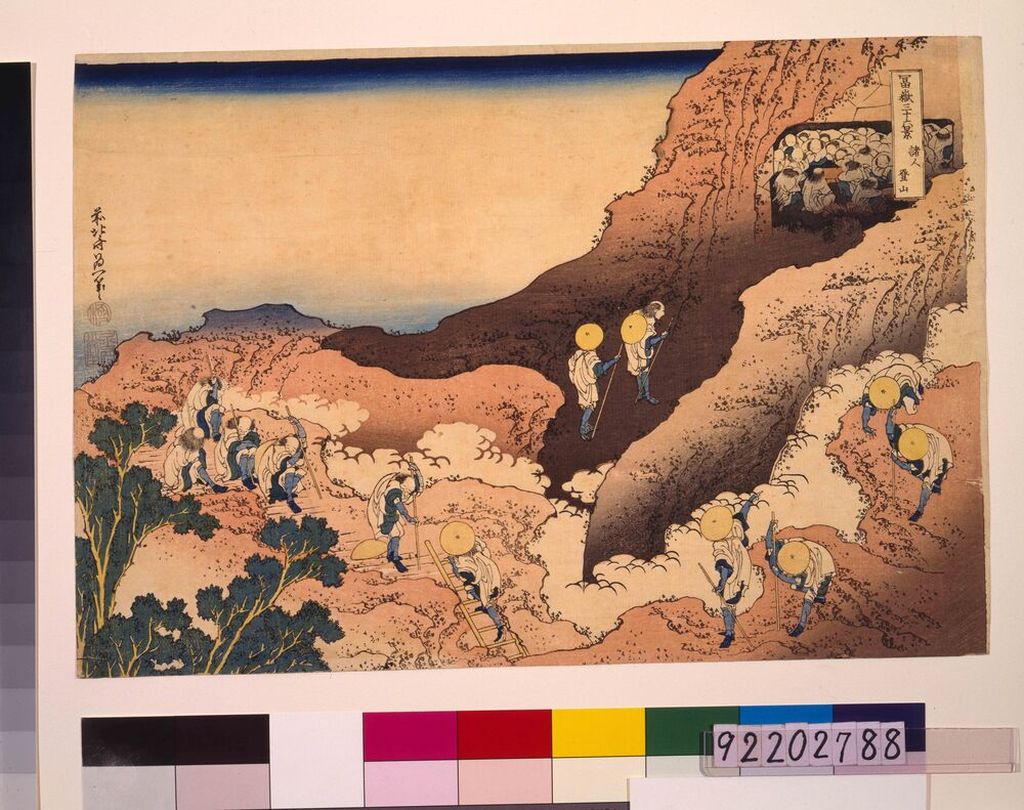
The Edo-Tokyo Museum’s impression 92202788, reproduced through Tokyo Museum Collection, makes a useful comparison with the Met’s JP1322. The ladder, the pair on the central slope and the people at the mouth of the chamber match across the two photographs. In the Edo-Tokyo photograph, the uppermost blue is an especially dense strip and the sky beneath it is warmer. The warm lines crossing the open sky are clearer in the Met photograph. The warmth of the central shadow and its relation to the surrounding rocks also differ between the two images. The same people reach the same rock chamber, even as the colour relationships change how quickly the eye finds them. [1] [9]
The National Museum of Western Art’s checklist places the Iuchi Collection impression at number 48 of its exhibition and at the end of its sequence of Fuji designs. Read at the end of a group of landscapes, the ascent feels like a change in the terms of looking. The peak that has served as a point of orientation elsewhere has become the place we are trying to get our bearings. It is the print’s ladders, joined and broken paths, and small adjustments of posture that establish where we stand. [1] [10]
The Met records its sheet as 25.4 by 37.5 centimetres. The Edo-Tokyo Museum records its sheet at 26.2 by 38.7 centimetres and dates it to 1831–34. Variations in the photographs can reflect printing, the condition of the paper or the way the sheets were photographed. Colour and measurements alone give no secure order of printing. To recover the experience that ties the impressions together, start again with the pilgrim at the ladder. Follow successive hands, staffs and bent knees uphill until the separate tracks seem to converge on the low opening. The print lets us judge the extent of the mountain through the effort of people who have made it almost to the top. [1] [9]
Where this work sits in Hokusai’s career
Annotated Details from Groups of Mountain Climbers
The Metropolitan Museum of Art, JP1322. [1]
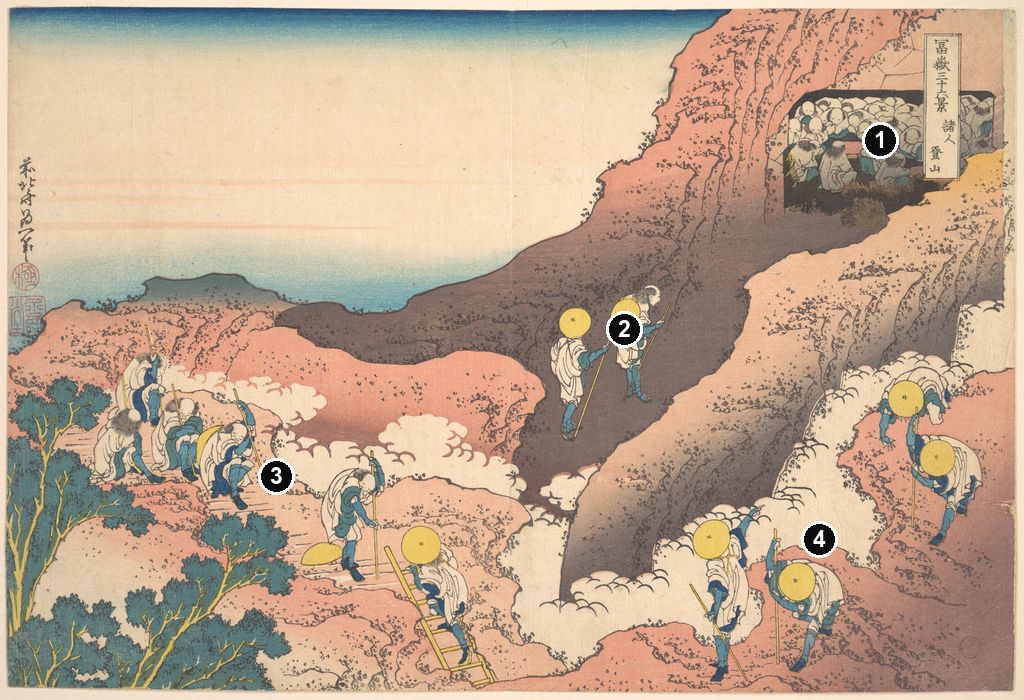
Details from GROUPS OF MOUNTAIN CLIMBERS
Select a detail to look closely.
A dark shelter interrupts the rock
A shadowed opening gathers several figures high on the right. The rock gives their meeting place a much larger scale. [1]
Climbers move through the middle passage
Figures occupy a narrow space between the rocky sides. Their positions break the larger diagonal into stages. [1]
The lower group spreads across the slope
Small figures appear at several different heights. Their movements contrast with the much steadier outlines of the terrain. [1]
The path bends sharply at the lower right
The rocks leave a small open route for the figures. Dark edges make the change of direction easy to trace. [1]
Explore Hokusai’s works
Discussion
Look again at the images and ideas explored in Climbing on Fuji. These editorial prompts invite your observations.
Reader Insights
How do the figures find different ways through the steep terrain?
What changes when you look up the slope towards the shelter?
Join the Conversation
Share a detail, comparison or question about Climbing on Fuji below.
References
- The Metropolitan Museum of Art, Groups of Mountain Climbers (Shojin tozan), impression JP1322, object record and image. View source.
- Sumida Hokusai Museum, Thirty-six Views of Mount Fuji: Groups of Mountain Climbers (冨嶽三十六景 諸人登山), collection record and interpretation of the pilgrimage. View source.
- Shimane Art Museum, Pilgrims Climbing the Mountain, Nagata Seiji Collection, title reading and comparison with One Hundred Views of Mount Fuji. View source.
- MOA Museum of Art, Thirty-six Views of Mount Fuji: Digital Remix, gallery 5, entry for 諸人登山. View source.
- The Metropolitan Museum of Art, Rainstorm Beneath the Summit (Sanka hakuu), object record and image. View source.
- National Diet Library, Climbing Mount Fuji and Fujizuka, Image Bank exhibition on Edo-period pilgrimage. View source.
- The Metropolitan Museum of Art, Groups of Mountain Climbers (Shojin tozan), impression JP2962, catalogue account of the ascent and worship at Fuji. View source.
- The Metropolitan Museum of Art, One Hundred Views of Mount Fuji, first volume, 1834, JIB18. View source.
- Edo-Tokyo Museum via Tokyo Museum Collection, Groups of Mountain Climbers, impression 92202788, object data and reproduction. View source.
- The National Museum of Western Art, Tokyo, Hokusai: Thirty-six Views of Mt. Fuji, exhibition checklist, no. 48, 諸人登山 (Groups of Mountain Climbers). View source.







