


 by Tom Gurney
Tom Gurney BSc (Hons) is an art history expert with over 20 years experience
Published on June 19, 2020 / Updated on November 20, 2026
Email: tomgurney1@gmail.com / Phone: +44 7429 011000
Ejiri in Suruga Province
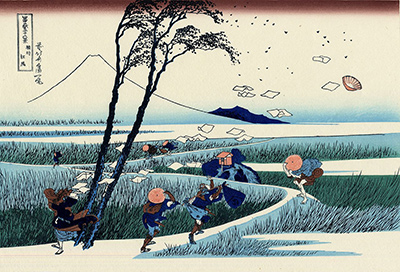
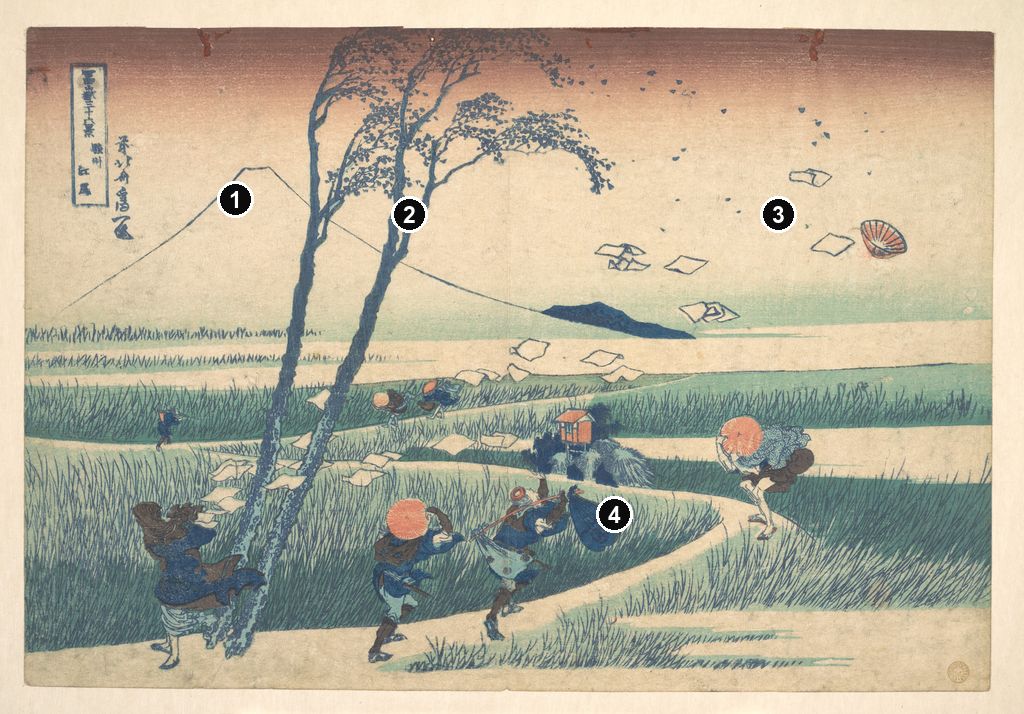
A travelling hat has gone sailing across the sky in Katsushika Hokusai’s Ejiri in Suruga Province. One of the people on the path rises far enough out of his crouch to look after it. The woman beside the trees has loose papers flying from her hands, while another traveller presses his own hat down. High behind them, the outline of Mount Fuji remains clear. Its two long slopes take up much of the left half of the sky, where a pair of wind-bent trees cuts across them. Hokusai gives you time to notice a fixed point in a scene that seems to have changed in the space of a breath. [1] [2]
The design is titled Sunshū Ejiri (駿州江尻), using another name for Suruga Province. It belongs to Hokusai’s Thirty-six Views of Mount Fuji. The Metropolitan Museum of Art dates the impression JP12, on which the close reading below is based, to about 1830–32. It is a colour woodblock print measuring 25.4 by 37.1 centimetres. Tokyo Fuji Art Museum keeps another impression of the design and describes Ejiri as a post station on the Tōkaidō next to the port of Shimizu, in what is now Shimizu Ward, Shizuoka. The title places the viewer at a well-known stop. The subject Hokusai chooses there is the trouble of staying on the path when a gust comes across open ground. [1] [3]
At a Glance
- ArtistKatsushika Hokusai
- Dateca. 1830–32
- MediumColour woodblock print
- SeriesThirty-six Views of Mount Fuji
Contents
The papers and the people who let them go
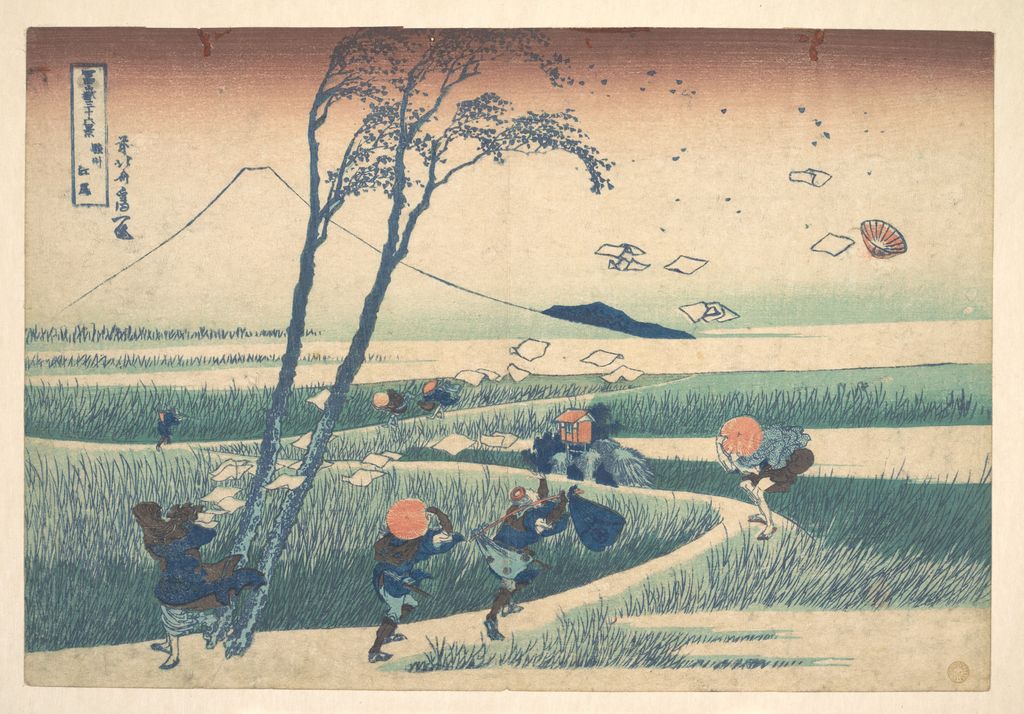
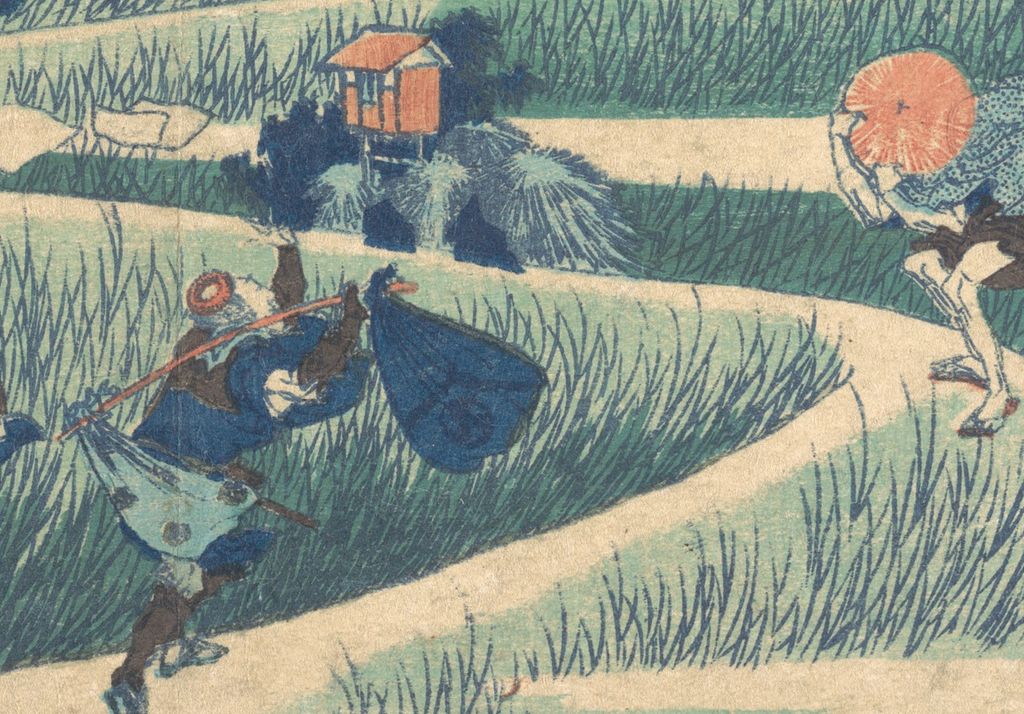
Start at the bottom left, where the figure whom the Ōta Memorial Museum of Art identifies as a woman has drawn her elbows up towards her face. Her clothes flare to one side and pale slips pass in front of the tree trunks. The museum identifies them as kaishi, small sheets of paper carried on the person. The first few are bunched up in the space just above her hands. Farther right they are spread across the field, and a series of sheets in the upper air carry the eye towards the hat. Some appear almost square. Others are drawn with corners turning inward or two edges apparently overlapping. Their outlines alternate between broad surfaces and thin angular folds, giving the impression of paper turning as it travels. [1] [2]
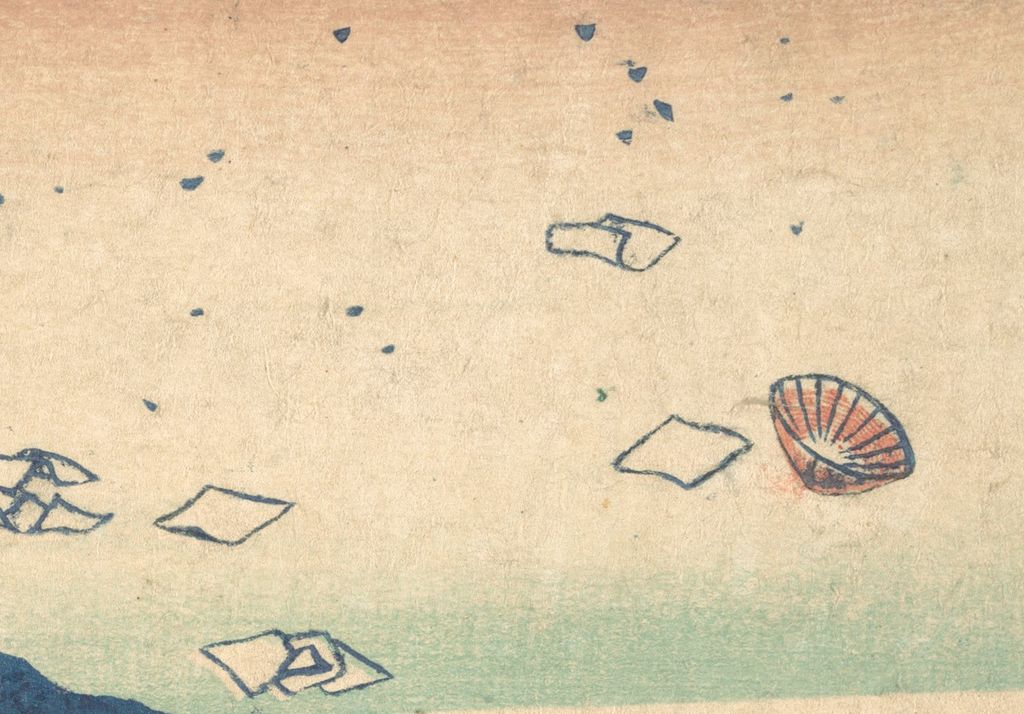
The hat near the upper right has a ribbed surface, visible from underneath, and a trace of warm colour. It sits across from one of the last broad sheets in the sky. Both have been carried into the same open space, yet the paper can change its apparent shape several times in the viewer’s passage across the print. The hat remains recognisable as one larger, more rigid object. Farther up there are marks so small they might escape notice on a first look. The Ōta museum describes leaves scattering from the trees. Behind the papers’ broad sweep, the scattering marks give the same gust a finer grain. [1] [2]
The people seldom meet the gust in quite the same position. In the centre foreground, a traveller with a pinkish circular hat has turned his upper body, bringing his hands near the brim even as his feet carry him forward. The figure ahead of him twists towards the right, his clothes pulled into dark shapes separated from his body. On the bend the rightmost traveller folds forward over one knee and brings his hands up to his hat. Smaller figures confront the same weather farther back, where a round hat or the angle of a lowered upper body remains legible after faces have disappeared. The trouble starts to seem widespread when those distant gestures join the larger ones in front. [1] [2]
How the road and the trees direct the eye
The path is one of the broadest areas of uninterrupted paper in the lower half of JP12. It comes in from the lower left, rounds a bank of dense grass and bends away behind the traveller on the right. At its turning point the path slips between angled tufts. In the distance further pale bands separate areas of vegetation and interrupt the dark downward strokes of the grass. The figures can be read as you follow the open ground from bend to bend. The papers move across those paths and up into the sky. Watching a sheet briefly cross a road before rising away from it makes the difference between the travellers’ route and the gust’s direction particularly clear. [1]
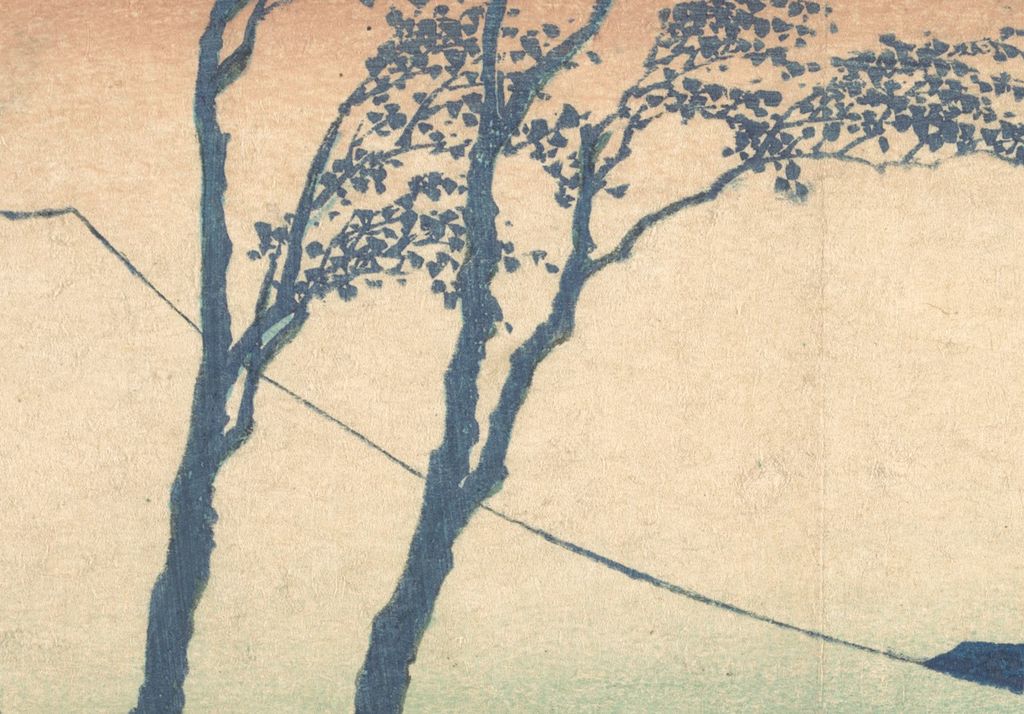
The tall pair of trunks grows out of the same foreground patch. Look up from the pale bases and see how quickly the branches spread towards the right, with a long arc of leaves ending over the open sky. The two trees are so close that their crowns seem to run together near the upper margin. For much of their height, however, there is enough room to see through to Fuji and its descending slope. Other forms in the landscape also anticipate the direction of the blast. Blades of grass stand in close, dark rows, and in places lean far enough to reveal wedges of light-coloured ground. In the landscape around the traveller at the bend, one can follow the change from upright strokes to a mass tilted over the bank. [1]
A curator at the Hokusai Museum in Obuse contrasts this strategy with a treatment of wind in the Hokusai Manga, where pale ink represents wind directly. In Ejiri the sky gives the evidence of the gust room to accumulate. There is nothing drawn between the last sheets and the hat to tell the eye what connects them. By the time the viewer reaches that gap, the behaviour of the objects and people below makes the connection easy to imagine. [1] [4]
The faint mountain and the print on paper
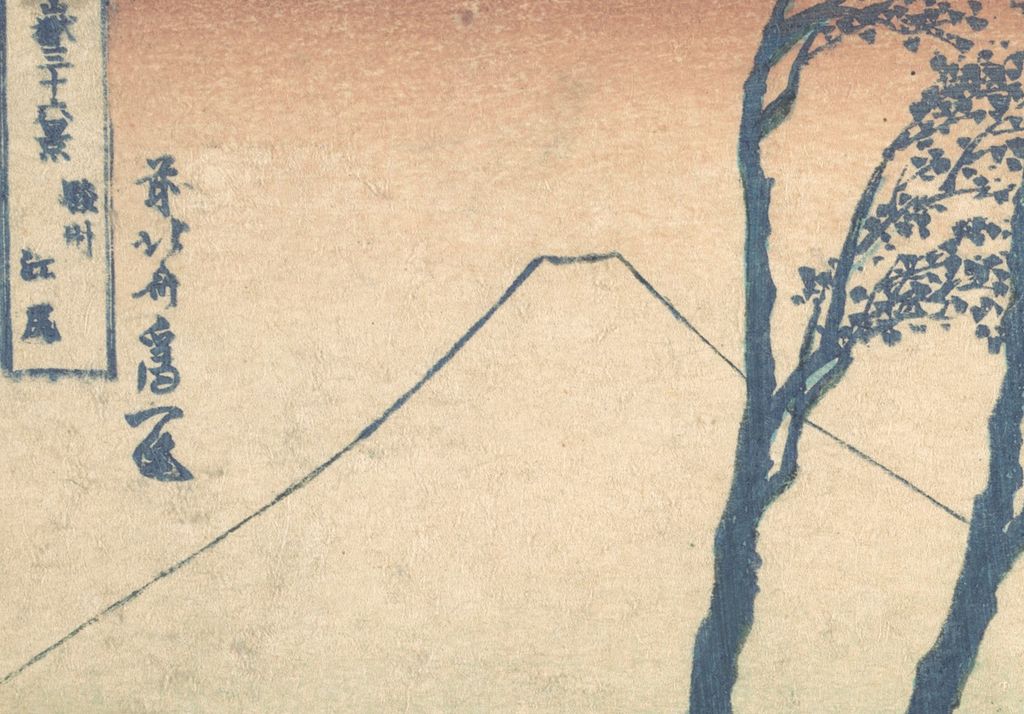
Fuji is drawn with a fine outline, its summit a small interruption between two much longer slopes. There is no large fill of colour that separates the mountain from the air behind it. Near the left trunk, part of the line disappears into the foreground growth. It comes back beyond the second trunk and continues until it meets a dark shape low in the distance. Once the upper outline has been located, the eyes can return to it repeatedly while the rest of the picture sends them off after the papers. It gives a reliable sense of distance in a landscape where so many kinds of movement are almost on top of one another. [1] [3]
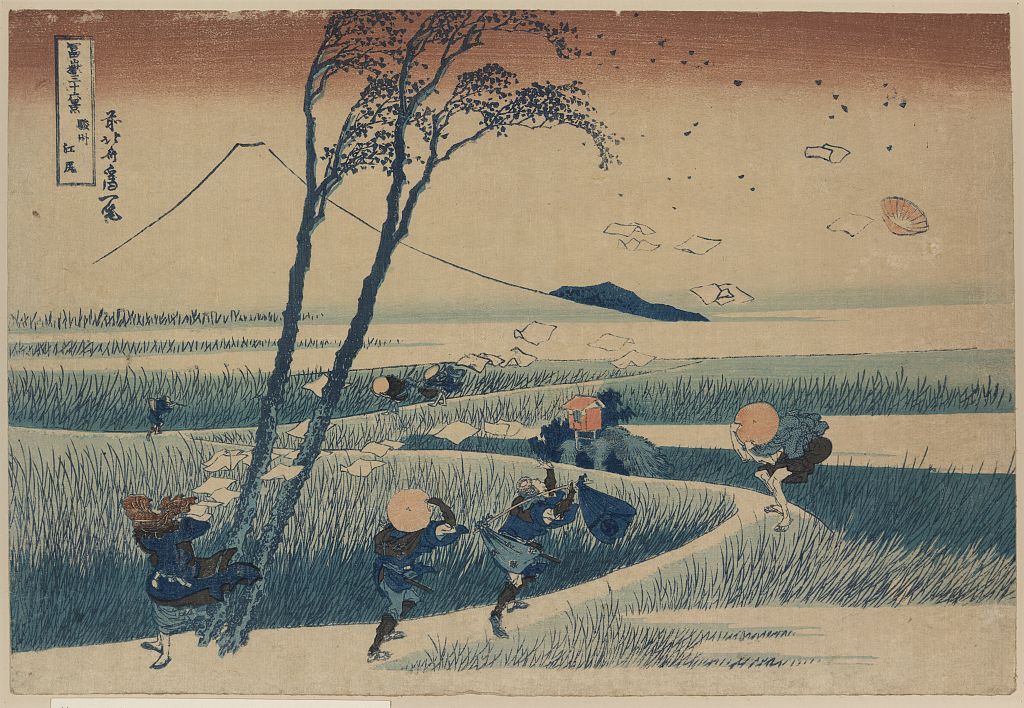
In JP12 a reddish-brown band at the very top slowly lightens into a pale field. Towards the horizon there is another passage of tone, a narrow stretch of green-blue that dissolves into lighter paper. These broad transitions leave space around the marks we read as flying objects. Compare the Tokyo Fuji Art Museum’s impression, which it describes as a horizontal ōban nishiki-e, a large-format multicolour print. In its published image, the traveller’s airborne hat still has radiating divisions, but the pinkish cast visible in JP12 is far less apparent. At the top, the colour band reads as warmer brown or ochre. Fading, printing and the photography of the objects can all affect such comparisons. The differently coloured reproductions are a reason to specify the sheet when describing its colours or measurements. The structure of the movement is legible in both. [1] [3]
Japan’s Agency for Cultural Affairs records that the Tokyo Fuji Art Museum impression lacks a censor’s seal and a publisher’s mark. It identifies a small gap prepared in the colour block among the grasses at lower right as a space intended to accommodate the kiwame approval seal. That observation gives the patch of foreground an interest apart from the larger design. The catalogue makes a specific distinction between reserving a space in the printed colour and actually finding a mark in it. A space in one impression is insufficient grounds for reading or identifying a mark in another. [3] [5]
The other view near Ejiri
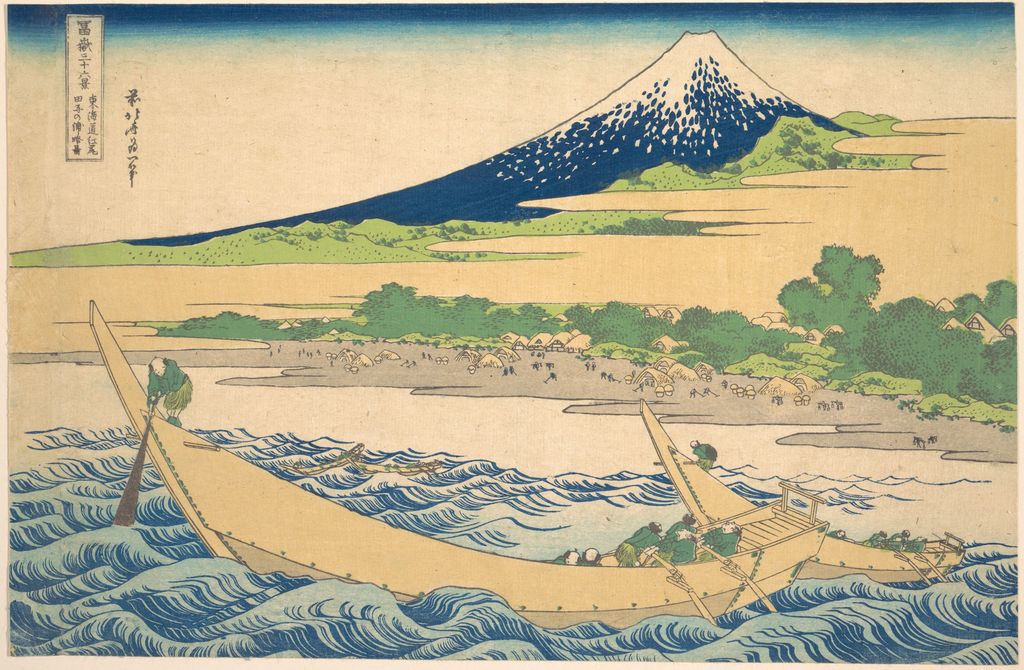
Another print in the series, Tago Bay near Ejiri on the Tōkaidō, names the same locality and shows a different landscape. In the Met’s JP2976 impression, boats occupy the foreground and blue waves repeat between them. A line of buildings and trees extends across the shore. Above them Fuji is larger, its upper slopes filled with deep blue markings below a pale summit. In Ejiri in Suruga Province, Hokusai uses pale paths, low grasses and the scattered responses to wind to convey a moment close to the traveller. In the bay scene the spacing of the boats, waves and shore articulates the distance through water. The two different Japanese titles in the series identify the related views with different emphases. The National Museum of Western Art’s Iuchi Collection checklist gives the bay title as a simplified view of Tago Beach near Ejiri, while the wind scene is simply Ejiri in Suruga Province. Both can be located by the place name. The much more specific circuit of land, shore and water belongs to the bay view. [1] [6] [7]
A gust carried into a photograph
Jeff Wall returned to the composition in 1993 in A Sudden Gust of Wind (after Hokusai). He set the scene in a cranberry bog outside Vancouver and constructed the picture using digital montage. It survives as a very large photographic transparency in a light box, now in Tate’s collection. The papers again provide something for a viewer to follow between the people and the sky. Bare branches and modern clothes establish a different setting, while the angled heads and bodies convey much the same predicament. The burst of paper makes a viewer consider what each person was doing an instant earlier. [8] [9]
Return to Hokusai’s print and try looking at it from the hat back towards the woman by the tree. What looks at first like one great diagonal turns out to contain hesitations. A sheet below the centre of the sky has almost folded back on itself. Another is so far from the others that its direction is difficult to judge. One person maintains a foothold while another has to chase something with his eyes. The outline in the distance tells us where we are. The small events in the foreground tell us what it feels like to be there. [1] [2]
Where this work sits in Hokusai’s career
Image comparison
Annotated Details from Ejiri in Suruga Province
The numbered view uses the Metropolitan Museum of Art’s impression JP12. Look for the same features in the complete sheet before opening the details below. [1]
Details from EJIRI IN SURUGA PROVINCE
The details show how the parts of the design work together.
Fuji beyond the field
The distant mountain stays legible in a light outline even while the foreground leans and twists in the wind. [1]
Trees leaning into the same gust
The trunks and branches pull across the sky. Their direction prepares the eye for the sheets that have already blown free. [1]
Paper and a flying hat
Papers scatter and turn in the air. The hat’s heavier shape interrupts the more delicate marks of the loose sheets. [1]
Travellers on the path
The people crouch or press forward at different angles. The winding path lets those responses read against a stable line on the ground. [1]
Explore Hokusai’s works
Discussion
Look again at the images and ideas explored in Ejiri in Suruga Province. These editorial prompts invite your observations.
Reader Insights
Which object gives you the clearest sense of the wind?
How does the low mountain affect the movement of the foreground?
Join the Conversation
Share a detail, comparison or question about Ejiri in Suruga Province below.
References
- The Metropolitan Museum of Art, Ejiri in Suruga Province (Sunshū Ejiri), accession JP12. View source.
- Ōta Memorial Museum of Art, Hokusai and His Rivals, exhibition commentary on Sunshū Ejiri, no. 3. View source.
- Tokyo Fuji Art Museum, Thirty-six Views of Mount Fuji: Ejiri in Suruga Province, collection record 01168. View source.
- Hokusai Museum, Obuse, Hokusai and Mysterious Space, exhibition commentary on making wind visible, 17 December 2021. View source.
- Agency for Cultural Affairs, Japan, Fugaku sanjūrokkei: Sunshū Ejiri, Cultural Heritage Online entry for the Tokyo Fuji Art Museum impression. View source.
- The Metropolitan Museum of Art, Tago Bay near Ejiri on the Tōkaidō, accession JP2976. View source.
- The National Museum of Western Art, Tokyo, Thirty-six Views of Mount Fuji from the Iuchi Collection, exhibition checklist, works 20 and 34. View source.
- The Museum of Modern Art, Jeff Wall, retrospective exhibition press release, 20 February 2007, p. 4. View source.
- Art Institute of Chicago, A Sudden Gust of Wind (after Hokusai), exhibition record for Tate accession T06951. View source.







