


 by Tom Gurney
Tom Gurney BSc (Hons) is an art history expert with over 20 years experience
Published on June 19, 2020 / Updated on November 20, 2026
Email: tomgurney1@gmail.com / Phone: +44 7429 011000
Lake Suwa in Shinano Province
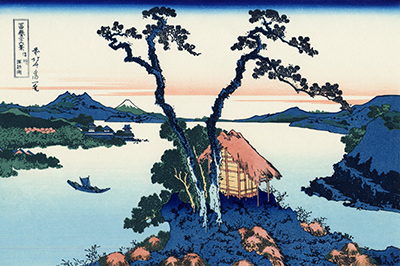
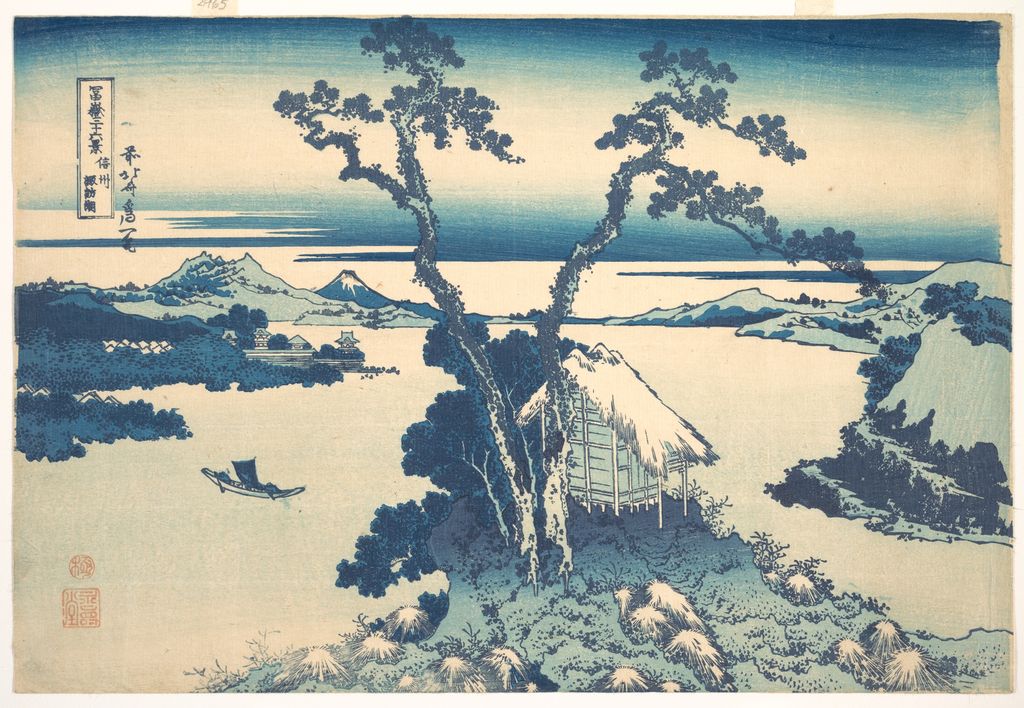
Two pines rise from the bank in Katsushika Hokusai’s Lake Suwa in Shinano Province. Behind their trunks stands a small thatched shrine whose pale roof takes up more space than the summit of Mount Fuji. A boat crosses the open water to the left, below the distant buildings of a lakeside settlement. Fuji appears above those buildings, its streaks of snow just large enough to pick out against the darker flank. To find the mountain, a viewer has to look past the bank, the boat and the far shore. Hokusai gives that act of looking across the lake as much weight as the distant landmark itself. [1] [2]
The Metropolitan Museum of Art dates its colour woodblock impression JP2965 to about 1830–32 and records dimensions of 26 by 38.4 centimetres. Its title cartouche at upper left names Lake Suwa in Shinano, in present-day Nagano Prefecture. The design belongs to Thirty-six Views of Mount Fuji. The National Museum of Western Art’s exhibition checklist includes a separate impression from the Iuchi Collection as item 17. The broad bands of blue and the light paper around Fuji described here can be seen in the Met’s photograph of JP2965. [1] [2] [3]
At a Glance
- ArtistKatsushika Hokusai
- Dateca. 1830–32
- MediumColour woodblock print
- SeriesThirty-six Views of Mount Fuji
Contents
The shrine and its pines
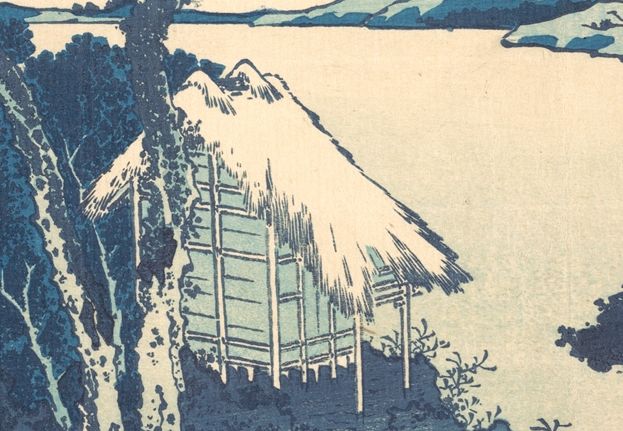
The foreground begins at the bottom edge with pale tufts set among low, dark growth. The slope rises into the sheet and narrows around the shrine, with water visible on either side. The two nearest pines stand where the ground is most densely worked. Their trunks, streaked with pale marks from root to branch, partly hide the front of the building. Hokusai allows enough of its uprights and crosspieces to show through for the wall to read as a built surface. The pale sweep of thatch then extends to the right, clear of the busiest part of the trunks. The National Gallery of Victoria identifies the building as a shrine in its exhibition label for a Japan Ukiyo-e Museum impression of the same design. [1] [2]
The position of the roof changes how the foreground meets the distance. Its peak rises just below the far shore, so the pale thatch appears in front of an expanse of water. Dark, fine strokes follow the slope of the roof and taper at its ragged lower edge. The pale summit of Fuji, smaller and farther to the left, also carries fine marks down one flank. The National Gallery of Victoria draws attention to the resemblance in shape between the shrine and Fuji. There is a difference in the way those shapes ask to be read. At the shrine, the eye can follow individual strands of thatch and then drop to the supports underneath. Fuji offers a few short traces of snow before the lower mountain merges with the overlapping country at the horizon. [1] [2]
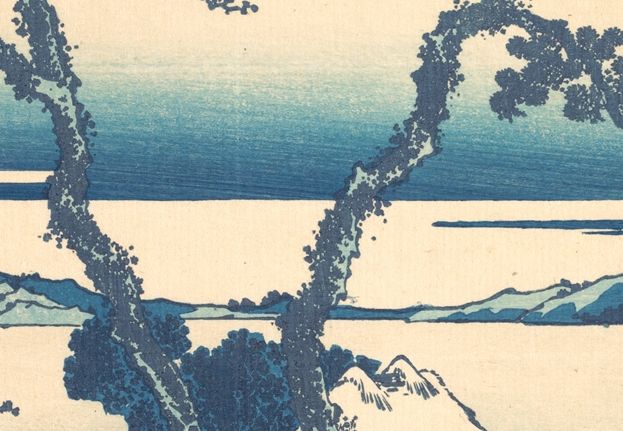
The trees make that depth legible even in areas where the colour stays close. The nearer branches divide into dark clusters against the blue at the top of the sheet. The left trunk bends across the distant shore to the right as it comes down into the foreground, and the right trunk arcs out towards the wooded slope across the water. There is a wedge of open sky between their crowns. Farther down, there are much narrower openings between the trunks and around the roof. The eye moves easily from the broad opening above to these smaller spaces below, where the overlapping shapes give a sense of standing close to the trees. [1]
Dense foliage joins the lower part of the pines to the promontory. At the left side of the bank, a cluster of dark leaf shapes stands out against pale water, with small irregular gaps in the silhouette. Beyond it, the far banks are also dark in places, but the marks simplify as the shoreline recedes. Near the middle of the sheet, the opposite bank is a narrow band with barely enough room for a rise and a cluster of trees. The land at the bottom can hold individual tufts, shadows around their bases and stray strokes at the lip of the bank. The different amount of detail helps keep the foreground from dissolving into the blue farther back. [1]
Across the water
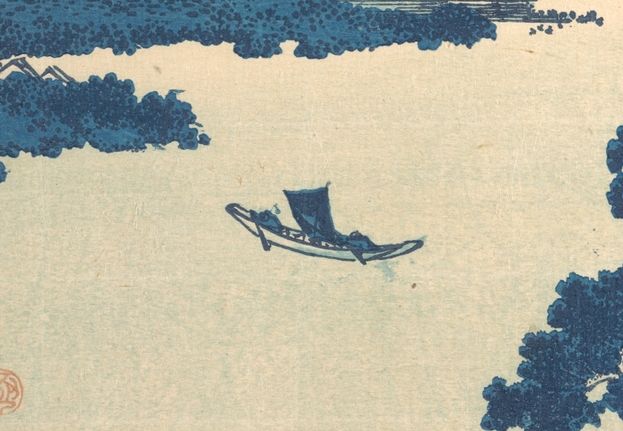
Hokusai leaves enough space around the boat for its curved hull to register at a glance. A dark panel rises within it, and the lighter edge of the hull dips between the two ends. The museum label describes two figures rowing towards the shrine. At the scale of JP2965, the boat first registers as a small set of marks within a large, lightly coloured area. Looking more closely brings out the human activity that gives the lake its scale. The hull seems quite substantial beside the flecks of foliage along the shore, then very small beside the branch that hangs over the water. Moving the eye between those two comparisons makes the wide pale surface feel traversable. [1] [2]
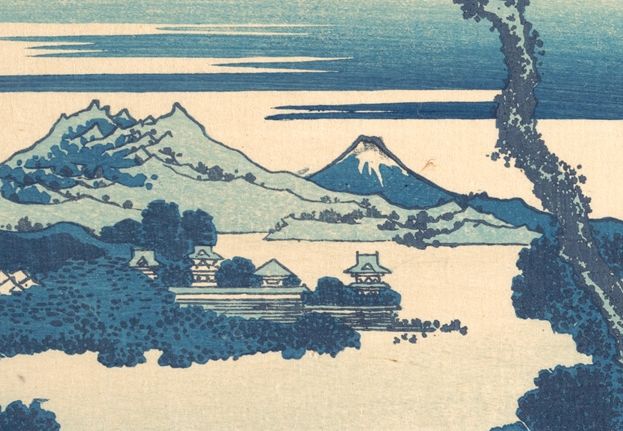
The settlement on the far left has several levels. A few light roof shapes stand above the nearer wooded edge, and a group of more distinct roofs sits to their right on a line of stepped horizontal marks. The National Gallery of Victoria identifies Takashima Castle in that distant group. Suwa’s tourism association describes the castle’s historic setting as a small island joined to the shore by a strip of land. Hokusai gives the castle a visual relationship with the water by setting those stepped lines at the edge of the pale lake. The roofs take up surprisingly little space between the wooded foreground and the hill behind, but their sharp angles and straight foundations make them easy to locate. [1] [2] [4]
The left-hand hills give Fuji a subdued entrance. A rougher ridge rises higher on the page and has more internal marks. Fuji appears immediately to its right, where the outward sweep of its dark slopes and the short pale lines just below its peak distinguish it from that neighbour. Across the rest of the far shore, low contours run behind the trunks and reappear as increasingly substantial hills on the right. Follow the right-hand waterline down and those hills bring the eye back towards the near bank. The far shore links the two sides of the lake even where the foreground interrupts the line. [1]
The deepest blue band lies along the top edge and grades down to a broad expanse of light paper. A separate blue passage gathers low in the sky and ends in long horizontal strokes above the hills. The strokes have hard ends, while the colour directly above them has a soft edge. Much of the lake below is lighter, with room for the contours of the shore and the little boat to be read without competing marks. The sheet therefore offers two broad horizontal passages, one above the hills and one below. The tree trunks cross both, making their different positions in space easy to see. [1]
Two impressions of Lake Suwa
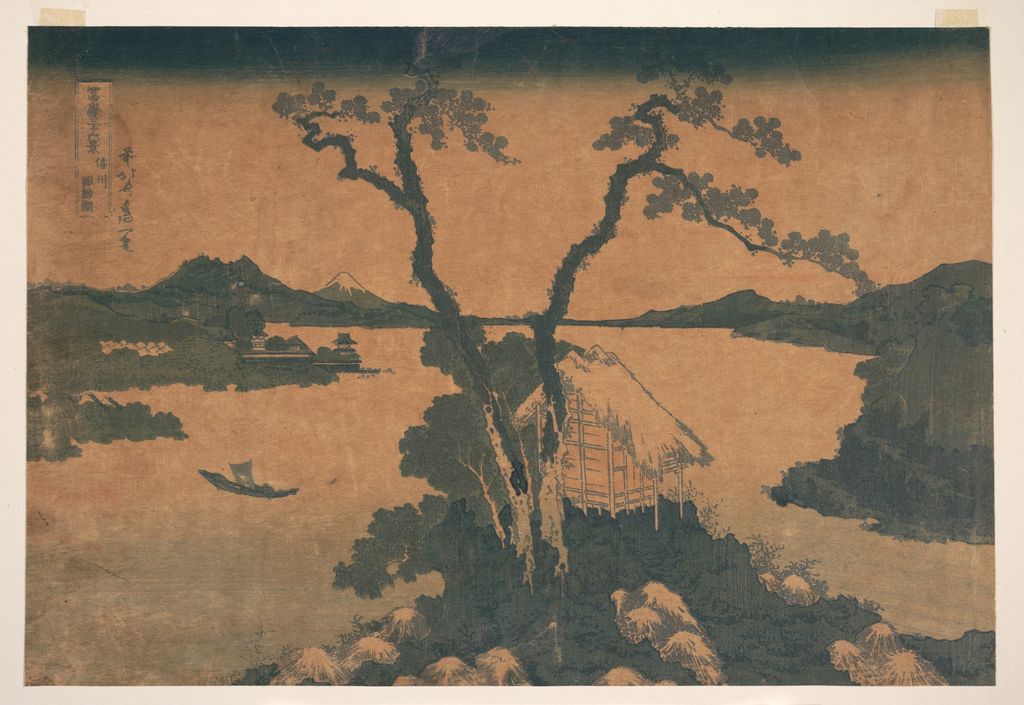
The Met’s impression JP1849 preserves the disposition of the shrine, pines and boat on a sheet that the museum measures at 25.7 by 37.6 centimetres. In its photograph, the light areas have a warm brown cast, the far shore forms a darker continuous edge, and the lower blue band that crosses the sky in JP2965 is much less apparent. That changes the space immediately around Fuji. In JP2965 the pale interval under the blue band picks out the summit clearly. In JP1849 the peak sits against a much more uniform field, and the eye can move from the long dark shoreline to the pale markings on the summit with fewer interruptions. The main outlines hold their places in both sheets. [1] [5]
The foreground gives an equally clear point of comparison. In JP2965, the strands of thatch stand out against the water and the mottled space under the eaves. In JP1849, the light roof and the light water are closer in tone, leaving the dark edge and descending strokes to define the thatch. The foreground bank is also darker in the photograph of JP1849, so its pale clumps of grass catch the eye more readily near the lower edge. These are differences between the museum photographs of the surviving sheets. The photographs alone leave the causes of those differences open. [1] [5]
Another lake in the series
Hokusai’s Lake at Hakone in Sagami Province also places a small Fuji beyond a lake. In the Met’s JP2980, the pale mountain rises at the left alongside a large hillside that climbs towards the right edge. A dark blue spread of water can be followed through the lower middle, between clumps of pointed trees. Several pale horizontal shapes extend across the hills and cut into the trees, with rounded ends that lead the eye from one patch of wooded land to another. The bands of sky at Suwa are straight and narrow near the hills. At Hakone the pale shapes have much greater width and overlap several different heights of land. Both schemes let the viewer move across a landscape that is visible in sections. [1] [6]
The buildings in Hakone are scattered along the shore, and their blue roofs share their colour with the water. The National Gallery of Victoria identifies those roofs with Hakone Shrine. They appear as small angled shapes among dense stands of trees, well down from the large hillside and well to the right of Fuji. At Suwa, the single nearby shrine is easy to see from the first glance, and the branches point both towards it and outward across the lake. Look back from the boat to that roof, then follow its angle to the distant summit. In Suwa the crossing happens on water, while the pines and the shrine establish where the viewer is standing when the mountain comes into sight. [1] [2] [6]
Where this work sits in Hokusai’s career
Annotated Details from Lake Suwako in Shinano Province
The Metropolitan Museum of Art, JP2965. [1]
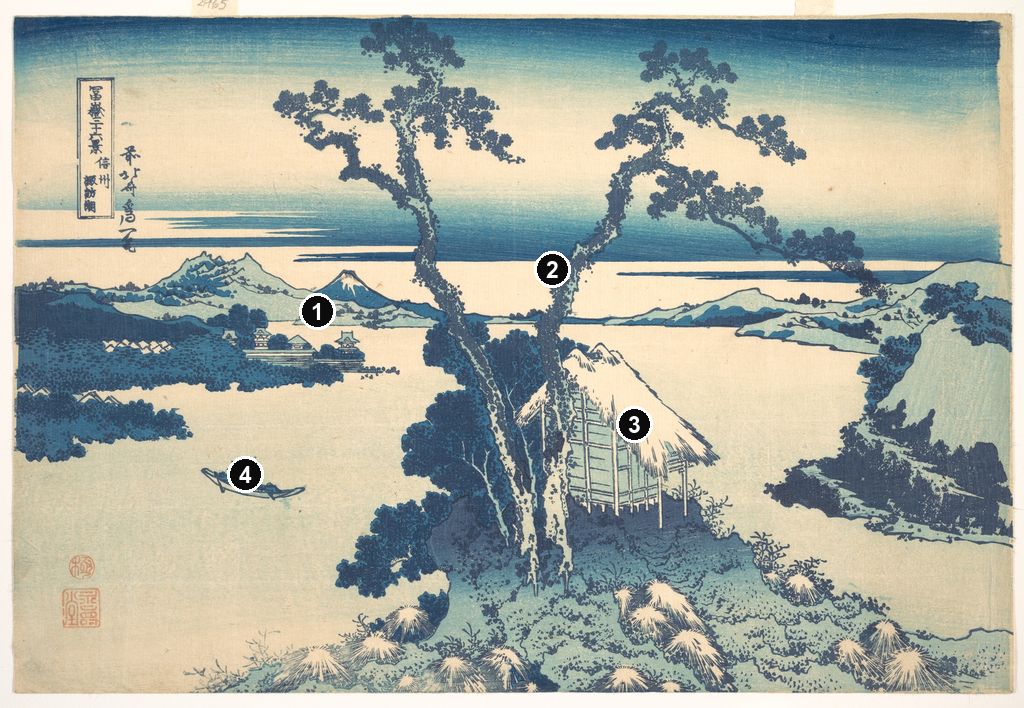
Details from LAKE SUWAKO IN SHINANO PROVINCE
Select a detail to look closely.
The opposite shore crosses the opening
Low land extends across the lake. Its distant outline breaks into layers behind the nearer tree. [1]
The pine divides the open water
Branches cross and recross the darker shore. Their irregular forms keep the foreground separate from the flatter view beyond. [1]
A shrine roof projects over the foreground
The little structure occupies a steep near edge. Its roof lines contrast with the long bands across the lake. [1]
A small boat offers a measure of distance
A compact shape interrupts the open water. Its small scale gives the lake room to read around the much larger foreground. [1]
Explore Hokusai’s works
Discussion
Look again at the images and ideas explored in Lake Suwa in Shinano Province. These editorial prompts invite your observations.
Reader Insights
Where do the branches separate the near and distant shorelines?
What gives the foreground shrine a sense of height?
Join the Conversation
Share a detail, comparison or question about Lake Suwa in Shinano Province below.
References
- The Metropolitan Museum of Art, Lake Suwa in Shinano Province (Shinshū Suwako), accession JP2965, collection record and photograph. View source.
- National Gallery of Victoria, Hokusai exhibition labels, entries for Lake Suwa in Shinano Province and Lake of Hakone in Sagami Province, Japan Ukiyo-e Museum impressions. View source.
- National Museum of Western Art, Tokyo, Hokusai: Thirty-six Views of Mt. Fuji, Iuchi Collection exhibition checklist, item 17. View source.
- Suwa Tourism Association, Suwa Area Guide, entry for Takashima Castle. View source.
- The Metropolitan Museum of Art, Lake Suwa in Shinano Province (Shinshū Suwako), accession JP1849, collection record and photograph. View source.
- The Metropolitan Museum of Art, The Lake at Hakone in Sagami Province (Sōshū Hakone kosui), accession JP2980, collection record and photograph. View source.







