


 by Tom Gurney
Tom Gurney BSc (Hons) is an art history expert with over 20 years experience
Published on June 19, 2020 / Updated on November 20, 2026
Email: tomgurney1@gmail.com / Phone: +44 7429 011000
Honganji Temple at Asakusa in Edo
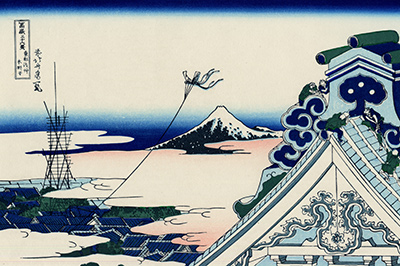
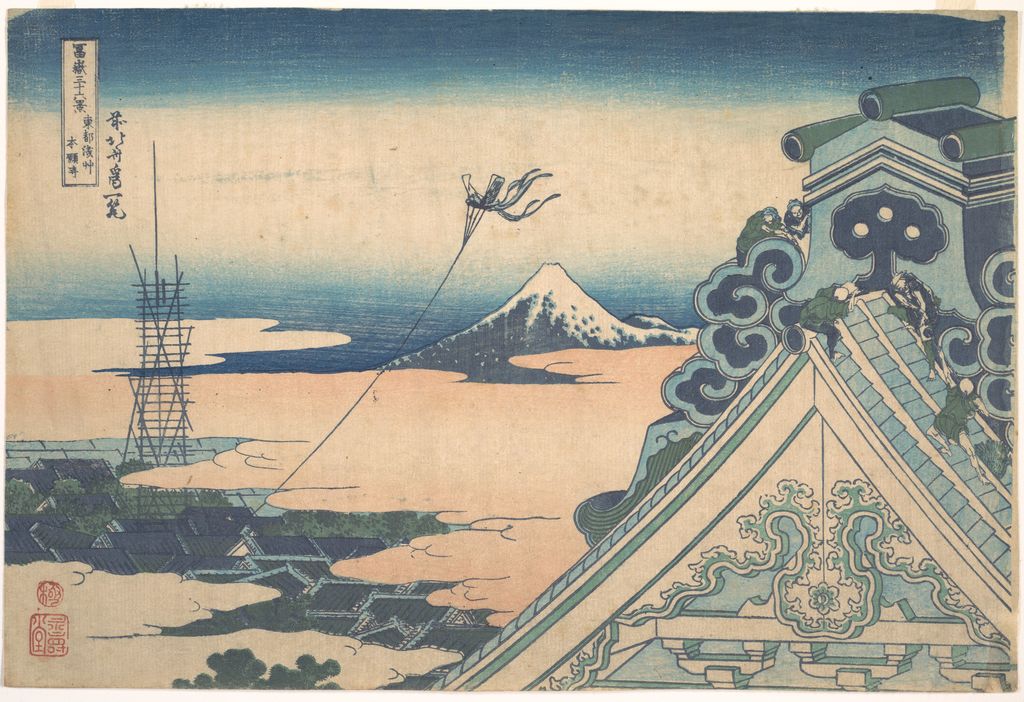
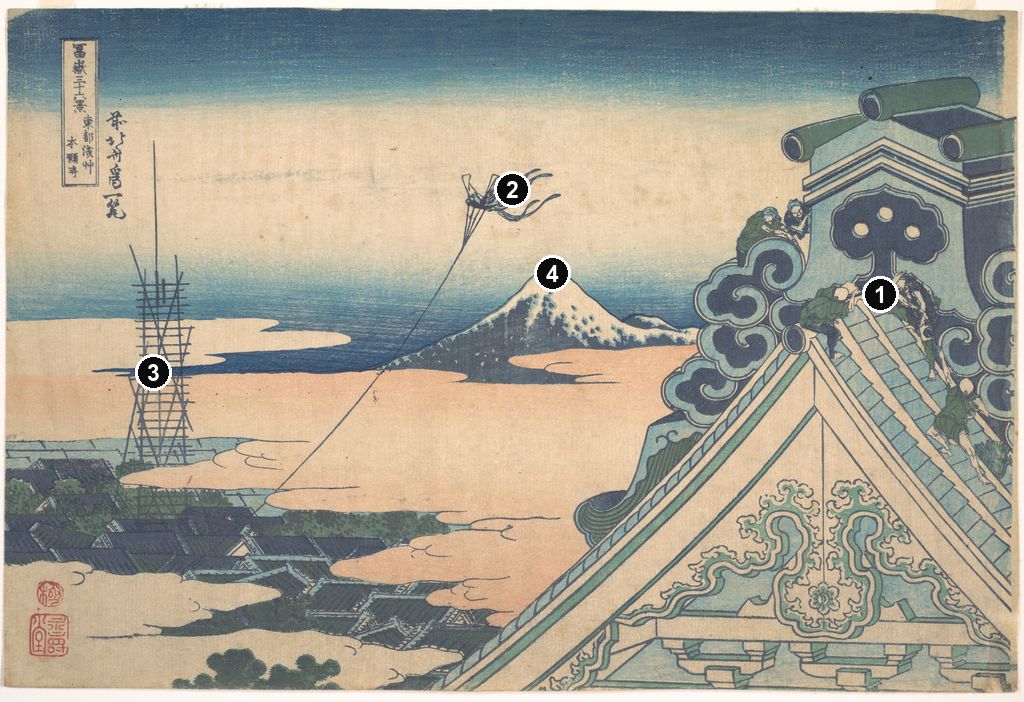
Mount Fuji rises just to the left of a temple gable in Katsushika Hokusai’s Honganji Temple at Asakusa in Edo. The roof fills the right side of the woodblock print. Its wide slope passes out of the picture at the lower edge, and the ridge is cut off on the right. Small figures picking their way among the tiles give the building its scale. Across the open sky, a kite pulls against a fine line. The line leads down across the city, where a lookout tower stands just high enough to interrupt the bands of cloud. The print puts us close enough to see hands and feet on the roof and far enough above the streets to lose most of them from sight. [1] [2]
The Metropolitan Museum of Art dates its impression JP2996 to about 1830–32. The sheet measures 25.4 by 38.1 centimetres and belongs to Thirty-six Views of Mount Fuji. The cartouche names the capital Edo and Honganji at Asakusa. The National Museum of Western Art’s exhibition checklist lists a separate impression from the Iuchi Collection under the Japanese title 東都浅草本願寺, as item 21. The list of titles names many places from which to see Fuji. Here the name directs attention first to an individual building, whose size and character have an immediate bearing on the view. [1] [3]
At a Glance
- ArtistKatsushika Hokusai
- Dateca. 1830–32
- MediumColour woodblock print
- SeriesThirty-six Views of Mount Fuji
Contents
Which temple is in the print?
The Sumida Hokusai Museum identifies the building as Higashi Honganji in what is now Nishi-Asakusa, Taitō. It notes that the large roof of the main hall was an Edo landmark that appeared in other prints. The institution’s own history traces the temple back to Kanda and recounts its relocation to Asakusa after the Great Fire of Meireki in 1657. The large structure Hokusai shows belongs to that Asakusa history. Sensōji, another temple in the district, traces its own history to the worship of Kannon. Its name and devotional tradition belong to a separate institution. In the print, the title determines which of the district’s temples the enlarged roof represents. [4] [5] [6]
Higashi Honganji’s account reproduces material from the Edo meisho zue, an illustrated gazetteer of famous places, to document how the temple and its surroundings appeared in print culture. The gazetteer could give a reader an overview of the grounds. Hokusai chooses a position from which the rest of the complex disappears. There is no continuous view of the roof from its ridge to the walls beneath, and the streets close to the hall are out of sight. A person trying to place the building from this print alone would have the title and a handful of architectural features. The enlargement makes the roof itself the landmark. [1] [5]
The roof and the people on it
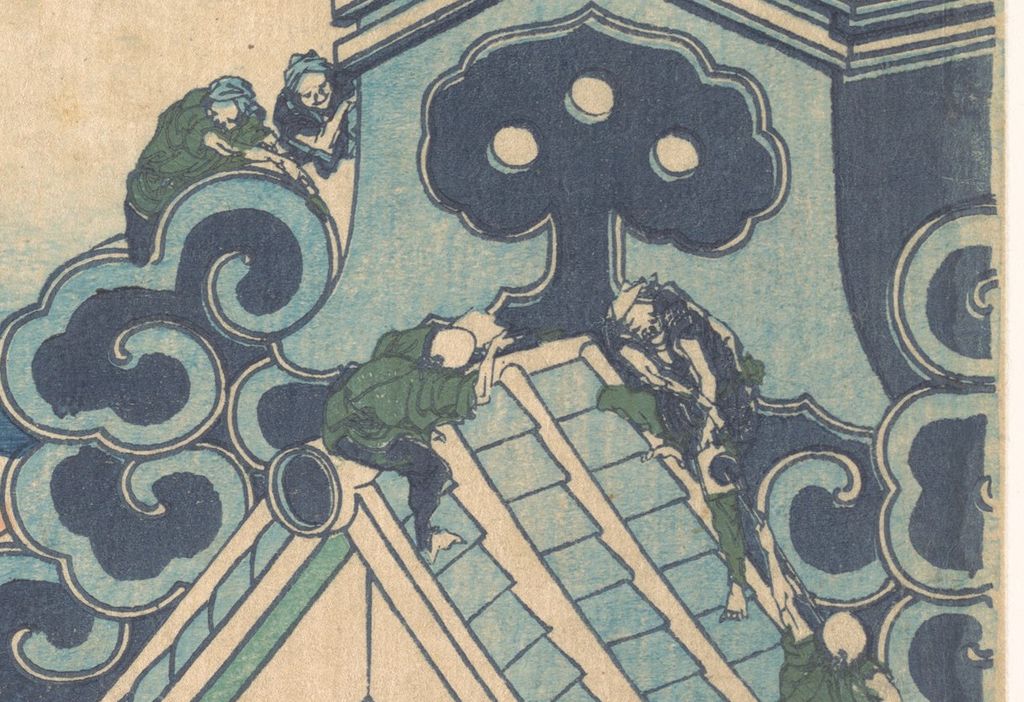
The dark tiles along the top of the gable turn from shallow parallel lines into prominent round ends. At the upper right, some of those circles are almost as large as a worker’s head. Curled forms step down the edges of the gable, filling the space between the strong diagonal and the open sky. Lower down, the underside of the triangular face comes into view. Its carved, interlocking curves are set into a lighter field, so the eye can follow both the outline of the whole structure and the pattern of its ornament. Parts of that decoration extend below the frame, leaving the dimensions of the hall to the viewer’s imagination. [1]
The Shimane Art Museum describes the figures as tile workers and draws attention to the contrast between their size and the roof. In JP2996, one worker crouches near the outline where the ridge turns. A second bends just below him, near a passage of small, closely spaced tile lines. Farther down to the right, a figure is partly lost in the overlapping forms of the roof. An arm or shoulder shows more readily than a full body. The Met’s Bulletin identifies the activity as repair to the tiles. The positions matter to that reading. The figures keep close to the surfaces they are working on, and a single pale head may be easier to see than the dark clothing around it. [1] [2] [7]
The workers give us a way to estimate the size of the gable before comparing it with the mountain. Follow the left roof edge from the lower boundary towards the ridge and you pass banks of roofs, pale cloud and finally open sky. Fuji’s own triangle can be traced in the opposite direction, away from its peak and down towards the city. The two outlines are similar enough to compare without lining up exactly. The mountain’s snowline breaks into little blue and pale marks. The gable edge runs through controlled, closely spaced lines. That difference helps keep a steep built surface legible beside an equally steep natural form. [1] [7]
The lookout and the kite
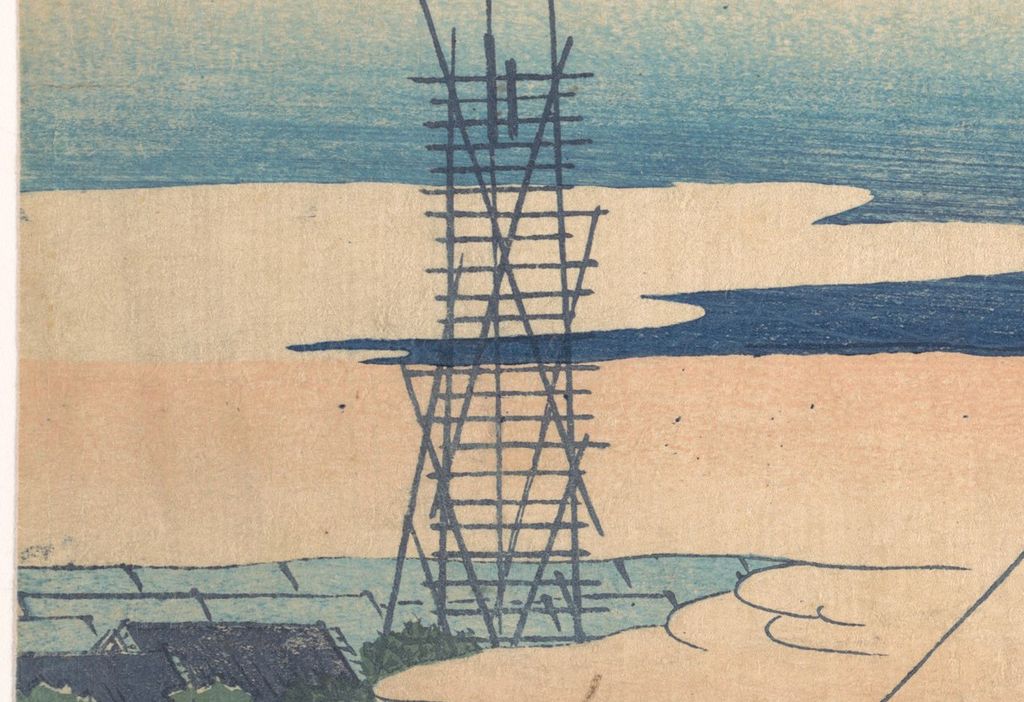
The Met’s Bulletin identifies the structure at left as the scaffolding of a fire station. Its slender uprights rise over the dark roofs, and the short crosspieces leave the surrounding atmosphere visible through them. Several of the print’s horizontal bands can be followed across that open structure. Seen beside the solid triangle of the gable, the tower looks almost transparent. It establishes a lower level of the city, between the great roof at our shoulder and the mountain beyond. Its height above the smaller buildings shows what counted as an elevated view in a part of Edo where many rooflines sit close together. [1] [2]
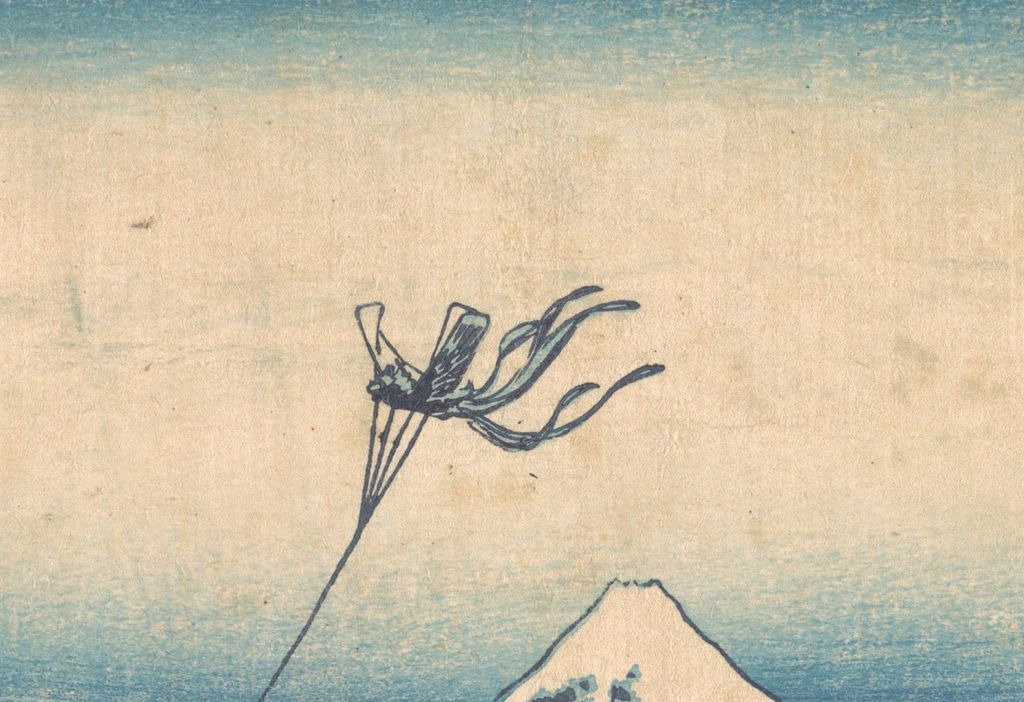
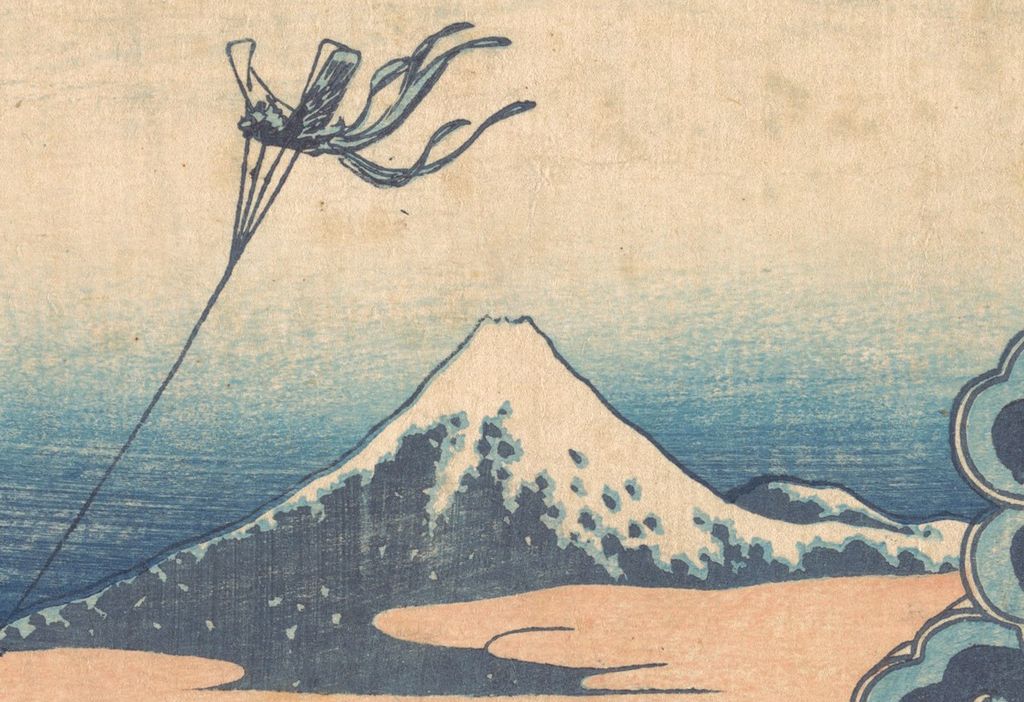
The kite has a different relationship to the skyline. It occupies a patch of pale sky above Fuji, and its streamers bend away from the body of the kite. The line narrows as it crosses the sky and clouds and reaches the roofs below. The kite’s position is easy to find because the paper around it has few marks. Its line takes longer to see, especially where a curve in the mist crosses it. Follow the line down and the dark roofs come into view as the origin of something moving overhead. In the foreground, the people bend and brace against the size of the building. The kite shows how little weight is needed to reach a comparable height in the picture. [1]
Broad banks of pale cloud cut across the little roofs and trees. At the left, the edges of some of those banks extend into long, narrow tongues. Beneath Fuji they spread much wider, concealing much of the ground below the snowy summit. Hokusai leaves just enough interruption in the cloud to connect the tower with the city and the slope of the mountain with the horizon. With so much of the intervening ground covered, Fuji appears close to the roof outline in the flat image even as the size of the details makes its distance plain. [1] [7]
The title sits in a narrow pale rectangle at upper left, with the signature beside it. Its ink makes a small group of upright strokes at the end of a picture otherwise dominated by a descending diagonal. The dark peak of the lookout sits well below it. The eye can move along that left margin from the written place name to the rough outline of the city as easily as it can follow the rising gable on the right. [1]
Two impressions in the Met
The Met’s JP1323 is a separate impression, measured at 25.7 by 38.4 centimetres. The shapes of the kite, tower, gable and mountain correspond closely with those on JP2996. Their surroundings look different in the photographs. On JP2996, the darker blue near the horizon extends visibly to the left beneath the cloud. The clear space farther up the sky has a warm cast. In JP1323 the upper blue fades down through a stronger blue-green, and the lighter part of the sky meets the blue at the horizon over a broader interval. The lighter space on both sheets allows the kite string to cross much of the view without competing with a black outline. [1] [8]
Look also at the marks at lower left. Both photographs show a pair of small red marks in the pale area beneath the lower band of roofs. They stand out more strongly on JP2996 in the Met’s photographs. The colour of the paper and the amount of margin also differ slightly. Observations about the photographs can help distinguish the impressions without settling how they were printed or which one came first. The positions of the printed forms are the useful point of comparison. Fuji’s pale peak sits between kite and gable in both, while the different intensity of the blue around it changes how easily it draws the eye. [1] [8]
Two Edo rooftops in the Fuji series
In The Mitsui Shop at Surugachō in Edo, another Fuji print, near roofs and small roof workers also set the scale of the mountain. There the two sides of the street form a gap, and the large shop signs lead the eye from that gap down towards the street. The shop buildings also put the kite and Fuji in an open strip of sky. At Asakusa the gable on the right is prominent enough to balance a cityscape on the other side. Its diagonal moves in just one direction, with no equivalent roof across the view. The isolated lookout and the kite occupy the space a second roof might have filled. In both designs Hokusai takes us above the ordinary street level. The work on the tiles lets us imagine a person’s footing even in a view whose height and distance stretch well beyond it. [1] [9]
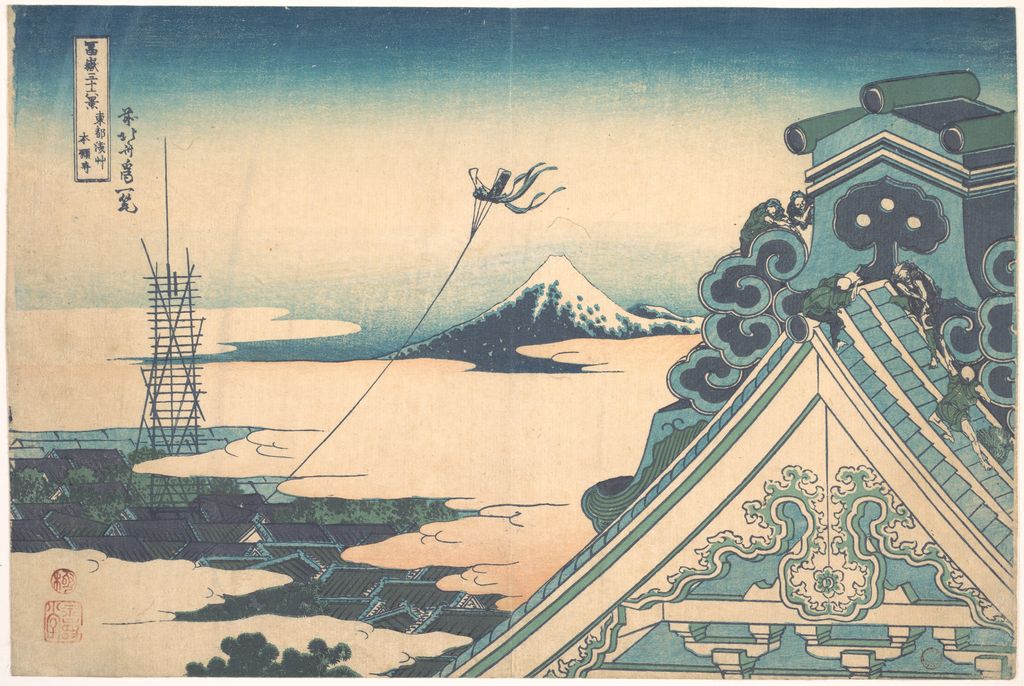
Image comparison
Where this work sits in Hokusai’s career
Annotated Details from Hongwanji Temple at Asakusa in Edo
The Metropolitan Museum of Art, JP2996. [1]
Details from HONGWANJI TEMPLE AT ASAKUSA IN EDO
Select a detail to look closely.
The temple roof fills the near view
The sloping tiles and ornamental ridge occupy much of the right side. They dwarf the roofs across the distance. [1]
A kite floats above the roof line
The kite is a dark shape within open sky. A thin line runs down towards the buildings. [1]
A lookout rises above the city
The narrow scaffolding stands out from the low buildings on the left. Its uprights contrast with the long roof slope. [1]
Fuji rises above the mist
The distant peak sits between bands of grey-blue and the straight descent of the temple roof. [1]
Explore Hokusai’s works
Discussion
Look again at the images and ideas explored in Honganji Temple at Asakusa in Edo. These editorial prompts invite your observations.
Reader Insights
How does the roof divide the image?
Which marks take your eye from the city into the sky?
Join the Conversation
Share a detail, comparison or question about Honganji Temple at Asakusa in Edo below.
References
- The Metropolitan Museum of Art, Honganji at Asakusa in Edo (Tōto Asakusa Honganji), accession JP2996, collection record and photograph. View source.
- The Metropolitan Museum of Art, Hokusai, The Metropolitan Museum of Art Bulletin, vol. 43, no. 1, summer 1985, caption to Honganji Temple at Asakusa in Edo, p. 45. View source.
- National Museum of Western Art, Hokusai: Thirty-six Views of Mt. Fuji, Iuchi Collection exhibition checklist, item 21. View source.
- Sumida Hokusai Museum, Honganji Temple at Asakusa in Edo, Japanese collection commentary. View source.
- Higashi Honganji, Asakusa, “History in Kantō: The Move to Asakusa,” Japanese institutional history and historical illustrations. View source.
- Sensōji, “About Sensōji,” Japanese institutional history and account of the temple’s foundation. View source.
- Shimane Art Museum, Hongan-ji Temple at Asakusa in Edo, Japanese collection commentary and detail of the roof. View source.
- The Metropolitan Museum of Art, Honganji at Asakusa in Edo (Tōto Asakusa Honganji), accession JP1323, collection record and photograph. View source.
- The Metropolitan Museum of Art, Mitsui Shop at Surugachō in Edo, accession JP1329, collection record and photograph. View source.







