 by Tom Gurney
Tom Gurney BSc (Hons) is an art history expert with over 20 years experience
Published on June 19, 2020 / Updated on November 29, 2026
Email: tomgurney1@gmail.com / Phone: +44 7429 011000
Constantin Brâncuși: Introduction
A kiss can be worked into a single block of stone. A bird can be suggested by the rise of a polished surface. A column can be built from units that imply it could keep going past its last visible edge. Constantin Brâncuși (1876–1957) made each of these propositions the subject of years of work. Changing the stone, the casting, the surface or the support could change what the sculpture asked a viewer to notice. One title often describes several physical objects, and each can have a distinct date, material and history. [1] [2]
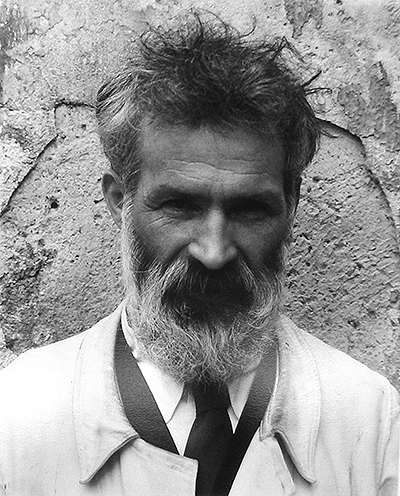
Born in Romania and based for most of his working life in Paris, Brâncuși reshaped modern sculpture through this close attention to the object and its setting. He carved wood and stone, made and revisited bronzes, designed bases, and used photographs and films to investigate how his work appeared. His Paris studio gave those investigations a setting he could change from day to day. His memorial ensemble at Târgu Jiu put related ideas to work on the scale of a city. [1] [3] [4]
At a Glance
- LifeConstantin Brâncuși was born in Romania in 1876 and settled in Paris in 1904. [1]
- SculpturesHe returned to forms such as the kiss, a sleeping head and a bird in flight across several decades, changing the way he carved, cast and displayed them. [2]
- StudioHis studio at Impasse Ronsin was a workshop, a place to show his art and a setting for his photography and film experiments. [5] [6]
- Târgu JiuThe Târgu Jiu ensemble, including The Endless Column, was built as a First World War memorial and entered the World Heritage List in 2024. [4]
Brâncuși’s artistic connections
Meet artists who worked with Brâncuși and later artists who drew on his sculpture.
- Auguste Rodin: Brâncuși spent a short period in Rodin’s workshop after his Paris training. [1]
- Man Ray: Man Ray helped Brâncuși acquire photographic equipment for his studio experiments. [6]
- Marcel Duchamp: Duchamp helped present Brâncuși’s work in the United States, including the exhibition around the 1926 shipment at issue in the customs case. [17]
- Richard Serra: Serra saw Brâncuși’s sculpture as a source of possibilities for making and placing sculpture. [25]
Constantin Brâncuși in context
Academic sculpture training
1894–1906 [1]Carving and modern sculpture
From c. 1907 [2]Modern public sculpture
1937–38 [4]Auguste Rodin
1907 workshop connection [1]Man Ray
1920s studio equipment [6]Marcel Duchamp
1926 US exhibition [17]Contents
- From Romanian workshops to Paris
- Faces, heads and the weight of a pose
- A bird worked out across several decades
- The base and the moving viewer
- The Paris studio as an ensemble
- A memorial on the scale of Târgu Jiu
- Exhibitions, collectors and the shape of a legacy
- How to compare works with the same title
From Romanian workshops to Paris
Brâncuși grew up in Oltenia, in south-western Romania. At the School of Arts and Crafts in Craiova he studied sculpture and wood carving before entering the fine arts school in Bucharest in 1898. The distinction between those two stages matters. His later work drew on a command of woodworking as well as the academic practices of modelling the body. It also shows how freely he could move among the materials and techniques he had learned. The long account belongs in his biography. For the sculpture, the point of departure is a young artist with several ways of making a figure already available to him. [1]
After travelling through Europe, he reached Paris in 1904 and continued his education with Antonin Mercié. He worked briefly in Auguste Rodin’s orbit in 1907. Rodin demonstrates what could be achieved by working into clay and then translating a model into another material through a workshop. A form developed in clay could subsequently be cast or be carved from stone by assistants. The eye can often follow the modelling in the apparently unsettled contours of a figure, or see a body emerging from material left rough around it. Brâncuși understood that vocabulary before taking his work in another direction. [1] [2]
One way into his independent work is to look for what the original block contributes. A flat edge might give the whole pose its weight. A vein in stone might cross a form without following the outline of the body. In wood, a divide in the grain or a natural branch can prompt the shape of a torso. The process of carving directly begins with a piece of material that already has limits. A cut permanently changes its surface and its relationship to the rest of the block. The sculptor can make these limits visible and use them to organise the result. Brâncuși’s early carvings make the process particularly clear, and the experiments continued after he had become a skilled maker of polished bronze. [1] [2] [5]
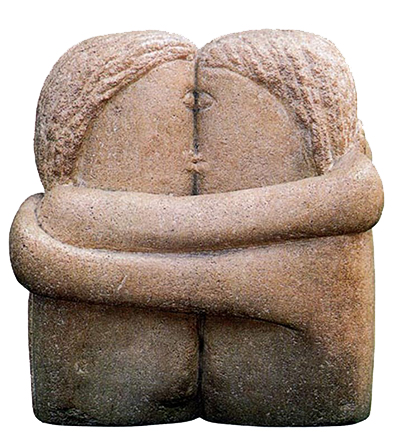
The Kiss makes this visible with minimal equipment. The compact limestone version in Philadelphia, dated 1916 by the museum, keeps the embracing figures within the reach of a single upright block. Two sets of arms travel around the sides. On one face, the eyes and the band of hair pull the two bodies into a common pattern. A joint in the composition still tells us where one person meets the other. Trace the arms around the stone and the embrace becomes legible as something the two bodies do together. The sculpture owes its compactness to how the figures occupy a shared mass. An account of the same subject built from separately posed bodies would offer another kind of intimacy. [7]
Romanian objects, rituals and places remained part of Brâncuși’s experience. His wooden bases and certain recurring forms can prompt comparison with Romanian carving, and the public memorial at Târgu Jiu directly involved him in a Romanian civic commission. The Paris that he inhabited also gave him access to new dealers, artists, collectors, and collections of sculpture from beyond Europe. A resemblance alone rarely establishes which object or tradition prompted a decision. Close attention to the work’s commission, dates and material is a more reliable way to judge individual instances. [1] [2] [4]
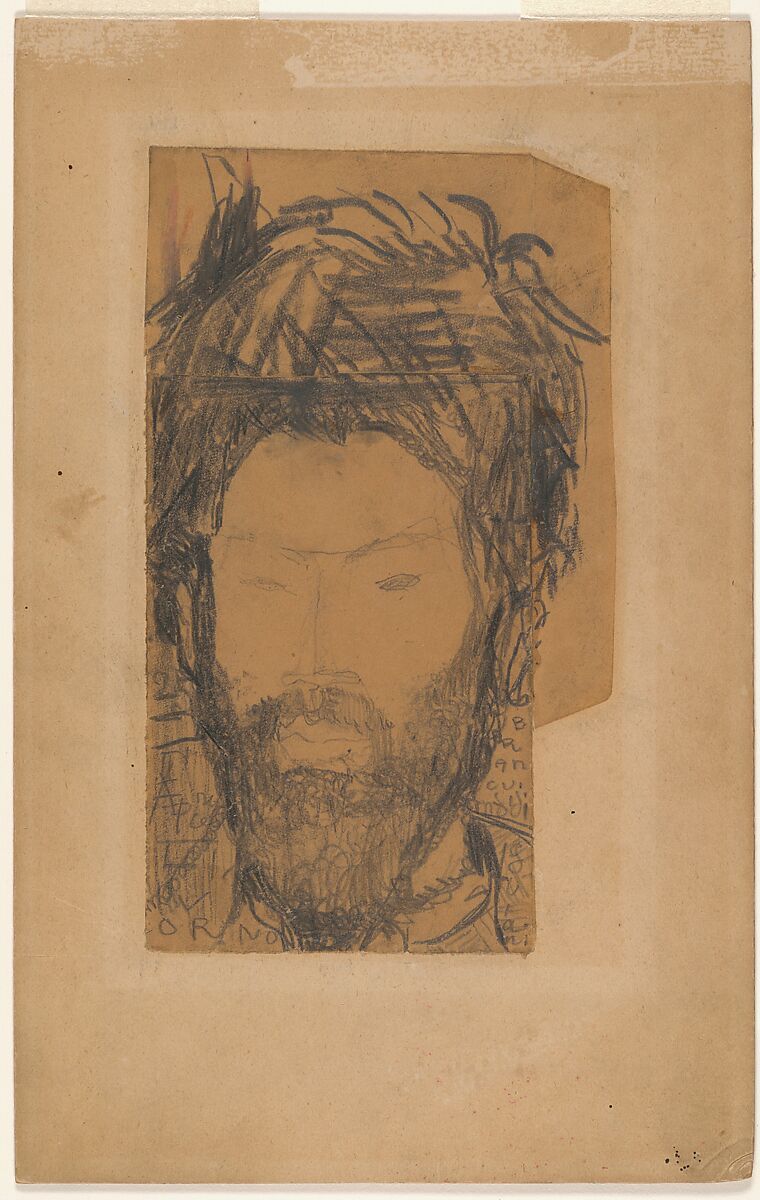
Amedeo Modigliani’s 1909 portrait of Constantin Brâncuși, in graphite with traces of crayon. The Metropolitan Museum of Art, Gift of the Constance B. and Carroll L. Cartwright Collection, 2025 (2025.236.5). Image source. Public Domain / Met Open Access CC0. Complete image, proportional export without enlargement or colour adjustment.
Four stages of Constantin Brâncuși’s career
These periods describe overlapping changes in the work and the places in which it was made.
From Craiova to Paris
The training in Craiova and Bucharest gave Brâncuși experience of academic sculpture and carving in wood. He moved to Paris in 1904. [1]
Carving figures and heads
Brâncuși continued his studies in Paris and worked briefly with Rodin. His independent work explored direct carving and tightly concentrated parts of the body. [1]
Changing form, base and surface
The artist developed groups of related works in different materials. His atelier gave him space to change the way he placed and photographed his sculptures. [5]
Faces, heads and the weight of a pose
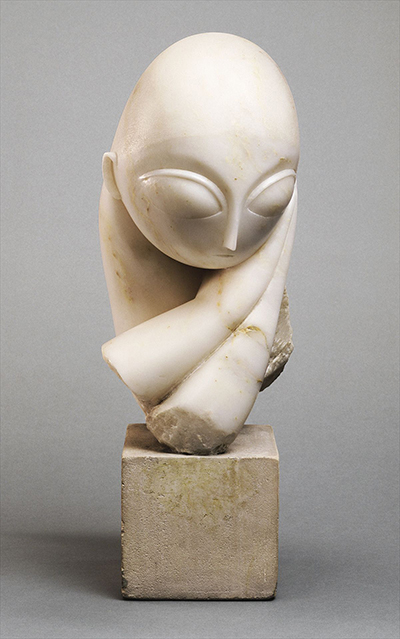
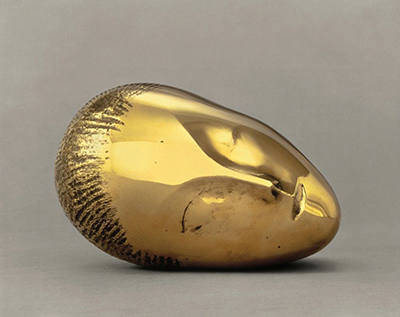
In a portrait, a person’s likeness can reside in the position of a head, the shape of an eyelid or the set of the mouth. Brâncuși tested how little of a face he needed to keep for the subject to remain present. In Sleeping Muse, a head rests on its side. The oval supplies most of the outline, and the features follow the curved surface rather than dividing it into distinct anatomical parts. The long line of a lowered eyelid belongs at once to the facial expression and to the rhythm of the whole sculpture. From one angle the head seems to bear gently on the surface under it. From another the point of contact recedes and the smooth form almost hovers. [8] [9]
Different Sleeping Muse works allow viewers to test these impressions against the materials. The Centre Pompidou and the Hirshhorn document versions in their collections, with separate records for the individual objects. A bronze version can catch a bright window or a dark figure passing through a room. In stone the figure’s outline and the colour of the material can remain easier to follow as the light changes. Such observations begin with how a particular sculpture is displayed. A photograph taken from one angle can make two versions seem much closer than they are in person, and the Hirshhorn’s own catalogue notes past confusion between an image of a bronze and its stone object. [8] [9]
The portrait of Margit Pogany made a different use of the head. In Mademoiselle Pogany the large eyes open outward while the small mouth and the impression of hands supporting the head concentrate the pose. The eyes do much of the recognisable work of a face, but they also make two strong volumes within the overall mass. Viewing the face straight on gives those volumes a symmetry that softens as soon as the viewer moves to one side. The structure has room for a particular sitter and for a sustained inquiry into how a head, arms and support cohere. Brâncuși revisited the form in different materials and finishes. The portrait series therefore takes time to see, with each object bringing something of its own. [2] [3] [10]
Consider The Newborn alongside the sleeping heads. The title supplies a circumstance in which small changes of expression can feel momentous. Modelling every muscle would give the child a particular face. Concentrating on an opening or a ridge instead invites the eye to dwell on how that feature interrupts a continuous volume. This also helps explain why the first impression of simplicity can mislead. At a distance an oval seems almost self-explanatory. From nearby, one can follow which parts of the form are left uninterrupted, which carry marks and where the weight seems to fall. That distribution changes the emotional bearing of an object. [2] [10]
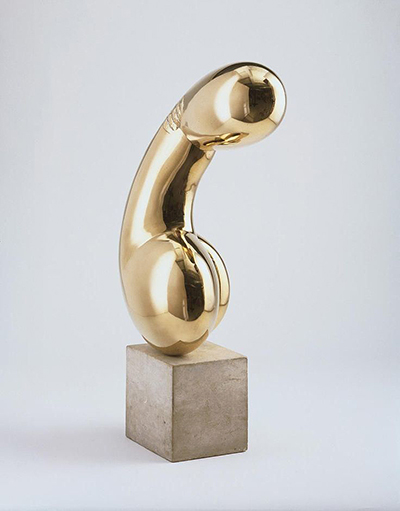
Brâncuși had room in his practice for more overt ambiguity. Princess X has a bent outline and a brilliant surface that make it possible to shift between suggested subjects as one walks around it. Its exhibition history is part of how the work has been seen. The sculpture itself still offers the most direct way to understand the persistence of competing descriptions. Start at its narrowest point and follow the curve back into the body. The change in direction is quite specific, even if the resulting shape never resolves into an unambiguous anatomy. [2] [11]
The Centre Pompidou's 1927 Newborn II shows how the artist continued to test the format long after the earlier versions. The stainless-steel head stands on a metal disk above a much taller walnut support. The polished volume and the unpolished disk handle the light differently, despite both being made of stainless steel. The change of material at the walnut adds a second surface contrast. As the viewer takes in the complete structure, the head appears exceptionally compact in relation to the base. The arrangement asks one to look up towards the head, an experience quite unlike watching the low, horizontal oval of a Sleeping Muse. The attachment of a small form to a tall support can affect the feeling of a work before the details of its face are clear. [12]
A bird worked out across several decades
The series of birds is a good route through Brâncuși’s sculptures because the works ask a related question at very different scales and in different materials. In Maiastra, the title connects the sculpture to the fantastic bird of Romanian tradition. A lifted head, swelling breast and upright stance still let a viewer recognise a creature. The base helps make the body look alert and elevated. The Venice collection traces the later bird works from this early group through Golden Bird and into the Bird in Space series. [3] [13]
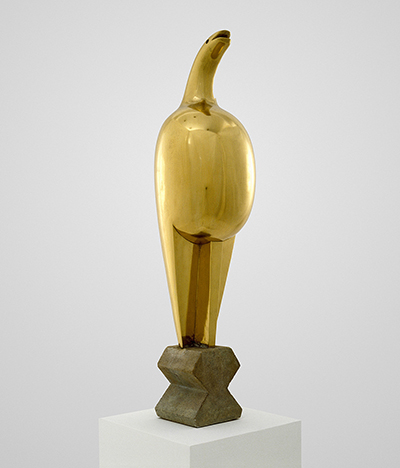
Golden Bird in Chicago has a tall, reflective bronze upper form. It rises above lower elements in stone and wood. The eye passes between surfaces that receive light very differently: the bronze can hold a crisp highlight, while the lower components make the structure seem comparatively firm. Seen this way, the sculpture’s upward movement begins well below what the title leads us to recognise as the bird. The Art Institute dates the bronze to 1919–20 and the base to about 1922. That division makes it possible to see the object as the outcome of more than one decision, made at different times. [14]
In Bird in Space, the long, rising body has no detachable wing to carry the impression of flight. The Met’s 1923 marble swells out from its narrow footing, then thins markedly toward the top. An oblique termination interrupts the upward contour. From one point of view it acts as a precise end to the line, and from another the line feels poised to continue into the space above it. Look down from that edge toward the base and the handling of the entire length becomes apparent. The sense of motion depends on how slowly the body grows and how decisively it tapers. [15]
The existence of multiple Bird in Space works has practical consequences when telling the artist’s story. The marble in the Met gives a specific date and material to one configuration. A bronze that passed through the hands of the photographer and collector Edward Steichen has its own provenance and is now recorded by the Seattle Art Museum. It is the work associated with the American customs dispute that MoMA recounts. The dispute arose after customs officials treated it as manufactured merchandise rather than granting the duty-free classification at stake for sculpture. The court ultimately accepted the work as sculpture. Comparing the two objects clarifies what the judgment tells us about an encounter between one piece and an official category. It also leaves room to see how the other versions work on their own terms. [15] [16] [17]
There is more to the series than a steady disappearance of the bird’s features. Material changes what the outline can do. In a darkened room, a polished metal bird might pick up a single light that lengthens it. In another room the metal might reflect sharp breaks between ceiling, wall and floor. Marble can offer a different relationship between the continuous outline and the light resting on it. The shape still belongs to an object with weight, a place to stand, and a direction in which to rise. These are useful things to look for before returning to the title. [2] [13] [15]
The base and the moving viewer
Brâncuși took as much care over the passage from floor to sculpture as many artists take over the main figure. A floor or a display surface gives a viewer a strong horizontal reference. A series of blocks above it can set up a slower or faster movement toward the top. Wood and stone can carry the eye past differences in grain and colour, and successive changes in width encourage a viewer to pause at different heights. By the time the main form begins, the rest of the arrangement may already have established whether it seems to press downward or to lift. [2] [5]
This is one reason the photographs of the Paris studio are such valuable companions to the objects. Brâncuși placed works together, changed their positions and sometimes moved a base from one sculpture to another. The parts acquired new relationships through these rearrangements. A work on a high stand entered roughly the same line of sight as the upper portion of a taller neighbour. A low head could be moved into a space where a viewer looked down at it. A change in arrangement might make two figures near each other seem strangely similar or make a previously quiet base appear assertive. The photographs allow us to see some of those arrangements as choices made by the artist himself. [5] [11]
In Fish, Brâncuși made the viewer’s point of view part of the subject. MoMA’s 1930 example is a long blue-grey marble above a multi-part pedestal. Seen broadside, its mass gives a strong horizontal impression. Seen closer to end-on, its silhouette can all but disappear into a slim edge. The stone rested on a pivot that could turn. Fish shows how much motion can be made perceptible with a heavy piece of marble and a change in angle. A photograph of the broad face gives a useful view of the work, while walking around it explains why that view tells only part of the story. [18]
Leda gives movement a more literal role. Its polished bronze is set horizontally too, but the arrangement included a motor that could turn the sculpture on its base. Motion allowed the changing surface to carry reflected light through successive positions. The title points toward the story of Leda and the swan while the contour keeps the precise distribution of body, wing and head open to interpretation. Together the two works reward attention to the different experiences of circling an object and watching an object rotate. Brâncuși registered both movement and stillness in the same material group. [19] [20]
The relationship between parts can be especially clear in a photograph that Brâncuși took himself. He could select a low angle, crop the surrounding equipment out of view, or direct attention to contrasts between nearby works. Once printed, the scene offered a fixed image of an arrangement built to permit change. In film he could also record what happened as a sculpture or the light moved. This work with cameras belongs alongside his drawings and the production of his sculpture. Each medium let him ask a different question about what he had made and how it could be seen. [2] [3] [5]
The Paris studio as an ensemble
At the Impasse Ronsin, Brâncuși’s workshop was also a place to receive guests and show finished work. Furnishings and tools had a presence alongside the carvings. A finished bronze might stand among the things needed to prepare another piece, giving attention to the work of making as well as the finished objects. Visitors could encounter a sculpture as part of a broader room whose material and arrangement the artist directed. A visit to such a space offers a different kind of encounter from examining an isolated work in a gallery, where the relationships are chosen by another institution. [2] [5] [11]
To follow the studio through time, distinguish the historical workshop from its subsequent re-creations. The Centre Pompidou’s account traces experiments in reconstructing the space after Brâncuși’s bequest to the French state. Curators had to interpret the relationship among the rooms, objects, tools and photographs. Brâncuși’s choices near the end of his life supplied evidence for what to preserve, while his photographs of earlier arrangements show the variety that a single reconstruction can never contain. The theme of the atelier has also structured later exhibitions, including the Neue Nationalgalerie retrospective and MoMA’s Brancusi: The Artist and His Studio. Each puts some studio relationships into a new institutional setting. [2] [5] [11]
The time visitors spend looking around the workshop also allows the less familiar work to come into view. Brâncuși’s studies on paper can isolate a gesture or a line without the effort of translating it into stone. His photographs can follow the redistribution of sculpture and furniture from one arrangement to another. The drawings and photographs let the reader see decisions that a polished object can make seem inevitable. Even if the work appears spare, many other configurations were possible. The documents make some of those possibilities visible. [2] [5] [11]
Photography and the edges of sculpture
In the 1920s Brâncuși acquired professional photographic equipment with the help of Man Ray and installed a darkroom in the workshop. He could follow a photograph through from staging to development. In one example described by the Centre Pompidou, he placed pale marble against dark fabric so that the silhouette stood out. That choice makes something visible that can be lost when an object and its surroundings are close in tone. In a photograph against the dark fabric, the pale edge grows more definite. The same distance from the camera and the same shape of marble can produce a photograph with a completely different emphasis if the background gives the edge somewhere to disappear. [6] [21]
A photograph can also make an area of polished metal look almost flat until a sharp reflection gives away the angle of the underlying form. Brightness may cross from one apparent plane into another or run along a narrow boundary seen from a particular position. Moving the camera before taking another picture lets the artist see the sculpture in both states. A photograph of one state can almost seem to show another work. This is especially useful when the sculpture has curved surfaces without a strong edge or seam to mark the transition. The photographs help a viewer see how the distribution of light is inseparable from the perception of the solid. [6]
Brâncuși photographed himself in the atelier, too. A self-portrait made there around 1934 survives as a glass negative in the Centre Pompidou. This is a different kind of record from a visitor’s view of a completed work. The artist chose how to present his body, his working environment and the space in front of the camera together. Such photographs bring the workshop within the history of the art as it was presented and circulated. They also give the later keepers of the atelier evidence of where things stood and how those positions might have mattered to the person who set them out. [1] [5]
A memorial on the scale of Târgu Jiu
In the later 1930s Brâncuși worked on a memorial for those who died defending Târgu Jiu during the First World War. The resulting monumental ensemble occupies two parks and the urban route between them. The site includes The Table of Silence and its seats, the Alley of Chairs, The Gate of the Kiss, and The Endless Column. UNESCO inscribed the ensemble on the World Heritage List in 2024, recognising how the sculpture is planned with the landscape and city around it. [4]
At the table near the river, the circular organisation turns the viewer’s eye back towards the centre. The low stone objects make the presence of people and places to sit part of the design. The gate offers a broad lintel and a passage underneath. Its sculptural motif can be looked at from a position on either side, or encountered while crossing between the two. Passing through the landscape that links these forms makes its gradual changes of direction and scale perceptible. A walk can turn alternately to an individual carving, to the space around it and to the next landmark in the larger route. [4]
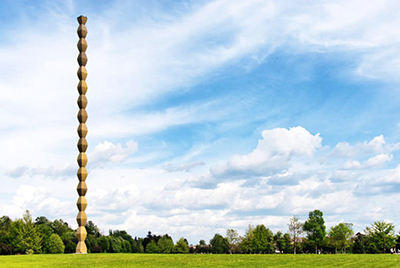
At the eastern end, the Endless Column pulls attention up from ground level. Its repeating metal units narrow and widen in sequence, producing a sculpture nearly thirty metres high. The alignment and repetition make it easy to imagine the form continuing upwards beyond the physical top. Earlier wooden columns belong to the development of this idea. The Romanian monument has its own scale, structure and conservation history, which distinguish it from a studio sculpture. Its parts work together on a public site exposed to the weather, and its restoration required technical work on the metal, coatings and internal structure. [2] [4] [22]
At Târgu Jiu, variations of height and position become things a person can experience while moving through a town. The encounter is larger than a walk around a bronze inside the studio but just as dependent on how one approaches. The different monuments leave room for different sorts of attention: a close look at stone cutting, a pause in the park, or the sight of a slender column from far away. The full route places both sculptural invention and the commemorative purpose in view. [4]
From an oak column to a city landmark
MoMA’s oak Endless Column, version I of 1918, gives an unusually direct view of how the repetition began. The cuts and gouges remain visible. Within each swelling, the angle of the cut changes quite abruptly. The rise of the column divides into passages in which it grows broader and then narrower. Curator Anne Umland points to the combination of a geometrical unit and the variability of the wood. A viewer can follow how Brâncuși sustained a common shape through slightly different cuts while keeping the continuity of the original piece of oak. [23]
The family resemblance to the Romanian monument is clear, even though the larger work solves a different problem. The wood of a studio column can guide how its axis develops. At the scale of the monument, engineering determines how the outer parts take their places along an interior support. The change in manufacture also changes what a person can see. On the oak a viewer can study the change of plane from nearby. At Târgu Jiu someone on the ground sees the upper elements at increasing distances. From below, the far end seems to draw away. Both works let a repeated form carry the eye upwards, each with its own relationship to the body of a person looking up at it. [4] [22] [23]
Exhibitions, collectors and the shape of a legacy
The idea of Brâncuși as a solitary craftsman only partly describes how the work reached its audiences. Collectors took individual versions into different collections. Marcel Duchamp supported his work and helped present it to audiences in the United States. The archives assembled by Sidney Geist preserve correspondence and research materials through which these relationships can be studied. MoMA’s own exhibition history includes the museum’s presentation of Bird in Space in 1934 and a show devoted to the sculpture in 1954. Each setting creates a different way to encounter a sculptor whose work circulated as individual pieces and as assembled groups. [3] [17] [24]
Later sculptors could draw on different aspects of the same achievement. Some had reason to look closely at how Brâncuși turned a wooden or stone block into an independent form. Others were drawn to the place of the base or to the relationship between sculpture and surrounding space. MoMA’s discussion of subsequent artists connects his work to Richard Serra’s sense of the possibilities it opened. Those possibilities become easier to recognise by keeping track of a single decision, such as which end of a piece bears its weight, through several sculptures. The eye begins to notice how often the artist reconsiders that decision, and how many later questions are already present in the result. [3] [25]
The holdings of the Centre Pompidou, Philadelphia Museum of Art, MoMA, the Art Institute of Chicago and other institutions reward different kinds of comparison. Philadelphia allows a reader to follow the history of a particular Kiss. Chicago lets a viewer connect the separate dates of the form and base of Golden Bird. The Pompidou gives context for works in repeated series, as well as for the studio and how it was photographed. Looking at the Met and Seattle collections together separates the history of an early marble Bird in Space from the bronze with a documented connection to the customs dispute. The records help an interested viewer find precise works and see how much information an image on its own can leave out. [5] [7] [14] [15] [16]
Modern sculpture can sometimes be difficult to approach because a clear subject does not immediately present itself. Brâncuși’s art gives the viewer other places to begin. A low head can be followed from the surface on which it rests to the line of a closed eye. A bird can be followed from the floor to the sudden stop at its top. A reflected light can carry attention across a bronze while nearby stone seems to hold still. These are ways of making sculpture worth returning to, long after a title and date have been learned. [2] [3]
MoMA's provenance of the 1918 oak Endless Column puts names and dates to one route across the Atlantic. It records the work's sale through Henri-Pierre Roché to John Quinn in 1922, while Brâncuși was still based in Paris, and the purchase from Quinn's estate by Roché and Duchamp in 1926. The record eventually identifies Mary Sisler as its donor to MoMA in 1983. This is one example of the time that could elapse between an encounter with a work in the artist’s lifetime and its entry into a public collection. It also shows how the same person could be involved at different points, bringing work to a first collector and later helping it change hands. The dates of the sculpture's ownership and exhibition can be as informative as the date carved into a museum label. [26]
How to compare works with the same title
Choose a view of a single object and note its material, approximate height and orientation before consulting images of its relatives. In a series such as Bird in Space, compare the narrowest point near the foot and the highest edge, then let the eye travel between them. In the sleeping heads, compare how far the face turns from the resting surface. A shift of a few degrees can change the apparent relationship between the sculpture and its support. It may take one view of the object from above and another at eye level to see where these changes happen. Collection records provide a stable material and accession number even when a familiar title turns up again. [8] [9] [15] [16]
Then check what the measurements include. The Met gives the height of its Bird in Space including the base. The Art Institute records the elements of Golden Bird across three different materials. Looking only at the most conspicuous reflective part of the latter can make it seem more compact than its dimensions suggest. Setting the two records against one another shows how much of a published height can belong to how a sculpture stands. It also makes it easier to notice what is missing when a photograph cuts off the lower part. Those comparisons lead into Brâncuși’s style and technique, where the construction and display of the work become subjects in their own right. [14] [15]
Finally, check whether the record distinguishes the date of the idea, the date of the surviving object and the dates at which it entered collections or exhibitions. A museum may be describing the first example it knows, a bronze cast related to an earlier marble, or a carving with a base made later. The archival record can show one work passing through the hands of several dealers and collectors before its purchase by a museum. The two objects that share a title may trace quite different routes through those records. When an image caption gives only the artist’s name and the series title, the material and collection give you a useful way to find out which work it shows. [14] [16] [23]
Essential Constantin Brâncuși works
Bird in Space
From 1923 · A rising form with separate examples in marble and metal. [15]
The Endless Column
1937–38 monument · Repeated forms carry the eye up from the park at Târgu Jiu. [4]
Sleeping Muse
Early versions 1909–10 · A reclining head shaped by its weight and its closed eyes. [8]
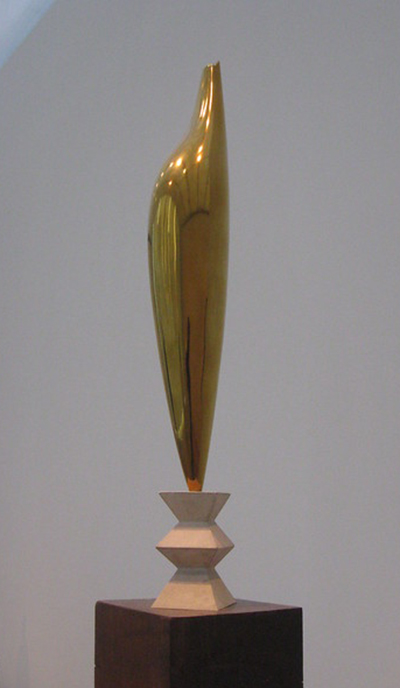
Golden Bird
1919–20 · The bronze rises above distinct wooden and stone components. [14]
Browse sculptures and drawings
Browse articles on the sculptures and separately catalogued museum objects. A work can have several physical versions. Drawing records from the Tate catalogue retain their October 2014 snapshot wording where present.
| Name | Date | Medium |
|---|---|---|
| Arch | Sculpture | |
| Bird in Space | Sculpture | |
| The Blond Negress | Sculpture | |
| The Cock | Sculpture | |
| The Endless Column | Sculpture | |
| The First Cry | Sculpture | |
| Fish | Sculpture | |
| The Gate of the Kiss | Sculpture | |
| Golden Bird | Sculpture | |
| Head | Sculpture | |
| The Kiss | Sculpture | |
| Leda | Sculpture | |
| Madame L.R. | Sculpture | |
| Mademoiselle Pogany II | Sculpture | |
| Mademoiselle Pogany | Sculpture | |
| Maiastra | Sculpture | |
| The Newborn | Sculpture | |
| Phoque II | Sculpture | |
| The Prayer | Sculpture | |
| Princess X | Sculpture | |
| Prometheus | Sculpture | |
| Târgu Jiu monumental ensemble | Sculpture | |
| Sculpture for the Blind | Sculpture | |
| The Seal | Sculpture | |
| The Signal | Sculpture | |
| Sleeping Muse | Sculpture | |
| The Sorceress | Sculpture | |
| The Table of Silence | Sculpture | |
| Torso of a Young Man | Sculpture | |
| Two Lamps | Sculpture | |
| Vitellius | Sculpture | |
| The White Negress | Sculpture | |
| The Wisdom of the Earth | Sculpture | |
| Young Bird | Sculpture | |
| The Kiss (Philadelphia, fourth version) | 1916 | Sculpture Catalogue. |
| Sleeping Muse (Pompidou bronze) | 1910 | Sculpture Catalogue. |
| Mlle Pogany, version I (MoMA bronze) | 1913, after a marble of 1912 | Sculpture Catalogue. |
| Maiastra (Venice brass) | about 1912 | Sculpture Catalogue. |
| Bird in Space (MoMA bronze) | about 1941 | Sculpture Catalogue. |
| Bird in Space (Venice brass) | 1932–40 | Sculpture Catalogue. |
| Endless Column, version I (oak) | 1918 | Sculpture Catalogue. |
| Brâncuși Monumental Ensemble of Târgu Jiu | 1937–38 | Sculpture Catalogue. |
| Bust of a nude woman in profile, head inclined | about 1910 | Drawing Catalogue. |
| Nude study, head inclined (recto) | — | Drawing Catalogue. |
| Self-portrait (ink) | — | Drawing Catalogue. |
| View of the Artist’s Studio | 1918 | Drawing Catalogue. |
| Study for the cock (lost clay Grand Coq) | about 1923 | Drawing Catalogue. |
| Portrait of a woman in profile | — | Drawing Catalogue. |
| Animal head | — | Drawing Catalogue. |
| Animal sketch (2002 checklist) | 1929 | Drawing Catalogue. |
| Plans of the studio (verso) | about 1930–38 | Drawing Catalogue. |
| Danaïde (Tate T00296) | c.1918 | Sculpture Catalogue. |
| Maiastra (Tate T01751) | 1911 | Sculpture Catalogue. |
| Head (Tate T03066) | c.1919–23 | Sculpture Catalogue. |
| Fish (Tate T07107) | 1926 | Sculpture Catalogue. |
Frequently Asked Questions
He was born in 1876 in Hobița, in the Oltenia region of Romania. He trained in Craiova and Bucharest and moved to Paris in 1904. [1]
It stands in Târgu Jiu, Romania, as part of the memorial ensemble designed in 1937–38. The Column belongs to an urban route that also incorporates the Gate of the Kiss and the Table of Silence. [4]
Discussion
Look again at the images and ideas explored in Constantin Brâncuși. These editorial prompts invite your observations.
Reader Insights
Which detail in Sleeping Muse gives you the clearest impression of a head at rest?
Where does Golden Bird seem to begin when you follow the sculpture upwards from the floor?
What changes when you compare a photograph of one of Brâncuși’s works in his studio with an image of the same object displayed on its own?
Join the Conversation
Share a detail, comparison or question about Constantin Brâncuși below.
References
- Centre Pompidou, L’artiste et son œuvre (French). View source.
- Neue Nationalgalerie, Brancusi exhibition texts, 2026. View source.
- Museum of Modern Art, Constantin Brancusi artist record. View source.
- UNESCO World Heritage Centre, Brâncuși Monumental Ensemble of Târgu Jiu. View source.
- Centre Pompidou, Brancusi’s Studio. View source.
- Centre Pompidou, Brancusi et la photographie (French). View source.
- Philadelphia Museum of Art, The Kiss, collection record, 1916 work. View source.
- Centre Pompidou, La Muse endormie, collection record. View source.
- Smithsonian Institution, Sleeping Muse I, Hirshhorn collection record. View source.
- Centre Pompidou, Constantin Brancusi research dossier (French). View source.
- Museum of Modern Art, Brancusi: The Artist and His Studio, exhibition record. View source.
- Museum of Modern Art, Brancusi: The Artist and His Studio checklist and captions, Newborn II object details. View source.
- Peggy Guggenheim Collection, Bird in Space, collection record and series account. View source.
- Art Institute of Chicago, Golden Bird, extended collection record. View source.
- The Metropolitan Museum of Art, Bird in Space, 1923 marble. View source.
- Seattle Art Museum, Bird in Space, Steichen bronze provenance. View source.
- Museum of Modern Art, Constantin Brancusi vs. the United States, account of the customs case. View source.
- Museum of Modern Art, Fish, collection record. View source.
- Centre Pompidou, Léda, collection record. View source.
- Museum of Modern Art, Movement and Stillness, gallery audio and transcript. View source.
- Centre Pompidou, Histoire de l’Atelier Brancusi, photographs section (French). View source.
- World Monuments Fund, Brancusi’s Endless Column Ensemble, conservation account. View source.
- Museum of Modern Art, Endless Column, version I, 1918 oak and Anne Umland’s gallery commentary. View source.
- Museum of Modern Art Archives, Brâncuși Correspondence and Research Material Collected by Sidney Geist, finding aid. View source.
- MoMA Magazine, Reimagining Brancusi: A Journey Through Art, guide to later artistic responses. View source.
- Museum of Modern Art, Endless Column, version I, object 645.1983 and provenance. View source.
More BRÂNCUȘI Sculptures
Bird in Space
Compare the marble and metal versions of Brâncuși’s sculpture.