 by Tom Gurney
Tom Gurney BSc (Hons) is an art history expert with over 20 years experience
Published on June 19, 2020 / Updated on November 29, 2026
Email: tomgurney1@gmail.com / Phone: +44 7429 011000
Golden Bird: Introduction
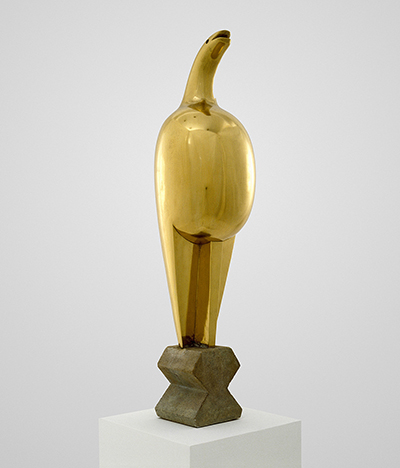
Constantin Brâncuși’s Golden Bird rises from a tower of carved wood and limestone into a slender, polished bronze body. Its long neck ends in the suggestion of an open beak, and its swelling breast narrows to an almost improbably small footing. The Art Institute of Chicago dates the bronze to 1919–20 and the base to about 1922. Together they stand roughly seven feet tall. The three-part pedestal sets the bird’s height, shapes its silhouette from below, and changes the way its golden surface catches the eye. [1] [2]
At a Glance
- ArtistConstantin Brâncuși
- TitleGolden Bird
- Date1919–20, base about 1922 [1]
- MaterialsPolished bronze on a three-part wood and limestone pedestal [1] [2]
- Overall dimensions217.8 × 29.9 × 29.9 cm (86 × 11¾ × 11¾ in.) [1]
- CollectionArt Institute of Chicago, accession 1990.88 [1]
- ProvenanceAcquired from Brâncuși by John Quinn by November 1920, sold from his estate to the Arts Club of Chicago in January 1927, and acquired by the Art Institute in 1990 [1]
Contents
- The bird’s shape and surface
- How the three-part pedestal works
- From Brâncuși’s studio to New York
- A long home in Chicago
- Between Maiastra and Bird in Space
- Other Golden Birds and Mina Loy’s poem
The bird’s shape and surface
The open beak gives the long outline a moment of articulation. Below it, a shallow change in contour distinguishes the head and neck, then the line swells into a breast and contracts into a fine foot. From some angles the upper form seems alert and almost about to call. From others the head is subordinate to the much longer curve below it. The bird can be read as a body gathering itself through the breast or as a body already rising through the neck. Brâncuși leaves enough anatomy for either impression, with little to interrupt the movement from one end of the bronze to the other. [1] [2]
Follow the sculpture from its point of contact with the limestone. The bronze grows out of a small oval, which Margherita Andreotti found was flatter towards the back and narrower towards the front. The slight asymmetry matters. An object turned to a perfectly circular profile would have the same section whichever way it faced. Brâncuși’s narrow footing carries an orientation even there, before the more obvious direction of the beak comes into view. A glance up from the stone catches that change from a footing barely an inch across to the almost metre-high bronze above it. [2]
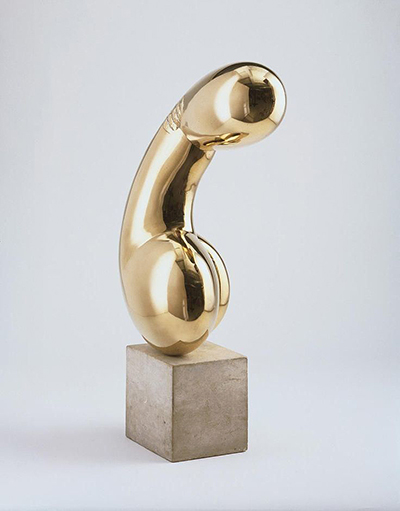
The polish makes the sculpture change with the room and with the viewer’s position. A broad, bright curve across the breast can become a thin streak from a different angle. Darker reflections can momentarily make part of the contour look less distinct, while a highlight may mark out the next turn of the body. The gold of the title describes an effect visible in the finish. Andreotti describes the bronze as polished without a patina, the coloured surface layer often seen on bronze sculpture. Its brightness comes into its own beside the relatively matte limestone and the darker wood. The three materials reward different kinds of attention. A changing reflection runs across the bird, while a growth ring stays fixed in the wood as you move. [1] [2]
The beak also keeps the sculpture open to readings beyond flight. In a 1922 letter to the American collector John Quinn about another bird, his wooden Rooster, Brâncuși joked that the earlier bird had caught a worm. Andreotti takes the remark as a possible way to read the stretched neck. The letter gives us a glimpse of how readily the artist could move between an ordinary gesture and a highly distilled shape. A bird reaching up to swallow and one lifting its head to sing might look much the same for an instant. Viewers can recognise that gesture even though the bronze leaves the rest of the action to their imagination. [2]
How the three-part pedestal works
At the floor is a tall wooden element shaped like two truncated pyramids meeting at their narrow ends. Its waist makes the lower support look slimmer than the large block above it. The middle element is a rectangular piece of wood, wider than the foot and still distinctly taller than it is wide. The stone immediately under the bronze is a low limestone section of four diminishing truncated pyramids, cut with variations in their height and size. Their stepped edges draw the eye to the much smaller area of contact between the limestone and the bronze. Andreotti likens both the bottom wood section and the upper stone section to units of Brâncuși’s Endless Column. The resemblance is clearest in the angled sides, which give the eye a repeated movement between narrowing and widening. [2]
The central wood block is the broadest interruption in that pattern. On two faces, the growth rings tell you that the evident geometry came out of a tree trunk. Brâncuși placed the rings so they would read clearly across those faces, giving the timber a visual centre. Andreotti records his circled initials on both wooden elements and his name etched beneath the bronze. The maker’s marks are ordinarily less visible than the surfaces. They are useful evidence of his attention to the pieces supporting the bird, just as the composition itself shows how deliberately he made the grain, angles and polish interact. [1] [2]
The height adds another effect. Andreotti measured the bronze at 37¾ inches, appreciably less than half the overall height recorded by the museum. A photograph cropped just below the bronze gives a fair sense of its smooth outline but removes the interval over which the eye rises to see it. In the full sculpture, the first length of wood, the overhanging block and the compact stepped limestone each establish a different scale. The bronze appears particularly slender after the weight of the wood and particularly continuous after the succession of stone edges. Even the rectangular block has a part in the upward movement because its longer dimension stands upright. [1] [2]
Brâncuși could also turn the bronze in relation to the block. Andreotti reads an installation photograph from 1926 as showing the bird facing a corner of the wood. In a photograph of the 1934 Renaissance Society exhibition, a face showing the tree rings is aligned with the front of the bird. The angle matters to the viewer. A corner makes the front of the bronze sit between two planes of wood, while a face makes the underlying block read as a broad plane beneath it. There is a continuity of materials and parts across these displays alongside a genuine difference in how to approach the sculpture. [2]
From Brâncuși’s studio to New York
John Quinn bought the bronze from Brâncuși by 24 November 1920, the date given by the Art Institute from Quinn’s ledger. Andreotti’s account places it in a group of four purchases, with a yellow marble bird and marble and bronze versions of Mlle Pogany II. The sculptor sent photographs of the works to Quinn before the sale. Photography could therefore introduce a prospective owner to an alternate grouping or view of an object that remained in the studio. An early studio photograph reproduced by Andreotti shows the Chicago bird above an arrangement close to the one it has now, with a zigzag chalk marking visible on the block. That evidence shows how early the design was being tried out. Quinn acquired the current base separately in 1922. [1] [2]
The 1922 Exhibition of Contemporary French Art at the Sculptors’ Gallery in New York placed the bronze on a different support. Andreotti’s reading of the installation photograph identifies a drum, whose exact material is uncertain, and a wooden piece similar in form to the bottom member of today’s pedestal. The yellow marble Yellow Bird, which Andreotti identifies as the sculpture now at Yale, was displayed nearby on an earlier support of its own. Seeing two related birds on bases that subsequently changed helps explain the importance of exhibition photographs. A pedestal could be a deliberate choice for one viewing and still give way to another arrangement later. [2]
The sculptor had no part in installing the 1922 show. He thanked Quinn for photographs but regretted that the pieces had been set so close to the wall. Four years later he had much more control at the Brummer Gallery, where the catalogue gave Golden Bird its familiar title and dated it to 1919. Photographs by Yasuo Kuniyoshi show space between the works and reveal how marble and metal sculptures on related themes could be seen across the room. Brâncuși installed Golden Bird on the base now in Chicago. With open space around it, a visitor could see more of the bird’s turning profile and the edge of the wood below. The layout put the polished surfaces in dialogue without requiring every sculpture to face the same way. [1] [2]
The change from 1922 to 1926 also explains why dates attached to a single work can look inconsistent. The Art Institute gives the range 1919–20 for the bronze, while the 1922 exhibition listed this object as Bird, dated 1921, and Brummer used Golden Bird, dated 1919. Andreotti puts the probable casting around late 1919 or early 1920. A letter requesting photographs of a bronze bird in April 1920 offers a possible clue, provided the correspondent meant this one. The sale that November gives the firmer endpoint. The base date refers to another part of the work’s history, and the Brummer installation gives a documented occasion on which it was brought together with the bronze. [1] [2]
A long home in Chicago
The New York exhibition travelled to the Arts Club of Chicago in January 1927. Marcel Duchamp installed this selection. Writing to Brâncuși on its opening day, he described Golden Bird and a Maiastra near opposite ends of the room, with Edward Steichen’s Bird in Space in the middle and a Column between the Steichen sculpture and Golden Bird. A visitor entering that room could thus compare several stages of the bird theme through their relations in space. The display set the upright bird shapes at different distances and gave each enough weight to anchor a part of the room. It also preserved a feature Andreotti identifies at Brummer, where differences of material and scale helped organise the installation. [2] [3] [4]
By then the bronze belonged to Quinn’s estate. Duchamp reported that the Arts Club purchased it for $1,200. Rue Winterbotham Carpenter, the club’s president, helped bring the show to the city. A portrait Brâncuși drew of her can be seen in one of Kuniyoshi’s photographs of the preceding Brummer exhibition. The photograph helps date the drawing and places Carpenter’s likeness in the exhibition before she helped bring the sculptures to Chicago. The transfer also had a public consequence. A sculpture that had been loaned from a New York collection now became a work a Chicago institution could lend elsewhere. [1] [2] [3]
One such loan took it to the Harvard Society for Contemporary Art in 1929, where an installation photograph shows the bronze in front of a painting by Joan Miró. Another took it to the University of Chicago’s Renaissance Society in 1934, where it was listed as Flight of Bird. In 1953, it appeared at the Art Institute as a loan in the travelling exhibition Sculpture of the Twentieth Century. The Art Institute acquired it in 1990 through a combination of gift and purchase support. The Arts Club describes the sale as part of its financing for a new building. Those separate episodes help explain the work’s long association with the city, for decades before the Art Institute gave it the accession number 1990.88. [1] [2] [5]
Between Maiastra and Bird in Space
The white marble Maiastra of 1910–12 at the Museum of Modern Art offers an earlier approach to a bird as a firmly perched body. Its breast pushes markedly outwards, its neck draws upwards from it, and its tail is separately legible. It takes its name from a magical bird in Romanian folklore. The support is already an assembly. In the middle of the three-part limestone pedestal is Double Caryatid, an earlier sculpture of two figures, which gives the white marble a distinctly figured element below it. The Centre Pompidou’s French account of this version calls attention to the relationship between the earthly weight of those blocks and the rising breast of the bird. The Art Institute’s Golden Bird develops a related interplay between lower weight and upper lift in a very different combination of materials and forms. [6] [7]
The most immediate difference between the two is where the eye pauses. With MoMA’s Maiastra, the protruding breast and the recognisable tail hold a viewer’s attention across the bird’s body. In Chicago the breast is drawn higher and the figure’s sweeping profile leads more insistently towards the point at the top. It is also possible to compare the pedestals in their own right. The early figures make the support another place to find an image, while the Chicago block shows marks of an entirely different origin in its grain. Both pedestals give the sculpture real vertical reach. Their role connects the works as much as the subjects do. Each assembly has its own history and the comparison concerns what the forms do when placed together for a viewer. [1] [2] [6] [7]
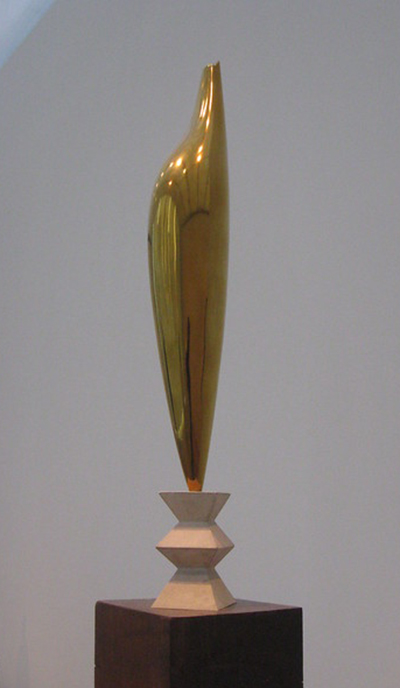
The Metropolitan Museum of Art’s marble Bird in Space of 1923 takes the pointed upward movement further. The torso becomes an even longer swell, and the head and beak recede into an angled termination. Its narrow conical footing gives the marble a pronounced upward push under diffuse light, where the shape reads mostly through its edges and the soft variations of the stone. Compare that to Chicago’s bright bronze, where a shifting reflection can call attention to a particular curve as strongly as the silhouette does. Brâncuși went on to make more Bird in Space sculptures in both marble and metal. The Met marble is one specific work within that series. [2] [8] [9]
Steichen’s 1926 Bird in Space, now at the Seattle Art Museum, provides an especially useful historical comparison because it appeared alongside Golden Bird at both Brummer and the Arts Club. This was the sculpture that United States customs officials assessed as a manufactured object on its arrival for the New York exhibition, leading to the case that Brâncuși ultimately won. At the Chicago show the same object occupied the central position described by Duchamp. Its customs history belongs to the Seattle bird, while the older bronze across the room had already been in Quinn’s collection for years. The two works can be historically connected without losing the individual stories told by their owners, their catalogues and their displays. [2] [4] [10]
Other Golden Birds and Mina Loy’s poem
Brâncuși’s closely related birds can be difficult to distinguish in a reproduction. Andreotti discusses the differences between the bronze in Chicago and the slightly smaller yellow marble at Yale. She entertains the possibility that the bronze could have come from a reworked plaster based on that marble. The idea remains a hypothesis about a possible stage of making. The small differences in the sculptures’ dimensions, the timelines reconstructed from letters and the way they are separately identified in the 1922 installation are reasons to give each its own identity when looking at or writing about it. [2]
There is also a closely related bronze Golden Bird at the Minneapolis Institute of Art. That distinction matters when reading Mina Loy’s poem “Brancusi’s Golden Bird,” first published in The Dial in November 1922 beside a photograph by Brâncuși. The image accompanying the poem has been identified with the Chicago bronze. Andreotti considered the possibility that Loy had seen it in New York. But Loy later recalled encountering a Golden Bird at the home of Mariette Mills, and editor Roger Conover argues that this recollection points to the Minneapolis bronze as the likely inspiration. The photograph and the remembered encounter connect different objects to the poem. The Arts Club’s exhibition guide on Loy also identifies the Mills sculpture as the work she encountered. [2] [11] [12] [13]
The photograph brought readers a different experience again. In the gallery, the pedestal and the surrounding room help determine where the bronze sits in a visitor’s field of vision. On a printed page, lighting and crop determine how much of that relationship survives. MoMA also holds a gelatin silver print by Brâncuși titled Golden Bird, catalogued as a photograph from 1919. Its separate collection record is a reminder to check whether a title describes a sculpture or a photograph of one. The distinctions are worth keeping because Brâncuși worked with real differences of material, support and illumination, even when the name of a work or the sweep of a silhouette seems familiar. [2] [11] [14]
Browse sculptures and drawings
Browse articles on the sculptures and separately catalogued museum objects. A work can have several physical versions. Drawing records from the Tate catalogue retain their October 2014 snapshot wording where present.
| Name | Date | Medium |
|---|---|---|
| Arch | Sculpture | |
| Bird in Space | Sculpture | |
| The Blond Negress | Sculpture | |
| The Cock | Sculpture | |
| The Endless Column | Sculpture | |
| The First Cry | Sculpture | |
| Fish | Sculpture | |
| The Gate of the Kiss | Sculpture | |
| Golden Bird | Sculpture | |
| Head | Sculpture | |
| The Kiss | Sculpture | |
| Leda | Sculpture | |
| Madame L.R. | Sculpture | |
| Mademoiselle Pogany II | Sculpture | |
| Mademoiselle Pogany | Sculpture | |
| Maiastra | Sculpture | |
| The Newborn | Sculpture | |
| Phoque II | Sculpture | |
| The Prayer | Sculpture | |
| Princess X | Sculpture | |
| Prometheus | Sculpture | |
| Târgu Jiu monumental ensemble | Sculpture | |
| Sculpture for the Blind | Sculpture | |
| The Seal | Sculpture | |
| The Signal | Sculpture | |
| Sleeping Muse | Sculpture | |
| The Sorceress | Sculpture | |
| The Table of Silence | Sculpture | |
| Torso of a Young Man | Sculpture | |
| Two Lamps | Sculpture | |
| Vitellius | Sculpture | |
| The White Negress | Sculpture | |
| The Wisdom of the Earth | Sculpture | |
| Young Bird | Sculpture | |
| The Kiss (Philadelphia, fourth version) | 1916 | Sculpture Catalogue. |
| Sleeping Muse (Pompidou bronze) | 1910 | Sculpture Catalogue. |
| Mlle Pogany, version I (MoMA bronze) | 1913, after a marble of 1912 | Sculpture Catalogue. |
| Maiastra (Venice brass) | about 1912 | Sculpture Catalogue. |
| Bird in Space (MoMA bronze) | about 1941 | Sculpture Catalogue. |
| Bird in Space (Venice brass) | 1932–40 | Sculpture Catalogue. |
| Endless Column, version I (oak) | 1918 | Sculpture Catalogue. |
| Brâncuși Monumental Ensemble of Târgu Jiu | 1937–38 | Sculpture Catalogue. |
| Bust of a nude woman in profile, head inclined | about 1910 | Drawing Catalogue. |
| Nude study, head inclined (recto) | — | Drawing Catalogue. |
| Self-portrait (ink) | — | Drawing Catalogue. |
| View of the Artist’s Studio | 1918 | Drawing Catalogue. |
| Study for the cock (lost clay Grand Coq) | about 1923 | Drawing Catalogue. |
| Portrait of a woman in profile | — | Drawing Catalogue. |
| Animal head | — | Drawing Catalogue. |
| Animal sketch (2002 checklist) | 1929 | Drawing Catalogue. |
| Plans of the studio (verso) | about 1930–38 | Drawing Catalogue. |
| Danaïde (Tate T00296) | c.1918 | Sculpture Catalogue. |
| Maiastra (Tate T01751) | 1911 | Sculpture Catalogue. |
| Head (Tate T03066) | c.1919–23 | Sculpture Catalogue. |
| Fish (Tate T07107) | 1926 | Sculpture Catalogue. |
Frequently Asked Questions
Discussion
Look again at the images and ideas explored in Golden Bird. These editorial prompts invite your observations.
Reader Insights
Start with the bronze and let your eye travel down to the floor. Which part of the pedestal has the greatest effect on how the bird seems to move?
Imagine turning the bronze so the beak faces an edge of the wooden block, then a corner. How might the sculpture draw you around it in each arrangement?
Compare Chicago’s Golden Bird with MoMA’s Maiastra. What clues in each sculpture make you imagine a living bird?
Join the Conversation
Share a detail, comparison or question about Golden Bird below.
References
- Art Institute of Chicago, Golden Bird, 1919/20 (base c. 1922), object 1990.88. Object description, measurements, ownership, exhibition and publication histories. View source.
- Margherita Andreotti, “Brancusi’s ‘Golden Bird’: A New Species of Modern Sculpture,” Art Institute of Chicago Museum Studies 19, no. 2 (1993), pp. 134–152 and 198–203, especially pp. 135–136, 141–145 and 147–152. JSTOR record View source 1. View source 2.
- The Arts Club of Chicago, An Exhibition of Sculpture by Brancusi, 1927. Exhibition record, Duchamp attribution and shipping correspondence. View source.
- Seattle Art Museum, Bird in Space, 1926, object 2000.221. Provenance and exhibitions, Brummer and the Arts Club of Chicago. View source.
- The Arts Club of Chicago, History, “1980–1997: Negotiations.” Circumstances of the sale to the Art Institute of Chicago. View source.
- Museum of Modern Art, Maiastra, 1910–12, object 144.1953.a-d. Object description and pedestal details. View source.
- Centre Pompidou, Maïastra. Essay on the subject and pedestal of the first version. French. View source.
- Metropolitan Museum of Art, Bird in Space, 1923, object 1996.403.7ab. Marble version and series overview. View source.
- Museum of Modern Art, Brancusi’s Birds. Comparison of versions and the date of the first Bird in Space. View source.
- Metropolitan Museum of Art, Brummer Galleries, Modern Art Index Project. Brummer exhibition and the Seattle sculpture’s customs dispute. View source.
- Mina Loy, “Brancusi’s Golden Bird,” The Dial 73, November 1922, pp. 507–508. Poem and Roger Conover’s editorial note, Electronic Poetry Center, University of Pennsylvania. View source.
- Minneapolis Institute of Art, Golden Bird, about 1919, Artwork in Focus. The separate Minneapolis bronze. View source.
- The Arts Club of Chicago, Mina Loy exhibition guide, pp. 24–25, entries 65–67. Loy’s encounter with the Mills bronze and the poem’s publication. View source.
- Museum of Modern Art, Golden Bird, 1919, object 1636.2001. Gelatin silver print by Brâncuși. View source.
More BRÂNCUȘI Sculptures
Bird in Space
Compare the marble and metal versions of Brâncuși’s sculpture.