 by Tom Gurney
Tom Gurney BSc (Hons) is an art history expert with over 20 years experience
Published on June 19, 2020 / Updated on November 29, 2026
Email: tomgurney1@gmail.com / Phone: +44 7429 011000
Mademoiselle Pogany: Introduction
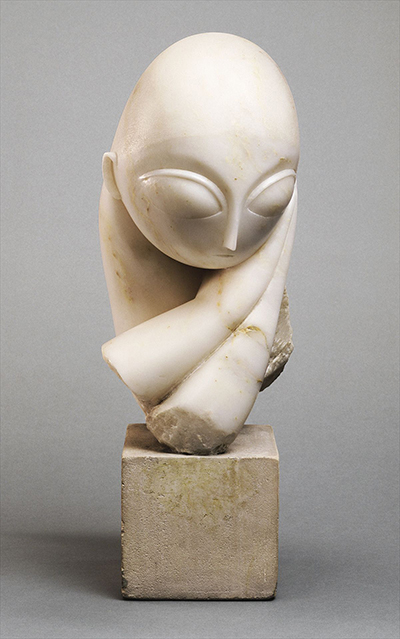
In Constantin Brâncuși’s Mademoiselle Pogany, a woman inclines her head into her hands. Her eyes take up so much of the face that the mouth almost disappears by comparison. Brâncuși made the portrait of Margit Pogany, a Hungarian painter who sat for him in Paris and later owned the bronze now at the Museum of Modern Art in New York. The Philadelphia Museum of Art’s early white marble, dated about 1912, and MoMA’s bronze of 1913 share that tilt of the head and the oversized eyes. In the bronze, a dark patina sets the hair apart from the warm surface of the face. The two objects resemble each other closely enough to make their differences worth looking for. [1] [2] [3]
At a Glance
- ArtistConstantin Brâncuși
- SitterMargit Pogany, a Hungarian painter [2] [4]
- Early marbleMademoiselle Pogany, c. 1912, Philadelphia Museum of Art, 1933-24-1 [1] [3] [4]
- Early bronzeMlle Pogany, version I, 1913 after a marble of 1912, Museum of Modern Art, 2.1953 [2]
- Public debutA plaster was exhibited at the 1913 Armory Show in New York [3] [4]
- Distinguishing featuresOval head, enlarged almond-shaped eyes, folded hands, hair gathered at the nape [2] [3]
Contents
- Margit Pogany and the commission
- Version I in white marble
- The 1913 bronze and the Paris plaster
- The Armory Show and the spread of the portrait
- The portrait revisited
- Selected works in the series
Margit Pogany and the commission
Pogany was studying painting in Paris when she met Brâncuși. The account she gave later, in letters discussed by the curator Alexander Kauffman, places their meeting in a Montparnasse boarding house. She commissioned the portrait and posed for it before returning to Budapest. MoMA dates the sittings to 1910 and 1911. Pogany’s account matters because the title conveys so little about her role. Mademoiselle is a French form of address. The woman it names in this case was a working artist who could discuss Brâncuși’s choices with him, follow the progress of the commission from abroad, and decide what the finished portrait meant to her. [2] [3] [4]
The clay studies explain why the sittings were important even though the first finished sculpture was made after Pogany left Paris. Alfred H. Barr Jr.’s 1953 acquisition notes recount Pogany’s memory of watching Brâncuși discard a fresh clay study at the end of a sitting. She thought the resemblance was already good. The Centre Pompidou also describes the destruction of the clay studies and the carving of the marble from memory after her return to Hungary. Taken together, these accounts describe a sculptor who had tried making a likeness with the sitter in front of him and who kept working after that opportunity had passed. The marble belongs to the later part of that process. [2] [5] [6]
The precise timing is less clear than the sequence. Barr’s acquisition notes place her departure in early 1912. Kauffman, drawing on her later letters, places her return to Budapest in January 1911. The surviving objects give firmer dates for the work than the retrospective accounts give for some of the events. Philadelphia labels the marble about 1912, and MoMA dates its bronze to 1913. The most direct evidence for the next step is MoMA’s provenance, which records the bronze passing from Brâncuși to Pogany in 1913. The acquisition notes and Kauffman also differ on who made the final choice of bronze over marble. The provenance establishes what she received. [1] [2] [3] [5]
Kauffman draws attention to an undated letter in which Pogany asks Brâncuși to keep the portrait a private matter between them and encourages him to pursue a design that might challenge even her understanding. Kauffman places the letter around the period of the commission on the basis of its wording. The letter offers a different angle on the story of the rejected clay studies. She had appreciated a convincing likeness during the sittings. In writing, she gave Brâncuși room to make something she might need time to understand. Their exchange makes it possible to see the eventual portrait as an experiment in which the sitter took an active interest. [3] [5]
Version I in white marble
The early Philadelphia marble stands on a limestone block. The narrow area where the lower part of the head and the hands meet carries much of the weight of the composition. The head leans towards the hands and seems to settle into their curve. Look at the lower edge of the face and follow it around into the neck. Brâncuși brings the planes so close together that the supporting gesture reads quickly, even though several anatomical transitions are compressed. The small slope where chin, hand and forearm come together tells the viewer how the woman is sitting. [1] [3] [7]
The eyes are cut into the same continuous body of stone as the cheeks and brow. On either side of the nose the raised contours of the eyes interrupt the broad, relatively smooth planes. The bridge of the nose gives the face a centre, while the inclination of the head draws the whole arrangement off the vertical of the base. A straight-on view makes it easy to concentrate on the matched arches of the eyes. A more oblique view puts the projection of the hands and the turn of the head into play. The eye shapes alone give something like the outline of a face. Seen with the upper body and the stone block below, they belong to a woman holding a pose. [1] [3] [7]
Brâncuși’s own photograph of the 1912 marble, dated to the beginning of 1914 by the Centre Pompidou, records a frontal view. It offers a way to compare the sculpture’s appearance early in its history with the familiar modern reproductions. The separate dates are easy to miss. The year 1912 in the photograph’s title describes the marble in front of the camera, while the museum’s creation date describes the print. The image also shows why the straight-on view became so effective in circulation. It compresses the silhouette of hair, cheek and hands into an arrangement that holds together on a small rectangle of paper. [7]
Pogany’s own Self-Portrait of 1913 helps explain what viewers recognize in the sculpture. In the painting she sits at the edge of a bed, her face turned towards something outside the picture. Loose hair casts a shadow across part of her face. The reds of the room and the quick, uneven strokes across the skin create a more volatile surface than the marble, even as both portraits stress the cheek, the curve of the hair and the direction of the gaze. Pogany later drew MoMA’s attention to a resemblance between the poses and said she had painted hers before seeing Brâncuși’s bust. The two works show how much can be made of those shared features by changing the material and viewpoint. [3] [4]
The appearance of the earliest portrait also has a history within Brâncuși’s work. The Centre Pompidou recounts Pogany’s recollection of an inclined head with very large eyes that she saw on an early visit to his studio. She took it for a portrait of herself. The museum suggests it was probably Narcisse, an alabaster of 1910 that is now missing. That distinction leaves room for two things to be true about the finished marble. It could carry features Pogany recognized as her own and draw on a kind of head Brâncuși had already been exploring. The eyes that look like an emphatic piece of observation may equally carry forward a sculptural idea. [8]
The Centre Pompidou’s Danaïde of 1913, a black-patinated and partly gilded bronze on limestone, makes the connection easier to see. Its eyes form shallow arches within the face, and the compact oval is presented without the embrace of hands that marks Mlle Pogany. The contrast places some limits on what the oval can do by itself. It can hold a face together when the facial features are dramatically reduced. The attitude of the Pogany portrait, with its distinctive leaning head, depends just as much on the visible gesture underneath. The museum describes the first white-marble Danaïde, an earlier state of that separate subject, as formally between the first and second Pogany versions. [2] [8]
The 1913 bronze and the Paris plaster
MoMA’s version I bronze measures 43.8 × 21.5 × 31.7 cm, with a limestone base catalogued separately. The museum describes a plaster mould taken from the marble and four bronze versions cast from it, including its example. Casting gave Brâncuși a way to carry a design across materials. The resulting bronze retains the underlying connection between the hands and the inclined face. Its surface adds a clear boundary where the dark hair meets the brow, then carries the dark area around the head to the chignon. The finish makes the sculpture read differently as the viewer moves from the face to the side of the head. [2]
The colour boundary is especially striking from a distance. In the marble, light and shadow do much of the work of separating one feature from another. The bronze gives the viewer a strong tonal division even where the modelling is shallow. Look again at the eyes after following the edge of the hair. The eyes hold their shape through changes in light, but the contrast between hair and face makes the brow above them a much stronger horizontal accent. This helps explain why a monochrome reproduction can convey the composition while missing much of the bronze’s character. [2] [7]
The Centre Pompidou catalogues a surviving plaster, Mlle Pogany I, dated 1912–13. Its cylindrical plaster support makes a useful comparison with the limestone block under MoMA’s bronze. The cylinder repeats some of the curves above it, while the block provides flat faces and straight edges that clarify the extent of the head’s lean. Both raise the compact figure high enough for the lower contour of the hands and forearms to contribute to the silhouette. In the Neue Nationalgalerie’s 2026 exhibition checklist, the Paris plaster appears with a further walnut support listed beneath the small cylindrical base. The scale of the whole assembly changes with the supports installed below the bust. [2] [9] [10]
MoMA records that Pogany kept her bronze in Budapest and later in Camberwell, Australia, before selling it to the museum in 1953. That history gives the bronze a particular place in the series. It remained in the sitter’s possession for decades, during which the portrait itself had already become widely known in other forms. When she approached MoMA, she also sent a reproduction of her painted self-portrait. The museum acquired the bronze, and the painting reached the Philadelphia Museum of Art through her family in 1966. In 2019 it was shown there alongside the sculpted portrait and Brâncuși’s Prometheus. An encounter Pogany had proposed in correspondence finally became possible in a gallery. [2] [3] [4] [5]
The Armory Show and the spread of the portrait
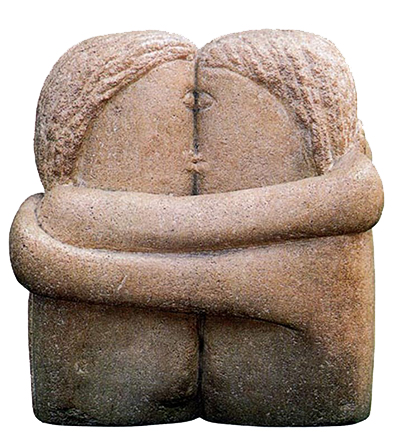
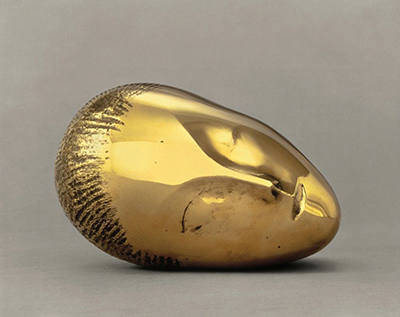
The version of Mademoiselle Pogany that went on view at the New York Armory Show in 1913 was a plaster. It shared an exhibition with other experiments by Brâncuși, and the Chicago catalogue from the following leg lists Mlle. Pogany as no. 27, after The Kiss, Sleeping Muse and A Muse. Seen together, those entries give some context for the sculpture’s departures from traditional portraiture. A head could lie nearly horizontal in one work, rise into a hand in another, or form half of a compact block of two embracing bodies. The viewer who met Mlle. Pogany at this show was seeing one of several ways Brâncuși joined the parts of a body into a single sculptural shape. [3] [4] [6] [11]
The portrait made the discrepancy between a recognizable pose and an unfamiliar face especially visible. Kauffman points to a contemporary headline asking, “Is She a Lady or an Egg?” The question picks out the unusually clean contour of the head. It also shows the limits of treating that contour as the whole work. Just below the oval are hands, and within it are eyes whose scale invites an immediate response. The portrait has enough cues for a viewer to register a person and enough departures in proportion to unsettle that first impression. The headline works because viewers could see both possibilities at once. [2] [3]
The plaster’s public appearance and the bronze’s ownership are two different strands of the story. The exhibition brought a version of Pogany’s likeness to an American audience in 1913. In the same year, the bronze that would eventually enter MoMA’s collection went to Pogany herself. Subsequent casts, photographs and exhibitions took the portrait into other settings. For a work that was already known in reproduction, the arrival of her bronze at MoMA gave the public a way to encounter the patina, the physical tilt of the head and the limestone beneath it. [2] [3] [4] [5] [7]
The portrait revisited
In the second version Brâncuși reworked the hair and reorganized its relation to the neck and back of the head. The Centre Pompidou’s 1920 Mlle Pogany II in plaster was taken from a marble of 1919 that the museum describes as privately held. Brâncuși’s own studio photograph, dated about 1920, places a veined marble of 1919 and a polished bronze of 1920 in the same view. The photograph makes clear how early the second version existed in more than one material. Shizuoka Prefectural Museum of Art records another execution, a polished bronze dated 1925. These objects form the setting for the separate discussion of Mademoiselle Pogany II. [12] [13] [14]
For the third version, the Philadelphia Museum of Art holds the white marble Mademoiselle Pogany [III] of 1931. The Centre Pompidou catalogues a 1933 plaster with a shellac patina taken from that marble. It identifies the plaster as the probable working intermediate for its separate bronze of 1933. A photograph of one of these works can look close to a view of another, particularly when it crops out the base or is printed in black and white. The museum records preserve the chain from marble to plaster to bronze and give each object its own entry. [15] [16] [17] [18]
The later marble still derives its pose from the early portrait. One of the quickest ways to see what changed is to compare the backs. In the 1931 marble, the cascade of carved hair continues down the back, extending the rhythm of its spirals to the lower part of the sculpture. When the viewer turns back towards the face, that greater continuity helps connect the head and the upright body in a way the compact chignon in the early version does differently. The Paris bronze is also shown with more than one level of support in the 2026 Berlin checklist, which records a limestone block and a tall oak base. That assembly gives a small head and hands a different presence in the room. [2] [10] [15] [17] [19]
There is a further coincidence in 1931. Kauffman reports that Pogany mailed Brâncuși a postcard reproducing her self-portrait in July of the year he made the third marble. The date gives the painting a place in their continued exchange. Whether it affected the third version remains open. The postcard matters in its own right as an instance of Pogany choosing the image through which she presented herself to the artist who had portrayed her nearly two decades earlier. [3] [15]
Selected works in the series
The dates below follow the record for each object. The early Philadelphia record and the MoMA label give different levels of precision for the marble and the later bronze. For the Pompidou plaster of 1920, the date of the marble it was taken from is part of the object’s history. Identifying a sculpture from a reproduction is easier when the date is checked alongside the material, the base and the catalogue number. [1] [2] [12]
| Work and date | Material or identifying detail | Collection and record |
|---|---|---|
| Mademoiselle Pogany, c. 1912 | White marble on a limestone block | Philadelphia Museum of Art, 1933-24-1 [1] [3] [4] |
| Mlle Pogany I, 1912–13 | Plaster with cylindrical plaster support | Centre Pompidou, AM 4002-50 and AM 4002-50 (1) [9] |
| Mlle Pogany, version I, 1913 after a marble of 1912 | Bronze with black patina on limestone | Museum of Modern Art, 2.1953 [2] |
| Mlle Pogany II, 1919 | Veined marble recorded as the source for the 1920 plaster | Private collection per the Centre Pompidou [12] [13] |
| Mlle Pogany II, 1920 | Plaster taken from the 1919 marble | Centre Pompidou, AM 4002-52 [12] |
| Mlle Pogany II, 1920 | Polished bronze pictured in the artist’s studio photograph | Centre Pompidou photograph PH 10 A, which also shows the 1919 marble [13] |
| Mademoiselle Pogany II, 1925 | Polished bronze | Shizuoka Prefectural Museum of Art exhibition record [14] |
| Mademoiselle Pogany [III], 1931 | White marble on a four-part limestone and oak base | Philadelphia Museum of Art, 1950-134-21 [15] [16] |
| Mlle Pogany III, 1933 | Shellac-patinated plaster taken from the 1931 marble | Centre Pompidou, AM 4002-53 [18] |
| Mlle Pogany III, 1933 | Bronze on a cubic limestone base, also documented with an oak support | Centre Pompidou, AM 4002-54, AM 4002-54 (1), and oak support AM 4002-166 [10] [17] |
A useful comparison begins with the 1913 bronze in New York and the 1931 marble in Philadelphia. The hairline in the early bronze draws the eye round to a gathered knot at the nape. In the later marble, the path continues through the descending ridges. Then look at what remains from one work to the next. The hands still bring the face and the body into close contact. For all the attention the head receives, its tilt depends on that small area where the volumes meet. Relating the face to the hands gives the portrait its particular quality of sustained attention. [2] [15] [19]
Browse sculptures and drawings
Browse articles on the sculptures and separately catalogued museum objects. A work can have several physical versions. Drawing records from the Tate catalogue retain their October 2014 snapshot wording where present.
| Name | Date | Medium |
|---|---|---|
| Arch | Sculpture | |
| Bird in Space | Sculpture | |
| The Blond Negress | Sculpture | |
| The Cock | Sculpture | |
| The Endless Column | Sculpture | |
| The First Cry | Sculpture | |
| Fish | Sculpture | |
| The Gate of the Kiss | Sculpture | |
| Golden Bird | Sculpture | |
| Head | Sculpture | |
| The Kiss | Sculpture | |
| Leda | Sculpture | |
| Madame L.R. | Sculpture | |
| Mademoiselle Pogany II | Sculpture | |
| Mademoiselle Pogany | Sculpture | |
| Maiastra | Sculpture | |
| The Newborn | Sculpture | |
| Phoque II | Sculpture | |
| The Prayer | Sculpture | |
| Princess X | Sculpture | |
| Prometheus | Sculpture | |
| Târgu Jiu monumental ensemble | Sculpture | |
| Sculpture for the Blind | Sculpture | |
| The Seal | Sculpture | |
| The Signal | Sculpture | |
| Sleeping Muse | Sculpture | |
| The Sorceress | Sculpture | |
| The Table of Silence | Sculpture | |
| Torso of a Young Man | Sculpture | |
| Two Lamps | Sculpture | |
| Vitellius | Sculpture | |
| The White Negress | Sculpture | |
| The Wisdom of the Earth | Sculpture | |
| Young Bird | Sculpture | |
| The Kiss (Philadelphia, fourth version) | 1916 | Sculpture Catalogue. |
| Sleeping Muse (Pompidou bronze) | 1910 | Sculpture Catalogue. |
| Mlle Pogany, version I (MoMA bronze) | 1913, after a marble of 1912 | Sculpture Catalogue. |
| Maiastra (Venice brass) | about 1912 | Sculpture Catalogue. |
| Bird in Space (MoMA bronze) | about 1941 | Sculpture Catalogue. |
| Bird in Space (Venice brass) | 1932–40 | Sculpture Catalogue. |
| Endless Column, version I (oak) | 1918 | Sculpture Catalogue. |
| Brâncuși Monumental Ensemble of Târgu Jiu | 1937–38 | Sculpture Catalogue. |
| Bust of a nude woman in profile, head inclined | about 1910 | Drawing Catalogue. |
| Nude study, head inclined (recto) | — | Drawing Catalogue. |
| Self-portrait (ink) | — | Drawing Catalogue. |
| View of the Artist’s Studio | 1918 | Drawing Catalogue. |
| Study for the cock (lost clay Grand Coq) | about 1923 | Drawing Catalogue. |
| Portrait of a woman in profile | — | Drawing Catalogue. |
| Animal head | — | Drawing Catalogue. |
| Animal sketch (2002 checklist) | 1929 | Drawing Catalogue. |
| Plans of the studio (verso) | about 1930–38 | Drawing Catalogue. |
| Danaïde (Tate T00296) | c.1918 | Sculpture Catalogue. |
| Maiastra (Tate T01751) | 1911 | Sculpture Catalogue. |
| Head (Tate T03066) | c.1919–23 | Sculpture Catalogue. |
| Fish (Tate T07107) | 1926 | Sculpture Catalogue. |
Frequently Asked Questions
Discussion
Look again at the images and ideas explored in Mademoiselle Pogany. These editorial prompts invite your observations.
Reader Insights
Follow the edge of the hands into the head. Which angle makes the gesture feel most like a person resting her face?
Compare an early marble view with a photograph of MoMA’s bronze. How does the dark hair change where you look first?
Where do you see the closest affinity between Pogany’s painted self-portrait and Brâncuși’s sculpture?
Join the Conversation
Share a detail, comparison or question about Mademoiselle Pogany below.
References
- Philadelphia Museum of Art. Mademoiselle Pogany. Collection record, c. 1912. View source.
- Museum of Modern Art. Mlle Pogany. Collection record, version I, 1913 (after a marble of 1912), no. 2.1953. Includes gallery labels and provenance. View source.
- Alexander Kauffman. “‘Mademoiselle Pogány’ as Artist and Patron”. January 2020. See the essay, figures 1–3 and notes 5–7 and 14–17. View source.
- Philadelphia Museum of Art. Margit Pogany, Self-Portrait. Collection record, 1913, including the two marble accessions and the history of the Armory Show plaster. View source.
- Alfred H. Barr Jr. “New Acquisitions – Check List with Notes”. Museum of Modern Art, February 11, 1953, p. 3. View source.
- Centre Pompidou. “Mademoiselle Pogany”. French educational dossier, account of the sittings and illustrated entries. View source.
- Centre Pompidou. Mlle Pogany vue de face, marbre (1912). Photograph by Brâncuși, beginning of 1914, PH 288 H. View source.
- Centre Pompidou. Danaïde. Bronze, 1913, AM 4002-48 and AM 4002-48 (1). See the analysis for the relationship to the Pogany series and the tentative identification of Narcisse. View source.
- Centre Pompidou. Mlle Pogany I. Plaster, 1912–13, AM 4002-50 and AM 4002-50 (1). View source.
- Neue Nationalgalerie, Staatliche Museen zu Berlin. Brancusi exhibition checklist. 2026, “Portraits?” section, entries for the version I plaster and bronze and the version III bronze. View source.
- Association of American Painters and Sculptors. Catalogue of the International Exhibition of Modern Art. Art Institute of Chicago, March 24–April 16, 1913, entries 24–27. View source.
- Centre Pompidou. Mlle Pogany II. Plaster, 1920, AM 4002-52. The fabrication-stage field identifies the 1919 marble in a private collection. View source.
- Centre Pompidou. Vue d’atelier with Mlle Pogany II. Photograph by Brâncuși of the 1919 marble, 1920 bronze and Le Baiser pilaster, c. 1920, PH 10 A. View source.
- Shizuoka Prefectural Museum of Art. Color Remix exhibition checklist. 2012, entry 92, Mademoiselle Pogany II, 1925, Japanese. View source.
- Philadelphia Museum of Art. Mademoiselle Pogany [III]. Collection record, 1931. View source.
- Philadelphia Museum of Art. Picasso and the Avant-Garde in Paris, gallery labels. 2010, p. 67, white marble with limestone and oak four-part base, 1950-134-21. View source.
- Centre Pompidou. Mlle Pogany III, bronze. 1933, AM 4002-54 and AM 4002-54 (1). View source.
- Centre Pompidou. Mlle Pogany III, plaster. 1933, AM 4002-53. See the fabrication-stage field for the relation to the marble and bronze. View source.
- French Sculpture Census. Mademoiselle Pogany [III]. No. 8298, Philadelphia accession 1950-134-21. Reproduces the Philadelphia Museum of Art’s 1995 catalogue discussion of the carved hair. View source.
More BRÂNCUȘI Sculptures
Bird in Space
Compare the marble and metal versions of Brâncuși’s sculpture.