 by Tom Gurney
Tom Gurney BSc (Hons) is an art history expert with over 20 years experience
Published on June 19, 2020 / Updated on November 29, 2026
Email: tomgurney1@gmail.com / Phone: +44 7429 011000
Princess X: Introduction
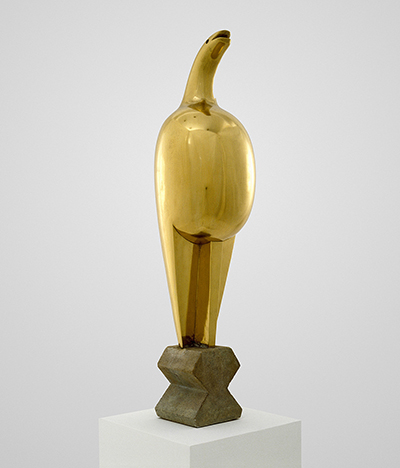
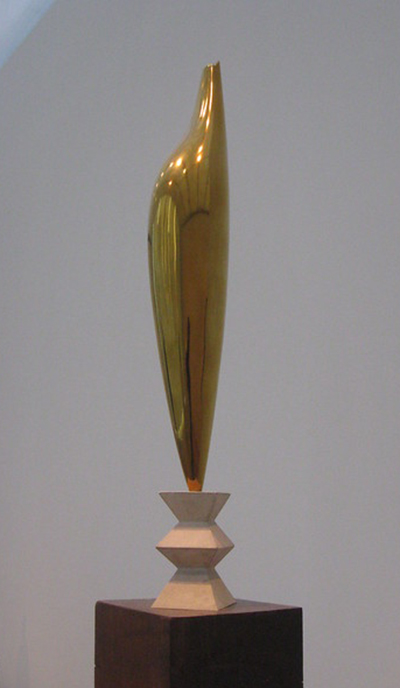
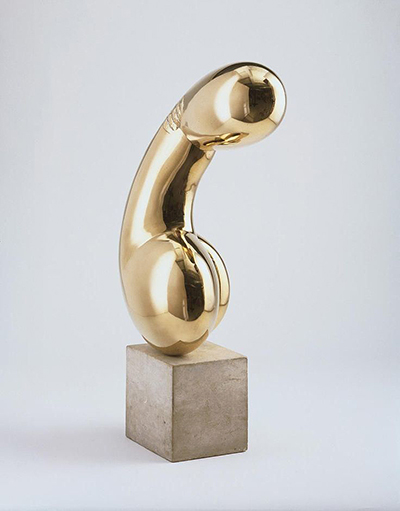
In Princess X, Constantin Brâncuși compressed the pose of a woman leaning towards a mirror into a handful of curves. In polished bronze, those curves could suggest a phallus as readily as a head, neck and breast. That resemblance led to the sculpture’s removal from the 1920 Salon des Indépendants in Paris. The surviving marble, plasters, bronzes and photographs show how Brâncuși arrived at a form that could be seen so differently. [1] [2]
At a Glance
- ArtistConstantin Brâncuși (1876–1957)
- TitlePrincess X (Princesse X)
- Paris bronze1915–16, polished bronze and limestone, Musée national d’art moderne, Centre Pompidou, AM 4002-88 [1]
- Philadelphia bronze1915–16, polished bronze and limestone block, Philadelphia Museum of Art, 1950-134-12 [3]
- Nebraska marble1909–16 in the Sheldon Museum of Art catalogue, marble on a Caen limestone base, U-418.1963 [2]
- Associated sitterPrincess Marie Bonaparte, named in an early exhibition title and identified with the work by Sheldon and the Smithsonian’s portrait archive [2] [4] [5]
- Paris receptionThe Centre Pompidou identifies its bronze as the example removed from the 1920 Salon des Indépendants. [1]
Contents
- A portrait held in a curve
- The woman and her mirror
- From marble to polished bronze
- Was it a portrait of Marie Bonaparte?
- The Salon des Indépendants in 1920
- How one form carries several readings
A portrait held in a curve
Begin with the point at which the sculpture meets its pale stone block. The hard, straight edges make the swelling bronze above them look softer. The lower mass thrusts out before narrowing and rising into a long curve. At the top, the smaller rounded mass leans away from the vertical of the base. What a figure might express with a lowered gaze is carried here by an imbalance that the sculpture sustains without appearing to topple. A continuous sweep holds the volumes together even as they seem to pull in different directions. [1] [3]
The portrait reading starts with that upward turn. An oval gives the impression of a bent head, the extended transition suggests a long neck, and the swelling below suggests the upper body. There is scarcely a face from which to read a mood or return a gaze. In her catalogue entry for the Paris bronze, Marielle Tabart traces a small mark at the nape to a lock of hair and discusses a surviving suggestion of a hand. Once you know to look for these details, their slightness is striking. A conventional bust could let its sitter’s face do most of the work. Here the angle of the head in relation to the neck and chest carries the character of the pose. [1]
The same economy leaves room for the phallic reading. Attend to the silhouette and the prominent swellings begin to look like parts of one upright form. A face would interrupt that reading by making the upper oval immediately legible as a head. A separate arm would set out a clearer boundary between the figure and its surroundings. Brâncuși leaves the passages between the main masses broad and smooth, so the eye can group them as a woman’s upper body or as male anatomy. The sculpture’s basic shape changes little as your perception switches. What changes is the part you take each curve to represent. [1]
Lighting can tip the balance. Against an even background the silhouette is especially clear. Under directional light a bright strip can run down the neck and break across the fuller volumes. As you shift position, areas that seemed almost flat can round out, and a support that looked nearly square from one angle can appear oblique from another. The pictures in the Paris and Philadelphia records give fixed views of a surface that picks up what surrounds it. The gold colour comes from polished bronze, and its brightness varies with the light. [1] [3]
The woman and her mirror
The source of the pose is easier to see in Brâncuși’s photographs of the lost Woman Looking in a Mirror (Femme se regardant dans un miroir), a sculpture from 1909. The Centre Pompidou preserves a glass negative showing the earlier figure in profile and a separate view from behind. Seen in profile, the figure bends towards what she holds close to the body. Seen from the rear, the slope of the back and the continuation of the neck are easier to pick out. Together the views show how much of the pose depended on the line of the body, even when the subject’s gesture was still readable from the more descriptive carving. [6] [7] [8]
Compare the profile with the bronze and follow the old figure’s head into the bend of the neck. That turn is recognisable after the mirror and most of the detail that explained the gesture have disappeared. In Princess X the head still inclines as if there were something to look at. The object of that attention is gone. Yet the new surface makes its own kind of mirror. Anyone standing near it can enter the sculpture as a moving patch of light or colour. The resemblance between the original subject and the later finish is a way to read the work today. It leaves open whether Brâncuși thought of the polish in those terms when he made it. [1] [6] [9]
The photographs are themselves objects with a history. The Pompidou dates the profile photograph around 1909 and records later photographic material under closely related titles, including a gelatin silver copy in negative values. A date on a photograph can refer to the camera negative or the print, and the date in parentheses can identify the sculpture depicted. This matters when the surviving evidence is photographic. A reproduction may reverse light and dark or isolate a contour more sharply than the sculpture would have appeared under ordinary room light. Comparing the different views helps recover the pose without mistaking any single exposure for the full object. [6] [7] [10]
A drawing in Cleveland gives a related example of the attention Brâncuși paid to contour. The museum titles its front Study for Princess X and dates the pencil and mustard-crayon sheet 1913–15. The nude has rounded outlines and arms crossed in front. The museum describes Brâncuși’s drawing practice as independent of preparation for sculpture. The sheet makes a fruitful comparison with the bronze because a few lines on paper can hold a recognisable body in place. In the sculpture, the bulge of a solid and the highlight it catches can have the effect of a line, even as the outline shifts with the angle. [11]
From marble to polished bronze
The Sheldon Museum’s Princess X in Lincoln, Nebraska, is the marble at the centre of this group. Sheldon dates it 1909–16 and identifies the base as Caen limestone. Its collection credit records Olga N. Sheldon’s gift in memory of Adams Bromley Sheldon. The Centre Pompidou dates the marble 1909–15 in its description of the source for the Paris bronze. The year’s difference belongs to the two institutions’ dating of the carved work. It gives no reason to transfer the date of a photograph or a bronze to the marble. [1] [2]
A photograph of the marble can emphasise the gradual changes of its curved surface through soft shifts in tone. A polished cast can carry much sharper reflections along those same transitions. A highlight spilling over a shoulder can make a mass feel broad and full. A narrow white ribbon through the neck can make that part feel taut and elongated. Tabart describes the marble’s finish as velvety and the bronze forms as more elastic. Her comparison helps explain why casting could leave the relationship of the main volumes intact while altering the way one passes into the next as we look. [1] [2] [3]
The Centre Pompidou’s Paris bronze is dated 1915–16 and measures 61.7 × 40.5 × 22.2 cm. The museum catalogues its limestone block separately within the work’s record and also identifies the two-element support on which the bronze and block sit. Brâncuși kept this example and it entered the French national collection through his 1957 bequest. The Philadelphia Museum of Art also dates its polished bronze to 1915–16 and gives those same measurements for the bronze itself. That cast entered Philadelphia with the Louise and Walter Arensberg Collection in 1950. The similar dimensions make an accession number particularly useful when identifying either bronze. [1] [3] [12]
Two intermediate plasters remained in Brâncuși’s studio. The Pompidou records its patinated plaster AM 4002-87 as having served in casting the bronze now in Philadelphia. The same record includes a photograph of the two plasters together in the reconstructed studio, identified as AM 4002-86 at left and AM 4002-87 at right. The museum assembled both plasters and its bronze for the 1999–2000 exhibition La Princesse X. La série et l’œuvre unique. Plaster matters to this history because it gave Brâncuși another surface on which to work. Tabart points to reworking of details of the hand and hair on one intermediate plaster, at the stage when the cast’s form could still be altered. [1] [12] [13]
Brâncuși also made a photograph titled Princess X, dated about 1918 in Philadelphia. It is a gelatin silver print from a separate acquisition, with the accession number 1997-30-7. Its date describes a photographic object. A photograph can make a bronze legible through a particular viewpoint and distribution of light, while the sculpture can be seen from any point around its support. With a work as dependent on silhouette as Princess X, what the photograph holds still is part of the artist’s interpretation of his own sculpture. [14]
One of Brâncuși’s studio negatives shows another way he presented the work. Dated before December 1917, it places Princess X in the company of Maïastra, Petite Colonne and La Muse endormie II in his studio on the Impasse Ronsin. In that setting the sculpture could be seen alongside a bird, a column and a reclining head. Their different axes of movement give the long bend of Princess X a context that an isolated portrait photograph cannot supply. The studio view also records the artist living and working with the form well before the Paris Salon made its subject a public dispute. [14]
Was it a portrait of Marie Bonaparte?
There is early documentary support for the association. The catalogue of the Society of Independent Artists’ first New York exhibition in 1917 lists no. 167 under Brâncuși as Portrait of Princess Bonaparte. Art historian Doina Lemny identifies that entry with a bronze Princess X. The title establishes what visitors were told to call the work and how a princess’s name was attached to it in public. The entry gives neither the circumstances under which a sitter posed nor the current accession number of the object on display. Sheldon identifies its marble with Marie Bonaparte, and the Smithsonian’s Catalog of American Portraits records that identification for the Sheldon object. [2] [4] [5] [8]
Marie Bonaparte married Prince George of Greece and Denmark in 1907. Her papers at the Library of Congress document her later career in psychoanalysis and include extensive correspondence with Sigmund Freud beginning in the 1920s. Looking backward from that part of her life can make the sculpture’s sexual ambiguity seem biographically inevitable. The order of events gives reason for care. The depiction of a woman with a mirror, the identity suggested by a published exhibition title, and the later career of the historical Marie Bonaparte are three different kinds of evidence. The sculpture can draw on a person without illustrating what she would go on to do. [5] [6] [15]
The woman has sometimes been characterised as vain, with the mirror taken as evidence of a habit. Sheldon recounts this tradition in its interpretation of the marble. The photographs give firmer ground for discussing the way a figure looks at her reflection. They show how her head and hands participate in the gesture. The bronze preserves enough of that arrangement to suggest a private moment of attention even after the object in her hands has disappeared. The record of the New York title is stronger evidence for the Bonaparte association than a story about how she behaved with a mirror. [2] [5] [6] [7]
The Salon des Indépendants in 1920
The Paris controversy had precedents as well as an American counterpart. The Centre Pompidou’s catalogue associates its bronze with an earlier refusal at the Salon d’Antin, organised in 1916 by André Salmon with Paul Poiret. The 1917 catalogue then places the named portrait in the New York Society of Independent Artists exhibition. In Paris in 1920, the event was the Salon des Indépendants, whose founding principle was to exhibit without an admissions jury or prizes. Removing a work because it had been read as obscene made the conditions of that artistic independence a public question. [1] [5] [8] [16]
A familiar recollection has one artist blurting out that the sculpture was a phallus before the exhibition opened. Tabart reports that the remark has been credited to Picasso or to Matisse. The changing attribution makes the anecdote a poor basis for assigning personal responsibility. More substantial evidence survives in the form of Brâncuși’s own draft protest, preserved in the archive described by the Centre Pompidou. The disputed identification of the form and the fact that the artist contested the withdrawal matter more than settling who first voiced an interpretation that others evidently shared. [1] [17]
Brâncuși also defended the sculpture publicly. Lemny quotes a contemporary interview with Roger Devigne, published in L’Ère nouvelle in late January 1920. Brâncuși objects to cutting small holes into beautiful material to indicate the eyes, ears and hair. He speaks of the sculpture’s winding, gleaming lines and of arriving at a general image of femininity. His explanation gives a reason for the very decisions that made the object ambiguous to others. Each feature omitted to give the bronze a continuous curve was one fewer feature by which viewers could recognise a woman’s face or body. [8]
Fernand Léger and other supporters rallied around the sculptor. On 25 February 1920, Le Journal du peuple published their protest under the title Pour l’indépendance de l’art (For the Independence of Art). More than seventy signatories included figures such as Jean Cocteau, Francis Picabia, Blaise Cendrars and Erik Satie. The title framed the dispute as a question about the freedom to exhibit. The protest could therefore bring together artists and writers with different views of what the bronze represented. [1] [8]
The withdrawal is securely documented. Accounts of the outcome differ. The Centre Pompidou’s collection entry and the finding aid for Brâncuși’s papers say the sculpture was reinstalled after supporters intervened. The museum’s 2024 exhibition podcast describes the exclusion as definitive despite the protest. The evidence establishes the removal and the public campaign. The museum’s accounts leave the timing and outcome of any return to view uncertain. [1] [9] [18]
How one form carries several readings
The surviving photographs of the earlier sculpture and Brâncuși’s remarks to Devigne provide distinct support for seeing a female figure. The phallic reading, meanwhile, comes from the bronze’s outline and was consequential in 1920 regardless of what the artist planned. Tabart also suggests androgyny as a way to understand how those associations coexist. In that reading, the sculptural form can bring conventionally male and female signs into the same object. That tells us something about the experience of looking. Brâncuși’s private intention to produce any precise sexual symbol is a separate historical question. [1] [6] [8]
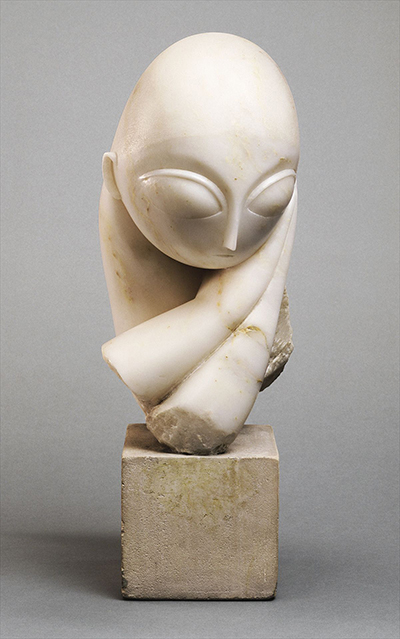
The contrast with Brâncuși’s Mademoiselle Pogany sharpens the point. In the Museum of Modern Art’s 1913 bronze, the eyes take up a great deal of the oval face, and the hair and chignon are differentiated by a dark patina. The museum identifies Margit Pogány and describes her sittings. With Princess X, the bend of the neck takes on some of the work done by the eyes and hair in the other portrait. The two series show how a face, a pose, a surface and a name could bear different amounts of the work of evoking a person. [1] [5] [19]
The ambiguity also became material for another artist. In Distinguished Air (1930), Charles Demuth puts a recognisable Princess X at an imagined exhibition opening. The Whitney Museum of American Art identifies the source as a short story by Robert McAlmon set in postwar Berlin. Demuth transfers the scene to an art exhibition and uses the visitors’ glances to make the social encounter as important as the sculpture. One man’s attention appears to be on the sailor beside him, making the arrangement about who looks at whom as well as what people see in Brâncuși’s work. The watercolour shows how a form that once prompted a demand for removal could become part of another artist’s treatment of desire in public. [20]
Browse sculptures and drawings
Browse articles on the sculptures and separately catalogued museum objects. A work can have several physical versions. Drawing records from the Tate catalogue retain their October 2014 snapshot wording where present.
| Name | Date | Medium |
|---|---|---|
| Arch | Sculpture | |
| Bird in Space | Sculpture | |
| The Blond Negress | Sculpture | |
| The Cock | Sculpture | |
| The Endless Column | Sculpture | |
| The First Cry | Sculpture | |
| Fish | Sculpture | |
| The Gate of the Kiss | Sculpture | |
| Golden Bird | Sculpture | |
| Head | Sculpture | |
| The Kiss | Sculpture | |
| Leda | Sculpture | |
| Madame L.R. | Sculpture | |
| Mademoiselle Pogany II | Sculpture | |
| Mademoiselle Pogany | Sculpture | |
| Maiastra | Sculpture | |
| The Newborn | Sculpture | |
| Phoque II | Sculpture | |
| The Prayer | Sculpture | |
| Princess X | Sculpture | |
| Prometheus | Sculpture | |
| Târgu Jiu monumental ensemble | Sculpture | |
| Sculpture for the Blind | Sculpture | |
| The Seal | Sculpture | |
| The Signal | Sculpture | |
| Sleeping Muse | Sculpture | |
| The Sorceress | Sculpture | |
| The Table of Silence | Sculpture | |
| Torso of a Young Man | Sculpture | |
| Two Lamps | Sculpture | |
| Vitellius | Sculpture | |
| The White Negress | Sculpture | |
| The Wisdom of the Earth | Sculpture | |
| Young Bird | Sculpture | |
| The Kiss (Philadelphia, fourth version) | 1916 | Sculpture Catalogue. |
| Sleeping Muse (Pompidou bronze) | 1910 | Sculpture Catalogue. |
| Mlle Pogany, version I (MoMA bronze) | 1913, after a marble of 1912 | Sculpture Catalogue. |
| Maiastra (Venice brass) | about 1912 | Sculpture Catalogue. |
| Bird in Space (MoMA bronze) | about 1941 | Sculpture Catalogue. |
| Bird in Space (Venice brass) | 1932–40 | Sculpture Catalogue. |
| Endless Column, version I (oak) | 1918 | Sculpture Catalogue. |
| Brâncuși Monumental Ensemble of Târgu Jiu | 1937–38 | Sculpture Catalogue. |
| Bust of a nude woman in profile, head inclined | about 1910 | Drawing Catalogue. |
| Nude study, head inclined (recto) | — | Drawing Catalogue. |
| Self-portrait (ink) | — | Drawing Catalogue. |
| View of the Artist’s Studio | 1918 | Drawing Catalogue. |
| Study for the cock (lost clay Grand Coq) | about 1923 | Drawing Catalogue. |
| Portrait of a woman in profile | — | Drawing Catalogue. |
| Animal head | — | Drawing Catalogue. |
| Animal sketch (2002 checklist) | 1929 | Drawing Catalogue. |
| Plans of the studio (verso) | about 1930–38 | Drawing Catalogue. |
| Danaïde (Tate T00296) | c.1918 | Sculpture Catalogue. |
| Maiastra (Tate T01751) | 1911 | Sculpture Catalogue. |
| Head (Tate T03066) | c.1919–23 | Sculpture Catalogue. |
| Fish (Tate T07107) | 1926 | Sculpture Catalogue. |
Frequently Asked Questions
Marie Bonaparte is the strongest documented association. The 1917 New York exhibition listed a work identified with the sculpture as Portrait of Princess Bonaparte. Sheldon and the Smithsonian’s portrait archive associate her with the Nebraska marble. The surviving evidence leaves details of any commission or sitting uncertain. [2] [4] [5] [8]
Discussion
Look again at the images and ideas explored in Princess X. These editorial prompts invite your observations.
Reader Insights
Which curve first suggested a figure to you? Does the same curve support another reading when you start at the base and look up?
What does the change from marble to polished bronze do to the sense of a woman looking into a mirror?
How would the title Portrait of Princess Bonaparte, used in 1917, change what you expect to see before you look at the sculpture?
Join the Conversation
Share a detail, comparison or question about Princess X below.
References
- Centre Pompidou, Musée national d’art moderne. Princesse X, AM 4002-88 and AM 4002-88 (1), including Marielle Tabart’s 2007 collection catalogue entry. View source.
- Sheldon Museum of Art. Princesse X, U-418.1963. View source.
- Philadelphia Museum of Art. Princess X, 1915–16, 1950-134-12. View source.
- Smithsonian National Portrait Gallery, Catalog of American Portraits. Princess X, Sheldon Museum of Art marble. View source.
- Society of Independent Artists. Catalogue of the First Annual Exhibition, New York, 1917, no. 167. View source.
- Centre Pompidou. Femme se regardant dans un miroir, vue de profil (1909). View source.
- Centre Pompidou. Femme se regardant dans un miroir, vue de dos (1909). View source.
- Doina Lemny. “Est-ce une femme ou un œuf ? La participation remarquée de Brancusi à l’Armory Show”, Studii și cercetări de istoria artei. Artă plastică, new series 4 (48), 2014, pp. 133–142, especially the discussion of Princesse X and note 5. View source.
- Centre Pompidou. Les visites du Centre Pompidou. Brancusi, 2024 exhibition podcast transcript, section on Princesse X. View source.
- Centre Pompidou. Femme se regardant dans un miroir, PH 409 C. View source.
- Cleveland Museum of Art. Study for Princess X (recto), Female Head in Profile (verso), 1982.373. View source.
- Centre Pompidou. Brancusi, La Princesse X. La série et l’œuvre unique, Atelier Brancusi, 1999–2000, and exhibition checklist. View source 1. View source 2.
- Centre Pompidou. Princesse X, patinated plaster, AM 4002-87. View source.
- Philadelphia Museum of Art. Princess X, c. 1918, gelatin silver print, 1997-30-7. Centre Pompidou. Studio view with Maïastra, Princesse X, Petite Colonne and La Muse endormie II, before December 1917. View source 1. View source 2.
- Library of Congress. Princess Marie Bonaparte Papers, finding aid. View source.
- Bibliothèque nationale de France. Salon des Indépendants, 1884–present, in Salons et expositions artistiques. View source.
- Centre Pompidou. La dation Brancusi, description of the artist’s autograph draft protesting the withdrawal. View source.
- Centre Pompidou, Bibliothèque Kandinsky. Fonds Constantin Brancusi, archival biography and scope notes. View source.
- Museum of Modern Art. Mlle Pogany, version I, 1913 (after a marble of 1912). View source.
- Whitney Museum of American Art. Charles Demuth, Distinguished Air, 1930. View source.
More BRÂNCUȘI Sculptures
Bird in Space
Compare the marble and metal versions of Brâncuși’s sculpture.