 by Tom Gurney
Tom Gurney BSc (Hons) is an art history expert with over 20 years experience
Published on June 19, 2020 / Updated on November 29, 2026
Email: tomgurney1@gmail.com / Phone: +44 7429 011000
Sculpture for the Blind: Introduction
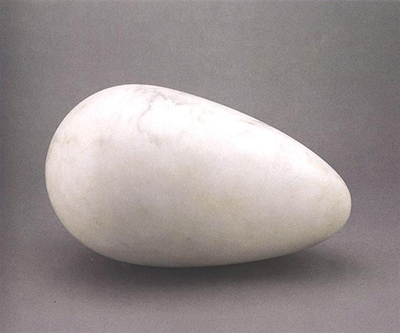
Constantin Brâncuși's Sculpture for the Blind [I] in Philadelphia is a smooth, veined marble oval about the width of a dinner plate. The title draws attention to things a hand might register, such as the way the curve rises from a narrower end or grows fuller around the middle. But the story that visitors at a New York exhibition in 1917 were invited to reach inside a bag and feel the sculpture is disputed. Brâncuși also made other objects that acquired the same title, including a plaster and an onyx in Paris. The distinction between them helps explain why the date, title and exhibition history of the Philadelphia marble have been so difficult to disentangle. [1] [2] [3] [4]
At a Glance
- ArtistConstantin Brâncuși
- Philadelphia marbleSculpture for the Blind [I], c. 1920, veined marble, approximately 17 × 29 × 18 cm. Philadelphia Museum of Art, The Louise and Walter Arensberg Collection, 1950, 1950-134-20. [1] [2]
- Paris plasterSculpture pour aveugles, 1920–21, plaster, 16.5 × 29.5 × 18 cm. Centre Pompidou, AM 4002-61. [3]
- Paris onyxSculpture pour aveugles, 1925, onyx, 16 × 32 × 24 cm. Centre Pompidou, AM 4002-64. [4]
- Paris exhibitionThe onyx was shown at the 1926 Salon des Indépendants as Muse endormie (sculpture pour aveugles), or Sleeping Muse (Sculpture for the Blind). [5] [6]
- New York accountHenri-Pierre Roché recalled a tactile display in 1917. The identification and exhibition story are disputed. [2] [6] [7]
Contents
- The Philadelphia marble and its title
- The plaster and the onyx in Paris
- What happened in 1917?
- A related form in The Beginning of the World
- Lenka Clayton's response
The Philadelphia marble and its title
The Philadelphia Museum of Art dates its Sculpture for the Blind [I] to about 1920. On its side the block reads as a single rounded mass. Its length is noticeably greater than its height, and the profile spreads out through the middle before narrowing again. The continuous surface matters because it leaves so little to pick out as a face. The veins belong to the marble itself and can suggest lines across the shape even where the sculptor has left its surface smooth. The distinction is part of the interest of experiencing this object through different senses. A line in the stone may be clear to someone looking at it without making any change in the contour their fingers would follow. [1] [2] [8]
A studio visit, a sale and a published title can tell different parts of an artwork's history. In her catalogue entry on the marble, Ann Temkin reported that the American collector John Quinn saw it in Brâncuși's studio in the summer of 1921 and bought it from the artist in 1922. It was described then as an “abstract woman's head”. Temkin traced its publication under the title Sculpture for the Blind to 1949. Her account gives a name attached to the marble close to the time of its making and another attached to it much later. Its 1950 accession records its entry into the Philadelphia collection with the Louise and Walter Arensberg Collection. Each date belongs to a particular event in the life of the same stone. [1] [2]
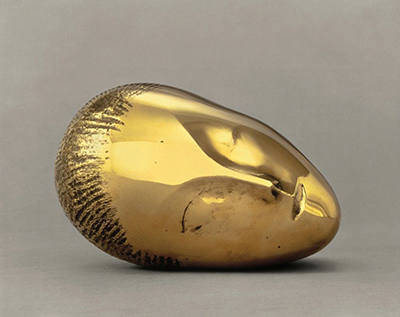
Quinn's description also helps place the marble within Brâncuși's experiments with heads. It asks us to imagine a head at rest in a sculpture that offers few of the landmarks of portraiture. The Philadelphia work takes the horizontal disposition familiar from Sleeping Muse so far that the form can be described just as readily as egg-like. The change is more substantial than a reduction in the number of features. With no clear front toward which to turn, the relation of one curve to the next can hold attention across the entire object. A form that first seems easy to take in may take a surprising amount of time to describe. [2] [5] [8]
The plaster and the onyx in Paris
The Centre Pompidou catalogs its Sculpture pour aveugles in plaster to 1920–21. Its measurements are close to those of the marble in Philadelphia, with both forms roughly 29 centimetres long and 18 centimetres deep. The Paris record describes the plaster as set on a beam. Where the rounded object meets that support, the beam supplies a long straight edge against which to read the oval. The similar dimensions and title make a comparison worthwhile, while the records identify separate objects and leave the precise relationship of their making open. Plaster and veined marble also offer different ways to read a rounded surface. In the marble, the stone's own pattern is part of the visible form. [2] [3]
The other Pompidou Sculpture pour aveugles is dated 1925. The museum's current record calls it onyx, although older accounts describe it as alabaster. This version is three centimetres longer than the Philadelphia marble and six centimetres deeper, with broadly comparable height. The increase in depth makes it spread further from front to back, a difference a single side view could easily understate. The Pompidou records this sculpture on a drum-shaped base. Both Paris works entered the collection through Brâncuși's bequest in 1957, and each has its own inventory number. [2] [3] [4] [7]
The 1925 onyx gives the title a firmer exhibition history. The Centre Pompidou identifies it as the piece exhibited at the 1926 Salon des Indépendants in Paris under the two-part title Muse endormie (sculpture pour aveugles). Temkin and Elio Grazioli also associate this later stone with the Brummer Gallery show that opened in New York in 1933, where it was presented as Sculpture for the Blind. The Paris title preserves both the head and the mode of encounter suggested by the work. The first part can make the stone seem like a figure at rest, while the second makes the sweep of its surface a subject in its own right. [2] [5] [6] [7]
What happened in 1917?
Henri-Pierre Roché, a friend of Brâncuși, later remembered a display at the Society of Independent Artists exhibition in New York in 1917. In his account the sculpture was concealed in a bag with two openings for visitors to put their hands through. The story offers a vivid idea of how to exhibit a sculpture through touch and helps explain its hold on later writers. If a whole object is concealed, a visitor can piece together its shape through the sequence of changes felt in the fingers and hands. The account, however, survives as a recollection whose historical basis has been questioned. [2] [6] [7]
Grazioli identifies the object in that recollection as the marble now in Philadelphia and puts its making in 1916. Temkin reported finding no record of the unusual display and preferred a date around 1920, weighing the sculpture's relation to other works and the documented Quinn purchase. Denys Riout, writing for a Centre Pompidou talk, went further and treated the bag story as fiction. The differences concern three questions worth keeping apart: whether an object was shown in 1917, whether visitors handled it in the way Roché later described, and whether that object was the marble in Philadelphia. The 1926 exhibition title documents a reference to blindness but leaves the handling arrangements open. [2] [5] [6] [7]
A related form in The Beginning of the World
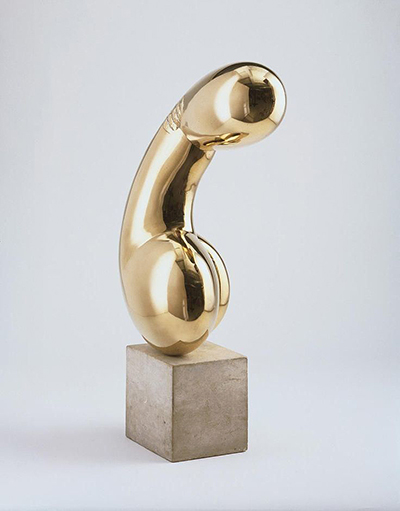
The Centre Pompidou's 1924 polished bronze Le Commencement du monde (The Beginning of the World) has its own inventory number, AM 4002-63. In her catalogue analysis, Marielle Tabart situates the 1925 onyx within the same family of forms and identifies the model for the bronze as the white marble in the Dallas Museum of Art. Dallas and Philadelphia therefore hold different marbles. The shared family explains why titles about a sleeping head, touch and the beginning of the world turn up in discussions of virtually featureless ovals. The accession numbers let us follow those connections without losing track of which object each history describes. [2] [4] [5]
The bronze changes the effect of the curve by reflecting its surroundings. Tabart describes the play between its polished skin and the mirrored steel disc beneath it. Highlights shift as the viewer changes position, and the disc carries the reflection below the point where the bronze meets its support. The mass itself stays still, but its visible surface varies with light and viewpoint. Comparing the bronze with the Philadelphia marble shows what Brâncuși could change while returning to similar proportions. In the marble, a vein belongs to the stone and stays fixed on it. On the bronze, a bright line may belong to the room and slide over the surface. Both curves can be understood as objects in space, yet their materials bring different parts of that experience forward. [2] [5]
Lenka Clayton's response
When the artist Lenka Clayton encountered the Philadelphia sculpture inside a glass case, its title prompted a practical question about who could experience it and how. She describes attempts to borrow the work, arrange tactile access or obtain a scan for a touchable copy. When these approaches proved unavailable, she wrote a detailed visual description of the marble. In collaboration with the Fabric Workshop and Museum, she read it aloud to blind and visually impaired participants and invited them to make forms from the same description. Their sculptures and a braille rendering of the text were exhibited in 2017. Philadelphia now catalogs the braille print as a work by Clayton. [8] [9]
The participants could interpret a single description in a variety of ways. The Henry Moore Institute's description of a later display describes some of the plaster forms as smooth, some as rough and some as hollowed or pierced. Visitors at that presentation could feel the contemporary works. The differences between the sculptures bring out how much information a written account leaves open, even when the starting shape looks easy to describe. Clayton's project records a collaborative approach to touch and authorship nearly a century after Brâncuși's work. It also gives a specific historical example of access, with the gallery's invitation to touch applying to the contemporary sculptures. [8] [9]
Browse sculptures and drawings
Browse articles on the sculptures and separately catalogued museum objects. A work can have several physical versions. Drawing records from the Tate catalogue retain their October 2014 snapshot wording where present.
| Name | Date | Medium |
|---|---|---|
| Arch | Sculpture | |
| Bird in Space | Sculpture | |
| The Blond Negress | Sculpture | |
| The Cock | Sculpture | |
| The Endless Column | Sculpture | |
| The First Cry | Sculpture | |
| Fish | Sculpture | |
| The Gate of the Kiss | Sculpture | |
| Golden Bird | Sculpture | |
| Head | Sculpture | |
| The Kiss | Sculpture | |
| Leda | Sculpture | |
| Madame L.R. | Sculpture | |
| Mademoiselle Pogany II | Sculpture | |
| Mademoiselle Pogany | Sculpture | |
| Maiastra | Sculpture | |
| The Newborn | Sculpture | |
| Phoque II | Sculpture | |
| The Prayer | Sculpture | |
| Princess X | Sculpture | |
| Prometheus | Sculpture | |
| Târgu Jiu monumental ensemble | Sculpture | |
| Sculpture for the Blind | Sculpture | |
| The Seal | Sculpture | |
| The Signal | Sculpture | |
| Sleeping Muse | Sculpture | |
| The Sorceress | Sculpture | |
| The Table of Silence | Sculpture | |
| Torso of a Young Man | Sculpture | |
| Two Lamps | Sculpture | |
| Vitellius | Sculpture | |
| The White Negress | Sculpture | |
| The Wisdom of the Earth | Sculpture | |
| Young Bird | Sculpture | |
| The Kiss (Philadelphia, fourth version) | 1916 | Sculpture Catalogue. |
| Sleeping Muse (Pompidou bronze) | 1910 | Sculpture Catalogue. |
| Mlle Pogany, version I (MoMA bronze) | 1913, after a marble of 1912 | Sculpture Catalogue. |
| Maiastra (Venice brass) | about 1912 | Sculpture Catalogue. |
| Bird in Space (MoMA bronze) | about 1941 | Sculpture Catalogue. |
| Bird in Space (Venice brass) | 1932–40 | Sculpture Catalogue. |
| Endless Column, version I (oak) | 1918 | Sculpture Catalogue. |
| Brâncuși Monumental Ensemble of Târgu Jiu | 1937–38 | Sculpture Catalogue. |
| Bust of a nude woman in profile, head inclined | about 1910 | Drawing Catalogue. |
| Nude study, head inclined (recto) | — | Drawing Catalogue. |
| Self-portrait (ink) | — | Drawing Catalogue. |
| View of the Artist’s Studio | 1918 | Drawing Catalogue. |
| Study for the cock (lost clay Grand Coq) | about 1923 | Drawing Catalogue. |
| Portrait of a woman in profile | — | Drawing Catalogue. |
| Animal head | — | Drawing Catalogue. |
| Animal sketch (2002 checklist) | 1929 | Drawing Catalogue. |
| Plans of the studio (verso) | about 1930–38 | Drawing Catalogue. |
| Danaïde (Tate T00296) | c.1918 | Sculpture Catalogue. |
| Maiastra (Tate T01751) | 1911 | Sculpture Catalogue. |
| Head (Tate T03066) | c.1919–23 | Sculpture Catalogue. |
| Fish (Tate T07107) | 1926 | Sculpture Catalogue. |
Frequently Asked Questions
Follow the holding institution's access guidance for the particular object and exhibition. The Philadelphia marble was shown in a vitrine when it inspired Clayton's project. At the Henry Moore Institute presentation of her response, the invitation to touch applied to the contemporary works made for that project. [8] [9]
Discussion
Look again at the images and ideas explored in Sculpture for the Blind. These editorial prompts invite your observations.
Reader Insights
What could you tell about the Philadelphia marble from the way it curves, and which details would depend on seeing the veins in its surface?
How does knowing the early description as a woman's head change what you notice in the oval? What changes when you encounter the title Sculpture for the Blind first?
If several people made a sculpture from the same spoken description, which parts of the form would you expect to vary most?
Join the Conversation
Share a detail, comparison or question about Sculpture for the Blind below.
References
- Philadelphia Museum of Art, Sculpture for the Blind [I], c. 1920. View source.
- French Sculpture Census, Sculpture for the Blind [I], object 8295. Records the material, measurements and credit and reproduces Ann Temkin's catalogue entry from Constantin Brancusi 1876–1957 (1995), p. 180, under “Comment”. View source.
- Centre Pompidou, Sculpture pour aveugles, plaster, 1920–21, AM 4002-61. View source.
- Centre Pompidou, Sculpture pour aveugles, onyx, 1925, AM 4002-64. View source.
- Centre Pompidou, Le Commencement du monde, polished bronze, 1924, AM 4002-63. Includes Marielle Tabart's analysis from the museum's modern art collection catalogue (2007). View source.
- Denys Riout, Sculpture pour aveugle, 1925, Centre Pompidou talk abstract, 9 December 2007. View source.
- Elio Grazioli, “Brancusi's ‘Sculpture for the Blind’”, in Bodies of Stone in the Media, Visual Culture and the Arts, Amsterdam University Press, abstract and opening excerpt. View source.
- Henry Moore Institute, Lenka Clayton, Sculpture For The Blind, By The Blind, Beyond the Visual audio guide, stop 15, tracks 1 and 2. View source.
- Philadelphia Museum of Art, Lenka Clayton, Description of Constantin Brancusi's “Sculpture for the Blind” (c. 1920), 2017. View source.
More BRÂNCUȘI Sculptures
Bird in Space
Compare the marble and metal versions of Brâncuși’s sculpture.