 by Tom Gurney
Tom Gurney BSc (Hons) is an art history expert with over 20 years experience
Published on June 19, 2020 / Updated on November 29, 2026
Email: tomgurney1@gmail.com / Phone: +44 7429 011000
Madame L.R.: Introduction
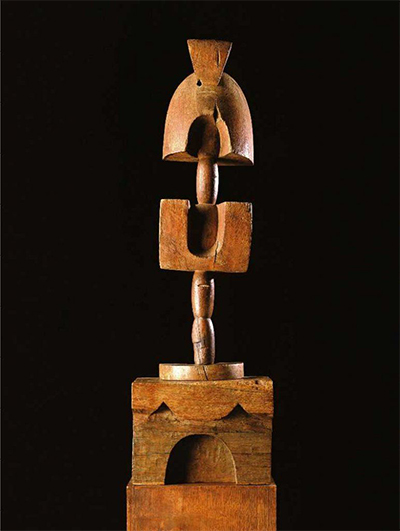
In Madame L.R., Constantin Brâncuși gives a standing figure the proportions of a narrow column. A broad, fan-shaped head rises above a slender neck, and the body contracts again towards a curved foot. He carved the figure in oak around 1914–17. The initials in the title are usually taken to refer to Léonie Ricou, a collector and salon host in Montparnasse. His photographs of the sculpture show how differently its forms can read when seen alone in profile or among other works in the studio. [1] [2]
At a Glance
- ArtistConstantin Brâncuși
- Catalogue titleMadame L.R. (Portrait de Mme L.R.) [1]
- DateCirca 1914–17, following the sculpture's lot entry [1]
- MaterialCarved oak [1]
- Recorded height117.1 cm (46⅛ in.) [1]
- Probable namesakeLéonie (also Léone) Ricou [1] [3]
- Documented saleYves Saint Laurent and Pierre Bergé collection, Christie's, 2009, lot 5157360 [1] [3]
Contents
- How the oak figure is carved
- Léonie Ricou and the portrait title
- A comparison with Mahongwe sculpture
- The sculpture in Brâncuși's photographs
- The carving and the auction photographs
How the oak figure is carved
Start with the outline of the head and follow it down. The width above the neck makes the narrowing underneath more abrupt. A second expansion, where one might expect the shoulders and chest, gives the middle of the sculpture its own visual weight. Below it, a slender upright ends in a broad curve that can be read as a foot. There are no arms to connect the head and torso in the usual way. The sequence of widths does much of the work that anatomy would do in a conventional standing portrait. You can recognise a figure from across a room and still find its parts difficult to name up close. [1] [2]
The sections look almost as though they might have been fitted together. In her essay for the 2009 sale, curator Margit Rowell describes the figure as carved from one piece of wood, with a separate rectangular base. She also records the restoration of the lower part of the leg after a break. The repeated swelling and narrowing have a particular effect in a continuous carving. Even the most constricted parts look as though they might support what is above them. A pause between two volumes can suggest a joint, and the repeating bands around the neck and lower section keep the eye moving across those intervals. [1]
The profile recorded by Brâncuși changes the order in which those features register. When the breadth of the head is foreshortened, its projection over the neck becomes easier to see. The profile also gives the foot its own silhouette, so that the transition from the narrow lower section to the base is easier to follow. The photographic negative in the Centre Pompidou is only about nine centimetres tall. In the carved object, the equivalent passage takes place across more than a metre of oak. The picture gives a clear outline, while the dimensions help recover the scale of the upright figure. [1] [2]
Léonie Ricou and the portrait title
Ricou hosted gatherings at 270 boulevard Raspail in Paris and collected works by artists in her circle. Sotheby's records a photograph once in her collection showing the wooden portrait in Brâncuși's studio. The photograph's history gives her a tangible link to the sculpture. The wood itself has a separate documented ownership history beginning with Fernand Léger after Brâncuși. Rowell also points out that the correspondence she consulted shows Ricou away from Paris for much of the relevant period and gives no direct account of the making of this portrait. Identifying Ricou as the likely namesake leaves open how much her appearance contributed to the carved form. [1] [3]
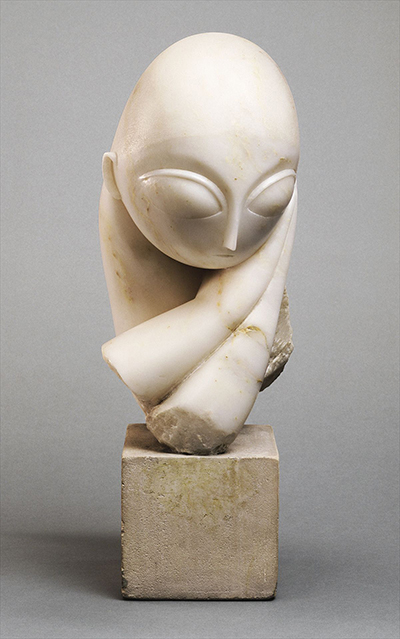
Brâncuși's Mademoiselle Pogany offers a comparison with a better-documented model. Margit Pogany sat for him during her time in Paris. After she left, he carved a version in marble from memory. In MoMA's bronze, the exaggerated eyes and the sweep of dark hair provide recognisable details even though the proportions are highly stylised. In Madame L.R., the upper shape could be a head or an elaborate hairstyle. That reading owes much to the title. Without it, the same shape might suggest a crest, especially when the piece is seen from the side. The two portraits show how selectively Brâncuși could use the features ordinarily associated with a likeness. [1] [2] [4]
A comparison with Mahongwe sculpture
Rowell compares the upper section to Mahongwe reliquary figures from Gabon. The comparison is specific. It rests on the spread of the head above a narrow neck and the way grooves run across part of the surface and meet a vertical division. The Metropolitan Museum of Art's Boho na bwete (face of the ancestor) helps explain what those features can do in a different work. Its maker used fine metal strips to articulate a leaf-like face around a central axis. The figure was part of a reliquary ensemble connected with the care and veneration of ancestors. [1] [5]
This comparison draws attention to the degree of invention in each object. The Mahongwe-Kota maker used light on metal to distinguish the face from its wooden support. Brâncuși let the cuts and recesses of the oak articulate the head. Placing the two works side by side makes the importance of the centreline and the disproportionate head easier to notice. The evidence establishes the visual affinity more clearly than it establishes a particular figure Brâncuși saw or used. [1] [5]
The sculpture in Brâncuși's photographs
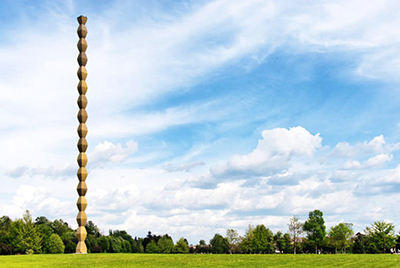
Two negatives in the Centre Pompidou let you compare different ways Brâncuși photographed the same object. The museum dates the profile negative, PH 601, to about 1917. The rear studio view, PH 602, is a glass negative made around 1920 at 8 impasse Ronsin. It includes the Colonne du Baiser beside the portrait. A wider studio print, PH 12 A, also shows the portrait in company with the Colonne du Baiser, alongside La Colonne sans fin, Platon and L'Oiseau jaune. The dates in parentheses in the photo titles identify the sculptures depicted. Each photograph has its own creation date and inventory record. [2] [6] [7]
The wider arrangement reveals what the isolated profile leaves out. With several vertical sculptures in the same field of view, the narrowing of the portrait's neck becomes one instance of a rhythm that Brâncuși explored across different works. The rear photograph also invites attention to the back of the figure, where the outline carries more of the description. A front view encourages the search for a face. The arrangement in the studio brings sculptural relationships into focus, including how the portrait divides its height into sections and how the other works distribute their weight. The photograph records a grouping at the moment of exposure. [6] [7]
The carving and the auction photographs
Christie's traces the sculpture from Fernand Léger through Nadia Léger and Galerie Tarica to Yves Saint Laurent and Pierre Bergé, who acquired it around 1970. The catalogue lists an exchange with Léger. Rowell qualifies the account of precisely what changed hands and when. The same entry records the sculpture's inclusion in the 1995 Brâncuși retrospective in Paris and Philadelphia. The 2009 sale marks a documented point in the sculpture's history. Its catalogue entry does not identify the present owner. [1] [3]
Before Léger acquired the carving, Brâncuși offered it to the American collector John Quinn in December 1917. Rowell reports that Quinn declined because he preferred stone. That episode gives the date range a useful anchor and shows how much the choice of medium could matter to a collector considering a work directly from the artist. [1]
The words Madame L.R. also appear in sales of photographic material. Christie's lot 5972133, titled (bois) Mme. L.R., 1914, is a signed and dated gelatin silver print, with a sheet height of 29.9 cm and Albert Eugene Gallatin in its provenance. The word bois describes the subject of the image. In March 2022, Sotheby's used Madame L.R. as the heading for a lot of three silver prints. One pictures the portrait alongside the Colonne du Baiser. The others show Danaïde and La Muse endormie. The record of Ricou's collection belongs to those prints. Reading the medium and dimensions alongside the title helps match each ownership history to the physical object on offer. [1] [3] [8]
Browse sculptures and drawings
Browse articles on the sculptures and separately catalogued museum objects. A work can have several physical versions. Drawing records from the Tate catalogue retain their October 2014 snapshot wording where present.
| Name | Date | Medium |
|---|---|---|
| Arch | Sculpture | |
| Bird in Space | Sculpture | |
| The Blond Negress | Sculpture | |
| The Cock | Sculpture | |
| The Endless Column | Sculpture | |
| The First Cry | Sculpture | |
| Fish | Sculpture | |
| The Gate of the Kiss | Sculpture | |
| Golden Bird | Sculpture | |
| Head | Sculpture | |
| The Kiss | Sculpture | |
| Leda | Sculpture | |
| Madame L.R. | Sculpture | |
| Mademoiselle Pogany II | Sculpture | |
| Mademoiselle Pogany | Sculpture | |
| Maiastra | Sculpture | |
| The Newborn | Sculpture | |
| Phoque II | Sculpture | |
| The Prayer | Sculpture | |
| Princess X | Sculpture | |
| Prometheus | Sculpture | |
| Târgu Jiu monumental ensemble | Sculpture | |
| Sculpture for the Blind | Sculpture | |
| The Seal | Sculpture | |
| The Signal | Sculpture | |
| Sleeping Muse | Sculpture | |
| The Sorceress | Sculpture | |
| The Table of Silence | Sculpture | |
| Torso of a Young Man | Sculpture | |
| Two Lamps | Sculpture | |
| Vitellius | Sculpture | |
| The White Negress | Sculpture | |
| The Wisdom of the Earth | Sculpture | |
| Young Bird | Sculpture | |
| The Kiss (Philadelphia, fourth version) | 1916 | Sculpture Catalogue. |
| Sleeping Muse (Pompidou bronze) | 1910 | Sculpture Catalogue. |
| Mlle Pogany, version I (MoMA bronze) | 1913, after a marble of 1912 | Sculpture Catalogue. |
| Maiastra (Venice brass) | about 1912 | Sculpture Catalogue. |
| Bird in Space (MoMA bronze) | about 1941 | Sculpture Catalogue. |
| Bird in Space (Venice brass) | 1932–40 | Sculpture Catalogue. |
| Endless Column, version I (oak) | 1918 | Sculpture Catalogue. |
| Brâncuși Monumental Ensemble of Târgu Jiu | 1937–38 | Sculpture Catalogue. |
| Bust of a nude woman in profile, head inclined | about 1910 | Drawing Catalogue. |
| Nude study, head inclined (recto) | — | Drawing Catalogue. |
| Self-portrait (ink) | — | Drawing Catalogue. |
| View of the Artist’s Studio | 1918 | Drawing Catalogue. |
| Study for the cock (lost clay Grand Coq) | about 1923 | Drawing Catalogue. |
| Portrait of a woman in profile | — | Drawing Catalogue. |
| Animal head | — | Drawing Catalogue. |
| Animal sketch (2002 checklist) | 1929 | Drawing Catalogue. |
| Plans of the studio (verso) | about 1930–38 | Drawing Catalogue. |
| Danaïde (Tate T00296) | c.1918 | Sculpture Catalogue. |
| Maiastra (Tate T01751) | 1911 | Sculpture Catalogue. |
| Head (Tate T03066) | c.1919–23 | Sculpture Catalogue. |
| Fish (Tate T07107) | 1926 | Sculpture Catalogue. |
Frequently Asked Questions
The sculpture is carved oak. The figure was cut from a single piece of wood and is presented on a separate base. [1]
Discussion
Look again at the images and ideas explored in Madame L.R.. These editorial prompts invite your observations.
Reader Insights
Which part of the carving first makes you see a standing person? Does it have the same effect in profile?
What changes when you look at the portrait alongside Colonne du Baiser in the studio photograph?
How much does the title guide you towards interpreting the top section as hair, a head or a face?
Join the Conversation
Share a detail, comparison or question about Madame L.R. below.
References
- Christie's, Madame L.R. (Portrait de Mme L.R.), lot 5157360, including Margit Rowell's catalogue essay View source.
- Centre Pompidou, profile negative of Portrait de Mme L.R., PH 601 View source.
- Sotheby's, Madame L.R., three photographic prints, lot 300, March 2022 View source.
- Museum of Modern Art, Mlle Pogany, version I, object 2.1953 View source.
- The Metropolitan Museum of Art, Mahongwe-Kota artist, Boho na bwete (face of the ancestor) View source.
- Centre Pompidou, rear studio view with Colonne du Baiser, PH 602 View source.
- Centre Pompidou, studio group with Portrait de Madame L. R., PH 12 A View source.
- Christie's, (bois) Mme. L.R., 1914, gelatin silver print, lot 5972133 View source.
More BRÂNCUȘI Sculptures
Bird in Space
Compare the marble and metal versions of Brâncuși’s sculpture.