 by Tom Gurney
Tom Gurney BSc (Hons) is an art history expert with over 20 years experience
Published on June 19, 2020 / Updated on November 29, 2026
Email: tomgurney1@gmail.com / Phone: +44 7429 011000
Prometheus: Introduction
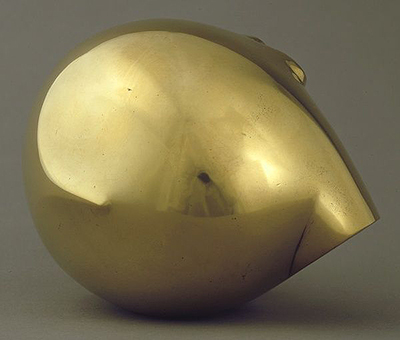
Constantin Brâncuși’s Prometheus (1911) takes the form of a small reclining head. The face is so lightly defined that the turn of the head carries much of the expression. A marble version in Philadelphia and a polished bronze in Paris offer different ways to see the same idea. In marble, the brow and mouth seem to sink into the stone. In bronze, a moving highlight can turn the curve of the face into a brief flash of light. That difference matters for a sculpture named after the Titan who gave fire to humankind. [1] [2]
At a Glance
- ArtistConstantin Brâncuși
- TitlePrometheus (Prométhée in French)
- Date1911 for the Philadelphia, Paris and Washington examples
- PhiladelphiaMarble, Philadelphia Museum of Art, object 51411 [1] [2]
- ParisPolished bronze, Centre Pompidou, AM 4002-22 [2]
- Washington, DCBrass, Hirshhorn Museum and Sculpture Garden, 66.612 [3]
Contents
- The head on its side
- The Titan and the gesture
- Marble, polished bronze and brass
- How it relates to Sleeping Muse and The Newborn
The head on its side
Begin with the silhouette and find where its curve tightens around the face. The nose and brow interrupt the oval just enough to give it direction. The back of the head carries much of the volume, while the mouth in the Philadelphia marble is a small detail that takes a moment to locate. The short remnant of neck helps fix the angle of the head. Once those few clues register, what might initially look like an undifferentiated ovoid acquires a front, a back and a sense of weight. [2]
The tilt changes how the sculpture meets the viewer. A head raised on a conventional bust offers the face frontally. Here the contour along the side of the head and the point where it comes down towards its support are just as consequential as the features. A view that makes the nose clearly visible can make the shape look portrait-like. From an angle where the features recede, the same mass takes on something of the character of a rounded stone. The small neck keeps the figure poised between those readings. It gives the impression that the form has come to rest somewhere in the course of a movement. [2]
The Centre Pompidou identifies Brâncuși’s initial model as the adolescent son of his Romanian friend Otilia Cosmutza. In the pose recorded by curator Marielle Tabart, the boy raised an arm and held his chin forward. The arm and torso disappeared as Brâncuși worked out the reclining head. The pose gives the sculpture a human starting point, even though little remains by which a viewer could recognise the sitter. Tabart traces the inclination of the head to a gesture of pain in Brâncuși’s early Study of Laocoön and in his later studies grouped under the theme of torment. [2]
The Titan and the gesture
In the Greek myth, Zeus punishes Prometheus for giving fire to humans. An eagle feeds on his liver while he is bound. In ancient representations of the story, the body and the eagle make the punishment explicit. Brâncuși puts the weight of the story on a much smaller gesture. Tabart records the sculptor’s description of the head falling towards the shoulder as the eagle attacks. The sculpture leaves the viewer to imagine where the shoulder would be and what might have prompted that turn. [2] [4]
Once the title is known, the head’s tilt can seem as much an act of endurance as a position of rest. That possibility is hard to fix in the expression alone. The small mouth and the quiet surface leave the face remarkably composed. The punished Titan and the bearer of fire also suggest two different ways to read the Paris bronze. One directs attention to the way the head falls. The other directs it to the light moving across the metal. Tabart proposes the latter association explicitly, linking the greater brilliance of polished bronze to Prometheus as bringer of fire. [2]
Marble, polished bronze and brass
The marble belongs to the Philadelphia Museum of Art. A Museum of Modern Art exhibition catalogue from 1972 lists it at 5 by 7 inches and credits the Louise and Walter Arensberg Collection. Its scale helps explain the economy of the carving. The subtle transition from the nose to the brow can be experienced at close range as part of a small, continuous surface. Tabart notes the translucency of the marble and the way the features seem to be absorbed into it. The effect is one of softness even where a ridge gives the face definition. [1] [2] [5]
Two archival records extend the marble’s history in different ways. The Arensberg Archives in Philadelphia list an undated Prometheus folder in a group of photographs of works in the collectors’ collection. In Paris, the Centre Pompidou has Brâncuși’s photographic negative titled Prométhée, marbre (1911). The museum tentatively dates that negative to before 27 December 1917. The date in the title identifies the sculpture, while the tentative date describes the photograph. Those records help track how an individual object was documented, and their dates serve different purposes from the creation date in a sculpture catalogue. [6] [7]
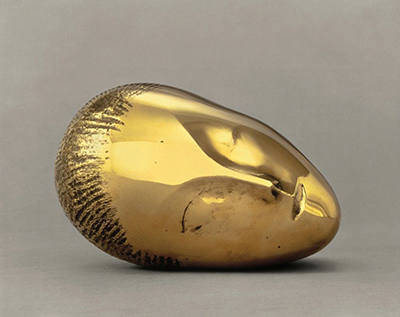
The Paris sculpture, AM 4002-22, measures 13.3 by 17 by 13.4 centimetres and entered the collection through Brâncuși’s 1957 bequest. The Pompidou records it resting on a table, itself numbered AM 4002-138. Its curatorial entry describes four metal casts made between 1911 and 1917. On the polished Paris bronze, a highlight can run across broad areas of the head and temporarily reduce the visibility of the face. A small change in viewing position can bring the ridge near the nose back into focus. The rounded volume stays constant while the pattern of light changes. [2]
The Smithsonian catalogues the Hirshhorn example, 66.612, as brass, dated 1911, and records ownership by the Brazilian painter Tarsila de Amaral in 1926. The provenance subsequently lists Galerie Europe in Paris and Joseph H. Hirshhorn, who gave it to the museum in 1966. Christie’s describes another example, lot 1686039, as gilded bronze cast in 1911. Its recorded history begins with Eileen Lane Kinney, who received it as a gift from Brâncuși, and includes an estate sale in 1981. The three metal examples can look closely related in photographs. Material descriptions, accession numbers and ownership histories let a viewer tell which one a particular catalogue discusses. [2] [3] [8]
How it relates to Sleeping Muse and The Newborn
The Hirshhorn’s marble Sleeping Muse I, dated 1909–1910, also lies on its side. Its elongated head has lines indicating brushed-back hair and delicately marked eyes. These details give the face a calm and recognisable orientation. In Prometheus, the brow and surviving neck carry more of that work. A viewer can compare how the two sculptures suggest rest or strain when their faces have relatively little conventional expression. The pose in Sleeping Muse I is given meaning by the closed eyes, while the pose in Prometheus gains tension from the angle at which the head seems to fall. [2] [9]
In MoMA’s 1920 bronze version of The Newborn, an intervention in the outline can suggest an open mouth and a cry. The shape remains ambiguous enough that other viewers have seen a beak, an egg or a cell. That echo between a human head and other rounded forms is already present in Prometheus. What changes is the kind of action the sculpture invites the viewer to imagine. In The Newborn, the eye is drawn towards an opening. In Prometheus, it follows a rounded contour towards the slight turn of a face. The two sculptures make a small difference in shape carry very different ideas of what the head is doing. [2] [10]
Brâncuși returned to the reclining child’s head in works that sit between these possibilities. The Pompidou traces his interest in the subject to a coloured plaster of 1906–1907 modelled on his young goddaughter Alice Poïana. The Neue Nationalgalerie’s Berlin exhibition checklist records two later examples titled Head of a Sleeping Child, both dated around 1921, in white marble and black stone. Seen alongside Prometheus, the repeated title makes the role of material especially clear. Across these heads, the suggestion of a child can survive the fading of the individual likeness, while the choice of stone or metal changes how easily the contours come into view. [2] [11]
Browse sculptures and drawings
Browse articles on the sculptures and separately catalogued museum objects. A work can have several physical versions. Drawing records from the Tate catalogue retain their October 2014 snapshot wording where present.
| Name | Date | Medium |
|---|---|---|
| Arch | Sculpture | |
| Bird in Space | Sculpture | |
| The Blond Negress | Sculpture | |
| The Cock | Sculpture | |
| The Endless Column | Sculpture | |
| The First Cry | Sculpture | |
| Fish | Sculpture | |
| The Gate of the Kiss | Sculpture | |
| Golden Bird | Sculpture | |
| Head | Sculpture | |
| The Kiss | Sculpture | |
| Leda | Sculpture | |
| Madame L.R. | Sculpture | |
| Mademoiselle Pogany II | Sculpture | |
| Mademoiselle Pogany | Sculpture | |
| Maiastra | Sculpture | |
| The Newborn | Sculpture | |
| Phoque II | Sculpture | |
| The Prayer | Sculpture | |
| Princess X | Sculpture | |
| Prometheus | Sculpture | |
| Târgu Jiu monumental ensemble | Sculpture | |
| Sculpture for the Blind | Sculpture | |
| The Seal | Sculpture | |
| The Signal | Sculpture | |
| Sleeping Muse | Sculpture | |
| The Sorceress | Sculpture | |
| The Table of Silence | Sculpture | |
| Torso of a Young Man | Sculpture | |
| Two Lamps | Sculpture | |
| Vitellius | Sculpture | |
| The White Negress | Sculpture | |
| The Wisdom of the Earth | Sculpture | |
| Young Bird | Sculpture | |
| The Kiss (Philadelphia, fourth version) | 1916 | Sculpture Catalogue. |
| Sleeping Muse (Pompidou bronze) | 1910 | Sculpture Catalogue. |
| Mlle Pogany, version I (MoMA bronze) | 1913, after a marble of 1912 | Sculpture Catalogue. |
| Maiastra (Venice brass) | about 1912 | Sculpture Catalogue. |
| Bird in Space (MoMA bronze) | about 1941 | Sculpture Catalogue. |
| Bird in Space (Venice brass) | 1932–40 | Sculpture Catalogue. |
| Endless Column, version I (oak) | 1918 | Sculpture Catalogue. |
| Brâncuși Monumental Ensemble of Târgu Jiu | 1937–38 | Sculpture Catalogue. |
| Bust of a nude woman in profile, head inclined | about 1910 | Drawing Catalogue. |
| Nude study, head inclined (recto) | — | Drawing Catalogue. |
| Self-portrait (ink) | — | Drawing Catalogue. |
| View of the Artist’s Studio | 1918 | Drawing Catalogue. |
| Study for the cock (lost clay Grand Coq) | about 1923 | Drawing Catalogue. |
| Portrait of a woman in profile | — | Drawing Catalogue. |
| Animal head | — | Drawing Catalogue. |
| Animal sketch (2002 checklist) | 1929 | Drawing Catalogue. |
| Plans of the studio (verso) | about 1930–38 | Drawing Catalogue. |
| Danaïde (Tate T00296) | c.1918 | Sculpture Catalogue. |
| Maiastra (Tate T01751) | 1911 | Sculpture Catalogue. |
| Head (Tate T03066) | c.1919–23 | Sculpture Catalogue. |
| Fish (Tate T07107) | 1926 | Sculpture Catalogue. |
Frequently Asked Questions
Centre Pompidou curator Marielle Tabart identifies the original model as the adolescent son of Otilia Cosmutza, a Romanian friend of Brâncuși. The sculpture takes its title from the Greek myth and retains only a few traces of the model’s pose. [2]
Discussion
Look again at the images and ideas explored in Prometheus. These editorial prompts invite your observations.
Reader Insights
Which feature first makes you recognise a head, and does that feature still stand out when you change your viewing angle?
How does the myth change your reading of the sculpture’s tilt?
What becomes easier to see in the marble, and what does polished bronze draw your eye towards?
Join the Conversation
Share a detail, comparison or question about Prometheus below.
References
- Philadelphia Museum of Art, Prometheus, 1911, object 51411 View source.
- Centre Pompidou, Prométhée, AM 4002-22, with analysis by Marielle Tabart View source.
- Smithsonian Provenance, Prometheus, Hirshhorn Museum and Sculpture Garden, 66.612 View source.
- Metropolitan Museum of Art, Pergamon and the Hellenistic Kingdoms of the Ancient World, catalogue entries 110a–c View source.
- Museum of Modern Art, Philadelphia in New York, 1972, catalogue entry 5 View source.
- Philadelphia Museum of Art Archives, Arensberg Archives, Prometheus, box 55, folder 17 View source.
- Centre Pompidou, Brâncuși’s photographic negative Prométhée, marbre (1911), PH 246 View source.
- Christie’s, Prometheus, gilded bronze, lot 1686039 View source.
- Hirshhorn Museum and Sculpture Garden, Revolutions accessibility guide, Sleeping Muse I View source.
- Museum of Modern Art, The Newborn, version I, 1920, audio transcript View source.
- Neue Nationalgalerie, Brâncuși exhibition checklist, Prométhée and Head of a Sleeping Child View source.
More BRÂNCUȘI Sculptures
Bird in Space
Compare the marble and metal versions of Brâncuși’s sculpture.