 by Tom Gurney
Tom Gurney BSc (Hons) is an art history expert with over 20 years experience
Published on June 19, 2020 / Updated on November 29, 2026
Email: tomgurney1@gmail.com / Phone: +44 7429 011000
The Wisdom of the Earth: Introduction
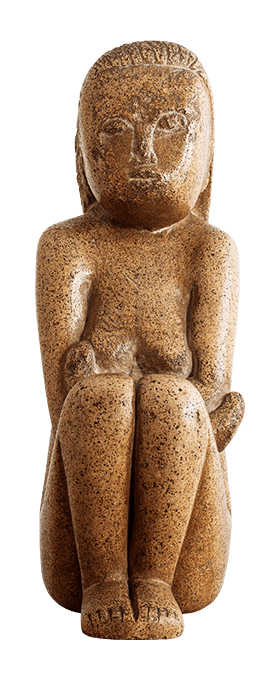
A woman sits with her knees drawn up, her arms gathered close and her broad face turned towards us. Constantin Brâncuși carved The Wisdom of the Earth from a block of limestone around 1907, leaving the seated body so compact that the figure still suggests the shape and weight of its stone. In Romania, where the work first went on public display in 1910, it is known as Cumințenia pământului. That title has room for wisdom, quiet and restraint, qualities that help explain why the same posture has struck different viewers as composed, withdrawn or watchful. [1] [2] [3]
At a Glance
- ArtistConstantin Brâncuși [1]
- Romanian titleCumințenia pământului [1]
- French titleLa Sagesse de la Terre [2]
- Date1907 in Romania’s heritage inventory. The Centre Pompidou’s 2024 exhibition dated it 1907–1908. [1] [2]
- Material and methodDirect-carved crinoidal limestone. The 2024 exhibition label describes the surface as polished and waxed. [1] [2]
- SubjectA seated nude woman with her knees drawn up. [2] [3]
- First documented exhibitionTinerimea Artistică, Bucharest, 1910. [3]
- Heritage designationTezaur, Romania’s national treasure category, under a listing order dated 14 July 1998. The inventory identifies the holding as a private collection in Bucharest. [1]
Contents
- How the Figure Fits the Stone
- Direct Carving in Brâncuși’s Early Work
- What Does Cumințenia Mean?
- Ancient Forms and Modern Comparisons
- From a Bucharest Exhibition to a Private Collection
- Heritage Status and the 2016 Acquisition Campaign
How the Figure Fits the Stone
Start with the knees. They rise in front of the body until the two legs read as a single rounded mass. The elbows and arms turn inwards, keeping the gesture close to the chest and knees. Above this folded arrangement, the head occupies an unusually large share of the figure. The shoulders are narrow and the neck scarcely interrupts the transition between head and torso. The image of a body sheltering itself comes as much from the silhouette as from any expression Brâncuși gave the woman. [2] [3]
Seen from the front, the paired eyes and central nose establish a strong axis. The broad face has shallow transitions between its features, with the nose standing forward and a distinct line around the hair. Turn to a three-quarter view and the depth of the knees begins to compete with the face. From this angle, the nose projects from the broad surface of the face, and the line of hair runs down the back of the head. The frontal view can feel almost immovable. The turn reveals the small adjustments that let the figure balance. It also shows how much of the body Brâncuși conveys by putting rounded volumes next to one another and cutting a few lines where they meet. [2] [3]
The base makes a difference to that balance. The low stone underneath the woman widens the contact with the ground, and the pull of the eyes towards the oversized head is answered by the weight at the bottom. Brâncuși could have separated the feet, opened a gap between the limbs or let an elbow project. Each would have changed how the sculpture occupies its space. Here, the small intervals between the features stand out because so much stone joins them. It takes very little carving to make one arm read separately once its edge catches the light. The small change in direction at a shoulder is enough to carry the eye back towards the chest. [2] [3]
Limestone also gives the body its surface. The Romanian heritage inventory specifies crinoidal limestone, a rock containing the remains of marine organisms known as crinoids. [1] [4] In colour views the stone is mottled, with light and dark patches running over both the broad face and the rounded legs. The patches belong to the material, while the broad planes and creases belong to the carving. The 2024 exhibition label describes a polished and waxed surface, so the subdued sheen in those views is compatible with a carefully finished object. It is one reason an image taken in strong light can seem to show a very different surface from an image in soft light. [1] [2]
The heritage register’s photograph shows how the pose changes from near the side. A foot projects at the bottom of the carving while the shin rises steeply towards the knee. Follow the outline past the knee and it breaks inward before climbing again to the shoulder and face. The back, by comparison, describes a nearly continuous upright edge. The shadow between the upper arm and torso is one of the darkest passages visible in the image. It helps the arm register as a separate form from this angle, even though the outline keeps the figure tightly together. [1] [2]
Direct Carving in Brâncuși’s Early Work
Brâncuși trained as a sculptor in Romania and was practising in Paris by the time he made The Wisdom of the Earth. His earlier work included studies that concentrated on individual likeness and the structure of the body. That training helps make sense of what he does here. The folded pose depends on recognisable anatomy, even where flesh, limbs and hair become simplified shapes. The body is compact enough to draw attention to the stone, yet there is still a legible shift from the mass of the knees to the narrower passage of the shoulders. [3] [5]
With direct carving, the sculptor works by removing material from the stone itself. In modelling, clay or another pliable material can be built up, pushed back and revisited. A sculptor can use such a model to produce a mould for casting or to guide the transfer of a form into stone. With a chisel in the final block, a deep cut commits the sculptor to working around what remains. That practical distinction helps explain why a work with few openings can have such a charged outline. A deeper separation at the wrist or under the chin would throw a different shadow and could fragment the shape that Brâncuși gathers into a single mass. The category describes how the final stone was shaped. It leaves room for the artist to have studied or developed the idea in other media. [3] [5]
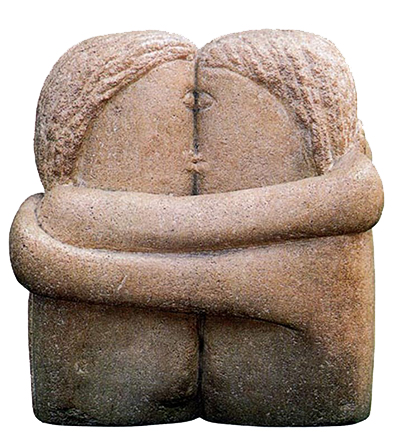
The Wisdom of the Earth belongs to the same period as The Prayer and Brâncuși’s first Kiss. All three reduce the descriptive detail of the human figure, with different results. In The Prayer, a kneeling figure lowers her head and expresses grief through the posture of the whole body. Brâncuși worked that figure in a form that was cast in bronze for a funerary monument. In the Kiss, the arms close the space between two people, and each body depends on the other for the shape of the whole. The held-in arms of The Wisdom of the Earth bring the two sides of a single figure together. A gesture that could express intimacy between two people in one work becomes a private act in the other. [3] [5]
The two carvings also had different futures. Brâncuși returned to the kiss repeatedly. The Philadelphia Museum of Art’s 1916 version shows how far he could take that idea, joining the two eyes into one oval and making the arms into a band around the stone. Art historian Doina Lemny identifies The Wisdom of the Earth as a unique work, with no comparable sculptural series in Brâncuși’s practice. Its limbs and the space between them retain the particular awkwardness of an actual person sitting tightly folded. That awkwardness survives all the simplification and gives the figure a bodily presence of its own. [3] [6]
What Does Cumințenia Mean?
The Wisdom of the Earth is a familiar English title, and the French La Sagesse de la Terre is close to it. In Romanian, cumințenie can suggest wisdom alongside qualities such as modesty and restraint. Lemny points out that the individual equivalents fail to convey the full sense of the word. Brâncuși’s title gives those qualities to the earth and presents them in the form of a woman with her limbs folded close. It becomes possible to read the pose as a kind of self-possession. The same bent body can also suggest vulnerability or the wish to make oneself small. The stone holds both responses in view. [2] [3]
The eyes sharpen the uncertainty. Their position gives the face a direct orientation, while their carving offers few clues about what the woman is looking at. A viewer can experience that stillness as a stare or feel that the figure has withdrawn into thought. Romanian writer Alexandru Vlahuță imagined her eyes turned “în lăuntru”, or “inwards”. He also pictured a woman drawing her limbs together against cold. Both impressions arise from the body Brâncuși actually carved. They show how far a pronounced posture and a few facial features can carry a reading without the help of a setting or a named sitter. [3] [7]
Ancient Forms and Modern Comparisons
The compact body prompted comparisons with ancient figures from the time of its first exhibition. Lemny records that a critic in the Romanian newspaper Universul invoked Mycenaean sculpture in 1910. The association was partly a response to the unfamiliar shape. If a visitor had expected a contemporary nude with natural proportions, familiar facial modelling and limbs drawn out into the space around it, a closed figure with a large, shallowly carved face might have looked closer to an object in an archaeological collection. A comparison of that kind tells us about the viewer’s frame of reference, even when the artist’s own sources remain uncertain. [3]
Brâncuși’s sculpture has also been compared to the prehistoric Thinker of Hamangia and the seated figure found with it in Romania. The pose makes the comparison understandable. Both bring the limbs close and use the bent body to create a complete, compact form. Lemny notes that the Hamangia sculptures came to light in 1956, almost five decades after Brâncuși carved The Wisdom of the Earth. The resemblance belongs to the history of how his sculpture has been interpreted. An ancient figure can help us see the modern one afresh even when chronology rules out a direct encounter. [3]
The Centre Pompidou’s 2024 exhibition set Brâncuși’s early work in a wider Parisian context and proposed that he probably saw Paul Gauguin’s Oviri at the 1906 Salon d’Automne retrospective. The Musée d’Orsay records Oviri as a stoneware work made in 1894. Gauguin’s figure is accompanied by animal forms, and the vertical composition lets its gestures travel sharply downwards. In The Wisdom of the Earth, the limbs turn towards the figure’s own body, and limestone supplies an entirely different set of surface effects. The comparison makes sense at the level of the deliberately simplified face and an interest in forms outside the academic tradition. The museum’s suggestion about what Brâncuși saw remains a probability. [2] [8]
Descriptions of early modern art have often grouped work from very different cultures under the word “primitive”. The Pompidou’s historical framing brings out something about what European artists sought in forms they regarded as distant from their schooling. It can also leave important differences obscured. The geometry of an ancient figure, the posture of Gauguin’s fired stoneware and the proportions of Brâncuși’s limestone woman can be compared individually. Each sits in a different history, and Brâncuși’s figure can recall more than one tradition without representing a specific deity or repeating a known figure. [2] [3] [8]
From a Bucharest Exhibition to a Private Collection
The 1910 exhibition of Tinerimea Artistică in Bucharest gave Romanian audiences their first documented chance to see the sculpture. The historian Sorana Georgescu-Gorjan identifies it as number 254 and records that it was shown in the Octagon Room alongside paintings by Cecilia Cuțescu-Storck. Georgescu-Gorjan describes a jury divided over its admission. Once admitted, the work drew sharp criticism from some commentators and support from others. Lemny credits the critic Theodor Cornel with taking the pose seriously as an artistic decision. He attended to the relations between the lines of the arms, legs and back and to the stillness they established as a group. [3] [9]
The correspondence reproduced by Georgescu-Gorjan gives the exhibition a domestic sequel. Cuțescu-Storck kept the carving after the exhibition and wrote to Brâncuși about how effective it looked in her studio. The painter Gheorghe Petrașcu then helped arrange a purchase for Gheorghe Romașcu, an engineer who acquired the work from Brâncuși in 1911. In Brâncuși’s reply to Petrașcu, the terms of the sale are practical enough to let the friends collect the stone from Cuțescu-Storck. His pleasure that it would go to Romașcu also comes through. That exchange puts a named household and a network of Romanian artists behind the movement from exhibition display to private hands. [3] [9]
Romașcu’s grandson Dinu Viloiu told News.ro in 2016 that the sculpture stood by the entrance to the family home. He recalled a family story in which his grandfather would lay his keys in the figure’s arms and tell it to guard the house. It is a small domestic detail, preserved as family testimony. The hollow at the centre of the densely folded figure had acquired a use in Romașcu’s household. A carving that some visitors had taken for an unfamiliar idol had become a familiar presence at the door. [9] [10]
Brâncuși also kept an image of the work. The Centre Pompidou records a glass-plate negative he made in 1908 and a gelatin silver print mounted under glass, both of which entered the French collection through his 1957 bequest. The mounted print was in Brâncuși’s studio at his death. The museum also catalogues a limestone pedestal used to support the framed photograph. That arrangement gave a flat image of the carving a physical presence in the studio years after the original had gone to Romania. Seeing the photograph on a stone support also changes the viewer’s sense of scale. The image occupies a chosen place in a room, while the depicted figure has a base and proportions of its own. [11] [12] [13]
Heritage Status and the 2016 Acquisition Campaign
The twentieth-century ownership history is more difficult to pin down. Georgescu-Gorjan records that the work entered the inventory of the Romanian state art museum in 1957 and was subsequently displayed in the National Museum of Art of Romania. Romașcu’s heirs argued that the state had taken it unlawfully. A final court decision ordered restitution, according to Georgescu-Gorjan’s account. She also records that by 2014 the sculpture was housed temporarily in the Treasury Room at the National Cotroceni Museum. The museum inventory, the family’s claim and the temporary display describe different parts of the work’s history, so a reference to one museum in a dated account may refer to custody at a particular time. [9]
Romania’s national heritage institute lists the sculpture under its 1998 Tezaur classification. The register identifies it as an object of exceptional cultural value and gives a private collection in Bucharest as its holding. The classification mattered when the owners sought a sale. As legal scholar Oana Hemen explains in her study of the case, the planned sale brought the Romanian state’s right of pre-emption into play, prompting negotiations over a possible acquisition. The sculpture could therefore be both a private holding and the focus of a national effort to secure it for a public collection. [1] [14]
The 2016 negotiations produced a proposed price of €11 million. The initial plan combined €5 million in government funding with €6 million to be raised by public subscription. Romania’s National Museum of the Romanian Peasant promoted the appeal under the name Brâncuși e al meu (“Brâncuși is mine”). An October 2016 budget measure named the sculpture and provided for the return of the supplementary budget allocation if the acquisition missed its deadline. The attempt ended without a purchase, and the Ministry of Culture later reported on the return of donations. The sum attached to the campaign was an agreed proposal for a particular transaction. It is part of the acquisition history of this sculpture. [14] [15] [16] [17]
A later opportunity to see the carving came at the Centre Pompidou retrospective in Paris, which ran from 27 March to 1 July 2024. There, the exhibition material names the original stone and gives a private lender credit. This entry has a different purpose from the museum’s catalogue records for the photographs and pedestal. A temporary exhibition brings together works from many owners and collections, and a lender credit describes the arrangement for that exhibition. The Romanian register provides the sculpture’s heritage status and holding category. The exhibition record adds a dated occasion when people could see it. Taken together, the records show how a work first debated in a Bucharest exhibition could return to public view in Paris, close to the place where Brâncuși developed his approach to carving. [1] [2] [11] [12] [13] [18]
Browse sculptures and drawings
Browse articles on the sculptures and separately catalogued museum objects. A work can have several physical versions. Drawing records from the Tate catalogue retain their October 2014 snapshot wording where present.
| Name | Date | Medium |
|---|---|---|
| Arch | Sculpture | |
| Bird in Space | Sculpture | |
| The Blond Negress | Sculpture | |
| The Cock | Sculpture | |
| The Endless Column | Sculpture | |
| The First Cry | Sculpture | |
| Fish | Sculpture | |
| The Gate of the Kiss | Sculpture | |
| Golden Bird | Sculpture | |
| Head | Sculpture | |
| The Kiss | Sculpture | |
| Leda | Sculpture | |
| Madame L.R. | Sculpture | |
| Mademoiselle Pogany II | Sculpture | |
| Mademoiselle Pogany | Sculpture | |
| Maiastra | Sculpture | |
| The Newborn | Sculpture | |
| Phoque II | Sculpture | |
| The Prayer | Sculpture | |
| Princess X | Sculpture | |
| Prometheus | Sculpture | |
| Târgu Jiu monumental ensemble | Sculpture | |
| Sculpture for the Blind | Sculpture | |
| The Seal | Sculpture | |
| The Signal | Sculpture | |
| Sleeping Muse | Sculpture | |
| The Sorceress | Sculpture | |
| The Table of Silence | Sculpture | |
| Torso of a Young Man | Sculpture | |
| Two Lamps | Sculpture | |
| Vitellius | Sculpture | |
| The White Negress | Sculpture | |
| The Wisdom of the Earth | Sculpture | |
| Young Bird | Sculpture | |
| The Kiss (Philadelphia, fourth version) | 1916 | Sculpture Catalogue. |
| Sleeping Muse (Pompidou bronze) | 1910 | Sculpture Catalogue. |
| Mlle Pogany, version I (MoMA bronze) | 1913, after a marble of 1912 | Sculpture Catalogue. |
| Maiastra (Venice brass) | about 1912 | Sculpture Catalogue. |
| Bird in Space (MoMA bronze) | about 1941 | Sculpture Catalogue. |
| Bird in Space (Venice brass) | 1932–40 | Sculpture Catalogue. |
| Endless Column, version I (oak) | 1918 | Sculpture Catalogue. |
| Brâncuși Monumental Ensemble of Târgu Jiu | 1937–38 | Sculpture Catalogue. |
| Bust of a nude woman in profile, head inclined | about 1910 | Drawing Catalogue. |
| Nude study, head inclined (recto) | — | Drawing Catalogue. |
| Self-portrait (ink) | — | Drawing Catalogue. |
| View of the Artist’s Studio | 1918 | Drawing Catalogue. |
| Study for the cock (lost clay Grand Coq) | about 1923 | Drawing Catalogue. |
| Portrait of a woman in profile | — | Drawing Catalogue. |
| Animal head | — | Drawing Catalogue. |
| Animal sketch (2002 checklist) | 1929 | Drawing Catalogue. |
| Plans of the studio (verso) | about 1930–38 | Drawing Catalogue. |
| Danaïde (Tate T00296) | c.1918 | Sculpture Catalogue. |
| Maiastra (Tate T01751) | 1911 | Sculpture Catalogue. |
| Head (Tate T03066) | c.1919–23 | Sculpture Catalogue. |
| Fish (Tate T07107) | 1926 | Sculpture Catalogue. |
Frequently Asked Questions
It was shown in Bucharest at Tinerimea Artistică in 1910, and it was temporarily housed at the National Cotroceni Museum in 2014. The stone figure appeared in the Centre Pompidou’s 2024 retrospective in Paris. Romania’s heritage register describes its holding as a private collection in Bucharest. [1] [2] [3] [9]
Discussion
Look again at the images and ideas explored in The Wisdom of the Earth. These editorial prompts invite your observations.
Reader Insights
Look at the figure from the front and from an angle. Where does the appearance of stillness give way to a sense of bodily effort?
Compare the arms in this work with the arms in Brâncuși’s The Kiss. How does a similar enclosing gesture change when it belongs to one person?
How would you read the woman’s posture if you encountered the carving before learning the Romanian title?
Join the Conversation
Share a detail, comparison or question about The Wisdom of the Earth below.
References
- Institutul Național al Patrimoniului, Cumințenia pământului. Tezaur object record 7169, listing order 3042, position 16. View source.
- Centre Pompidou, Brancusi, exhibition labels. 2024 exhibition, pp. 7–8, La Sagesse de la Terre and Oviri. View source.
- Doina Lemny, Brâncuși. 2012, pp. 20–28, the early work, the 1910 exhibition and Cumințenia pământului. View source.
- British Geological Survey, “Crinoids”. Crinoid fossils, marine environments and crinoidal limestone. View source.
- Centre Georges Pompidou, Constantin Brancusi, exhibition press dossier. 1995, opening release and exhibition route, rooms 1–2. View source.
- Philadelphia Museum of Art, The Kiss. Collection record for the 1916 version. View source.
- Doina Lemny, Brâncuși: Cumințenia pământului – operă unică. Editura Brâncuși, 2018, institutional catalogue excerpt reproducing Vlahuță. View source.
- Musée d’Orsay, Paul Gauguin, Oviri. Object record and exhibition history. View source.
- Sorana Georgescu-Gorjan, “Brâncuși și Cumințenia pământului”. Confesiuni, no. 20, October 2014. Includes transcribed excerpts of the Storck, Petrașcu and Brâncuși correspondence. View source.
- Dinu Viloiu, interview with Patricia Marinescu. News.ro, 18 March 2016, on the sculpture in the Romașcu household. View source.
- Centre Pompidou, La Sagesse de la terre, pierre. Glass negative PH 202. View source.
- Centre Pompidou, La Sagesse de la terre. Mounted print PH 202 C. View source.
- Centre Pompidou, Socle-stèle. Limestone support AM 4002-198. View source.
- Oana Hemen, “Cumințenia pământului călătorește prin sms”. Cercul de Drept Civil European, pp. 1–4. View source.
- Muzeul Național al Țăranului Român, Cumințenia pământului. Archived notice for the public subscription. View source.
- Senatul României, budget ordinance file. October 2016 appropriation, art. 34. View source.
- AGERPRES, Ministry of Culture statement on subscription refunds. 12 December 2019. View source.
- Centre Pompidou, Brancusi, exhibition programme. Paris, 27 March to 1 July 2024. View source.
More BRÂNCUȘI Sculptures
Bird in Space
Compare the marble and metal versions of Brâncuși’s sculpture.