 by Tom Gurney
Tom Gurney BSc (Hons) is an art history expert with over 20 years experience
Published on June 19, 2020 / Updated on November 29, 2026
Email: tomgurney1@gmail.com / Phone: +44 7429 011000
The Table of Silence: Introduction
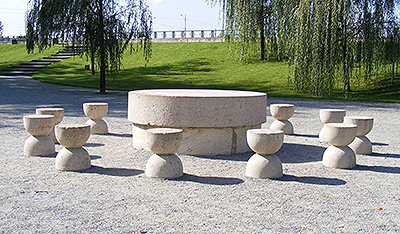
At the western end of Constantin Brâncuși’s memorial route through Târgu Jiu, a round stone table stands within a circle of twelve seats. The tabletop rises less than a metre from the ground. Each seat narrows at its centre, and the spaces between them let the eye follow an unmarked circular line. The river is close by. Stand at any point on the outer circle and the table is at the same distance from you as it would be from several other positions. Look past it and the rest of the park comes into view. [1] [2]
The Table of Silence, known in Romanian as Masa Tăcerii, belongs to the First World War memorial ensemble built in 1937–38. The stone group includes the Alley of Chairs and the Gate of the Kiss, and the urban route continues east to the Endless Column. The table gives the western end a centre of its own. It brings attention down towards the ground and makes the spaces between visitors, seats and tabletop as important to the composition as the stone. [1] [2]
At a Glance
- ArtistConstantin Brâncuși
- Dates1937–38. The present arrangement followed an earlier table design. [3] [4]
- PlaceConstantin Brâncuși Park beside the Jiu River, Târgu Jiu, Romania. [1] [2]
- SizeThe table is 0.90 metres high. The upper disk measures 2.15 metres across, and the lower disk 2 metres. [3]
- FormA circular stone table and twelve hourglass-shaped seats. [2] [3]
Contents
- A place to stop at the river
- How the disks and seats work together
- From an earlier table to the arrangement in the park
- The name and the twelve places
- Conservation at the western park
A place to stop at the river
A visitor coming to the work from the route through town first encounters the Gate and then the rows of stools along the alley. That stretch has a clear forward direction. Near the river the table changes the arrangement. There is still an overall east–west alignment, but the parts closest to the visitor describe a centre as well. The backs of the seats offer no obvious front, so one can stop at the circle from either side and still get a sense of its shape. From here a traveller can look back towards the park and place the table in relation to the path. [1] [2]
The river is part of the memorial’s historical geography. Târgu Jiu was defended near the Jiu crossing in 1916, and the ensemble commemorates those who died defending the city. This gives the western park a local point of reference within a work built across the town. In the circuit around the table there is no individual face on which all the other figures’ eyes might settle. A visitor instead looks across a circle of empty stone seats and outward to the setting. The arrangement allows for attention to the landscape and to people standing on the opposite side. [1] [2]
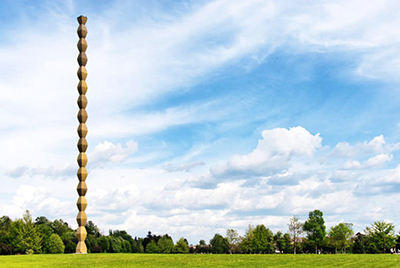
The other main park is occupied by a column that pulls the eye upward. The table, with its broad and comparatively low top, brings the visitor’s gaze close to the level of the ground. Both works repeat a shape. At the column, repeated metal units occur along a vertical line. At the table, repetition appears in the sequence of individual stones distributed on a level plane. The walk through the town connects these different systems of scale without reducing either work to an illustration of the other. [1] [2]
How the disks and seats work together
The table is made up of two broad circular elements of different diameters. The top extends a little beyond the lower stone. The difference is easy to overlook because their rounding aligns when seen from in front, but from the side the overhang changes the edge of the shadow beneath the tabletop. At a distance the form appears to have a continuous, compact weight. Up close the line between the two components and the change of radius help a visitor understand the work as a particular combination of separate stones. When the light is low, the two circles cast shadows at different levels. [3] [5]
The seats have a different rhythm. Each rises, contracts and broadens again. From far enough back, the spaces between them become as regular as the seated forms themselves. Nearer one seat, they open into gaps through which the surrounding grass or path can be seen. The intervals around the central stone also make it easy to recognise the arrangement when some of the seats have dropped out of view behind the table. A person looking from ground level can rarely see the whole circle with equal clarity. A high view makes the geometry easier to chart, while a low view gives the seats mass and makes their spacing feel more tangible. [2] [5]
The seats along the Alley of Chairs belong to the same part of the park. Their square form gives them sharper edges than the round seats at the table, and they run in groups of three on each side of the path. The movement changes when one comes from those groups into the circle. Along the alley, there are moments between the groups where the repeated rows fall away and the path keeps going. Around the table, a change of direction leads to the next seat without breaking the overall figure. Comparing the two arrangements is one of the more direct ways to see the care Brâncuși took over the space around each individual stone. [2] [3]
From an earlier table to the arrangement in the park
The current double-disk form reflects a change made in the process of creating the memorial. The Romanian nomination describes an earlier table and a later solution in which its upper disk was retained as the lower part and a larger disk placed above it. Centrul Brâncuși’s account follows the change through the two configurations. The official dimensional record gives the upper and lower diameters for the resulting work. When viewed together, the evidence explains why the substantial lower cylinder has so much visual presence. A narrower pedestal would have made the broad top seem more distinctly separated from the ground. [3] [4] [6]
Witness testimony adds another perspective to the construction chronology. In Adina Andrițoiu’s study of the recollections of Ioan Alexandrescu, the assistant remembered the ordering of a larger table disk and taking part in placing the surrounding seats. The recollection describes decisions and actions during the making of the work. It deserves to be read alongside the official record, in which the completed table and seats are described in their final configuration. A close study of the ensemble can therefore distinguish between what was standing at an earlier moment and the form in which the work has been conserved. [4] [6] [7]
The Centre Pompidou holds a photograph attributed to Brâncuși and catalogued around 1938. It shows the table and the seating in relation to the park. Photographs from the period are useful for seeing how much of the design belongs to what surrounds the stone. An isolated photograph of the tabletop might make it look like a compact domestic object. An image that includes the seats and the space behind the circle brings out a second scale, concerned with how a group might gather and where the river and trees enter the view. The documentary record lets a reader compare historically situated views without assuming that every feature of the landscape remains identical. [5] [8]
The name and the twelve places
A circle of twelve empty seats makes it possible to imagine a group of people around the table. The title suggests a pause in speech, and the documented memorial purpose helps explain why the work has often been discussed in relation to absence and remembrance. ICOMOS records associations with a family gathering, the Last Supper and an altar, giving several possible ways to understand the familiar form. Those comparisons illuminate aspects of the work. A reader can use them to consider the gathering implied by the seats, and still distinguish a later description of the work from a statement by Brâncuși about each individual seat. [1] [2]
Sorana Georgescu-Gorjan examines the different names and descriptions attached to the stone table in recollections and records. A municipal description and the caption of an early reproduced photograph refer in plain terms to a round stone table and seats. Other remembered names and accounts make it difficult to reconstruct a single, secure naming history from any one later source. That uncertainty sits alongside several things that are quite clear on site. The seats have a fixed relation to the central form, all twelve are left visible and the visitor’s eye can cross the spaces between them. These observations can support an interpretation without requiring a claim about what each seat symbolises. [4] [9]
Conservation at the western park
The table and seats form an outdoor stone installation. Their horizontal surfaces meet the weather differently from the undersides of the disks or the inward curves of the seats. The stone conservation history is documented within the wider care of the ensemble. The Romanian restorers’ association describes design and investigation work for the stone monuments, including the Gate and the alley as well as the table and seats. ICOMOS records that wider restoration campaigns between 2000 and 2004 included the stone works and that the two parks were also re-landscaped. The programme and the assessments describe a group of works. They do not identify the origin of every mark on a particular surface. [2] [10]
Maintaining the setting means preserving room to see the circle and to approach it along the path. An object of this height can easily be visually absorbed by things placed next to it. The heritage recognition of the whole route gives the surroundings importance in their own right. A pause by the table can feel personal in an otherwise open public park. The clear space around it allows space for other people to share that encounter, before continuing along the path to the Gate or back into the town. [1] [2]
Browse sculptures and drawings
Browse articles on the sculptures and separately catalogued museum objects. A work can have several physical versions. Drawing records from the Tate catalogue retain their October 2014 snapshot wording where present.
| Name | Date | Medium |
|---|---|---|
| Arch | Sculpture | |
| Bird in Space | Sculpture | |
| The Blond Negress | Sculpture | |
| The Cock | Sculpture | |
| The Endless Column | Sculpture | |
| The First Cry | Sculpture | |
| Fish | Sculpture | |
| The Gate of the Kiss | Sculpture | |
| Golden Bird | Sculpture | |
| Head | Sculpture | |
| The Kiss | Sculpture | |
| Leda | Sculpture | |
| Madame L.R. | Sculpture | |
| Mademoiselle Pogany II | Sculpture | |
| Mademoiselle Pogany | Sculpture | |
| Maiastra | Sculpture | |
| The Newborn | Sculpture | |
| Phoque II | Sculpture | |
| The Prayer | Sculpture | |
| Princess X | Sculpture | |
| Prometheus | Sculpture | |
| Târgu Jiu monumental ensemble | Sculpture | |
| Sculpture for the Blind | Sculpture | |
| The Seal | Sculpture | |
| The Signal | Sculpture | |
| Sleeping Muse | Sculpture | |
| The Sorceress | Sculpture | |
| The Table of Silence | Sculpture | |
| Torso of a Young Man | Sculpture | |
| Two Lamps | Sculpture | |
| Vitellius | Sculpture | |
| The White Negress | Sculpture | |
| The Wisdom of the Earth | Sculpture | |
| Young Bird | Sculpture | |
| The Kiss (Philadelphia, fourth version) | 1916 | Sculpture Catalogue. |
| Sleeping Muse (Pompidou bronze) | 1910 | Sculpture Catalogue. |
| Mlle Pogany, version I (MoMA bronze) | 1913, after a marble of 1912 | Sculpture Catalogue. |
| Maiastra (Venice brass) | about 1912 | Sculpture Catalogue. |
| Bird in Space (MoMA bronze) | about 1941 | Sculpture Catalogue. |
| Bird in Space (Venice brass) | 1932–40 | Sculpture Catalogue. |
| Endless Column, version I (oak) | 1918 | Sculpture Catalogue. |
| Brâncuși Monumental Ensemble of Târgu Jiu | 1937–38 | Sculpture Catalogue. |
| Bust of a nude woman in profile, head inclined | about 1910 | Drawing Catalogue. |
| Nude study, head inclined (recto) | — | Drawing Catalogue. |
| Self-portrait (ink) | — | Drawing Catalogue. |
| View of the Artist’s Studio | 1918 | Drawing Catalogue. |
| Study for the cock (lost clay Grand Coq) | about 1923 | Drawing Catalogue. |
| Portrait of a woman in profile | — | Drawing Catalogue. |
| Animal head | — | Drawing Catalogue. |
| Animal sketch (2002 checklist) | 1929 | Drawing Catalogue. |
| Plans of the studio (verso) | about 1930–38 | Drawing Catalogue. |
| Danaïde (Tate T00296) | c.1918 | Sculpture Catalogue. |
| Maiastra (Tate T01751) | 1911 | Sculpture Catalogue. |
| Head (Tate T03066) | c.1919–23 | Sculpture Catalogue. |
| Fish (Tate T07107) | 1926 | Sculpture Catalogue. |
Frequently Asked Questions
The official dimensional account records a height of 0.90 metres. The upper disk measures 2.15 metres in diameter and the lower disk 2 metres. [3]
Discussion
Look again at the images and ideas explored in The Table of Silence. These editorial prompts invite your observations.
Reader Insights
Walk the circle in your mind and imagine the table from a seat, from the path and from above. What does one view reveal that the others leave hard to see?
Compare the spaces between the circular seats with those between the grouped stools in the alley. How do these arrangements change what seems to be the main direction?
Join the Conversation
Share a detail, comparison or question about The Table of Silence below.
References
- UNESCO World Heritage Centre. Brâncuși Monumental Ensemble of Târgu Jiu, brief synthesis. View source.
- ICOMOS. Brâncuși Monumental Ensemble of Târgu Jiu, advisory evaluation, printed pp. 310–312, location, form and conservation. View source.
- Romanian nomination supporting file. Târgu Jiu ensemble components, dimensional descriptions of the Table and Alley of the Stools. View source.
- Centrul Brâncuși. Masa Tăcerii, construction and naming history (Romanian). View source.
- Centre Pompidou. L’ensemble monumental de Târgu Jiu, discussion and historical images (French). View source.
- Romania. World Heritage nomination dossier, Table of Silence, printed p. 20, dimensional and assembly history. View source.
- Adina Andrițoiu. Constantin Brâncuși în amintirile lui Ioan Alexandrescu, Litua XXIII, discussion of Alexandrescu’s work on the table and seats (Romanian). View source.
- Centre Pompidou. La Table du silence à Târgu Jiu, photograph PH 588 C, circa 1938. View source.
- Sorana Georgescu-Gorjan, Centrul Brâncuși. Ansamblul brâncușian de la Târgu-Jiu, historical names and records for the Table (Romanian). View source.
- UNRMI. Ansamblul Monumental realizat de Constantin Brâncuși la Târgu-Jiu a fost înscris pe Lista Patrimoniului Mondial UNESCO, 2003 stone conservation design work (Romanian). View source.
More BRÂNCUȘI Sculptures
Bird in Space
Compare the marble and metal versions of Brâncuși’s sculpture.