 by Tom Gurney
Tom Gurney BSc (Hons) is an art history expert with over 20 years experience
Published on June 19, 2020 / Updated on November 29, 2026
Email: tomgurney1@gmail.com / Phone: +44 7429 011000
Sleeping Muse: Introduction
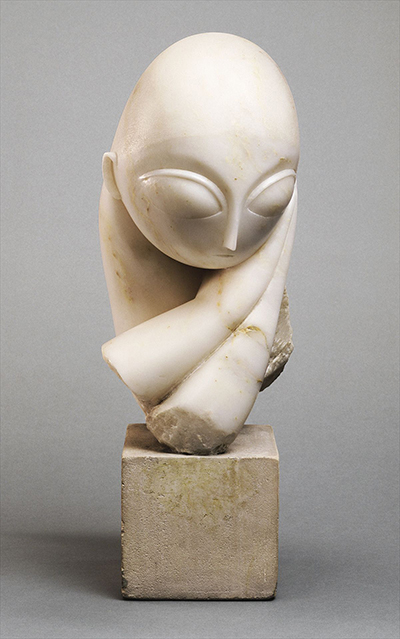
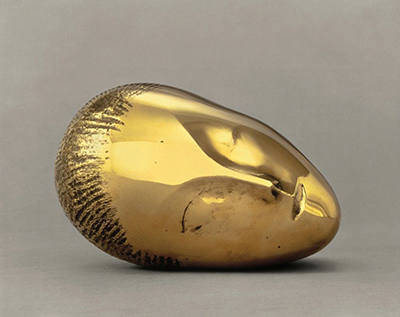
Constantin Brâncuși’s Sleeping Muse is a portrait of Baroness Renée Irana Frachon transformed into a reclining oval head. A fine ridge marks the nose, shallow lines gather around the closed eyes, and the head rests on its side. Brâncuși carved the early marble in 1909–10 and developed the form through plaster and bronze. In one bronze, darkened hair borders a polished face. In another, traces from the plaster and areas of gold leaf give the surface a different character. [1] [2] [3] [4] [5]
At a Glance
- ArtistConstantin Brâncuși (1876–1957).
- French titleLa Muse endormie.
- SitterBaroness Renée Irana Frachon, who posed for Brâncuși from 1908 to 1910. [1] [2]
- Early marbleSleeping Muse I, 1909–10, Hirshhorn Museum and Sculpture Garden, Washington, DC, 66.610. [3]
- Plaster and bronzeThe Centre Pompidou holds a shellac-treated plaster, AM 4002-37, and two bronzes catalogued as 1910, AM 818 S and AM 1374 S. Early bronzes also belong to the Metropolitan Museum of Art and the Art Institute of Chicago. [2] [5] [6] [7] [8] [9]
- What to look forThe head’s point of contact, the raised ridge of the nose and the way the finish changes the visibility of the eyes, lips and hair.
Contents
- From the Baroness’s portrait to the reclining head
- The marble, the plaster and the bronzes
- The face in marble and bronze
- Early exhibitions and the evidence of photographs
- The sleeping head and Brâncuși’s other portraits
From the Baroness’s portrait to the reclining head
Frachon sat for Brâncuși over several years. The Centre Pompidou traces the lying head back to realistic studies in which she was upright, as a sitter would be for a conventional portrait bust. Those studies are lost. The marble that survives shows the scale of the change. Brâncuși removed the shoulders and the supporting column of the neck, and the head now carries its weight low on its own curve. Its orientation makes the attitude of sleep legible even before the viewer finds the eyelids. The general title, Sleeping Muse, leaves room for that experience while the identity of the sitter remains documented. [1] [2] [3]
An earlier work helps explain how Brâncuși arrived at the reclining pose. In Sleep (Somnul, 1908), now held by the National Museum of Art of Romania in Bucharest, a woman’s face is barely discernible in a marble block. Romania’s national cultural heritage register records that the collector Anastase Simu commissioned that marble. The Centre Pompidou connects it to Sleeping Muse as an earlier treatment of the motif. In Sleep, the stone that surrounds the face helps suggest the way a sleeper sinks out of sight. In Sleeping Muse, the oval has a continuous outer contour and can be read from the back as well as the front. The feeling of sinking has to come from the head’s bearing and its contact with the surface below it. [2] [10]
The title also changes the encounter with Frachon. A formal bust ordinarily raises the image of a sitter to face the viewer. This head stays low and its eyes remain closed. Seen from the front, the sculpture invites much the same examination as a likeness. Seen from the crown or behind, the face can nearly disappear from view. The viewer can recover it by moving a short distance. That change of viewpoint brings a human character in and out of an almost geometric mass. [1] [2] [3]
Frachon remained part of the work’s history after the sittings ended. In 1963 she gave her polished bronze to the Musée national d’art moderne, now part of the Centre Pompidou. The gift identifies one particular cast through the sitter herself. The museum’s other bronze entered the collection by purchase in 1947. Both are titled La Muse endormie and dated 1910, but the two accessions and their separate paths into the museum make it possible to tell them apart. [2] [6]
The marble, the plaster and the bronzes
Six records show how a single title can describe a group of objects. The dimensions below follow each institution’s record. They help identify objects when read alongside the place, date and material.
| Collection and object | Recorded date and material | Object details |
|---|---|---|
| Hirshhorn Museum and Sculpture Garden, 66.610 | 1909–10, marble | Sleeping Muse I, 17.2 × 27.6 × 21.2 cm. Gift of Joseph H. Hirshhorn, 1966. [3] |
| Centre Pompidou, AM 4002-37 | About 1910, patinated plaster and shellac | 18 × 27.5 × 20.5 cm. Brâncuși bequest, 1957. [5] |
| Centre Pompidou, AM 818 S | 1910, bronze | 16.5 × 26 × 18 cm. Valsuani casting, bought in 1947. [6] |
| Centre Pompidou, AM 1374 S | 1910, polished bronze | 16 × 27.3 × 18.5 cm. Gift of Baroness Frachon, 1963. [2] |
| Metropolitan Museum of Art, 49.70.225 | 1910, bronze | 16.5 × 27 × 21 cm. Alfred Stieglitz Collection, 1949. [7] |
| Art Institute of Chicago, 1931.523 | 1910, bronze | 16.1 × 27.7 × 19.3 cm. Arthur Jerome Eddy Memorial Collection. [8] [9] |
The marble was carved, whereas molten bronze took the form of a mould made through an intermediate process. The Pompidou dates its patinated plaster to around 1910 and identifies it as the probable intermediary for its Valsuani bronze, AM 818 S. It came to the museum through Brâncuși’s bequest. The collection account by curator Marielle Tabart explains that Brâncuși could work the intermediate plaster or the cast metal, so that small differences in symmetry, dimensions and surface could enter the series at more than one stage. A casting process that repeats the overall outline still leaves scope for decisions about which details to emphasise in the finished object. [2] [5] [6]
The records distinguish the date of the carving from the dates of individual casts. The Met dates its cast to 1910 and describes it as one of four cast in that year from a marble of the previous year. The Pompidou discusses six bronzes in its account of the broader group. Christie’s, which also discusses six identified casts, specifies that the patinated and gilded bronze it offered in 2017 was cast by 1913. Its catalogue records a Valsuani foundry stamp and traces the work to Jacques Ulmann by February 1958, while qualifying the proposed earlier ownerships. The casting deadline and the historical sale pertain to this particular bronze. [2] [3] [4] [7]
The terminology for finish can vary even when an accession number settles the identity. The 2026 Neue Nationalgalerie checklist describes AM 818 S as polished bronze. The owning museum lists its technique more broadly as bronze, and the plaster record describes the associated cast as gold-patinated. In the same collection, the term bronze poli appears expressly under the technique of the Frachon gift, AM 1374 S. The accession numbers and acquisition details identify those two works consistently across the differences in wording. [2] [5] [6] [8]
The face in marble and bronze
Begin with the Hirshhorn marble from the front and imagine tracing the contour from the crown towards the chin. The top of the head is a broad curve that narrows at the jaw. The chin rounds away before it can make a sharp point. Against those sweeping edges, the nose makes a small, firm rise. The Hirshhorn’s visual description notes engraved hair lines, almond-shaped eyes and a small mouth. Because the features are shallow, the ridge of the nose gives the eye a fixed place to start before it follows the quieter marks across the white stone. [3] [11]
The low angle contributes just as much as the features. Look for where the lower cheek turns under. The contour above it seems to be held in place by the head’s weight, while the upper curve remains free of the support. A bust usually makes the viewer’s eye travel up the pedestal and neck to reach the face. Here the eye travels almost horizontally between the face and the plane where the object lies. That small gap and the shadow along the underside make the oval feel like a volume even when a photograph reduces it to a shape. [3] [11]
The Pompidou’s Frachon bronze offers a different kind of contrast. Tabart describes the hair striations as patinated and the face as polished. Follow the hair away from the forehead and the striations hold their place as visible lines. Across the temple and cheek, a broad reflected highlight can travel with the viewer. In a bright reflection the shallow lines around the eyes or the fine opening at the lips can briefly lose definition. From a different angle those same marks separate again from the face. The bronze can therefore make the distinction between a head and an oval seem less settled as the viewer moves. [2]
The material also changes the impression of stillness. In the marble the most persistent cues are the pale mass against the support and the contours of the engraved features. The polished bronze can carry flashes of the room across the forehead and cheek even though the object remains fixed. Looking at the two together exposes how much of the effect comes from the placement of light. Especially in a photograph taken at close range, a bright patch can look like part of the sculpted face when it is a reflection on the metal. [2] [3] [11]
With the Christie’s bronze, the catalogue calls attention to areas of patination, polishing and gold leaf, and to imperfections carried through from the casting plaster. That account offers a concrete instance of two kinds of variation in a single object. The plaster could leave traces in the form that the mould took, and work on the bronze could then give particular areas of the surface their lustre. Different treatments of the same broad oval can therefore produce markedly different photographs. The gold leaf recorded on this cast is a specific material fact. Visual warmth in an image of another bronze is far less precise evidence. [4] [5] [6]
Early exhibitions and the evidence of photographs
A title in an exhibition catalogue establishes that a work under that name was listed. At the 1913 Armory Show, the Chicago edition lists Sleeping Muse as number 25. The Art Institute’s 1931 Eddy exhibition bulletin associates its bronze with both the New York and Chicago venues. Doïna Lemny’s study of the early American exhibitions discusses alternative identifications, including a plaster for the New York entry. The catalogue title by itself cannot settle which physical example was shown in each city. [9] [12] [13]
A photograph of Brâncuși’s 1914 exhibition at Alfred Stieglitz’s 291 gallery offers firmer ground for a comparison. In the National Gallery of Art’s identification of the works in Stieglitz’s installation photograph, the bronze now at the Met lies at the far left and the marble now at the Hirshhorn is the fifth object from the left. Two versions of the same motif shared the room with other experiments in portraiture and an upright wooden figure. The Hirshhorn’s record notes that the marble lay on a pedestal shared with another work, without a separate base or socle of its own. The way a version was supported could be part of the display decisions for that occasion. [3] [14]
The installation also anticipates two different collecting histories. The Hirshhorn records the marble with Arthur B. Davies from around 1914. It subsequently passed through a sale of Davies’s collection in 1929 and entered Joseph H. Hirshhorn’s collection in 1962. His gift brought it to the museum in 1966. The Met identifies its bronze with the Alfred Stieglitz Collection, 1949. The historical photo connects both versions to one room at an early date while the museums’ records give each object an independent identity. [3] [7] [14]
Photographs could give rise to confusion as well. The Smithsonian’s catalogue notes that a photograph by Brâncuși of a Paris bronze has repeatedly been reproduced as an image of the Hirshhorn marble. A black-and-white print compresses differences in colour, and the lighting may make a bronze appear pale or make its shallow grooves hard to see. The artist’s own use of photography is part of the story here. In a studio image catalogued by MoMA under Sleeping Muse II, the later work shares the space with Maiastra, Princess X and an Endless Column. The Pinault Collection holds a separate silver print, dated about 1917–22, which it identifies as Brâncuși’s photograph of an alabaster version made in 1917–18. The print is the collection object, and the alabaster head is its subject. [3] [15] [16]
Tabart distinguishes two later reclining heads from the early marble and its bronzes. She identifies Sleeping Muse II as alabaster and Sleeping Muse III as veined marble, both from around 1917–18. These were further treatments of the head in stone. The alabaster in Brâncuși’s photograph has such lightly indicated features that the curve of the silhouette takes over much of the work once done by the incised eyes, hair and lips. The later heads help explain how the reclining pose could remain recognisable as Brâncuși made it harder to pick out a face. [16] [17]
The sleeping head and Brâncuși’s other portraits
An especially close comparison is the 1912 marble Muse in the Guggenheim. Lemny links the upright figure to Brâncuși’s studies of Frachon. The Guggenheim’s account by Nancy Spector reads the figure as an ideal, looking at the shape the work took beyond its origins in the portrait. Its tilted head sits on a slender curving neck, with a fragment of an arm pressed to the side of the face. The neck and arm give the composition the upright bearing that Brâncuși had set aside in Sleeping Muse. Where the sleeping head lies on its own cheek, this head seems to shift its weight towards an arm. A different kind of repose comes from the way the curve of the neck and the fragment of the arm meet. [13] [18]
The closed eyes of Sleeping Muse have a counterpart in the exaggerated eyes of Mademoiselle Pogany. MoMA’s 1913 bronze, made after a marble of 1912, represents the Hungarian artist Margit Pogany. Her eyes occupy a large part of the face and the hands rise into the composition. Brâncuși treated the hair with black patina, giving its edges a strong presence around the head. Where the eyes of the sleeping Frachon draw the viewer into fine variations of the surface, those of Pogany can be read immediately from farther away. Both portraits begin with a sitter, but the features that carry the likeness take on different weight. [2] [19]
A related turn in the other direction appears in Prometheus. The Centre Pompidou’s polished bronze has a more compact profile, with an impression of a chin tipping forward and a face indicated by a few changes in the curve. The museum traces the form to sittings with the young son of Brâncuși’s Romanian friend Otilia Cosmutza. It reads the polish of the bronze in connection with the myth of the bringer of fire. The comparison with Sleeping Muse shows how a reflective finish can support different readings. In Frachon’s cast the dark hair sets off the bright plane of the face. In Prometheus, the concentrated glow can suggest the subject named in the title. [2] [20]
With The Beginning of the World, Brâncuși developed the horizontal oval into a form that dispenses with the facial cues. The Pompidou’s 1924 polished bronze version rests on a disk over a base, and the disk gives the outline a second surface to register against. Compare that bronze with Frachon’s head. In Sleeping Muse, the nose and eyelids establish which way the resting form faces. The later oval has neither of those directional signs, so the viewer can attend to the distribution of the curves and the reflections between object and disk. The shape carries across from one work to the other while its relationship to the human body changes. [2] [17]
The titles moved between the forms, too. Tabart records that Brâncuși exhibited an onyx oval as Sleeping Muse (Sculpture for the Blind) at the Salon des Indépendants in 1926. The Pompidou relates that onyx to The Beginning of the World. The exhibition title kept the idea of the sleeping head in circulation after the last traces of the face had disappeared from the form. It is one more reason to read a title alongside an object’s date and material. [17]
Browse sculptures and drawings
Browse articles on the sculptures and separately catalogued museum objects. A work can have several physical versions. Drawing records from the Tate catalogue retain their October 2014 snapshot wording where present.
| Name | Date | Medium |
|---|---|---|
| Arch | Sculpture | |
| Bird in Space | Sculpture | |
| The Blond Negress | Sculpture | |
| The Cock | Sculpture | |
| The Endless Column | Sculpture | |
| The First Cry | Sculpture | |
| Fish | Sculpture | |
| The Gate of the Kiss | Sculpture | |
| Golden Bird | Sculpture | |
| Head | Sculpture | |
| The Kiss | Sculpture | |
| Leda | Sculpture | |
| Madame L.R. | Sculpture | |
| Mademoiselle Pogany II | Sculpture | |
| Mademoiselle Pogany | Sculpture | |
| Maiastra | Sculpture | |
| The Newborn | Sculpture | |
| Phoque II | Sculpture | |
| The Prayer | Sculpture | |
| Princess X | Sculpture | |
| Prometheus | Sculpture | |
| Târgu Jiu monumental ensemble | Sculpture | |
| Sculpture for the Blind | Sculpture | |
| The Seal | Sculpture | |
| The Signal | Sculpture | |
| Sleeping Muse | Sculpture | |
| The Sorceress | Sculpture | |
| The Table of Silence | Sculpture | |
| Torso of a Young Man | Sculpture | |
| Two Lamps | Sculpture | |
| Vitellius | Sculpture | |
| The White Negress | Sculpture | |
| The Wisdom of the Earth | Sculpture | |
| Young Bird | Sculpture | |
| The Kiss (Philadelphia, fourth version) | 1916 | Sculpture Catalogue. |
| Sleeping Muse (Pompidou bronze) | 1910 | Sculpture Catalogue. |
| Mlle Pogany, version I (MoMA bronze) | 1913, after a marble of 1912 | Sculpture Catalogue. |
| Maiastra (Venice brass) | about 1912 | Sculpture Catalogue. |
| Bird in Space (MoMA bronze) | about 1941 | Sculpture Catalogue. |
| Bird in Space (Venice brass) | 1932–40 | Sculpture Catalogue. |
| Endless Column, version I (oak) | 1918 | Sculpture Catalogue. |
| Brâncuși Monumental Ensemble of Târgu Jiu | 1937–38 | Sculpture Catalogue. |
| Bust of a nude woman in profile, head inclined | about 1910 | Drawing Catalogue. |
| Nude study, head inclined (recto) | — | Drawing Catalogue. |
| Self-portrait (ink) | — | Drawing Catalogue. |
| View of the Artist’s Studio | 1918 | Drawing Catalogue. |
| Study for the cock (lost clay Grand Coq) | about 1923 | Drawing Catalogue. |
| Portrait of a woman in profile | — | Drawing Catalogue. |
| Animal head | — | Drawing Catalogue. |
| Animal sketch (2002 checklist) | 1929 | Drawing Catalogue. |
| Plans of the studio (verso) | about 1930–38 | Drawing Catalogue. |
| Danaïde (Tate T00296) | c.1918 | Sculpture Catalogue. |
| Maiastra (Tate T01751) | 1911 | Sculpture Catalogue. |
| Head (Tate T03066) | c.1919–23 | Sculpture Catalogue. |
| Fish (Tate T07107) | 1926 | Sculpture Catalogue. |
Frequently Asked Questions
Both materials were used. The Hirshhorn holds the early carved marble. The Met, the Art Institute of Chicago and the Centre Pompidou hold bronze examples. The Pompidou also holds a patinated plaster connected to the casting process. The title on its own is shared by several objects. [2] [3] [5] [6] [7] [8] [9]
Most of the early examples listed here measure about 26 to 28 centimetres along their longest dimension. The Hirshhorn marble measures 27.6 centimetres in length. The Centre Pompidou’s bronze AM 818 S is 26 centimetres long and the Frachon bronze AM 1374 S is 27.3 centimetres long. [2] [3] [6] [7] [8] [9]
Discussion
Look again at the images and ideas explored in Sleeping Muse. These editorial prompts invite your observations.
Reader Insights
Try following the eyelid from its inner corner to the temple. The point where it merges into the surrounding curve changes with light and viewpoint.
Frachon’s likeness began with upright studies. When the head is turned on its side, its weight becomes part of the expression that a sitter’s gaze might otherwise carry.
Imagine walking from the marble to the bronze in Stieglitz’s gallery. Which features would help you recognise the second version immediately? Which would take a return to the first to compare?
Join the Conversation
Share a detail, comparison or question about Sleeping Muse below.
References
- Centre Pompidou, “La Muse endormie,” educational dossier. View source.
- Centre Pompidou, “La Muse endormie,” AM 1374 S, including analysis by Marielle Tabart. View source.
- Smithsonian Institution and Hirshhorn Museum and Sculpture Garden, “Sleeping Muse I,” 66.610. View source.
- Christie’s, “La muse endormie,” lot 6073960, 2017. View source.
- Centre Pompidou, “La Muse endormie,” plaster AM 4002-37. View source.
- Centre Pompidou, “La Muse endormie,” bronze AM 818 S. View source.
- Metropolitan Museum of Art, “Sleeping Muse,” 49.70.225. View source.
- Neue Nationalgalerie, “Brancusi,” 2026 exhibition checklist, pp. 1–2. View source.
- Art Institute of Chicago, “Exhibition of the Arthur Jerome Eddy Collection of Modern Paintings and Sculpture,” 1931, p. 28. View source.
- Institutul Național al Patrimoniului, national cultural heritage register entry for “Somnul”. View source.
- Hirshhorn Museum and Sculpture Garden, “Revolutions,” accessibility booklet, visual description of “Sleeping Muse I,” p. 10. View source.
- Art Institute of Chicago archives, “International Exhibition of Modern Art,” 1913 Chicago catalogue, no. 25. View source.
- Doïna Lemny, “« Est-ce une femme ou un œuf ? », la participation remarquée de Brancusi à l’Armory Show,” 2014, pp. 133, 136–137. View source.
- National Gallery of Art, Alfred Stieglitz, “Brancusi Exhibition at 291,” 1949.3.352. View source.
- Museum of Modern Art, “The Original Copy,” 2010 exhibition checklist, no. 91. View source.
- Pinault Collection, Constantin Brâncuși, “Sleeping Muse,” silver print. View source.
- Centre Pompidou, “Le Commencement du monde,” polished bronze AM 4002-63. View source.
- Solomon R. Guggenheim Museum, “Muse,” 85.3317, including analysis by Nancy Spector. View source.
- Museum of Modern Art, “Mlle Pogany,” version I, 2.1953. View source.
- Centre Pompidou, “Prométhée,” AM 4002-22. View source.
More BRÂNCUȘI Sculptures
Bird in Space
Compare the marble and metal versions of Brâncuși’s sculpture.