 by Tom Gurney
Tom Gurney BSc (Hons) is an art history expert with over 20 years experience
Published on June 19, 2020 / Updated on November 29, 2026
Email: tomgurney1@gmail.com / Phone: +44 7429 011000
The Endless Column: Introduction
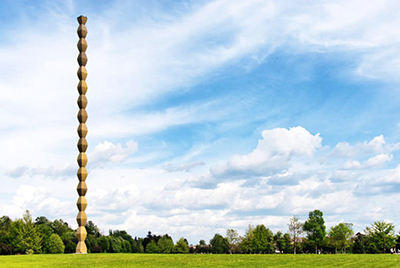
At the eastern end of the Avenue of Heroes in Târgu Jiu, Romania, Constantin Brâncuși’s Endless Column rises from the grass in a single rhythm. The gold-coloured shaft widens, narrows and widens again for nearly thirty metres. At the top it stops partway through the pattern, at a place where another piece could begin. The construction has a measurable height. The sequence it sets in motion has no obvious conclusion. [1] [2]
Made in 1937–38, the Column commemorates the defenders of Târgu Jiu in the First World War as part of the Brâncuși Monumental Ensemble. Its silhouette grew out of Brâncuși’s earlier experiments with carved wood. To realise the form at the scale of a public monument, he worked with engineer Ștefan Georgescu-Gorjan, who devised an internal steel structure to carry the cast-iron sculpture upright. Their collaboration was tested six decades later, when conservators had to decide whether the steel at the centre of the work could be saved. [1] [2] [3]
At a Glance
- ArtistConstantin Brâncuși
- Technical design and construction coordinationȘtefan Georgescu-Gorjan
- Date1937–38
- LocationPark of the Column, Târgu Jiu, Romania
- Height29.35 metres, approximately 96 feet
- MaterialsCast-iron outer modules with a gold-coloured metallic finish, a steel spine and a concrete foundation
- ConstructionSeventeen cast-iron pieces comprising fifteen full modules and two end half-modules
- World HeritageInscribed in 2024 as part of the Brâncuși Monumental Ensemble of Târgu Jiu [1] [2] [3] [4]
Contents
- How the Column creates a sense of infinity
- From a carved base to a work in its own right
- A memorial at the end of an avenue
- How Brâncuși and Georgescu-Gorjan built it
- Why the 1990s intervention was contested
- What the 2000 restoration preserved
- Looking at the Column from the park
How the Column creates a sense of infinity
Take one of the full modules on its own. It is widest at the middle, where two truncated square pyramids meet at their broad ends. Each tapers to a smaller square face. From many viewpoints that gives the piece a diamond-like outline with the tips cut off. Put another identical shape on top and the narrow end of the first becomes the narrow beginning of the second. A crest and a waist repeat at even intervals all the way up. The nomination dossier gives the full module a height of 1.80 metres, a maximum width of 90 centimetres and a minimum width of 45 centimetres. [1]
The Column’s proportions make the widening and narrowing unusually easy to read. Its full modules share a profile, so that no one of them becomes a centrepiece. A viewer looking from the park can follow the outer edge up, then follow the changing bands of light across the faces. Those two ways of reading the sculpture can give different impressions. The outline is a succession of angular reversals. Light can make one plane stand out as a bright surface while its neighbour darkens, giving the Column a more pronounced sense of relief. From some positions the bulges are apparent first. From others the narrowing joins draw the eye.
The half-modules at the two ends are crucial. The upper one leaves the sequence open by showing only part of the shape already learned from the repeats below. The eye can supply the other half and then keep going. At the bottom, a half-form with a short prismatic extension meets the ground. Brâncuși thereby leaves an impression that the pattern might have started below the surface of the park. The suggestion works in both directions even though the eye is drawn upward by the great height of the shaft. [1] [5]
The count of seventeen refers to separately cast pieces. Fifteen are full modules, and the top and bottom half-forms each count as a piece. If the half-forms are counted as parts of the repeated shape, the two together give one more full-module equivalent, making sixteen. This second count describes the geometry, rather than the inventory of iron parts. Nor is the whole monument exactly sixteen times 1.80 metres. The lower casting has an extra prismatic section, which brings that end piece to 1.45 metres. The top half is 0.90 metres. Together with the fifteen full modules, those heights give the official 29.35 metres. [1] [3] [6]
A photograph often turns the sculpture into a sequence of diamonds. From below, the same shapes gradually appear closer together as they recede upward. That change is an effect of perspective on physically repeated forms. The closer you are to the foot of the Column, the greater the apparent distance between the first elements and the last. A view from farther off makes the proportions of the whole shaft easier to grasp. Brâncuși himself made a 1938 photograph catalogued by the Centre Pompidou as a general view of the work against a dark sky. Both the choice of sky and the use of black and white invite attention to the edge and the value of the light on the metal. [7]
Even the title changed with the circumstances in which people encountered the work. Sorana Georgescu-Gorjan traces several early names. Alice Poiană used Coloana Infinitului in a letter to Brâncuși in May 1938 after seeing it at Târgu Jiu. A newspaper that October used a name closer to “endless pillar.” In an autobiographical account dictated to the composer Marcel Mihalovici, Brâncuși settled on the French sans fin, or “without end,” according to Georgescu-Gorjan. The difference between the names is small but instructive. “Infinity” names the idea evoked by the sculpture. “Without end” can describe the immediate experience of following its repeated shape to the point where the iron stops. [8]
From a carved base to a work in its own right
Years before Târgu Jiu, Brâncuși placed related shapes underneath other sculptures. A doubled pyramid could serve as one of the parts of a base. Making the same shape recur vertically gave it a stronger identity and eventually a work of its own. The development is revealing in the context of Brâncuși’s sculptures, in which the stand can affect a work’s outline, orientation and relationship to the floor as much as the object it supports. A form that had helped lift an object into view could itself become the entire subject of a sculpture. [9]
Endless Column, version I, 1918
The Museum of Modern Art’s Endless Column, version I, in New York is the earliest surviving version of the motif according to the museum. The work is oak and stands 203.2 centimetres high. Its upright scale is close enough to human height to permit comparison with the body, and its carved surface gives the recurrent shape the texture and variation of a piece of timber. The two metres of oak are already enough to establish an apparently extendable rhythm. The artist would spend years exploring what happened to that rhythm when its size, position and surroundings changed. [9]
A person standing near the oak sculpture can see much of the work relatively close to eye level. At Târgu Jiu, even a single full module is almost the height of the entire MoMA column. The repeated shape has remained legible at both scales, but anyone beneath the iron monument has to tilt their head to follow the sequence upward. This bodily difference is part of what the change of scale accomplished. [1] [9]
The column at Edward Steichen’s garden in Voulangis
A second distinct object stood outdoors in Voulangis, France, at the home of photographer Edward Steichen. A photograph by Brâncuși held by the Centre Pompidou records it there in the summer of 1926. Its title identifies the point of view as inside Steichen’s house. The photograph documents the move into a garden setting as well as the artist’s interest in how the work could be framed from a particular position. The wood column at Voulangis preceded the Romanian memorial and belonged to a different setting and purpose. [10]
A garden introduces views across a distance along with a sky, planted ground and shadows that change over a day. Brâncuși could see the upright form among those elements and photograph it as part of an environment. The exercise was important for a design whose visual effect depends on how much ground and sky the eye takes in with the sculpture. At Târgu Jiu that relation would become part of a path across a town, with room around the shaft to see it both at a distance and close to the base. [1] [10]
La Colonne sans fin III, before 1928
The Centre Pompidou has also documented La Colonne sans fin III, a separate wooden version dated before 1928 and standing just over three metres high. The museum’s account of Brâncuși’s studio lists columns alongside other works and records versions in wood and plaster. This variety helps explain how Brâncuși developed the idea. He could change the number of units, vary a material or alter how the sequence met the floor and still preserve the relation of a wide middle to narrow ends. [11] [12]
The earlier works are finished sculptures in their own right, and there were also models made for future work. The distinction matters for Târgu Jiu. The artist’s wooden study for the foundry workers in 1937 belonged to the making of that commission. The MoMA and Pompidou works already had their own identity before the casting and assembly of the Romanian Column. The repeated profile links the objects, while their scale, materials and ways of being made distinguish them. [1] [9] [11] [12]
By 1933 Brâncuși had given the prospect of enlargement a striking formulation. Romania’s nomination dossier reproduces a title from his exhibition catalogue in New York in which he imagines an enlarged column supporting the arch of the heavens. The title gives a sense of what extra height offered him well before the design was worked out in iron. The sky could become part of the subject of a sculpture whose shape had formerly been used as a base in the studio. That suggestion of support is figurative in the finished monument. At the top, the final plane stands clear in the air. [1]
A memorial at the end of an avenue
The National League of Women of Gorj initiated the Târgu Jiu commission under its president, Arethia Tătărescu. It arose from the city’s memory of the First World War, particularly the fighting in 1916. The World Heritage Committee describes the memorial’s dedication as encompassing soldiers, police and civilians who died defending the city. Sorana Georgescu-Gorjan’s account of the commission traces Brâncuși’s acceptance in 1935 and describes how an initial focus on the Column developed into a larger project. The monument’s repeat form thus came to stand within a setting with a distinct commemorative purpose. [1] [2] [8]
At the western end of the ensemble, near the River Jiu, the Table of Silence gathers its seats around a low stone circle. Farther along, the Gate of the Kiss gives the visitor an opening to pass through. The Avenue of Heroes, also called Calea Eroilor, carries the line east through the town towards the Column. The final monument takes up very little ground relative to its great reach above the park. From a route that has provided successive places for the eye and body to pause, the sculpture gives the eye its longest upward movement. [1] [2]
The choice of park gives the work room to be seen as a whole. At some distances its edge makes a slender zigzag against the sky, and from nearer the entrance the bands across the surface become more apparent. Approaching through the town also gives the work scale. The surrounding buildings and horizontal ground provide a measure for the rising shaft. The World Heritage Committee drew particular attention to that relationship among monument, landscape and urban setting when it inscribed the ensemble as a whole in 2024. [1] [2] [4]
The ground Brâncuși chose for the Column in July 1937 was a former cattle market on raised land above the river terrace. The nomination dossier records that he called it the Hay Market on account of the haystacks there. Landscape architect Rebhuhn’s design for the Park of the Column used an approximately triangular area. An approach from the west follows the line of the avenue, while the paths near the monument allow it to be seen from several sides. The site can therefore bring the outline of the Column into focus on a single axis and also open up the range of angles through which its metal surfaces can be seen. [1]
The memorial purpose sheds light on the title without dictating a single reading. A vertical series with no apparent end can suggest the endurance of memory beyond the individual lives commemorated. Some interpreters have placed more emphasis on the journey upward. Sorana Georgescu-Gorjan recounts Mircea Eliade’s association of the Column with a Romanian sky-column motif and a world axis linking earth and heaven. She also records Petru Comarnescu’s reading of the work as a funerary pillar and ladder to the sky. These are readings of the shape in its setting. The dedication and location are documented facts. [2] [8]
The decision to make the form abstract has consequences for the way it commemorates. Every full module is effectively accorded the same rank in the stack. There is no principal figure at the top to draw attention away from the repetition. At the scale of the whole work, the variants that matter are the changes in light, the foreshortening as the eye travels upward and the half-shapes at the ends. In this setting it is possible to read the recurring form as a collective memorial without assigning one piece to one person, year or event. None of those assignments is needed to explain the documented count. [1] [2]
How Brâncuși and Georgescu-Gorjan built it
Brâncuși supplied the sculptural conception and worked out the visible profile and proportions. The Romanian nomination describes him working in linden wood in 1937 on a model to guide the makers. Georgescu-Gorjan developed the technical design and coordinated the work. Castings were made at the Central Workshops in Petroșani, an industrial works experienced in mining equipment. The project put the resources of a foundry and an engineering shop to work on a shape that had first been developed through carving. [1] [3] [8]
Direct carving and casting present different problems. In the oak sculpture at MoMA, the repeated contours are worked in wood. In the Romanian Column the visible continuity had to be produced across a set of bulky pieces. Each one had to fit over the central structure and bear evenly against its neighbours. At the same time, the joins needed to sit within the rhythm of the design. The narrow meeting faces gave the builders a place for those joints at the recurring waists, where the observer already sees one side of the profile give way to the next. [1] [3] [9]
A stepped concrete foundation anchors the structure. A square-section steel pillar rises from it inside the shell of cast iron. Its three sections make up the spine, which disappears from sight once the hollow modules are in place. Guided around the pillar, the castings bear vertically on one another. Connections to the spine allow horizontal forces such as wind loads to be transferred to the structure inside. Romania’s nomination records that casting and on-site assembly took place in autumn 1937, with the surface metallisation following in 1938. [1] [3]
The mechanical division tells us something about the appearance. At the base there is little visual suggestion of the size or weight of the foundation. We see the lower metal shape meet the ground and the first of the narrow joints. What steadies the work is below the surface of the park and inside the shaft. Brâncuși was able to preserve the impression of a continuous carved form at outdoor scale because the buried and concealed parts let the visible body stand without external braces. [1] [3]
What gives the Column its colour?
The outer pieces are cast iron beneath a metallic surface treatment. Brâncuși specified a yellow colour for the metallisation in his correspondence. Romania’s nomination describes application by spraying in 1938 and records later restoration evidence for a zinc layer beneath a brass coating. ICOMOS describes the visible result as gold-coloured brass. That distinction between underlying casting and surface is central to the work’s character. Brâncuși could choose a tone for the sculpture independently of the metal that made its serial casting feasible. [1] [13]
The finish changes the way the planes read in the open. In direct light the brightest faces can appear markedly different from a face turned away from the sun. Under an even sky the division may be more subtle and the silhouette more prominent. The yellow surface is also vulnerable to weathering, and metal deteriorates differently where water or moisture is able to collect. The Column’s maintenance has therefore had to address its appearance and the protective work done by the coating. [1] [5] [6]
The sculpture in the wind
A very slender structure responds to more than a steady push. A wind gust can set it vibrating. The motion can vary with wind direction, with the distribution of weight and with the shape that the air meets. The engineer Giovanni Solari’s published analysis includes wind-tunnel work and compares the behaviour of the assembled Column with that of the bare spine. The experiments found the assembled profile substantially less susceptible to a form of wind-driven oscillation known as galloping. When the castings were removed, the exposed steel could be more vulnerable to it. [14]
The steel spine steadies the stack, and the mounted castings change the way the wind acts on the structure. Solari’s comparison also explains a particular risk of conservation work. An engineering conclusion about the assembled monument may cease to apply to the temporarily stripped structure. Its stability during dismantling and reassembly presented a separate question from its long-term condition. [3] [14]
Solari pursued the wind-tunnel study after the Column had been reassembled. One experiment used a scaled model representing three full modules. That section preserved the local changes in width along the silhouette so the team could measure how the air acted on surfaces shaped like Brâncuși’s castings. The study combined experiments with calculations of the response of the full-height structure. For art history the finding is striking in its own right. The widening and narrowing that we recognise as Brâncuși’s signature in the work also affect the loads the finished sculpture experiences outside. [14]
Why the 1990s intervention was contested
By the second half of the twentieth century the Column needed attention to its protective finish. Georgescu-Gorjan supervised an intervention in 1965 that renewed the surface treatment. In 1984 Romania’s national construction research institute, INCERC, investigated the structure. The nomination dossier says the assessment judged the condition good and called for corrosion protection on the central pillar and renewed metallisation of the castings. Emil Sever Georgescu’s engineering account for AGIR also emphasises the 1984 finding that the Column was in no critical structural condition and argues that the decision to dismantle it in 1996 was unwarranted. [1] [3]
The 1996 World Monuments Watch listing focused international attention on deterioration in the ensemble. That year the outer modules were removed to allow investigation of the spine and other parts of the structure. The proposal that followed envisaged replacing the original central pillar with a stainless-steel one. Advocates of preserving the old pillar argued that it embodied Georgescu-Gorjan’s solution to the commission and formed part of the original monument’s fabric. A replica concealed beneath the iron might have preserved the silhouette while losing that particular record of how the original was made. [1] [5] [6] [14] [15]
The World Monuments Fund’s 1998–99 Watch catalogue captures the project while it was still unresolved. Its entry describes disassembled parts and treats a stainless-steel spine as work ahead. The announcement predates the 1999 meeting and the treatment that followed. Reading this catalogue alongside the restorers’ published report makes it possible to trace the change in approach. The earlier publication records what was then expected. The later report documents what the engineers actually reinforced and put back into service. [15] [16]
Accounts of the period answer different questions. The AGIR paper weighs the case for dismantling in light of what INCERC had found in 1984. The World Monuments Fund reporting describes the preservation effort and the work needed to address the Column’s condition. An earlier inspection, a later examination of the exposed structure and a decision about treatment at the end of the decade were separate events. The record supports the need for conservation and documents objections to the scale of the initial intervention. The presence of the first problem did not by itself resolve the second. [1] [3] [6] [14] [15]
What to do with the finish was another question. The goal of recovering a protective, gold-toned surface had to be reconciled with the survival of the original metal beneath it. Art historian Alexandra Parigoris reports that Marielle Tabart of the Centre Pompidou drew the 1999 meeting’s attention to Brâncuși’s own photographs as evidence for the surface’s appearance. A black-and-white print can show tonal differences and how much light a face reflects. For the coating’s composition, conservators also had the surviving material to examine. [1] [5] [7]
What the 2000 restoration preserved
Following expert assessment and an international workshop in 1999, the restoration kept the original steel spine in place and strengthened it. The project team’s published account and Romania’s nomination dossier document the decision to retain and repair it. The team reinforced the lower part of the pillar and treated deteriorated areas. The work then returned the conserved castings to their places on the shaft. The central engineering achievement thus survived together with the visible form that it had made possible. [1] [6] [15]
The intervention was concentrated low down because that was where the project engineers identified the part of the pillar with the least margin under their calculations. Their account describes renewing some of the horizontal welded joints and using higher-strength steel plates in the critical area. The later pieces were marked so that someone examining the structure could distinguish them from the original. Replacement at the scale of a few plates had a different consequence from replacing the pillar. It allowed a conservative structural design to retain the arrangement, position and much of the original fabric of Georgescu-Gorjan’s spine. [1] [15]
The European Heritage Awards archive records treatment of all seventeen cast-iron pieces and welding repairs to four damaged ones. The components received a protective coating, while measures to improve ventilation and drainage addressed the environment inside the reassembled shaft. The Column’s lightning protection was also renewed. To the eye these changes can be hard to detect. They deal with how a hollow outdoor sculpture weathers, including risks inside the body that a viewer cannot judge from the sheen of its surface alone. [1] [6] [15] [17]
Conserving the shape of those pieces also meant paying attention to irregularities in the cast iron. The World Monuments Fund’s account describes cleaning and repairing the modules before recoating. Small pits and voids that belonged to the cast surface were left in place. At normal viewing distance the eye registers the ordered repetition and colour. Close to the surface, retaining the casting texture preserves evidence of how each of those seemingly identical elements was made. Treating damage and keeping that evidence were both part of the work. [6]
The date consistently attested for the restored Column’s return is December 2000. Parigoris gives 15 December for the end of the works, while the European Heritage Awards entry records 17 December as the project completion date. These accounts use slightly different dates for completion. The larger ensemble underwent work over a longer period. The award entry dates to 2001, and the World Heritage inscription of the ensemble followed in 2024. [1] [4] [5] [6] [17]
The restoration gave the hidden pillar a place in the public understanding of the artwork. Whatever a spectator knows about the steel, the stacked contours remain the first thing to see. But the debate showed how much of the monument’s identity resides in the method of construction as well as the profile. For this sculpture, retaining the original engineer’s solution was a way of preserving a part of Brâncuși’s collaboration that leaves almost no visible trace from across the park. [5] [14] [15]
Looking at the Column from the park
Start at a distance far enough for the Column to fit easily into one glance. Its profile is clearest where there is an unobstructed stretch of sky behind it. Follow a single edge from the grass to the uppermost half-form. There is a regular alternation of outward and inward slopes, but the view of the top changes as you move. Seen close by, it is an abrupt point of arrival for your eye. From farther back it can seem like a place at which the next full form might begin.
Walk closer and look for the difference between the bottom shape and the one at the top. The lower casting extends down below its half-module profile, and the top ends after its half-module. The resulting asymmetry is small beside the regularity of fifteen intervening full shapes. Once it is visible, it becomes easier to see how the work joins the earth while implying further extension above it. The grass may read as a horizontal line that interrupts a longer sequence. [1] [5]
Then move sideways and watch which faces catch the light. The silhouette will still give you a narrow, rising outline, but the ridges and oblique surfaces are revealed differently as the viewing angle changes. Finally, look back along the Avenue of Heroes. The walk puts the Column in relation to ground, trees, street and the two low stone compositions nearer the river. Its great height gains meaning through encountering the other spaces at walking pace. [1] [2]
Browse sculptures and drawings
Browse articles on the sculptures and separately catalogued museum objects. A work can have several physical versions. Drawing records from the Tate catalogue retain their October 2014 snapshot wording where present.
| Name | Date | Medium |
|---|---|---|
| Arch | Sculpture | |
| Bird in Space | Sculpture | |
| The Blond Negress | Sculpture | |
| The Cock | Sculpture | |
| The Endless Column | Sculpture | |
| The First Cry | Sculpture | |
| Fish | Sculpture | |
| The Gate of the Kiss | Sculpture | |
| Golden Bird | Sculpture | |
| Head | Sculpture | |
| The Kiss | Sculpture | |
| Leda | Sculpture | |
| Madame L.R. | Sculpture | |
| Mademoiselle Pogany II | Sculpture | |
| Mademoiselle Pogany | Sculpture | |
| Maiastra | Sculpture | |
| The Newborn | Sculpture | |
| Phoque II | Sculpture | |
| The Prayer | Sculpture | |
| Princess X | Sculpture | |
| Prometheus | Sculpture | |
| Târgu Jiu monumental ensemble | Sculpture | |
| Sculpture for the Blind | Sculpture | |
| The Seal | Sculpture | |
| The Signal | Sculpture | |
| Sleeping Muse | Sculpture | |
| The Sorceress | Sculpture | |
| The Table of Silence | Sculpture | |
| Torso of a Young Man | Sculpture | |
| Two Lamps | Sculpture | |
| Vitellius | Sculpture | |
| The White Negress | Sculpture | |
| The Wisdom of the Earth | Sculpture | |
| Young Bird | Sculpture | |
| The Kiss (Philadelphia, fourth version) | 1916 | Sculpture Catalogue. |
| Sleeping Muse (Pompidou bronze) | 1910 | Sculpture Catalogue. |
| Mlle Pogany, version I (MoMA bronze) | 1913, after a marble of 1912 | Sculpture Catalogue. |
| Maiastra (Venice brass) | about 1912 | Sculpture Catalogue. |
| Bird in Space (MoMA bronze) | about 1941 | Sculpture Catalogue. |
| Bird in Space (Venice brass) | 1932–40 | Sculpture Catalogue. |
| Endless Column, version I (oak) | 1918 | Sculpture Catalogue. |
| Brâncuși Monumental Ensemble of Târgu Jiu | 1937–38 | Sculpture Catalogue. |
| Bust of a nude woman in profile, head inclined | about 1910 | Drawing Catalogue. |
| Nude study, head inclined (recto) | — | Drawing Catalogue. |
| Self-portrait (ink) | — | Drawing Catalogue. |
| View of the Artist’s Studio | 1918 | Drawing Catalogue. |
| Study for the cock (lost clay Grand Coq) | about 1923 | Drawing Catalogue. |
| Portrait of a woman in profile | — | Drawing Catalogue. |
| Animal head | — | Drawing Catalogue. |
| Animal sketch (2002 checklist) | 1929 | Drawing Catalogue. |
| Plans of the studio (verso) | about 1930–38 | Drawing Catalogue. |
| Danaïde (Tate T00296) | c.1918 | Sculpture Catalogue. |
| Maiastra (Tate T01751) | 1911 | Sculpture Catalogue. |
| Head (Tate T03066) | c.1919–23 | Sculpture Catalogue. |
| Fish (Tate T07107) | 1926 | Sculpture Catalogue. |
Frequently Asked Questions
There are seventeen separate castings. Fifteen are full modules, and each end has a half-module. Taken together the two end forms make one full-module equivalent, giving sixteen in terms of the repeated pattern. For the overall height, the lower end also includes a short prismatic extension. [1] [3] [6]
Discussion
Look again at the images and ideas explored in The Endless Column. These editorial prompts invite your observations.
Reader Insights
How does the Column change as you move between the avenue and the park?
Which details would you compare on the oak column and the Târgu Jiu monument?
Join the Conversation
Share a detail, comparison or question about The Endless Column below.
References
- Romania, Brâncuși Monumental Ensemble of Târgu Jiu: Nomination for Inscription on the World Heritage List, especially pp. 11–13, 33–40, 53–54 and the conservation section. Nomination dossier View source.
- World Heritage Committee, Decision 46 COM 8B.24, 2024. Inscription decision and statement of outstanding universal value View source.
- Emil Sever Georgescu, Ingineria Coloanei Infinite de la forma dată de Constantin Brancuşi la structura inovativă realizată de inginerul Ştefan Georgescu-Gorjan. Buletinul AGIR, no. 1, 2019. Engineering paper and bilingual abstract View source.
- UNESCO World Heritage Centre, Brâncuși Monumental Ensemble of Târgu Jiu. World Heritage List entry View source.
- Alexandra Parigoris, Endless Column Restored, 2002. On-site report in Sculpture View source.
- World Monuments Fund, The Restoration of Brancusi’s “Endless Column”, Târgu-Jiu, Romania, 2006, reproduced in the Romanian nomination annexes. See also the restoration notes in Icon, p. 37, reproduced in the same annexes. Conservation report and annexes View source.
- Centre Pompidou, Constantin Brâncuși, Vue générale sur ciel sombre de La Colonne sans fin de Târgu Jiu, 1938, PH 561 A. Photograph catalogue record View source.
- Sorana Georgescu-Gorjan, Ansamblul brâncușian de la Târgu-Jiu. Centrul de Cercetare, Documentare și Promovare „Constantin Brâncuși”. Commission history and interpretations View source.
- The Museum of Modern Art, Constantin Brancusi, Endless Column, version I, 1918, 645.1983. Object record and gallery labels View source.
- Centre Pompidou, Constantin Brâncuși, La Colonne sans fin de Voulangis vue de l’intérieur de la maison de Steichen, summer 1926, PH 542 B. Photograph catalogue record View source.
- Centre Pompidou, Modernités plurielles, installation guide, entry for La Colonne sans fin III. Exhibition guide View source.
- Centre Pompidou, Visite de l’atelier Brancusi, item 7. Studio guide View source.
- ICOMOS, Brâncuși Monumental Ensemble of Târgu Jiu, evaluation for the World Heritage Committee, 2024. Advisory body evaluation View source.
- Giovanni Solari, Brâncuşi Endless Column: A Masterpiece of Art and Engineering. International Journal of High-Rise Buildings, vol. 2, no. 3, 2013, pp. 193–212, reproduced in the Romanian nomination annexes. Structural and wind-engineering study View source.
- Mircea and Rodica Crișan, An Exceptional Experience of Structural Restoration: The “Endless Column” of Constantin Brâncuși. Transsylvania Nostra, no. 1, 2007, pp. 7–11, reproduced in the Romanian nomination annexes. Project team’s restoration account View source.
- World Monuments Fund, World Monuments Watch 1998–1999 List of 100 Most Endangered Sites, site no. 74, printed p. 50. Contemporary Watch catalogue View source.
- European Heritage Awards Archive, Endless Column Restoration, Târgu Jiu, HA 2001/RU/01. Award record and project description View source.
More BRÂNCUȘI Sculptures
Bird in Space
Compare the marble and metal versions of Brâncuși’s sculpture.