 by Tom Gurney
Tom Gurney BSc (Hons) is an art history expert with over 20 years experience
Published on June 19, 2020 / Updated on November 29, 2026
Email: tomgurney1@gmail.com / Phone: +44 7429 011000
The Cock: Introduction
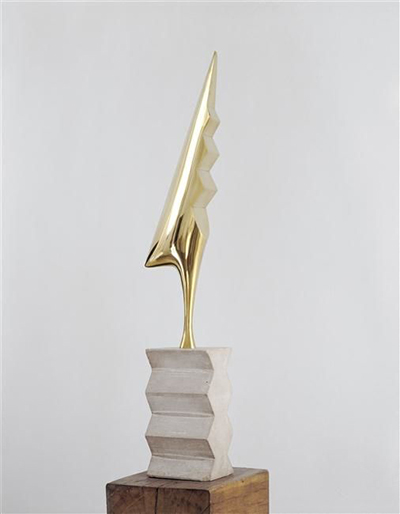
Constantin Brâncuși made the rooster recognizable by a single feature, the jagged comb that crowns its head. In the 1924 wooden Cock at the Museum of Modern Art in New York, that jagged line climbs above a cylindrical foot cut from the same block. In the Centre Pompidou’s polished bronze of 1935, the figure stands straighter and the shape of its comb finds an echo in its tall pedestal. The two are part of a longer study that eventually produced plaster roosters more than four metres tall. [1] [2] [3]
At a Glance
- ArtistConstantin Brâncuși
- TitlesThe Cock, Le Coq, also translated as Rooster
- New York version1924, cherry wood according to MoMA, accession 620.1959
- Paris version1935, polished bronze on limestone and oak, Centre Pompidou AM 817 S
- Related monumental workGrand Coq IV, 1941–52, plaster, Centre Pompidou AM 4002-116
- Distinguishing featureA rising sawtooth profile derived from the rooster’s comb
Contents
- A Rooster Drawn in Profile
- The 1924 Carving in New York
- Bronze, Limestone and Oak in 1935
- A Rooster at Architectural Scale
- What the Cock Shares with Brâncuși’s Other Birds
A Rooster Drawn in Profile
A rooster’s body, folded wings and legs would give a naturalist sculptor a wide range of starting points. Brâncuși put much of the work of recognition into the line across the top. In profile, a run of sharply changing angles extends along the back and gathers into a rising silhouette. The points are few and large enough to register from some distance. A viewer who knows the title can see a rooster’s comb, yet the same outline also establishes a sequence of directions for the eye to follow. The bird could be recognized quickly while the decisions that made the shape hold together reward a longer look. [1] [2]
Brâncuși had used a heavier profile before. The Centre Pompidou identifies a lost wooden Coq gaulois of 1922 with four sawtooth edges. Its account describes the silhouette of the 1924 work as more extended in the rear, with the length of the tail accentuating the slant of the back. Those changes show how much could happen within a subject when the individual details had already been reduced. One edge fewer alters the spacing of the points. A shift in the tail changes where the viewer locates the bird’s weight, even though the foot still carries it firmly. [2]
The 1924 Carving in New York
MoMA measures its carving at 121 × 46.3 × 14.6 centimetres. The contrast between its width and depth helps account for the two different impressions it makes as one moves around it. In profile the jagged edge commands attention and the body has room to extend toward the tail. A more end-on view compresses the drawing and gives the thickness of the wood greater importance. The cylindrical foot gives those views a shared starting point. MoMA identifies it as part of the same piece of wood as the rooster. The junction between bird and ground is therefore also a passage between two shapes cut out of one material. [1]
There is a material discrepancy in the catalogues. MoMA, which holds the carving, names cherry and specifies wild cherry in its gallery text. The Centre Pompidou’s essay on the 1935 bronze calls the New York work walnut. The two sources point to the same Paris carving dated 1924. MoMA also identifies it as the only surviving wooden Cock and traces its 1959 acquisition to the artist’s heirs, listing LeRay W. Berdeau in the credit. The wood label and the ownership details belong to this object. A French title on another record is insufficient to transfer either of them to a different sculpture. [1] [2]
Bronze, Limestone and Oak in 1935
The bronze in the Centre Pompidou derived from a plaster model preserved in the studio and catalogued separately as AM 4002-115. The metal bird is 103.4 centimetres tall. Its limestone-and-oak support adds 150 centimetres, giving a total height of 253.4 centimetres. Reading the figures separately is important. The metal figure by itself is shorter than MoMA’s carving including its integral foot. Mounted as recorded, the Paris sculpture occupies substantially more space above the ground and the viewer can take in its ascending profile across both bird and base. [1] [2]
The Centre Pompidou records four pedestal elements, including a sawtooth limestone piece and a zigzag in oak. They repeat the directional changes of the silhouette at different intervals and in different materials. A block with a level face briefly interrupts that rhythm, so the repeated angles are easier to pick out. The polish introduces a further change. Movement around the piece brings different patches of light into view on the face of the metal, while the outline drawn against the room remains comparatively sharp. This gives the bronze an effect that can shift with the display, even though the figure itself remains still. [2]
The museum acquired the work in 1947. The Neue Nationalgalerie’s 2026 exhibition checklist identifies the lender and the same inventory number, lists the metal and base measurements separately, and gives Hahn and Rooster as the German and English titles. The exhibition set it within a group of animal subjects that included a wooden turtle and a marble seal. In that company, the cock’s vertical emphasis becomes especially easy to see. The seal takes up a broad plane close to its circular base. The cock leads the eye up past a succession of supports before it reaches the peak of the bird. [2] [4]
A Rooster at Architectural Scale
The small plaster associated with the casting and the studio’s Grand Coq plasters played different roles. The Centre Pompidou records the former as a model for the 1935 bronze. It identifies Grand Coq IV, worked on between 1941 and 1952, as a sculpture in plaster set on a cylindrical support, with 485 centimetres listed as the height of the figure and another 45 centimetres recorded for that support. A studio view on the museum’s record shows four named versions standing together. Seeing their differing heights and profiles in one room helps explain why an account of The Cock needs several dates and several descriptions of materials. [3] [5]
At several metres tall, the upright form implies a different relationship to the ground. A viewer close to it would have to look up along the length of the body to register its final point. From farther away, the profile could be read more nearly as a whole. The artist considered a stainless-steel realization of the last version for France. The Centre Pompidou records that this particular project remained unrealized during his lifetime. The surviving plaster allows the proposed scale to be understood through a tangible object, while the projected steel belongs to the history of his plans. [2] [3]
What the Cock Shares with Brâncuși’s Other Birds
The two MoMA works The Cock and Bird in Space are separated by only a few years, yet they offer different ways for a form to rise. In the museum’s 1928 bronze Bird in Space, the viewer can follow a smooth taper. In the wooden Cock, a viewer moving up the outline keeps meeting breaks and turns. Their common interest in elevation can therefore be studied precisely, without treating all the artist’s upright birds as examples of the same design. One carries the eye along a gradual curve. The other takes it through a sequence of angular changes. [1] [6]
The Centre Pompidou curator Philippe-Alain Michaud places the cock within a body of work that includes creatures from the air and water, moving between the study of an animal’s characteristic action and its symbolic possibilities. The implication for looking at The Cock is that its points can suggest a living creature in an emphatic pose even when most of its anatomy has disappeared. A connection to a rooster’s cry or alert stance can arise from the form itself. MoMA reports that Brâncuși purportedly identified himself with the rooster. That story offers one way of understanding his sustained interest in the subject. The carving, bronze and monumental plasters give independent evidence of the many ways he pursued it. [1] [7]
Browse sculptures and drawings
Browse articles on the sculptures and separately catalogued museum objects. A work can have several physical versions. Drawing records from the Tate catalogue retain their October 2014 snapshot wording where present.
| Name | Date | Medium |
|---|---|---|
| Arch | Sculpture | |
| Bird in Space | Sculpture | |
| The Blond Negress | Sculpture | |
| The Cock | Sculpture | |
| The Endless Column | Sculpture | |
| The First Cry | Sculpture | |
| Fish | Sculpture | |
| The Gate of the Kiss | Sculpture | |
| Golden Bird | Sculpture | |
| Head | Sculpture | |
| The Kiss | Sculpture | |
| Leda | Sculpture | |
| Madame L.R. | Sculpture | |
| Mademoiselle Pogany II | Sculpture | |
| Mademoiselle Pogany | Sculpture | |
| Maiastra | Sculpture | |
| The Newborn | Sculpture | |
| Phoque II | Sculpture | |
| The Prayer | Sculpture | |
| Princess X | Sculpture | |
| Prometheus | Sculpture | |
| Târgu Jiu monumental ensemble | Sculpture | |
| Sculpture for the Blind | Sculpture | |
| The Seal | Sculpture | |
| The Signal | Sculpture | |
| Sleeping Muse | Sculpture | |
| The Sorceress | Sculpture | |
| The Table of Silence | Sculpture | |
| Torso of a Young Man | Sculpture | |
| Two Lamps | Sculpture | |
| Vitellius | Sculpture | |
| The White Negress | Sculpture | |
| The Wisdom of the Earth | Sculpture | |
| Young Bird | Sculpture | |
| The Kiss (Philadelphia, fourth version) | 1916 | Sculpture Catalogue. |
| Sleeping Muse (Pompidou bronze) | 1910 | Sculpture Catalogue. |
| Mlle Pogany, version I (MoMA bronze) | 1913, after a marble of 1912 | Sculpture Catalogue. |
| Maiastra (Venice brass) | about 1912 | Sculpture Catalogue. |
| Bird in Space (MoMA bronze) | about 1941 | Sculpture Catalogue. |
| Bird in Space (Venice brass) | 1932–40 | Sculpture Catalogue. |
| Endless Column, version I (oak) | 1918 | Sculpture Catalogue. |
| Brâncuși Monumental Ensemble of Târgu Jiu | 1937–38 | Sculpture Catalogue. |
| Bust of a nude woman in profile, head inclined | about 1910 | Drawing Catalogue. |
| Nude study, head inclined (recto) | — | Drawing Catalogue. |
| Self-portrait (ink) | — | Drawing Catalogue. |
| View of the Artist’s Studio | 1918 | Drawing Catalogue. |
| Study for the cock (lost clay Grand Coq) | about 1923 | Drawing Catalogue. |
| Portrait of a woman in profile | — | Drawing Catalogue. |
| Animal head | — | Drawing Catalogue. |
| Animal sketch (2002 checklist) | 1929 | Drawing Catalogue. |
| Plans of the studio (verso) | about 1930–38 | Drawing Catalogue. |
| Danaïde (Tate T00296) | c.1918 | Sculpture Catalogue. |
| Maiastra (Tate T01751) | 1911 | Sculpture Catalogue. |
| Head (Tate T03066) | c.1919–23 | Sculpture Catalogue. |
| Fish (Tate T07107) | 1926 | Sculpture Catalogue. |
Frequently Asked Questions
Discussion
Look again at the images and ideas explored in The Cock. These editorial prompts invite your observations.
Reader Insights
How does the integral base of the carving affect your sense of balance compared with the layered pedestal of the bronze?
Which view of the work makes the rooster most recognizable, and what changes as you move away from that view?
What happens to the sense of rhythm when you compare the stepped contour with the long taper of Bird in Space?
Join the Conversation
Share a detail, comparison or question about The Cock below.
References
- The Museum of Modern Art, The Cock (1924), 620.1959 View source.
- Centre Pompidou, Le Coq (1935), AM 817 S View source.
- Centre Pompidou, Grand Coq IV, AM 4002-116 View source.
- Neue Nationalgalerie, Brancusi exhibition checklist, 2026 View source.
- Centre Pompidou, Grand Coq I, AM 4002-112 View source.
- The Museum of Modern Art, Bird in Space (1928), 153.1934 View source.
- Philippe-Alain Michaud, Le bestiaire poétique de Constantin Brancusi, Centre Pompidou View source.
More BRÂNCUȘI Sculptures
Bird in Space
Compare the marble and metal versions of Brâncuși’s sculpture.