 by Tom Gurney
Tom Gurney BSc (Hons) is an art history expert with over 20 years experience
Published on June 19, 2020 / Updated on November 29, 2026
Email: tomgurney1@gmail.com / Phone: +44 7429 011000
Maiastra: Introduction
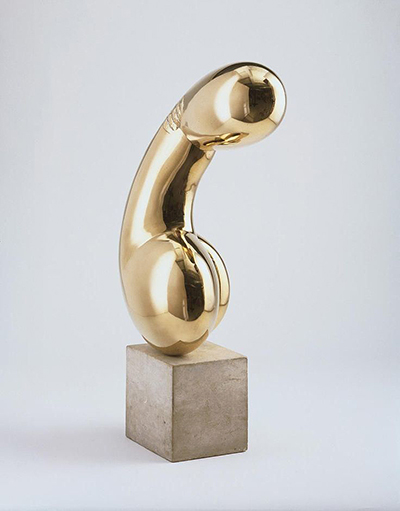
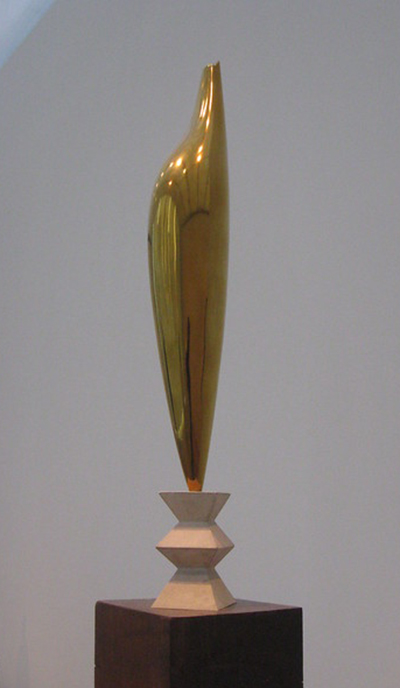
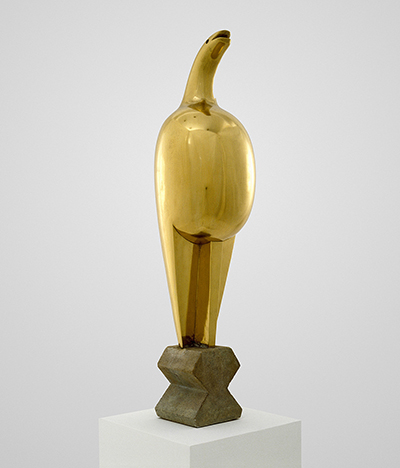
A bird lifts its head above a rounded breast and opens its beak. In Constantin Brâncuși’s Maiastra, that small adjustment gives a stationary sculpture the expectancy of a creature about to sing. Brâncuși began making versions around 1910 and drew the title from Romanian folklore. The bird he carved in white marble at the Museum of Modern Art, the polished bronze in Washington and the polished brass in Venice make the same gesture with different effects of weight, light and height. [1] [2] [3]
At a Glance
- ArtistConstantin Brâncuși (1876–1957)
- SubjectThe enchanted bird known in Romanian as pasărea măiastră. [1] [2] [3]
- MoMA, New York1910–12. White marble, 55.9 cm high, on a three-part limestone pedestal 177.8 cm high. Katherine S. Dreier Bequest, 144.1953.a-d. [1]
- National Gallery of Art, Washingtonc. 1911. Polished bronze, 55.9 × 18.9 × 18.7 cm, with a separately measured rectangular marble base. Gift of Katharine Graham, 1980.75.1. [2]
- Tate, London1911. Bronze on limestone, 90.5 × 17.1 × 17.8 cm with base. T01751. [4]
- Peggy Guggenheim Collection, Venicec. 1912. Polished brass on limestone, 76 × 18.5 × 20.3 cm overall as catalogued. 76.2553 PG 50. [3]
- Related worksGolden Bird, 1919/20, Art Institute of Chicago, and Bird in Space, 1923, Metropolitan Museum of Art. [5] [6]
Contents
- The bird in the Romanian tale
- The white marble at MoMA
- Bronze in Washington and London, brass in Venice
- Two workshop records in Paris
- From Maiastra to Golden Bird
- How Bird in Space changes the gesture
The bird in the Romanian tale
The Romanian expression pasărea măiastră names a marvellous or enchanted bird. The second word carries a sense of exceptional skill as well as magic. In Studii folklorice, the Romanian folklorist Lazăr Șăineanu notes that the adjective can describe beings with magical powers and cites examples from spells, stories and a funeral lament. The bird belongs to a vocabulary of powers that ordinary creatures lack. English museum labels that use master bird and those that describe a magic bird capture different parts of that association. [2] [3] [7]
Petre Ispirescu’s collected tale Pasărea măiastră begins with a ruler who builds a monastery whose tower repeatedly collapses. He dreams that it can be finished if a bird from the other world is brought there and allowed to nest in the tower. His sons go in search of it. In that telling, the youngest prince advances through a series of encounters in which the help of other creatures and the harm done by his brothers are as important as the difficulty of reaching the bird. Finding it is the object of a quest, and bringing it to its appointed height is bound up with the completion of a building. [8]
There are other ways of telling the story. The Art Institute of Chicago refers to a bird that leads a prince to a princess. The Peggy Guggenheim Collection stresses its brilliant plumage and the restorative power of its song. In the National Gallery of Art’s account, the Paris production of Stravinsky’s The Firebird in 1910 offers a possible parallel from Russian folklore. The Romanian title establishes the sculpture’s clearest cultural connection. Ispirescu’s tale is one documented version that can be read alongside the sculpture, and the Paris ballet is a possibility raised by the museum. [2] [3] [8] [5]
The physical relationship between bird and tower in Ispirescu is especially suggestive beside the tall New York sculpture. There the small white bird occupies the top of a construction that has been assembled from three pieces of limestone. A reader who knows the tale may bring that association to the work, although the pedestal has a documented history of its own. Seen from the floor, its height also makes the viewer look up and approach a familiar bird posture as an encounter with something overhead. [1] [8]
The white marble at MoMA
Start with the marble and follow the profile from the support to the rounded chest. From the broad body the outline tightens into the neck and changes direction at the lifted head. The short incision at the beak is slight in relation to the volume below it. It gives the turn of the head a specific action, like the opening of a mouth just before a note, while the large chest makes that action seem to start lower in the body. MoMA also identifies the tail in the streamlined form. It provides a second direction and gives the otherwise upright figure a fore and aft. [1]
From an oblique angle, the broad curve catches enough light to describe a single, swelling volume. That continuity allows the eye to travel between body and neck with few stops. The beak interrupts the sweep, and the ledge beneath the bird gives it a place to stand. The result can suggest an alert creature without requiring a feather pattern or a modelled wing. At close range the movement is a turn of the head. At a distance the same turn caps a sculpture whose dominant direction runs upwards from the floor. [1]
The bird is 55.9 centimetres tall. Its three-part limestone pedestal adds 177.8 centimetres beneath it. The central piece, Double Caryatid, was an independent carving exhibited in 1908. A caryatid is a figure that takes the place of an architectural support. Brâncuși’s carving shows two figures bearing stone above their heads. Reused between the rectilinear limestone sections, the pair also does the visual work of holding up the marble bird. MoMA identifies this as the first time Brâncuși incorporated an existing sculpture into a pedestal, a practice he continued. [1]
The differences between the four parts remain visible. The geometrical blocks make the edges of the stack readable across a room. The heavily textured middle carving catches small shadows, and the marble at the top carries broader changes of tone. As the eye moves upwards, the change in surface makes the bird look unusually smooth and self-contained. Looking down again follows a different logic: the bird has weight, borne by the horizontal top and passed down through the standing figures. That exchange between the weight of the assembly and the bird’s apparent lightness accounts for much of the work’s scale. [1]
The Katherine S. Dreier bequest brought this marble and pedestal into MoMA’s collection in 1953. A photograph dated 1930 in the Centre Pompidou archives records the marble in Dreier’s garden in West Redding, Connecticut. The accession, 144.1953.a-d, identifies the ensemble now in New York. An illustration that crops away most of the pedestal can still show the first bird form. It also changes the proportions of the work that Dreier bequeathed, which asks the eye to spend time on a much taller structure beneath the bird. [1] [9]
Bronze in Washington and London, brass in Venice
National Gallery of Art
Washington’s Maiastra has a bird the same recorded height as the New York marble, 55.9 centimetres. The polished bronze introduces a different kind of detail. Highlights can travel across the chest as a viewer moves. Even where a bright reflection makes the edge look momentarily elusive, the opening at the beak gives the head a point of reference. The gallery describes a slight turn of the head and a subtle treatment of the eyes. Small adjustments like these matter because the chest is so unbroken. An inflection at the head can register as a change in the bird’s attention. [2]
The National Gallery illustrates the bronze on a rectangular marble block and a taller, angular wooden pedestal. Its dimensions list the bronze and the marble element separately. Seen in the gallery’s image, the wood narrows and opens again, while the pale intervening block makes the boundary with the metal easy to read. The angular cut of the wood turns the assemblage into a series of changes in width. From below, the last of those changes is the expansion of the bird’s breast. The Washington pedestal and marble block belong to the reading of that example. The supporting figures under the New York marble tell a separate story. [1] [2]
The Washington bronze has an early ownership history. Agnes Ernst Meyer bought it from Brâncuși in 1911 or 1912. She gave it to her daughter Katharine Graham in 1957 or 1958, and Graham gave it to the National Gallery in 1980. The gallery lists it as a possible exhibit at Alfred Stieglitz’s 291 in 1914. That qualified identification is useful because an early exhibition title by itself can be a poor way of telling related sculptures apart. For the Washington bronze there is also a physical identifier, the lost-wax foundry stamp of C. Valsuani recorded on the lower back. [2]
Tate
The Tate Maiastra can be identified by the number T01751. The Neue Nationalgalerie’s bilingual checklist for its 2026 Brâncuși exhibition records it as a bronze on a limestone base, dated 1911, and measures the combination at 90.5 centimetres high. That is nearly a metre for the exhibited assembly. The acquired date, 1973, belongs to Tate’s collection history. The date 1911 belongs to the work. Because Washington records the bird separately in its dimensions, a comparison of the two published heights needs to take account of what is included. [2] [4]
The Mucem in Marseille identifies the Tate sculpture as the bronze once owned by the photographer Edward Steichen. The museum dates the purchase to 1911, while MoMA’s Object:Photo chronology associates Steichen’s purchase of a bronze Maiastra with the 1913 Salon des Indépendants. A photograph taken by Brâncuși around 1920–23 documents the bird in Steichen’s garden at Voulangis, where it was shown high on a pillar. The outdoor installation gives a further sense of how much the bird’s physical address could change with its setting. A figure placed high in a garden meets the light and the viewer at different angles from the figure shown indoors on its limestone base. [4] [10] [11] [12]
Peggy Guggenheim Collection
The Venice Maiastra of about 1912 is catalogued as polished brass on limestone. The collection’s interpretive text uses the term bronze when it describes the gleaming surface, but the formal medium field specifies brass. Reading the accession entry is important here because the golden colour, visible in both brass and bronze examples, is an effect of the material and its finish. The colour alone is insufficient to identify the metal. [2] [3]
The Venice museum reads the bulging chest and open beak as the body and mouth of a singing bird. In its photograph the angle of the head carries the light up the throat to the beak, and the hard-edged shape underfoot gives the curve a firm point of contact. The reflected light calls to mind the bird’s brilliant plumage even on a smooth surface. The shape of the breast suggests a breath held in the body. In the marble comparison, the swelling contour and the shadow across it produce a comparable sense of breath without the mirror-like flashes of the metal. [1] [3]
These three metal examples make the usefulness of accession numbers especially clear. A date like 1911 points to a period of work, and the title points to a family of forms. The date alone does little to identify a cast. The number, collection, medium and measurement boundary together give a description that can be checked, and the provenance explains which object a collector or exhibition record refers to. [2] [3] [4]
Two workshop records in Paris
The Centre Pompidou preserves a plaster Maïastra dated about 1912, AM 4002-142. Its record describes an incomplete cast taken from marble. At 52 centimetres high, it is roughly the scale of the early New York and Washington birds. The plaster broadens the material history of the motif beyond the highly finished surfaces familiar in gallery photographs. Its incomplete state records a different stage of work from the level of finish in a polished metal version. [1] [2] [13]
A second Pompidou record is particularly useful for dating the motif’s afterlife. AM 4002-95 is an 89-centimetre Maïastra in blue turquin marble, catalogued in the bracketed range 1923–1940. The museum describes it as a replica after a white marble dated 1915–1918 that once belonged to Marius de Zayas. It also records separate inventory numbers for the base under the blue version and for the white version’s base, which remained in the studio. Thus two objects and two supports can figure in the history of a single design. The earlier marble’s date belongs to the model. The later range belongs to the blue marble in Paris. [14]
That later range overlaps with Brâncuși’s work on Bird in Space. The blue sculpture makes it possible to see the history as the ongoing choice of a form from several available types. He could develop the rising profile of his newer birds while revisiting an earlier body and posture. The extent of that overlap is clearer when the individual object records are read together than it is in a single line of dates attached to the three series titles. [14] [6] [15] [16]
From Maiastra to Golden Bird
In the Art Institute of Chicago’s Golden Bird, dated 1919/20 with a base of about 1922, the bird still has a trace of feet, tail and an upward-pointing beak. Its proportions draw the end points farther from the swelling centre, making the whole outline feel more stretched. Below, a hewn wooden section presents broad planes. The tree rings visible on those planes belong to the substance of the pedestal, while the polished bronze registers light and nearby colours. Both the continuation of the upturned beak and the contrast with a coarse support link the Chicago sculpture to the earlier birds. [1] [2] [5]
The Art Institute traces its example from Brâncuși to the collector John Quinn, who had acquired it by November 1920. Its exhibition records include a showing as Bird in 1922 and as Golden Bird in 1926. Title changes of that kind give a further reason to check the object’s material and ownership. A related 1919 plaster, L’Oiseau d’or, in the Centre Pompidou is described as possibly taken from the yellow marble Yellow Bird at Yale for use in casting the Chicago bronze. The word possibly matters because that is a proposed workshop relationship among objects with their own records. [5] [17]
Compare the positions of the heads in the early and intermediate forms. In the New York marble the neck is still legible as the part that lifts and turns the head. In the Chicago bronze the beak ends an extended profile, and the eye is pulled along a more continuous rise. The difference becomes particularly clear after looking at the two supports. The caryatids at MoMA interpose a recognisable action of bearing weight. The Chicago pedestal stresses the grain, cut and mass of the wood. Both compositions use the material below to make the change to the polished bird above more pronounced. [1] [5]
How Bird in Space changes the gesture
In the Metropolitan Museum of Art’s marble Bird in Space of 1923, accession 1996.403.7ab, the upper end is an inclined oval plane. It stands where a viewer familiar with the earlier birds might expect to find the neck turning and the beak opening. The full body has become a drawn-out swelling, balanced on a narrow conical foot. Looking from the middle to either end reveals a long increase and decrease in width. The geometry carries the suggestion of upward movement through the entire piece. [6]
Venice provides another comparison because the same collection holds Maiastra and a Bird in Space dated 1932–40. Both are polished brass on limestone, so the change in profile can be considered with a shared medium in mind. In Maiastra, light has a broad breast and a turning throat to pick out. In the later bird, reflections can run along a narrow, pointed arc. Near the bottom, a more irregular stem joins the rising curve to its support. In these two pieces, the visible contact with the base changes as decisively as the silhouette above it. [3] [15]
The Centre Pompidou’s polished bronze L’Oiseau dans l’espace of 1941 offers a further version of that relationship. Its record identifies a cylindrical onyx support and two additional supports for the studio ensemble. The slender bronze could stand above a layered assembly even after its head, beak and body had merged into a continuous form. The arrangement recalls a problem already visible in the earliest Maiastra: how to make a figure seem ready to rise by giving it a convincing place to rest. [1] [16]
These comparisons also explain why Brâncuși kept returning to the bird. A pinched neck could become a continuous arc. An opened beak could become an angled surface. A tall group of stones could raise the figure high above the viewer, and a narrow foot could concentrate attention on the point from which the body appeared to rise. In Maiastra the broad breast and open mouth make a moment of attention recognisable. Later birds discover how much of that upward pull a single profile can sustain. [1] [5] [6] [15] [16]
Browse sculptures and drawings
Browse articles on the sculptures and separately catalogued museum objects. A work can have several physical versions. Drawing records from the Tate catalogue retain their October 2014 snapshot wording where present.
| Name | Date | Medium |
|---|---|---|
| Arch | Sculpture | |
| Bird in Space | Sculpture | |
| The Blond Negress | Sculpture | |
| The Cock | Sculpture | |
| The Endless Column | Sculpture | |
| The First Cry | Sculpture | |
| Fish | Sculpture | |
| The Gate of the Kiss | Sculpture | |
| Golden Bird | Sculpture | |
| Head | Sculpture | |
| The Kiss | Sculpture | |
| Leda | Sculpture | |
| Madame L.R. | Sculpture | |
| Mademoiselle Pogany II | Sculpture | |
| Mademoiselle Pogany | Sculpture | |
| Maiastra | Sculpture | |
| The Newborn | Sculpture | |
| Phoque II | Sculpture | |
| The Prayer | Sculpture | |
| Princess X | Sculpture | |
| Prometheus | Sculpture | |
| Târgu Jiu monumental ensemble | Sculpture | |
| Sculpture for the Blind | Sculpture | |
| The Seal | Sculpture | |
| The Signal | Sculpture | |
| Sleeping Muse | Sculpture | |
| The Sorceress | Sculpture | |
| The Table of Silence | Sculpture | |
| Torso of a Young Man | Sculpture | |
| Two Lamps | Sculpture | |
| Vitellius | Sculpture | |
| The White Negress | Sculpture | |
| The Wisdom of the Earth | Sculpture | |
| Young Bird | Sculpture | |
| The Kiss (Philadelphia, fourth version) | 1916 | Sculpture Catalogue. |
| Sleeping Muse (Pompidou bronze) | 1910 | Sculpture Catalogue. |
| Mlle Pogany, version I (MoMA bronze) | 1913, after a marble of 1912 | Sculpture Catalogue. |
| Maiastra (Venice brass) | about 1912 | Sculpture Catalogue. |
| Bird in Space (MoMA bronze) | about 1941 | Sculpture Catalogue. |
| Bird in Space (Venice brass) | 1932–40 | Sculpture Catalogue. |
| Endless Column, version I (oak) | 1918 | Sculpture Catalogue. |
| Brâncuși Monumental Ensemble of Târgu Jiu | 1937–38 | Sculpture Catalogue. |
| Bust of a nude woman in profile, head inclined | about 1910 | Drawing Catalogue. |
| Nude study, head inclined (recto) | — | Drawing Catalogue. |
| Self-portrait (ink) | — | Drawing Catalogue. |
| View of the Artist’s Studio | 1918 | Drawing Catalogue. |
| Study for the cock (lost clay Grand Coq) | about 1923 | Drawing Catalogue. |
| Portrait of a woman in profile | — | Drawing Catalogue. |
| Animal head | — | Drawing Catalogue. |
| Animal sketch (2002 checklist) | 1929 | Drawing Catalogue. |
| Plans of the studio (verso) | about 1930–38 | Drawing Catalogue. |
| Danaïde (Tate T00296) | c.1918 | Sculpture Catalogue. |
| Maiastra (Tate T01751) | 1911 | Sculpture Catalogue. |
| Head (Tate T03066) | c.1919–23 | Sculpture Catalogue. |
| Fish (Tate T07107) | 1926 | Sculpture Catalogue. |
Frequently Asked Questions
Brâncuși placed an earlier limestone sculpture, Double Caryatid, between two blocks in the base. The two carved figures carry a stone above their heads and also appear to bear the weight of the upper part of the assemblage. [1]
Discussion
Look again at the images and ideas explored in Maiastra. These editorial prompts invite your observations.
Reader Insights
Follow the outline from breast to beak in the marble and bronze examples. At what point does the sculpture begin to suggest a living action to you?
Compare the bird’s height with the height of its support at MoMA and in Venice. How does the implied position of your eye change the encounter?
Which feature lets you recognise a connection between Maiastra and Bird in Space when the beak and rounded breast have lost their distinct outlines?
Join the Conversation
Share a detail, comparison or question about Maiastra below.
References
- Museum of Modern Art, Maiastra, 1910–12, object 144.1953.a-d, gallery label and MoMA Highlights excerpt. View source.
- National Gallery of Art, Maiastra, c. 1911, accession 1980.75.1, overview, provenance, exhibition history and inscriptions. View source.
- Peggy Guggenheim Collection, Maiastra, c. 1912, accession 76.2553 PG 50, collection image, interpretation and medium field. View source.
- Neue Nationalgalerie, Staatliche Museen zu Berlin, Brancusi bilingual exhibition checklist, entry for Tate T01751. View source.
- Art Institute of Chicago, Golden Bird, 1919/20, accession 1990.88, guide entry, exhibition and ownership history. View source.
- Metropolitan Museum of Art, Bird in Space, 1923, marble, 1996.403.7ab. View source.
- Lazăr Șăineanu, Studii folklorice, p. 120, “Ielele”, digitised by the Central University Library of Bucharest. View source.
- Petre Ispirescu, “Pasărea măiastră”, Romanian text of the collected folktale. View source.
- Centre Pompidou, Maïastra in Katherine S. Dreier’s garden, anonymous photograph dated 1930, PH 1273 A. View source.
- Museum of Modern Art, “Constantin Brancusi,” Object:Photo, chronology entry for the 1913 Salon des Indépendants. View source.
- Mucem, Folklore exhibition labels, bilingual entry for Măiastră, Tate T01751. View source.
- Centre Pompidou, Brâncuși’s photograph of Maïastra in Edward Steichen’s garden, c. 1920–23, PH 1059 A. View source.
- Centre Pompidou, Maïastra, c. 1912, plaster, AM 4002-142, Stade de la création. View source.
- Centre Pompidou, Maïastra, 1923–1940, blue turquin marble, AM 4002-95, description and Stade de la création. View source.
- Peggy Guggenheim Collection, Bird in Space, 1932–40, polished brass on limestone, 76.2553 PG 51. View source.
- Centre Pompidou, L’Oiseau dans l’espace, 1941, AM 4002-106 and AM 4002-106 (1), ensemble description and analysis by Marielle Tabart. View source.
- Centre Pompidou, L’Oiseau d’or, 1919, plaster, Design stage. View source.
More BRÂNCUȘI Sculptures
Bird in Space
Compare the marble and metal versions of Brâncuși’s sculpture.