 by Tom Gurney
Tom Gurney BSc (Hons) is an art history expert with over 20 years experience
Published on June 19, 2020 / Updated on November 29, 2026
Email: tomgurney1@gmail.com / Phone: +44 7429 011000
Constantin Brâncuși Quotes: Introduction
In a 1926 exhibition catalogue, Constantin Brâncuși described simplicity as something an artist arrives at through work. In a private letter about the Endless Column, he urged an engineer to watch the quality of the materials. The two statements make a revealing pair. The first describes what Brâncuși hoped to find in a subject. The second shows what it took to give that search a physical form. A customs ruling and an apprentice’s recollections add two other perspectives on how his sculptures were made and understood. [1] [2] [3] [4]
At a Glance
- ArtistConstantin Brâncuși (1876–1957), Romanian sculptor. [5]
- Words by BrâncușiA statement published for his 1926 Brummer Gallery exhibition, a later account of flight and two dated letters. [1] [2] [5] [6]
- Words about Brâncuși and his workThe U.S. Customs Court’s 1928 opinion on Bird in Space and Isamu Noguchi’s recollections of working in the Paris studio. [3] [4]
- LanguagesThe letters appear here in English translation. The catalogue and flight excerpts follow their cited English versions. [1] [2] [5] [6]
Contents
- Brâncuși on simplicity
- Brâncuși on flight
- The Customs Court on Bird in Space
- Brâncuși in letters to friends and collaborators
- Isamu Noguchi on learning in the studio
Brâncuși on simplicity
“Simplicity is not an end in art, but one arrives at simplicity in spite of oneself, in approaching the real sense of things.”
Brâncuși, 1926 Brummer Gallery exhibition catalogue, as quoted by the Art Institute of Chicago. [1]
There is a difference between deciding that a sculpture should look simple and finding that a simpler shape brings the subject into focus. Brâncuși’s statement describes the latter. It suggests that the artist discovers, through repeated decisions about a particular subject, which features matter to the way the sculpture works. Subtraction can be one of those decisions. It takes judgement to know whether removing a feature will sharpen the effect or leave the viewer with less to see. [1]
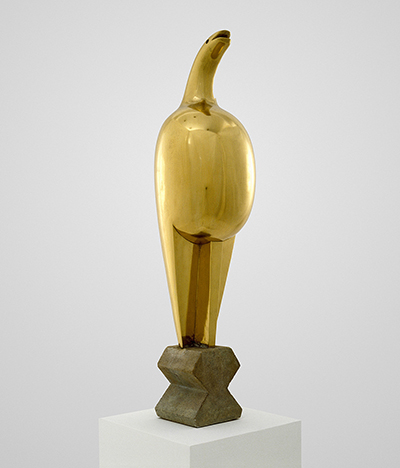
His bird sculptures let us follow that process across distinct forms. In the National Gallery of Art’s bronze Maiastra, inspired by a bird of Romanian folklore, the chest, upright neck and head still give the viewer bearings. The Art Institute’s Golden Bird draws those features into a more continuous surface. In Bird in Space, the upward sweep carries much of the association with flight. Seeing the three together makes it possible to trace how the emphasis shifts from the parts of a bird’s body to what the outline can suggest about its movement. [1] [5] [7]
The Golden Bird also shows how much visual incident a simplified figure can contain. The polished bronze picks up light and reflections around it, while the angular, relatively matte base gives the eye a different set of edges and surfaces. As the viewer walks around the piece, the outline continues to define the sculpture while the reflected light moves. The economical form gives that changing surface more room to register. [1]
Brâncuși on flight
“It’s not the bird I want to express, but the gift, the flight, the momentum.”
Brâncuși, in the English translation used by the Neue Nationalgalerie for its Brancusi exhibition. [5]
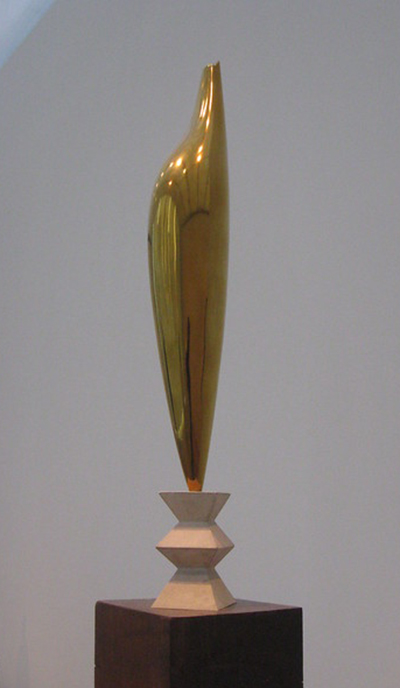
Brâncuși was looking back on his bird sculptures when he described this aim. Claire Gilles Guilbert published the statement in 1957. Its emphasis on momentum helps explain why the nearly featureless surface of a later bronze can evoke movement. A narrow attachment above the pedestal makes the mass seem delicately balanced. The profile expands and draws in as it rises, carrying the eye from the support to the tip. An object that is physically fixed can give the experience of a continuous upward motion. [5] [7] [8]
The series also invites attention to where that movement begins. The Neue Nationalgalerie compared an early marble Bird in Space, with its sharply angled base, to later birds placed on narrower supports. The marble establishes a stronger visual connection to the ground. The narrower support under a tall polished bronze can make the transition into open space feel more abrupt. Both are versions of the same artistic question, with different answers in the sculpture’s lower half. The artist’s statement directs attention upward, but the base is part of how he gets the viewer there. [5]
The Customs Court on Bird in Space
“It is beautiful and symmetrical in outline”
U.S. Customs Court, C. Brancusi v. United States, 26 November 1928. [3]
The court was deciding whether a particular polished bronze qualified for duty-free entry as sculpture under the tariff law. The judges described its dimensions, curved profile, surface and stand. They acknowledged the difficulty of associating the shape with a bird. Witnesses disagreed over whether it qualified as sculpture, so both the object in front of the court and the testimony about contemporary artistic practice mattered to the ruling. [3]
The sentence about beauty and symmetry comes near the end of the opinion. It is one part of an explanation that also considers the work’s originality and Brâncuși’s standing as a professional sculptor. The judges recognised that a developing school of art sought to portray ideas in forms that departed from literal representation, and they sustained the protest against the duty. Their practical task was to apply an import classification to the sculpture. [3]
Read beside Brâncuși’s words about momentum, the judges’ emphasis on outline becomes especially interesting. The court described what its members could see and agree upon even if the bird remained hard to identify. Brâncuși described how he wanted a sculpture to convey a quality of movement. The title focuses attention on flight, but the court’s account helps explain how a viewer could admire the same taper and curve without being able to name the subject. [3] [5]
Brâncuși in letters to friends and collaborators
“I meant to write a poem in reply”
Brâncuși to Jim Ede, 22 December 1933, translated from the French letter transcribed by Kettle’s Yard. [6]
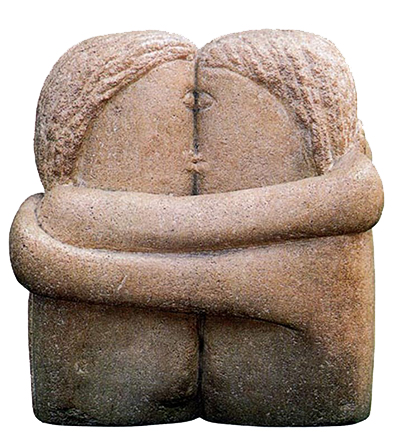
Brâncuși was thanking Ede for a flower and catching up after a visit. He jokes about how little has come of the poem he intended to write. He also mentions having sent Ede a catalogue for his New York exhibition through Vera, remarks on the work that went into the show and offers to send photographs. Kettle’s Yard preserves the letter with pen-and-ink sketches of The Kiss. The same sheet carried news about an exhibition across the Atlantic, an image of a familiar sculptural motif and a holiday greeting to friends. [6]
The catalogue in the letter has a different role from the one that contains the 1926 statement on simplicity. It is something the sculptor sends to a friend who has visited him and may already have the photographs. The postscript leaves us with a small clue to how someone outside Paris might stay in touch with work in the studio. The drawings, photographs and catalogues had their own ways of travelling. A private letter could be both a friendly exchange and part of how information about the sculpture circulated. [1] [6]
“I ask you to spare no expense and watch the quality of the materials as closely as possible.”
Brâncuși to Ștefan Georgescu-Gorjan, 2 September 1937, translated from the Romanian transcription published by the recipient. [2]
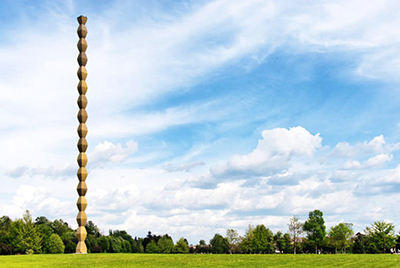
That request came while the Endless Column at Târgu Jiu was in preparation. Brâncuși writes about funds for the foundations, asks for work to start promptly so the foundation has time to harden and requests news of the work on the elements. He also relays Mrs Tătărescu’s wish that the cast iron retain some roughness. Georgescu-Gorjan later explained that the grain of the casting sand constrained the texture. He recalled that the finished surfaces came out smoother and that Brâncuși liked them when he saw them. [2]
The completed column consists of cast-iron modules mounted on a steel spine. The repetition makes the sculpture easy to grasp as a single rising form, yet each section had to be produced and fitted, and the column needed a foundation capable of supporting it. The artist’s letter and the engineer’s account give two points of entry into the project. One records what Brâncuși was asking for while the outcome was still uncertain. The other describes what the team could make with the materials it had. [2] [9]
Isamu Noguchi on learning in the studio
“He showed me how to help him cut bases, for instance, out of limestone”
Isamu Noguchi, recalling his time with Brâncuși in a 1973 interview with Paul Cummings. [4]
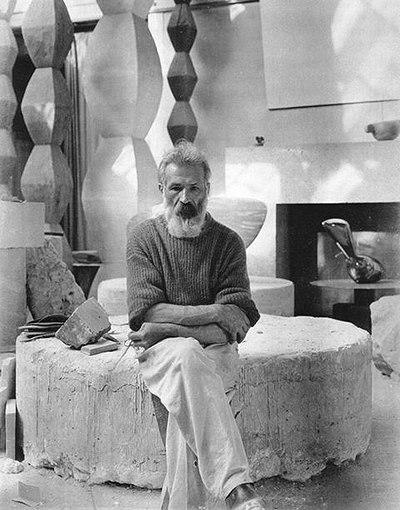
Noguchi had admired the 1926 New York exhibition before he met Brâncuși in Paris the following year. He recalled that he was introduced through an acquaintance, asked if he could help and spent part of his day at the studio while continuing to draw at art schools. In the interview he was unsure how many months he stayed. His memory of the kind of work he did was more specific. Cutting stone for bases was among the tasks he could learn by working beside the sculptor. [4]
That detail rewards a return to the sculptures. A base controls how high the viewer first encounters the carved or cast form. Its width, texture and weight can make the work appear grounded or poised. Some of Brâncuși’s studio photographs show him trying different supports for Golden Bird. Seen in that light, the limestone Noguchi remembered cutting belonged to the part of sculpture where practical work and decisions about how to see the object were closely connected. [1] [4]
Browse sculptures and drawings
Browse articles on the sculptures and separately catalogued museum objects. A work can have several physical versions. Drawing records from the Tate catalogue retain their October 2014 snapshot wording where present.
| Name | Date | Medium |
|---|---|---|
| Arch | Sculpture | |
| Bird in Space | Sculpture | |
| The Blond Negress | Sculpture | |
| The Cock | Sculpture | |
| The Endless Column | Sculpture | |
| The First Cry | Sculpture | |
| Fish | Sculpture | |
| The Gate of the Kiss | Sculpture | |
| Golden Bird | Sculpture | |
| Head | Sculpture | |
| The Kiss | Sculpture | |
| Leda | Sculpture | |
| Madame L.R. | Sculpture | |
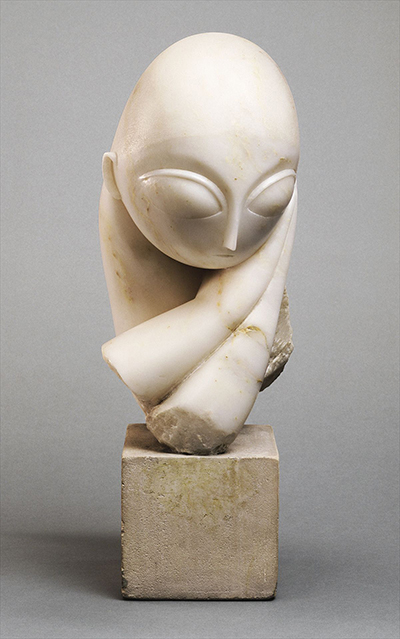
| Mademoiselle Pogany II | Sculpture | |
| Mademoiselle Pogany | Sculpture | |
| Maiastra | Sculpture | |
| The Newborn | Sculpture | |
| Phoque II | Sculpture | |
| The Prayer | Sculpture | |
| Princess X | Sculpture | |
| Prometheus | Sculpture | |
| Târgu Jiu monumental ensemble | Sculpture | |
| Sculpture for the Blind | Sculpture | |
| The Seal | Sculpture | |
| The Signal | Sculpture | |
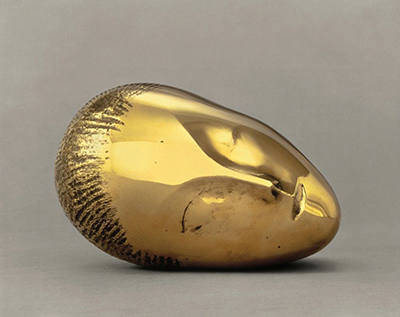
| Sleeping Muse | Sculpture | |
| The Sorceress | Sculpture | |
| The Table of Silence | Sculpture | |
| Torso of a Young Man | Sculpture | |
| Two Lamps | Sculpture | |
| Vitellius | Sculpture | |
| The White Negress | Sculpture | |
| The Wisdom of the Earth | Sculpture | |
| Young Bird | Sculpture | |
| The Kiss (Philadelphia, fourth version) | 1916 | Sculpture Catalogue. |
| Sleeping Muse (Pompidou bronze) | 1910 | Sculpture Catalogue. |
| Mlle Pogany, version I (MoMA bronze) | 1913, after a marble of 1912 | Sculpture Catalogue. |
| Maiastra (Venice brass) | about 1912 | Sculpture Catalogue. |
| Bird in Space (MoMA bronze) | about 1941 | Sculpture Catalogue. |
| Bird in Space (Venice brass) | 1932–40 | Sculpture Catalogue. |
| Endless Column, version I (oak) | 1918 | Sculpture Catalogue. |
| Brâncuși Monumental Ensemble of Târgu Jiu | 1937–38 | Sculpture Catalogue. |
| Bust of a nude woman in profile, head inclined | about 1910 | Drawing Catalogue. |
| Nude study, head inclined (recto) | — | Drawing Catalogue. |
| Self-portrait (ink) | — | Drawing Catalogue. |
| View of the Artist’s Studio | 1918 | Drawing Catalogue. |
| Study for the cock (lost clay Grand Coq) | about 1923 | Drawing Catalogue. |
| Portrait of a woman in profile | — | Drawing Catalogue. |
| Animal head | — | Drawing Catalogue. |
| Animal sketch (2002 checklist) | 1929 | Drawing Catalogue. |
| Plans of the studio (verso) | about 1930–38 | Drawing Catalogue. |
| Danaïde (Tate T00296) | c.1918 | Sculpture Catalogue. |
| Maiastra (Tate T01751) | 1911 | Sculpture Catalogue. |
| Head (Tate T03066) | c.1919–23 | Sculpture Catalogue. |
| Fish (Tate T07107) | 1926 | Sculpture Catalogue. |
Frequently Asked Questions
In the 1926 Brummer Gallery catalogue, he described simplicity as something that emerges as an artist approaches the meaning of a subject. The Art Institute of Chicago reproduces the statement in its study of Golden Bird. [1]
The judges of the U.S. Customs Court used those words in their 1928 opinion. They were explaining their decision to admit the contested bronze duty-free as sculpture. [3]
Discussion
Look again at the images and ideas explored in Constantin Brâncuși Quotes. These editorial prompts invite your observations.
Reader Insights
Simplicity and detail. Which part of Maiastra would you miss most in a later Bird in Space? What takes over its role?
Watching flight. Follow the outline of Bird in Space from the pedestal to the tip. Where does the form first give you a sense of movement?
The work below eye level. After reading Noguchi’s recollection, what do you notice about the effect of a limestone or wooden base on the sculpture above it?
Join the Conversation
Share a detail, comparison or question about Constantin Brâncuși Quotes below.
References
- Constantin Brâncuși, “Propos,” in Brancusi, Brummer Gallery exhibition catalogue, New York, 17 November–15 December 1926, unpaginated. English wording reproduced in Margherita Andreotti, “Brancusi’s Golden Bird: A New Species of Modern Sculpture,” Art Institute of Chicago Museum Studies 19, no. 2 (1993), p. 198, note 4. See also the article’s discussion of the three bird types, polished bronze and the base, pp. 140–43. Art Institute of Chicago View source.
- Ștefan Georgescu-Gorjan, “Scrisori de la Constantin Brâncuși,” Ramuri, no. 8 (194), 15 August 1980, p. 13. Letter beginning with the dateline 2 September 1937, paragraph on material quality, and recipient commentary, points 2–5. Romanian. Digitised issue, INOE archive View source.
- C. Brancusi v. United States, 54 Treas. Dec. 428, T.D. 43063 (U.S. Customs Court, Third Division, 26 November 1928), pp. 2–3 of the linked copy. Quotation from the court’s concluding paragraph. Court opinion View source.
- Isamu Noguchi, interview by Paul Cummings, November–December 1973, excerpt in Speaking of Art, Archives of American Art, Smithsonian Institution. “Isamu Noguchi” section, reply to the question about activity in Brâncuși’s studio. Smithsonian transcript excerpt View source.
- Neue Nationalgalerie and Centre Pompidou, Brancusi, 2026, English exhibition texts, p. 4, “Birds in Space.” Neue Nationalgalerie exhibition texts View source.
- Constantin Brâncuși, Letter with sketches of ‘The Kiss’, 22 December 1933, KY00696.E, text below the object record. French. Kettle’s Yard View source.
- National Gallery of Art, Maiastra, accession 1980.75.1, discussion of the three bird series and the sculpture’s subject. National Gallery of Art View source.
- Claire Gilles Guilbert, “Propos de Brancusi,” Prisme des Arts, no. 12 (1957), pp. 5–7. The passage on the birds on p. 7 is reproduced in English, with a slightly different wording, in the section “The bird in space: a case study” of “Sculpting essences, not forms: a theosophical interpretation of Brancusi”. View source.
- World Monuments Fund, Endless Column restoration report, introduction and history, with a description of construction and materials. World Heritage Centre document archive View source.
More BRÂNCUȘI Sculptures
Bird in Space
Compare the marble and metal versions of Brâncuși’s sculpture.