 by Tom Gurney
Tom Gurney BSc (Hons) is an art history expert with over 20 years experience
Published on June 19, 2020 / Updated on November 29, 2026
Email: tomgurney1@gmail.com / Phone: +44 7429 011000
The Gate of the Kiss: Introduction
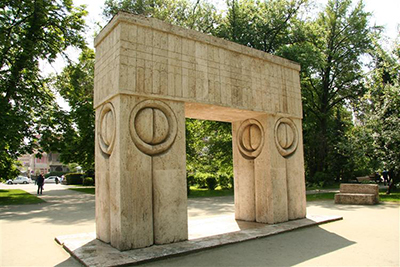
In the riverside park at Târgu Jiu, two square stone pillars hold a lintel above a path. The opening is wide enough for people to pass through together. On the outer faces of the pillars, a central cut divides a round shape into two halves. On the lintel, related forms recur across a band that carries the eye from one end of the Gate to the other. The sculpture is Constantin Brâncuși’s Gate of the Kiss, or Poarta Sărutului, a monument made as part of the city’s First World War memorial of 1937–38. [1] [2]
Brâncuși had spent decades recasting the idea of an embrace in stone. Here he made the motif part of an architectural opening, to be seen in the course of walking. The entry to the riverside group, a route between trees, and the view along the Avenue of Heroes all give the carving a setting. Visitors can approach the Gate from the city or from the river, and find that the same stone carries a different weight in each view. [1] [3]
At a Glance
- ArtistConstantin Brâncuși
- Date and setting1937–38, Constantin Brâncuși Park, Târgu Jiu, Romania. [1]
- MaterialTravertine from Banpotoc, Romania. [1]
- Approximate size6.35 metres wide, 5.13 metres high and 1.69 metres deep, according to the ICOMOS evaluation. [1]
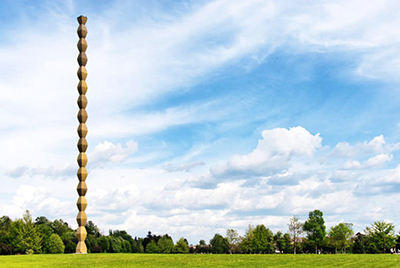
- Related monumentsThe Table of Silence and Alley of Chairs are between the Gate and the Jiu River. The Endless Column stands at the eastern end of the ensemble. [1] [2]
Contents
- Where the Gate stands
- Two supports and a common lintel
- From a studio study to a public passage
- The Gate in a war memorial
- Care of the stone and its setting
Where the Gate stands
The monumental ensemble has two principal settings. The group nearest the Jiu River begins with the Table of Silence and extends through the Alley of Chairs to the Gate. Farther east, beyond the intervening streets, the Endless Column stands in its own park. The works line up across about a kilometre and a half of the city. A single fixed viewpoint cannot take in everything close enough to show the carving. The visitor moves between locations, passing both through the spaces Brâncuși shaped and along the streets of a working town. [1] [2]
ICOMOS records that the Gate was originally planned for the entrance to the Public Garden. At Brâncuși’s request it was placed farther into the park. This detail matters because a gate directly on the street would make the shift from town to green space immediate. The actual arrangement allows distance on both sides. Someone arriving from the Avenue of Heroes has a short approach during which the structure can be seen within the park before it becomes a passage. From the river side, the rhythm of the Alley of Chairs gives a clear approach to the opening. The Gate participates in the transition whether the visitor is arriving or leaving. [1] [3]
Two stone benches flank the portal. A bench allows a person to see the Gate from outside its central line and at a lower eye level. The view from the side makes the depth of the supports easier to judge. It also gives the interaction of the horizontal lintel and vertical pillars a different balance. From the main path the two pillars frame the opening symmetrically. From a bench or the side of the path, the nearest pillar can dominate and the opening begins to read as a space between massive pieces of stone. A single photograph taken straight on shows the design clearly. The walk around the outer edge explains more about what it is like to be near it. [1] [4]
Two supports and a common lintel
The Gate has the familiar construction of a portal, with uprights and a horizontal member. The pillars rise as broad four-sided masses and the lintel projects well beyond the opening. The span brings the empty passage into the design. Viewed from a distance, the field of shadow beneath the lintel lies between the upright blocks and separates them. When someone passes through, that area of shade becomes a short space a body can occupy. The lintel’s depth gives this crossing a perceptible duration. It is a much shorter experience than walking the axis, but the design gives that part of the walk shape. [1]
ICOMOS identifies the material as travertine from Banpotoc and describes Brâncuși working on the elements at the site. Travertine has the partly open surface that gives the Gate a visible texture. Tilt the view along a carved face and recessed details acquire sharper edges as their shadows grow. At a greater distance these small irregularities resolve into a broad tone, and the lines of the supports and lintel come forward. This is one way to understand why the Gate can work from across a park and still reward looking at the stone from a much closer position. [1] [4]
A relief is a carving that remains attached to the surface from which it rises. At the Gate, relief marks run across the lintel and around the four faces of each pillar. Look first at one of the pillar motifs. The two rounded halves share an outline, and the cut that divides them is also the line along which they meet. At the height of the lintel, the normal viewing angle makes fine features harder to distinguish. Its much longer row of motifs can be followed by rhythm and spacing. By using the subject on both supports and lintel, Brâncuși gave the motif quite different relationships to the viewer within a single structure. [1] [4]
From a studio study to a public passage
The Centre Pompidou preserves a limestone model for one of the pillars, made between 1935 and 1937. It measures just 33.5 centimetres in height and is catalogued as AM 4002-8. The museum also records its use in the studio as a support for the model of the lintel and for another sculpture. The same object could therefore serve to consider the design and to build relationships among works in a room. The separate lintel model carries its own inventory number. These are small things that can be seen close by, on a scale very different from that of the portal standing in the park. [5] [6]
Place the museum model beside the finished Gate in your mind and consider the difference in where the eye goes first. On a model you can look straight at the motif and take in the supporting stone almost at once. At Târgu Jiu you may see a pillar upright against a background of trees first, then notice a round form distributed across its face. The experience of moving around the actual support gives meaning to the repetition around its sides. Where the model helps one study proportion and the placement of the carving, the installed structure allows Brâncuși’s design to come in and out of focus at different distances. [1] [5]
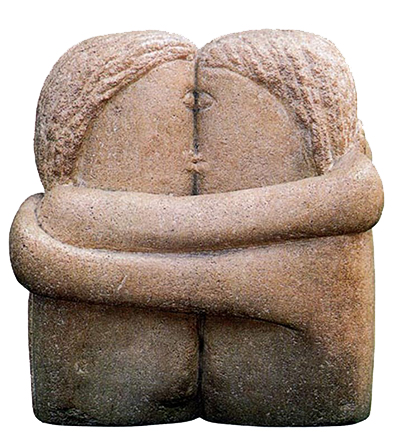
In the 1916 Philadelphia version of The Kiss, the two lovers embrace inside one rectangular block. Its face and sides describe the bodies directly. The Gate takes an idea from the earlier sculptures into a different type of object. A motif that occupied one small stone can now repeat along a long lintel. Two upright forms of architectural scale can mark the edges of a path, with the figures suggested by the smaller carved pattern. Even without comparing the works side by side, the title directs attention to an act of joining that the structure can express through the image, the contact of the motifs and the conjunction of stone parts. [1] [3] [7]
The Gate in a war memorial
The National Women’s League of Gorj initiated the commission to commemorate the defence of Târgu Jiu during the First World War. Its president, Arethia Tătărescu, approached the Romanian sculptor, who was then living in Paris. The riverside group grew from a project that had at first emphasised the Column. The portal was part of the larger scheme in which the park, the Avenue of Heroes and the site of the Column could be taken together. ICOMOS records Brâncuși’s presence at the Gate site in the summer of 1938, when he was also attending to the other components. The ensemble was inaugurated in October that year. [1] [2] [3]
The memorial purpose is documented for the ensemble. The exact meaning of the Gate’s shapes admits several readings. The joining of two forms is easy to associate with its title and with Brâncuși’s earlier sculpture. Its placement on a route makes an interpretation as a threshold equally understandable. A passage in a memorial can give people a moment to consider those they are walking to remember. On an ordinary afternoon the same path has another use, and the gate can register first as a dark opening among trees, then as a pair of carved surfaces close to the shoulder. It is that ability to work in daily life as well as on commemorative occasions that distinguishes the park setting from a more isolated display. [1] [2]
Care of the stone and its setting
The portal has stood outdoors since its installation. An upright surface, the highest horizontal surfaces and the lower parts of the stone face different exposure. ICOMOS records repairs in 1965–66, including work on damaged travertine elements and the installation of lead covering and gutters above the lintel. These operations concerned how the structure responded to the weather, as well as the appearance of repaired stone. The record also traces a wider restoration campaign covering the outdoor works and parks between 2000 and 2004. [1]
A history of the 2003 design work describes specialists coordinating studies of the Gate, Table and Alley stone components. Such programme descriptions show what questions informed the conservation. They have a different evidentiary value from an assessment of one stone face after treatment. For a viewer, the distinction matters when interpreting any visible join or stain. A difference in texture might belong to the stone as first worked, to its exposure outdoors or to an intervention. Current World Heritage recognition concerns the whole ensemble and includes maintaining the relation among the Gate, the route and the surrounding park. [1] [2] [8]
Browse sculptures and drawings
Browse articles on the sculptures and separately catalogued museum objects. A work can have several physical versions. Drawing records from the Tate catalogue retain their October 2014 snapshot wording where present.
| Name | Date | Medium |
|---|---|---|
| Arch | Sculpture | |
| Bird in Space | Sculpture | |
| The Blond Negress | Sculpture | |
| The Cock | Sculpture | |
| The Endless Column | Sculpture | |
| The First Cry | Sculpture | |
| Fish | Sculpture | |
| The Gate of the Kiss | Sculpture | |
| Golden Bird | Sculpture | |
| Head | Sculpture | |
| The Kiss | Sculpture | |
| Leda | Sculpture | |
| Madame L.R. | Sculpture | |
| Mademoiselle Pogany II | Sculpture | |
| Mademoiselle Pogany | Sculpture | |
| Maiastra | Sculpture | |
| The Newborn | Sculpture | |
| Phoque II | Sculpture | |
| The Prayer | Sculpture | |
| Princess X | Sculpture | |
| Prometheus | Sculpture | |
| Târgu Jiu monumental ensemble | Sculpture | |
| Sculpture for the Blind | Sculpture | |
| The Seal | Sculpture | |
| The Signal | Sculpture | |
| Sleeping Muse | Sculpture | |
| The Sorceress | Sculpture | |
| The Table of Silence | Sculpture | |
| Torso of a Young Man | Sculpture | |
| Two Lamps | Sculpture | |
| Vitellius | Sculpture | |
| The White Negress | Sculpture | |
| The Wisdom of the Earth | Sculpture | |
| Young Bird | Sculpture | |
| The Kiss (Philadelphia, fourth version) | 1916 | Sculpture Catalogue. |
| Sleeping Muse (Pompidou bronze) | 1910 | Sculpture Catalogue. |
| Mlle Pogany, version I (MoMA bronze) | 1913, after a marble of 1912 | Sculpture Catalogue. |
| Maiastra (Venice brass) | about 1912 | Sculpture Catalogue. |
| Bird in Space (MoMA bronze) | about 1941 | Sculpture Catalogue. |
| Bird in Space (Venice brass) | 1932–40 | Sculpture Catalogue. |
| Endless Column, version I (oak) | 1918 | Sculpture Catalogue. |
| Brâncuși Monumental Ensemble of Târgu Jiu | 1937–38 | Sculpture Catalogue. |
| Bust of a nude woman in profile, head inclined | about 1910 | Drawing Catalogue. |
| Nude study, head inclined (recto) | — | Drawing Catalogue. |
| Self-portrait (ink) | — | Drawing Catalogue. |
| View of the Artist’s Studio | 1918 | Drawing Catalogue. |
| Study for the cock (lost clay Grand Coq) | about 1923 | Drawing Catalogue. |
| Portrait of a woman in profile | — | Drawing Catalogue. |
| Animal head | — | Drawing Catalogue. |
| Animal sketch (2002 checklist) | 1929 | Drawing Catalogue. |
| Plans of the studio (verso) | about 1930–38 | Drawing Catalogue. |
| Danaïde (Tate T00296) | c.1918 | Sculpture Catalogue. |
| Maiastra (Tate T01751) | 1911 | Sculpture Catalogue. |
| Head (Tate T03066) | c.1919–23 | Sculpture Catalogue. |
| Fish (Tate T07107) | 1926 | Sculpture Catalogue. |
Frequently Asked Questions
Discussion
Look again at the images and ideas explored in The Gate of the Kiss. These editorial prompts invite your observations.
Reader Insights
From which side of the Gate can you see its depth most clearly?
Compare one pillar motif with the longer band across the lintel. Which one makes you think first of the original embrace, and what leads you to that reading?
Join the Conversation
Share a detail, comparison or question about The Gate of the Kiss below.
References
- ICOMOS. Advisory Body evaluation of the Brâncuși Monumental Ensemble of Târgu Jiu, pp. 311–312, location, material, dimensions, construction and conservation. View source.
- UNESCO World Heritage Centre. Brâncuși Monumental Ensemble of Târgu Jiu, brief synthesis and integrity. View source.
- Sorana Georgescu-Gorjan, Centrul Brâncuși. Ansamblul brâncușian de la Târgu-Jiu, archive-based account (Romanian). View source.
- Centrul Brâncuși. Poarta Sărutului, local documentation on the structure and location (Romanian). View source.
- Centre Pompidou. Maquette du pilier de la Porte du Baiser, AM 4002-8, detailed physical description. View source.
- Centre Pompidou. Maquette du linteau de la Porte du Baiser, AM 4002-12. View source.
- Philadelphia Museum of Art. The Kiss, 1916, collection record and carving description. View source.
- UNRMI. Ansamblul Monumental realizat de Constantin Brâncuși la Târgu-Jiu a fost înscris pe Lista Patrimoniului Mondial UNESCO, restoration-design project section (Romanian). View source.
More BRÂNCUȘI Sculptures
Bird in Space
Compare the marble and metal versions of Brâncuși’s sculpture.