 by Tom Gurney
Tom Gurney BSc (Hons) is an art history expert with over 20 years experience
Published on June 19, 2020 / Updated on November 29, 2026
Email: tomgurney1@gmail.com / Phone: +44 7429 011000
Torso of a Young Man: Introduction
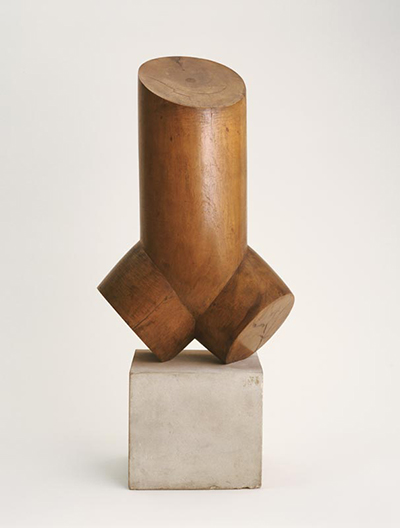
Turn a fork in a tree upside down and its branches can begin to look like legs. Constantin Brâncuși used that resemblance in Torso of a Young Man, carving a piece of maple into a trunk and two parted upper thighs. Philadelphia’s carving, dated about 1917–1922, is the starting point for a patinated plaster model and two polished metal versions. Brâncuși also carved a related torso in walnut. The pieces share a silhouette, but the angle of a cut, the handling of the surface and the height of the base can make each figure look quite different. [1] [2]
At a Glance
- Torso of a Young Man [I]Date and material: About 1917–1922. Maple on a limestone base. [1] [3]; Collection: Philadelphia Museum of Art, object 51091
- Torse de jeune hommeDate and material: 1919–1924. Patinated plaster developed from the maple carving. [2]; Collection: Centre Pompidou, AM 4002-78
- Torse de jeune hommeDate and material: 1923. Walnut on a limestone base. [4] [5]; Collection: Centre Pompidou, AM 4002-79
- Male TorsoDate and material: Brass. Cleveland dates the work to 1917. The Centre Pompidou dates the casting to 1924. [2] [6]; Collection: Cleveland Museum of Art, 1937.3205
- Torso of a Young ManDate and material: 1924. Brass, limestone and wood. [7]; Collection: Hirshhorn Museum and Sculpture Garden, 66.611
Contents
- What Brâncuși saw in a fork of maple
- What changed in walnut and plaster
- The metal figures in Cleveland and Washington
- How the bases change the figure
- How much of a body do we need to see?
What Brâncuși saw in a fork of maple
The decisive part of the Philadelphia sculpture is the junction near the bottom. The long upper form might register as a post if seen alone. Follow it down and two short forms diverge, bringing the hips and upper thighs into view. Once that happens the long section above begins to look like a torso. A waist, rib cage and shoulders would have made the subject easier to recognise, but the junction does much of the work those features usually do. Even the gap at the fork matters. It gives each short cylinder a side of its own and makes the weight above seem to be divided between two legs. [1] [2]
The fork was already in the wood. As Centre Pompidou curator Marielle Tabart explains, Brâncuși selected the part of the tree where two branches diverged and carved it with those branches pointing down. In a living tree they would have carried growth out and up. In the sculpture they direct the eye towards the stone and look as though they carry the body’s weight. The tree helped determine where the legs part. Brâncuși determined how much wood to keep and where to end each form. The flat cuts make those decisions especially apparent because they interrupt a continuous, rounded surface. [2]
The upper cut also gives the sculpture a direction. Tabart points to the pronounced slope at the end of the main shaft in the maple. From an angle where the slope reads clearly, the top has a high side and a low side. It can suggest a torso pitched away from centre even while the shaft rises. The carving is about nineteen inches high before its limestone support, according to the Museum of Modern Art’s catalogue of the Philadelphia collection loan exhibition in 1972. That catalogue dated it to 1916, while the Philadelphia Museum of Art’s current entry gives about 1917–1922. The range is the museum’s estimate for this object. [1] [2] [3]
What changed in walnut and plaster
The Centre Pompidou’s 1923 walnut torso has its own inscription giving Brâncuși’s name, Paris and the year. At 43 centimetres high, it is a little shorter than the Philadelphia carving. Tabart describes the maple as the more massive of the two, with a more steeply sloped upper cut. The walnut can be read as a fresh decision about the proportions of the same forked figure. What alters its bearing is the relationship between the long central piece and the smaller ends. A shallower slope across the top makes the chief vertical less obviously directional. [2] [3] [4]
The plaster that led to the two metal versions followed a different path. The Centre Pompidou dates this patinated plaster to 1919–1924. According to Tabart, an artist-dated photograph places the making of the model in 1919, while the maple was still in progress. The plaster itself bears a pencil inscription in Brâncuși’s hand with the year 1919. Both details help explain how the wooden work and its plaster derivative could be developed during overlapping years. The museum relates this particular plaster to the maple, while its walnut record links that carving to a separate mould. [2] [4]
Brâncuși cut back the oblique plane at the top of the plaster towards the horizontal before it was used for the metal versions. The upper cut still has an angle in the Cleveland museum’s photograph. What matters is the change in emphasis. A flatter termination brings attention to the relationship between that broad face and the two smaller cut faces at the bottom. Tabart relates the resulting regularity and gleam of the metal to the machine aesthetic of Brâncuși’s friend Fernand Léger. Seen this way, the resemblance to a manufactured object has as much to do with a change made in plaster as it does with the shine of the finished metal. [2] [6]
The metal figures in Cleveland and Washington
Cleveland’s Male Torso and the Hirshhorn’s Torso of a Young Man share the long upper cylinder and two short cylinders branching out below. Their museums list brass for the figure. The Centre Pompidou calls the same pieces polished bronzes in its account of the model, and assigns both castings to 1924. The Hirshhorn also gives 1924. Cleveland dates Male Torso to 1917 in its collection record. These are different catalogue descriptions of two identifiable objects. The collection and accession number give a firmer basis for comparing them than a title, date or metal name on its own. [2] [6] [7]
In Cleveland’s photograph a broad highlight runs up the main cylinder, with darker areas wrapping around the sides. Look along the rounded length and then at the cut end. The light on the length changes gradually, while the end has a sharper boundary. A polished surface makes that transition especially visible. From a different viewpoint the band of light can move, changing how broad the torso appears even though the silhouette scarcely changes. Near the fork, reflected light and shadow can make the two legs read as separate volumes before the outline itself resolves. These effects give a simple outline more variety than it first appears to have. [6]
The Hirshhorn record also traces its example to Henri-Pierre Roché, who acquired it from Brâncuși, and later to Joseph H. Hirshhorn, who gave it to the museum in 1966. The metal work travelled with the 1995 retrospective from Paris to Philadelphia. That exhibition history is an example of why the city alone may be a poor clue to a picture’s subject. A photograph connected to the Philadelphia show could depict a work on loan, while the Philadelphia museum’s own Torso of a Young Man [I] is the carving in maple. [1] [7]
How the bases change the figure
Cleveland gives a height of 63.8 centimetres with the base. The sculpture appears close to its broad, low support in the museum’s photograph, so the eye can readily compare the cut ends of the thighs with the surface beneath them. The Smithsonian lists 148.6 centimetres for its work, which the Hirshhorn describes as an approximately eighteen-inch metal figure over a pale stone block, a rectangular wood block and a lower, hourglass-shaped wood base. Set over that taller stack, the torso crowns a series of volumes. The narrowing in the bottom support creates another interruption in the rise, well below the opening between the carved legs. The difference in the recorded heights includes the way each object is mounted. [6] [7] [8]
The walnut carving has its own documented relationship to the floor and to neighbouring objects. The Centre Pompidou describes it on a limestone block, itself on a long beam base, beside The Turtle. The Neue Nationalgalerie’s exhibition list records the walnut with its individual stone support. The catalogue entries describe the work at two levels, first as a figure standing on its own block and then as part of a grouping. With the beam in view, the vertical fork and the horizontal line beneath it become as easy to compare as the profiles of the two sculptures. [4] [5]
How much of a body do we need to see?
A title can make three cylinders look immediately human. It can also send the viewer searching for anatomical cues that the carving leaves open. In 1923, according to Tabart, Roché wrote to the collector John Quinn praising the novelty and economy of the form, which he took to be a woman’s torso. He was responding to the maple, and his reading shows how little the wood itself settles the subject’s gender. Viewers may also read the entire outline as phallic, with the long cylinder rising above two rounded ends. The part read as a torso in one moment can suggest a single organ in the next. Both impressions depend on the relation between the same three forms. [2]
The Amsterdam exhibition Brancusi: The Birth of Modern Sculpture brought this ambiguity into focus by grouping the torso with Princess X and Torso of a Young Girl. In Torso of a Young Man the cues for a figure lie low, at the division into thighs. Trace the silhouette upwards from that point and the empty space on either side is where the arms and shoulders might be expected. Trace it downwards and the look of the piece changes at the fork. The work asks the eye to decide which small part of a silhouette makes everything around it look bodily. That decision can shift repeatedly in the time it takes to walk around it. [2] [9]
Browse sculptures and drawings
Browse articles on the sculptures and separately catalogued museum objects. A work can have several physical versions. Drawing records from the Tate catalogue retain their October 2014 snapshot wording where present.
| Name | Date | Medium |
|---|---|---|
| Arch | Sculpture | |
| Bird in Space | Sculpture | |
| The Blond Negress | Sculpture | |
| The Cock | Sculpture | |
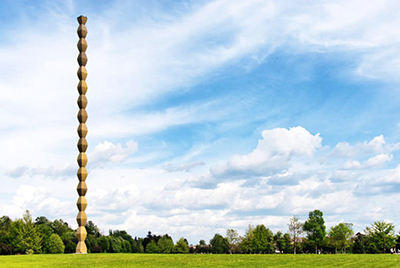
| The Endless Column | Sculpture | |
| The First Cry | Sculpture | |
| Fish | Sculpture | |
| The Gate of the Kiss | Sculpture | |
| Golden Bird | Sculpture | |
| Head | Sculpture | |
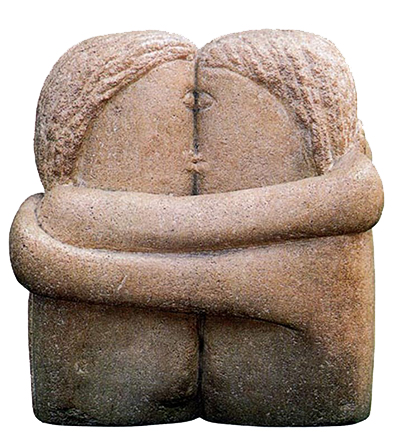
| The Kiss | Sculpture | |
| Leda | Sculpture | |
| Madame L.R. | Sculpture | |
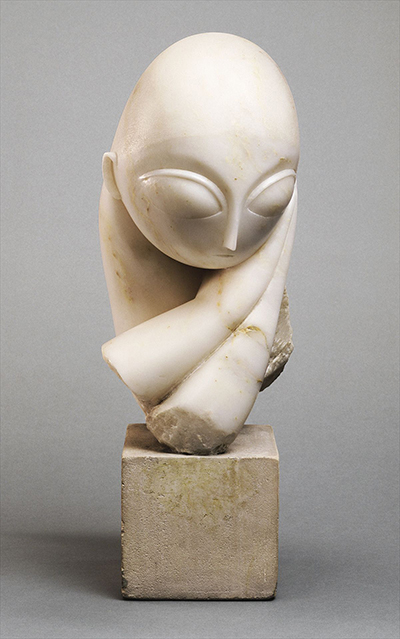
| Mademoiselle Pogany II | Sculpture | |
| Mademoiselle Pogany | Sculpture | |
| Maiastra | Sculpture | |
| The Newborn | Sculpture | |
| Phoque II | Sculpture | |
| The Prayer | Sculpture | |
| Princess X | Sculpture | |
| Prometheus | Sculpture | |
| Târgu Jiu monumental ensemble | Sculpture | |
| Sculpture for the Blind | Sculpture | |
| The Seal | Sculpture | |
| The Signal | Sculpture | |
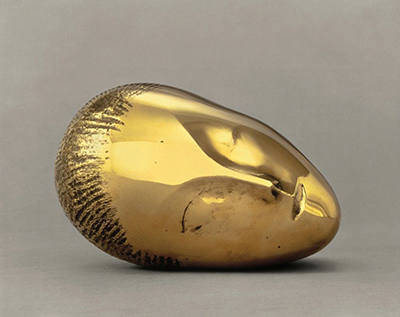
| Sleeping Muse | Sculpture | |
| The Sorceress | Sculpture | |
| The Table of Silence | Sculpture | |
| Torso of a Young Man | Sculpture | |
| Two Lamps | Sculpture | |
| Vitellius | Sculpture | |
| The White Negress | Sculpture | |
| The Wisdom of the Earth | Sculpture | |
| Young Bird | Sculpture | |
| The Kiss (Philadelphia, fourth version) | 1916 | Sculpture Catalogue. |
| Sleeping Muse (Pompidou bronze) | 1910 | Sculpture Catalogue. |
| Mlle Pogany, version I (MoMA bronze) | 1913, after a marble of 1912 | Sculpture Catalogue. |
| Maiastra (Venice brass) | about 1912 | Sculpture Catalogue. |
| Bird in Space (MoMA bronze) | about 1941 | Sculpture Catalogue. |
| Bird in Space (Venice brass) | 1932–40 | Sculpture Catalogue. |
| Endless Column, version I (oak) | 1918 | Sculpture Catalogue. |
| Brâncuși Monumental Ensemble of Târgu Jiu | 1937–38 | Sculpture Catalogue. |
| Bust of a nude woman in profile, head inclined | about 1910 | Drawing Catalogue. |
| Nude study, head inclined (recto) | — | Drawing Catalogue. |
| Self-portrait (ink) | — | Drawing Catalogue. |
| View of the Artist’s Studio | 1918 | Drawing Catalogue. |
| Study for the cock (lost clay Grand Coq) | about 1923 | Drawing Catalogue. |
| Portrait of a woman in profile | — | Drawing Catalogue. |
| Animal head | — | Drawing Catalogue. |
| Animal sketch (2002 checklist) | 1929 | Drawing Catalogue. |
| Plans of the studio (verso) | about 1930–38 | Drawing Catalogue. |
| Danaïde (Tate T00296) | c.1918 | Sculpture Catalogue. |
| Maiastra (Tate T01751) | 1911 | Sculpture Catalogue. |
| Head (Tate T03066) | c.1919–23 | Sculpture Catalogue. |
| Fish (Tate T07107) | 1926 | Sculpture Catalogue. |
Frequently Asked Questions
Discussion
Look again at the images and ideas explored in Torso of a Young Man. These editorial prompts invite your observations.
Reader Insights
Where does the outline first suggest a body to you, and does your answer change if you follow it from the base up?
How would a high stack of bases change your impression of the metal figure compared with a single low support?
Which feature would you keep if you had to simplify this torso further and still make it recognisable?
Join the Conversation
Share a detail, comparison or question about Torso of a Young Man below.
References
- Philadelphia Museum of Art, Torso of a Young Man [I], object 51091. View source.
- Centre Pompidou, Torse de jeune homme, AM 4002-78. Includes Marielle Tabart’s catalogue analysis of the maple, walnut, plaster and metal works. In French. View source.
- Museum of Modern Art, Philadelphia in New York: 90 Modern Works from the Philadelphia Museum of Art (1972), catalogue entry 9. View source.
- Centre Pompidou, Torse de jeune homme, AM 4002-79. Walnut carving and display record. View source.
- Neue Nationalgalerie, Staatliche Museen zu Berlin, Brancusi, exhibition checklist (2026). Walnut carving AM 4002-79 and limestone base AM 4002-220. In German and English. View source.
- Cleveland Museum of Art, Male Torso, 1937.3205. View source.
- Smithsonian Institution, Torso of a Young Man, Hirshhorn Museum and Sculpture Garden, 66.611. View source.
- Hirshhorn Museum and Sculpture Garden, Revolutions: Art from the Hirshhorn Collection, 1860–1960, accessibility brochure, p. 7. View source.
- H’ART Museum, Brancusi: The Birth of Modern Sculpture, exhibition press kit. View source.
More BRÂNCUȘI Sculptures
Bird in Space
Compare the marble and metal versions of Brâncuși’s sculpture.