 by Tom Gurney
Tom Gurney BSc (Hons) is an art history expert with over 20 years experience
Published on June 19, 2020 / Updated on November 29, 2026
Email: tomgurney1@gmail.com / Phone: +44 7429 011000
The Prayer: Introduction
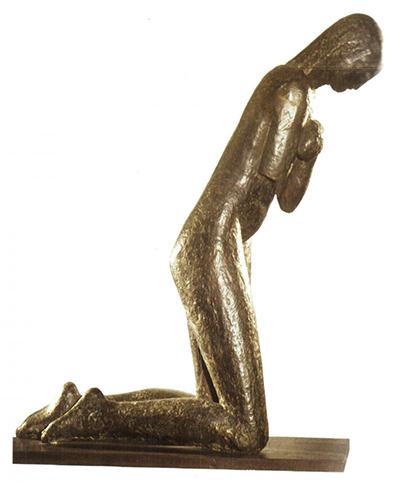
Constantin Brâncuși’s The Prayer shows a woman kneeling, her head bowed and one hand drawn close to her chest. Brâncuși developed the figure for the grave of Petre Stănescu, a lawyer from Buzău, Romania. The monument placed the anonymous figure beside a separate portrait bust of Stănescu. The bust gave the memorial a likeness. The kneeling figure gave it a gesture that a visitor could recognise from across the ground. [1] [2] [3]
At a Glance
- ArtistConstantin Brâncuși
- TitleThe Prayer (Rugăciunea in Romanian, La Prière in French)
- CommissionEliza Seceleanu commissioned a funerary monument for her husband, Petre Stănescu, in 1907. [1] [2]
- SubjectA kneeling woman in prayer, paired at the grave with a separate portrait bust. [1] [3]
- InstallationDumbrava Cemetery, Buzău, 1914. [1] [2]
- Documented bronzeNational Museum of Art of Romania, Bucharest, inv. 7202, catalogued as 1907. [3] [4]
- Cemetery versionBuzău’s heritage account records a later replica of The Prayer at Dumbrava from 2014. [1]
Contents
- A monument for Petre Stănescu
- How the figure conveys prayer
- The plaster in Brâncuși’s studio
- The Bucharest bronze and the cemetery replicas
A monument for Petre Stănescu
Petre Stănescu died in 1905, aged thirty-one. His widow, Eliza Seceleanu, turned to Brâncuși to make a monument for the grave in Buzău. The documentary chronology compiled by Sorana Georgescu-Gorjan dates the contract to 18 April 1907. It still gives Brâncuși’s address at Place Dauphine in Paris. By December he had reported a new address, 54 rue du Montparnasse, to the Romanian authorities. Georgescu-Gorjan connects the move to the need for more room to fulfil the commission. A studio photograph later catalogued at that address shows the plaster figure among other works and studies. [1] [2] [5]
The surviving accounts describe a project in which Brâncuși had to give form to two different ideas. One sculpture was a bust of the deceased. The other was a woman beside the plinth. The contract wording, as reproduced by AGERPRES from Nicolae Peneș’s account, called for an allegorical woman weeping and specified photographs as a guide for the portrait. Buzău’s heritage account also records that Petre’s brother Justin posed for the bust. The brief for the woman left Brâncuși room to decide how mourning would appear. In the sculpture he gave the woman a quiet, inward posture, a reading reinforced by the title The Prayer. [1] [3] [6]
The bases belonged to the commission too. Buzău’s account records that Brâncuși carved them from stone from Măgura when he came to the town in 1914. The stone anchored the bronzes to the grave, and each sculpture occupied its own base. A visitor approaching the ensemble could register the height and inclination of two bodies very differently. A bust brings the head into view as the focus of a portrait. In the kneeling woman, the head only completes a movement already legible in the legs and torso. The pairing makes both kinds of attention possible at a single graveside. [1] [3]
The dates describe stages in that work. Romania’s National Heritage Institute catalogues its bronze under 1907, the year the commission began. Buzău’s heritage account reports a Paris exhibition in 1910, and Georgescu-Gorjan places completion of the memorial project in 1914. The Buzău account also gives 1914 for installation at Dumbrava. The installation date fixes the point at which the two sculptures and their bases stood together at the grave. The 1907 date in the inventory identifies the work and gives no separate casting date. [1] [2] [3] [4]
How the figure conveys prayer
The published inventory photograph of the Bucharest bronze gives a three-quarter view of the figure. The knees meet the base and the feet extend behind them. Above the knees, the thighs and trunk lift the body, while the neck and head tip forward. From this angle the pose depends on two directions at once. The body rises from the knees and the head dips back towards the chest. The face sits low in the silhouette, drawing the eye to the overall movement of the body before its features become clear. [7]
The hand and arm make that movement more concentrated. The surviving forearm crosses the chest, and the termination of the other arm is among the details described in the national listing papers. The gesture is held close enough to the body for the outline of the torso to remain clear. There is little in the figure’s projection to suggest an appeal directed outwards. The bent head and drawn-in arm make prayer readable as a private act, even when the figure is seen at a distance. [3] [4] [7]
That economy matters beside a portrait. In a family memorial, a face can carry details that distinguish one person from every other person who might be remembered there. The woman’s role is different. Her face is downturned and her bare body carries few clues to a place, period or social position. The pose can therefore be read as an image of remembrance rather than as a description of a particular mourner. The inventory’s description also emphasises recollection and humility in its reading of the posture. [1] [3] [7]
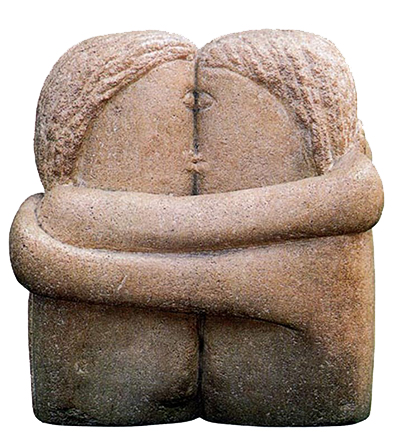
The handling remains visible in the bronze. Light catches the slightly uneven surface along the flank, thighs and shoulder in the inventory photograph. The trunk and limbs retain the weight and unevenness of a human figure even where their outlines have been simplified. The National Museum of Art of Romania singles out The Prayer as a turning point among Brâncuși’s early works. The sculpture shows how he could condense a subject while keeping the body recognisable. In the early stone carvings grouped around The Kiss, he would use the unity of the block to a different end. Here the change happens through a modelled figure whose view from the side can differ sharply from its view from the front. [7] [8] [9]
The plaster in Brâncuși’s studio
A photograph in the Centre Pompidou’s collection preserves an early view of the design in white plaster. It shows the figure on a high base in Brâncuși’s Montparnasse studio, with small clay studies nearby. The museum’s catalogue dates the photograph after 1907 and identifies it as a glass negative. It also records that the view was reversed left to right. Anyone comparing the photograph with another view has to allow for that reversal before judging which side a particular feature appears on. [5]
The white plaster and the small clay studies bring the scale of the finished figure into focus. In a study the sculptor could explore the balance of the bent legs and upright body on a small scale. On a high base the plaster gave the figure a presence of its own within a room. The photograph records that studio presentation. The Măgura stone at Dumbrava belongs to a later setting with a different purpose, where the kneeling woman forms part of a grave monument. How a base changes the figure above it would remain a concern throughout Brâncuși’s sculpture. [1] [5] [9]
The Centre Pompidou also holds a photograph, dated about 1907, of a model posing for the sculpture. In a separate record for a photograph titled La Prière, the museum describes Brâncuși setting aside a first proposal and scaling back the sensual detail in the kneeling nude. It attributes to him the idea that working in the presence of the model made it difficult to convey prayer as he wanted to. The photograph of the sitter gives us evidence of a model session, while the museum’s account speaks to a decision about how much of that encounter the sculpture would retain. The body keeps the effort involved in kneeling. The front of the torso, the bowed head and the line of the arm carry the expression that might otherwise have depended on a carefully described face. For a figure designed to stand outdoors beside a tomb, that decision made the gesture clear from several paces away. [7] [10] [11]
The Bucharest bronze and the cemetery replicas
Romania’s National Heritage Institute identifies the Bucharest bronze as accession 7202 in the National Museum of Art of Romania. Its record lists casting, chasing and patination. Those terms distinguish the making of the bronze from work done to refine its surface and give it its finish. The 1998 national listing papers supply individual marks. They describe Brâncuși’s signature on the cut section of the left arm and a Valsuani foundry stamp beneath it. They also record the museum’s acquisition in June 1958. Those physical and documentary details identify a particular object within the history of the design. [3] [4]
At Dumbrava, the local heritage account records that a replica took the place of the kneeling figure after the museum acquisition. The portrait bust followed a separate course. It entered the same museum in 1976 and was also replaced at the grave. This arrangement kept the two forms visible beside one another at the cemetery, where the identity of the man and the gesture of the woman are apprehended together. The bronzes in the museum’s custody offer a different kind of encounter, with individual objects whose ownership and manufacture can be studied. [1] [3] [4] [6]
The cemetery replacements acquired histories of their own. The Buzău account documents thefts affecting the replicas, recovery of the bust and the installation of a further copy of The Prayer in 2014. AGERPRES later interviewed the director of the Buzău County Museum, who likewise described the kneeling figure at the site as a later reconstruction and placed the ensemble at its original location. The local accounts differ on some years in the sequence of thefts and returns. Both place the later replica at the cemetery where the commission was installed and the documented museum bronze in Bucharest. [1] [3] [6]
That distinction gives both places a role in understanding the work. The national inventory helps answer questions about one bronze, down to the mark left by its foundry. The grave explains why the body kneels beside a portrait and how the stone beneath each figure brings the two together. In the museum the sculpture’s lowered head can draw the viewer closer. At the grave the same tilt can be understood in relation to the person whose memory gave rise to the commission. [1] [3] [4] [7]
Browse sculptures and drawings
Browse articles on the sculptures and separately catalogued museum objects. A work can have several physical versions. Drawing records from the Tate catalogue retain their October 2014 snapshot wording where present.
| Name | Date | Medium |
|---|---|---|
| Arch | Sculpture | |
| Bird in Space | Sculpture | |
| The Blond Negress | Sculpture | |
| The Cock | Sculpture | |
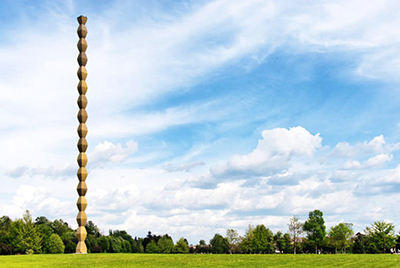
| The Endless Column | Sculpture | |
| The First Cry | Sculpture | |
| Fish | Sculpture | |
| The Gate of the Kiss | Sculpture | |
| Golden Bird | Sculpture | |
| Head | Sculpture | |
| The Kiss | Sculpture | |
| Leda | Sculpture | |
| Madame L.R. | Sculpture | |
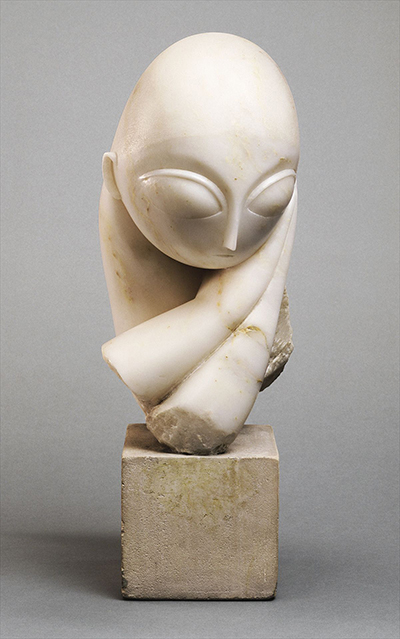
| Mademoiselle Pogany II | Sculpture | |
| Mademoiselle Pogany | Sculpture | |
| Maiastra | Sculpture | |
| The Newborn | Sculpture | |
| Phoque II | Sculpture | |
| The Prayer | Sculpture | |
| Princess X | Sculpture | |
| Prometheus | Sculpture | |
| Târgu Jiu monumental ensemble | Sculpture | |
| Sculpture for the Blind | Sculpture | |
| The Seal | Sculpture | |
| The Signal | Sculpture | |
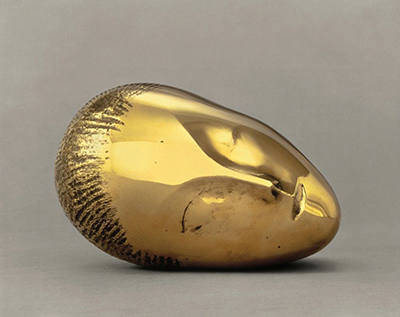
| Sleeping Muse | Sculpture | |
| The Sorceress | Sculpture | |
| The Table of Silence | Sculpture | |
| Torso of a Young Man | Sculpture | |
| Two Lamps | Sculpture | |
| Vitellius | Sculpture | |
| The White Negress | Sculpture | |
| The Wisdom of the Earth | Sculpture | |
| Young Bird | Sculpture | |
| The Kiss (Philadelphia, fourth version) | 1916 | Sculpture Catalogue. |
| Sleeping Muse (Pompidou bronze) | 1910 | Sculpture Catalogue. |
| Mlle Pogany, version I (MoMA bronze) | 1913, after a marble of 1912 | Sculpture Catalogue. |
| Maiastra (Venice brass) | about 1912 | Sculpture Catalogue. |
| Bird in Space (MoMA bronze) | about 1941 | Sculpture Catalogue. |
| Bird in Space (Venice brass) | 1932–40 | Sculpture Catalogue. |
| Endless Column, version I (oak) | 1918 | Sculpture Catalogue. |
| Brâncuși Monumental Ensemble of Târgu Jiu | 1937–38 | Sculpture Catalogue. |
| Bust of a nude woman in profile, head inclined | about 1910 | Drawing Catalogue. |
| Nude study, head inclined (recto) | — | Drawing Catalogue. |
| Self-portrait (ink) | — | Drawing Catalogue. |
| View of the Artist’s Studio | 1918 | Drawing Catalogue. |
| Study for the cock (lost clay Grand Coq) | about 1923 | Drawing Catalogue. |
| Portrait of a woman in profile | — | Drawing Catalogue. |
| Animal head | — | Drawing Catalogue. |
| Animal sketch (2002 checklist) | 1929 | Drawing Catalogue. |
| Plans of the studio (verso) | about 1930–38 | Drawing Catalogue. |
| Danaïde (Tate T00296) | c.1918 | Sculpture Catalogue. |
| Maiastra (Tate T01751) | 1911 | Sculpture Catalogue. |
| Head (Tate T03066) | c.1919–23 | Sculpture Catalogue. |
| Fish (Tate T07107) | 1926 | Sculpture Catalogue. |
Frequently Asked Questions
Its photography collection holds Brâncuși’s studio view of the white plaster version and the nearby clay studies. The glass negative is catalogued as PH 193. [5]
Discussion
Look again at the images and ideas explored in The Prayer. These editorial prompts invite your observations.
Reader Insights
Follow the line from the knees to the bowed head. Where do you first read the figure’s posture as prayer?
How does the kneeling figure change the way you might look at a portrait bust displayed beside it?
What can you learn from the setting at Dumbrava that would be harder to see in a photograph of the sculpture by itself?
Join the Conversation
Share a detail, comparison or question about The Prayer below.
References
- Patrimoniu QR Buzău, Lucrarea „Rugăciune” și bustul avocatului Petre Stănescu (in Romanian, with English and French versions). View source.
- Sorana Georgescu-Gorjan, Cronologie brâncușiană după iulie 1904, Constantin Brâncuși Research, Documentation and Promotion Centre, 1907 commission and studio move (in Romanian). View source.
- Institutul Național al Patrimoniului, Rugăciunea, inventory 7202 (object record in Romanian). View source.
- Romanian Ministry of Culture, Order no. 3042 of 14 July 1998 and accompanying inventory, printed p. 4, entry 8, Rugăciune (in Romanian). View source.
- Centre Pompidou, Vue d’atelier : La Prière (1907), photograph PH 193 (catalogue description in French). View source.
- Florin Zafiu, AGERPRES, Two copies by Brancusi, as famous as the originals, after being stolen, at home, in Buzau, 14 July 2023, citing the commission and interviewing the director of Buzău County Museum. View source.
- Institutul Național al Patrimoniului, Rugăciune, Brâncuși album entry, documented view of inventory 7202 (in Romanian). View source.
- Muzeul Național de Artă al României, În atelierul artistului, room 7, “Colecția MNAR” (in Romanian). View source.
- Centre Pompidou, Constantin Brancusi retrospective exhibition dossier, PDF p. 5, rooms 1 and 2 (in French). View source.
- Centre Pompidou, Modèle posant pour La Prière, photograph PH 802 A (in French). View source.
- Centre Pompidou, La prière, photograph PH 194 A, catalogue commentary on the design and the model (in French). View source.
More BRÂNCUȘI Sculptures
Bird in Space
Compare the marble and metal versions of Brâncuși’s sculpture.