 by Tom Gurney
Tom Gurney BSc (Hons) is an art history expert with over 20 years experience
Published on June 19, 2020 / Updated on November 29, 2026
Email: tomgurney1@gmail.com / Phone: +44 7429 011000
The Kiss: Introduction
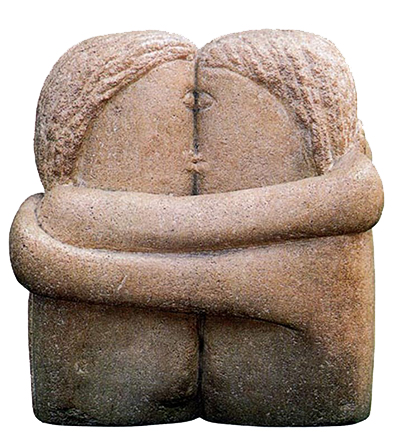
In Constantin Brâncuși’s The Kiss, two people turn towards one another inside a single block of stone. Their arms almost close a ring around it. In the early carving at the Craiova Art Museum, their features meet across a narrow, uneven divide. In the 1916 limestone version in Philadelphia, the two eyes work together as one almond-shaped outline. Both make intimacy visible through the shape and surface of the stone, but they arrive at that effect by different means. [1] [2]
Brâncuși returned to the subject for decades. There are several independent stone carvings, plaster casts made from the earliest carving and later uses of the motif in relief and architecture. The standing couple on a grave in Montparnasse is a separate carving, and the portal at Târgu Jiu brings the motif into a public memorial. Dates and measurements become useful as soon as they are tied to an individual work. [3] [4] [5]
At a Glance
- The Kiss (Sărutul), CraiovaDated 1907 by the Craiova Art Museum and Romanian national register. Direct-carved Marne stone, about 28 cm high, inventory 4/948. The first stone version. [1] [6] [7]
- Second stone carving, formerly in the Harold Diamond collectionUsually dated around 1908. Limestone, 32.4 cm high in the 2004 Sotheby’s catalogue. A separate hand-carved version. [8]
- The Kiss, Montparnasse CemeteryCarved in 1909 in Euville stone. The standing figures were secured to Tatiana Rachewskaïa’s funerary stele in April 1911. [4]
- The Kiss, Nasher Sculpture CenterPlaster from the early stone version. The Nasher dates the composition 1907–08 and its cast before 1914. [3]
- The Kiss, Philadelphia Museum of ArtDated 1916. Limestone, 58.4 × 33.7 × 25.4 cm, accession 1950-134-4. Commissioned by the collector John Quinn. [2] [9]
- Le Baiser, Centre PompidouDated 1923–25. Brown limestone, 36.5 × 24.5 × 23 cm, inventory AM 4002-3. Entered the collection through Brâncuși’s 1957 bequest. [10]
- Gate of the Kiss, Târgu JiuTravertine portal in the memorial ensemble erected in 1937–38. Its carved motifs carry the subject into architecture. [5] [11]
- Le Baiser, Centre PompidouCirca 1940. Yellow limestone, 71.8 cm high, inventory AM 4002-1. The museum catalogues its associated base separately. [12]
Contents
- The first stone Kiss in Craiova
- Direct carving and the comparison with Rodin
- The second carving and the plaster casts
- Montparnasse and the grave of Tatiana Rachewskaïa
- The 1916 Philadelphia Kiss
- The later carvings in the Centre Pompidou collection
- From the carved couple to the Gate of the Kiss
- What the embrace means
The first stone Kiss in Craiova
The small carving in Craiova is the place to begin. Both its museum and Romania’s national heritage register date it to 1907 and identify the material as Marne stone. The national register calls it the first stone version. The official classification documentation gives its height as 28 cm and its weight as 24 kg. Its shape is low and compact, so the mass comes as a surprise if you know it chiefly from photographs. The dimensions in the classification annex are 28 × 26 × 21.8 cm, close enough in height and width for the broad face of the block to read as roughly square. The Craiova museum records its first public exhibition in Bucharest in 1910 with the Tinerimea Artistică group. [1] [6] [7]
Some sources use 1907–08 for the first composition. The Nasher uses that range when describing the early plaster in its collection, and the Centre Pompidou uses it when naming the work in a photograph Brâncuși made around 1910. For the Craiova sculpture itself, 1907 is the date used by the holding museum and the Romanian register. An early photograph can carry two dates because the date of the carving and the date when the sculptor photographed it answer different questions. The same distinction applies to plaster, which can preserve a design from an earlier year. [1] [3] [6] [13]
The sculpture pictured here appears to show the early Craiova form. Its low proportions and individually described profiles are consistent with that identification. In the early carving, a line between the bodies runs slightly off a strict centre, and the arms overlap at slightly different heights. The hands also receive more attention than their size might suggest. Deep cuts pick out the fingers, while the backs and chests are suggested with much shallower changes of surface. Viewed in the round, this difference between a fine incised line and a slight swelling of the stone matters as much as the familiar outline of two faces kissing. [1] [6]
Try following the woman’s arms. They reach around the man’s shoulders, and her hands cross behind his neck. His reach completes the circuit across the other surfaces. From one side, you may see the hands as the destination of a gesture. From another, their fingers read as a cluster of short marks that tuck back into the surface. The stillness of the larger stone planes makes those marks lively. Beneath them, the block carries both figures down to one shared bottom edge. [1]
The kiss is also a problem of visibility. As the faces close, the mouths become difficult to see as separate forms. A meeting of lips is ordinarily a tiny event in a sculpture made up of two bodies. Brâncuși gives it greater weight by bringing the whole composition in around it. Each partner’s arm reinforces the same action at a different level. The meeting is legible through the conduct of the hands and bodies even when the point of contact itself almost disappears. [1] [6]
Brâncuși gave the early carving to Victor N. Popp in 1910, according to the provenance discussed in the auction and exhibition catalogues. The Romanian classification annex also identifies the Popp collection, and the Craiova Art Museum records the work among the sculptures exhibited in the city at the 1943 Săptămâna Olteniei exhibition. This history helps explain why Walter Pach’s plaster, rather than the first stone, was the example John Quinn saw when he sought a carving of his own. [1] [7] [8] [9]
Direct carving and the comparison with Rodin
Direct carving means shaping the work in its material, here by cutting into stone. It differs from modelling a sculpture in a pliable material such as clay, then using that model as the basis for a cast or to guide the transfer of the design into stone. In the Craiova Kiss, the rectangular block remains apparent in the finished work. Removing the stone between the bodies would have produced more anatomical separation, yet it would also have changed the relation between the act of embracing and the form that encloses it. Brâncuși’s handling makes the shape of the material part of the subject. [1] [14]
This practice still leaves considerable room for decisions about finish. At Craiova, the incisions and the more gently shaped surfaces belong to one piece of stone. A deep line can put a finger into relief without requiring the hand to project far into space. A broad change of plane can suggest a shoulder with very little outlining. The difference is easy to miss in a front-facing photograph taken in flat light. Seen obliquely, the shallow passages and the pronounced cuts catch the light differently, and the bodily details emerge from an otherwise compact mass. [1] [6]
A comparison with Auguste Rodin’s marble Kiss at the Musée Rodin makes that choice visible. Rodin’s pair began as Paolo and Francesca from Dante’s Inferno, conceived in connection with The Gates of Hell. He removed them from the doorway design and exhibited the group independently in 1887. The French state commissioned the enlarged marble in 1888. The smooth surfaces of Rodin’s turning figures emerge from the rock beneath them, and the tilt of the bodies gives the embrace a sweep that extends beyond the point where the faces meet. [15]
Brâncuși’s figures put comparable pressure on a much smaller piece of stone. Rodin gives the viewer a knee, the swing of a torso and a long sweep of back to follow. Brâncuși lets the fingers, the route of the arms and the meeting of two profiles do much of that work in a short distance. Rodin’s marble preserves a contrast between the figures and their rough seat. In Craiova, the quieter planes between and around the couple participate in the closeness of the figures. Even where the earlier artist’s composition suggests a particular story, both works can be apprehended immediately as embraces. [1] [15]
The relationship is biographical as well as visual. Brâncuși spent a brief time in Rodin’s workshop in Paris before pursuing his own direction. The Craiova Art Museum reads the early Kiss as a deliberate contrast with Rodin, and the Nasher puts the shift to direct carving at the centre of that break. The same visual evidence has prompted discussion of other artistic precedents. The Nasher points to African and ancient Cycladic sculpture, and Ann Temkin’s catalogue entry for the Philadelphia work raises affinities with Cubist sculpture and with the carving of Paul Gauguin and André Derain. These comparisons illuminate different features. They offer ways to understand the strong outline, concentrated carving and surviving block shape without assigning the composition to a single prototype. [1] [3] [9] [14]
The second carving and the plaster casts
The second version, reproduced in Sotheby’s 2004 catalogue, is a limestone sculpture approximately 32 cm high. It is associated with the Harold Diamond collection and is generally dated around 1908. Its rougher, greyer stone and greater height are useful distinguishing features. Its carving makes the outer mass more emphatic and the couple’s heads seem more embedded than in the first version. Looking at the two objects side by side, the same amount of apparent closeness comes from a changed distribution of detail. [8]
The auction record is also a reminder that a provenance can retain open questions even when the sculpture itself is recognisable. It lists either Léone Ricou in Paris or Alexandru C. Bogdan Pitești in Bucharest at the beginning of its ownership history. Later entries name the dealer Pierre Loeb and American collectors. The auction record establishes the identity of the object brought to sale in 2004. Its earliest ownership remains uncertain in that record, and the entry is no basis for assuming where the work is today. [8]
The plaster casts belong to another branch of the series. A mould taken from an existing form can carry its shape into another material without recarving it. The cast at the Nasher Sculpture Center in Dallas gives a particularly good example of what remains visible from that process. Fine raised seams on the heads and arms show where sections of the mould fitted together. Those lines may resemble incisions when viewed from a distance, but at close range they rise from the plaster rather than sinking into it. The museum also notes wear that it suggests may come from a period of outdoor display. Chisel, mould and later exposure have each left a different kind of evidence on or in the surviving surfaces. [3]
The plaster casts helped the early composition travel. The Craiova museum records a plaster at the Armory Show in 1913, and the Chicago catalogue lists The Kiss as number 24. A photograph in the Library of Congress shows the compact two-bust design associated with the New York exhibition. In her archival study of the exhibition, Doïna Lemny traces the cast lent by artist and organiser Walter Pach, including his letter recalling how he placed it between two windows and hung Brâncuși’s photograph of the Montparnasse monument below it. That pairing already brought two separate incarnations of the embrace together around a shared title. [1] [16] [17] [18]
The Nasher traces its own cast through Alexandre Mercereau, who was involved with the 1914 exhibition in Prague at which the plaster is recorded. The cast’s association with the first carving describes its form. Its own exhibition and ownership record describes a separate physical object. A reproduction of an old photograph can obscure that distinction, particularly if it carries only the artist’s name and the title. A cast date, exhibition history or accession number can settle questions that a familiar outline leaves open. [3] [19]
Montparnasse and the grave of Tatiana Rachewskaïa
In the Montparnasse version, Brâncuși extends the composition to a standing pair. The figures remain pressed together at the head and shoulders, but the weight of the embrace now continues down a long vertical block. Seen atop the grave, the paired bodies share an upright axis with the stele. The early Craiova and plaster busts concentrate the viewer’s attention around the shoulders. The Montparnasse carving invites the eye to travel down from that meeting into a distinctive change of scale between the small carved figures, the inscribed support and the grave below. [4] [13]
The dates matter because the work acquired its funerary purpose after it was carved. The Conseil d’État identifies it as the third version, made in 1909. Tatiana Rachewskaïa died in December 1910. Her father acquired the existing sculpture from Brâncuși for the grave and had a stoneworker make a stele to support it. The court records that both were made in Euville stone, and that the group was fixed and sealed to the stele in April 1911. The physical connection was intentional from the moment the grave monument was made, even though the carving itself was already in existence. [4]
The family’s later attempt to detach and sell the sculpture sharpened the question of what one ought to regard as the work. France protected the entire grave as a historic monument in 2010. In 2021 the Conseil d’État upheld that protection. Its reasoning took in the foundation, the stele with its epitaph and the group permanently incorporated into it. The separate origin of the carved figures did not determine the legal status of the completed funerary structure. [4]
That judgment helps explain why the Montparnasse setting belongs in the history of this particular version. A generic reproduction of the two figures can convey their embrace, but without the stele it loses the register below them where a name and an epitaph give the image a specific purpose. The transformation from a sculpture of two people into part of a monument to one person took place through purchase, installation and use. It remains possible to study the formal invention it shares with Craiova and Philadelphia while keeping the memorial’s individual history in view. [4] [13]
The 1916 Philadelphia Kiss
The Philadelphia Museum of Art’s The Kiss is limestone and stands 58.4 cm high. It is considerably taller than the first stone version or the second. The profile of the new block does as much to differentiate it as any individual mark. In Philadelphia the straight sides continue well below the main belt of arms. The broad lower surfaces prolong the vertical weight of the stone after the busiest carving has finished. Together with the paired heads, that length gives the work a different tempo. [2] [9]
The collector John Quinn commissioned this sculpture after seeing the small plaster owned by Walter Pach, who acted as an intermediary. Their correspondence distinguishes the familiar small design from the carving Quinn ordered. A letter dated 3 March 1916 confirms the request for a new stone version. Older exhibition dates led some writers to assign the Philadelphia sculpture to 1908 or 1912. The commission correspondence and the museum’s current dating support 1916 for the object now in Philadelphia. [2] [9]
The different date changes the question one brings to the sculpture. In 1907 the artist was establishing the relation between the two figures and their shared block. By 1916 he could rely on the structure of a recognisable composition and reconsider how little an eye, an arm or a hairline needed to identify it. One sees the effects at the top of the Philadelphia block. From the best-known broad view, an eye on each profile completes the outline of a single almond shape across the divide. The hair over the two heads becomes one arch. These are the features of two people and, at the same time, shared shapes that can only arise from the meeting of two sides. [2] [9]
The arms trace a lower pattern. Brâncuși has brought them so close to the surface that the line of an embrace also looks like a band around a solid. Hands are still present. Their abbreviated shapes and position make it possible to follow which partner reaches towards which shoulder, but the stone between the hands is as broad and continuous as the hands are narrow. A small rounding at the chest and the fall of longer hair down a back let distinctions between the figures reappear as you go around the work. Read from another angle, the apparently single face becomes the meeting of two profiles again. [2] [9]
There is a practical way to test the difference between the first and the fourth stone carvings. Start with the eyes and ignore the caption for a moment. In photographs of the Craiova group, the eyes stay more individually marked and a slight irregularity runs along the meeting of the figures. In Philadelphia, the eye that seems to belong to both people holds your attention at the centre. Then move down to the hands. The opposite sides in the earlier work have a busy clasp, more evident in the form of fingers overlapping and crossing. Across the taller block in Philadelphia the horizontal sweep of the arms has more force because it interrupts a longer vertical rise. The two versions give greater weight to different moments of the same touch. [1] [2] [9]
From Quinn’s commission to the Arensberg collection
The museum traces the stone from Brâncuși to Quinn in 1916. After Quinn died in 1924, the work remained with his estate until its sale through the dealer Joseph Brummer to Marcel Duchamp and Henri-Pierre Roché by September 1926. It then passed to Louise and Walter Arensberg in Los Angeles. Philadelphia’s label dates the acquisition to 1932, while its detailed provenance qualifies that year as possible. The sculpture entered the museum as a gift in 1950 as part of the Arensberg Collection. Its accession number, 1950-134-4, identifies this particular carving through changes of display, photography and titles in different languages. [2]
The placement of the work was itself a subject of correspondence. When Pach asked about a base on Quinn’s behalf, Brâncuși recommended letting the group stand as a whole on a separate support. The Arensbergs initially displayed it alone on a section of beam. By the mid-1940s they had set it on a low bench made by Brâncuși flanked by six stone sculptures from their collection of pre-Columbian art. The carved upper block stayed the same while the things immediately adjoining it changed. [2] [9]
A high, narrow support can emphasise the doubled profile and lead the eye back toward the middle of the sculpture. A low, long bench gives the block neighbours and a horizon. In such an arrangement, the experience of the carving includes moving from one object to the next and comparing how they occupy space. The Arensbergs’ display tells us something about twentieth-century collecting and how these owners chose to see Brâncuși alongside sculpture from the Americas. The historical association belongs to their arrangement. The earlier commission and its correspondence tell a different part of the work’s story. [2] [9]
The later carvings in the Centre Pompidou collection
The Centre Pompidou’s brown limestone Le Baiser, dated 1923–25, shows that Brâncuși continued to make freestanding versions. At 36.5 cm high, it is closer in height to the Craiova and former Diamond works than to the Philadelphia carving. The museum records a Paris 1925 inscription underneath and identifies a shared support on which the studio version could be placed alongside Torso of a Young Man. Its provenance runs from the artist to the museum through his bequest. [10]
The comparison complicates the impression that a series necessarily gets taller, smaller or simpler as it goes along. The date changes, the size contracts and the broader arrangement of forms comes into play again. An isolated view allows the viewer to scrutinise the limits of the individual carving. The Centre Pompidou catalogue’s photograph of the two works on a common support shows how a pair of bodies could operate as one solid shape beside the upright form of another sculpture. A setting can make a given amount of anatomical detail look more or less pronounced because it changes what the viewer uses as a point of comparison. [10]
The museum also holds a distinct Le Baiser in yellow limestone, dated around 1940. It gives a height of 71.8 cm for that sculpture and lists its rectangular base separately. Like the brown stone carving, it came to the collection through the artist’s 1957 bequest. One photograph in the record shows the later carving apart from the associated base. The earlier object and this later assembly share a French title and an ownership history as far back as the studio, so colour, size, date and inventory number do more to identify them than the title does. [10] [12]
The surviving objects also suggest an answer to a question that the two famous museum examples can leave open. Why change the look of the couple once an effective solution had already been found? With each pairing of bodies and block, Brâncuși could change what the surrounding stone does. A small horizontal unit makes the gesture crowd almost all the space it has. A more elongated unit gives it room to become a band interrupting a vertical form. The artist could move between these possibilities over decades and return to the same title with a different distribution of mass. [2] [10] [12]
From the carved couple to the Gate of the Kiss
Brâncuși’s photographs document another direction for the motif. The Centre Pompidou preserves a gelatin silver print titled Colonne du Baiser (1916–1917). The subject is a column, and the item in the museum’s photography collection is a print of the column. The same distinction applies to the photograph of a model for the gate, dated 1935–37 in the Centre Pompidou’s dossier. These objects show the sculptor thinking of an embrace as a design that could occupy a different shape and scale. [13] [20]
At Târgu Jiu, the Gate of the Kiss is a travertine portal that visitors can approach and pass through. The rounded forms of the motif are carved in low relief on the pillars, and variations of the embrace recur in a horizontal frieze above. A shallow relief belongs to the supporting wall or pillar more completely than an independent sculpture standing on a base. The two halves of the motif are legible from a distance, where the fine details of a hand would be lost. Both the upright supports and the long course of the lintel offer surfaces on which two aligned forms can meet or repeat. [5] [11]
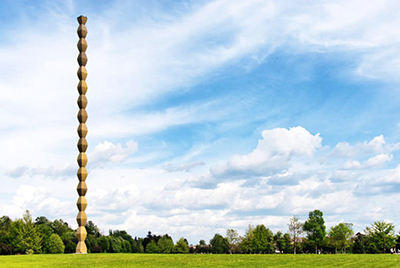
The portal was erected as part of the Târgu Jiu monumental ensemble of 1937–38 in memory of those who died defending the city in the First World War. It stands on a route that includes seats, a table, a pre-existing church and the Endless Column, among other elements. In the portable sculptures, a spectator normally circles the stone. At Târgu Jiu, passing through and continuing along the ensemble’s axis become part of the experience. The emblem on the blocks faces outward into a city where people encounter the work while moving between other places. [5] [11]
The connection to the early sculptures is easiest to see in the way that Brâncuși gives weight to the line between two forms. In the Craiova and Philadelphia carvings, that line once again separates the couple as soon as the eye notices it. On the Gate, a division remains legible even where much of the surrounding body has fallen away. At the scale of a public memorial the recurring motif keeps something of the force of an encounter between two people through the way its parts face, touch and repeat. [1] [2] [5] [11]
What the embrace means
The title offers one clear subject, and the sculptures leave room for more than one feeling. The clasping hands and close profiles can make the encounter tender. The pressure of one body against the other can make it seem urgent. The straight outside edges hold the gesture in place through either reading. Because two heads and several arms remain visible, their union has a tension it would lose if all the parts simply melted into a smooth surface. [1] [2] [9]
There is also a difference between what the sculptor carved and what later owners or settings made of it. In an intimate interior a work like the Philadelphia Kiss can become a centre of attention among other objects. In Montparnasse, an embrace became inseparable from the grave of a specific person. At Târgu Jiu the later motif acquired a collective commemorative purpose. These associations stem from the distinct histories of the works. Looking across them, the shape of two forms joined at an edge turns out to have been durable enough to carry a private act into several very different settings. [2] [4] [5]
The same habit of returning to a subject can be seen across Brâncuși’s sculptures. The Kiss gives it an especially visible starting point because the act and the problem of making it can both be recognised at once. The title is easy to understand. The way the eyes, hands and stone planes keep reassigning the boundary between two figures is what rewards a second look. [1] [13] [14]
Browse sculptures and drawings
Browse articles on the sculptures and separately catalogued museum objects. A work can have several physical versions. Drawing records from the Tate catalogue retain their October 2014 snapshot wording where present.
| Name | Date | Medium |
|---|---|---|
| Arch | Sculpture | |
| Bird in Space | Sculpture | |
| The Blond Negress | Sculpture | |
| The Cock | Sculpture | |
| The Endless Column | Sculpture | |
| The First Cry | Sculpture | |
| Fish | Sculpture | |
| The Gate of the Kiss | Sculpture | |
| Golden Bird | Sculpture | |
| Head | Sculpture | |
| The Kiss | Sculpture | |
| Leda | Sculpture | |
| Madame L.R. | Sculpture | |
| Mademoiselle Pogany II | Sculpture | |
| Mademoiselle Pogany | Sculpture | |
| Maiastra | Sculpture | |
| The Newborn | Sculpture | |
| Phoque II | Sculpture | |
| The Prayer | Sculpture | |
| Princess X | Sculpture | |
| Prometheus | Sculpture | |
| Târgu Jiu monumental ensemble | Sculpture | |
| Sculpture for the Blind | Sculpture | |
| The Seal | Sculpture | |
| The Signal | Sculpture | |
| Sleeping Muse | Sculpture | |
| The Sorceress | Sculpture | |
| The Table of Silence | Sculpture | |
| Torso of a Young Man | Sculpture | |
| Two Lamps | Sculpture | |
| Vitellius | Sculpture | |
| The White Negress | Sculpture | |
| The Wisdom of the Earth | Sculpture | |
| Young Bird | Sculpture | |
| The Kiss (Philadelphia, fourth version) | 1916 | Sculpture Catalogue. |
| Sleeping Muse (Pompidou bronze) | 1910 | Sculpture Catalogue. |
| Mlle Pogany, version I (MoMA bronze) | 1913, after a marble of 1912 | Sculpture Catalogue. |
| Maiastra (Venice brass) | about 1912 | Sculpture Catalogue. |
| Bird in Space (MoMA bronze) | about 1941 | Sculpture Catalogue. |
| Bird in Space (Venice brass) | 1932–40 | Sculpture Catalogue. |
| Endless Column, version I (oak) | 1918 | Sculpture Catalogue. |
| Brâncuși Monumental Ensemble of Târgu Jiu | 1937–38 | Sculpture Catalogue. |
| Bust of a nude woman in profile, head inclined | about 1910 | Drawing Catalogue. |
| Nude study, head inclined (recto) | — | Drawing Catalogue. |
| Self-portrait (ink) | — | Drawing Catalogue. |
| View of the Artist’s Studio | 1918 | Drawing Catalogue. |
| Study for the cock (lost clay Grand Coq) | about 1923 | Drawing Catalogue. |
| Portrait of a woman in profile | — | Drawing Catalogue. |
| Animal head | — | Drawing Catalogue. |
| Animal sketch (2002 checklist) | 1929 | Drawing Catalogue. |
| Plans of the studio (verso) | about 1930–38 | Drawing Catalogue. |
| Danaïde (Tate T00296) | c.1918 | Sculpture Catalogue. |
| Maiastra (Tate T01751) | 1911 | Sculpture Catalogue. |
| Head (Tate T03066) | c.1919–23 | Sculpture Catalogue. |
| Fish (Tate T07107) | 1926 | Sculpture Catalogue. |
Frequently Asked Questions
The Craiova Art Museum and Romanian national register date the first stone version to 1907. Other sources use 1907–08 for the initial composition. The Montparnasse carving dates to 1909 and was installed on the grave in 1911. The Philadelphia Museum of Art identifies its carving as the version commissioned in 1916. [1] [2] [3] [4] [6] [9]
Discussion
Look again at the images and ideas explored in The Kiss. These editorial prompts invite your observations.
Reader Insights
In the Craiova and Philadelphia carvings, where can you most clearly distinguish the two figures? What changes when you follow the arms instead of the faces?
What happens to your reading of the Montparnasse figures when you see them above the stele and epitaph?
How do you recognise the embrace once Brâncuși has translated it into the relief patterns of the Gate at Târgu Jiu?
Join the Conversation
Share a detail, comparison or question about The Kiss below.
References
- Muzeul de Artă Craiova. Constantin Brâncuși collection and 1907 Sărutul entry. View source.
- Philadelphia Museum of Art. The Kiss, 1916, object 51306 and provenance. View source.
- Nasher Sculpture Center. The Kiss (Le Baiser), early plaster cast. View source.
- Conseil d’État. Decision no. 447967, 2 July 2021, Montparnasse funerary monument. View source.
- UNESCO World Heritage Centre. Brâncuși Monumental Ensemble of Târgu Jiu. View source.
- Institutul Național al Patrimoniului. National register entry for Sărutul, inventory 4/948. View source.
- Romanian Ministry of Culture. Classification order 2579/05.03.2003, annex entry 1. View source.
- Sotheby’s. The Kiss, former Harold Diamond collection, 2004 sale catalogue, lot 8. View source.
- Ann Temkin. Catalogue entry for the Philadelphia Kiss, from Constantin Brancusi 1876–1957, 1995, p. 142, reproduced with the Philadelphia Museum of Art’s listing. View source.
- Centre Pompidou. Le Baiser, 1923–25, AM 4002-3. View source.
- ICOMOS. Advisory body evaluation, Brâncuși Monumental Ensemble of Târgu Jiu. View source.
- Centre Pompidou. Le Baiser, circa 1940, AM 4002-1. View source.
- Centre Pompidou. Le Baiser, educational dossier with Brâncuși’s photographs. View source.
- Centre Pompidou. Brancusi, 2024 exhibition podcast transcript. View source.
- Musée Rodin. Auguste Rodin, The Kiss, marble S.1002 / Lux.132. View source.
- Association of American Painters and Sculptors. Catalogue of the International Exhibition of Modern Art, Art Institute of Chicago, 1913. View source.
- Library of Congress. The Kiss, photograph associated with the 1913 Armory Show. View source.
- Doïna Lemny. « Est-ce une femme ou un œuf ? », la participation remarquée de Brancusi à l’Armory Show, 2014, pp. 133–142. View source.
- French Sculpture Census. Nasher cast, exhibition history and catalogue commentary. View source.
- Centre Pompidou. Colonne du Baiser (1916–1917), photograph PH 222 C. View source.
More BRÂNCUȘI Sculptures
Bird in Space
Compare the marble and metal versions of Brâncuși’s sculpture.