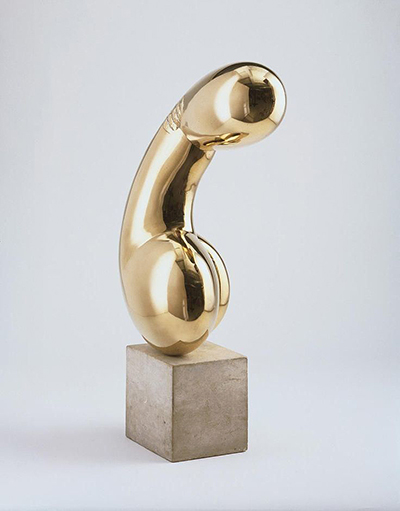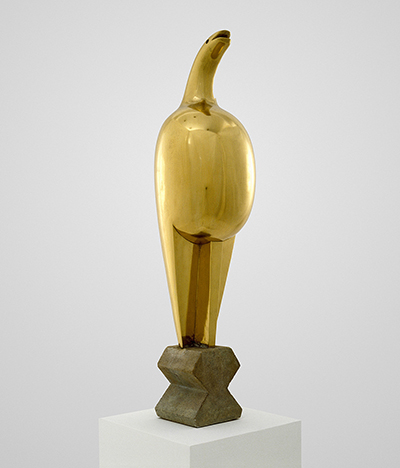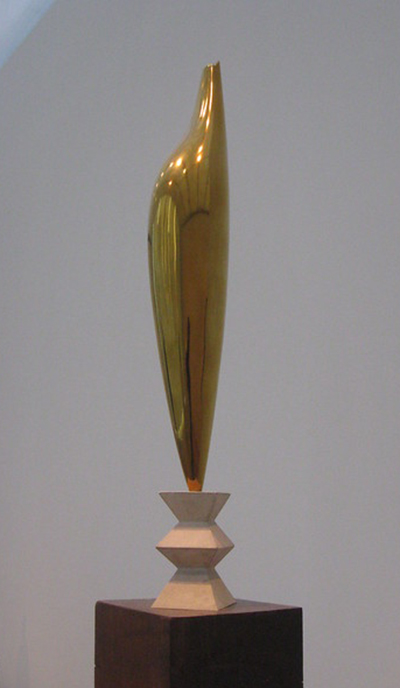
 by Tom Gurney
Tom Gurney BSc (Hons) is an art history expert with over 20 years experience
Published on June 19, 2020 / Updated on November 29, 2026
Email: tomgurney1@gmail.com / Phone: +44 7429 011000
The Newborn: Introduction
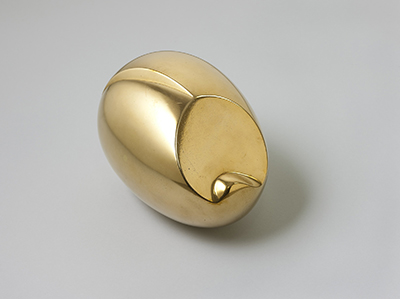
A small, egg-shaped head lies on its side. A broad plane interrupts the curve, and a little ridge rises from it like a lip. In Constantin Brâncuși’s The Newborn, those few changes of surface are enough to suggest the first cry of an infant. Brâncuși carved the white marble now in Philadelphia in 1915. The closely related bronze at the Museum of Modern Art in New York dates to 1920. Both museums call their work a first version. [1] [2] [3] [4]
Brâncuși returned to the subject in The Newborn II, softening the remaining facial features and experimenting with how the sculpture sat on its base. Those changes matter as much as the move from stone to metal. In the Centre Pompidou’s polished bronze, the oval reflects the disc beneath it, while the disc catches a second image of the oval. The same subject that begins with a mouth opening in a marble head comes to depend on what happens in the space around the object. [4]
At a Glance
- Newborn [I]1915, white marble, Philadelphia Museum of Art. [1] [5]
- The Newborn, version I1920, bronze, Museum of Modern Art, New York, 605.1943. [2]
- Le Nouveau-Né II1919–21, white marble, Moderna Museet, Stockholm. The Centre Pompidou proposes 1916 for this marble. [4] [6]
- Le Nouveau-Né IIAround 1923, polished bronze on a polished bronze disc and a three-part base, Centre Pompidou, Paris, AM 4002-33. [4]
- Le Nouveau-Né II1927, stainless steel on a steel disc and base, Centre Pompidou, Paris, AM 4002-34. [7]
Contents
- How Brâncuși suggests a cry
- Marble, plaster and bronze in Version I
- What changed in The Newborn II
- Why the bronze changes in photographs
- The First Cry and The Beginning of the World
How Brâncuși suggests a cry
The Philadelphia marble offers two ways into the image. Follow the long outer curve and you see an egg, tilted slightly away from the horizontal. Look into the slanting cut and the form acquires a face. The lip seems to protrude from that plane, while the fullness underneath gives the mouth the weight of a chin. Neither reading needs a full outline of the features. The same stretch of marble serves as the rounded shell of an egg and as the surface of a head. The title points towards a child, leaving the stone free to suggest the more general idea of birth. [1] [4]
The apparent action happens where the curve meets the plane. The rounded body leads the eye around the stone without interruption until that sudden change of angle. A shallow depression takes on depth because the ridge immediately beside it catches the light. As you move around the head, the edge of the plane changes its relation to the outline. One view makes the mouth readable, while another lets it recede until the mass seems almost closed again. That alternation gives the cry a duration in the act of looking. You can spend a moment finding the face and then lose it after taking a step. [1] [3]
The dimensions help explain why that gesture feels intimate. MoMA’s bronze measures about 21 centimetres at its widest, close to the span of an outstretched hand. The features are concentrated in a small part of that surface, leaving a broad field of unbroken curve. Anyone looking for a likeness has very little to go on, but the viewer looking for an action has a precise clue. A mouth opening is something a viewer can recognise from the change it makes to the surrounding form. Brâncuși gives the action particular weight by making the eye cross so much quiet surface to get there. [2] [3]
Marble, plaster and bronze in Version I
The 1915 and 1920 dates belong to individual objects. The Philadelphia work is the carved marble, while the MoMA bronze carries its own date and accession number. A surviving plaster helps explain how the design moved between materials. The Centre Pompidou dates its plaster Le Nouveau-Né I, AM 4002-28, to 1915–20 and identifies it as the probable intermediary for the polished bronze at MoMA. The museum’s qualification matters. The plaster and the bronze provide evidence of a casting process, while the relationship between these particular objects is stated as a likelihood. [1] [2] [8]
Although the two first versions share roughly the same scale and arrangement of forms, they register light differently. The white stone allows the change between the oval and the cut to read in relatively gradual shading, with firmer shadows where the surface turns abruptly. In the bronze, a light source can produce a sharply defined streak across a gently rounded area. That streak can be visually stronger than the edge Brâncuși gave to the face. Comparing the two materials brings out how much of the image comes from the object's shape and how much comes from light arriving at the surface. [1] [2] [3]
The two objects also travelled separately. In its reconstruction of Brâncuși’s 1927 exhibition at the Arts Club of Chicago, the Musée d’art contemporain de Montréal traces the Philadelphia marble from Louise and Walter Arensberg to the collector John Quinn in 1922, then back to the Arensbergs in 1933 before it entered the Philadelphia Museum of Art in 1950. MoMA records that Brâncuși gave its bronze to Joella Lloyd in August 1927. The museum purchased it from Lloyd through the Julien Levy Gallery in 1943. The collections preserve two different histories of the same idea, one through a marble that changed hands more than once and one through a bronze that left the studio as a gift. [2] [9]
What changed in The Newborn II
The second version carries the egg shape further. The Centre Pompidou describes the white marble now at Moderna Museet as larger than the 1915 marble, with the nose tip and projecting chin smoothed away. At about 25 centimetres wide it is still an object one could imagine cradling. Its fuller oval, however, has fewer small changes in contour that could place a viewer in front of a face. The title continues to suggest a child even when the shape looks self-contained. The Stockholm museum dates its marble to 1919–21. The Centre Pompidou proposes 1916 for the same object and records that Rolf de Maré bought it in 1926. Moderna Museet records its own purchase in 1961. [4] [6]
The Centre Pompidou traces its polished bronze of The Newborn II back through a polished and patinated plaster from Brâncuși’s studio. Its record dates the bronze to around 1923 and its curatorial account describes the casting as taking place before 1923. The bronze is listed at 17 by 25.5 by 17 centimetres, above a polished bronze disc 50 centimetres across. The disc in turn sits on three elements of marble, oak and limestone. The sculpture and its supports remained with Brâncuși, and the bronze entered the French national collection through his 1957 bequest. [4]
That broad disc gives the sculpture a surrounding surface of its own. The oval sits above the reflected image of its underside, so a slight shift in the viewer’s position changes the overlap between the two shapes. Below the disc are forms with a different weight and character. The white marble cross and the opening in the oak bring their own straight edges and shadows into the ensemble. The downward progression from reflected light to solid supports makes the polished oval seem especially poised. The Pompidou catalogue traces this arrangement to after 1927 and records it as established by the 1933–34 Brummer Gallery exhibition. The bronze and the ensemble in which it appears thus have different histories. [4]
Another Newborn II in Paris makes the distinction between material and appearance especially useful. Brâncuși had a stainless-steel version made in Jean Prouvé’s workshop in 1927, using the plaster mould to test steel casting for a projected giant Bird in Space at the vicomte de Noailles’s villa in Hyères. The larger project never came about. The resulting Newborn II has its own unpolished steel disc, measuring 45 centimetres across, and its own base. The object shows how a subject Brâncuși had already studied in stone and bronze could also serve as a trial for an entirely different commission. It too entered the Centre Pompidou collection through the artist’s bequest. [7]
Why the bronze changes in photographs
When MoMA photographed its 1920 bronze for a new record, the surrounding studio and the camera appeared in its polished surface. The team first surrounded it with white to subdue obvious reflections. The even light softened the very transitions they wanted to show, particularly the flattened plane and the small lip. A second approach using directional lights established clearer details but produced strong contrasts that were difficult to read together. The museum’s published account explains that the final photograph combined parts of several captures to approximate the experience of seeing the work in person. [3]
This helps explain why photographs of a polished Newborn can look dissimilar even when they record the same object. A black swath may be a reflection of an unlit space rather than a deep indentation. A thin band of white can sharpen or obscure the curve it crosses depending on where the light is placed. A photograph from above may make a disc and an oval look like crossing ellipses, while a side view makes the same disc seem almost as thin as a line. The collection and object number give the most reliable starting point for identifying a version. The view and lighting then help explain what each image reveals. [2] [3] [4]
The First Cry and The Beginning of the World
The First Cry deals with a similar expression through a different sculptural history. MoMA’s exhibition label for a 1917 bronze from a private collection relates the cast to a carved wooden Head of a Child. That head survived from The First Step, a figure Brâncuși later destroyed. In the bronze, a scooped line across the face helps define the brow, eye and nose, and a distinct indentation below it reads as the open mouth. Looking at the two works together shows how an infant’s distress could be conveyed either by several incisions or by concentrating the expression where a single broad plane meets an oval. The Centre Pompidou also sees the wooden head as a formal precedent for the marble Newborn, especially in the way a few cuts and projections stand for the features. The two sculptures share that precedent through different processes. One is cast from the wooden head, and the other reworks its forms in carved marble. [1] [4] [10]
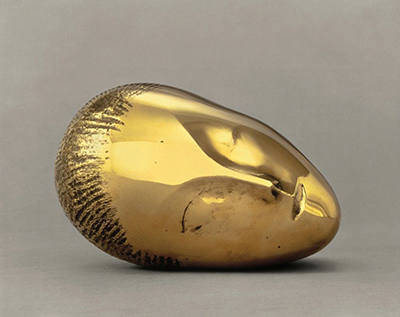
The Beginning of the World offers a comparison at the other end of the range. The polished bronze in the Centre Pompidou, dated 1924, has a continuous oval surface without the facial interruption that gives The Newborn its mouth. The museum identifies it as one of two bronze versions derived from the marble now in the Dallas Museum of Art and connects its form to Sleeping Muse. That fuller history makes the visual resemblance more interesting. In The Newborn, the title and the turn of the surface invite the viewer to discern an infant. In The Beginning of the World, the uninterrupted curve lets the egg stand on its own, and the title asks the viewer to think about beginnings at a different scale. [4] [11]
Browse sculptures and drawings
Browse articles on the sculptures and separately catalogued museum objects. A work can have several physical versions. Drawing records from the Tate catalogue retain their October 2014 snapshot wording where present.
| Name | Date | Medium |
|---|---|---|
| Arch | Sculpture | |
| Bird in Space | Sculpture | |
| The Blond Negress | Sculpture | |
| The Cock | Sculpture | |
| The Endless Column | Sculpture | |
| The First Cry | Sculpture | |
| Fish | Sculpture | |
| The Gate of the Kiss | Sculpture | |
| Golden Bird | Sculpture | |
| Head | Sculpture | |
| The Kiss | Sculpture | |
| Leda | Sculpture | |
| Madame L.R. | Sculpture | |
| Mademoiselle Pogany II | Sculpture | |
| Mademoiselle Pogany | Sculpture | |
| Maiastra | Sculpture | |
| The Newborn | Sculpture | |
| Phoque II | Sculpture | |
| The Prayer | Sculpture | |
| Princess X | Sculpture | |
| Prometheus | Sculpture | |
| Târgu Jiu monumental ensemble | Sculpture | |
| Sculpture for the Blind | Sculpture | |
| The Seal | Sculpture | |
| The Signal | Sculpture | |
| Sleeping Muse | Sculpture | |
| The Sorceress | Sculpture | |
| The Table of Silence | Sculpture | |
| Torso of a Young Man | Sculpture | |
| Two Lamps | Sculpture | |
| Vitellius | Sculpture | |
| The White Negress | Sculpture | |
| The Wisdom of the Earth | Sculpture | |
| Young Bird | Sculpture | |
| The Kiss (Philadelphia, fourth version) | 1916 | Sculpture Catalogue. |
| Sleeping Muse (Pompidou bronze) | 1910 | Sculpture Catalogue. |
| Mlle Pogany, version I (MoMA bronze) | 1913, after a marble of 1912 | Sculpture Catalogue. |
| Maiastra (Venice brass) | about 1912 | Sculpture Catalogue. |
| Bird in Space (MoMA bronze) | about 1941 | Sculpture Catalogue. |
| Bird in Space (Venice brass) | 1932–40 | Sculpture Catalogue. |
| Endless Column, version I (oak) | 1918 | Sculpture Catalogue. |
| Brâncuși Monumental Ensemble of Târgu Jiu | 1937–38 | Sculpture Catalogue. |
| Bust of a nude woman in profile, head inclined | about 1910 | Drawing Catalogue. |
| Nude study, head inclined (recto) | — | Drawing Catalogue. |
| Self-portrait (ink) | — | Drawing Catalogue. |
| View of the Artist’s Studio | 1918 | Drawing Catalogue. |
| Study for the cock (lost clay Grand Coq) | about 1923 | Drawing Catalogue. |
| Portrait of a woman in profile | — | Drawing Catalogue. |
| Animal head | — | Drawing Catalogue. |
| Animal sketch (2002 checklist) | 1929 | Drawing Catalogue. |
| Plans of the studio (verso) | about 1930–38 | Drawing Catalogue. |
| Danaïde (Tate T00296) | c.1918 | Sculpture Catalogue. |
| Maiastra (Tate T01751) | 1911 | Sculpture Catalogue. |
| Head (Tate T03066) | c.1919–23 | Sculpture Catalogue. |
| Fish (Tate T07107) | 1926 | Sculpture Catalogue. |
Frequently Asked Questions
Discussion
Look again at the images and ideas explored in The Newborn. These editorial prompts invite your observations.
Reader Insights
Where does the oval first begin to look like a head to you? Trace the plane, the lip and the outer curve to see which feature makes it recognisable.
Compare a photograph of the white marble with one of the polished bronze. Which lines belong to the sculpture and which ones are made by the light?
How does the broad disc beneath the Paris bronze change your sense of its weight or balance?
Join the Conversation
Share a detail, comparison or question about The Newborn below.
References
- Philadelphia Museum of Art. Newborn [I]. Object 51011, title, maker and 1915 date. View source.
- Museum of Modern Art. The Newborn, version I, 1920. Object 605.1943, medium, dimensions and Provenance Research Project entry. View source.
- Museum of Modern Art. From the Imaging Studio. Reflections on Brancusi’s Newborn. 11 November 2010, photographs and account of the three lighting approaches. View source.
- Centre Pompidou. Le Nouveau-Né II. AM 4002-33, detailed description and Marielle Tabart’s analysis of the marble, plaster, bronze and bases (French). View source.
- Philadelphia Museum of Art. Museum Studies 1. Exhibition description identifying the museum’s source sculpture as Brâncuși’s marble The Newborn. View source.
- Maria Görts. Routine and Selection. The Genesis of the Moderna Museet Collection. In The History Book, Moderna Museet, caption for Le nouveau-né II with date, medium, dimensions and purchase in 1961. View source.
- Centre Pompidou. Le Nouveau-Né II. AM 4002-34, detailed description and account of the steel casting trial (French). View source.
- Centre Pompidou. Le Nouveau-Né I. AM 4002-28, detailed description, including the probable role of this plaster in making the MoMA bronze (French). View source.
- Musée d’art contemporain de Montréal. Alphabetical List of Sculptures by Constantin Brancusi from the 1927 Arts Club Exhibition. Item 10, provenance of Newborn I, pp. 10–11. View source.
- Museum of Modern Art. Constantin Brancusi Sculpture. Extended exhibition label for The First Cry, 1917, p. 9. View source.
- Centre Pompidou. Le Commencement du monde. AM 4002-63, detailed description and analysis, including the relationship to the Dallas marble and Sleeping Muse (French). View source.
More BRÂNCUȘI Sculptures
Bird in Space
Compare the marble and metal versions of Brâncuși’s sculpture.