 by Tom Gurney
Tom Gurney BSc (Hons) is an art history expert with over 20 years experience
Published on June 19, 2020 / Updated on January 15, 2024
Email: tomgurney1@gmail.com / Phone: +44 7429 011000
An Amateur: Introduction
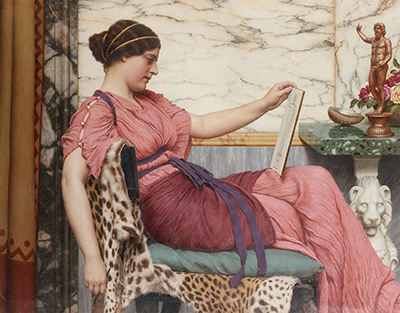
In John William Godward’s An Amateur, a woman in rose-coloured drapery leans back to inspect a drawing. One hand holds the board upright, its lower edge resting on the fabric over her knee. The other hangs beside the spotted skin on her chair, with a fine point still between the fingers. A small bronze stands among the roses at the edge of the canvas. Its raised arm appears again in the drawing. Godward gives us the moment when the woman takes her hand away from the work to see how it is coming along. [1]
The painting is an oil on canvas measuring 59.5 × 76 cm in the Bonhams catalogue. Godward signed and dated the face “J.W.GODWARD.1915.” The reverse carries the title and his name, followed by “ROME ’16”. Both dates belong to the painting’s recorded inscriptions. The face supplies the conventional date of 1915, while the inscription on the back records Rome and 1916, during Godward’s years in Italy. [2]
At a Glance
- Date1915 on the front, Rome 1916 on the reverse
- MediumOil on canvas
- Dimensions59.5 × 76 cm
This work across John William Godward’s career
The Bouquet
1899 [3]The New Perfume
1914–15 inscriptions [4]A Fair Reflection
1915 [5]An Amateur (current article)
1915–16 inscriptions [1]A Souvenir
1920 [7]Contents
- The drawing on her knee
- Jupiter, Adonis and the roses
- A rose, a scroll and a clay figure
- From a family collection to public view
- Annotated details
The drawing on her knee
The drawing is easy to miss at first. Its surface is narrow from our angle and nearly the colour of the pale wall. The darker edge shows that she is holding something firm. Near the top are the head and lifted arm. Below them a few long lines describe the trunk and legs, and at the foot of the board the artist has marked in the pedestal. That repeated base is telling. She is studying the little sculpture as it stands before her, mount and all. The bronze catches light across its chest and thighs. On the board, contour has to do almost all the work. [1]
Bonhams describes the support as a gessoed panel, and Sotheby’s calls the object on the marble tabletop an abalone shell used as an inkwell. The shell has a pale, lustrous interior and a curved lip, so the proposed use makes sense. There is also a dark, pointed implement in the relaxed hand. The image leaves some uncertainty about the precise tool and drawing medium. What the painting makes clear is the working arrangement. The shell is within reach of the chair, and the statuette is far enough away for the woman to take in its whole outline without moving it. [1] [2] [8]
Godward places her face against the palest band of marble. The near-profile makes the direction of her gaze easy to follow, and the extended arm crosses that same uninterrupted field of stone. Under it, a strip of yellow moulding runs towards the drawing and disappears behind it. Her weight sinks into the green cushion, while the skirt falls across the right side in long folds. The chair both supports the leaning pose and leaves one arm free to hang into the narrow space beside it. The woman pauses, yet the disposition of her limbs still tells us what she has been doing. [1]
The surfaces help keep that movement legible. The spotted skin breaks up the dark chair and sets off the fingers holding the point. Across the canvas the lion-headed table support comes into view below the knees, its pale muzzle framed by darker stone and fabric. The polished slab above it reflects the shell and makes a hard edge beside the softer rose petals. Godward gives the furnishings enough specificity to be individually recognisable. He also makes them useful to the person in the picture. A marble table that could simply have carried a display of flowers becomes the place where she sets up a model and leaves her materials. [1]
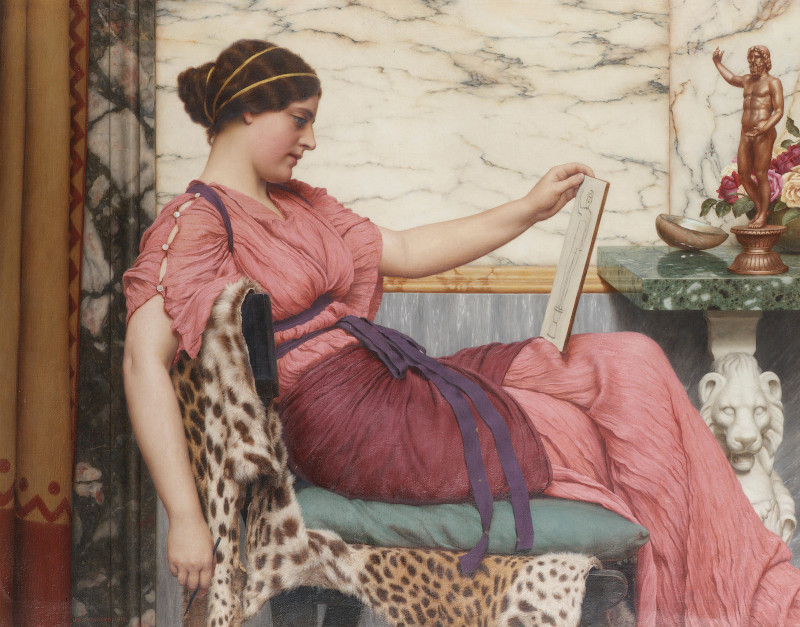 An Amateur in Detail by John William Godward
Jupiter, Adonis and the roses
In 2004 Bonhams suggested the bronze might represent Adonis and imagined that a lover had sent the roses and might come through the curtain. Sotheby’s in 2007 also entertained a romantic interpretation, drawing on the proximity of the roses and the male nude. Its catalogue took the identification of the bronze in a different direction, proposing a Jupiter from a group found near Paramythia in Epirus. Both auction houses also point to the statuette’s recurrence in Godward’s 1916 painting Rich Gifts Wax Poor When Lovers Prove Unkind. Sotheby’s suggested that Godward may have worked from a modern copy of the ancient bronze. [2] [8]
Heather Sharpe illustrates the specific candidate in her study of the Paramythia bronzes. The British Museum’s Jupiter, inventory 1824,0453.5, came from the collection of Richard Payne Knight. Sharpe places it among bronzes that probably furnished a Roman household shrine. The British Museum’s 1899 catalogue lists the same bronze as Zeus and describes a short cloak over its lowered arm. Set beside Godward’s figure, the published photograph shows a resemblance in reverse. The raised arm falls on the opposite side of the image, but the compact curls and beard, the wide chest, the balance of the legs and the arrangement of the lifted and lowered arms make the comparison persuasive. Godward’s lower hand appears palm-up in front of the body, and he shows the figure on an ornamental pedestal, with no drapery on the arm. The resemblance supports Sotheby’s identification. How the design reached Godward, and what kind of object he had before him, remain open. [1] [8] [9] [10]
Other bronzes show why a single gesture is an imperfect guide to identification. The Getty’s Roman Jupiter also stands nude with his weight on one leg, and the museum relates it to an older Greek image of Zeus the Thunderer. The Met’s bronze Jupiter, whose figure survives down to the thighs, is wrapped in a mantle. Its curators reconstruct a sceptre in the raised hand and a thunderbolt in the extended one. In a much later, early sixteenth-century bronze at the Fitzwilliam Museum, Jupiter still wields a visible bolt. No such attribute is clearly visible in Godward’s painting. The comparison with the Paramythia figure depends on the whole stance as well as the arm. [11] [12] [13]
The flowers leave room for the romance the catalogues propose. The woman’s eyes settle on the work in her hand, and the heavy curtain hangs undisturbed. The roses also pick up the colour of her drapery, while the bronze’s raised arm stands clear against the veined marble. In Rich Gifts Wax Poor When Lovers Prove Unkind, the figure with the raised arm stands on a high plinth behind a woman leaning on a terrace parapet. She looks away from the sculpture. The flowers lie at her feet. That later arrangement helps show how specifically Godward had made the statuette serve as a model in An Amateur. [1] [2] [8] [14]
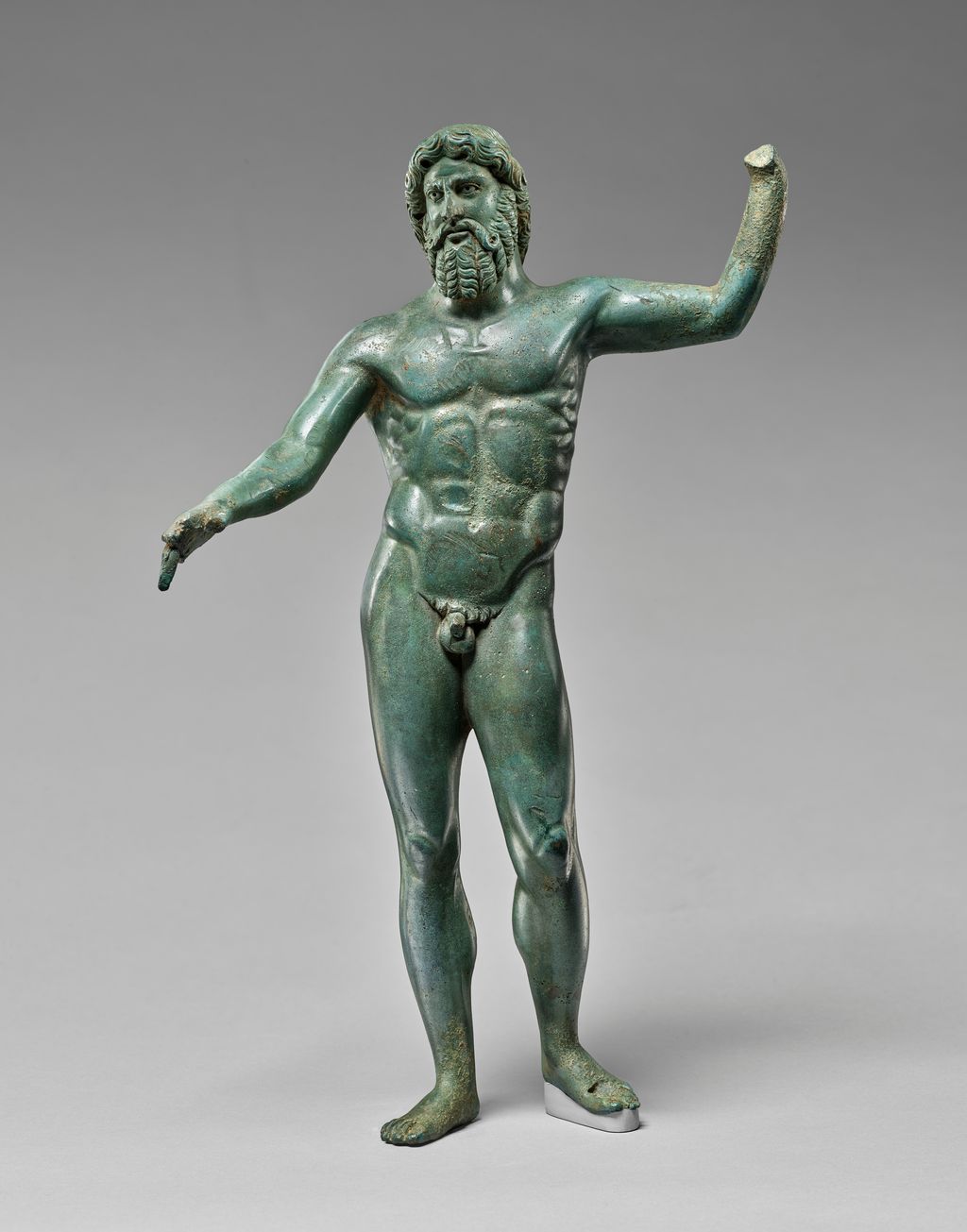
Statuette of Jupiter, J. Paul Getty Museum. The Getty bronze puts the raised arm and the balance of the legs in view for comparison with the painted statuette. Image source. CC0 / Public domain.
Annotated Details from An Amateur
The numbered points identify visible features discussed in this article. Return from each detail to the numbered overview. John William Godward, An Amateur (1915). Image source. Public domain.
.jpg)
Details from AN AMATEUR
Compare the cropped details with the source images above. Notice how their colours, shapes and positions contribute to the larger compositions.
The raised sheet
A fine drawing is visible on the tilted sheet. The woman holds it away from her body to study it.
 Detail 01 the-raised-sheet.jpg)
The tabletop bronze
The statuette’s raised arm and the outline of its body stand clear against pale marble.
 Detail 02 the-tabletop-bronze.jpg)
The spotted skin and cushion
The edges of fur, upholstery and fabric set three different textures against each other.
 Detail 03 the-spotted-skin-and-cushion.jpg)
John William Godward videos
See Godward’s paintings and studio practice alongside films on two Victorian contemporaries.
John William Godward - Part 1: The Last Painter of the Victorian Age
An overview of Godward’s career and the Victorian market for pictures set in antiquity.
Watch on YouTubeA rose, a scroll and a clay figure
In The Time of Roses, Godward returned to a woman in pink on a similar chair, with the spotted skin falling over its back. Christie’s records the circular oil as signed and dated 1916. Here the elbow rests on the chair, the figure examines a single pale rose, and a bowl of cut flowers stands behind it. The rose is held nearer the face than the drawing in An Amateur. The large space between the model on the table and the drawing on the knee has disappeared. The circle brings the lifted flower, fingertips and lowered eyes together. [8] [15] [16]
The seated reader in the circular An Edition de Luxe of 1920 brings back the spotted skin, the marble, the roses and even the lion-headed support. The woman uses both hands to hold an open scroll. Its yellow surface and patterned borders face us more directly than the sketch in An Amateur. The earlier painting gives the hands contrasting tasks, one holding the image steady and the other retaining the tool that made it. The later figure needs both hands for reading. The recurring furniture makes the change in what she does especially easy to see. [17]
Godward changed the furniture and the posture more decisively in A Dilettante, a separate upright canvas signed and dated 1922. The woman sits outdoors and leans across a marble table towards a small figure. Her hands remain close to the sculpture and its base. Sotheby’s describes her as an amateur sculptor and identifies the clay figure with the type of the veiled Titeux Dancer. The Louvre’s example is a 21-centimetre terracotta found on the Athenian Acropolis and dated to the second quarter of the fourth century BCE. In A Dilettante, the little sculpture is what the woman is making. In An Amateur, it is the object she translates into line. Sotheby’s reproduced An Amateur as figure 1 in its catalogue entry for the later painting. [18] [19]
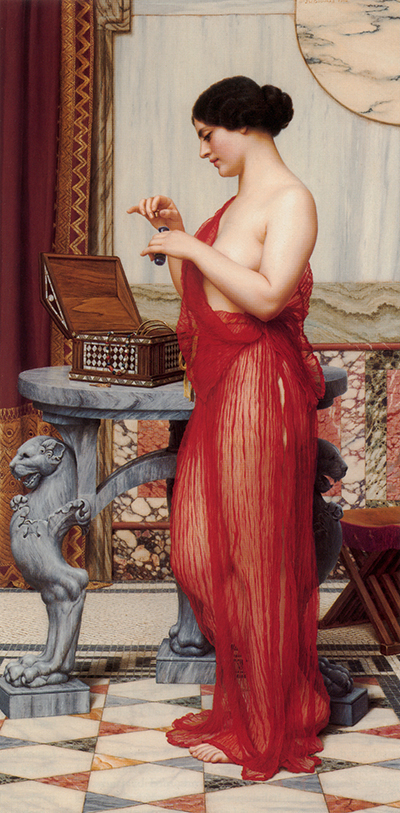
Godward’s own drawing associated with The New Perfume allows another comparison between line and paint. In that study, the tilt of the woman’s head, the position of her hands and the table support already give the scene much of the structure it has in the finished oil. The little drawing in An Amateur works at an even simpler level. Its marks record the balance of a standing figure and the shape beneath its feet. By painting those few marks and the hand that holds them at a distance, Godward shows the judgment involved in deciding which lines are enough. [20] [4]
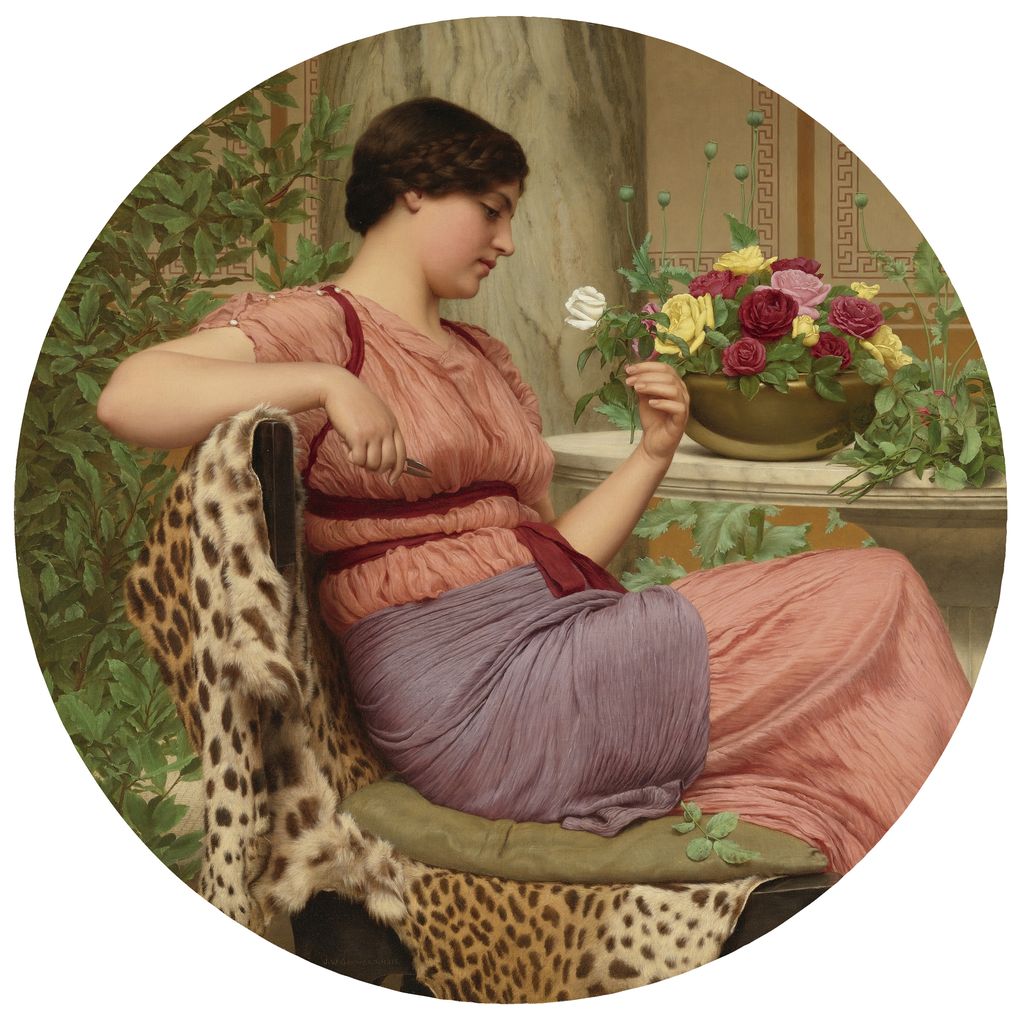
John William Godward, The Time of Roses (1916). In this later canvas Godward gives roses and their arrangement much more of the woman’s attention. Image source. Public domain.
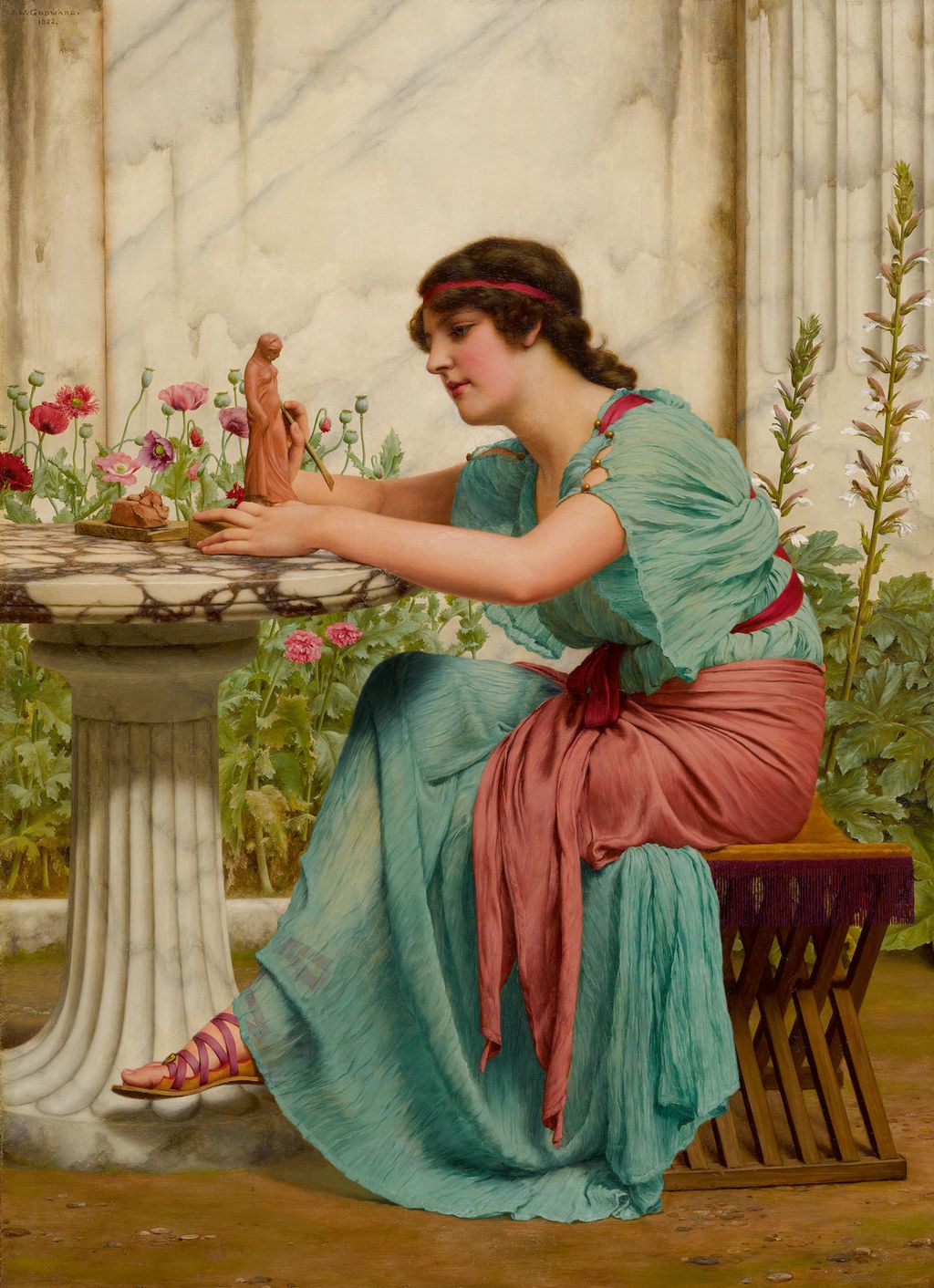
John William Godward, A Dilettante (1922). The later picture also treats a small sculpture as an object that can be held and inspected. Image source. Public domain.
From a family collection to public view
Bonhams traced the picture back to the grandparents of the 2004 vendor. They probably acquired it from Blairmans in Manchester around 1916, and it descended in their family. It sold at Bonhams in London on 17 November 2004 for £200,250 including premium. Both Bonhams and Sotheby’s described the painting as a rediscovery absent from Vern Swanson’s original catalogue. Sotheby’s explicitly cited the Bonhams lot when it offered the painting in December 2007. Its provenance places Richard Green, London, after the 2004 sale and records a private collection thereafter. [2] [8]
The 2007 examination reported an unlined canvas and an apparently stable paint surface. Under ultraviolet light the examiner found an opaque varnish and no apparent signs of retouching or restoration. Those observations describe the painting at the time of the sale. A photograph from Sotheby’s 2012 Age of Elegance selling exhibition in Hong Kong shows the same composition. The accompanying report gives 61 × 75.9 cm, slightly different dimensions from the 2004 Bonhams measurement. A separate canvas offered by James D. Julia in 2008 was listed as an unsigned work after Godward and measured 20 × 24 in. The 2007 lot lists a private collection after Richard Green. The record of the Hong Kong exhibition adds a public showing of the work to that history. [2] [8] [21] [22]
John William Godward artworks directory
Search documented oil paintings, drawings, watercolours and reproductive prints. The directory includes the Art Renewal Center’s catalogue and additional works in museum, exhibition and sale records.
| Name | Date | Medium |
|---|---|---|
| Absence Makes the Heart Grow Fonder | 1912 | Oil on canvas |
| Amaryllis | 1903 | Oil on canvas |
| An Amateur | 1915 | Oil on canvas |
| Ancient Pastimes | 1916 | Oil on canvas |
| The Answer | 1917 | Oil on canvas |
| An Arcadian Beauty | 1899 | Painting |
| At the Fountain | 1893 | Oil on canvas |
| At the Garden Door | 1901 | Oil on canvas |
| At the Garden Shrine, Pompeii | 1892 | Oil on canvas |
| At the Gate of the Temple | 1898 | Oil on canvas |
| At the Thermae | 1909 | Oil on canvas |
| Atalanta | 1892 | Oil on canvas |
| Athenais | 1908 | Oil on canvas |
| An Auburn Beauty | 1895 | Oil on canvas |
| Autumn | 1900 | Oil on canvas |
| Beauty in a Marble Room | 1894 | Oil on canvas |
| The Belvedere | 1913 | Oil on canvas |
| The Betrothed | 1892 | Oil on canvas |
| The Betrothed (print after Godward) | 1893 | Photoengraving, as reported |
| The Bouquet | 1899 | Oil on canvas |
| Briseis | 1896 | Painting |
| The Broken Vase | 1889 | Oil on canvas |
| By the Blue Ionian Sea | 1916 | Oil on canvas |
| By the Wayside | 1912 | Oil on canvas |
| Byrsina | 1915 | Painting |
| Campaspe | 1896 | Oil on canvas |
| Campaspe (print after Godward) | Print, process unconfirmed | |
| Chloris (A Summer Rose) | 1902 | Oil on canvas |
| Classical Beauty | Oil on canvas | |
| A Classical Beauty | Oil on canvas | |
| A Classical Beauty | Painting | |
| A Classical Beauty | Oil on canvas | |
| A Classical Beauty | 1909 | Oil on canvas |
| A Classical Beauty In Profile | Oil on canvas | |
| A Classical Lady | 1908 | Oil on canvas |
| Clymene | 1892 | Oil on canvas |
| A Congenial Task | 1915 | Oil on canvas |
| Contemplation | 1922 | Oil on canvas |
| A Cool Retreat | 1910 | Oil on canvas |
| Country House in the 18th Century | c. 1883 | Oil on canvas |
| Cytheris | 1922 | Painting |
| The Day Dream | 1920 | Oil on canvas |
| The Delphic Oracle | 1899 | Oil on canvas |
| A Dilettante | 1922 | Oil on canvas |
| Distant Thoughts | 1918 | Oil on canvas |
| Dolce Far Niente | 1897 | Oil on canvas |
| Dolce Far Niente | 1906 | Oil on canvas |
| Dolce far niente (A Pompeian Fishpond) | 1904 | Oil on canvas |
| Dolce far niente (coloured print after Godward) | Exhibited 1900 | Coloured print, exact process unconfirmed |
| Dolce far niente (grapes) | 1907 | Oil on canvas |
| Dora | 1887 | Oil on canvas |
| Drusilla | 1906 | Oil on canvas |
| An Edition de Luxe | 1920 | Oil on canvas |
| Eighty and Eighteen | 1898 | Oil on canvas |
| Endymion | 1893 | Oil on canvas |
| The Engagement Ring (horizontal composition) | 1888 | Oil on canvas |
| The Engagement Ring (upright composition) | c. 1891 | Oil on canvas |
| Erato at Her Lyre | Oil on canvas | |
| A Fair Reflection | 1915 | Oil on canvas |
| A Fair Reflection (Taber-Prang print) | By 1923 | Sepia artotype |
| Far Away Thoughts (circular sewing scene) | 1911 | Oil on canvas |
| Far Away Thoughts (left-facing profile) | 1892 | Oil on canvas |
| Far Away Thoughts (right-facing profile) | 1892 | Oil on canvas |
| Female Figure (probable Grecian Idyll study) | 1907 | Oil on board |
| Flabellifera | 1905 | Oil on canvas |
| Flabellifera (painted study) | c. 1905 | Oil study |
| Flabellifera (pencil study) | c. 1905 | Pencil on paper |
| The Flower Girl | Painting | |
| A Flower Seller | 1896 | Oil on canvas |
| The Flowers of Venus | 1890 | Oil on canvas |
| A Fond Farewell | 1918 | Watercolour |
| The Fragrant Rose | 1892 | Painting |
| The Fruit Vendor | 1917 | Oil on canvas |
| A Garland Seller | 1914 | Painting |
| Giotto Drawing from Nature | Painting | |
| Girl in Yellow Drapery | 1901 | Oil on canvas |
| Golden Hours | 1913 | Oil on canvas |
| A Grecian Girl | 1908 | Oil on canvas |
| Grecian Idyll | 1907 | Oil on canvas |
| A Grecian Lovely | 1909 | Oil on canvas |
| Grecian Reverie | 1889 | Oil on canvas |
| Grecian Reverie | 1889 | Oil on canvas |
| A Greek Beauty | 1905 | Oil on canvas |
| A Happy Awakening | 1903 | Oil on canvas |
| He Loves Me, He Loves Me Not | 1896 | Oil on canvas |
| A head and shoulders profile portrait of a young woman wearing a white tunic style blouse | c. 1889 | Painting |
| Head of a Girl (The Priestess) | 1896 | Oil on canvas |
| Heart on her Lips and Soul within her Eyes | 1904 | Painting |
| His Birthday Gift | 1889 | Oil on canvas |
| Ianthe | 1889 | Oil on canvas |
| An Idle Hour | 1890 | Oil on canvas |
| Idle Moments | 1895 | Oil on canvas |
| Idle Thoughts | 1898 | Oil on canvas |
| Idleness | 1900 | Oil on canvas |
| Il Dolce Far Niente (Pears print after Amaryllis) | 1906 | Chromolithograph |
| Il Dolce far niente (seated figure) | 1893 | Oil on canvas |
| In Expectation | c. 1892 | Oil on canvas |
| In Realms of Fancy | 1911 | Oil on canvas |
| In the Prime of the Summertime (Reverie) | 1914 | Oil on canvas |
| In the Tepidarium | 1913 | Oil on canvas |
| Innocent Amusements | 1891 | Oil on canvas |
| Ione | c. 1896-1898 | Oil on canvas |
| Ionian Dancing Girl | 1902 | Oil on canvas |
| Ismenia | 1908 | Oil on canvas |
| An Italian Beauty | 1897 | Oil on canvas |
| An Italian Girls' Head | 1902 | Oil on canvas |
| The Jewel Casket | 1900 | Oil on canvas |
| Julia | 1914 | Painting |
| Knuckle Bones | 1890 | Oil on canvas |
| La Pensierosa | 1913 | Oil on canvas |
| A Lady | 1895 | Oil on canvas |
| Landscape: Blossoming Red Almond [study] | c. 1912 | Oil on panel |
| Le Billet Doux (The Love Letter) | 1913 | Oil on canvas |
| Leaning Against a Column | 1901 | Painting |
| Leaning on the Balcony | 1892 | Oil on canvas |
| Leisure Hours | 1905 | Oil on canvas |
| Lesbia with her Sparrow | 1916 | Oil on canvas |
| The Letter | 1899 | Painting |
| Liegende | 1893 | Oil on canvas |
| A Lily Pond | 1917 | Oil on canvas |
| Looking Out to Sea | 1918 | Pencil and watercolour |
| The Love Letter (circular composition) | 1907 | Oil on canvas |
| Lucilia | 1917 | Oil on canvas |
| Lycinna | 1918 | Oil on canvas |
| Marcella | 1912 | Painting |
| Matrona Superba | Oil on canvas | |
| Megilla | 1921 | Oil on canvas |
| A Melody | 1904 | Oil on canvas |
| Memories | c. 1891 | Oil on canvas |
| Mirinna | Painting | |
| The Mirror | 1899 | Oil on canvas |
| Mischief | 1905 | Oil on canvas |
| Mischief and Repose | 1895 | Oil on canvas |
| A Mouse in the Work Basket | 1893 | Oil on canvas |
| Nerissa | 1906 | Oil on canvas |
| The New Perfume | 1914 | Oil on canvas |
| Noon Day Rest | 1910 | Oil on canvas |
| Nu Sur La Plage | 1922 | Oil on panel |
| Nude Study | Oil on canvas | |
| An Offering to Venus | 1912 | Oil on canvas |
| The Old, Old Story | Oil on canvas | |
| The Old, Old Story | 1903 | Oil on canvas |
| On the Balcony | 1911 | Oil on canvas |
| On The Terrace | 1918 | Oil on canvas |
| Ophelia | Oil on panel | |
| The Peacock Fan | 1912 | Oil on canvas |
| Phyleis | 1908 | Oil on canvas |
| The Playground | 1892 | Oil on canvas |
| Playtime | 1891 | Oil on canvas |
| A Pompeian Bath | 1890 | Oil on canvas |
| A Pompeian Lady | 1891 | Oil on canvas |
| A Pompeian Lady | 1895 | Oil on board |
| A Pompeian Lady | 1901 | Painting |
| A Pompeian Lady | 1904 | Painting |
| Portrait of Mary Frederica 'Nin' Godward | c. 1882-1883 | Oil on canvas |
| Portrait of Mary Perkinton Godward | c. 1880-1881 | Watercolor |
| The Posy | 1900 | Painting |
| A Priestess (bare-shouldered figure) | 1893 | Oil on canvas |
| A Priestess (clothed composition) | 1894 | Oil on canvas |
| A Priestess (W. Biscombe Gardner after Godward) | Exhibited 1897 | Print, process unconfirmed |
| A Priestess of Bacchus | 1890-1890 | Oil on canvas |
| Pyrallis | 1918 | Oil on canvas |
| The Quiet Pet | 1906 | Oil on canvas |
| A Red, Red Rose | 1920 | Oil on canvas |
| Reflections | 1893 | Oil on canvas |
| The Rendezvous | 1903 | Oil on canvas |
| Repose, the Flower Girl | c. 1887 | Oil on canvas |
| Reverie | 1888 | Oil on panel |
| Reverie | 1912 | Oil on canvas |
| Reverie (In the Days of Sappho) | 1904 | Oil on canvas |
| Reverie (Pears print after In the Prime of the Summertime) | 1916 | Chromolithograph |
| 'Rich Gifts Wax Poor When Lovers Prove Unkind' | 1916 | Oil on canvas |
| The Ring | 1898 | Oil on canvas |
| A Roman Matron | 1905 | Oil on canvas |
| Sabinella | 1912 | Oil on canvas |
| Sappho | 1910 | Oil on canvas |
| The Siesta | Oil on canvas | |
| A Siesta | 1895 | Oil on canvas |
| The Signal | 1899 | Oil on canvas |
| Sitting for Her Portrait | 1893 | Oil on canvas |
| Sketch for Amaryllis | 1903 | Oil on board |
| A Souvenir | 1920 | Oil on canvas |
| Stesicrate | 1914 | Oil on canvas |
| Study for 'Rêverie' | 1890 | Oil on canvas |
| Study for 'The Priestess' | 1895 | Oil on board |
| Study for An Egyptian Minstrel | 1906 | Painting |
| Study for The New Perfume | Drawing, medium unconfirmed | |
| Study for ‘The Old, Old Story’ | 1903 | Oil paint on wood |
| Study of a Girl's Head | 1899 | Painting |
| Study of Campaspe | Oil on canvas | |
| Study of Head and Drapery, Miss Ethel Warwick | 1898 | Painting |
| Summer Day | 1897 | Painting |
| Summer Flowers | 1903 | Oil on canvas |
| Sweet Dreams | 1901 | Oil on canvas |
| Sweet Dreams | 1904 | Painting |
| The Sweet Siesta of a Summer's Day | 1891 | Oil on canvas |
| The Tambourine Girl (profile at the marble wall) | 1906 | Oil on canvas |
| The Tambourine Girl (relief-backed version) | 1906 | Oil on canvas |
| Tender Thoughts | 1917 | Oil on canvas |
| Tender Thoughts (woman leaning over a parapet) | 1918 | Pencil and watercolour |
| The Tiff (oil) | By 1888 | Oil on canvas |
| The Tiff (print after Godward) | 1894 | Photogravure |
| The Tigerskin | 1889 | Oil on canvas |
| The Time of Roses | 1916 | Oil on canvas |
| Tranquillity | 1914 | Oil on canvas |
| A Tryst | 1912 | Oil on canvas |
| Tympanistria | 1909 | Oil on canvas |
| Under the Blossom that Hangs on the Bough | 1917 | Oil on canvas |
| Venus at the Bath | 1901 | Oil on canvas |
| Venus Binding Her Hair | 1897 | Oil on canvas |
| Violets, Sweet Violets | 1906 | Painting |
| Waiting for an Answer | 1889 | Oil on canvas |
| Waiting for the Procession | 1890 | Oil on canvas |
| Waiting for the Procession | 1890 | Painting |
| The Water Carrier (magazine reproduction of At the Fountain) | 1898 | Magazine reproduction |
| When the Heart is Young | 1902 | Oil on canvas |
| Who Can They Be | Painting | |
| Winding Wool | 1894 | Painting |
| 'With Violets Wreathed and Robe of Saffron Hue' | 1902 | Oil on canvas |
| The Yellow Shawl | 1893 | Painting |
| 'Yes or No?' | 1893 | Oil on canvas |
| Young Girl Picking Grapes | 1902 | Oil on canvas |
| Youth and Time | 1901 | Oil on canvas |
Discussion
Look again at the images and ideas explored in An Amateur. These editorial prompts invite your observations.
Reader Insights
Where do you first notice the drawing in the woman’s hand?
What connects the paper to the bronze on the table?
Join the Conversation
Share a detail, comparison or question about An Amateur below.
References
- John William Godward. An Amateur. Bonhams sale photograph reproduced by Wikimedia Commons. The image supplies the visual evidence for the sketch, tool and bronze. View source.
- Bonhams. An Amateur, London, 17 November 2004, lot 153. Inscriptions, dimensions, provenance and catalogue interpretation. English. View source.
- The Bouquet. View source.
- Christie’s. The New Perfume, lot 245788. Oil and inscriptions. English. View source.
- A Fair Reflection. View source.
- Under the Blossom that Hangs on the Bough. View source.
- A Souvenir. View source.
- Sotheby’s. An Amateur, London, 11 December 2007, lot 18. Provenance, condition report and proposed source for the bronze. English. View source.
- Heather Sharpe. “The Paramythia Bronzes: Expressions of Cultural Identity in Roman Epirus”, in Artistry in Bronze, Getty Publications, 2017. See fig. 16.9 and the appendix for British Museum Jupiter 1824,0453.5. English. View source.
- H. B. Walters. Catalogue of the Bronzes, Greek, Roman, and Etruscan, in the Department of Greek and Roman Antiquities, British Museum, 1899, p. 36, no. 275, pl. VII. English. View source.
- J. Paul Getty Museum. Statuette of Jupiter, Roman bronze. English. View source.
- The Metropolitan Museum of Art. Roman Art: A Resource for Educators, pp. 85–86, on its bronze Statuette of Jupiter, 1997.159. English. View source.
- The Fitzwilliam Museum. Jupiter, G.R.2-1925, workshop of Severo di Ravenna. English. View source.
- John William Godward. Rich Gifts Wax Poor When Lovers Prove Unkind. Auction reproduction hosted by MutualArt, used for visual comparison. View source.
- Christie’s. The Time of Roses, New York, 18 October 2000, lot 96. Signed and dated circular oil. English. View source.
- John William Godward. The Time of Roses. Sotheby’s sale photograph reproduced by Wikimedia Commons. View source.
- Sotheby’s. An Edition de Luxe, London, 11 July 2019, lot 44. Image, object description and comparison with An Amateur. English. View source.
- Sotheby’s. A Dilettante, New York, 2019, lot 425. Object description, Titeux Dancer comparison and fig. 1 for An Amateur. English. View source.
- Musée du Louvre. Figurine, CA 462, the veiled Titeux Dancer. French. View source.
- The History of Art. Drawing associated with The New Perfume. Image used for compositional comparison. View source.
- ArtDaily. “Sotheby’s opens a selling exhibition of fine and decorative arts from nineteenth-century Europe”, 10 November 2012. Includes Sotheby’s photograph from Age of Elegance and lists exhibition dimensions. English. View source.
- James D. Julia. An Amateur, after John William Godward, 10 May 2008, lot 591. English. View source.