 by Tom Gurney
Tom Gurney BSc (Hons) is an art history expert with over 20 years experience
Published on June 19, 2020 / Updated on October 14, 2023
Email: tomgurney1@gmail.com / Phone: +44 7429 011000
Dolce Far Niente by John William Godward: Introduction
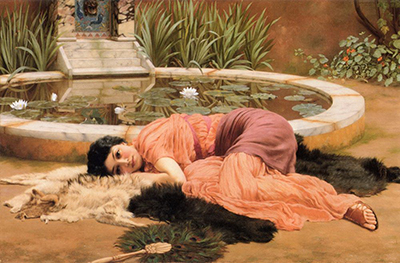
A woman lies on animal skins at the edge of a garden pond. Her head is low, her body is folded almost in two, and one sandalled foot emerges from the long sweep of her dress. Her eyes meet ours. Follow the curve of her back upwards and the scene opens into another register of activity. White flowers punctuate the pool. The water reflects the pale stone beneath a fountain, and tall leaves crowd the wall behind it. John William Godward painted this version of Dolce far niente in 1904. The oil on canvas measures 50.8 × 76.2 cm and is also documented as A Pompeian Fishpond. The pond and fountain identify it among several distinct pictures that share the Italian title. The Art Renewal Center also indexes this composition under the English title Sweet Nothings. [1] [2] [3] [4]
Dolce far niente means “the sweetness of doing nothing”. The phrase describes idleness as a pleasure, and in this painting it helps explain why even the smallest marks matter. The woman has set down her fan. A few steps away, the surface of a pool gathers an entire garden into reflections. The viewer has as little reason as she does to hurry past either. [5]
At a Glance
- Date1904
- MediumOil on canvas
- Dimensions50.8 × 76.2 cm
This work across John William Godward’s career
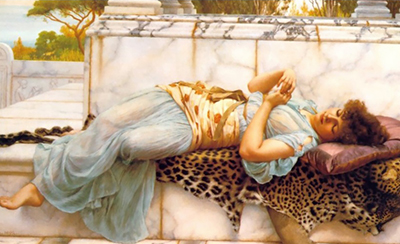
The Betrothed
1892 [6]The Quiet Pet
1906 [9]Noon Day Rest
1910 [10]Contents
- From the reclining figure to the fountain
- A Pompeian garden
- Repose, exhaustion and the woman's gaze
- The same title in Victorian painting
- The 1904 painting at auction and at the Royal Academy
- Two earlier paintings of sweet idleness
- The two later paintings
- Annotated details
From the reclining figure to the fountain
The woman occupies the lower half of the picture, close enough for us to follow the folds as they change direction. The coral-coloured cloth runs down from her shoulder, bunches where her body bends and spreads out over the ground to the right. Deeper violet fabric rounds over her hip, making the high point of the pose unusually clear. Where the coral folds thin out at the edge, bare ground and the dark straps of a sandal come into view. Look back along the dress and the lines converge again at the torso. A pose that seems to have settled entirely under its own weight still gives the eye plenty of work to do.
Her body's outline is distinct above the waist and harder to follow below it. The dress hides the precise arrangement of her legs. Where the cloth meets the black fur, its fine pale ridges stand out sharply. At the left, her hair sits against light fur with a recognisable animal head spread flat on the ground. Between those two dark accents, the skin of her face and arm catches the light. The painted surfaces suggest different kinds of contact. The fur yields beneath her head, the fabric gathers around her body, and behind both the smooth coping of the pond holds its shape. The peacock-feather fan enters at the bottom edge, its spread of dark green drawing the eye back towards the plants beyond the water. [2] [3]
The pond's near rim is interrupted by the woman and the skins. Its far rim continues across the picture and curves forward at the right, defining a stretch of shallow pictorial space around her. Twisting leaves have an answering curve on the surface of the pool. The upright face of the fountain and its stepped stone base give that play of curves a fixed point. Look below the base and its image comes back upside down, interspersed with floating leaves. Godward lets the spectator distinguish the weight of the stone from its reflection while keeping both in almost the same range of light colours. The compositional shift is small enough to miss at first glance and substantial enough to change the pace of looking. [2] [3]
A Pompeian garden
Christie's makes a comparison that helps place the setting. In its catalogue for A Pompeian Garden, another signed oil from 1904, it points to a similar lily pond in Dolce far niente. The two titles describe different pictures. Their shared garden feature gives a specific instance of Godward returning to a setting as well as a pose. A pond can occupy a wide stretch of canvas with its low, rounded edge, and behind it a painter can build height with foliage and a fountain. Here the grounds appear carefully tended, though the painter gives the viewer very little of the property beyond the water. [11]
The Archaeological Park of Pompeii describes how the House of the Small Fountain was laid out so that a visitor standing at the entrance could see the decorated garden fountain at the rear. There the siting of the fountain helped announce the household's standing, and its niche was finished with coloured mosaics and shells. That house offers a historical comparison for the care lavished on the water feature in Godward's picture. The archaeological account explains a visitor's route through an actual house. The painting keeps its viewer close to the pool, with the fountain already in sight and the surrounding house largely beyond the frame. [12]
The combination of a carefully rendered setting and a woman at her ease can make Godward's antiquity seem curiously private. Few signs of the work required to keep such a garden are visible. The water is already laid out for enjoyment, and the fan and skins are already at hand. The alternate title identifies a place and an amenity, while the Italian title offers a way of spending time in it. Each directs the viewer to a different part of the same picture. [1] [3]
Repose, exhaustion and the woman's gaze
In the version of his biography formerly published on the Art Renewal Center website, Vern Grosvenor Swanson interpreted the woman as a bacchante exhausted after dancing. That reading supplies an event that could have preceded the pose. Her folded body and the discarded fan are compatible with fatigue. The face complicates the idea of sleep. Her open eyes remain available to the viewer even when her body has come to rest, and there is room to read physical ease, curiosity or languor in the same outward look. [13]
Michael Allan Kodysz connects Godward's curled figure to Frederic Leighton's Flaming June, another study of a folded body and warm drapery. Leighton's sleeper closes her eyes and fills a square canvas with a compact knot of orange. In Godward's wider painting the face turns out towards us and the pool claims space of its own. Kodysz takes Swanson's bacchante reading seriously and finds the mood ambiguous. He sees an invitation in the open gaze and also a quieter, inward quality in the languor. His wider study follows Godward's increasing interest in idealised figures whose expression and circumstances give them no obvious moral lesson. [2] [14]
Rina Kajima's Japanese-language study starts with a different question. She compares what women actually do in pictures called Dolce far niente and how their bodies are fitted into the spaces around them. She sees Godward's emphasis on drapery and fur as part of the pictures' sensual appeal and reads the woman in the 1904 painting in the context of a Victorian tradition of displaying the languid female body for a spectator. The viewer's position matters to that reading. The spectator is close to the woman, and her outward gaze makes the encounter part of the picture, while the garden itself continues behind her as if undisturbed. Swanson's dance places the source of her condition in an imagined earlier moment. Kajima's account puts more weight on what the painting makes happen in front of us. [3] [13]
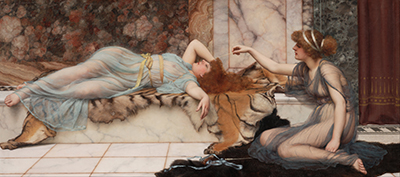
An earlier Godward, Mischief and Repose, offers a way to test how much difference a single gesture makes. There, a second figure brings a dress pin close to her companion's face. The Getty identifies the sleeping woman's companion and her intended prank as the centre of the composition. The viewer can anticipate the next moment because one person is acting upon the other. In the fishpond painting the figure is alone, and her eye contact is the nearest thing to an exchange. The pool, the spread of fur and the folds at her feet each hold our attention without advancing a plot. [15] [3]
Kajima also considers the series in light of a later idea about modern painting. She uses Clement Greenberg's emphasis on the flatness of the canvas and the reduction of literary narrative to ask what the repetitions made possible. In the fishpond composition, for example, the foreshortened rim gives the water depth. It also makes a pale arc across the painted surface, a shape that can be read in relation to the curve of the hip. One mark can contribute to an illusion of space and still have a job in the pattern of the picture. Kajima finds a stronger tendency towards shallow, relief-like arrangements in the 1897 and 1906 paintings. That difference matters here. The pond gives the gaze somewhere to go after it leaves the woman. [3]
Marta Chiara Olimpia Nicosia, writing about the depiction of daydreaming, reads the expression as quietly questioning and finds that the closeness of the woman and her gaze make the encounter intimate. She explicitly doubts that the picture depicts the aftermath of a dance. Her comparison with When the Heart is Young brings out a quality that a description of the rich clothing can miss. Godward can make a figure appear available to the eyes of a spectator while leaving her thoughts to herself. The head low to the ground in the fishpond picture intensifies that uncertainty. We can see the woman's eyes clearly enough to register the look, and we are left to infer what, if anything, it asks. [16]
John William Godward videos
See Godward’s paintings and studio practice alongside films on two Victorian contemporaries.
John William Godward - Part 1: The Last Painter of the Victorian Age
An overview of Godward’s career and the Victorian market for pictures set in antiquity.
Watch on YouTubeThe same title in Victorian painting
Godward took up an established title. In John William Waterhouse's 1880 Dolce far niente, now in the Fife Council collection, a woman lies on a cushioned seat with a peacock-feather fan, the warm yellows of costume and furnishings grouping her with the things around her. The fan stays in her hand. In Waterhouse's separate 1879 version loose white feathers rise through the space above the reclining figure. In the Christie's catalogue their arc links the extended arm at the bottom to the hanging lamp. Kajima observes that the earlier Waterhouse also uses the recession of the body and an opening beyond it to suggest deeper space. Godward's 1904 garden similarly draws the eye past the figure, though the visual inducement is the spread of water behind her. [3] [17]
William Holman Hunt's Il dolce far niente is dated 1866 and was exhibited at the Royal Academy in 1867. Its half-length figure and opulent costume prompted Christie's to connect it to the period's interest in Venetian painting. Hunt recalled that the picture let him work at a larger scale and set aside the moral instruction he usually built into his subjects. The Christie's provenance names Thomas McLean as its first buyer. The name also appears in Godward's commercial history. That is a documented point of contact between the pictures' circulation, while the use each artist made of the restful subject can be seen in their radically different formats. [18]
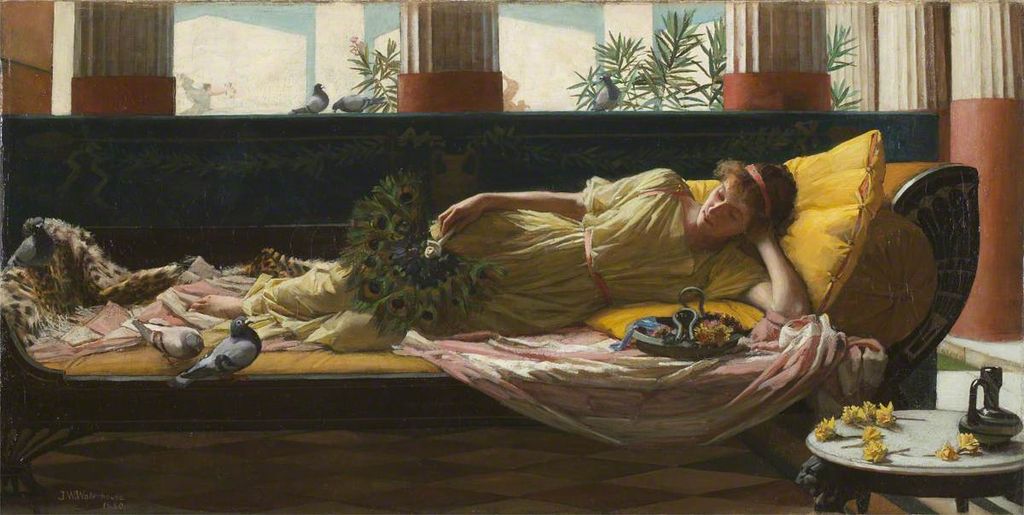
John William Waterhouse, Dolce Far Niente (1880). Waterhouse’s own use of the title gives another Victorian picture of leisure. Image source. Public domain.
The 1904 painting at auction and at the Royal Academy
Sotheby's records the fishpond painting as lot 80 in its sale of 16 February 1995. Desmond Bazley, writing in 2004, reports its purchase by Andrew Lloyd Webber at that sale for $563,500 and gives £650 for an earlier sale in 1972. A sharply critical Daily Telegraph passage reproduced by Swanson gave the price in sterling and questioned the enthusiasm for Godward. The passage records how one critic reacted to the artist's rise on the auction market. In 2003 the same picture could be seen at the Royal Academy on a different basis, as part of Pre-Raphaelite and Other Masters: The Andrew Lloyd Webber Collection, held from 20 September to 12 December. Robyn Asleson's entry appeared on page 191 as catalogue no. 140, the number also cited by Christie's in its account of A Pompeian Garden. The collection is documented at that exhibition and in the later Sotheby's reference. [19] [1] [13] [2] [11]
Two earlier paintings of sweet idleness
1893, the woman in the chair
A signed 1893 oil complicates the history of the title. Sotheby's offered it as Il Dolce far Niente in 2017 and identified it with the canvas catalogued and illustrated by Swanson as Classical Scene. The woman sits in a chair under a marble wall, with a bronze bust and a strip of sunlit terrace at the right. The upright figure looks directly out, while the curves of the tiger skin and the soft folds around her waist run across the hard lines of the room. This separate composition shows that the outward gaze and the pairing of fur and stone were already part of Godward's treatment of leisure. The different catalogue titles also explain why a search for the Italian phrase alone can miss or double-count a painting. [20]
1897, the parrot and McLean's print
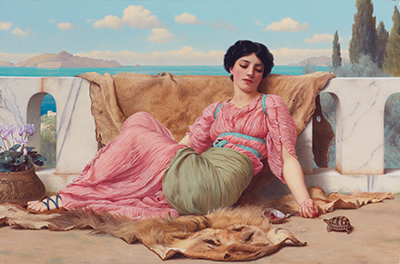
An earlier oil, signed and dated 1897, is easy to distinguish by the woman's raised arm. A woman in pale blue dress lies below a dark semicircular wall panel and holds up a parrot. The arm rises in front of the wall's broad bands and sets the little bird high above her face. A stair appears at the edge of the setting, where its promise of another space is cut off by a hanging. Kajima draws attention to how closely the wall and floor enclose the figure. At 77.4 × 127 cm the painting is appreciably wider and taller than the fishpond canvas, yet its principal action stays within reach of one hand. Sotheby's lists a signature and the date “97” at the upper left. [3] [21]
The 1897 oil had a commercial life almost at once. Sotheby's traces it to McLean in June 1897 and subsequently to Sir Merton Russell-Cotes, whose picture returned to McLean through Christie's in March 1905. The Connoisseur's contemporary account records it at 155 guineas. The same provenance later takes it to the Meitetsu department store in Nagoya and to a private buyer in 1977, a documented Japanese connection quite separate from Kajima's later research. Swanson's reading of the June 1897 correspondence records an edition of 150 proofs and 500 prints. He also reports an agreement under which the buyer of the oil would receive half the profits from publication. The agreement gave the owner of a private painting a share in its wider circulation. [21] [22] [13]
An exhibition catalogue from 1900 at Earl's Court independently lists a Dolce far niente after Godward among its coloured prints. Thomas McLean was the lender, and the entry was marked for sale. The listing supplies contemporary evidence that a print under the title reached a public exhibition before Godward painted the 1904 fishpond. The entry gives neither an engraver nor the class of impression. The account of Godward's prints follows comparable distinctions between a painted original, a publisher, an edition and an individual impression. [23]
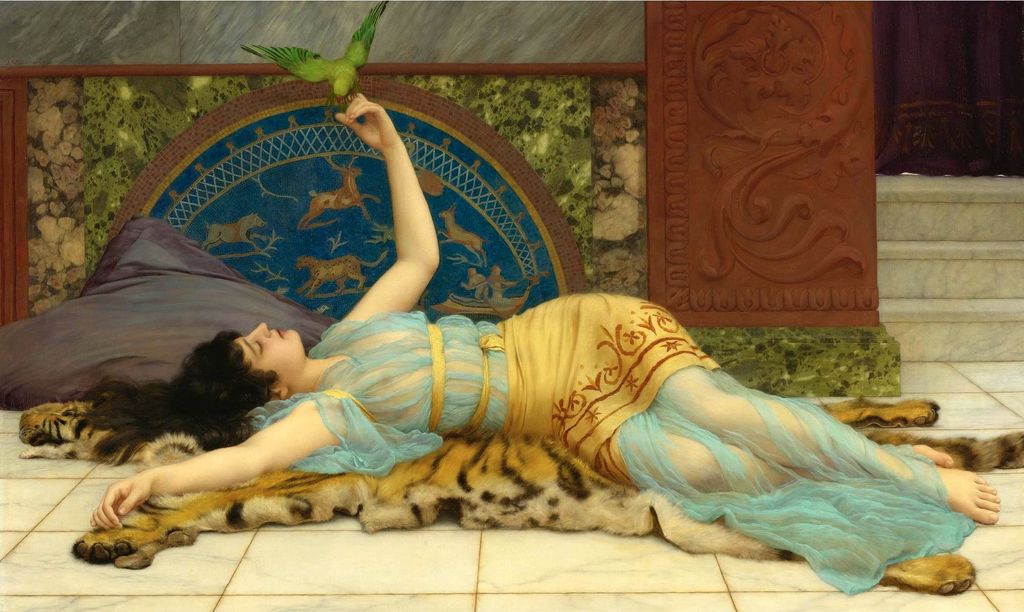
John William Godward, Dolce Far Niente (1897). The 1897 parrot scene gives the same title an action and a very different layout. Image source. Public domain.
The two later paintings
1906, the terrace and sea
The 1906 oil, signed and dated at the lower left according to Sotheby's, is only 36.2 cm high and 73.7 cm wide. Dark purplish cloth spills over the terrace as a woman lies on her back on a pelt. Her upturned arm, the curve of her hips and the line of her legs can be followed almost continuously in this wider, lower field. The pale terrace stretches long and straight beneath her. Upright trees and a column provide counterpoints, while distant islands appear on the horizon. For Kajima that view has something of a theatre backdrop. The sea is far away, yet the body, stone and trees work almost like a shallow relief in front of it. The fishpond of the 1904 picture asks us to look down and into the garden. Here the eye can travel straight across the terrace and then directly out to sea. Sotheby's also notes a print marketed by Pears with McLean at the size of this picture, a separate account from the agreement Swanson describes for the 1897 work. [19] [3]
1907, the grapes
The 1907 painting is again an oil on canvas, signed and dated at the lower left. Its 51.4 × 76.2 cm format is close to that of the fishpond picture. The woman leans back against cushions and looks down at a bunch of grapes, cupping the fruit in one hand and bringing up the fingers of the other. The orange skirt drops from a raised knee through a series of broad folds, with one red sandal appearing at the left. Flowering foliage and a distant shore frame the seat. The head and hands stay close together on the right, so the little gesture registers even across the breadth of the picture. The bunch of grapes is the feature Swanson used to distinguish this composition in his catalogue. Sotheby's records a McLean letter dated 19 March 1907, a Christie's sale in 1925 from the estate of Sarah Darnell, and the work's reappearance at Bonhams in 2018 and Sotheby's in 2023. These particulars belong to the grape picture. Its proportions alone would be a poor way to distinguish it from the 1904 work. [24]
The bird, the pool, the view and the grapes give each painting a different pace. The raised arm in 1897 keeps the viewer close to an action, however slight. The thinner proportions and extended figure in 1906 draw attention along the terrace. In 1904 the eye can leave the woman altogether and follow the reflections, then return to find her still looking out. The title gives all these pictures the same freedom from hurry. Godward's invention lies in how differently he fills the time. [3] [19] [21] [24]
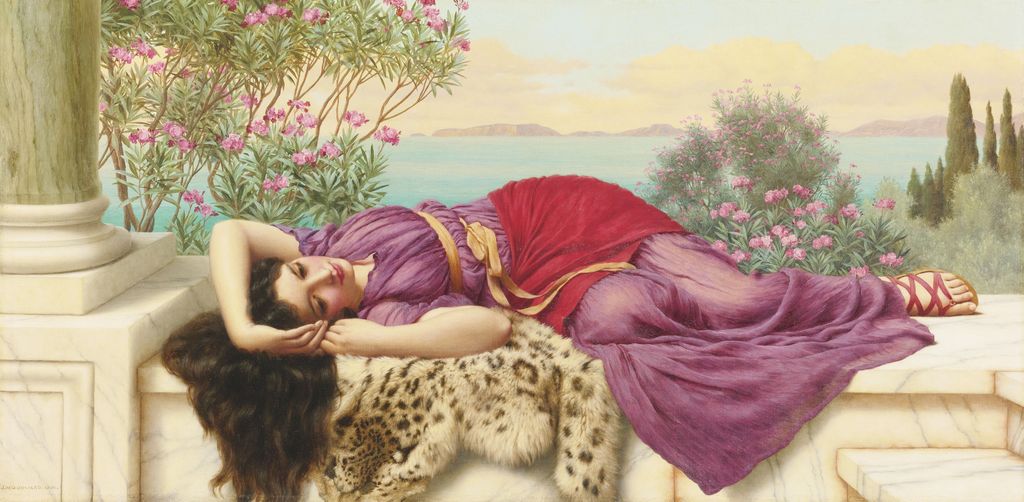
John William Godward, Dolce Far Niente (1906). The reclining woman in mauve is placed against marble, flowers and a distant island. Image source. Public domain.
Annotated Details from Dolce Far Niente
The numbered points identify visible features discussed in this article. Return from each detail to the numbered overview. Each caption identifies the work shown.
Dolce Far Niente (1904)
John William Godward, Dolce Far Niente (1904). Image source. Public domain.
.jpg)
Dolce Far Niente (1906)
John William Godward, Dolce Far Niente (1906). The reclining woman in mauve is placed against marble, flowers and a distant island. Image source. Public domain.
.jpg)
Dolce Far Niente (1897)
John William Godward, Dolce Far Niente (1897). The 1897 parrot scene gives the same title an action and a very different layout. Image source. Public domain.
.jpg)
Details from DOLCE FAR NIENTE
Compare the cropped details with the source images above. Notice how their colours, shapes and positions contribute to the larger compositions.
Dolce Far Niente (1904)
The look out of the picture
The woman’s eyes stay open and meet the viewer from just above the animal skin.
 Detail 01 the-look-out-of-the-picture.jpg)
The rim and the water lilies
Reflections and leaves soften the line inside the pool’s curved stone edge.
 Detail 02 the-rim-and-the-water-lilies.jpg)
Pink fabric across the fur
A broad bend in the fabric marks the lifted leg, while the fur follows the floor underneath.
 Detail 03 pink-fabric-across-the-fur.jpg)
Dolce Far Niente (1906)
Face below the raised arm
The elbow and shoulder enclose the face, while the dark hair falls over the bench.
 Detail 04 face-below-the-raised-arm.jpg)
The folds and the skin
The mauve drapery crosses the lighter animal skin in a broad turn over the marble.
 Detail 05 the-folds-and-the-skin.jpg)
The island beyond the foreground
A low island remains visible through the break between the taller plants.
 Detail 06 the-island-beyond-the-foreground.jpg)
Dolce Far Niente (1897)
The reach towards the parrot
The arm rises from the reclining body and carries the eye upward to the green bird.
 Detail 07 the-reach-towards-the-parrot.jpg)
A patterned disc against the wall
The round band of blue and gold cuts across the horizontal and vertical divisions of the room.
 Detail 08 a-patterned-disc-against-the-wall.jpg)
Fabric and fur over the floor
A warm wrap and a thin turquoise layer follow the bend in the body above the tiger skin.
 Detail 09 fabric-and-fur-over-the-floor.jpg)
John William Godward artworks directory
Search documented oil paintings, drawings, watercolours and reproductive prints. The directory includes the Art Renewal Center’s catalogue and additional works in museum, exhibition and sale records.
| Name | Date | Medium |
|---|---|---|
| Absence Makes the Heart Grow Fonder | 1912 | Oil on canvas |
| Amaryllis | 1903 | Oil on canvas |
| An Amateur | 1915 | Oil on canvas |
| Ancient Pastimes | 1916 | Oil on canvas |
| The Answer | 1917 | Oil on canvas |
| An Arcadian Beauty | 1899 | Painting |
| At the Fountain | 1893 | Oil on canvas |
| At the Garden Door | 1901 | Oil on canvas |
| At the Garden Shrine, Pompeii | 1892 | Oil on canvas |
| At the Gate of the Temple | 1898 | Oil on canvas |
| At the Thermae | 1909 | Oil on canvas |
| Atalanta | 1892 | Oil on canvas |
| Athenais | 1908 | Oil on canvas |
| An Auburn Beauty | 1895 | Oil on canvas |
| Autumn | 1900 | Oil on canvas |
| Beauty in a Marble Room | 1894 | Oil on canvas |
| The Belvedere | 1913 | Oil on canvas |
| The Betrothed | 1892 | Oil on canvas |
| The Betrothed (print after Godward) | 1893 | Photoengraving, as reported |
| The Bouquet | 1899 | Oil on canvas |
| Briseis | 1896 | Painting |
| The Broken Vase | 1889 | Oil on canvas |
| By the Blue Ionian Sea | 1916 | Oil on canvas |
| By the Wayside | 1912 | Oil on canvas |
| Byrsina | 1915 | Painting |
| Campaspe | 1896 | Oil on canvas |
| Campaspe (print after Godward) | Print, process unconfirmed | |
| Chloris (A Summer Rose) | 1902 | Oil on canvas |
| Classical Beauty | Oil on canvas | |
| A Classical Beauty | Oil on canvas | |
| A Classical Beauty | Painting | |
| A Classical Beauty | Oil on canvas | |
| A Classical Beauty | 1909 | Oil on canvas |
| A Classical Beauty In Profile | Oil on canvas | |
| A Classical Lady | 1908 | Oil on canvas |
| Clymene | 1892 | Oil on canvas |
| A Congenial Task | 1915 | Oil on canvas |
| Contemplation | 1922 | Oil on canvas |
| A Cool Retreat | 1910 | Oil on canvas |
| Country House in the 18th Century | c. 1883 | Oil on canvas |
| Cytheris | 1922 | Painting |
| The Day Dream | 1920 | Oil on canvas |
| The Delphic Oracle | 1899 | Oil on canvas |
| A Dilettante | 1922 | Oil on canvas |
| Distant Thoughts | 1918 | Oil on canvas |
| Dolce Far Niente | 1897 | Oil on canvas |
| Dolce Far Niente | 1906 | Oil on canvas |
| Dolce far niente (A Pompeian Fishpond) | 1904 | Oil on canvas |
| Dolce far niente (coloured print after Godward) | Exhibited 1900 | Coloured print, exact process unconfirmed |
| Dolce far niente (grapes) | 1907 | Oil on canvas |
| Dora | 1887 | Oil on canvas |
| Drusilla | 1906 | Oil on canvas |
| An Edition de Luxe | 1920 | Oil on canvas |
| Eighty and Eighteen | 1898 | Oil on canvas |
| Endymion | 1893 | Oil on canvas |
| The Engagement Ring (horizontal composition) | 1888 | Oil on canvas |
| The Engagement Ring (upright composition) | c. 1891 | Oil on canvas |
| Erato at Her Lyre | Oil on canvas | |
| A Fair Reflection | 1915 | Oil on canvas |
| A Fair Reflection (Taber-Prang print) | By 1923 | Sepia artotype |
| Far Away Thoughts (circular sewing scene) | 1911 | Oil on canvas |
| Far Away Thoughts (left-facing profile) | 1892 | Oil on canvas |
| Far Away Thoughts (right-facing profile) | 1892 | Oil on canvas |
| Female Figure (probable Grecian Idyll study) | 1907 | Oil on board |
| Flabellifera | 1905 | Oil on canvas |
| Flabellifera (painted study) | c. 1905 | Oil study |
| Flabellifera (pencil study) | c. 1905 | Pencil on paper |
| The Flower Girl | Painting | |
| A Flower Seller | 1896 | Oil on canvas |
| The Flowers of Venus | 1890 | Oil on canvas |
| A Fond Farewell | 1918 | Watercolour |
| The Fragrant Rose | 1892 | Painting |
| The Fruit Vendor | 1917 | Oil on canvas |
| A Garland Seller | 1914 | Painting |
| Giotto Drawing from Nature | Painting | |
| Girl in Yellow Drapery | 1901 | Oil on canvas |
| Golden Hours | 1913 | Oil on canvas |
| A Grecian Girl | 1908 | Oil on canvas |
| Grecian Idyll | 1907 | Oil on canvas |
| A Grecian Lovely | 1909 | Oil on canvas |
| Grecian Reverie | 1889 | Oil on canvas |
| Grecian Reverie | 1889 | Oil on canvas |
| A Greek Beauty | 1905 | Oil on canvas |
| A Happy Awakening | 1903 | Oil on canvas |
| He Loves Me, He Loves Me Not | 1896 | Oil on canvas |
| A head and shoulders profile portrait of a young woman wearing a white tunic style blouse | c. 1889 | Painting |
| Head of a Girl (The Priestess) | 1896 | Oil on canvas |
| Heart on her Lips and Soul within her Eyes | 1904 | Painting |
| His Birthday Gift | 1889 | Oil on canvas |
| Ianthe | 1889 | Oil on canvas |
| An Idle Hour | 1890 | Oil on canvas |
| Idle Moments | 1895 | Oil on canvas |
| Idle Thoughts | 1898 | Oil on canvas |
| Idleness | 1900 | Oil on canvas |
| Il Dolce Far Niente (Pears print after Amaryllis) | 1906 | Chromolithograph |
| Il Dolce far niente (seated figure) | 1893 | Oil on canvas |
| In Expectation | c. 1892 | Oil on canvas |
| In Realms of Fancy | 1911 | Oil on canvas |
| In the Prime of the Summertime (Reverie) | 1914 | Oil on canvas |
| In the Tepidarium | 1913 | Oil on canvas |
| Innocent Amusements | 1891 | Oil on canvas |
| Ione | c. 1896-1898 | Oil on canvas |
| Ionian Dancing Girl | 1902 | Oil on canvas |
| Ismenia | 1908 | Oil on canvas |
| An Italian Beauty | 1897 | Oil on canvas |
| An Italian Girls' Head | 1902 | Oil on canvas |
| The Jewel Casket | 1900 | Oil on canvas |
| Julia | 1914 | Painting |
| Knuckle Bones | 1890 | Oil on canvas |
| La Pensierosa | 1913 | Oil on canvas |
| A Lady | 1895 | Oil on canvas |
| Landscape: Blossoming Red Almond [study] | c. 1912 | Oil on panel |
| Le Billet Doux (The Love Letter) | 1913 | Oil on canvas |
| Leaning Against a Column | 1901 | Painting |
| Leaning on the Balcony | 1892 | Oil on canvas |
| Leisure Hours | 1905 | Oil on canvas |
| Lesbia with her Sparrow | 1916 | Oil on canvas |
| The Letter | 1899 | Painting |
| Liegende | 1893 | Oil on canvas |
| A Lily Pond | 1917 | Oil on canvas |
| Looking Out to Sea | 1918 | Pencil and watercolour |
| The Love Letter (circular composition) | 1907 | Oil on canvas |
| Lucilia | 1917 | Oil on canvas |
| Lycinna | 1918 | Oil on canvas |
| Marcella | 1912 | Painting |
| Matrona Superba | Oil on canvas | |
| Megilla | 1921 | Oil on canvas |
| A Melody | 1904 | Oil on canvas |
| Memories | c. 1891 | Oil on canvas |
| Mirinna | Painting | |
| The Mirror | 1899 | Oil on canvas |
| Mischief | 1905 | Oil on canvas |
| Mischief and Repose | 1895 | Oil on canvas |
| A Mouse in the Work Basket | 1893 | Oil on canvas |
| Nerissa | 1906 | Oil on canvas |
| The New Perfume | 1914 | Oil on canvas |
| Noon Day Rest | 1910 | Oil on canvas |
| Nu Sur La Plage | 1922 | Oil on panel |
| Nude Study | Oil on canvas | |
| An Offering to Venus | 1912 | Oil on canvas |
| The Old, Old Story | Oil on canvas | |
| The Old, Old Story | 1903 | Oil on canvas |
| On the Balcony | 1911 | Oil on canvas |
| On The Terrace | 1918 | Oil on canvas |
| Ophelia | Oil on panel | |
| The Peacock Fan | 1912 | Oil on canvas |
| Phyleis | 1908 | Oil on canvas |
| The Playground | 1892 | Oil on canvas |
| Playtime | 1891 | Oil on canvas |
| A Pompeian Bath | 1890 | Oil on canvas |
| A Pompeian Lady | 1891 | Oil on canvas |
| A Pompeian Lady | 1895 | Oil on board |
| A Pompeian Lady | 1901 | Painting |
| A Pompeian Lady | 1904 | Painting |
| Portrait of Mary Frederica 'Nin' Godward | c. 1882-1883 | Oil on canvas |
| Portrait of Mary Perkinton Godward | c. 1880-1881 | Watercolor |
| The Posy | 1900 | Painting |
| A Priestess (bare-shouldered figure) | 1893 | Oil on canvas |
| A Priestess (clothed composition) | 1894 | Oil on canvas |
| A Priestess (W. Biscombe Gardner after Godward) | Exhibited 1897 | Print, process unconfirmed |
| A Priestess of Bacchus | 1890-1890 | Oil on canvas |
| Pyrallis | 1918 | Oil on canvas |
| The Quiet Pet | 1906 | Oil on canvas |
| A Red, Red Rose | 1920 | Oil on canvas |
| Reflections | 1893 | Oil on canvas |
| The Rendezvous | 1903 | Oil on canvas |
| Repose, the Flower Girl | c. 1887 | Oil on canvas |
| Reverie | 1888 | Oil on panel |
| Reverie | 1912 | Oil on canvas |
| Reverie (In the Days of Sappho) | 1904 | Oil on canvas |
| Reverie (Pears print after In the Prime of the Summertime) | 1916 | Chromolithograph |
| 'Rich Gifts Wax Poor When Lovers Prove Unkind' | 1916 | Oil on canvas |
| The Ring | 1898 | Oil on canvas |
| A Roman Matron | 1905 | Oil on canvas |
| Sabinella | 1912 | Oil on canvas |
| Sappho | 1910 | Oil on canvas |
| The Siesta | Oil on canvas | |
| A Siesta | 1895 | Oil on canvas |
| The Signal | 1899 | Oil on canvas |
| Sitting for Her Portrait | 1893 | Oil on canvas |
| Sketch for Amaryllis | 1903 | Oil on board |
| A Souvenir | 1920 | Oil on canvas |
| Stesicrate | 1914 | Oil on canvas |
| Study for 'Rêverie' | 1890 | Oil on canvas |
| Study for 'The Priestess' | 1895 | Oil on board |
| Study for An Egyptian Minstrel | 1906 | Painting |
| Study for The New Perfume | Drawing, medium unconfirmed | |
| Study for ‘The Old, Old Story’ | 1903 | Oil paint on wood |
| Study of a Girl's Head | 1899 | Painting |
| Study of Campaspe | Oil on canvas | |
| Study of Head and Drapery, Miss Ethel Warwick | 1898 | Painting |
| Summer Day | 1897 | Painting |
| Summer Flowers | 1903 | Oil on canvas |
| Sweet Dreams | 1901 | Oil on canvas |
| Sweet Dreams | 1904 | Painting |
| The Sweet Siesta of a Summer's Day | 1891 | Oil on canvas |
| The Tambourine Girl (profile at the marble wall) | 1906 | Oil on canvas |
| The Tambourine Girl (relief-backed version) | 1906 | Oil on canvas |
| Tender Thoughts | 1917 | Oil on canvas |
| Tender Thoughts (woman leaning over a parapet) | 1918 | Pencil and watercolour |
| The Tiff (oil) | By 1888 | Oil on canvas |
| The Tiff (print after Godward) | 1894 | Photogravure |
| The Tigerskin | 1889 | Oil on canvas |
| The Time of Roses | 1916 | Oil on canvas |
| Tranquillity | 1914 | Oil on canvas |
| A Tryst | 1912 | Oil on canvas |
| Tympanistria | 1909 | Oil on canvas |
| Under the Blossom that Hangs on the Bough | 1917 | Oil on canvas |
| Venus at the Bath | 1901 | Oil on canvas |
| Venus Binding Her Hair | 1897 | Oil on canvas |
| Violets, Sweet Violets | 1906 | Painting |
| Waiting for an Answer | 1889 | Oil on canvas |
| Waiting for the Procession | 1890 | Oil on canvas |
| Waiting for the Procession | 1890 | Painting |
| The Water Carrier (magazine reproduction of At the Fountain) | 1898 | Magazine reproduction |
| When the Heart is Young | 1902 | Oil on canvas |
| Who Can They Be | Painting | |
| Winding Wool | 1894 | Painting |
| 'With Violets Wreathed and Robe of Saffron Hue' | 1902 | Oil on canvas |
| The Yellow Shawl | 1893 | Painting |
| 'Yes or No?' | 1893 | Oil on canvas |
| Young Girl Picking Grapes | 1902 | Oil on canvas |
| Youth and Time | 1901 | Oil on canvas |
Frequently Asked Questions
This is the 1904 oil of a woman reclining beside a garden fishpond. Godward reused the title for different paintings, including the 1897 parrot scene and the 1907 grape scene.
Discussion
Look again at the images and ideas explored in Dolce Far Niente by John William Godward. These editorial prompts invite your observations.
Reader Insights
Does your attention settle first on the figure or on the fishpond?
What changes when the title shifts from the pond to the pleasure of idleness?
Join the Conversation
Share a detail, comparison or question about Dolce Far Niente by John William Godward below.
References
- Desmond Bazley. “John William Godward (1861–1922),” Merton Historical Society Bulletin 151, September 2004, pp. 8–9. Caption based on the 2003 Royal Academy catalogue and account of the 1995 purchase. View source.
- Michael Allan Kodysz. The Classical-Genre Paintings of John William Godward: From Archaeology to Archetypes, University of Manchester master's dissertation, 2007, restored digital edition. See p. 5 n. 19, pp. 48–49 and fig. 5. View source.
- Rina Kajima. “反復される『何もしない』女性たち――ジョン・ウィリアム・ゴッドワード《愉しき無為》の分析” (“Repetition of Women Who Are Doing Nothing: Analysis of Dolce Far Niente by John William Godward”), 文化交流研究, 20, pp. 1–24, especially pp. 8–14 and figs. 1–3, 9–12. Japanese with an English abstract. View source.
- Art Renewal Center. Dolce far niente, record 1103, reproduction of the fountain and pond composition. The catalogue supplies Sweet Nothings as the English translation. View source.
- Treccani. “Dólce”, Vocabolario. The entry explains the expression il dolce far niente. View source.
- The Betrothed. View source.
- Girl in Yellow Drapery. View source.
- When the Heart is Young. View source.
- The Quiet Pet. View source.
- Noon Day Rest. View source.
- Christie's. A Pompeian Garden, lot essay and reference to Pre-Raphaelite and Other Masters: The Andrew Lloyd Webber Collection, no. 140. View source.
- Archaeological Park of Pompeii. A Guide to the Pompeii Excavations, p. 58, “House of the Small Fountain”. View source.
- Vern Grosvenor Swanson. J. W. Godward: The Eclipse of Classicism, Art Renewal Center archived web edition, p. 7. View source.
- Museo de Arte de Ponce. Frederic Leighton, Flaming June, 1895, object 63.0406. View source.
- J. Paul Getty Museum. Mischief and Repose, 1895, object 79.PA.149. View source.
- Marta Chiara Olimpia Nicosia. L'Art de la Rêverie: Female Daydreams in Nineteenth Century Painting, IMT Institute for Advanced Studies Lucca, PhD thesis, 2015, pp. 163–164 and figs. 113–114. View source.
- Christie's. John William Waterhouse, Dolce Far Niente, signed 1879 canvas and comparison with the separate 1880 painting in Kirkcaldy. View source.
- Christie's. William Holman Hunt, Il Dolce far Niente, signed and dated 1866, with exhibition history, provenance and excerpts from Hunt's memoir. View source.
- Sotheby's. Dolce far Niente, sale N09034, lot 9, 2013. Signed 1906 painting with separate references to the 1897 and 1904 sales. View source.
- Sotheby's. Il Dolce far Niente, sale L17133, lot 12, 2017. The signed 1893 painting, Swanson's alternative title and related works. View source.
- Sotheby's. Dolce Far Niente, sale N08630, lot 64, 2010. Signed 1897 oil and provenance. View source.
- The Connoisseur. Auction report on the Russell-Cotes sale, vol. XII, 1905, pp. 59–60, records the 1897 oil at Christie's on 11 March. View source.
- Woman's Exhibition, Earl's Court. Official Fine Art, Historical and General Catalogue, 1900, p. 152, “Coloured Prints”, no. 3154. View source.
- Sotheby's. Dolce far niente, lot 153, 2023. Signed 1907 oil with McLean letter and subsequent provenance. View source.