 by Tom Gurney
Tom Gurney BSc (Hons) is an art history expert with over 20 years experience
Published on June 19, 2020 / Updated on October 14, 2023
Email: tomgurney1@gmail.com / Phone: +44 7429 011000
John William Godward Drawings: Introduction
In John William Godward’s pencil study for Flabellifera, a seated woman lifts a broad fan behind her head. Short parallel strokes give weight to the cushion and suggest the texture of the fan. A few decisive lines mark the forearm that braces her on the seat. The Art Renewal Center dates the drawing to about 1905 and records it as pencil on paper in a private collection. The finished composition takes the same tilt of the head and raised hand into a setting of coloured drapery, stone and distant water. In the drawing you can see how much of the pose would survive even if everything around it changed. [1] [2]
At a Glance
- Surviving evidenceSketchbooks, pencil studies, studies in oil and related watercolours
- ExamplesFlabellifera, Tender Thoughts and By the Blue Ionian Sea
Contents
- Three versions of Flabellifera
- What went into the sketchbooks
- When the order of the versions matters
- Ethel Warwick and the evidence of a named model
- The artist at work inside the picture
- Annotated details
Three versions of Flabellifera
The Royal Academy’s 1905 Summer Exhibition catalogue lists Flabellifera as no. 252 in Gallery IV. Vern Grosvenor Swanson identifies the exhibited work as the 71 × 61 cm oil on canvas. He reproduces it alongside both the drawing and a much smaller painted study, which he describes as oil on panel, 15 × 11.5 cm. The Art Renewal Center catalogues a 1905 painted study under the same title as oil on canvas. The two descriptions of the support need checking against the object. The Academy number refers to the full-scale painting. [2] [3] [4] [5]
The three versions give different kinds of attention to the same figure. Pencil establishes the rise of the fan, the slant of the shoulders and the way the weight settles into the seat. The small painted study lets colour pull the figure forward against the cooler distance. In the larger canvas, the shore and terrace are clearly articulated, and the viewer can read the surface of the stone beside the folds of the dress. A change of medium makes new visual decisions possible while holding on to the physical arrangement that gave the picture its shape. [1] [2]
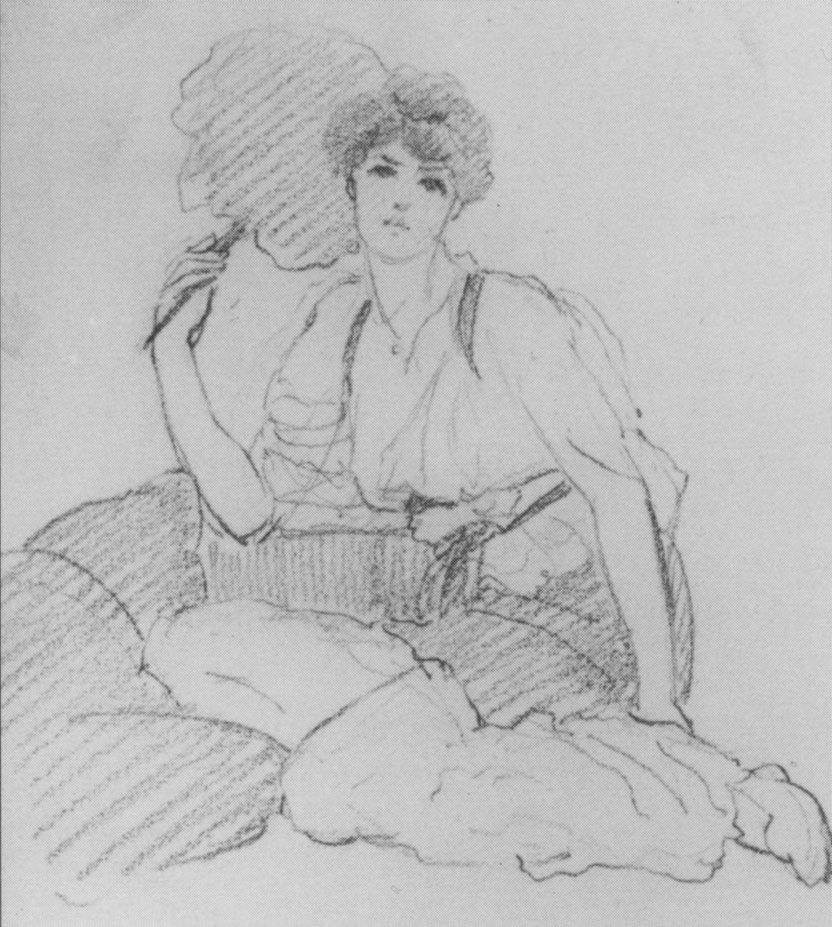
John William Godward, Flabellifera, pencil study. Pencil fixes the pose and the direction of the fan before the larger painted setting is worked up. Image source. Public domain.
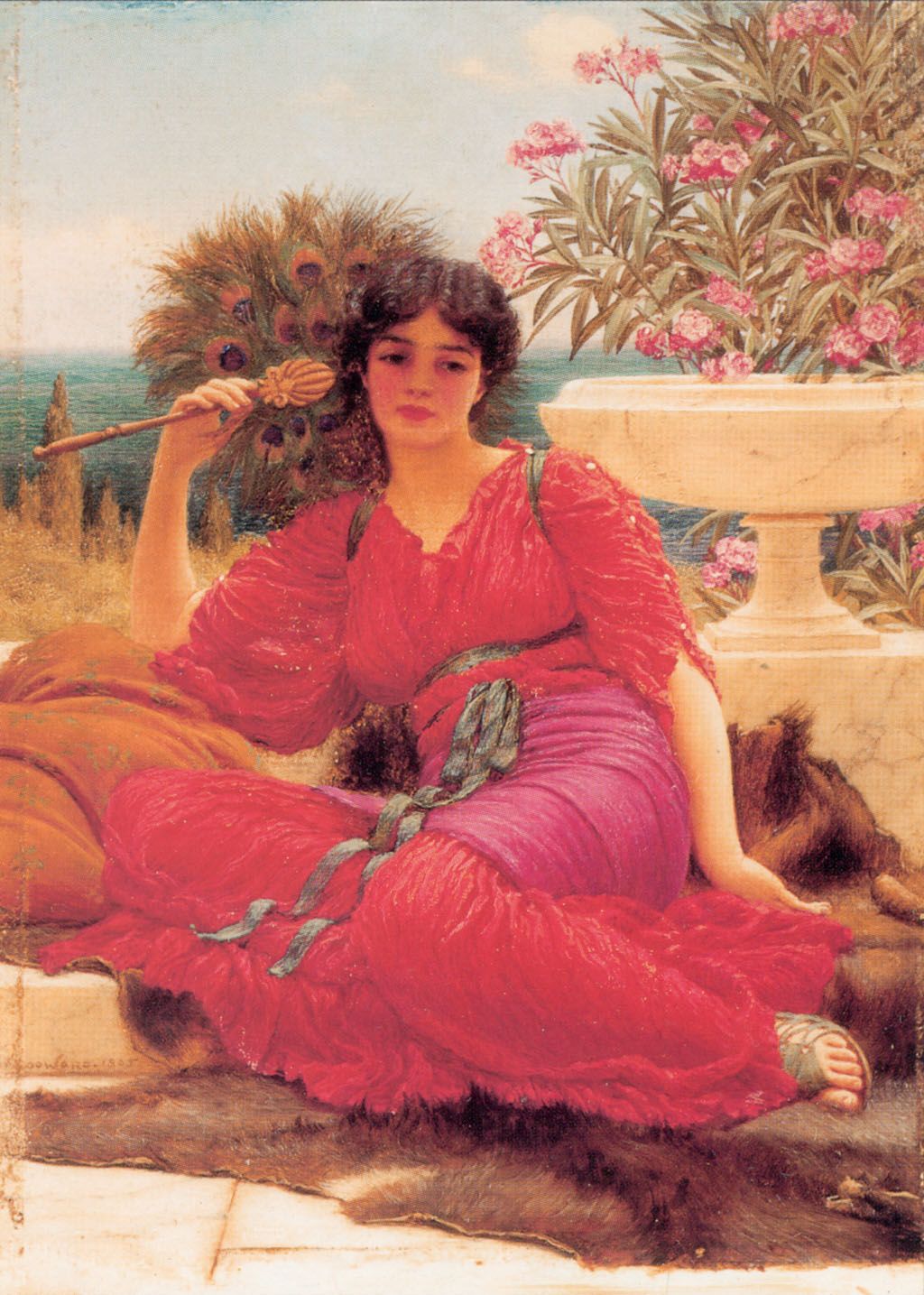
John William Godward, Flabellifera (1905), oil study. The painted study carries the raised arm and the broad placement of the fan into colour. Image source. Public domain.
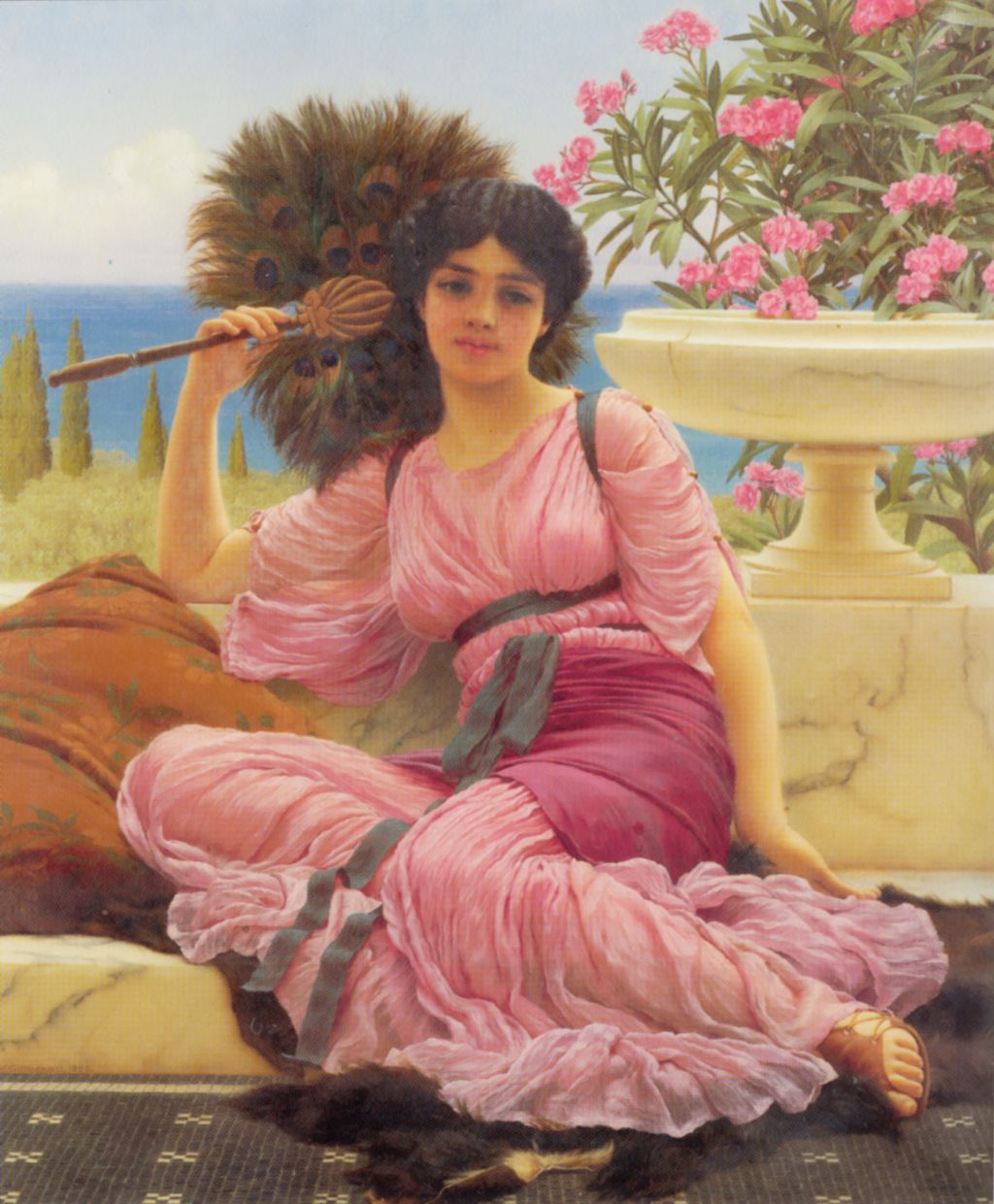
John William Godward, Flabellifera (1905), finished oil. The finished oil gives the pink drapery, marble, fur and feathers more sharply separated textures. Image source. Public domain.
Annotated Details from John William Godward Drawings
The numbered points identify visible features discussed in this article. Return from each detail to the numbered overview. John William Godward, Flabellifera (1905), finished oil. The finished oil gives the pink drapery, marble, fur and feathers more sharply separated textures. Image source. Public domain.
, finished oil.jpg)
Details from JOHN WILLIAM GODWARD DRAWINGS
Compare the cropped details with the source images above. Notice how their colours, shapes and positions contribute to the larger compositions.
The fan held beside her face
The handle runs beside the raised fingers and the feathers make a broad dark silhouette against the sky.
, finished oil Detail 01 the-fan-held-beside-her-face.jpg)
Folded fabric and a dropped hand
The hand drops beside the gathered fabric, where the pink folds use softer edges than the pale stone.
, finished oil Detail 02 folded-fabric-and-a-dropped-hand.jpg)
Flowers above the vessel
The branches and blooms break the regular curve of the vessel’s edge.
, finished oil Detail 03 flowers-above-the-vessel.jpg)
What went into the sketchbooks
Swanson describes two small surviving sketchbooks, dating them roughly to 1904–05 and 1912–13. He distinguishes quick contour drawings made while models tried poses from more composed drawings set within drawn borders. A contour sketch could hold the turn of a shoulder or the angle of a raised wrist. A border would let Godward test the space those gestures occupied in the whole picture. Swanson describes a further stage in small oils and fresh sittings from the model for the final canvas. The model could resume a pose set out in the study while the painter worked out how light and fabric behaved at a larger scale. The surviving examples support that sequence for some works and show how much of the process is missing for others. [2]
A sketchbook could keep a pose available for years. Art historian Rina Kajima reproduces a sketch dated about 1903–05 in her Japanese study of Godward’s reclining figures and identifies it with By the Blue Ionian Sea. She points to the way the curved body is set against the horizontal line. The signed 1916 oil is tall and narrow, while the sketch has a circle around the seated figure. Swanson also draws attention to the woman’s right arm, which bends back in both versions. The arm was worth retaining even as Godward moved the figure into a taller field and gave more space to the stone and sea. The gap between the dates suggests how long he could keep a useful arrangement in reserve. [6] [7]
Other pages preserved information about things. Swanson reports four studies of antiquities in Naples, including a sketch of a statue from two angles with notes, the words “Naples Museum” and an inventory number. He reads the two views as evidence that Godward probably saw the object in person. His account gives neither the digits nor an identifiable reproduction of the sheet, so the entry cannot be matched securely to an object in the museum’s inventory. Photographs of the Naples sculptures were already available. The Italian Istituto Centrale per la Grafica dates an Alinari campaign at the museum to about 1895. The inscription connects the study to the collection, while the source of the two views remains open. [4] [8]
Michael Allan Kodysz identified another way material could pass from a real object into a picture. The patterned girdles in Henry Ryland’s By the Southern Sea and Godward’s Young Woman of 1894 match closely. The painters had occupied neighbouring rooms at Bolton Studios in London in 1888–89. Kodysz reads the costume overlap as evidence of contact between their studios. It is a useful comparison with the Naples sketch. An inventory number could help an artist recover information about an antiquity, while a length of patterned fabric in a studio could be draped and drawn at the next sitting. [9]
John William Godward videos
See Godward’s paintings and studio practice alongside films on two Victorian contemporaries.
John William Godward - Part 1: The Last Painter of the Victorian Age
An overview of Godward’s career and the Victorian market for pictures set in antiquity.
Watch on YouTubeWhen the order of the versions matters
Christie’s traces the composition for Tender Thoughts to a sketchbook drawing of about 1913–14. According to the catalogue, Godward used that design to pose a live model for an oil study and returned to a model for the finished canvas, signed and inscribed Rome, 1917. The location of the intermediate oil study was unknown when the catalogue was written. A year after the canvas, he reworked the composition in the watercolour offered by Sotheby’s as Looking Out to Sea. The watercolour repeats the woman’s chin on her hand and her other palm held open at her waist. Christie’s catalogues a separate 1918 watercolour as Tender Thoughts. There the woman faces the other way and leans over a parapet with both hands behind her. The sequence gives Looking Out to Sea a different role from the earlier pencil drawing. The drawing helped Godward develop the picture, while the watercolour tests how much of the finished canvas he could carry into another medium. Godward returned to a painted subject in much the same way with Songs without Words, a 1918 oil whose watercolour version appeared in 1919. [10] [11] [12] [13]
The 1903 Sketch for Amaryllis is a compact oil on board measuring 7 × 9 inches. The Maas Gallery records that the artist’s descendants held several drawings associated with the oil. It also documents a later chromolithograph, issued by Pears Annual in 1906 after the finished painting. The drawings belong to the history of making the picture, and the mechanically reproduced colour sheet belongs to the history of distributing it. The shared title makes the medium and publication date particularly useful when distinguishing an original from one of Godward’s prints. [14]
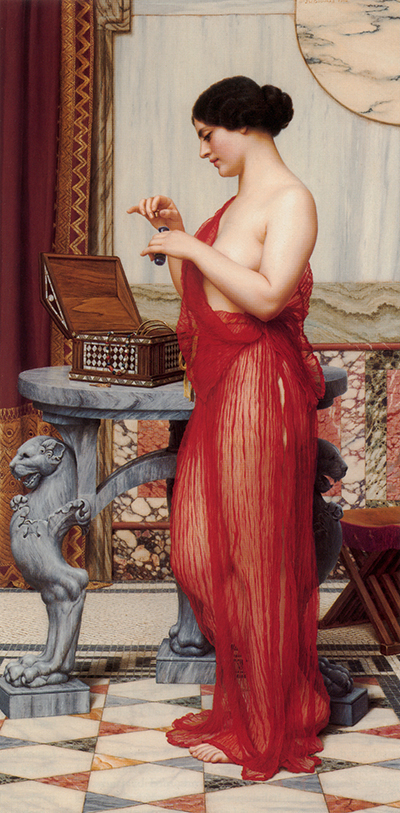
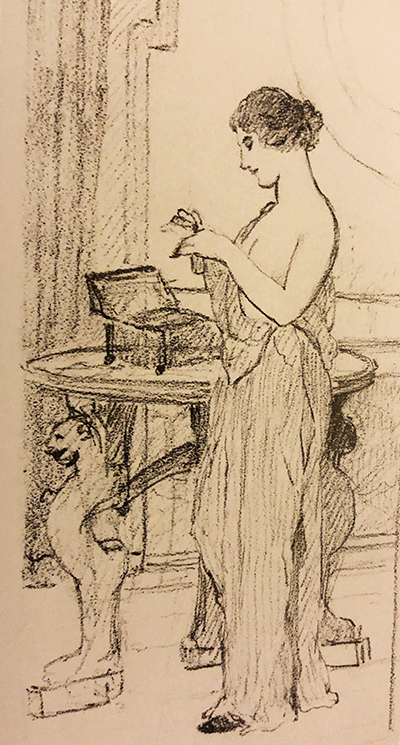
In a drawing associated with The New Perfume, the woman bends her head over her raised hands beside an open box. The angled lid, the oval table and its griffin support are already present. The inner lines of the skirt gather into a knot at the hip. In the finished painting the lid stands higher, the floor has a strongly marked pattern, and the folds become vivid red against the pale wall. Those correspondences identify the composition represented in the drawing. Its physical medium, date and current location remain unverified. Christie’s gives separate dates for the surviving oil’s inscriptions, 1914 on the front and Rome, 1915 on the back. Those dates belong to the canvas. [15] [16]
References to studies sometimes outlast usable reproductions of them. Christie’s mentions a preliminary drawing in its discussion of two oils from 1914, In the Prime of the Summertime and Tranquility, which share a mountain vista. The entry also mentions an oil study of the distant mountains. The two references point to different tasks at the planning stage, arranging the figure and observing the landscape. [17]
Other works on paper had a purpose of their own. Swanson describes a miniature gouache of Godward’s grandmother Mary Perkinton Godward, about 4½ by 3¼ inches, in a family collection when he wrote. She had died by the time he dates the portrait to around 1880–81. Swanson suggests that he worked from a photograph or an earlier drawing. This is a named family portrait on a small scale, with no known later canvas for which it served as preparation. [18]
Ethel Warwick and the evidence of a named model
For the signed 1900 canvas Preparing for the Bath, Sotheby’s describes a sketch in which the figure appears without the transparent garment that covers her in the painting. Swanson also reports that The Artist reproduced a nude study in June 1900, under the title The Toilet. The name appears on an old label on the back of the canvas. The published accounts give good grounds for discussing the two treatments of the figure. They leave open whether the same decision can be traced in the paint layers beneath the finished gown. Sotheby’s identifies Ethel Maud Warwick as the likely model. [2] [19]
Two dated Godward pictures help establish the context for that attribution. The Russell-Cotes Art Gallery & Museum holds Ethel, an oil on canvas dated 1898, in which Godward shows her in contemporary dress. Sotheby’s catalogued a different oil as Study of a Head in Drapery, Miss Ethel Warwick, signed and dated 1898 at the upper right. Its recorded provenance includes the dealer Thomas McLean in September 1899 and the Cider House Gallery in Surrey. The catalogue also cites Swanson’s illustration of a pen-and-ink sketch for that picture in a letter to McLean. The canvas, the ink drawing and the museum portrait are three distinct records. McLean’s association with the letter and the oil supplies a documentary link independent of the sitter’s likeness. [20] [21]
The evidence for identifying Warwick in drawings by her contemporaries takes several forms. Christie’s catalogued two of Herbert Draper’s studies for The Lament for Icarus, both pencil and black and white chalk on buff paper. Draper’s inscription names Ethel Gurden on one, while the lot essay identifies Ethel Maud Warwick as the model for the figure supporting Icarus. The two studies came down through Draper’s family and were exhibited in 1999 as part of a larger sheet. In a separate group, Whistler’s three studies were dated to the same day, 4 June 1900, on the evidence of his former secretary and heir, Rosalind Birnie Philip. The Hunterian has the two sheets catalogued as Ethel Warwick asleep on a sofa and Ethel Warwick holding an apple. A third, Nude Model Reclining, is a more developed chalk and pastel drawing on brown paper with Whistler’s butterfly monogram. Faint traces of an earlier figure show through underneath. Dreweatts traced its ownership through Birnie Philip and later private collections. The name on Draper’s sheet identifies one model. Birnie Philip’s account connects a group of Whistler studies to a single day. Godward’s bath painting relies on the auction catalogue’s identification, with the named 1898 portrait providing a comparison. [22] [23] [24]
The artist at work inside the picture
In An Amateur, a seated woman holds a sheet at arm’s length to look at the drawing on it. The edge of the sheet sits against the pale marble, and the extended arm carries the eye across the painting. Sotheby’s describes the image on it as a study of a male nude. The figure’s active hand is easy to miss because she sits with the ease of one of Godward’s resting women. Her raised hand gives that ease a purpose. She is taking a moment to look at what she has made. [25] [26]
In the 1922 A Dilettante, the subject of that concentration is a small sculpture. The woman works at a round table, and the height of the statuette brings it close to her sightline. Sotheby’s compares it to the ancient Greek terracotta known as the Danseuse Titeux in the Louvre. The catalogue of the Louvre places its figurine in Athens around 375–350 BCE. Period accounts report that casts had circulated before the original entered the Louvre in 1891, which leaves several ways Godward might have encountered the form. The figure in An Amateur suspends a sheet to inspect a line. The sculptor leans toward an object that can be examined in the round. Both paintings invite the viewer to follow an artist’s attention, which is also one of the pleasures of looking at Godward’s surviving drawings. [25] [27] [28]
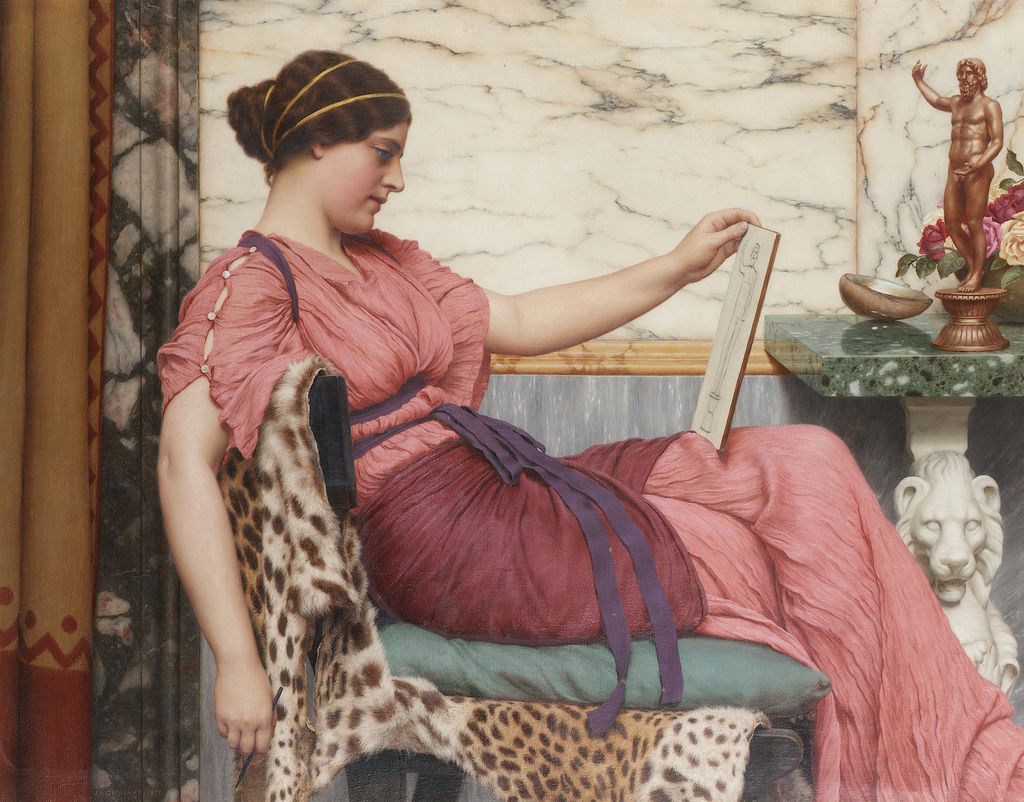
John William Godward, An Amateur (1915). The sitter lifts the small drawing away from her lap to inspect it. Image source. Public domain.
John William Godward artworks directory
Search documented oil paintings, drawings, watercolours and reproductive prints. The directory includes the Art Renewal Center’s catalogue and additional works in museum, exhibition and sale records.
| Name | Date | Medium |
|---|---|---|
| Absence Makes the Heart Grow Fonder | 1912 | Oil on canvas |
| Amaryllis | 1903 | Oil on canvas |
| An Amateur | 1915 | Oil on canvas |
| Ancient Pastimes | 1916 | Oil on canvas |
| The Answer | 1917 | Oil on canvas |
| An Arcadian Beauty | 1899 | Painting |
| At the Fountain | 1893 | Oil on canvas |
| At the Garden Door | 1901 | Oil on canvas |
| At the Garden Shrine, Pompeii | 1892 | Oil on canvas |
| At the Gate of the Temple | 1898 | Oil on canvas |
| At the Thermae | 1909 | Oil on canvas |
| Atalanta | 1892 | Oil on canvas |
| Athenais | 1908 | Oil on canvas |
| An Auburn Beauty | 1895 | Oil on canvas |
| Autumn | 1900 | Oil on canvas |
| Beauty in a Marble Room | 1894 | Oil on canvas |
| The Belvedere | 1913 | Oil on canvas |
| The Betrothed | 1892 | Oil on canvas |
| The Betrothed (print after Godward) | 1893 | Photoengraving, as reported |
| The Bouquet | 1899 | Oil on canvas |
| Briseis | 1896 | Painting |
| The Broken Vase | 1889 | Oil on canvas |
| By the Blue Ionian Sea | 1916 | Oil on canvas |
| By the Wayside | 1912 | Oil on canvas |
| Byrsina | 1915 | Painting |
| Campaspe | 1896 | Oil on canvas |
| Campaspe (print after Godward) | Print, process unconfirmed | |
| Chloris (A Summer Rose) | 1902 | Oil on canvas |
| Classical Beauty | Oil on canvas | |
| A Classical Beauty | Oil on canvas | |
| A Classical Beauty | Painting | |
| A Classical Beauty | Oil on canvas | |
| A Classical Beauty | 1909 | Oil on canvas |
| A Classical Beauty In Profile | Oil on canvas | |
| A Classical Lady | 1908 | Oil on canvas |
| Clymene | 1892 | Oil on canvas |
| A Congenial Task | 1915 | Oil on canvas |
| Contemplation | 1922 | Oil on canvas |
| A Cool Retreat | 1910 | Oil on canvas |
| Country House in the 18th Century | c. 1883 | Oil on canvas |
| Cytheris | 1922 | Painting |
| The Day Dream | 1920 | Oil on canvas |
| The Delphic Oracle | 1899 | Oil on canvas |
| A Dilettante | 1922 | Oil on canvas |
| Distant Thoughts | 1918 | Oil on canvas |
| Dolce Far Niente | 1897 | Oil on canvas |
| Dolce Far Niente | 1906 | Oil on canvas |
| Dolce far niente (A Pompeian Fishpond) | 1904 | Oil on canvas |
| Dolce far niente (coloured print after Godward) | Exhibited 1900 | Coloured print, exact process unconfirmed |
| Dolce far niente (grapes) | 1907 | Oil on canvas |
| Dora | 1887 | Oil on canvas |
| Drusilla | 1906 | Oil on canvas |
| An Edition de Luxe | 1920 | Oil on canvas |
| Eighty and Eighteen | 1898 | Oil on canvas |
| Endymion | 1893 | Oil on canvas |
| The Engagement Ring (horizontal composition) | 1888 | Oil on canvas |
| The Engagement Ring (upright composition) | c. 1891 | Oil on canvas |
| Erato at Her Lyre | Oil on canvas | |
| A Fair Reflection | 1915 | Oil on canvas |
| A Fair Reflection (Taber-Prang print) | By 1923 | Sepia artotype |
| Far Away Thoughts (circular sewing scene) | 1911 | Oil on canvas |
| Far Away Thoughts (left-facing profile) | 1892 | Oil on canvas |
| Far Away Thoughts (right-facing profile) | 1892 | Oil on canvas |
| Female Figure (probable Grecian Idyll study) | 1907 | Oil on board |
| Flabellifera | 1905 | Oil on canvas |
| Flabellifera (painted study) | c. 1905 | Oil study |
| Flabellifera (pencil study) | c. 1905 | Pencil on paper |
| The Flower Girl | Painting | |
| A Flower Seller | 1896 | Oil on canvas |
| The Flowers of Venus | 1890 | Oil on canvas |
| A Fond Farewell | 1918 | Watercolour |
| The Fragrant Rose | 1892 | Painting |
| The Fruit Vendor | 1917 | Oil on canvas |
| A Garland Seller | 1914 | Painting |
| Giotto Drawing from Nature | Painting | |
| Girl in Yellow Drapery | 1901 | Oil on canvas |
| Golden Hours | 1913 | Oil on canvas |
| A Grecian Girl | 1908 | Oil on canvas |
| Grecian Idyll | 1907 | Oil on canvas |
| A Grecian Lovely | 1909 | Oil on canvas |
| Grecian Reverie | 1889 | Oil on canvas |
| Grecian Reverie | 1889 | Oil on canvas |
| A Greek Beauty | 1905 | Oil on canvas |
| A Happy Awakening | 1903 | Oil on canvas |
| He Loves Me, He Loves Me Not | 1896 | Oil on canvas |
| A head and shoulders profile portrait of a young woman wearing a white tunic style blouse | c. 1889 | Painting |
| Head of a Girl (The Priestess) | 1896 | Oil on canvas |
| Heart on her Lips and Soul within her Eyes | 1904 | Painting |
| His Birthday Gift | 1889 | Oil on canvas |
| Ianthe | 1889 | Oil on canvas |
| An Idle Hour | 1890 | Oil on canvas |
| Idle Moments | 1895 | Oil on canvas |
| Idle Thoughts | 1898 | Oil on canvas |
| Idleness | 1900 | Oil on canvas |
| Il Dolce Far Niente (Pears print after Amaryllis) | 1906 | Chromolithograph |
| Il Dolce far niente (seated figure) | 1893 | Oil on canvas |
| In Expectation | c. 1892 | Oil on canvas |
| In Realms of Fancy | 1911 | Oil on canvas |
| In the Prime of the Summertime (Reverie) | 1914 | Oil on canvas |
| In the Tepidarium | 1913 | Oil on canvas |
| Innocent Amusements | 1891 | Oil on canvas |
| Ione | c. 1896-1898 | Oil on canvas |
| Ionian Dancing Girl | 1902 | Oil on canvas |
| Ismenia | 1908 | Oil on canvas |
| An Italian Beauty | 1897 | Oil on canvas |
| An Italian Girls' Head | 1902 | Oil on canvas |
| The Jewel Casket | 1900 | Oil on canvas |
| Julia | 1914 | Painting |
| Knuckle Bones | 1890 | Oil on canvas |
| La Pensierosa | 1913 | Oil on canvas |
| A Lady | 1895 | Oil on canvas |
| Landscape: Blossoming Red Almond [study] | c. 1912 | Oil on panel |
| Le Billet Doux (The Love Letter) | 1913 | Oil on canvas |
| Leaning Against a Column | 1901 | Painting |
| Leaning on the Balcony | 1892 | Oil on canvas |
| Leisure Hours | 1905 | Oil on canvas |
| Lesbia with her Sparrow | 1916 | Oil on canvas |
| The Letter | 1899 | Painting |
| Liegende | 1893 | Oil on canvas |
| A Lily Pond | 1917 | Oil on canvas |
| Looking Out to Sea | 1918 | Pencil and watercolour |
| The Love Letter (circular composition) | 1907 | Oil on canvas |
| Lucilia | 1917 | Oil on canvas |
| Lycinna | 1918 | Oil on canvas |
| Marcella | 1912 | Painting |
| Matrona Superba | Oil on canvas | |
| Megilla | 1921 | Oil on canvas |
| A Melody | 1904 | Oil on canvas |
| Memories | c. 1891 | Oil on canvas |
| Mirinna | Painting | |
| The Mirror | 1899 | Oil on canvas |
| Mischief | 1905 | Oil on canvas |
| Mischief and Repose | 1895 | Oil on canvas |
| A Mouse in the Work Basket | 1893 | Oil on canvas |
| Nerissa | 1906 | Oil on canvas |
| The New Perfume | 1914 | Oil on canvas |
| Noon Day Rest | 1910 | Oil on canvas |
| Nu Sur La Plage | 1922 | Oil on panel |
| Nude Study | Oil on canvas | |
| An Offering to Venus | 1912 | Oil on canvas |
| The Old, Old Story | Oil on canvas | |
| The Old, Old Story | 1903 | Oil on canvas |
| On the Balcony | 1911 | Oil on canvas |
| On The Terrace | 1918 | Oil on canvas |
| Ophelia | Oil on panel | |
| The Peacock Fan | 1912 | Oil on canvas |
| Phyleis | 1908 | Oil on canvas |
| The Playground | 1892 | Oil on canvas |
| Playtime | 1891 | Oil on canvas |
| A Pompeian Bath | 1890 | Oil on canvas |
| A Pompeian Lady | 1891 | Oil on canvas |
| A Pompeian Lady | 1895 | Oil on board |
| A Pompeian Lady | 1901 | Painting |
| A Pompeian Lady | 1904 | Painting |
| Portrait of Mary Frederica 'Nin' Godward | c. 1882-1883 | Oil on canvas |
| Portrait of Mary Perkinton Godward | c. 1880-1881 | Watercolor |
| The Posy | 1900 | Painting |
| A Priestess (bare-shouldered figure) | 1893 | Oil on canvas |
| A Priestess (clothed composition) | 1894 | Oil on canvas |
| A Priestess (W. Biscombe Gardner after Godward) | Exhibited 1897 | Print, process unconfirmed |
| A Priestess of Bacchus | 1890-1890 | Oil on canvas |
| Pyrallis | 1918 | Oil on canvas |
| The Quiet Pet | 1906 | Oil on canvas |
| A Red, Red Rose | 1920 | Oil on canvas |
| Reflections | 1893 | Oil on canvas |
| The Rendezvous | 1903 | Oil on canvas |
| Repose, the Flower Girl | c. 1887 | Oil on canvas |
| Reverie | 1888 | Oil on panel |
| Reverie | 1912 | Oil on canvas |
| Reverie (In the Days of Sappho) | 1904 | Oil on canvas |
| Reverie (Pears print after In the Prime of the Summertime) | 1916 | Chromolithograph |
| 'Rich Gifts Wax Poor When Lovers Prove Unkind' | 1916 | Oil on canvas |
| The Ring | 1898 | Oil on canvas |
| A Roman Matron | 1905 | Oil on canvas |
| Sabinella | 1912 | Oil on canvas |
| Sappho | 1910 | Oil on canvas |
| The Siesta | Oil on canvas | |
| A Siesta | 1895 | Oil on canvas |
| The Signal | 1899 | Oil on canvas |
| Sitting for Her Portrait | 1893 | Oil on canvas |
| Sketch for Amaryllis | 1903 | Oil on board |
| A Souvenir | 1920 | Oil on canvas |
| Stesicrate | 1914 | Oil on canvas |
| Study for 'Rêverie' | 1890 | Oil on canvas |
| Study for 'The Priestess' | 1895 | Oil on board |
| Study for An Egyptian Minstrel | 1906 | Painting |
| Study for The New Perfume | Drawing, medium unconfirmed | |
| Study for ‘The Old, Old Story’ | 1903 | Oil paint on wood |
| Study of a Girl's Head | 1899 | Painting |
| Study of Campaspe | Oil on canvas | |
| Study of Head and Drapery, Miss Ethel Warwick | 1898 | Painting |
| Summer Day | 1897 | Painting |
| Summer Flowers | 1903 | Oil on canvas |
| Sweet Dreams | 1901 | Oil on canvas |
| Sweet Dreams | 1904 | Painting |
| The Sweet Siesta of a Summer's Day | 1891 | Oil on canvas |
| The Tambourine Girl (profile at the marble wall) | 1906 | Oil on canvas |
| The Tambourine Girl (relief-backed version) | 1906 | Oil on canvas |
| Tender Thoughts | 1917 | Oil on canvas |
| Tender Thoughts (woman leaning over a parapet) | 1918 | Pencil and watercolour |
| The Tiff (oil) | By 1888 | Oil on canvas |
| The Tiff (print after Godward) | 1894 | Photogravure |
| The Tigerskin | 1889 | Oil on canvas |
| The Time of Roses | 1916 | Oil on canvas |
| Tranquillity | 1914 | Oil on canvas |
| A Tryst | 1912 | Oil on canvas |
| Tympanistria | 1909 | Oil on canvas |
| Under the Blossom that Hangs on the Bough | 1917 | Oil on canvas |
| Venus at the Bath | 1901 | Oil on canvas |
| Venus Binding Her Hair | 1897 | Oil on canvas |
| Violets, Sweet Violets | 1906 | Painting |
| Waiting for an Answer | 1889 | Oil on canvas |
| Waiting for the Procession | 1890 | Oil on canvas |
| Waiting for the Procession | 1890 | Painting |
| The Water Carrier (magazine reproduction of At the Fountain) | 1898 | Magazine reproduction |
| When the Heart is Young | 1902 | Oil on canvas |
| Who Can They Be | Painting | |
| Winding Wool | 1894 | Painting |
| 'With Violets Wreathed and Robe of Saffron Hue' | 1902 | Oil on canvas |
| The Yellow Shawl | 1893 | Painting |
| 'Yes or No?' | 1893 | Oil on canvas |
| Young Girl Picking Grapes | 1902 | Oil on canvas |
| Youth and Time | 1901 | Oil on canvas |
Discussion
Look again at the images and ideas explored in John William Godward Drawings. These editorial prompts invite your observations.
Reader Insights
Which change between a study and a finished work tells you the most about Godward’s choices?
What can you see more clearly in the drawing than in the painting?
Join the Conversation
Share a detail, comparison or question about John William Godward Drawings below.
References
- Art Renewal Center. Flabellifera (pencil study), artwork 11390. English. View source.
- Vern Grosvenor Swanson. J.W. Godward: The Eclipse of Classicism, archived Art Renewal Center edition, web p. 14. Studio method and three illustrated Flabellifera versions. English. View source.
- Royal Academy of Arts. Exhibition of the Royal Academy, 1905, Gallery IV, no. 252. English. View source.
- Vern Grosvenor Swanson. J.W. Godward: The Eclipse of Classicism, archived Art Renewal Center edition, web p. 8. The exhibited oil and Naples drawings, including note 156. English. View source.
- Art Renewal Center. Study for Flabellifera, artwork 1110. English. View source.
- Rina Kajima. “反復される『何もしない』女性たち――ジョン・ウィリアム・ゴッドワード《愉しき無為》の分析” (“Repetition of Women Who Are Doing Nothing: Analysis of Dolce Far Niente by John William Godward”), section 2-2 and fig. 15. Japanese with an English abstract. View source.
- Heather James Fine Art. By the Blue Ionian Sea. Record and illustration of the 1916 oil. English. View source.
- Istituto Centrale per la Grafica. Napoli – Museo Nazionale. Eschine, Alinari photograph F-P4115. Italian. View source.
- Michael Allan Kodysz. The Classical-Genre Paintings of John William Godward: From Archaeology to Archetypes, chapter 1, pp. 11–12 and figs. 7–8. English. View source.
- Christie’s. Tender Thoughts, 1917 oil and study history. English. View source.
- Sotheby’s. Looking Out to Sea, December 2014 sale, lot 45. Plate of the watercolour reworking the 1917 oil, Swanson no. 1918.6. English. View source.
- Christie’s. Tender Thoughts, November 2006 sale, lot 185. Separate 1918 pencil and watercolour, Swanson no. 1918.13. English. View source.
- Christie’s. Songs without Words, 1918 oil and 1919 watercolour. English. View source.
- The Maas Gallery. British Pictures 2019, no. 17, Sketch for Amaryllis, p. 21. English. View source.
- The History of Art. Drawing associated with The New Perfume. Image for compositional comparison. View source.
- Christie’s. The New Perfume, oil and front and back inscriptions. English. View source.
- Christie’s. In the Prime of the Summertime (Reverie), 1914 oil and mention of a preliminary drawing. English. View source.
- Vern Grosvenor Swanson. J.W. Godward: The Eclipse of Classicism, archived Art Renewal Center edition, web p. 1. The early family portrait and its possible sources. English. View source.
- Sotheby’s. Preparing for the Bath, 2017 sale, lot 15. English. View source.
- Russell-Cotes Art Gallery & Museum. Digital Guide to the Paintings, Main Hall, Ethel. English. View source.
- Sotheby’s. Study of a Head in Drapery, Miss Ethel Warwick, July 2015 sale, lot 20. English. View source.
- Christie’s. Herbert James Draper, Two Female Nude Studies for “The Lament for Icarus”. English. View source.
- University of Glasgow. Ethel Maud Warwick, the James McNeill Whistler catalogue, related works M.1604–1606. English. View source.
- Dreweatts. Turner & Whistler: Five Works on Paper, lot 140. English. View source.
- Sotheby’s. A Dilettante, with An Amateur as fig. 1. English. View source.
- Sotheby’s. An Edition de Luxe, catalogue comparison with An Amateur. English. View source.
- Musée du Louvre. Figurine dite Danseuse Titeux, CA 462. French. View source.
- Léon Heuzey. Une danseuse voilée en terre cuite offerte au Louvre par le sculpteur Cavelier, Académie des Inscriptions et Belles-Lettres, 1891, pp. 264–265. French. View source.