 by Tom Gurney
Tom Gurney BSc (Hons) is an art history expert with over 20 years experience
Published on June 19, 2020 / Updated on October 14, 2023
Email: tomgurney1@gmail.com / Phone: +44 7429 011000
The New Perfume: Introduction
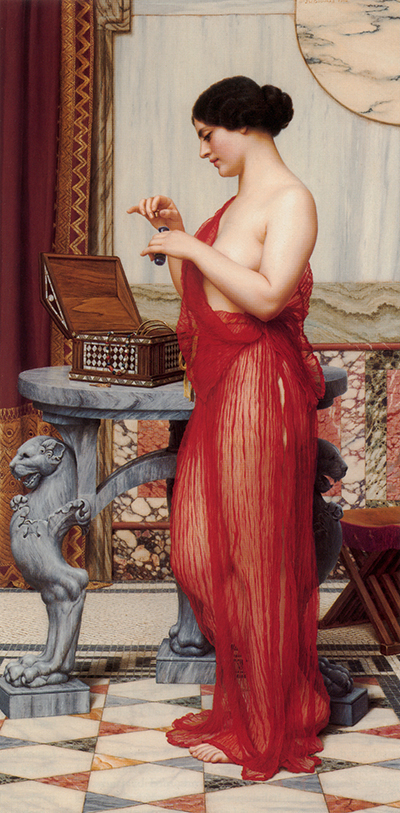
A woman in a sheer red gown lowers her eyes towards her hands. One hand steadies a small blue vessel, its rounded base visible beneath her fingers. The other hovers above the mouth, the fingers drawn together as though about to lift a stopper or handle a drop. An inlaid box stands open to her left, with several small curved forms visible inside. Beneath it, the foremost support of a stone table has the head and raised wing of a griffin and the foot of a lion. A curtain closes off one side of the room. A folding stool is half hidden on the other. In this secluded interior, the one action in progress could be over in seconds. [1]
Christie’s records The New Perfume as an oil on canvas measuring 101.6 × 50.7 cm (40 × 20 in.). The date beside Godward’s signature on the front is 1914. The reverse carries the title, his signature and the inscription Rome, 1915. Both dates belong to this canvas, and the reason for the difference remains unknown. Christie’s also records the painting as no. 10 in Richard Green’s London exhibition The Victorian Scene in 1979, illustrated on pp. 28–29 of the exhibition catalogue. That entry documents where it was shown. Bradstreet’s 2022 figure caption records a private collection, without naming the owner. The present whereabouts of the painting are unconfirmed. [2] [3]
At a Glance
- Date1914 on the front, Rome 1915 on the reverse
- MediumOil on canvas
- Dimensions101.6 × 50.7 cm
This work across John William Godward’s career
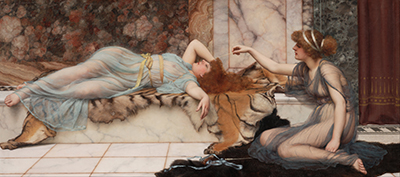
The Bouquet
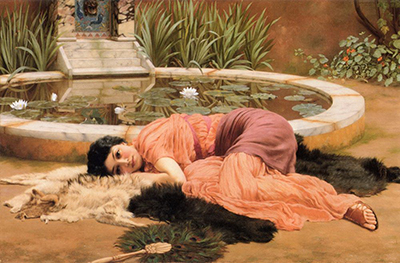
1899 [4]Tranquillity
1914 [5]The New Perfume (current article)
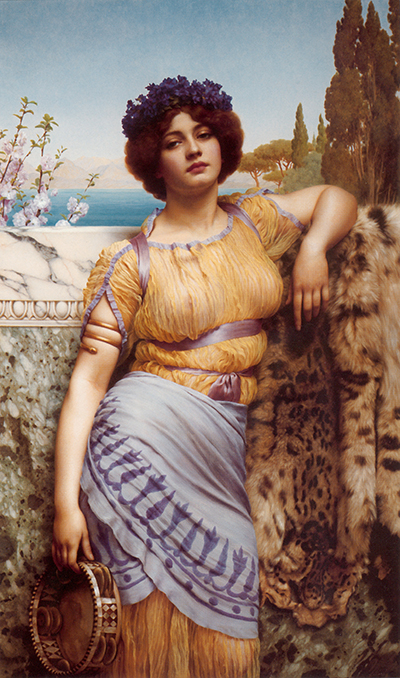
1914–15 inscriptions [2]An Amateur
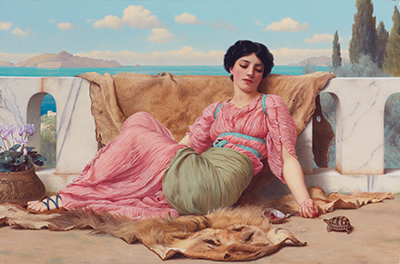
1915–16 inscriptions [6]A Souvenir
1920 [8]Contents
- A scent implied by two hands
- A new perfume in 1914
- Roman glass and carved furniture
- The same pose on paper
- Where the figures look
- Annotated details
A scent implied by two hands
The title supplies a sense that the eye has to imagine. There is no curl of smoke or bunch of flowers to announce a fragrance. Godward gives us the blue vessel, the gap between the fingers, and the woman’s inward look. With the title in mind, the movements become intelligible as the handling of perfume. The liquid and the moment of application remain out of view. Even the word “new” draws attention to her concentration. She could be finding out how a fresh scent behaves or how it smells on her skin. The painting leaves the outcome with her. [1] [3]
The narrowed canvas concentrates that attention. Pale stone gives the fingers a clear outline, and a sliver of the blue vessel keeps showing through their overlap. The box lid rises towards the hands, while the rim of the table curves away behind the woman. Follow the red cloth down from the exposed shoulder and the folds seem almost continuous until they break and pool around the bare toes. The diamonds on the floor, the patches in the wall panelling and the pale veins in the tabletop give the eye several surfaces to explore. The woman remains intent on the thing she can hold between a few fingers. [1]
In the introduction to Scented Visions, Christina Bradstreet argues that the visual cues to a smell can recover something of the assumptions and habits of the people for whom a work was made. A vessel, a gesture or a title can set that process in motion. One of her examples is a pair of nineteenth-century scent bottles shaped like opera glasses. Their maker borrowed the shape of an instrument for seeing to package something perceived by smell. [9]
Bradstreet treats The New Perfume directly in “Death by Perfume,” where it appears as figure 59. In her reading, the woman’s elongated form and flowing robe echo the vial and its fluid contents. Bradstreet also sees an analogy between the pleasure of acquiring perfume and that of an affluent buyer taking home a finely made painting. The title makes a recent purchase imaginable inside an ancient-looking room. [3]
A new perfume in 1914
Bradstreet brings that analogy into focus by recalling the opening of Selfridges’ ground-floor perfume bazaar in 1910 and the way perfumers marketed scent through distinctive bottles and packaging. Her closest comparison is L. T. Piver’s Pompeïa, introduced in 1907. The name invited buyers to associate their own toilette with the buried Roman city. In an advertisement in the illustrated review of London’s 1908 Franco-British Exhibition, Piver offered the fragrance in forms including extract, soap, face powder and toilet water, and directed British customers to chemists, shops and drapers. A Pompeia bottle and box preserved at Madrid’s Museo del Traje both bear an image of a woman in classical dress. Commercial design made the association between personal fragrance and an imagined ancient life visible on the dressing table. [3] [10] [11]
Piver’s labelled bottle and box provide a period counterpart to Godward’s ancient-looking ensemble. In the oil, the decorated box is open, the vessel has no legible label, and the woman is already absorbed in handling it. What a buyer in 1914 might have imagined owed something to the scents and wares they knew from shops and advertisements. The fragrance in her hand remains unidentified. [1] [3] [10] [11]
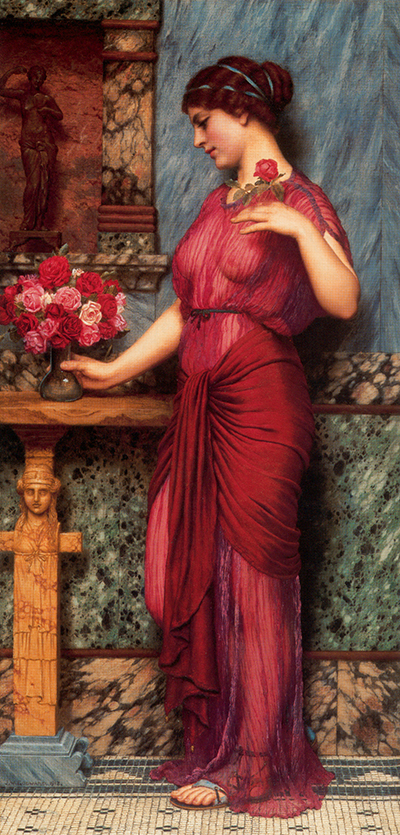
Bradstreet discusses a different Godward oil, At the Garden Shrine, Pompeii of 1892, later in the same chapter. The woman there raises a rose to her face, and smoke curls above the burner. Bradstreet reads that thin movement of smoke against the apparent stillness of the garden, with its carved beasts and stone furniture. A rose held to the nose gives the viewer an explicit source for the scent. In The New Perfume, Godward makes the room equally tangible but asks the title and a much smaller gesture to do the work of the flower and the smoke. [1] [3] [12]
Annotated Details from The New Perfume
The numbered points identify visible features discussed in this article. Return from each detail to the numbered overview. John William Godward, The New Perfume (1914 on the front, 1915 on the reverse). Image source. Public domain.
.jpg)
Details from THE NEW PERFUME
Compare the cropped details with the source images above. Notice how their colours, shapes and positions contribute to the larger compositions.
The vessel in the hands
Her fingers bring the small vessel close to her face. The movement makes scent imaginable.
 Detail 01 the-vessel-in-the-hands.jpg)
The carved support
The carved animal supports the table’s weight while its curved body projects into the room.
 Detail 02 the-carved-support.jpg)
The red fabric at floor level
The narrow pleats widen near the hem and interrupt the hard lines of the tiled floor.
 Detail 03 the-red-fabric-at-floor-level.jpg)
John William Godward videos
See Godward’s paintings and studio practice alongside films on two Victorian contemporaries.
John William Godward - Part 1: The Last Painter of the Victorian Age
An overview of Godward’s career and the Victorian market for pictures set in antiquity.
Watch on YouTubeRoman glass and carved furniture
The Metropolitan Museum of Art’s Roman glass perfume bottle 74.51.5780 shows how differently an ancient vessel of this kind could be shaped. Made in the second or third century CE, the blown-glass unguentarium has a tall, narrow neck and a low, spreading body. It stands 16.8 cm high. Light passes through its pale blue-green body, while a warmer green appears in the neck and rim. The neck and mouth of Godward’s compact vessel are largely concealed by the fingers. The ancient bottle gives us a documented example of glass used to contain perfume. The blue in the painting does not establish the vessel’s material or an archaeological match. [1] [13]
The Met’s first-century BCE trapezophoros is a closer comparison for the animal carving. A winged griffin rises from a feline leg at each end. Between the beasts, vines and flowers spread over the stone. Some 129 cm wide, this support was one of a pair that the museum thinks probably carried a large tabletop in the atrium of a wealthy Roman house. The painted table is smaller in implied scale, with its supports distributed beneath a rounded top. Film historian Ivo Blom identifies Godward’s form with the mensa delphica, a round table with three animal-shaped legs. The archaeological park’s guide describes a table on three marble legs with lions’ paws in Pompeii’s House of Casca Longus. The Pompeian example clarifies the arrangement of the legs, while the Met example offers a comparison for the carved griffin. The painting’s source for either feature is undocumented. [1] [14] [15] [16]
In his account of Godward’s Roman years, Vern Swanson quotes Joseph A. Kestner’s assessment of the picture. Kestner reads the table and stool as studio props. He sees Frederic Leighton’s example in the precise folds of the red drapery and finds the room less archaeologically convincing than Lawrence Alma-Tadema’s interiors. He also anticipates a more specific action than the canvas shows, interpreting the exposed breast as the place where the woman is about to apply the scent. His criticism draws attention to how prominently Godward shows the equipment of the toilette. The foreground griffin is sharply outlined, the robe falls in folds fine enough to show the leg through it, and the open box lets us see the grain of its lid. The skin, cloth, wood and stone all reward close looking. The fragrance is left to the imagination. [1] [17]
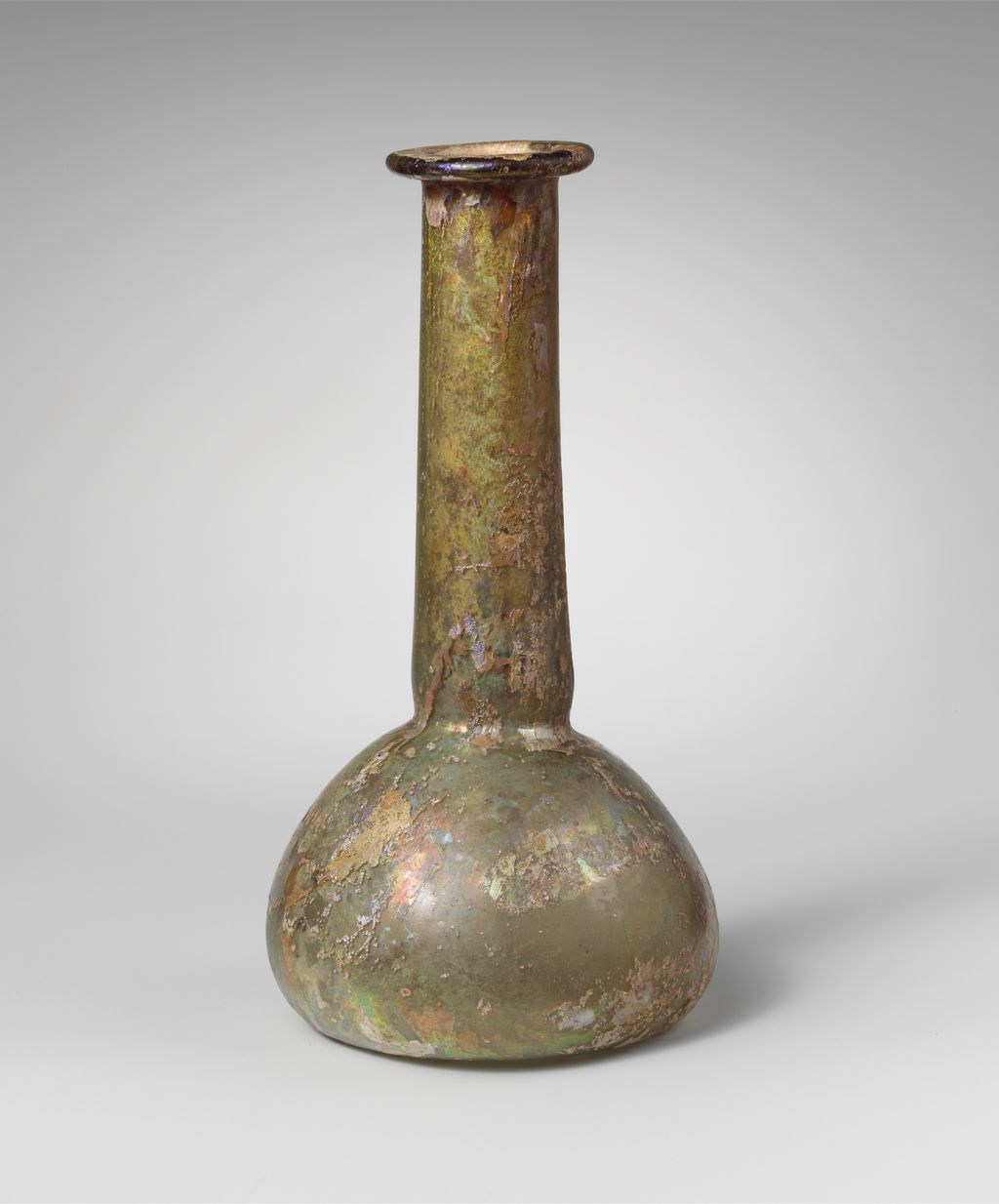
Ancient glass perfume bottle, The Met. An ancient vessel that could hold perfume gives a different profile from the one partly hidden by the woman’s hands. The Metropolitan Museum of Art. Image source. CC0 / Public domain.
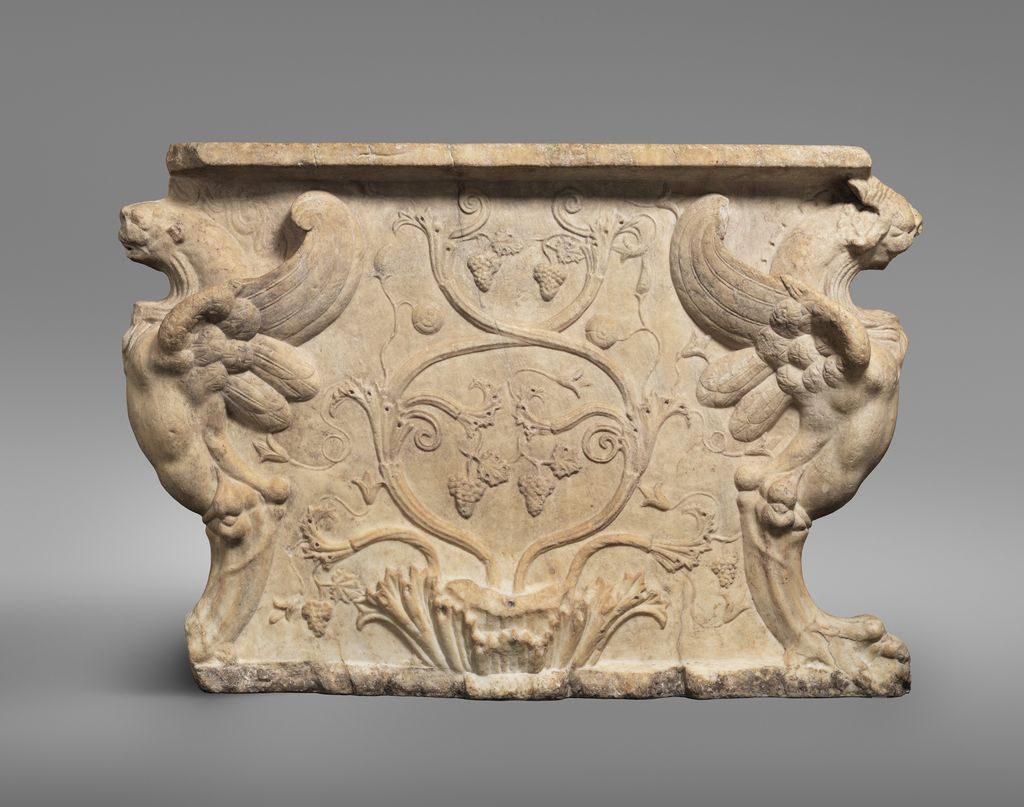
Roman marble table support with a griffin, The Met. The surviving carved support makes the relationship between animal form and supporting block visible. The Metropolitan Museum of Art. Image source. CC0 / Public domain.
The same pose on paper
A drawing associated with the oil shows the woman with her head bent towards her raised hands. It has the same ensemble of open box, curved tabletop, griffin support, gathered drapery and partially hidden stool. In the drawing the lid sits lower, and the floor is only sparsely marked. In the oil the lid stands up strongly against the curtain, and the tiled foreground gives the gown a sharply patterned edge to fall across. The shared arrangement is easy to see. The date, physical medium and present whereabouts of the sheet remain unverified, so its place in the sequence of the work is uncertain. [1] [18]
Where the figures look
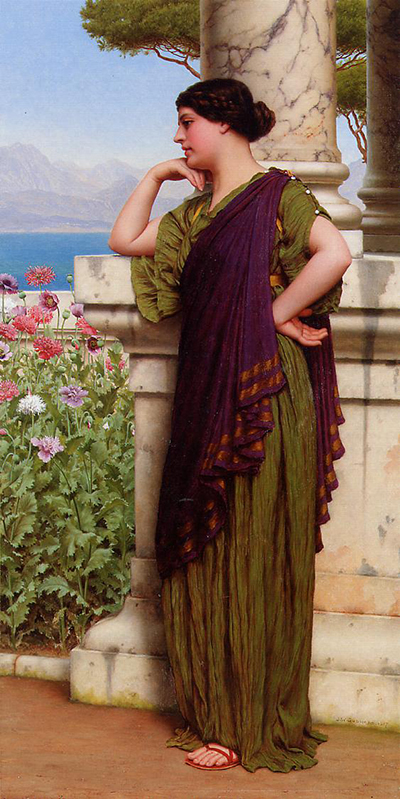
The surviving records for Tender Thoughts give a better-documented example of how a pose could travel. Christie’s relates the oil inscribed Rome, 1917, to a drawing in a sketchbook dated circa 1913–14, an untraced oil study and a simplified 1918 watercolour. The standing woman in that oil rests her chin on a hand and looks across the scene. Flowers rise beside her and the architecture opens onto blue sea. The woman in The New Perfume has both hands in front of her and lowers her eyes to the shallow space between them. An upright figure fills both tall canvases, but the direction of her attention gives the two scenes different kinds of space. [1] [19]
In An Amateur, illustrated in Sotheby’s catalogue for A Dilettante, a seated woman holds a sheet out to look at it. The raised hand puts the drawing at a distance where she can judge what she has made. In A Fair Reflection, signed and dated 1915, the woman has both hands at her hair. A tilted mirror and another open box sit beside her. The mirror reflects a patch of marble into a room already rich in stone. Godward has drawn attention to a different sense in each of these small acts. In An Amateur, looking is part of the action. In A Fair Reflection, the reflected stone is a detail for us to discover while the woman feels for her hair. In The New Perfume, the angle of her head and the position of her fingers give the viewer a part in an experience that takes place beyond sight. [1] [20] [21]
Further reading
Scented Visions: Smell in Art, 1850–1914. Christina Bradstreet. Penn State University Press, 2022.
The book’s final chapter discusses The New Perfume directly and puts the oil in the context of the perfume trade. See the contents and publisher’s sample.
John William Godward artworks directory
Search documented oil paintings, drawings, watercolours and reproductive prints. The directory includes the Art Renewal Center’s catalogue and additional works in museum, exhibition and sale records.
| Name | Date | Medium |
|---|---|---|
| Absence Makes the Heart Grow Fonder | 1912 | Oil on canvas |
| Amaryllis | 1903 | Oil on canvas |
| An Amateur | 1915 | Oil on canvas |
| Ancient Pastimes | 1916 | Oil on canvas |
| The Answer | 1917 | Oil on canvas |
| An Arcadian Beauty | 1899 | Painting |
| At the Fountain | 1893 | Oil on canvas |
| At the Garden Door | 1901 | Oil on canvas |
| At the Garden Shrine, Pompeii | 1892 | Oil on canvas |
| At the Gate of the Temple | 1898 | Oil on canvas |
| At the Thermae | 1909 | Oil on canvas |
| Atalanta | 1892 | Oil on canvas |
| Athenais | 1908 | Oil on canvas |
| An Auburn Beauty | 1895 | Oil on canvas |
| Autumn | 1900 | Oil on canvas |
| Beauty in a Marble Room | 1894 | Oil on canvas |
| The Belvedere | 1913 | Oil on canvas |
| The Betrothed | 1892 | Oil on canvas |
| The Betrothed (print after Godward) | 1893 | Photoengraving, as reported |
| The Bouquet | 1899 | Oil on canvas |
| Briseis | 1896 | Painting |
| The Broken Vase | 1889 | Oil on canvas |
| By the Blue Ionian Sea | 1916 | Oil on canvas |
| By the Wayside | 1912 | Oil on canvas |
| Byrsina | 1915 | Painting |
| Campaspe | 1896 | Oil on canvas |
| Campaspe (print after Godward) | Print, process unconfirmed | |
| Chloris (A Summer Rose) | 1902 | Oil on canvas |
| Classical Beauty | Oil on canvas | |
| A Classical Beauty | Oil on canvas | |
| A Classical Beauty | Painting | |
| A Classical Beauty | Oil on canvas | |
| A Classical Beauty | 1909 | Oil on canvas |
| A Classical Beauty In Profile | Oil on canvas | |
| A Classical Lady | 1908 | Oil on canvas |
| Clymene | 1892 | Oil on canvas |
| A Congenial Task | 1915 | Oil on canvas |
| Contemplation | 1922 | Oil on canvas |
| A Cool Retreat | 1910 | Oil on canvas |
| Country House in the 18th Century | c. 1883 | Oil on canvas |
| Cytheris | 1922 | Painting |
| The Day Dream | 1920 | Oil on canvas |
| The Delphic Oracle | 1899 | Oil on canvas |
| A Dilettante | 1922 | Oil on canvas |
| Distant Thoughts | 1918 | Oil on canvas |
| Dolce Far Niente | 1897 | Oil on canvas |
| Dolce Far Niente | 1906 | Oil on canvas |
| Dolce far niente (A Pompeian Fishpond) | 1904 | Oil on canvas |
| Dolce far niente (coloured print after Godward) | Exhibited 1900 | Coloured print, exact process unconfirmed |
| Dolce far niente (grapes) | 1907 | Oil on canvas |
| Dora | 1887 | Oil on canvas |
| Drusilla | 1906 | Oil on canvas |
| An Edition de Luxe | 1920 | Oil on canvas |
| Eighty and Eighteen | 1898 | Oil on canvas |
| Endymion | 1893 | Oil on canvas |
| The Engagement Ring (horizontal composition) | 1888 | Oil on canvas |
| The Engagement Ring (upright composition) | c. 1891 | Oil on canvas |
| Erato at Her Lyre | Oil on canvas | |
| A Fair Reflection | 1915 | Oil on canvas |
| A Fair Reflection (Taber-Prang print) | By 1923 | Sepia artotype |
| Far Away Thoughts (circular sewing scene) | 1911 | Oil on canvas |
| Far Away Thoughts (left-facing profile) | 1892 | Oil on canvas |
| Far Away Thoughts (right-facing profile) | 1892 | Oil on canvas |
| Female Figure (probable Grecian Idyll study) | 1907 | Oil on board |
| Flabellifera | 1905 | Oil on canvas |
| Flabellifera (painted study) | c. 1905 | Oil study |
| Flabellifera (pencil study) | c. 1905 | Pencil on paper |
| The Flower Girl | Painting | |
| A Flower Seller | 1896 | Oil on canvas |
| The Flowers of Venus | 1890 | Oil on canvas |
| A Fond Farewell | 1918 | Watercolour |
| The Fragrant Rose | 1892 | Painting |
| The Fruit Vendor | 1917 | Oil on canvas |
| A Garland Seller | 1914 | Painting |
| Giotto Drawing from Nature | Painting | |
| Girl in Yellow Drapery | 1901 | Oil on canvas |
| Golden Hours | 1913 | Oil on canvas |
| A Grecian Girl | 1908 | Oil on canvas |
| Grecian Idyll | 1907 | Oil on canvas |
| A Grecian Lovely | 1909 | Oil on canvas |
| Grecian Reverie | 1889 | Oil on canvas |
| Grecian Reverie | 1889 | Oil on canvas |
| A Greek Beauty | 1905 | Oil on canvas |
| A Happy Awakening | 1903 | Oil on canvas |
| He Loves Me, He Loves Me Not | 1896 | Oil on canvas |
| A head and shoulders profile portrait of a young woman wearing a white tunic style blouse | c. 1889 | Painting |
| Head of a Girl (The Priestess) | 1896 | Oil on canvas |
| Heart on her Lips and Soul within her Eyes | 1904 | Painting |
| His Birthday Gift | 1889 | Oil on canvas |
| Ianthe | 1889 | Oil on canvas |
| An Idle Hour | 1890 | Oil on canvas |
| Idle Moments | 1895 | Oil on canvas |
| Idle Thoughts | 1898 | Oil on canvas |
| Idleness | 1900 | Oil on canvas |
| Il Dolce Far Niente (Pears print after Amaryllis) | 1906 | Chromolithograph |
| Il Dolce far niente (seated figure) | 1893 | Oil on canvas |
| In Expectation | c. 1892 | Oil on canvas |
| In Realms of Fancy | 1911 | Oil on canvas |
| In the Prime of the Summertime (Reverie) | 1914 | Oil on canvas |
| In the Tepidarium | 1913 | Oil on canvas |
| Innocent Amusements | 1891 | Oil on canvas |
| Ione | c. 1896-1898 | Oil on canvas |
| Ionian Dancing Girl | 1902 | Oil on canvas |
| Ismenia | 1908 | Oil on canvas |
| An Italian Beauty | 1897 | Oil on canvas |
| An Italian Girls' Head | 1902 | Oil on canvas |
| The Jewel Casket | 1900 | Oil on canvas |
| Julia | 1914 | Painting |
| Knuckle Bones | 1890 | Oil on canvas |
| La Pensierosa | 1913 | Oil on canvas |
| A Lady | 1895 | Oil on canvas |
| Landscape: Blossoming Red Almond [study] | c. 1912 | Oil on panel |
| Le Billet Doux (The Love Letter) | 1913 | Oil on canvas |
| Leaning Against a Column | 1901 | Painting |
| Leaning on the Balcony | 1892 | Oil on canvas |
| Leisure Hours | 1905 | Oil on canvas |
| Lesbia with her Sparrow | 1916 | Oil on canvas |
| The Letter | 1899 | Painting |
| Liegende | 1893 | Oil on canvas |
| A Lily Pond | 1917 | Oil on canvas |
| Looking Out to Sea | 1918 | Pencil and watercolour |
| The Love Letter (circular composition) | 1907 | Oil on canvas |
| Lucilia | 1917 | Oil on canvas |
| Lycinna | 1918 | Oil on canvas |
| Marcella | 1912 | Painting |
| Matrona Superba | Oil on canvas | |
| Megilla | 1921 | Oil on canvas |
| A Melody | 1904 | Oil on canvas |
| Memories | c. 1891 | Oil on canvas |
| Mirinna | Painting | |
| The Mirror | 1899 | Oil on canvas |
| Mischief | 1905 | Oil on canvas |
| Mischief and Repose | 1895 | Oil on canvas |
| A Mouse in the Work Basket | 1893 | Oil on canvas |
| Nerissa | 1906 | Oil on canvas |
| The New Perfume | 1914 | Oil on canvas |
| Noon Day Rest | 1910 | Oil on canvas |
| Nu Sur La Plage | 1922 | Oil on panel |
| Nude Study | Oil on canvas | |
| An Offering to Venus | 1912 | Oil on canvas |
| The Old, Old Story | Oil on canvas | |
| The Old, Old Story | 1903 | Oil on canvas |
| On the Balcony | 1911 | Oil on canvas |
| On The Terrace | 1918 | Oil on canvas |
| Ophelia | Oil on panel | |
| The Peacock Fan | 1912 | Oil on canvas |
| Phyleis | 1908 | Oil on canvas |
| The Playground | 1892 | Oil on canvas |
| Playtime | 1891 | Oil on canvas |
| A Pompeian Bath | 1890 | Oil on canvas |
| A Pompeian Lady | 1891 | Oil on canvas |
| A Pompeian Lady | 1895 | Oil on board |
| A Pompeian Lady | 1901 | Painting |
| A Pompeian Lady | 1904 | Painting |
| Portrait of Mary Frederica 'Nin' Godward | c. 1882-1883 | Oil on canvas |
| Portrait of Mary Perkinton Godward | c. 1880-1881 | Watercolor |
| The Posy | 1900 | Painting |
| A Priestess (bare-shouldered figure) | 1893 | Oil on canvas |
| A Priestess (clothed composition) | 1894 | Oil on canvas |
| A Priestess (W. Biscombe Gardner after Godward) | Exhibited 1897 | Print, process unconfirmed |
| A Priestess of Bacchus | 1890-1890 | Oil on canvas |
| Pyrallis | 1918 | Oil on canvas |
| The Quiet Pet | 1906 | Oil on canvas |
| A Red, Red Rose | 1920 | Oil on canvas |
| Reflections | 1893 | Oil on canvas |
| The Rendezvous | 1903 | Oil on canvas |
| Repose, the Flower Girl | c. 1887 | Oil on canvas |
| Reverie | 1888 | Oil on panel |
| Reverie | 1912 | Oil on canvas |
| Reverie (In the Days of Sappho) | 1904 | Oil on canvas |
| Reverie (Pears print after In the Prime of the Summertime) | 1916 | Chromolithograph |
| 'Rich Gifts Wax Poor When Lovers Prove Unkind' | 1916 | Oil on canvas |
| The Ring | 1898 | Oil on canvas |
| A Roman Matron | 1905 | Oil on canvas |
| Sabinella | 1912 | Oil on canvas |
| Sappho | 1910 | Oil on canvas |
| The Siesta | Oil on canvas | |
| A Siesta | 1895 | Oil on canvas |
| The Signal | 1899 | Oil on canvas |
| Sitting for Her Portrait | 1893 | Oil on canvas |
| Sketch for Amaryllis | 1903 | Oil on board |
| A Souvenir | 1920 | Oil on canvas |
| Stesicrate | 1914 | Oil on canvas |
| Study for 'Rêverie' | 1890 | Oil on canvas |
| Study for 'The Priestess' | 1895 | Oil on board |
| Study for An Egyptian Minstrel | 1906 | Painting |
| Study for The New Perfume | Drawing, medium unconfirmed | |
| Study for ‘The Old, Old Story’ | 1903 | Oil paint on wood |
| Study of a Girl's Head | 1899 | Painting |
| Study of Campaspe | Oil on canvas | |
| Study of Head and Drapery, Miss Ethel Warwick | 1898 | Painting |
| Summer Day | 1897 | Painting |
| Summer Flowers | 1903 | Oil on canvas |
| Sweet Dreams | 1901 | Oil on canvas |
| Sweet Dreams | 1904 | Painting |
| The Sweet Siesta of a Summer's Day | 1891 | Oil on canvas |
| The Tambourine Girl (profile at the marble wall) | 1906 | Oil on canvas |
| The Tambourine Girl (relief-backed version) | 1906 | Oil on canvas |
| Tender Thoughts | 1917 | Oil on canvas |
| Tender Thoughts (woman leaning over a parapet) | 1918 | Pencil and watercolour |
| The Tiff (oil) | By 1888 | Oil on canvas |
| The Tiff (print after Godward) | 1894 | Photogravure |
| The Tigerskin | 1889 | Oil on canvas |
| The Time of Roses | 1916 | Oil on canvas |
| Tranquillity | 1914 | Oil on canvas |
| A Tryst | 1912 | Oil on canvas |
| Tympanistria | 1909 | Oil on canvas |
| Under the Blossom that Hangs on the Bough | 1917 | Oil on canvas |
| Venus at the Bath | 1901 | Oil on canvas |
| Venus Binding Her Hair | 1897 | Oil on canvas |
| Violets, Sweet Violets | 1906 | Painting |
| Waiting for an Answer | 1889 | Oil on canvas |
| Waiting for the Procession | 1890 | Oil on canvas |
| Waiting for the Procession | 1890 | Painting |
| The Water Carrier (magazine reproduction of At the Fountain) | 1898 | Magazine reproduction |
| When the Heart is Young | 1902 | Oil on canvas |
| Who Can They Be | Painting | |
| Winding Wool | 1894 | Painting |
| 'With Violets Wreathed and Robe of Saffron Hue' | 1902 | Oil on canvas |
| The Yellow Shawl | 1893 | Painting |
| 'Yes or No?' | 1893 | Oil on canvas |
| Young Girl Picking Grapes | 1902 | Oil on canvas |
| Youth and Time | 1901 | Oil on canvas |
Discussion
Look again at the images and ideas explored in The New Perfume. These editorial prompts invite your observations.
Reader Insights
Which details suggest a smell before you have read the title?
What had Godward already decided in the drawing for this composition?
Join the Conversation
Share a detail, comparison or question about The New Perfume below.
References
- John William Godward. The New Perfume, reproduction of the signed oil. View source.
- Christie’s. The New Perfume, lot 245788. Oil, inscriptions and Richard Green exhibition history. English. View source.
- Christina Bradstreet. “Death by Perfume,” in Scented Visions: Smell in Art, 1850–1914, Penn State University Press, 2022, pp. 202–204 and 217–219, figs. 59 and 66. Illustration list. English. View source 1. View source 2.
- The Bouquet. View source.
- Tranquillity. View source.
- An Amateur. View source.
- Under the Blossom that Hangs on the Bough. View source.
- A Souvenir. View source.
- Christina Bradstreet. Introduction to Scented Visions: Smell in Art, 1850–1914, especially pp. 4–5, 8–9 and 11–14. English. View source.
- L. T. Piver. Pompeïa advertisement in The Franco-British Exhibition Illustrated Review, edited by F. G. Dumas, Chatto & Windus, 1908, unpaginated front matter. English. View source.
- Laura Luceño Casals. “La renovada exposición permanente del Museo del Traje. Espacio, contexto, patrimonio e innovación”, Indumenta 5, 2022, p. 185, fig. 1, Museo del Traje object MTCE112325. Spanish. View source.
- Christie’s. At the Garden Shrine, Pompeii, lot 2039756. English. View source.
- The Metropolitan Museum of Art. Glass perfume bottle, Roman, object 74.51.5780. English. View source.
- The Metropolitan Museum of Art. Marble trapezophoros (table support), Roman, object 13.115.1. English. View source.
- Ivo Blom. “The Pictorial Turn: Intervisuality and Recycling in Fabiola (Enrico Guazzoni, 1918)”, in Intermedial Encounters, 2022, pp. 129–130. English. View source.
- Archaeological Park of Pompeii. Guida agli scavi di Pompei, “Casa di Casca Longus.” Italian. View source.
- Vern G. Swanson. John William Godward: The Eclipse of Classicism, “The Middle Roman Years (1914–1918)”, Art Renewal Center archive, web p. 10, quoting Joseph A. Kestner, 1989, pp. 338–339, at note 213. English. View source.
- The History of Art. Drawing associated with The New Perfume, reproduction for compositional comparison. View source.
- Christie’s. Tender Thoughts, lot 1369821. English. View source.
- Sotheby’s. A Dilettante, 2019, lot 425, fig. 1 (An Amateur, 1915). English. View source.
- Sotheby’s. A Fair Reflection, 2012, lot 12. English. View source.