 by Tom Gurney
Tom Gurney BSc (Hons) is an art history expert with over 20 years experience
Published on June 19, 2020 / Updated on October 14, 2023
Email: tomgurney1@gmail.com / Phone: +44 7429 011000
The Betrothed by John William Godward: Introduction
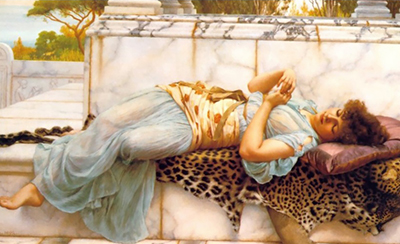
A woman lies so low on a marble bench that her raised hands seem to make the only movement in the picture. Her head rests on a mauve cushion at the right and one bare foot emerges from pale blue folds at the far left. A spotted animal skin hangs over the front of the seat. Above it, the woman brings her hands together and lowers her eyes towards them. John William Godward painted The Betrothed in 1892. The oil on canvas measures 43 cm high by 83 cm wide and belongs to Guildhall Art Gallery in London. [1] [2]
At a Glance
- Date1892
- MediumOil on canvas
- Dimensions43 × 83 cm
- CollectionGuildhall Art Gallery, London
This work across John William Godward’s career
Contents
- How the bench shapes the pose
- What can we see of the ring?
- Courtship in a different register
- A reclining figure turned the other way
- From an early print to Guildhall
- Annotated details
How the bench shapes the pose
Two horizontal edges give the painting its structure. The top of the backrest runs behind the figure just below the upper edge of the canvas. Beneath her, the front of the seat establishes a second line, which vanishes and reappears behind cloth and fur. The body takes up almost the entire width between foot and cushion, yet the pose has several changes of direction. The legs bend and the skirt slides down. At the other end, the bent arms rise into the light space above the chest. The bench gives these small movements a firm reference point. Against its unbroken top edge, even the slight lift of a wrist catches the eye. [2]
Godward also cuts the setting close. At the upper edge, only the bases of the stonework show above the backrest, with foliage behind them. A narrow opening at the far left gives a glimpse of trees and light, then the bench closes off the view again. The right end continues beyond the frame. This asymmetry makes the opening feel incidental, as if the viewer has come close enough for most of the grounds to pass out of sight. The backrest offers a pale field behind the woman’s hands. Look at how the seams and veins of the marble cross it, while the dark mass of her hair comes forward clearly against the stone. [2]
The seat is easiest to understand by following what happens to the materials laid over it. To the left, thin blue folds lose their definition where the cloth lies over the legs, then gather into darker creases as it falls beyond the edge. Around the waist, a gold sash dotted with red interrupts that stretch of blue. Further right the spotted hide hangs in separate tapering shapes. The spots bunch up in the creases and spread where the fur lies flatter, so they help show how much of the skin rests on the bench and how much falls towards us. The Guildhall-credited image caption describes it as a leopard skin. Its irregular edge gives the front of the seat a broken rhythm while the line of the stone remains visible below. [2] [8]
What can we see of the ring?
Start with the hands. One rests just above the blue cloth and the other turns down over it, with the fingers almost touching. In the larger reproduction, a tiny light mark is visible where the fingers meet. The caption supplied with the Guildhall Library and Art Gallery photograph identifies a ring on her left hand. The hands overlap, and the reproduction gives a clearer view of the gesture than of the ring itself. Godward gives the act of looking more space than the object that occasions it. [2] [8]
The title supplies a circumstance, and the picture leaves us to imagine how it came about. The art historian Marta Chiara Olimpia Nicosia reads the woman as enjoying her new status, idly playing with the ring. Her interpretation suits the way the shoulders and head settle while the fingers remain occupied. The lowered gaze and relaxed face also leave room for a quieter reading, in which the woman is simply absorbed in a new possession. There is no other figure with whom she might exchange a look. Viewers can picture the event that preceded the pose, but all the painted action takes place in the small space between her face and hands. [8] [9]
The question of who posed for her belongs to the painter’s studio. In its catalogue for At the Fountain, Sotheby’s proposed that Godward used Rose Pettigrew in that 1893 painting and recognised a likeness to her in The Betrothed and several other early works. The wavy hair and profile make the comparison intelligible. The identification remains a proposal based on resemblance, while the subject’s situation comes from the title and the gesture. [10]
Annotated Details from The Betrothed
The numbered points identify visible features discussed in this article. Return from each detail to the numbered overview. John William Godward, The Betrothed (1892). Image source. Public domain.
.jpg)
Details from THE BETROTHED
Compare the cropped details with the source images above. Notice how their colours, shapes and positions contribute to the larger compositions.
The lifted hands
The small gesture above the woman’s chest brings her attention to one spot at the end of the long terrace.
 Detail 01 the-lifted-hands.jpg)
Turquoise folds over the step
Broad folds run over the stone and describe the weight of the body along the bench.
 Detail 02 turquoise-folds-over-the-step.jpg)
Skin under the cushion
The spots break across the edge of the marble. The dark cushion lifts the head against the pale wall.
 Detail 03 skin-under-the-cushion.jpg)
John William Godward videos
See Godward’s paintings and studio practice alongside films on two Victorian contemporaries.
John William Godward - Part 1: The Last Painter of the Victorian Age
An overview of Godward’s career and the Victorian market for pictures set in antiquity.
Watch on YouTubeCourtship in a different register
Godward’s signed 1888 The Engagement Ring gives the same theme much more space to unfold. A woman sits low in a marble interior, a scroll lies near her feet and a doorway opens behind her. The room extends beyond her, inviting the viewer to look for other clues. The picture was shown in 1889 under the title The Betrothal Ring, which can sound like another name for the Guildhall painting. In the 1892 canvas Godward pares the furnishings down to the things within reach of the reclining woman. The body is closer to us and the central gesture is smaller. [1] [11]
In Waiting for an Answer of 1889, Godward places a man beside the woman and uses their different directions of gaze to sustain an unanswered question. One figure’s attention makes us look for a response in the other. In The Betrothed, the woman has the time and space of the bench to herself. Her hands hold our attention because they are where her own attention comes to rest. [2] [11] [3]
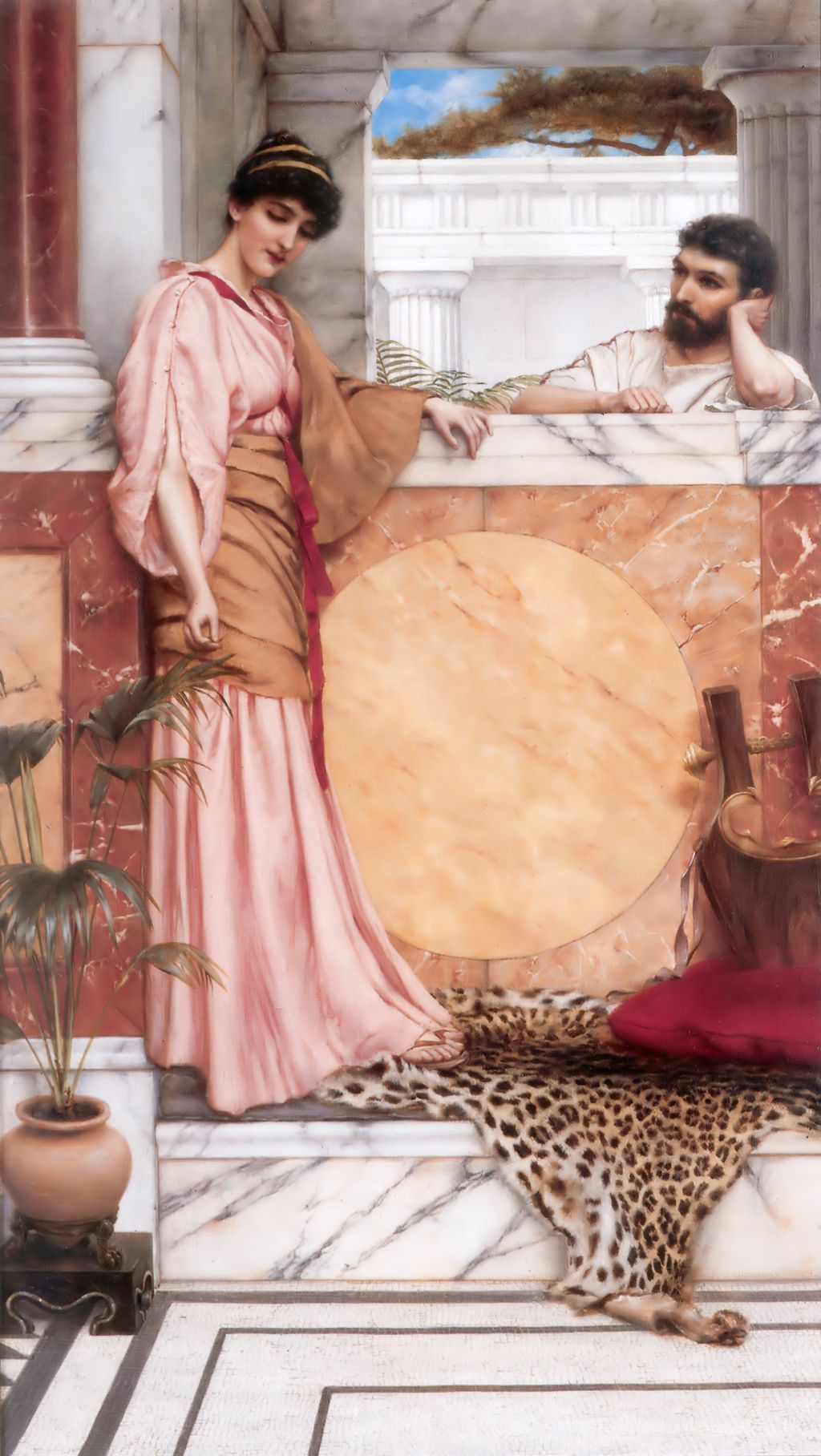
John William Godward, Waiting for an Answer (1889). The distance between the hands becomes part of the exchange in this earlier painting. Image source. Public domain.
A reclining figure turned the other way
Girl in Yellow Drapery, a signed oil from 1901, gives a later example of what Godward could do with a long stone seat. The woman’s head is on the left, near the carved end of the bench, and her sandalled feet extend to the right. One arm lies under her head and the other curves above it. That curve loosely frames the head, in contrast to the lifted hands in The Betrothed, which lead the eye away from the face. The fall of cloth differs, too. The yellow drapery spills across a broad part of the front of the seat. The stone shows through the thin cloth, and the colour deepens where the folds overlap. The 1892 canvas shares that space between the blue garment and the densely patterned hide. [2] [12]
The dimensions show how closely related the two formats are. Girl in Yellow Drapery is 30.5 by 61 cm, twice as wide as it is high, while the Guildhall canvas comes close to that proportion on a larger scale. Both formats keep the figure and furniture in a shallow strip with room for a glimpse of the outdoors above or beside the stone. In the yellow painting the bench still supports a bent arm, but the hand comes to rest by the forehead. In The Betrothed, the bend of the arms leaves just enough room above the body for a sustained, private occupation. [1] [2] [12]
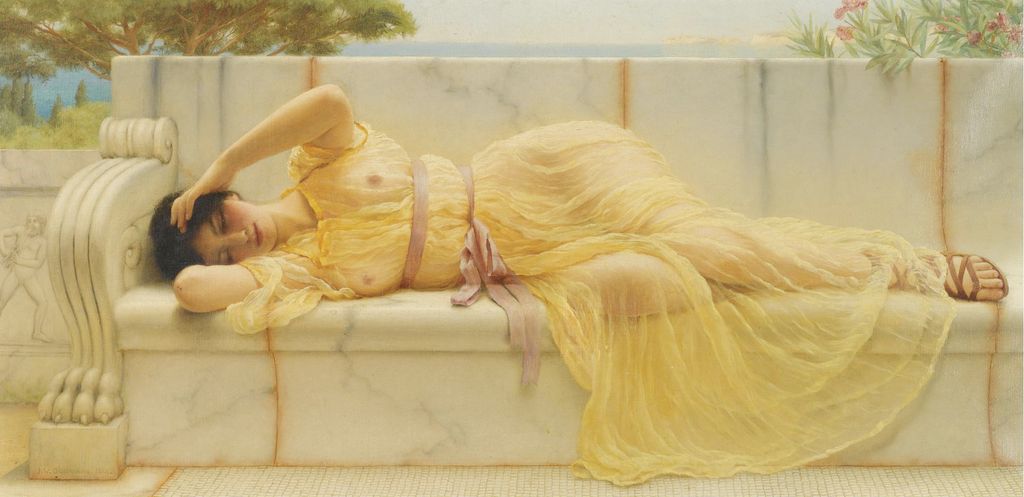
John William Godward, Girl in Yellow Drapery (1901). The woman in yellow stretches in the opposite direction along the bench. Image source. Public domain.
From an early print to Guildhall
The picture had a life in reproduction before it entered the public collection. Godward’s biographer Vern Grosvenor Swanson dates a photoengraving of The Betrothed to September 1893, about a year after the canvas was painted. He places it at the beginning of a series of reproductions issued by the London dealer Thomas McLean, who worked regularly with the German printer Franz Hanfstaengl. McLean occurs again in the history of Girl in Yellow Drapery, which Heritage Auctions traces to the dealer in July 1901. The 1893 photoengraving was part of a separate trade in prints after Godward’s paintings, which allowed the same composition to reach more than one buyer. [1] [12] [13]
The City of London’s record for the painting begins its collection history with the gift of H. S. E. Vanderpant in 1916. It identifies the work by accession number 981. The gift brought Godward’s domestic scene in classical dress into a civic collection with an established interest in Victorian painting. It joined a collection that already held Lawrence Alma-Tadema’s The Pyrrhic Dance (1869), received through the Gassiot bequest in 1902. Alma-Tadema places a line of shield-bearing dancers before a seated audience. Godward gives the scene one figure and an action almost small enough to miss, even though it takes place in front of us. [1] [14] [15]
John William Godward artworks directory
Search documented oil paintings, drawings, watercolours and reproductive prints. The directory includes the Art Renewal Center’s catalogue and additional works in museum, exhibition and sale records.
| Name | Date | Medium |
|---|---|---|
| Absence Makes the Heart Grow Fonder | 1912 | Oil on canvas |
| Amaryllis | 1903 | Oil on canvas |
| An Amateur | 1915 | Oil on canvas |
| Ancient Pastimes | 1916 | Oil on canvas |
| The Answer | 1917 | Oil on canvas |
| An Arcadian Beauty | 1899 | Painting |
| At the Fountain | 1893 | Oil on canvas |
| At the Garden Door | 1901 | Oil on canvas |
| At the Garden Shrine, Pompeii | 1892 | Oil on canvas |
| At the Gate of the Temple | 1898 | Oil on canvas |
| At the Thermae | 1909 | Oil on canvas |
| Atalanta | 1892 | Oil on canvas |
| Athenais | 1908 | Oil on canvas |
| An Auburn Beauty | 1895 | Oil on canvas |
| Autumn | 1900 | Oil on canvas |
| Beauty in a Marble Room | 1894 | Oil on canvas |
| The Belvedere | 1913 | Oil on canvas |
| The Betrothed | 1892 | Oil on canvas |
| The Betrothed (print after Godward) | 1893 | Photoengraving, as reported |
| The Bouquet | 1899 | Oil on canvas |
| Briseis | 1896 | Painting |
| The Broken Vase | 1889 | Oil on canvas |
| By the Blue Ionian Sea | 1916 | Oil on canvas |
| By the Wayside | 1912 | Oil on canvas |
| Byrsina | 1915 | Painting |
| Campaspe | 1896 | Oil on canvas |
| Campaspe (print after Godward) | Print, process unconfirmed | |
| Chloris (A Summer Rose) | 1902 | Oil on canvas |
| Classical Beauty | Oil on canvas | |
| A Classical Beauty | Oil on canvas | |
| A Classical Beauty | Painting | |
| A Classical Beauty | Oil on canvas | |
| A Classical Beauty | 1909 | Oil on canvas |
| A Classical Beauty In Profile | Oil on canvas | |
| A Classical Lady | 1908 | Oil on canvas |
| Clymene | 1892 | Oil on canvas |
| A Congenial Task | 1915 | Oil on canvas |
| Contemplation | 1922 | Oil on canvas |
| A Cool Retreat | 1910 | Oil on canvas |
| Country House in the 18th Century | c. 1883 | Oil on canvas |
| Cytheris | 1922 | Painting |
| The Day Dream | 1920 | Oil on canvas |
| The Delphic Oracle | 1899 | Oil on canvas |
| A Dilettante | 1922 | Oil on canvas |
| Distant Thoughts | 1918 | Oil on canvas |
| Dolce Far Niente | 1897 | Oil on canvas |
| Dolce Far Niente | 1906 | Oil on canvas |
| Dolce far niente (A Pompeian Fishpond) | 1904 | Oil on canvas |
| Dolce far niente (coloured print after Godward) | Exhibited 1900 | Coloured print, exact process unconfirmed |
| Dolce far niente (grapes) | 1907 | Oil on canvas |
| Dora | 1887 | Oil on canvas |
| Drusilla | 1906 | Oil on canvas |
| An Edition de Luxe | 1920 | Oil on canvas |
| Eighty and Eighteen | 1898 | Oil on canvas |
| Endymion | 1893 | Oil on canvas |
| The Engagement Ring (horizontal composition) | 1888 | Oil on canvas |
| The Engagement Ring (upright composition) | c. 1891 | Oil on canvas |
| Erato at Her Lyre | Oil on canvas | |
| A Fair Reflection | 1915 | Oil on canvas |
| A Fair Reflection (Taber-Prang print) | By 1923 | Sepia artotype |
| Far Away Thoughts (circular sewing scene) | 1911 | Oil on canvas |
| Far Away Thoughts (left-facing profile) | 1892 | Oil on canvas |
| Far Away Thoughts (right-facing profile) | 1892 | Oil on canvas |
| Female Figure (probable Grecian Idyll study) | 1907 | Oil on board |
| Flabellifera | 1905 | Oil on canvas |
| Flabellifera (painted study) | c. 1905 | Oil study |
| Flabellifera (pencil study) | c. 1905 | Pencil on paper |
| The Flower Girl | Painting | |
| A Flower Seller | 1896 | Oil on canvas |
| The Flowers of Venus | 1890 | Oil on canvas |
| A Fond Farewell | 1918 | Watercolour |
| The Fragrant Rose | 1892 | Painting |
| The Fruit Vendor | 1917 | Oil on canvas |
| A Garland Seller | 1914 | Painting |
| Giotto Drawing from Nature | Painting | |
| Girl in Yellow Drapery | 1901 | Oil on canvas |
| Golden Hours | 1913 | Oil on canvas |
| A Grecian Girl | 1908 | Oil on canvas |
| Grecian Idyll | 1907 | Oil on canvas |
| A Grecian Lovely | 1909 | Oil on canvas |
| Grecian Reverie | 1889 | Oil on canvas |
| Grecian Reverie | 1889 | Oil on canvas |
| A Greek Beauty | 1905 | Oil on canvas |
| A Happy Awakening | 1903 | Oil on canvas |
| He Loves Me, He Loves Me Not | 1896 | Oil on canvas |
| A head and shoulders profile portrait of a young woman wearing a white tunic style blouse | c. 1889 | Painting |
| Head of a Girl (The Priestess) | 1896 | Oil on canvas |
| Heart on her Lips and Soul within her Eyes | 1904 | Painting |
| His Birthday Gift | 1889 | Oil on canvas |
| Ianthe | 1889 | Oil on canvas |
| An Idle Hour | 1890 | Oil on canvas |
| Idle Moments | 1895 | Oil on canvas |
| Idle Thoughts | 1898 | Oil on canvas |
| Idleness | 1900 | Oil on canvas |
| Il Dolce Far Niente (Pears print after Amaryllis) | 1906 | Chromolithograph |
| Il Dolce far niente (seated figure) | 1893 | Oil on canvas |
| In Expectation | c. 1892 | Oil on canvas |
| In Realms of Fancy | 1911 | Oil on canvas |
| In the Prime of the Summertime (Reverie) | 1914 | Oil on canvas |
| In the Tepidarium | 1913 | Oil on canvas |
| Innocent Amusements | 1891 | Oil on canvas |
| Ione | c. 1896-1898 | Oil on canvas |
| Ionian Dancing Girl | 1902 | Oil on canvas |
| Ismenia | 1908 | Oil on canvas |
| An Italian Beauty | 1897 | Oil on canvas |
| An Italian Girls' Head | 1902 | Oil on canvas |
| The Jewel Casket | 1900 | Oil on canvas |
| Julia | 1914 | Painting |
| Knuckle Bones | 1890 | Oil on canvas |
| La Pensierosa | 1913 | Oil on canvas |
| A Lady | 1895 | Oil on canvas |
| Landscape: Blossoming Red Almond [study] | c. 1912 | Oil on panel |
| Le Billet Doux (The Love Letter) | 1913 | Oil on canvas |
| Leaning Against a Column | 1901 | Painting |
| Leaning on the Balcony | 1892 | Oil on canvas |
| Leisure Hours | 1905 | Oil on canvas |
| Lesbia with her Sparrow | 1916 | Oil on canvas |
| The Letter | 1899 | Painting |
| Liegende | 1893 | Oil on canvas |
| A Lily Pond | 1917 | Oil on canvas |
| Looking Out to Sea | 1918 | Pencil and watercolour |
| The Love Letter (circular composition) | 1907 | Oil on canvas |
| Lucilia | 1917 | Oil on canvas |
| Lycinna | 1918 | Oil on canvas |
| Marcella | 1912 | Painting |
| Matrona Superba | Oil on canvas | |
| Megilla | 1921 | Oil on canvas |
| A Melody | 1904 | Oil on canvas |
| Memories | c. 1891 | Oil on canvas |
| Mirinna | Painting | |
| The Mirror | 1899 | Oil on canvas |
| Mischief | 1905 | Oil on canvas |
| Mischief and Repose | 1895 | Oil on canvas |
| A Mouse in the Work Basket | 1893 | Oil on canvas |
| Nerissa | 1906 | Oil on canvas |
| The New Perfume | 1914 | Oil on canvas |
| Noon Day Rest | 1910 | Oil on canvas |
| Nu Sur La Plage | 1922 | Oil on panel |
| Nude Study | Oil on canvas | |
| An Offering to Venus | 1912 | Oil on canvas |
| The Old, Old Story | Oil on canvas | |
| The Old, Old Story | 1903 | Oil on canvas |
| On the Balcony | 1911 | Oil on canvas |
| On The Terrace | 1918 | Oil on canvas |
| Ophelia | Oil on panel | |
| The Peacock Fan | 1912 | Oil on canvas |
| Phyleis | 1908 | Oil on canvas |
| The Playground | 1892 | Oil on canvas |
| Playtime | 1891 | Oil on canvas |
| A Pompeian Bath | 1890 | Oil on canvas |
| A Pompeian Lady | 1891 | Oil on canvas |
| A Pompeian Lady | 1895 | Oil on board |
| A Pompeian Lady | 1901 | Painting |
| A Pompeian Lady | 1904 | Painting |
| Portrait of Mary Frederica 'Nin' Godward | c. 1882-1883 | Oil on canvas |
| Portrait of Mary Perkinton Godward | c. 1880-1881 | Watercolor |
| The Posy | 1900 | Painting |
| A Priestess (bare-shouldered figure) | 1893 | Oil on canvas |
| A Priestess (clothed composition) | 1894 | Oil on canvas |
| A Priestess (W. Biscombe Gardner after Godward) | Exhibited 1897 | Print, process unconfirmed |
| A Priestess of Bacchus | 1890-1890 | Oil on canvas |
| Pyrallis | 1918 | Oil on canvas |
| The Quiet Pet | 1906 | Oil on canvas |
| A Red, Red Rose | 1920 | Oil on canvas |
| Reflections | 1893 | Oil on canvas |
| The Rendezvous | 1903 | Oil on canvas |
| Repose, the Flower Girl | c. 1887 | Oil on canvas |
| Reverie | 1888 | Oil on panel |
| Reverie | 1912 | Oil on canvas |
| Reverie (In the Days of Sappho) | 1904 | Oil on canvas |
| Reverie (Pears print after In the Prime of the Summertime) | 1916 | Chromolithograph |
| 'Rich Gifts Wax Poor When Lovers Prove Unkind' | 1916 | Oil on canvas |
| The Ring | 1898 | Oil on canvas |
| A Roman Matron | 1905 | Oil on canvas |
| Sabinella | 1912 | Oil on canvas |
| Sappho | 1910 | Oil on canvas |
| The Siesta | Oil on canvas | |
| A Siesta | 1895 | Oil on canvas |
| The Signal | 1899 | Oil on canvas |
| Sitting for Her Portrait | 1893 | Oil on canvas |
| Sketch for Amaryllis | 1903 | Oil on board |
| A Souvenir | 1920 | Oil on canvas |
| Stesicrate | 1914 | Oil on canvas |
| Study for 'Rêverie' | 1890 | Oil on canvas |
| Study for 'The Priestess' | 1895 | Oil on board |
| Study for An Egyptian Minstrel | 1906 | Painting |
| Study for The New Perfume | Drawing, medium unconfirmed | |
| Study for ‘The Old, Old Story’ | 1903 | Oil paint on wood |
| Study of a Girl's Head | 1899 | Painting |
| Study of Campaspe | Oil on canvas | |
| Study of Head and Drapery, Miss Ethel Warwick | 1898 | Painting |
| Summer Day | 1897 | Painting |
| Summer Flowers | 1903 | Oil on canvas |
| Sweet Dreams | 1901 | Oil on canvas |
| Sweet Dreams | 1904 | Painting |
| The Sweet Siesta of a Summer's Day | 1891 | Oil on canvas |
| The Tambourine Girl (profile at the marble wall) | 1906 | Oil on canvas |
| The Tambourine Girl (relief-backed version) | 1906 | Oil on canvas |
| Tender Thoughts | 1917 | Oil on canvas |
| Tender Thoughts (woman leaning over a parapet) | 1918 | Pencil and watercolour |
| The Tiff (oil) | By 1888 | Oil on canvas |
| The Tiff (print after Godward) | 1894 | Photogravure |
| The Tigerskin | 1889 | Oil on canvas |
| The Time of Roses | 1916 | Oil on canvas |
| Tranquillity | 1914 | Oil on canvas |
| A Tryst | 1912 | Oil on canvas |
| Tympanistria | 1909 | Oil on canvas |
| Under the Blossom that Hangs on the Bough | 1917 | Oil on canvas |
| Venus at the Bath | 1901 | Oil on canvas |
| Venus Binding Her Hair | 1897 | Oil on canvas |
| Violets, Sweet Violets | 1906 | Painting |
| Waiting for an Answer | 1889 | Oil on canvas |
| Waiting for the Procession | 1890 | Oil on canvas |
| Waiting for the Procession | 1890 | Painting |
| The Water Carrier (magazine reproduction of At the Fountain) | 1898 | Magazine reproduction |
| When the Heart is Young | 1902 | Oil on canvas |
| Who Can They Be | Painting | |
| Winding Wool | 1894 | Painting |
| 'With Violets Wreathed and Robe of Saffron Hue' | 1902 | Oil on canvas |
| The Yellow Shawl | 1893 | Painting |
| 'Yes or No?' | 1893 | Oil on canvas |
| Young Girl Picking Grapes | 1902 | Oil on canvas |
| Youth and Time | 1901 | Oil on canvas |
Discussion
Look again at the images and ideas explored in The Betrothed by John William Godward. These editorial prompts invite your observations.
Reader Insights
What first draws you to the woman’s hands?
How does the title change what you make of her pose?
Join the Conversation
Share a detail, comparison or question about The Betrothed by John William Godward below.
References
- City of London Corporation, London Picture Archive. The Betrothed, record 11044 (English). Guildhall Art Gallery collection entry, with accession, date, medium, dimensions and gift. View source.
- Wikimedia Commons. The Betrothed, 1892 (English). Reproduction of Guildhall Art Gallery accession 981. View source.
- Sotheby’s. Waiting for an Answer, sale N08355, lot 163 (English). Illustration and signed date. View source.
- The Engagement Ring. View source.
- Far Away Thoughts. View source.
- Mischief and Repose. View source.
- Le Billet Doux (The Love Letter). View source.
- Guildhall Library & Art Gallery / Heritage Images, via Getty Images. The Betrothed, 1892 (English). Caption identifying the ring and the spotted skin. View source.
- Marta Chiara Olimpia Nicosia. L’Art de la Rêverie: Female Daydreams in Nineteenth Century Painting, IMT Institute for Advanced Studies, Lucca, 2015, pp. 162–163, fig. 108 (English). Discussion of the pose and the ring. View source.
- Sotheby’s. At the Fountain, sale L18133, lot 28 (English). Catalogue comparison proposing the likeness to Rose Pettigrew. View source.
- Sotheby’s. The Engagement Ring, 2023 (English). Signed date, illustration, 1889 exhibition title and comparison with the Guildhall painting. View source.
- Heritage Auctions. Girl in Yellow Drapery, sale 656, lot 23113 (English). Illustration, inscription, medium and dimensions. View source.
- Vern Grosvenor Swanson. J. W. Godward: The Eclipse of Classicism, p. 6, Art Renewal Center, archived 24 June 2003 (English). Account of the September 1893 photoengraving and Thomas McLean’s series. View source.
- City of London Corporation. “Collections History” (English). History of the Victorian collection and the Gassiot gifts. View source.
- City of London Corporation, London Picture Archive. The Pyrrhic Dance (English). Guildhall Art Gallery’s record and image of Alma-Tadema’s painting, received in 1902. View source.