 by Tom Gurney
Tom Gurney BSc (Hons) is an art history expert with over 20 years experience
Published on June 19, 2020 / Updated on October 14, 2023
Email: tomgurney1@gmail.com / Phone: +44 7429 011000
An Offering to Venus: Introduction
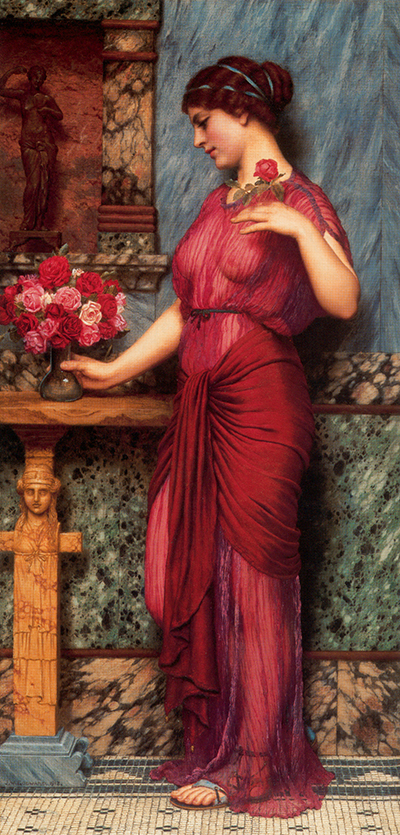
A woman holds a red rose near her throat while her other hand touches the neck of a vase already crowded with flowers. Behind the bouquet, a small figure stands in a dark recess. John William Godward’s title, An Offering to Venus, makes those three details part of one action. The woman could be setting out flowers, and the title gives her arrangement a recipient. Godward painted the scene in oil on canvas in 1912. It measures 78 × 39.4 cm, a little under twice as high as it is wide. The front carries his signature and the date at lower left, along the blue-grey base of the table support. Christie’s also records a signature, the title and “Rome. 1912” on the reverse, quoting earlier cataloguing for that inscription. [1] [2]
At a Glance
- Date1912
- MediumOil on canvas
- Dimensions78 × 39.4 cm
This work across John William Godward’s career
Contents
- The woman and the roses
- Stone, sculpture and mosaic
- Roses as a gift to Venus
- Other classical pictures by Godward
- From Godward to Cremetti
- Annotated details
The woman and the roses
Godward shows the woman in profile and at full length, close enough to the wall for her head to cast a shadow on the blue panel. Turquoise bands threaded through her dark hair pick up the colour behind her. Her lowered gaze falls towards the table. One hand reaches left to the little vessel, and the other holds a stem across her chest. The movements are small, but each wrist hangs at a different angle. Follow the raised hand out to the red blossom and then down to the mass of roses. The single flower sits higher than any in the bouquet, almost at face level. Its stem links the vivid spot of colour against her neck to the fingers against her dress. [2]
The bouquet combines red and pink blooms, some cupped and others open enough to show several layers of petals. One pale bloom near the right edge of the cluster almost comes forward into the space above her forearm. The vase is dark and round at its base, with a narrow neck, and small enough for the flowers to conceal much of it. Its reflected highlights describe the curved surface. The stems disappear into that narrow opening, making the spread of the bouquet look wider. The distinction between the one rose she still holds and the many she has gathered is the nearest thing the painting gives us to a before and after. [2]
Two kinds of fold give the clothing its structure. Fine, almost vertical ridges run over the bodice and gather under a dark belt. Denser wine-red fabric crosses the hips in a diagonal, then fans out from a tight gathering at the front. Below it the finer violet and rose fabric is visible again. At the floor it pools in uneven edges around one sandal, whose thin blue straps repeat the blue in the upper part of the painting. The dark folds at the hip carry more weight than the fabric at the shoulder, where the figure’s skin and the folds cast delicate changes of colour across each other. One foot emerges beneath the hem at the end of that long curve. [2]
Stone, sculpture and mosaic
At left the table’s warm slab rests on a carved upright shaped like a front-facing figure above a straight shaft. Look higher and the small standing sculpture occupies a maroon recess, with a veined pilaster to its right. The carved table support faces the viewer directly, the niche figure bends one arm upwards, and the woman turns to the left. Three upright figures fit into a very narrow space. Godward gives each a distinct scale and direction, keeping the living figure legible even though the room leaves her little space to move. [2]
The wall changes from a broad blue-grey expanse behind her head to broken green speckling below the table. Narrow bands divide the surfaces, and the angled dark veins in the lowest stone course stop where the mosaic floor begins. Just behind the sandal, rows of small light and dark tiles tighten into a band. Closer to the viewer, dark marks interrupt the pale field at regular intervals, while slight variations in the tiny painted squares keep it from looking mechanically drawn. The relative scale of the tiles, the foot and the table helps fix the height of the scene. The small tiles give the foot a firm surface to rest on and the hanging cloth a precise point of contact. [2]
The niche figure has a bronze-like colour, but its material and model are uncertain. The Louvre’s marble Venus of Arles is a useful comparison for a partly draped figure. Its present arms and attributes owe much to the seventeenth-century sculptor François Girardon, who supplied an apple and a mirror. The painted figure raises one hand almost to its head, well above the position of either attribute in the restored marble. A Roman bronze in the Metropolitan Museum of Art offers another comparison at a smaller scale. Just 10.2 cm high, it represents Aphrodite Anadyomene, with the goddess attending to her hair after rising from the sea. An upraised arm therefore opens several possibilities for Godward’s figure, whose exact source remains unknown. [2] [8] [9]
The Art Institute of Chicago’s study of a Roman marble fragment of Venus points to its largely flat, roughly worked back as one reason it might once have stood in a niche. The museum’s study of its Roman Aphrodite of Knidos also considers how sculpture of the goddess could furnish public settings or provide the body for a commemorative portrait. The sanctuary is one of several places where a Roman viewer might have encountered an image of Venus. In Godward’s interior the recess is persuasive as a place to display a figure, and the title supplies the clearest reason to read it as the focus of devotion. [2] [10] [11]
Annotated Details from An Offering to Venus
The numbered points identify visible features discussed in this article. Return from each detail to the numbered overview. John William Godward, An Offering to Venus (1912). Image source. Public domain.
.jpg)
Details from AN OFFERING TO VENUS
Compare the cropped details with the source images above. Notice how their colours, shapes and positions contribute to the larger compositions.
Roses held at two heights
The flowers in her raised hand and at the table draw the eye diagonally across the figure.
 Detail 01 roses-held-at-two-heights.jpg)
The small figure in the niche
The vertical border encloses a much smaller sculpted figure, barely lighter than the setting around it.
 Detail 02 the-small-figure-in-the-niche.jpg)
The hem and paving
The falling purple folds meet the small regular marks of the paving just beside an exposed foot.
 Detail 03 the-hem-and-paving.jpg)
John William Godward videos
See Godward’s paintings and studio practice alongside films on two Victorian contemporaries.
John William Godward - Part 1: The Last Painter of the Victorian Age
An overview of Godward’s career and the Victorian market for pictures set in antiquity.
Watch on YouTubeRoses as a gift to Venus
A Roman literary parallel puts the roses in a more specific light. In the Fasti, the poet Ovid marks 1 April by addressing women attending to the image of Venus. They are to remove the gold from her marble neck, wash her, restore the jewellery and bring fresh flowers and a new rose. The flowers belong to the care of a figure treated as a presence. Godward’s woman has set hers in a vessel below the image. The picture gives no clear sign of washing or adorning the statue, and no known statement by Godward connects the scene to Ovid’s passage. The poem shows why roses beside a figure of Venus could have a devotional meaning while leaving the setting and occasion of the painting open. [2] [12]
A Latin inscription from Gabii, now at the Louvre, records a very different scale of dedication. Aulus Plutius Epaphroditus, a silk merchant with a role in the cult, funded a temple for Venus at his own expense. The gift included a bronze statue of the goddess, four bronze statues in niches, doors and an altar. The text records the donor and the equipment in detail. The dedication shows that a niche could form part of a larger ensemble of religious furnishings. The shrine and its purpose are known because the inscription survives. [13]
An early first-century Roman terracotta plaque in Chicago makes an offering legible through another kind of gesture. Two attendants kneel, supporting a shallow bowl over a stand the museum reads as a lamp support or incense burner. A small twisted shape rises from the bowl, interpreted by the museum as a flame. Their lowered hands wind ribbons around the support. Godward centres his scene on standing, handling stems and placing a vase within reach. He gives the individual hand movements the attention that the relief gives to the women’s shared action around the stand. With the sitter’s office and the rite unspecified, the red rose itself carries much of the narrative. [2] [14]
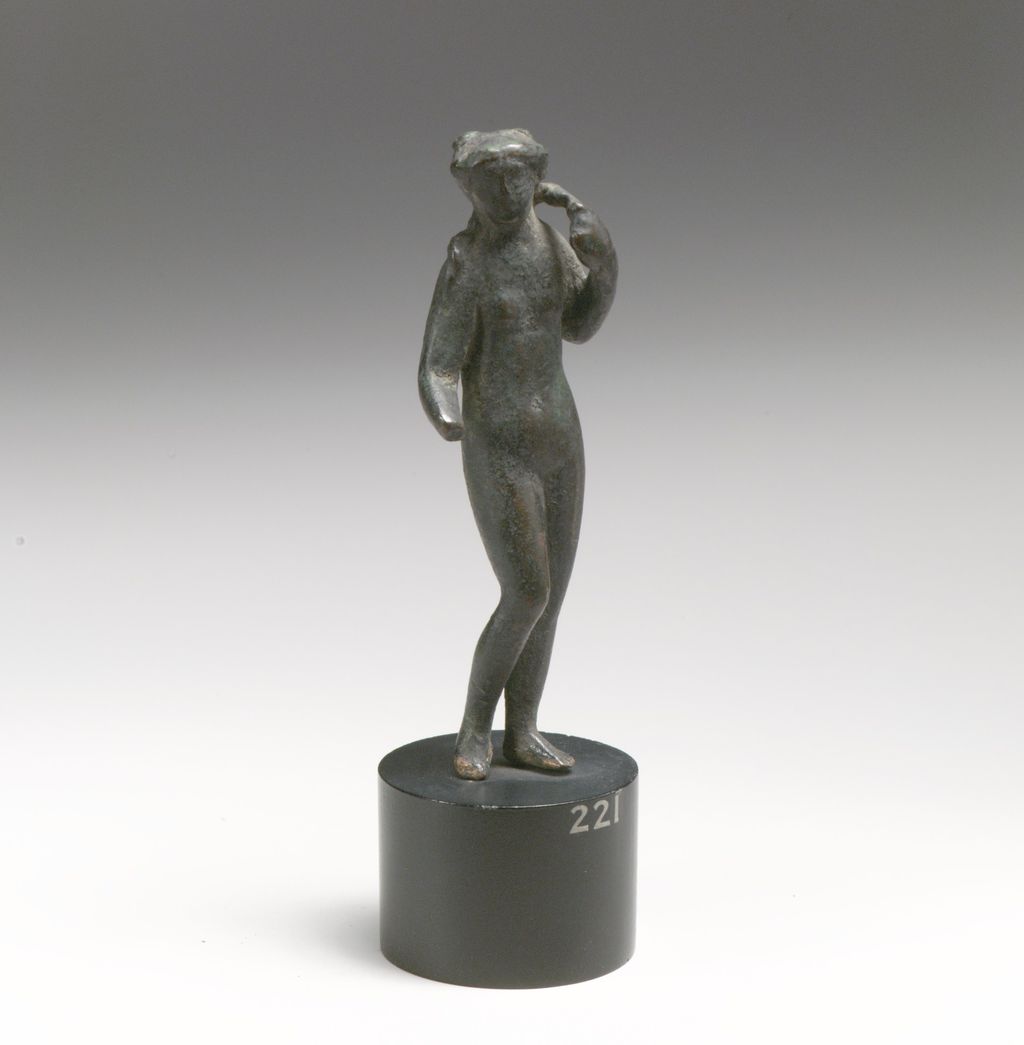
Bronze statuette of Venus, first to second century CE, The Met. A Roman figure of Venus gives a securely catalogued comparison for the much smaller painted sculpture. The Metropolitan Museum of Art. Image source. CC0 / Public domain.
Other classical pictures by Godward
Godward had already put the goddess’s name on a slender canvas in The Flowers of Venus. The 1890 painting measures 59.8 × 21 cm and gives its standing figure plants and garden architecture to work among. Vern Grosvenor Swanson identifies it as a companion to An Idle Hour at Thomas McLean’s winter exhibition of 1890–91. The 1912 painting moves the flowers into an interior and gives the arrangement a particular destination in the niche above the table. In the earlier work the daylight and vegetation remain part of the subject. [2] [3] [15]
The woman in At the Gate of the Temple has a clearer emblem of her association with a deity. She stands in front of tall doors holding a thyrsus, the staff associated with Bacchus, and turns her face towards the viewer. Swanson compares that work to Godward’s clothed Priestess of 1894. The 1895 Academy Notes describes an exhibited priestess in black gauze before polished brass doors, giving an idea of how deliberately Godward could make a doorway and costume define the role. In An Offering to Venus, the attention stays within the scene, concentrated on the woman’s hands and on what can be done with a single blossom. [2] [5] [16]
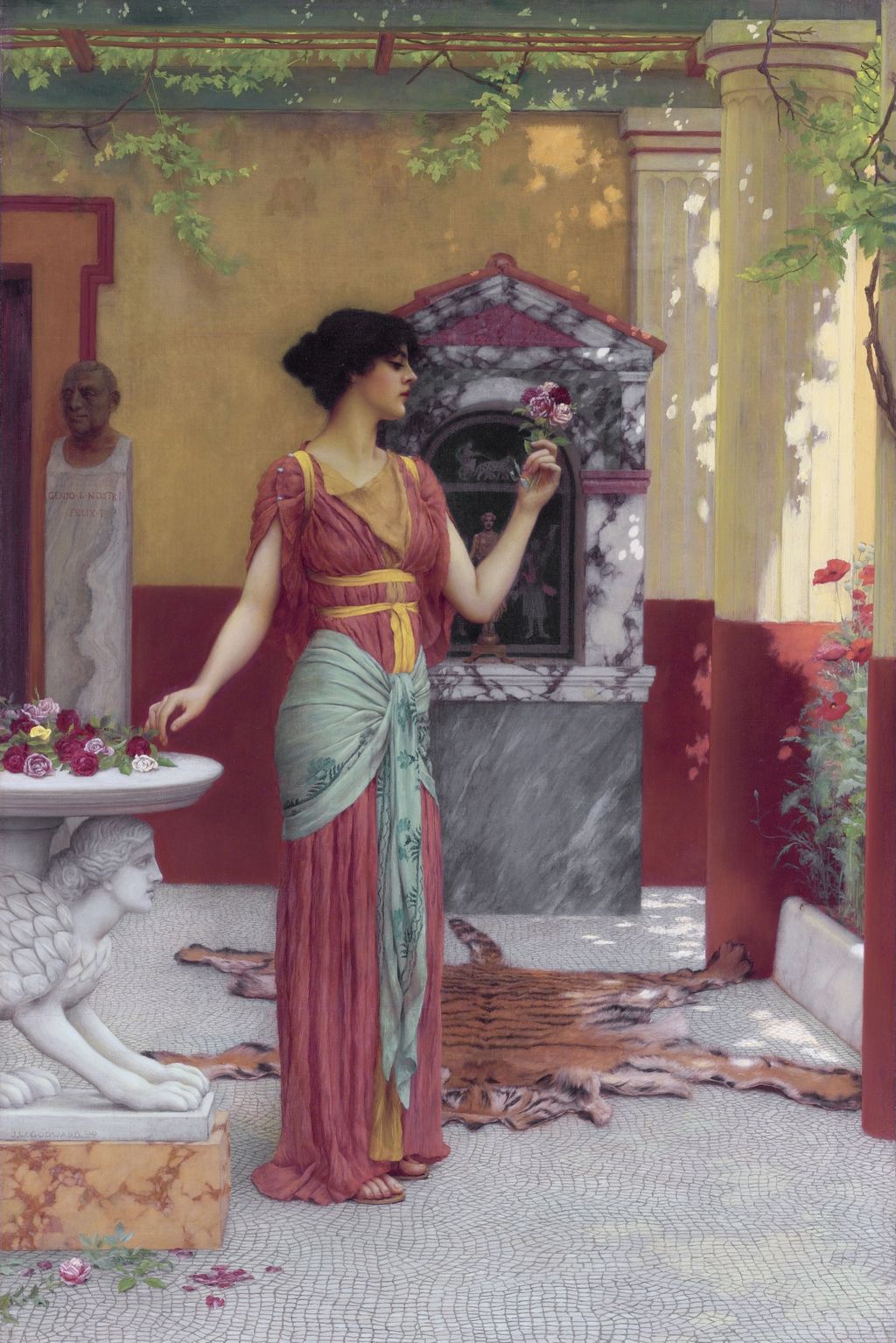
John William Godward, The Bouquet (1899). A flower arranger takes a different attitude towards the roses and the little statue beyond her hands. Image source. Public domain.
From Godward to Cremetti
Christie’s dates the painting’s acquisition from Godward by the London firm of Eugène Cremetti to 5 May 1912. It cites a letter from Cremetti to Godward of the same date in the Milo-Turner Collection. The letter is known here by that catalogue citation. In the 1914 London trades directory, Cremetti appears as McLean’s successor at 7 Haymarket. Sotheby’s traces that takeover to 1908 and describes an arrangement under which Cremetti paid Godward separately for the right to reproduce Crytilla. In that 1908 oil another woman selects a single blossom from the bunch held against her chest. The similar hand movement is used there to pick out a violet anemone. The terms of the acquisition of An Offering to Venus are unconfirmed. [1] [17] [18]
The reported Rome inscription and the London acquisition are part of a wider pattern in Godward’s biography. Sotheby’s records Rome and 1910 on the reverse of the earlier Memories, together with Cremetti’s acquisition in London on 8 September 1910 and a letter of that date. Both paintings belong to the period when Godward was establishing his connection with Rome and keeping his links to the London trade. Taken on its own, the dealer’s May 1912 acquisition gives a latest date for the painting’s passage from the artist, while the inscription, as reported, associates it with work in Rome that year. [1] [19]
Christie’s next records an anonymous Sotheby’s sale in New Delhi on 8 October 1992, lot 40, and the painting with the London dealer Richard Green until June 1993. The cover of Sotheby’s catalogue for Indian, European and Oriental Paintings and Works of Art shows that the New Delhi auction ran on 8 and 9 October. Christie’s offered the canvas from the estate of Ian Fry as lot 126 at King Street, London, on 13 July 2016. Its present whereabouts remain unconfirmed. [1] [2] [20]
John William Godward artworks directory
Search documented oil paintings, drawings, watercolours and reproductive prints. The directory includes the Art Renewal Center’s catalogue and additional works in museum, exhibition and sale records.
| Name | Date | Medium |
|---|---|---|
| Absence Makes the Heart Grow Fonder | 1912 | Oil on canvas |
| Amaryllis | 1903 | Oil on canvas |
| An Amateur | 1915 | Oil on canvas |
| Ancient Pastimes | 1916 | Oil on canvas |
| The Answer | 1917 | Oil on canvas |
| An Arcadian Beauty | 1899 | Painting |
| At the Fountain | 1893 | Oil on canvas |
| At the Garden Door | 1901 | Oil on canvas |
| At the Garden Shrine, Pompeii | 1892 | Oil on canvas |
| At the Gate of the Temple | 1898 | Oil on canvas |
| At the Thermae | 1909 | Oil on canvas |
| Atalanta | 1892 | Oil on canvas |
| Athenais | 1908 | Oil on canvas |
| An Auburn Beauty | 1895 | Oil on canvas |
| Autumn | 1900 | Oil on canvas |
| Beauty in a Marble Room | 1894 | Oil on canvas |
| The Belvedere | 1913 | Oil on canvas |
| The Betrothed | 1892 | Oil on canvas |
| The Betrothed (print after Godward) | 1893 | Photoengraving, as reported |
| The Bouquet | 1899 | Oil on canvas |
| Briseis | 1896 | Painting |
| The Broken Vase | 1889 | Oil on canvas |
| By the Blue Ionian Sea | 1916 | Oil on canvas |
| By the Wayside | 1912 | Oil on canvas |
| Byrsina | 1915 | Painting |
| Campaspe | 1896 | Oil on canvas |
| Campaspe (print after Godward) | Print, process unconfirmed | |
| Chloris (A Summer Rose) | 1902 | Oil on canvas |
| Classical Beauty | Oil on canvas | |
| A Classical Beauty | Oil on canvas | |
| A Classical Beauty | Painting | |
| A Classical Beauty | Oil on canvas | |
| A Classical Beauty | 1909 | Oil on canvas |
| A Classical Beauty In Profile | Oil on canvas | |
| A Classical Lady | 1908 | Oil on canvas |
| Clymene | 1892 | Oil on canvas |
| A Congenial Task | 1915 | Oil on canvas |
| Contemplation | 1922 | Oil on canvas |
| A Cool Retreat | 1910 | Oil on canvas |
| Country House in the 18th Century | c. 1883 | Oil on canvas |
| Cytheris | 1922 | Painting |
| The Day Dream | 1920 | Oil on canvas |
| The Delphic Oracle | 1899 | Oil on canvas |
| A Dilettante | 1922 | Oil on canvas |
| Distant Thoughts | 1918 | Oil on canvas |
| Dolce Far Niente | 1897 | Oil on canvas |
| Dolce Far Niente | 1906 | Oil on canvas |
| Dolce far niente (A Pompeian Fishpond) | 1904 | Oil on canvas |
| Dolce far niente (coloured print after Godward) | Exhibited 1900 | Coloured print, exact process unconfirmed |
| Dolce far niente (grapes) | 1907 | Oil on canvas |
| Dora | 1887 | Oil on canvas |
| Drusilla | 1906 | Oil on canvas |
| An Edition de Luxe | 1920 | Oil on canvas |
| Eighty and Eighteen | 1898 | Oil on canvas |
| Endymion | 1893 | Oil on canvas |
| The Engagement Ring (horizontal composition) | 1888 | Oil on canvas |
| The Engagement Ring (upright composition) | c. 1891 | Oil on canvas |
| Erato at Her Lyre | Oil on canvas | |
| A Fair Reflection | 1915 | Oil on canvas |
| A Fair Reflection (Taber-Prang print) | By 1923 | Sepia artotype |
| Far Away Thoughts (circular sewing scene) | 1911 | Oil on canvas |
| Far Away Thoughts (left-facing profile) | 1892 | Oil on canvas |
| Far Away Thoughts (right-facing profile) | 1892 | Oil on canvas |
| Female Figure (probable Grecian Idyll study) | 1907 | Oil on board |
| Flabellifera | 1905 | Oil on canvas |
| Flabellifera (painted study) | c. 1905 | Oil study |
| Flabellifera (pencil study) | c. 1905 | Pencil on paper |
| The Flower Girl | Painting | |
| A Flower Seller | 1896 | Oil on canvas |
| The Flowers of Venus | 1890 | Oil on canvas |
| A Fond Farewell | 1918 | Watercolour |
| The Fragrant Rose | 1892 | Painting |
| The Fruit Vendor | 1917 | Oil on canvas |
| A Garland Seller | 1914 | Painting |
| Giotto Drawing from Nature | Painting | |
| Girl in Yellow Drapery | 1901 | Oil on canvas |
| Golden Hours | 1913 | Oil on canvas |
| A Grecian Girl | 1908 | Oil on canvas |
| Grecian Idyll | 1907 | Oil on canvas |
| A Grecian Lovely | 1909 | Oil on canvas |
| Grecian Reverie | 1889 | Oil on canvas |
| Grecian Reverie | 1889 | Oil on canvas |
| A Greek Beauty | 1905 | Oil on canvas |
| A Happy Awakening | 1903 | Oil on canvas |
| He Loves Me, He Loves Me Not | 1896 | Oil on canvas |
| A head and shoulders profile portrait of a young woman wearing a white tunic style blouse | c. 1889 | Painting |
| Head of a Girl (The Priestess) | 1896 | Oil on canvas |
| Heart on her Lips and Soul within her Eyes | 1904 | Painting |
| His Birthday Gift | 1889 | Oil on canvas |
| Ianthe | 1889 | Oil on canvas |
| An Idle Hour | 1890 | Oil on canvas |
| Idle Moments | 1895 | Oil on canvas |
| Idle Thoughts | 1898 | Oil on canvas |
| Idleness | 1900 | Oil on canvas |
| Il Dolce Far Niente (Pears print after Amaryllis) | 1906 | Chromolithograph |
| Il Dolce far niente (seated figure) | 1893 | Oil on canvas |
| In Expectation | c. 1892 | Oil on canvas |
| In Realms of Fancy | 1911 | Oil on canvas |
| In the Prime of the Summertime (Reverie) | 1914 | Oil on canvas |
| In the Tepidarium | 1913 | Oil on canvas |
| Innocent Amusements | 1891 | Oil on canvas |
| Ione | c. 1896-1898 | Oil on canvas |
| Ionian Dancing Girl | 1902 | Oil on canvas |
| Ismenia | 1908 | Oil on canvas |
| An Italian Beauty | 1897 | Oil on canvas |
| An Italian Girls' Head | 1902 | Oil on canvas |
| The Jewel Casket | 1900 | Oil on canvas |
| Julia | 1914 | Painting |
| Knuckle Bones | 1890 | Oil on canvas |
| La Pensierosa | 1913 | Oil on canvas |
| A Lady | 1895 | Oil on canvas |
| Landscape: Blossoming Red Almond [study] | c. 1912 | Oil on panel |
| Le Billet Doux (The Love Letter) | 1913 | Oil on canvas |
| Leaning Against a Column | 1901 | Painting |
| Leaning on the Balcony | 1892 | Oil on canvas |
| Leisure Hours | 1905 | Oil on canvas |
| Lesbia with her Sparrow | 1916 | Oil on canvas |
| The Letter | 1899 | Painting |
| Liegende | 1893 | Oil on canvas |
| A Lily Pond | 1917 | Oil on canvas |
| Looking Out to Sea | 1918 | Pencil and watercolour |
| The Love Letter (circular composition) | 1907 | Oil on canvas |
| Lucilia | 1917 | Oil on canvas |
| Lycinna | 1918 | Oil on canvas |
| Marcella | 1912 | Painting |
| Matrona Superba | Oil on canvas | |
| Megilla | 1921 | Oil on canvas |
| A Melody | 1904 | Oil on canvas |
| Memories | c. 1891 | Oil on canvas |
| Mirinna | Painting | |
| The Mirror | 1899 | Oil on canvas |
| Mischief | 1905 | Oil on canvas |
| Mischief and Repose | 1895 | Oil on canvas |
| A Mouse in the Work Basket | 1893 | Oil on canvas |
| Nerissa | 1906 | Oil on canvas |
| The New Perfume | 1914 | Oil on canvas |
| Noon Day Rest | 1910 | Oil on canvas |
| Nu Sur La Plage | 1922 | Oil on panel |
| Nude Study | Oil on canvas | |
| An Offering to Venus | 1912 | Oil on canvas |
| The Old, Old Story | Oil on canvas | |
| The Old, Old Story | 1903 | Oil on canvas |
| On the Balcony | 1911 | Oil on canvas |
| On The Terrace | 1918 | Oil on canvas |
| Ophelia | Oil on panel | |
| The Peacock Fan | 1912 | Oil on canvas |
| Phyleis | 1908 | Oil on canvas |
| The Playground | 1892 | Oil on canvas |
| Playtime | 1891 | Oil on canvas |
| A Pompeian Bath | 1890 | Oil on canvas |
| A Pompeian Lady | 1891 | Oil on canvas |
| A Pompeian Lady | 1895 | Oil on board |
| A Pompeian Lady | 1901 | Painting |
| A Pompeian Lady | 1904 | Painting |
| Portrait of Mary Frederica 'Nin' Godward | c. 1882-1883 | Oil on canvas |
| Portrait of Mary Perkinton Godward | c. 1880-1881 | Watercolor |
| The Posy | 1900 | Painting |
| A Priestess (bare-shouldered figure) | 1893 | Oil on canvas |
| A Priestess (clothed composition) | 1894 | Oil on canvas |
| A Priestess (W. Biscombe Gardner after Godward) | Exhibited 1897 | Print, process unconfirmed |
| A Priestess of Bacchus | 1890-1890 | Oil on canvas |
| Pyrallis | 1918 | Oil on canvas |
| The Quiet Pet | 1906 | Oil on canvas |
| A Red, Red Rose | 1920 | Oil on canvas |
| Reflections | 1893 | Oil on canvas |
| The Rendezvous | 1903 | Oil on canvas |
| Repose, the Flower Girl | c. 1887 | Oil on canvas |
| Reverie | 1888 | Oil on panel |
| Reverie | 1912 | Oil on canvas |
| Reverie (In the Days of Sappho) | 1904 | Oil on canvas |
| Reverie (Pears print after In the Prime of the Summertime) | 1916 | Chromolithograph |
| 'Rich Gifts Wax Poor When Lovers Prove Unkind' | 1916 | Oil on canvas |
| The Ring | 1898 | Oil on canvas |
| A Roman Matron | 1905 | Oil on canvas |
| Sabinella | 1912 | Oil on canvas |
| Sappho | 1910 | Oil on canvas |
| The Siesta | Oil on canvas | |
| A Siesta | 1895 | Oil on canvas |
| The Signal | 1899 | Oil on canvas |
| Sitting for Her Portrait | 1893 | Oil on canvas |
| Sketch for Amaryllis | 1903 | Oil on board |
| A Souvenir | 1920 | Oil on canvas |
| Stesicrate | 1914 | Oil on canvas |
| Study for 'Rêverie' | 1890 | Oil on canvas |
| Study for 'The Priestess' | 1895 | Oil on board |
| Study for An Egyptian Minstrel | 1906 | Painting |
| Study for The New Perfume | Drawing, medium unconfirmed | |
| Study for ‘The Old, Old Story’ | 1903 | Oil paint on wood |
| Study of a Girl's Head | 1899 | Painting |
| Study of Campaspe | Oil on canvas | |
| Study of Head and Drapery, Miss Ethel Warwick | 1898 | Painting |
| Summer Day | 1897 | Painting |
| Summer Flowers | 1903 | Oil on canvas |
| Sweet Dreams | 1901 | Oil on canvas |
| Sweet Dreams | 1904 | Painting |
| The Sweet Siesta of a Summer's Day | 1891 | Oil on canvas |
| The Tambourine Girl (profile at the marble wall) | 1906 | Oil on canvas |
| The Tambourine Girl (relief-backed version) | 1906 | Oil on canvas |
| Tender Thoughts | 1917 | Oil on canvas |
| Tender Thoughts (woman leaning over a parapet) | 1918 | Pencil and watercolour |
| The Tiff (oil) | By 1888 | Oil on canvas |
| The Tiff (print after Godward) | 1894 | Photogravure |
| The Tigerskin | 1889 | Oil on canvas |
| The Time of Roses | 1916 | Oil on canvas |
| Tranquillity | 1914 | Oil on canvas |
| A Tryst | 1912 | Oil on canvas |
| Tympanistria | 1909 | Oil on canvas |
| Under the Blossom that Hangs on the Bough | 1917 | Oil on canvas |
| Venus at the Bath | 1901 | Oil on canvas |
| Venus Binding Her Hair | 1897 | Oil on canvas |
| Violets, Sweet Violets | 1906 | Painting |
| Waiting for an Answer | 1889 | Oil on canvas |
| Waiting for the Procession | 1890 | Oil on canvas |
| Waiting for the Procession | 1890 | Painting |
| The Water Carrier (magazine reproduction of At the Fountain) | 1898 | Magazine reproduction |
| When the Heart is Young | 1902 | Oil on canvas |
| Who Can They Be | Painting | |
| Winding Wool | 1894 | Painting |
| 'With Violets Wreathed and Robe of Saffron Hue' | 1902 | Oil on canvas |
| The Yellow Shawl | 1893 | Painting |
| 'Yes or No?' | 1893 | Oil on canvas |
| Young Girl Picking Grapes | 1902 | Oil on canvas |
| Youth and Time | 1901 | Oil on canvas |
Discussion
Look again at the images and ideas explored in An Offering to Venus. These editorial prompts invite your observations.
Reader Insights
How do the raised rose and the hidden figure change the meaning of the bouquet?
Which visible gestures support the title’s suggestion of a ritual?
Join the Conversation
Share a detail, comparison or question about An Offering to Venus below.
References
- Christie’s. John William Godward, An Offering to Venus. London, 13 July 2016, sale 12236, lot 126. Medium, dimensions, inscriptions, provenance and Milo-Turner Collection correspondence citation. English. View source.
- Christie’s, via Wikimedia Commons. Photograph of An Offering to Venus. Sale 12236, lot 126, catalogue photograph. English. View source.
- Art Renewal Center. John William Godward, The Flowers of Venus, artwork 11593, 1890. Reproduction and catalogue details. English. View source.
- A Priestess. View source.
- Christie’s. John William Godward, At the Gate of the Temple. Signed date, catalogue photograph and Swanson’s comparison with the 1894 Priestess. English. View source.
- The Bouquet. View source.
- The Peacock Fan. View source.
- Musée du Louvre. Le Passage de Vénus, exhibition material on the Vénus d’Arles (Ma 439) and François Girardon’s restorations. French. View source.
- Metropolitan Museum of Art. Bronze statuette of Venus, acc. no. 96.9.408. Roman bronze of the Aphrodite Anadyomene type, first or second century CE. English. View source.
- Art Institute of Chicago. Fragment of a Statue of Venus, Roman Art at the Art Institute of Chicago, catalogue no. 3, acc. no. 1904.18. English. View source.
- Art Institute of Chicago. Statue of the Aphrodite of Knidos, Roman Art at the Art Institute of Chicago, catalogue no. 13, acc. no. 1981.11. English. View source.
- Ovid. Fasti, book 4, lines 133–162, French translation and commentary, Bibliotheca Classica Selecta. View source.
- Musée du Louvre. Dedication to Venus Vera Felix of Gabii, inv. Ma 1562, dated 168 CE. Latin inscription and French catalogue record. View source.
- Art Institute of Chicago. Relief Plaque, Roman Art at the Art Institute of Chicago, catalogue no. 159, acc. no. 1990.87. English. View source.
- Vern Grosvenor Swanson. J. W. Godward: The Eclipse of Classicism, archived Art Renewal Center edition, web p. 5. McLean exhibition and companion painting. English. View source.
- Henry Blackburn, ed. Academy Notes, 1895, p. 12, Gallery IV, no. 304. Contemporary description of A Priestess. English. View source.
- Kelly’s Directories. Post Office London Directory, 1914, trades section, private picture galleries. University of Leicester Special Collections. English. View source.
- Sotheby’s. John William Godward, Crytilla, 2004, lot 23. Cremetti’s succession to McLean and his purchase of reproduction rights. English. View source.
- Sotheby’s. John William Godward, Memories, 2007, lot 177. Inscriptions, acquisition and correspondence of 8 September 1910. English. View source.
- Sotheby’s. Indian, European and Oriental Paintings and Works of Art. New Delhi, 8–9 October 1992 as printed on the cover. Tuli Research Centre for India Studies, catalogue 00861838. English. View source.