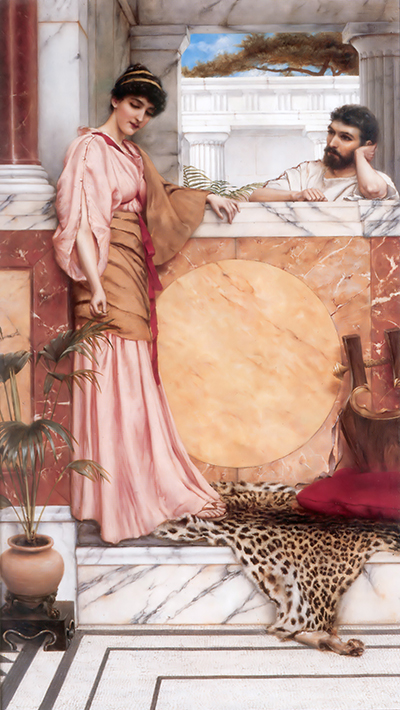
 by Tom Gurney
Tom Gurney BSc (Hons) is an art history expert with over 20 years experience
Published on June 19, 2020 / Updated on October 14, 2023
Email: tomgurney1@gmail.com / Phone: +44 7429 011000
John William Godward Quotes and Reception: Introduction
Turn over John William Godward’s Tender Thoughts and there is a second signature. On the face of the canvas, he left his name and the year 1917. On the back, according to Christie’s transcription, he gave the picture its title and added “Rome. 1917.” That small inscription is among the clearest examples of his own words. In 1908 a collector asked him how he chose another painting’s title. The man’s question survives in print. Godward’s answer remains unknown. [1] [2]
At a Glance
- SourcesTrade letters, exhibition reviews, reported testimony and later scholarship
- Published witnessesHenry Blackburn, H. Goodchild and Vern Grosvenor Swanson
Contents
- What Godward wrote on his paintings
- A collector asks about a title
- On the walls of the Royal Academy
- Recollections of the studio
- How the Picasso story travelled
- What later readers found in the pictures
What Godward wrote on his paintings
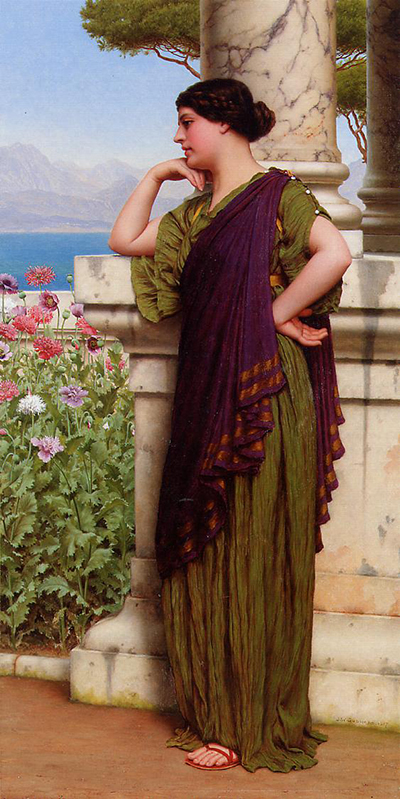
In the tall, narrow Tender Thoughts, a woman stands by a mass of poppies, with the sea beyond the terrace. The title tells the viewer how to approach her pause without giving her a story, and the place under the signature tells us where Godward marked the canvas. The auction essay connects the pose with a drawing from a sketchbook of about 1913–14 and with a simpler watercolour made in 1918. In this case the date attached to the signed painting singles out one stage of a composition that occupied him on separate occasions. [1]
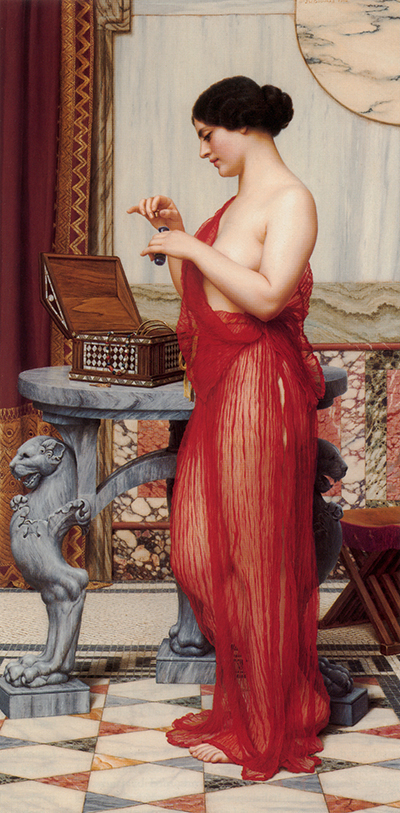
The two sides of The New Perfume make that distinction harder to miss. Christie’s records Godward’s signature and the date 1914 on the front. Its transcription of the reverse gives the title, the signature and “Rome.1915”. Christie’s leaves the difference between the two dates unexplained. In Lycinna, Sotheby’s records 1918 on both faces and transcribes the title, signature and Rome on the back. As paintings pass among dealers and collections, inscriptions on the reverse can tie a familiar title to a particular canvas. [3] [4]
Godward did write to his agent, Thomas McLean. Sotheby’s describes a letter dated 26 September 1901 with a pen-and-ink sketch corresponding to Leaning Against a Column. The painting resurfaced after being known from that drawing. In the oil, a woman seated on a marble terrace leans towards a column and lifts a peacock fan to shade her face. The catalogue records the sketch without transcribing the letter. It gives us a glimpse of how Godward could show his dealer what he meant on the same sheet of paper. [5]
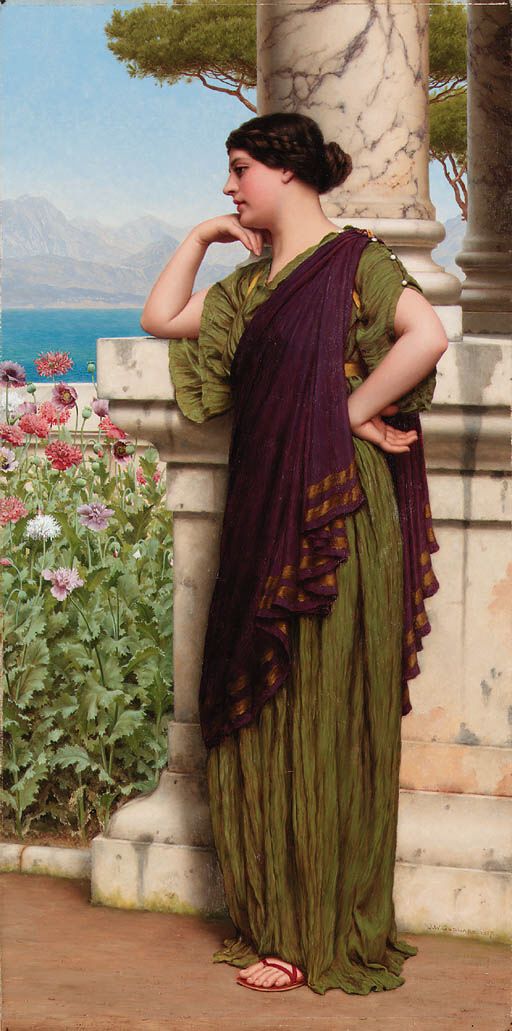
John William Godward, Tender Thoughts (1917), oil. Christie’s recorded the title and the place and date on the reverse of this signed 1917 canvas. Image source. Public domain.
A collector asks about a title
W. H. Churton saw Crytilla at London’s New Gallery in 1908. In his letter of 10 June, he stood by an offer of 200 guineas and asked for an answer that week. Six days later he returned to a different question, asking “how you came to select the name of Crytilla”. Sotheby’s reproduces the exchanges from the buyer’s side. The young woman in the oil is occupied with a flower she holds close to her chest, and there is little in the scene to tell us how her name was chosen. Churton wanted to hear the association from the person who made the painting. His question survives as part of the picture’s earliest reception, alongside the sum he was willing to pay. [2]
Ownership of the canvas and the right to make reproductions involved separate transactions. Sotheby’s records a £25 payment to Godward from Eugène Cremetti for the copyright of Crytilla. A black-and-white photo-engraving followed in 1908 and a smaller colour engraving in 1910. These put the picture before viewers who could never see it in Churton’s collection. The auction catalogue says the composition was known through those reproductions before the canvas came to light again. [2]
Sotheby’s lists a letter from Francis Michael Evans to Godward dated 24 May 1906 under The Quiet Pet, a picture signed that year. It lists Evans among the owners by 1906 and again as the buyer at a 1909 sale. For the signed 1907 Dolce Far Niente with the bunch of grapes, a letter from McLean to Godward is dated 19 March 1907, and McLean appears in the provenance by the same date. [6] [7]
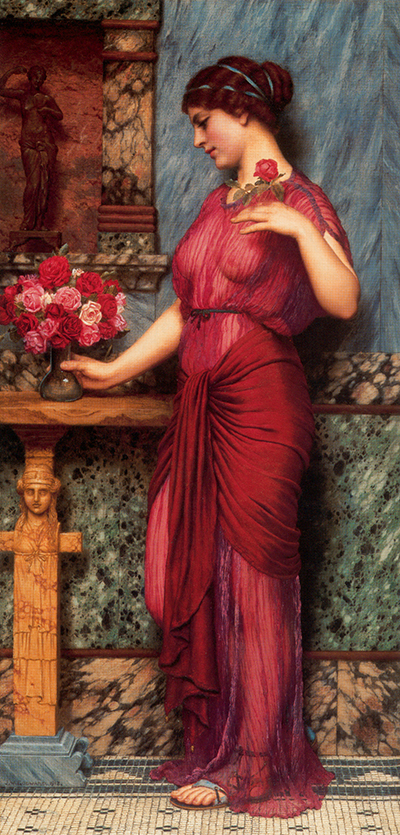
The Sotheby’s entry for Memories records Cremetti acquiring the canvas on 8 September 1910 and cites a letter to Godward dated the same day. The canvas also bears a Rome inscription dated 1910. The records for An Offering to Venus show Cremetti acquiring it from the artist on 5 May 1912 and cite a letter to him of that date. For the Rome inscription on the reverse, Christie’s explicitly relies on a previous catalogue. Put beside the inscriptions, the letters help trace how work bearing Godward’s Rome inscriptions reached a London dealer’s stock. The catalogue descriptions name the correspondents and date the paperwork, while leaving the language of the exchanges out of view. [8] [9]
On the walls of the Royal Academy
The 1895 Royal Academy catalogue puts A Priestess, no. 304, in Gallery IV. Henry Blackburn’s Academy Notes describes a chestnut-haired woman facing the viewer in a “transparent black gauze robe”. Behind her were the “polished brass doors” of a temple. A reader could use those details to pick out the painting in the gallery. The description depends on the different ways two surfaces catch the light, through thin material on the figure and off the metal immediately behind her. Blackburn is describing a clothed composition. That gives us a way to distinguish the exhibit from the near-nude A Priestess, although the exact surviving canvas corresponding to no. 304 remains uncertain. [10] [11]
Two years after Blackburn’s notice, the Academy showed A Priestess in a different form. The 1897 catalogue lists W. Biscombe Gardner’s work after Godward as no. 1719 in the Black and White Room. Humrich Fine Art catalogues a small, clothed panel as the source for an engraving Gardner made in 1896 for Cadbury, Jones & Co. The Academy entry establishes that the reproduction was exhibited and names both artists. It leaves open the precise relationship between the small panel and the oil shown in 1895. Where Cremetti’s payment for Crytilla records a reproduction right changing hands, the Gardner entry shows a reproduction going back on public display under its own catalogue number. [12] [13] [2]
H. Goodchild came to the Royal Academy to look for bird paintings. In his account in Bird Notes, a work depicting ptarmigan was hung high enough to make the details hard to see. He also noticed a picture by Godward, Flabellifera, no. 252 in the 1905 catalogue. It was a figure subject, so he explained its place in the article by praising the “perfect painting of the Peacock’s feathers.” He had found something he normally looked for in a specialist bird picture in an oil about a woman holding a fan. This was the earlier composition with the fan raised, distinct from the standing woman in The Peacock Fan of 1912. Goodchild’s seeing the feathers as a subject in their own right is a reason to look closely at both pictures. [14] [15]
An anonymous memorial in The Connoisseur in 1923 recalled how popular Godward’s pictures had once been. It described the interior of his Fulham Road studio as an evocation of a Roman building and placed the pergolas and fountains in the surrounding garden. The writer even heard an echo of an ancient amphitheatre in the shouts from the neighbouring football ground. The memorial places the end of his regular appearances at the Royal Academy around 1905. Goodchild’s review records seeing Flabellifera there that year. [14] [15] [16]
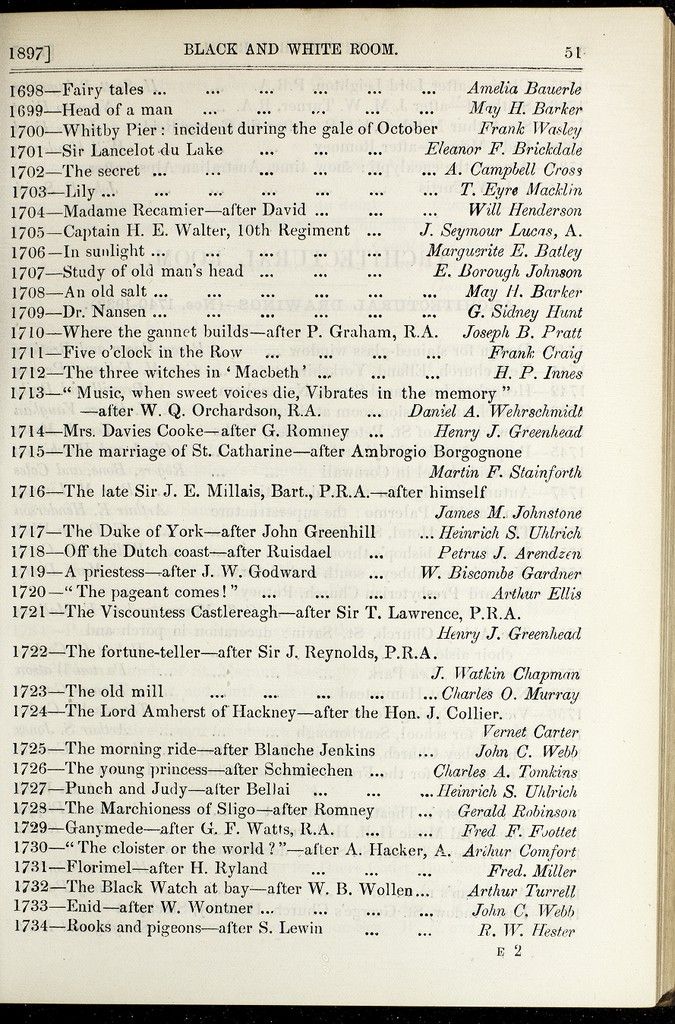
Royal Academy of Arts, 1897 exhibition catalogue, no. 1719. The entry names Gardner as the maker of the exhibited work after Godward. It appears as number 1719 in the Black and White Room. Royal Academy of Arts. Image source. Public domain.
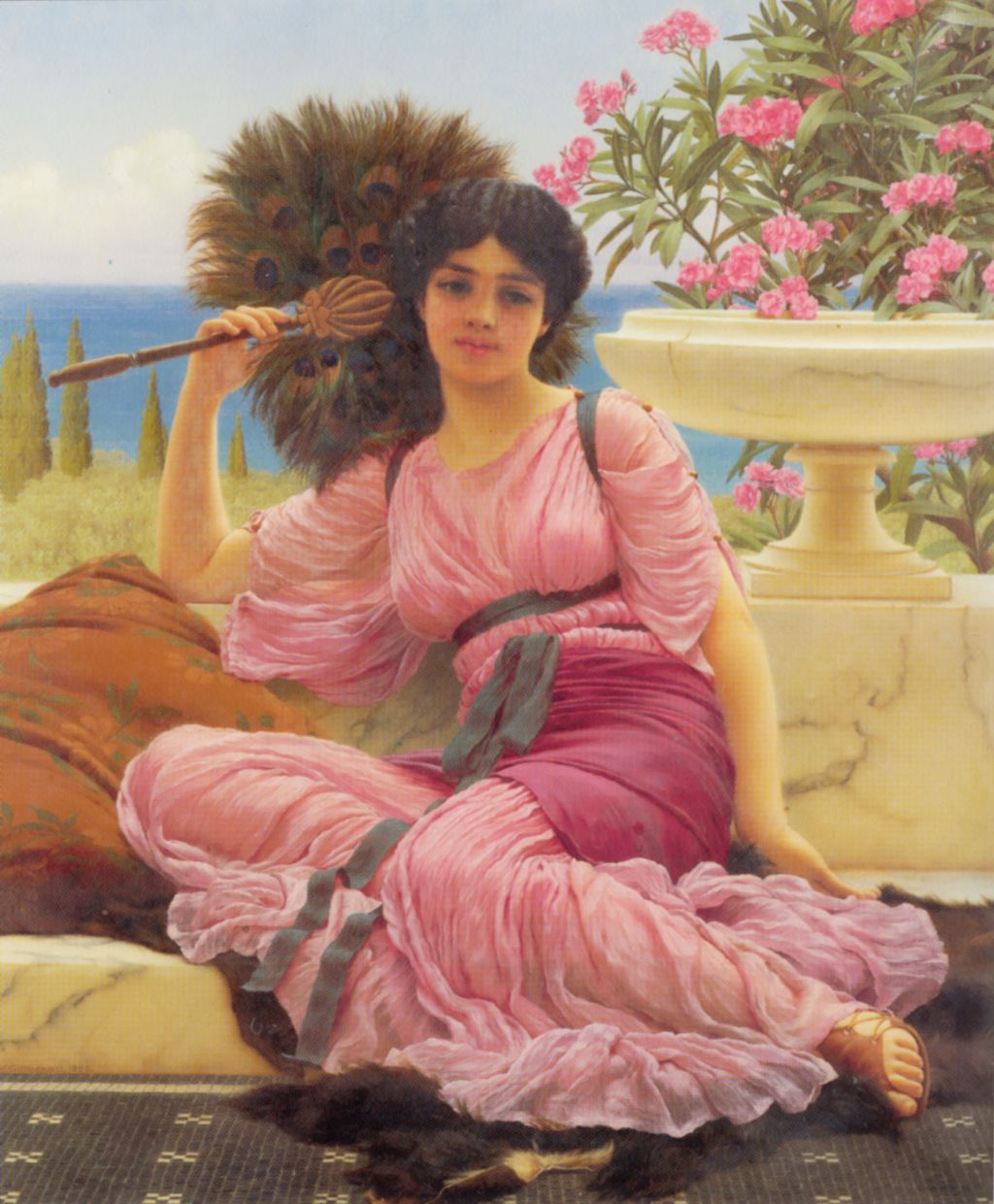
John William Godward, Flabellifera (1905), finished oil. This is the composition with the raised fan that caught Goodchild’s attention in 1905. Image source. Public domain.
John William Godward videos
See Godward’s paintings and studio practice alongside films on two Victorian contemporaries.
John William Godward - Part 1: The Last Painter of the Victorian Age
An overview of Godward’s career and the Victorian market for pictures set in antiquity.
Watch on YouTubeRecollections of the studio
The painter William Russell Flint remembered Godward at work in Rome, where he visited the studio in 1912. In the recollection reproduced by Sotheby’s, Godward painted his figures in “Liberty silks” with a Roman model Flint calls Dolcissima. At tea Flint’s wife called the sitter’s attention to a white thread on her coat. Flint recalls being told afterwards that the woman had left it there because she associated it with dressmakers. His anecdote catches a professional sitter setting as much store by her own clothes as the outfit she wore at work. The auction essay suggests she might have sat for The Day Dream, but the oil is dated 1920 and the recollection does not identify that picture. The visit tells us about one model and the modern textiles Flint saw in a studio whose finished pictures evoked antiquity. [17]
The biographer Vern Grosvenor Swanson found a different witness in Ivy Godward. In a 1998 interview with Dave Gagon, he recalls that Ivy, who was nineteen in 1922, could describe the painter’s dress and manners but knew little about his artistic training. Swanson presents such conversations as the painstaking work behind John William Godward: The Eclipse of Classicism. He also explains what drew him to the subject. While researching Lawrence Alma-Tadema, he encountered pictures whose signatures, he believed, had been altered to name that more marketable painter. He wanted to investigate the fortunes of classical subject painting as a whole. His description of how little earlier writing he found conveys the difficulty of gathering enough material for a book. Blackburn’s notice and Goodchild’s review show how much can survive in sources filed under an exhibition or a specialist subject. [11] [15] [18]
The account attributed to the model Marietta Avico comes through a different kind of record. Swanson reproduced a Fulham Gazette report of the 1922 inquest, in which Avico was reported to have known Godward about eighteen months. The essay for Sotheby’s Contemplation also reports remarks ascribed to her about what Godward said in conversation and suggests she may have posed for late paintings. Those are layers of reporting around a witness’s account. The model’s identity in the particular canvas remains a suggestion, and the conversation is available to readers through later reporting rather than through a text in Godward’s hand. Rina Kajima’s study identifies coverage dated 14 December 1922 in the Daily News and 17 December in the Sunday Illustrated as separate leads in the contemporary press. [19] [20] [21]
How the Picasso story travelled
Several later writers tell a story in which Godward thought there was room for only one painter, himself or Picasso. In 2004, Desmond Bazley wrote for the Merton Historical Society that Godward had reputedly said it. In Bonhams Magazine in 2018, A. N. Wilson called the story a family legend about what the artist believed. The Russell-Cotes guide for An Italian Girl’s Head gives a different wording, “the world is not big enough for myself and a Picasso”, and presents it as something he was said to have written. The changing wording and descriptions are part of the story’s later history. None establishes a statement by Godward. [22] [23] [24]
Étienne Barilier turned the reputed rivalry into fiction. The Swiss National Library lists his 2014 French novel Ruiz doit mourir, and the Bibliothèque Sonore Romande describes an imagined Godward diary set around Picasso’s presence in Rome in 1917. Its Godward watches Picasso and imagines confronting him over what each takes beauty to be. A diary lets a novelist give the painter an interior voice for which the historical records leave little material. [25] [26]
What later readers found in the pictures
On the dust jacket of his 1997 book, as quoted by Sotheby’s, Swanson placed Godward “among the brightest stars of the late Graeco-Roman painters”. He singled out marble, flowers and drapery as grounds for comparison with Alma-Tadema and Frederic Leighton, while attributing the comparison to those who believed Godward equalled them in those particulars. In the interview the following year he used a more measured term, “a worthy artist”, and described the importance of the era the painter lived through. The dust jacket makes a case for the painter through his handling of familiar surfaces. The interview explains why his position in the art market mattered to a historian tracing a change in taste. [5] [18]
Michael Allan Kodysz asks how Godward used the archaeological evidence that Victorian painters brought to classical subjects. He compares the crossed-paw lion in Godward’s The Fruit Vendor of 1917 with the lion in Edward John Poynter’s Israel in Egypt of 1867. The figures in Poynter’s picture haul a colossal statue based on one of the British Museum’s Prudhoe lions. Kodysz connects Godward’s lion to the statues of Nektanebos I in Rome and points out two liberties Godward took. He painted the dark porphyry as pale marble and left out the hieroglyphs. At that scale the animal balances the figure of the fruit vendor, where Poynter’s dominates a scene of labour. For Kodysz the comparison helps explain how Godward could draw on the same archaeological tradition as his peers and use it to give shape to an image with very little action. [27]
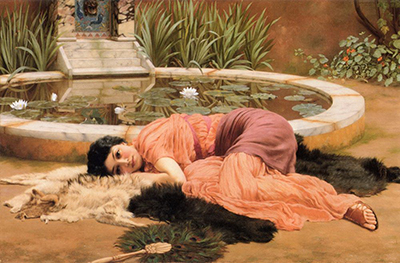
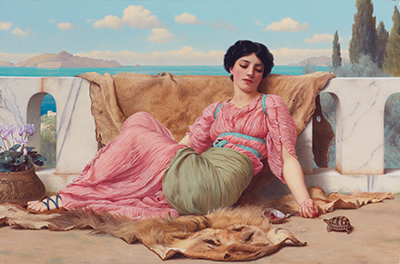
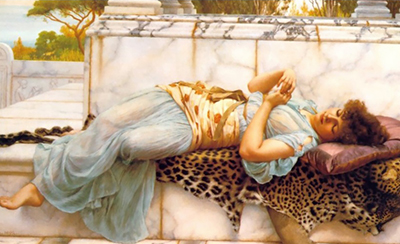
Kajima follows a different motif across versions of Dolce Far Niente. The woman in the 1897 picture has a parakeet to occupy her. In the 1904 painting she lies in pink by a pool and meets the viewer’s gaze. In 1906 a woman in mauve lies back on marble, with an island barely visible in the distance. Kajima compares how the floor, wall and stairs in 1897 and the terrace, column and tall plants in 1906 give the reclining body a structure of straight lines to play against. Animal skin, flesh and translucent cloth bring different surfaces into that arrangement. In setting these pictures alongside paintings of idleness by Waterhouse, Perugini and Alma-Tadema, Kajima considers how Godward’s shallow settings and sharply defined surfaces keep the viewer’s attention on the figure. [21]
Each reader brings something different to the picture. Churton asks about a name and leaves a record of what someone would pay for the canvas. Blackburn’s doorway gives us a way to distinguish two works that share a title. Goodchild’s account of the feathers brings us close enough to notice what Godward could do with a brush. [1] [2] [10] [11] [14] [15]
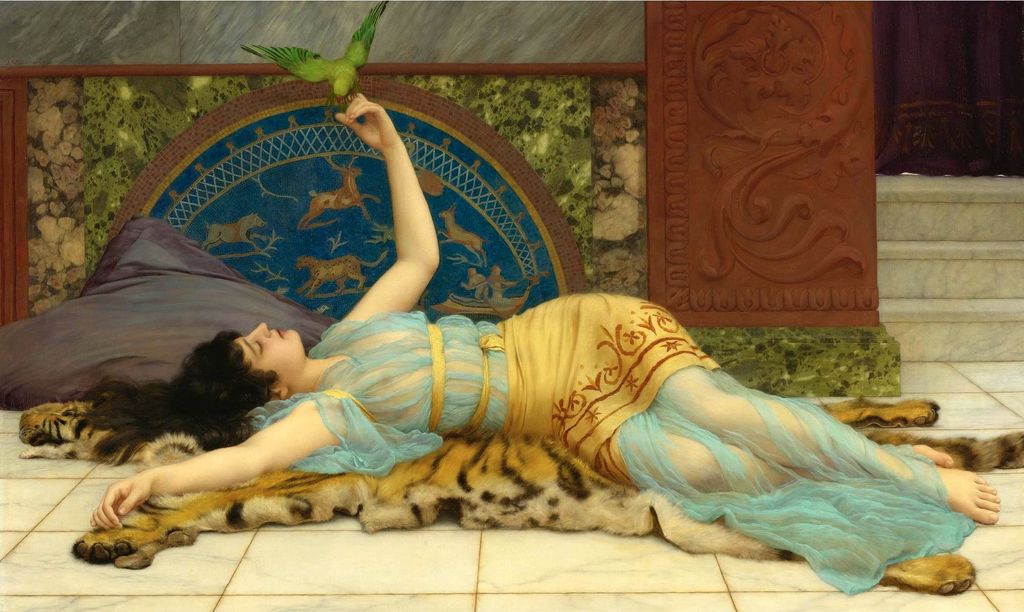
John William Godward, Dolce Far Niente (1897). Kajima compares the upward reach of the 1897 composition with the differently arranged limbs of the later versions. Image source. Public domain.
John William Godward artworks directory
Search documented oil paintings, drawings, watercolours and reproductive prints. The directory includes the Art Renewal Center’s catalogue and additional works in museum, exhibition and sale records.
| Name | Date | Medium |
|---|---|---|
| Absence Makes the Heart Grow Fonder | 1912 | Oil on canvas |
| Amaryllis | 1903 | Oil on canvas |
| An Amateur | 1915 | Oil on canvas |
| Ancient Pastimes | 1916 | Oil on canvas |
| The Answer | 1917 | Oil on canvas |
| An Arcadian Beauty | 1899 | Painting |
| At the Fountain | 1893 | Oil on canvas |
| At the Garden Door | 1901 | Oil on canvas |
| At the Garden Shrine, Pompeii | 1892 | Oil on canvas |
| At the Gate of the Temple | 1898 | Oil on canvas |
| At the Thermae | 1909 | Oil on canvas |
| Atalanta | 1892 | Oil on canvas |
| Athenais | 1908 | Oil on canvas |
| An Auburn Beauty | 1895 | Oil on canvas |
| Autumn | 1900 | Oil on canvas |
| Beauty in a Marble Room | 1894 | Oil on canvas |
| The Belvedere | 1913 | Oil on canvas |
| The Betrothed | 1892 | Oil on canvas |
| The Betrothed (print after Godward) | 1893 | Photoengraving, as reported |
| The Bouquet | 1899 | Oil on canvas |
| Briseis | 1896 | Painting |
| The Broken Vase | 1889 | Oil on canvas |
| By the Blue Ionian Sea | 1916 | Oil on canvas |
| By the Wayside | 1912 | Oil on canvas |
| Byrsina | 1915 | Painting |
| Campaspe | 1896 | Oil on canvas |
| Campaspe (print after Godward) | Print, process unconfirmed | |
| Chloris (A Summer Rose) | 1902 | Oil on canvas |
| Classical Beauty | Oil on canvas | |
| A Classical Beauty | Oil on canvas | |
| A Classical Beauty | Painting | |
| A Classical Beauty | Oil on canvas | |
| A Classical Beauty | 1909 | Oil on canvas |
| A Classical Beauty In Profile | Oil on canvas | |
| A Classical Lady | 1908 | Oil on canvas |
| Clymene | 1892 | Oil on canvas |
| A Congenial Task | 1915 | Oil on canvas |
| Contemplation | 1922 | Oil on canvas |
| A Cool Retreat | 1910 | Oil on canvas |
| Country House in the 18th Century | c. 1883 | Oil on canvas |
| Cytheris | 1922 | Painting |
| The Day Dream | 1920 | Oil on canvas |
| The Delphic Oracle | 1899 | Oil on canvas |
| A Dilettante | 1922 | Oil on canvas |
| Distant Thoughts | 1918 | Oil on canvas |
| Dolce Far Niente | 1897 | Oil on canvas |
| Dolce Far Niente | 1906 | Oil on canvas |
| Dolce far niente (A Pompeian Fishpond) | 1904 | Oil on canvas |
| Dolce far niente (coloured print after Godward) | Exhibited 1900 | Coloured print, exact process unconfirmed |
| Dolce far niente (grapes) | 1907 | Oil on canvas |
| Dora | 1887 | Oil on canvas |
| Drusilla | 1906 | Oil on canvas |
| An Edition de Luxe | 1920 | Oil on canvas |
| Eighty and Eighteen | 1898 | Oil on canvas |
| Endymion | 1893 | Oil on canvas |
| The Engagement Ring (horizontal composition) | 1888 | Oil on canvas |
| The Engagement Ring (upright composition) | c. 1891 | Oil on canvas |
| Erato at Her Lyre | Oil on canvas | |
| A Fair Reflection | 1915 | Oil on canvas |
| A Fair Reflection (Taber-Prang print) | By 1923 | Sepia artotype |
| Far Away Thoughts (circular sewing scene) | 1911 | Oil on canvas |
| Far Away Thoughts (left-facing profile) | 1892 | Oil on canvas |
| Far Away Thoughts (right-facing profile) | 1892 | Oil on canvas |
| Female Figure (probable Grecian Idyll study) | 1907 | Oil on board |
| Flabellifera | 1905 | Oil on canvas |
| Flabellifera (painted study) | c. 1905 | Oil study |
| Flabellifera (pencil study) | c. 1905 | Pencil on paper |
| The Flower Girl | Painting | |
| A Flower Seller | 1896 | Oil on canvas |
| The Flowers of Venus | 1890 | Oil on canvas |
| A Fond Farewell | 1918 | Watercolour |
| The Fragrant Rose | 1892 | Painting |
| The Fruit Vendor | 1917 | Oil on canvas |
| A Garland Seller | 1914 | Painting |
| Giotto Drawing from Nature | Painting | |
| Girl in Yellow Drapery | 1901 | Oil on canvas |
| Golden Hours | 1913 | Oil on canvas |
| A Grecian Girl | 1908 | Oil on canvas |
| Grecian Idyll | 1907 | Oil on canvas |
| A Grecian Lovely | 1909 | Oil on canvas |
| Grecian Reverie | 1889 | Oil on canvas |
| Grecian Reverie | 1889 | Oil on canvas |
| A Greek Beauty | 1905 | Oil on canvas |
| A Happy Awakening | 1903 | Oil on canvas |
| He Loves Me, He Loves Me Not | 1896 | Oil on canvas |
| A head and shoulders profile portrait of a young woman wearing a white tunic style blouse | c. 1889 | Painting |
| Head of a Girl (The Priestess) | 1896 | Oil on canvas |
| Heart on her Lips and Soul within her Eyes | 1904 | Painting |
| His Birthday Gift | 1889 | Oil on canvas |
| Ianthe | 1889 | Oil on canvas |
| An Idle Hour | 1890 | Oil on canvas |
| Idle Moments | 1895 | Oil on canvas |
| Idle Thoughts | 1898 | Oil on canvas |
| Idleness | 1900 | Oil on canvas |
| Il Dolce Far Niente (Pears print after Amaryllis) | 1906 | Chromolithograph |
| Il Dolce far niente (seated figure) | 1893 | Oil on canvas |
| In Expectation | c. 1892 | Oil on canvas |
| In Realms of Fancy | 1911 | Oil on canvas |
| In the Prime of the Summertime (Reverie) | 1914 | Oil on canvas |
| In the Tepidarium | 1913 | Oil on canvas |
| Innocent Amusements | 1891 | Oil on canvas |
| Ione | c. 1896-1898 | Oil on canvas |
| Ionian Dancing Girl | 1902 | Oil on canvas |
| Ismenia | 1908 | Oil on canvas |
| An Italian Beauty | 1897 | Oil on canvas |
| An Italian Girls' Head | 1902 | Oil on canvas |
| The Jewel Casket | 1900 | Oil on canvas |
| Julia | 1914 | Painting |
| Knuckle Bones | 1890 | Oil on canvas |
| La Pensierosa | 1913 | Oil on canvas |
| A Lady | 1895 | Oil on canvas |
| Landscape: Blossoming Red Almond [study] | c. 1912 | Oil on panel |
| Le Billet Doux (The Love Letter) | 1913 | Oil on canvas |
| Leaning Against a Column | 1901 | Painting |
| Leaning on the Balcony | 1892 | Oil on canvas |
| Leisure Hours | 1905 | Oil on canvas |
| Lesbia with her Sparrow | 1916 | Oil on canvas |
| The Letter | 1899 | Painting |
| Liegende | 1893 | Oil on canvas |
| A Lily Pond | 1917 | Oil on canvas |
| Looking Out to Sea | 1918 | Pencil and watercolour |
| The Love Letter (circular composition) | 1907 | Oil on canvas |
| Lucilia | 1917 | Oil on canvas |
| Lycinna | 1918 | Oil on canvas |
| Marcella | 1912 | Painting |
| Matrona Superba | Oil on canvas | |
| Megilla | 1921 | Oil on canvas |
| A Melody | 1904 | Oil on canvas |
| Memories | c. 1891 | Oil on canvas |
| Mirinna | Painting | |
| The Mirror | 1899 | Oil on canvas |
| Mischief | 1905 | Oil on canvas |
| Mischief and Repose | 1895 | Oil on canvas |
| A Mouse in the Work Basket | 1893 | Oil on canvas |
| Nerissa | 1906 | Oil on canvas |
| The New Perfume | 1914 | Oil on canvas |
| Noon Day Rest | 1910 | Oil on canvas |
| Nu Sur La Plage | 1922 | Oil on panel |
| Nude Study | Oil on canvas | |
| An Offering to Venus | 1912 | Oil on canvas |
| The Old, Old Story | Oil on canvas | |
| The Old, Old Story | 1903 | Oil on canvas |
| On the Balcony | 1911 | Oil on canvas |
| On The Terrace | 1918 | Oil on canvas |
| Ophelia | Oil on panel | |
| The Peacock Fan | 1912 | Oil on canvas |
| Phyleis | 1908 | Oil on canvas |
| The Playground | 1892 | Oil on canvas |
| Playtime | 1891 | Oil on canvas |
| A Pompeian Bath | 1890 | Oil on canvas |
| A Pompeian Lady | 1891 | Oil on canvas |
| A Pompeian Lady | 1895 | Oil on board |
| A Pompeian Lady | 1901 | Painting |
| A Pompeian Lady | 1904 | Painting |
| Portrait of Mary Frederica 'Nin' Godward | c. 1882-1883 | Oil on canvas |
| Portrait of Mary Perkinton Godward | c. 1880-1881 | Watercolor |
| The Posy | 1900 | Painting |
| A Priestess (bare-shouldered figure) | 1893 | Oil on canvas |
| A Priestess (clothed composition) | 1894 | Oil on canvas |
| A Priestess (W. Biscombe Gardner after Godward) | Exhibited 1897 | Print, process unconfirmed |
| A Priestess of Bacchus | 1890-1890 | Oil on canvas |
| Pyrallis | 1918 | Oil on canvas |
| The Quiet Pet | 1906 | Oil on canvas |
| A Red, Red Rose | 1920 | Oil on canvas |
| Reflections | 1893 | Oil on canvas |
| The Rendezvous | 1903 | Oil on canvas |
| Repose, the Flower Girl | c. 1887 | Oil on canvas |
| Reverie | 1888 | Oil on panel |
| Reverie | 1912 | Oil on canvas |
| Reverie (In the Days of Sappho) | 1904 | Oil on canvas |
| Reverie (Pears print after In the Prime of the Summertime) | 1916 | Chromolithograph |
| 'Rich Gifts Wax Poor When Lovers Prove Unkind' | 1916 | Oil on canvas |
| The Ring | 1898 | Oil on canvas |
| A Roman Matron | 1905 | Oil on canvas |
| Sabinella | 1912 | Oil on canvas |
| Sappho | 1910 | Oil on canvas |
| The Siesta | Oil on canvas | |
| A Siesta | 1895 | Oil on canvas |
| The Signal | 1899 | Oil on canvas |
| Sitting for Her Portrait | 1893 | Oil on canvas |
| Sketch for Amaryllis | 1903 | Oil on board |
| A Souvenir | 1920 | Oil on canvas |
| Stesicrate | 1914 | Oil on canvas |
| Study for 'Rêverie' | 1890 | Oil on canvas |
| Study for 'The Priestess' | 1895 | Oil on board |
| Study for An Egyptian Minstrel | 1906 | Painting |
| Study for The New Perfume | Drawing, medium unconfirmed | |
| Study for ‘The Old, Old Story’ | 1903 | Oil paint on wood |
| Study of a Girl's Head | 1899 | Painting |
| Study of Campaspe | Oil on canvas | |
| Study of Head and Drapery, Miss Ethel Warwick | 1898 | Painting |
| Summer Day | 1897 | Painting |
| Summer Flowers | 1903 | Oil on canvas |
| Sweet Dreams | 1901 | Oil on canvas |
| Sweet Dreams | 1904 | Painting |
| The Sweet Siesta of a Summer's Day | 1891 | Oil on canvas |
| The Tambourine Girl (profile at the marble wall) | 1906 | Oil on canvas |
| The Tambourine Girl (relief-backed version) | 1906 | Oil on canvas |
| Tender Thoughts | 1917 | Oil on canvas |
| Tender Thoughts (woman leaning over a parapet) | 1918 | Pencil and watercolour |
| The Tiff (oil) | By 1888 | Oil on canvas |
| The Tiff (print after Godward) | 1894 | Photogravure |
| The Tigerskin | 1889 | Oil on canvas |
| The Time of Roses | 1916 | Oil on canvas |
| Tranquillity | 1914 | Oil on canvas |
| A Tryst | 1912 | Oil on canvas |
| Tympanistria | 1909 | Oil on canvas |
| Under the Blossom that Hangs on the Bough | 1917 | Oil on canvas |
| Venus at the Bath | 1901 | Oil on canvas |
| Venus Binding Her Hair | 1897 | Oil on canvas |
| Violets, Sweet Violets | 1906 | Painting |
| Waiting for an Answer | 1889 | Oil on canvas |
| Waiting for the Procession | 1890 | Oil on canvas |
| Waiting for the Procession | 1890 | Painting |
| The Water Carrier (magazine reproduction of At the Fountain) | 1898 | Magazine reproduction |
| When the Heart is Young | 1902 | Oil on canvas |
| Who Can They Be | Painting | |
| Winding Wool | 1894 | Painting |
| 'With Violets Wreathed and Robe of Saffron Hue' | 1902 | Oil on canvas |
| The Yellow Shawl | 1893 | Painting |
| 'Yes or No?' | 1893 | Oil on canvas |
| Young Girl Picking Grapes | 1902 | Oil on canvas |
| Youth and Time | 1901 | Oil on canvas |
Frequently Asked Questions
The saying appears in several later accounts. The original note or a contemporary record of the exact statement has not been established.
Discussion
Look again at the images and ideas explored in John William Godward Quotes and Reception. These editorial prompts invite your observations.
Reader Insights
Which contemporary witness made you notice something you had missed in a painting?
Which record gives you the clearest sense of Godward’s role in the trade?
Join the Conversation
Share a detail, comparison or question about John William Godward Quotes and Reception below.
References
- Christie’s. John William Godward, Tender Thoughts, lot 1369821. Transcription of the front and reverse and account of the related drawing and watercolour. View source.
- Sotheby’s. John William Godward, Crytilla, London, 2004, lot 23. Churton’s letters of 10 and 16 June 1908, the copyright payment and print history. View source.
- Christie’s. John William Godward, The New Perfume, lot 245788. Transcriptions of the different dated inscriptions. View source.
- Sotheby’s. John William Godward, Lycinna, London, 2009, lot 11. Signature and Rome inscription. View source.
- Sotheby’s. John William Godward, Leaning Against a Column, lot 20A. Catalogue of the canvas, the 1901 letter sketch and the wording of the dust jacket of Swanson’s 1997 book. View source.
- Sotheby’s. John William Godward, The Quiet Pet, New York, 2012, lot 80. Evans provenance and the letter citation dated 24 May 1906. View source.
- Sotheby’s. John William Godward, Dolce far niente, London, 2023, lot 153. The signed 1907 canvas and McLean’s letter of 19 March 1907. View source.
- Sotheby’s. John William Godward, Memories, New York, 2007, lot 177. Rome inscription, provenance and Cremetti letter citation. View source.
- Christie’s. John William Godward, An Offering to Venus, lot 6012063. Cremetti acquisition and letter of 5 May 1912, and reverse inscription cited from earlier cataloguing. View source.
- Royal Academy of Arts. The Exhibition of the Royal Academy, 1895, p. 17, Gallery IV, no. 304. View source.
- Henry Blackburn. Academy Notes, 1895, p. 12, Gallery IV, no. 304. View source.
- Royal Academy of Arts. The Exhibition of the Royal Academy, 1897, p. 51, Black and White Room, no. 1719. Gardner’s A Priestess, after Godward. View source.
- Humrich Fine Art. John William Godward, A Bacchante, a Priestess of Bacchus, Guarding the Gates to the Temple. Dealer’s identification of the painted panel and the engraving. View source.
- Royal Academy of Arts. The Exhibition of the Royal Academy, 1905, p. 15, Gallery IV, no. 252. Direct scan of the catalogue page. View source 1. View source 2.
- H. Goodchild. “Bird Pictures at the Royal Academy”, Bird Notes, vol. IV, p. 69. Searchable transcription of the same volume. View source 1. View source 2.
- The Connoisseur. Anonymous memorial notice for John William Godward, vol. 65, 1923, p. 108. Later transcription, reproduced by Vern Grosvenor Swanson immediately before his footnote 257. View source 1. View source 2.
- Sotheby’s. John William Godward, The Day Dream, London, 2007, lot 16. Reproduces William Russell Flint’s recollection of the Rome studio and model. View source.
- Dave Gagon. Interview with Vern Grosvenor Swanson, Deseret News, 30 August 1998. View source.
- Vern Grosvenor Swanson. Reproduction of the Fulham Gazette coverage of the inquest, published by the Art Renewal Center and preserved by the Internet Archive. The inquest report is cited there as 22 December 1922, p. 3. View source.
- Sotheby’s. John William Godward, Contemplation, London, 2014, lot 219. Later account of evidence ascribed to Marietta Avico. View source.
- Rina Kajima. 反復される「何もしない」女性たち (study of reclining women in Godward’s Dolce Far Niente), University of Tsukuba repository, in Japanese. See the opening notes for the press references, sections 2-1 to 2-2 and figures 1–3 for the comparison. View source.
- Desmond Bazley. Article on John William Godward, Merton Historical Society Bulletin 151, September 2004, p. 8. View source.
- A. N. Wilson. “Antique mode show”, Bonhams Magazine 56, autumn 2018, pp. 22–25. The family legend appears on p. 25. View source.
- Russell-Cotes Art Gallery & Museum. Guide to the Study, entry for An Italian Girl’s Head, PDF p. 14. View source.
- Swiss National Library. Le Livre suisse, 2014/09, entry 1079, Étienne Barilier, Ruiz doit mourir. View source.
- Bibliothèque Sonore Romande. Étienne Barilier, Ruiz doit mourir, 2014. Catalogue record and synopsis identifying its fictional diary form. View source.
- Michael Allan Kodysz. The Classical-Genre Paintings of John William Godward: From Archaeology to Archetypes, University of Manchester master’s dissertation, 2007, restored electronic edition. See chapter 2, pp. 25–28, figs. 22–25. Full text also supplied by the author. View source 1. View source 2.